

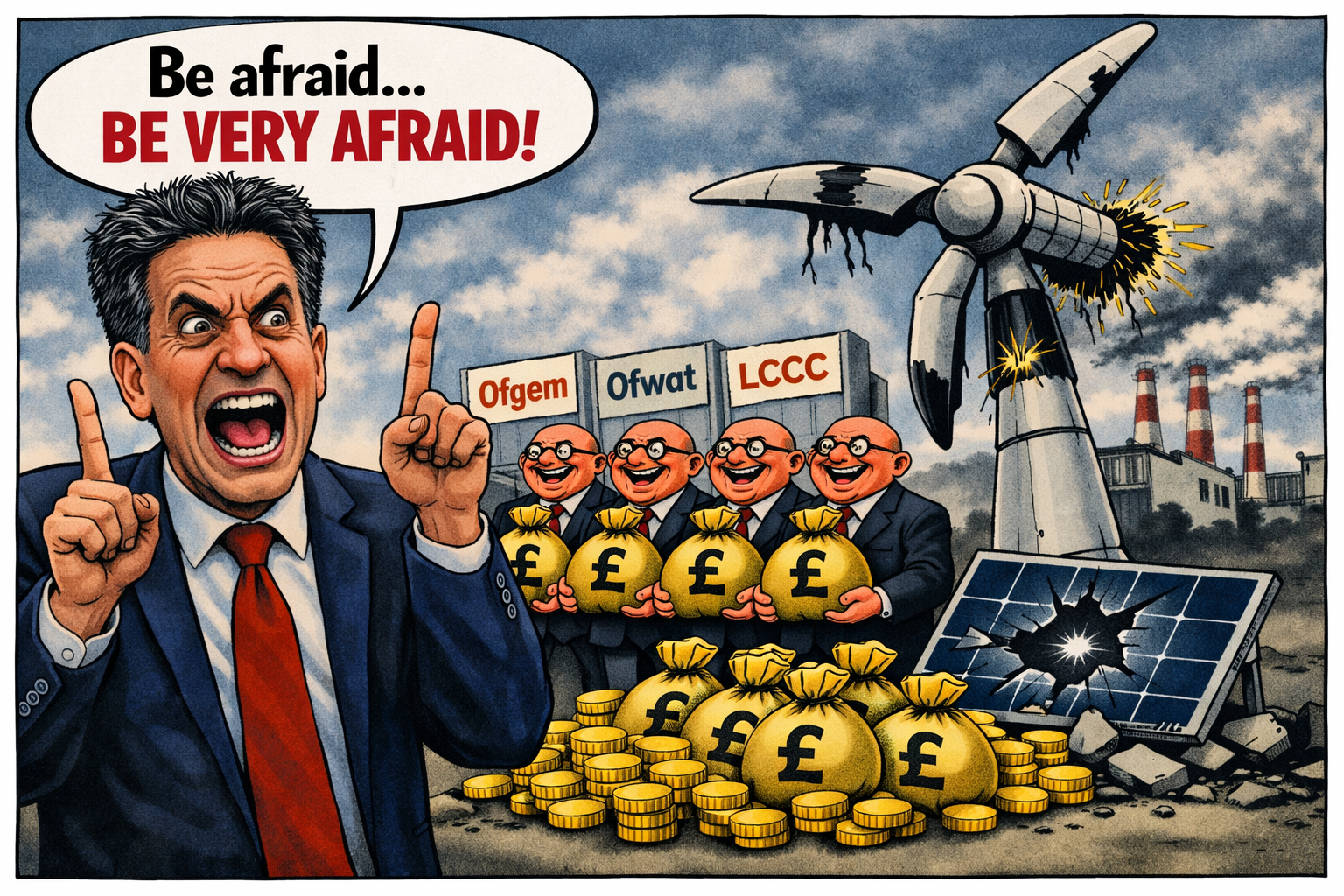
If you are anything like me, you’re not wrong to feel that this is insane. On the face of it, Britain has:
- Among the highest electricity prices in the developed world, especially for industry.
- Growing periods of negative wholesale prices, where generators pay others to take power.
That combination is not just a glitch; it’s the product of how the UK has chosen to do net zero—through a tangle of subsidies, rigid contracts and a grid that was never upgraded to match the political ambition.
This is the Ed Miliband paradox: a “cheap renewables” story that somehow delivers some of the world’s most expensive power, and then occasionally becomes so oversupplied that we literally pay France and others to take it away.
What is actually happening when prices go negative?
Negative prices are not a metaphor. For several dozen hours already this year, the wholesale price of electricity in Britain has dropped below zero.
Generators effectively pay the system to keep running, and interconnectors export that surplus to countries like France, Holland and Belgium—sometimes with a “chunky payment” attached.
This happens when:
- Supply massively exceeds demand—typically on windy, sunny, mild days when heating and cooling demand is low.
- Certain generators cannot or will not switch off—because of technical constraints (nuclear, some gas) or because their subsidy contracts reward them for generating regardless of price.
- The grid cannot move or store the surplus—limited storage, constrained transmission, and slow grid reinforcement mean power piles up in the wrong place at the wrong time.
In that moment, electricity stops being a valuable commodity and becomes a waste product that must be disposed of. Interconnectors to France and others are the “sewer pipe” for that surplus.
Why the UK is uniquely bad at this
Negative prices are not just a British phenomenon—Germany, Spain, the Netherlands and others have also seen record hours of sub‑zero prices as renewables surge. But the UK has managed to combine:
- High average prices, especially for industry;
- Frequent negative prices at the margin;
- Huge policy costs loaded onto bills rather than general taxation.
That cocktail is the result of several design choices.
1. Subsidy structures that pay to generate, not to be useful
A big chunk of UK renewables is supported by:
- Legacy Renewables Obligation (RO) schemes, which reward output regardless of system need.
- Contracts for Difference (CfDs), which guarantee a fixed “strike price” to generators. If the market price is below the strike price, consumers top up the difference.
In a negative price event, the market is screaming “stop generating”. But if your contract still pays you based on output, you have every incentive to keep going. The cost of paying someone else to take the power can be less than the subsidy you’d lose by switching off.
So the system ends up doing something perverse: it pays generators to keep producing power that nobody wants, and then pays other countries to take it away.
2. A grid built for yesterday, not for a renewables surge
The UK has poured money into generation capacity—offshore wind, solar, interconnectors—but has been slow, bureaucratic and under‑invested on:
- Transmission upgrades—moving power from windy Scotland and the North Sea to demand centres in England.
- Storage—batteries, pumped hydro, demand‑side response at scale.
- Flexible backup—fast‑ramping gas, smart tariffs, and industrial load‑shifting.
When you bolt a 21st‑century renewables fleet onto a 20th‑century grid, you get congestion, curtailment and waste.
The system then has to pay wind farms not to generate in some regions, while importing power elsewhere. Negative prices are just the most visible symptom of that mismatch.
3. Political obsession with “headline capacity” over system design
Net zero politics has been sold as a race to headline numbers:
- X gigawatts of offshore wind by year Y
- Z per cent of power from renewables
- “Clean power by 2030”
What has not been sold—or properly designed—is the system architecture that makes that capacity economically coherent: locational pricing, flexible demand, storage, and a planning regime that can actually deliver grid reinforcement on time.
Ed Miliband’s own Electricity Market Review explicitly rejected zonal pricing in favour of a reformed national price, arguing that a single price is “fairest” and better for investment. That sounds nice politically, but it hides the real cost of congestion and mis‑location.
Instead of prices signalling “don’t build another wind farm here until the grid is upgraded”, the system socialises the pain across everyone’s bills.
Why are we paying France?
Interconnectors are not inherently stupid. In a rational system, they:
- Smooth out volatility—import when you’re short, export when you’re long.
- Share capacity—you don’t need to build as much domestic backup if you can lean on neighbours.
The problem is that the UK has created a structure where:
- We over‑generate at certain times because of rigid contracts and inflexible plant.
- We lack storage and flexible demand to soak up that surplus domestically.
- We then use interconnectors as a dumping ground, paying others to take power that our own consumers have already funded through subsidies and levies.
France, with its large nuclear fleet and different cost structure, can happily take that cheap or even “paid‑to-take” power, displacing its own generation and lowering its average costs.
Meanwhile, UK industry is paying power prices around 60 per cent higher than in France on average.
So, we (the UK) socialise the cost of building and subsidising the capacity, then export the benefit at a discount.
How did this policy architecture even get created?
This isn’t one bad decision; it’s a stack of incentives and political choices that line up in the worst possible way.
1. Short‑term politics, long‑term contracts
Governments of all colours wanted:
- Quick, visible progress on renewables.
- Private capital to fund it, not the state balance sheet.
- Minimal upfront tax rises.
The answer was long‑term, legally binding contracts (RO, CfDs, capacity market) that shifted risk onto consumers via bills. Once signed, these contracts are hard to change without spooking investors or triggering compensation claims.
So ministers get the photo‑ops—“world‑leading offshore wind”, “clean power by 2030”—while the structural costs and distortions are baked in for decades.
2. Ideological framing: net zero as a moral crusade, not an engineering project
Net zero has been framed as a moral imperative first, an engineering challenge second. That has consequences:
- Questioning the design is painted as questioning the goal.
- Complex system trade‑offs are reduced to slogans about “cheap renewables” and “green jobs”.
- Uncomfortable truths—like the need for gas backup, storage, and grid reform—are pushed into the technical long grass.
The result is a policy environment where it is easier to announce another offshore wind auction than to confront the messy, expensive business of rewiring the grid and redesigning market signals.
3. Regulatory fragmentation and institutional cowardice
Ofgem, National Grid ESO, the Department for Energy Security and Net Zero, the Treasury—each has a slice of the problem, but no one owns the whole system outcome.
- Ofgem focuses on consumer protection and network costs, often slowing investment.
- Treasury resists big upfront public spending on grid and storage, preferring “market‑based” fixes.
- Ministers chase announcements that look good in manifestos.
No one is politically rewarded for saying: “We need to spend billions on grid reinforcement and storage now, or we’ll be paying France to take our power in five years.” So it doesn’t happen at the necessary scale.
Is this fixable, or are we stuck paying others to take our power?
It is fixable—but not with more of the same.
An honest, grown‑up approach would mean:
- Rewriting incentives so generators are paid for being useful to the system, not just for raw output. That means tighter rules on when subsidies are paid during negative prices, and contracts that reward flexibility.
- Accelerating grid and storage investment as national infrastructure, not an afterthought. That likely means more state involvement and faster planning, not just hoping private investors will do it.
- Introducing stronger locational signals—whether full zonal pricing or something close to it—so that the cost of building in the wrong place is visible, not smeared across everyone’s bills.
- Using interconnectors intelligently, not as a dumping ground: export surplus when it’s genuinely cheap, but don’t subsidise over‑generation just to keep contracts happy.
So how stupid is this policy?
On a technical level, the engineers keeping the lights on are doing miracles with the system they’ve been given. The stupidity sits higher up:
- Designing a net zero pathway around rigid subsidies and under‑built infrastructure.
- Refusing to confront the trade‑offs, then acting surprised when the physics bites back.
- Allowing a political narrative of “cheap green power” to coexist with some of the highest industrial prices in the world and growing episodes of negative pricing.
The real scandal isn’t just that we pay France to take our power. It’s that British households and firms have already paid once—through levies and high tariffs—to build that surplus, and then pay again when the system has to bribe someone else to use it.
Work that one out…!
