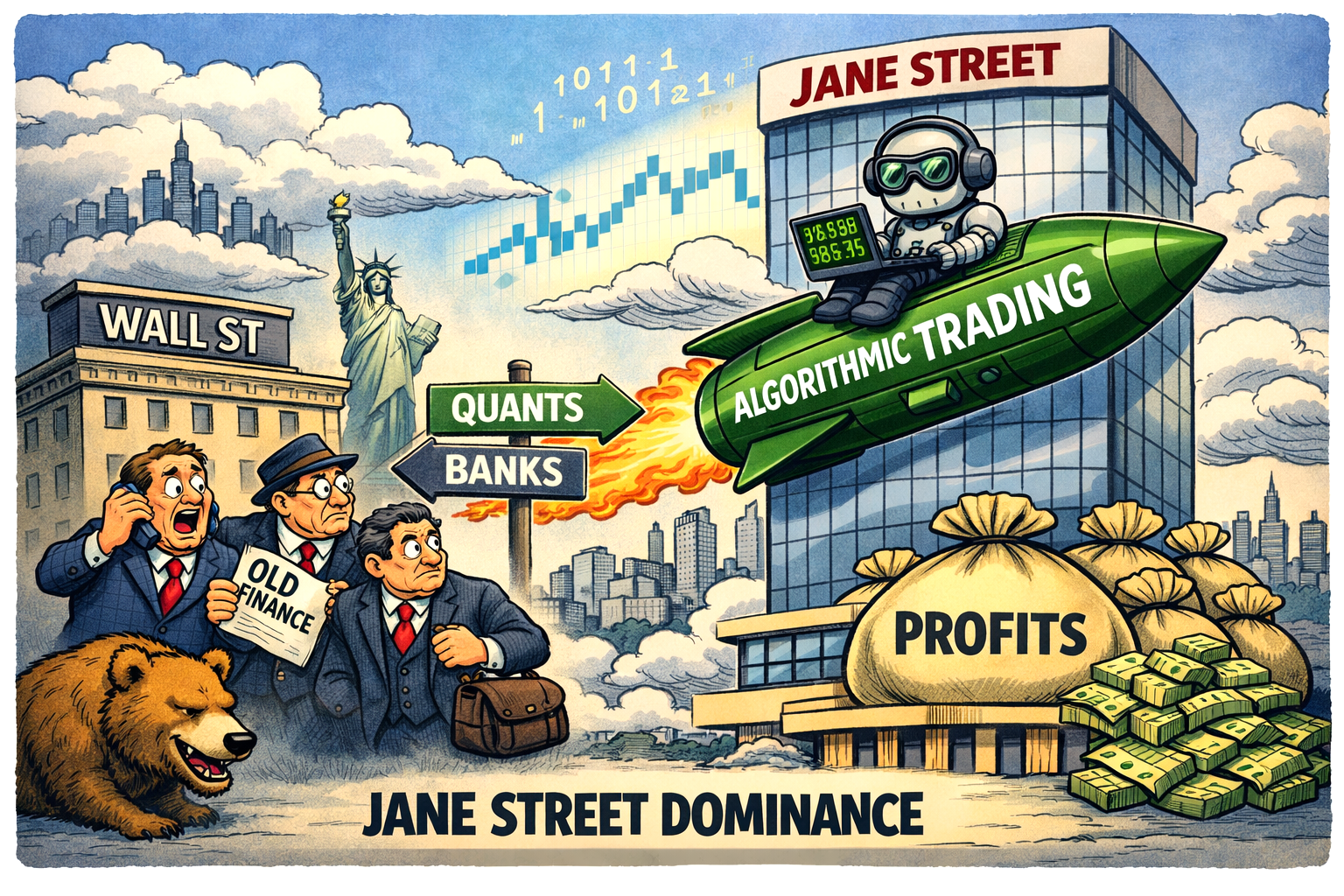
Jane Street’s Rise and the Quiet Transformation of Wall Street

AI Algorithmic trading

The idea that “Jane Street is taking over Wall Street” is not a literal claim of ownership but a reflection of a deeper structural shift in global finance.

Over the past ten years, the centre of gravity in markets has moved away from the traditional, relationship‑driven banking model and towards firms built on mathematics, automation, and relentless execution.

Down your street

Jane Street is the most visible and successful expression of that shift, and its ascent tells a larger story about how modern markets now function.

Founded in 2000, Jane Street began as a niche player in the then‑nascent world of exchange‑traded funds. ETFs were still viewed as a technical curiosity, but the firm recognised early that they would become the backbone of global investing.

By building sophisticated systems to price, hedge, and arbitrage these instruments, Jane Street positioned itself at the heart of a market that has since grown to more than $10 trillion.

Today, it is one of the largest ETF liquidity providers in the world, often stepping in when banks cannot or will not.

Different

What makes the firm stand out is not just scale but method. Jane Street operates with a level of automation that traditional banks struggle to match.

Its trading is driven by quantitative models, rapid data ingestion, and a culture that treats technology as the primary engine of profit.

This allows it to operate across asset classes — bonds, options, currencies, commodities — with a consistency and precision that human‑centred trading desks cannot replicate.

The results are striking. In recent years, Jane Street has generated trading revenues comparable to major global banks, despite employing only a fraction of their staff and avoiding the capital‑intensive business lines that weigh down traditional institutions.

Its profitability has surged during periods of market stress, when liquidity evaporates and automated firms with strong balance sheets become indispensable.

Break from tradition

Culturally, too, Jane Street represents a break from Wall Street tradition. It has no CEO, minimal hierarchy, and a compensation model that rewards collective performance rather than individual deal‑making.

This structure attracts elite quantitative talent and reinforces the firm’s identity as a technology‑driven institution rather than a bank with traders attached.

Its culture is radically different

Jane Street has:

  • No CEO, minimal hierarchy, and a collective‑profit pay model.
  • Extremely high compensation — ~£700k average pay in the UK, with interns earning over $23k/month

To say Jane Street is “taking over” is to acknowledge that the old Wall Street — built on phone calls, intuition, and personal networks — is being eclipsed by firms whose competitive edge lies in code, computation, calculations and speed.

The transformation is quiet but profound: the future of market‑making belongs to those who can automate complexity, and Jane Street is already operating in that future.

AI plays a central role in how Jane Street operates. The firm’s entire trading model is built around automation, data analysis, and algorithmic decision‑making.

Here’s how AI fits into its structure:

Core of its trading engine

Jane Street’s systems ingest vast amounts of market data in real time — prices, volumes, volatility, and correlations across thousands of instruments.

Machine‑learning models help identify patterns and optimise execution strategies, allowing trades to be placed faster and more efficiently than any human desk could manage.

Reinforcement and predictive modelling

AI techniques such as reinforcement learning are used to refine trading algorithms. These systems learn from past market behaviour, adjusting parameters to improve outcomes under different conditions — for example, predicting liquidity shifts or price movements in ETFs and derivatives.

Risk and portfolio management

AI also supports risk control. Automated models continuously assess exposure across asset classes, recalibrating positions when volatility spikes or correlations change.

This enables Jane Street to maintain tight risk limits while trading billions of dollars daily.

Talent and culture

The firm’s workforce is dominated by mathematicians, physicists, and computer scientists rather than traditional bankers.

They design and maintain AI‑driven systems that make trading decisions autonomously, with human oversight focused on model validation and strategic direction.

Broader impact

Jane Street’s success has influenced the entire financial ecosystem. Banks and hedge funds now emulate its AI‑centred approach, shifting from intuition‑based trading to quantitative automation.

In that sense, AI isn’t just a tool for Jane Street — it’s the foundation of its dominance.

In short, AI is the invisible trader behind Jane Street’s rise, enabling the firm to process information, execute trades, and manage risk at a scale and speed that traditional Wall Street institutions can’t match.

Financial advisors are reportedly cautious about Bitcoin ETFs and are adopting them slowly, according to BlackRock

Bitcoin ETF

Bitcoin exchange-traded funds (ETFs) debuted in January 2024, yet their adoption by financial advisors has reportedly been sluggish.

Advisors’ hesitations stem from Bitcoin’s price volatility and its relatively brief history. Bitcoin ETFs serve as a conduit between cryptocurrency and conventional finance. According to a BlackRock spokesperson – financial advisors are cautiously, but progressively, embracing the long-anticipated Bitcoin ETFs since their launch.

Currently, it is estimated that approximately 80% of Bitcoin ETF purchases are being made by self-directed investors who decide their own allocation, frequently via an online brokerage account.

Bitcoin one year chart snapshot 18th June 2024 (am)

Bitcoin one year chart snapshot 18th June 2024 (am)

Nvidia to get 20%+ weighting as ETF fund reportedly plans to acquire $10 billion of shares

EFT fund

Nvidia’s swift ascent is poised to prompt a major technology exchange-traded fund to acquire more than $10 billion in shares of the semiconductor maker, consequently reducing its shareholding in Apple.

The Technology Select Sector SPDR Fund (XLK), which will rebalance soon, is guided by an index that will adjust based on the market cap value at Friday’s close. According SPDR Americas Research, the recalibration will reportedly position Microsoft as the leading stock, followed by Nvidia, and then Apple.

Without caps, each of the three stocks would exceed a 20% weight in the index. However, the index’s diversification rules restrict the total weight that stocks constituting at least a 5% share of the fund can hold.

Consequently, it is anticipated that Microsoft and Nvidia will each approach a 21% weight, while Apple’s share is projected to drop to approximately 4.5%.

This news moved markets on 17th June 2024 and pushed the S&P 500 to a new all-time high. The Nasdaq100 index also relished the news reaching: 19902.75

The Nasdaq100 index also relished the news reaching: 19902.75

Nvidia share price 17th June 2024 – one year chart

Nvidia share price 17th June 2024

SEC finally approves Bitcoin ETF

Bitcoin ETF approval

After years of regulatory rejection, the U.S. Securities and Exchange Commission on Wednesday 10th January 2024 finally approved the Bitcoin EFT.

It has approved what are known as ‘spot’ Bitcoin Exchange-Traded Funds (ETFs), which can be purchased by anyone from pension funds to retail investors. This now means that some of the biggest asset managers in the world, including BlackRock and Fidelity can trade a crypto related ETF.

Now, instead of using a crypto asset exchange such as Binance, Coinbase or Kraken to purchase and hold a token like Bitcoin, traders can now trade a ‘spot’ Bitcoin ETF for direct exposure to the digital asset market.

It may also mean that investors could pay lower fees than they would if they bought the digital currency from a crypto exchange directly.

Basically, it is now cheaper than ever to buy Bitcoin – but is this positive for the long-term?

Crypto fans can now invest in Exchange-Traded Funds (ETFs) – but what exactly are they?

A Bitcoin ETF allows investors to buy a product that tracks the price of Bitcoin through the same method they already use to buy stocks and other existing products. This also reduces additional worry of managing their crypto related holdings, which typically involves maintaining a cryptocurrency wallet and a safe storage system to safeguard that investment.

But what exactly is an ETF?

ETFs are holdings or portfolios that allow investors to ‘bet’ on multiple assets, without having to buy any themselves. Traded on stock exchanges like shares, their value depends on how the overall portfolio performs in real time.

An ETF could comprise a combination of gold and silver bullion, for example, or a mixture of shares in both big technology and energy companies. Some ETFs already contain Bitcoin indirectly – but a spot Bitcoin ETF will buy the cryptocurrency directly, ‘on the spot’, at its current live price, throughout the trading day.

Bitcoin, the first cryptocurrency

Based on an idea by someone called, Satoshi Nakamoto, Bitcoin was the first cryptocurrency and remains the most valuable and famous to-date. Its price is often seen as a barometer for the whole industry of thousands of other coins (altcoins), tokens and products built on the same blockchain technology.

Art illustration of Bitcoin blockchain

And with an influx of new money, many expect a surge in interest in cryptocurrency technology in general.

How will the decision affect cryptocurrency adoption and is this decentralisation as originally intended?

Some say this decision shows the existing ‘old financial school’ establishment is finally taking Bitcoin seriously, at least as a speculative asset. For those who consider Bitcoin legitimate ‘digital gold’, what better proof could there be than the biggest wealth-management institutions flocking to buy, and now overseen by regulators?

Others say cryptocurrency is about rejecting traditional financial systems in favour of a decentralised, people-powered alternative. And investment bankers buying Bitcoin just to get rich on U.S. dollars is not what Satoshi Nakamoto had in mind.

But judging from the chatter on social media, the prevailing sentiment is expecting the new cash injection will make existing Bitcoin investors and owners rich.

What are the risks to future investors?

It is possible to lose all of your investment

The price of Bitcoin can change rapidly and often without warning or explanation – it is a volatile asset. So investors will need to be aware when investing in ETFs linked to a digital coin.

Art illustration of Bitcoin trading

But ETFs are often sold as high-risk, high-reward products anyway. It is EXTREMELY high risk – don’t do it if you don’t understand it and even if you do, or think you do – BE CAREFUL! These products can rip the shirt off your back!

Cyber-crime risk

Another potential risk is cyber-crime. Bitcoin and other cryptocurrencies have been the subject of huge and costly attacks that have seen crypto companies drained of sometimes hundreds of millions of dollars overnight. And if the likes of Blackrock become major holders of Bitcoin, their cyber-security will be tested in ways never before. Let’s hope their security systems are extremely robust.

Cost of mining coins

Another downside is the heavy cost to the environment is that Bitcoin use a massive number of powerful computers around the world, to process transactions on the blockchain ledger and to create coins – this is known as mining.

Renewable energy use is growing – but it remains to be seen how investment companies will tackle the environmental cost of Bitcoin.

Be careful

ETFs are here now – but BE CAREFUL when entering a Bitcoin related ETF trade or investment, or any type of ETF for that matter. If it goes wrong, you will lose your money, and quickly.

Your money is at HIGH risk!

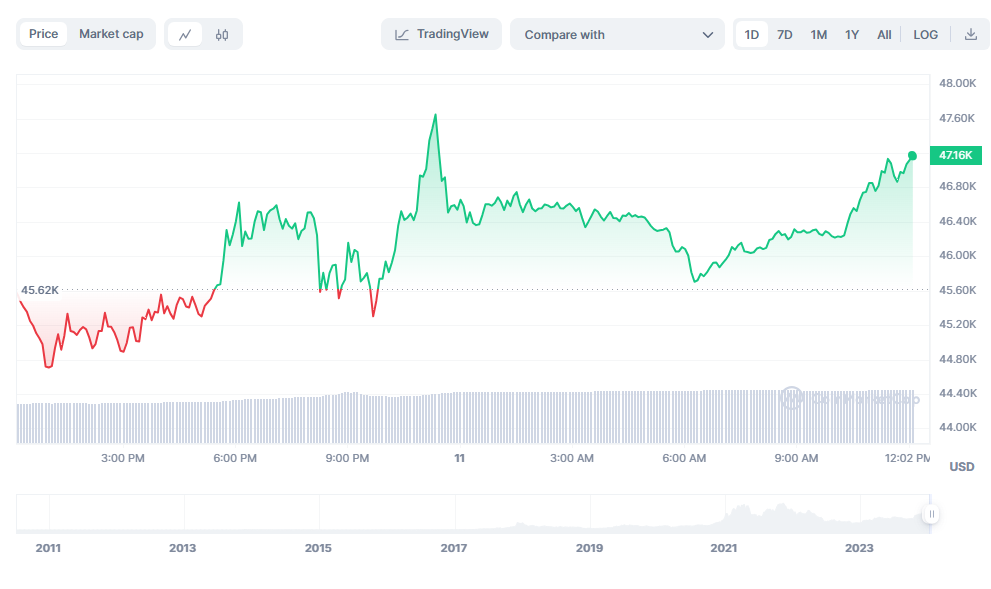
Bitcoin chart as at 12pm January 11th 2024

Bitcoin chart as at 12pm January 11th 2024