

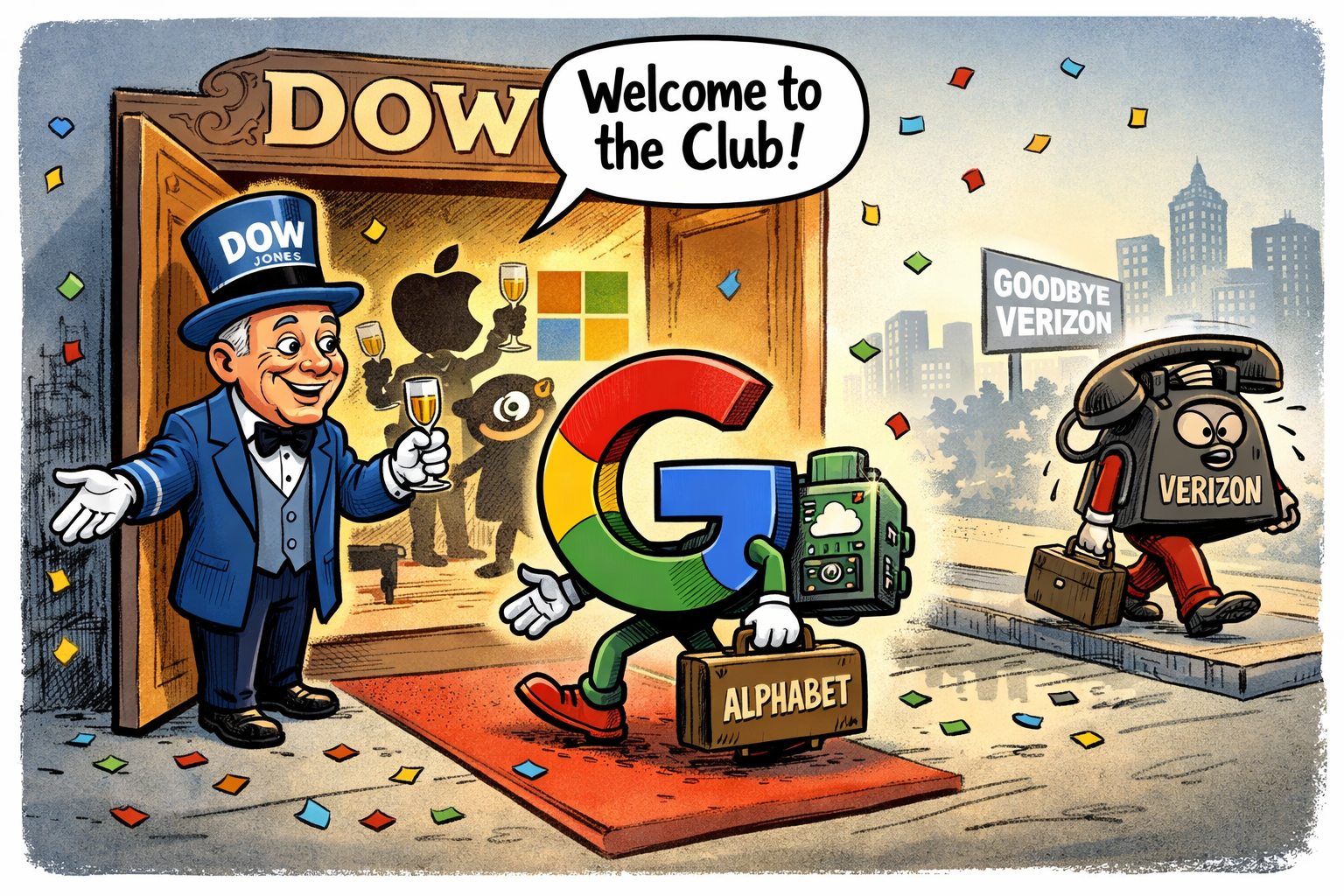
Alphabet’s arrival in the Dow marks a decisive shift in America’s most famous index

Alphabet in club Dow

Alphabet’s entry into the Dow Jones Industrial Average this week is more than a routine reshuffle; it is a symbolic acknowledgement that the modern U.S. economy is now defined by data, cloud infrastructure and artificial intelligence rather than legacy telecommunications.

The change took effect on 29 June 2026, placing Google’s parent company among the 30 blue‑chip names that represent the industrial and corporate backbone of the United States.

Keeping up with the Joneses

Alphabet replaces Verizon, which leaves the index after more than two decades. The Dow is a price‑weighted index, meaning companies with higher share prices exert greater influence on its movements.

Verizon’s comparatively low share price had steadily reduced its mechanical impact, while Alphabet’s share price—hovering around $350—immediately makes it one of the Dow’s most consequential components.

This weighting logic, rather than any judgement on business quality, is the primary reason behind the switch.

The inclusion also reflects a broader structural shift. Alphabet brings significant exposure to AI, cloud computing, digital advertising and autonomous systems, areas that now dominate corporate investment and market leadership.

Five of the Mag Seven now in club Dow – 9 of the Dow are Tech related Companies

Its arrival means the Dow now contains five members of the so‑called Magnificent Seven, aligning the index more closely with the forces driving U.S. equity performance.

Verizon’s departure underscores how the Dow evolves to remain representative of the economy it tracks.

Alphabet’s addition signals that the digital era is not merely influencing markets—it is now embedded at the heart of America’s oldest stock benchmark.

But does this spell potential danger for the Dow in the future as the balance of power is weighted more towards tech?

Should the markets crash because of the overreach of AI tech’ then the Dow will fall hard.

SectorCompanies
TechnologyApple, Microsoft, Amazon, Alphabet, Nvidia, Cisco Systems, Intel, IBM, Salesforce
FinancialsGoldman Sachs, JPMorgan Chase, American Express, Travelers, Visa
IndustrialsBoeing, Caterpillar, Honeywell, 3M, UnitedHealth Group
ConsumerMcDonald’s, Coca‑Cola, Procter & Gamble, Nike, Walmart
HealthcareJohnson & Johnson, Merck, Amgen
EnergyChevron
CommunicationsWalt Disney
MaterialsDow Inc.

The mystery surrounding the origin of Bitcoin

Origin of Bitcoin

Bitcoin’s origin is one of the most captivating mysteries of the digital age. The cryptocurrency was created in 2008 by an unknown individual or group under the pseudonym Satoshi Nakamoto.

Despite numerous investigations, the true identity of Nakamoto remains shrouded in secrecy.

Story

The story of Bitcoin begins with the release of a whitepaper titled “Bitcoin: A Peer-to-Peer Electronic Cash System.” This document outlined a new kind of decentralised digital currency, one that relied on cryptographic principles to ensure security and prevent double-spending.

Nakamoto’s revolutionary vision was to create a financial system free from the control of traditional banks and government interference.

Genesis block

In January 2009, Nakamoto mined the first block of the Bitcoin blockchain, known as the ‘genesis block,’ marking the birth of the cryptocurrency. Over the next couple of years, Nakamoto continued to work on the project, communicating with other developers via email and online forums.

The mystery surrounding the origin of Bitcoin

However, by 2011, Nakamoto had largely stepped away from active involvement in the project, leaving behind a legacy that would forever change the financial landscape.

Speculation

Speculation about Nakamoto’s true identity has been rampant. Some believe Nakamoto is a single, exceptionally talented individual, while others theorise that it could be a group of developers working under a collective pseudonym.

Over the years, various names have been proposed as possible candidates, including renowned cryptographers, developers, and even eccentric entrepreneurs. Yet, none of these theories have been definitively proven, and Nakamoto’s identity remains a closely guarded secret.

Intrigue

The intrigue surrounding Nakamoto is not just a matter of curiosity but also of financial significance. As the creator of Bitcoin, Nakamoto is estimated to own around one million Bitcoins. At current market values, this makes Nakamoto one of the wealthiest individuals in the world.

Bitcoin chart from inception as of 7th November 2024 touching $75,000

Bitcoin chart from inception as of 7th November 2024 touching $75,000

However, these Bitcoins have never been moved or spent, adding to the enigma of Nakamoto’s motives and intentions.

Myth?

The myth of Satoshi Nakamoto has taken on a life of its own, becoming a symbol of the power and potential of decentralized technology. The anonymity of Nakamoto also serves as a reminder of the core principles behind Bitcoin: privacy, decentralisation, and freedom from traditional financial systems.

In a world increasingly dominated by surveillance and control, the mystery of Nakamoto provides a compelling counter-narrative, one that continues to inspire and intrigue both technologists and libertarians alike.

In the end, the true identity of Satoshi Nakamoto may never be revealed, and perhaps that is as it should be. The enduring mystery adds to the allure of Bitcoin, ensuring that its origins will forever be a topic of fascination and debate.

Mastercard reportedly to remove manual card number entry for online payments and replace it with a token system in Europe by 2030

Credit card

Beginning in 2030, Mastercard will eliminate the need for Europeans to manually enter their card numbers during online checkout, regardless of the platform or device used.

The familiar 16-digit card number will be substituted with a randomly generated ‘token.’ This change will enable consumers to complete payments with a single click at the checkout page, authenticated by a thumbprint.

Mastercard reported that 100% tokenization across e-commerce sites will reduce fraud rates dramatically.

The way we pay for products and services online will feel very different in the coming years.