

China’s Economy Loses Momentum in May 2026 as Consumers Pull Back

China consumer slow down

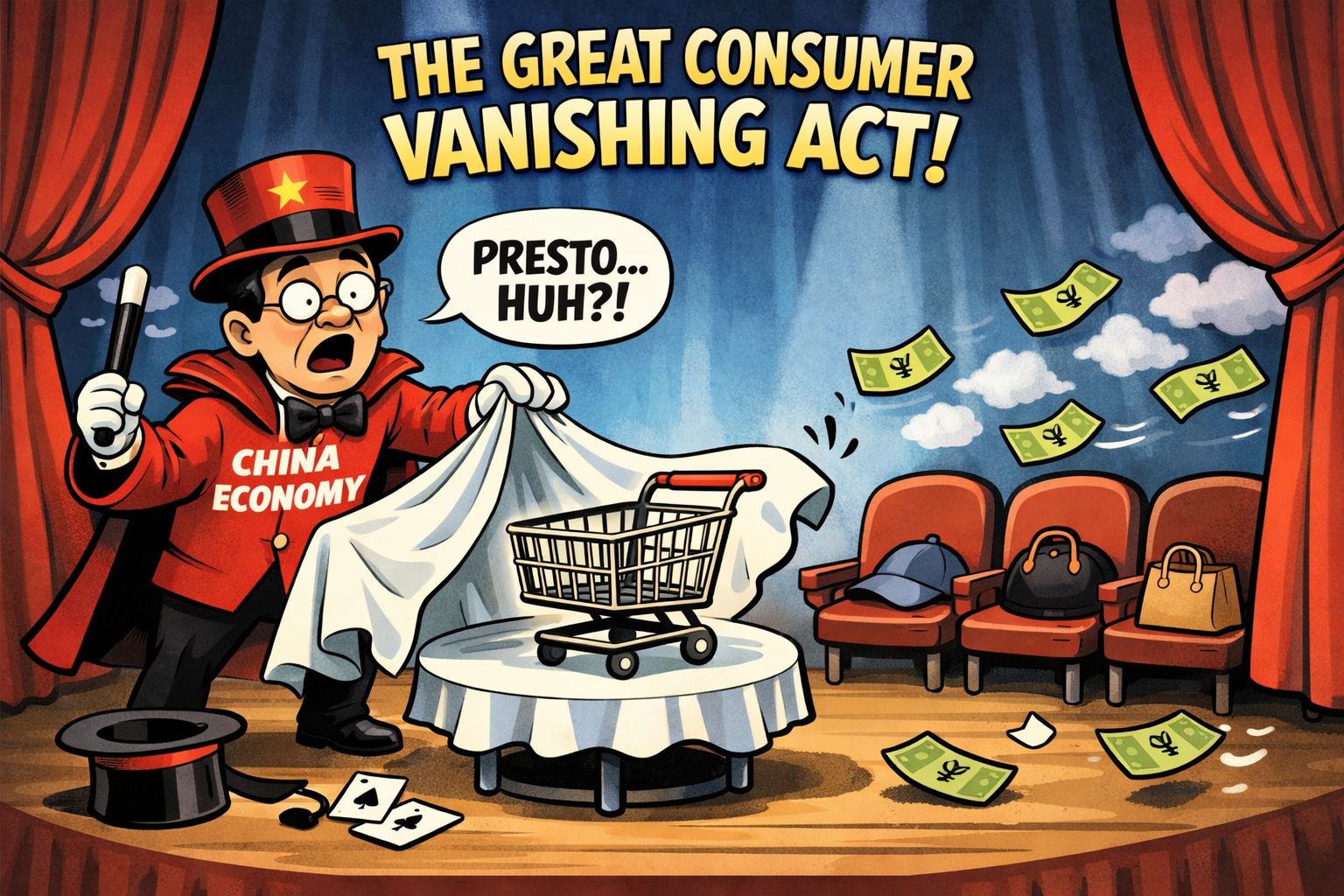
China’s economy showed fresh signs of strain in May 2026, with retail sales slipping for the first time this year and exposing the fragility of the country’s consumer‑led recovery.

The latest figures point to households becoming more cautious as job insecurity, weak income growth and a still‑ailing property sector weigh on confidence.

Retail sales — a key gauge of consumer demand — fell compared with a year earlier, reversing April’s modest rise.

Troubling?

Analysts note that the decline is particularly troubling because it comes despite a raft of local government incentives aimed at boosting spending on cars, appliances and electronics. Instead, households appear to be prioritising savings over discretionary purchases.

Industrial production continued to expand, but at a slower pace than earlier in the spring, suggesting that the export‑heavy manufacturing sector is also losing some momentum.

With global demand softening and geopolitical tensions disrupting supply chains, factories are finding it harder to sustain the strong output seen earlier in the year.

Weakness

The weakness in May 2026 adds pressure on Beijing to consider more forceful support measures. While policymakers have so far resisted large‑scale stimulus, the combination of faltering consumption and a deep property downturn is making the recovery increasingly uneven.

For now, the data underline a simple reality: China’s rebound remains fragile, and confidence is still in short supply.

U.S. consumer confidence falls the most in three years

U.S. consumer

In September 2024, consumer sentiment plummeted, marking the most significant drop in over three years, driven by escalating concerns over employment and business conditions, according to a report by the Conference Board released on Tuesday 24th September 2024.

The consumer confidence index reportedly fell to 98.7 from 105.6 in August 2024, marking the largest one-month drop since August 2021. This was contrary to the forecast of 104 and a stark contrast to the 132.6 reading in February 2020, just before the Covid pandemic’s onset.

All five components surveyed by the organisation declined this month, with the most significant decrease observed in the age bracket of 35-54 with incomes under $50,000.

Concerning

“Consumer evaluations of the present business conditions have turned negative, and the outlook on the current labour market has further weakened. There is also a growing pessimism about future labour market conditions, business conditions, and income prospects,” the Conference Board’s chief economist reportedly commented.

This significant dip in the confidence index last occurred as inflation began its ascent to the highest point in over four decades.

Following the announcement, stocks experienced temporary declines, and Treasury yields decreased.

U.S. consumer spending improved in July 2024 as retail sales increased by 1% – better than forecast

U.S. retail

In July 2024, U.S. consumer spending exceeded expectations, and inflation pressures continued to ease, as reported by the U.S. Department of Commerce on Thursday 15th August 2024.

Retail sales in the U.S. rose by 1% for the month, with advanced figures adjusted for seasonality but not for inflation. This surpassed the 0.3% increase anticipated. The initially flat reported sales for June 2024 were revised to a 0.2% decrease.

Removing auto-related items, sales saw a 0.4% rise, which was substantially more favourable than the predicted 0.1%.

The number of weekly jobless claims fell to 227,000, a drop of 7,000 from the preceding week, and was below the forecasted 235,000.

Markets have responded positively to all this good news, and together with other favourable developments, it appears increasingly likely that the Federal Reserve will have no reason other than to cut rates in September 2024.