

Bank busting figures as profits pile up!

Banks' profits surge

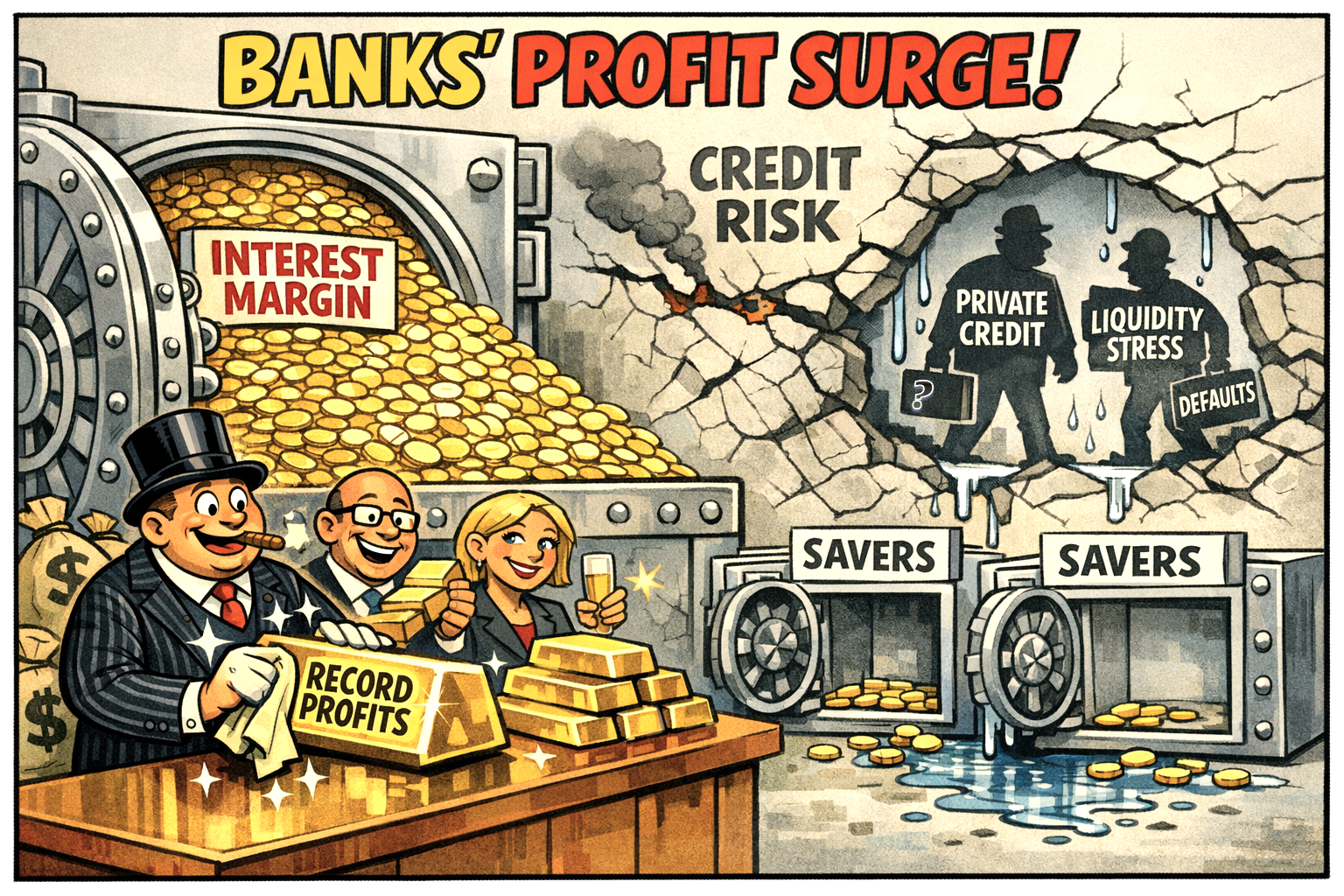
Banks are reporting unusually strong profits because higher interest rates have widened margins, while slow pass‑through to savers, cost‑cutting, and capital optimisation have amplified returns — even as credit risks begin to rise.

Why profits are so high

The latest figures show that UK banks are still benefiting from the long tail of the interest‑rate cycle.

Even though the Bank of England has not raised rates since August 2023, the base rate remains at 4.5%, allowing lenders to earn significantly more on mortgages and credit than they pay out on deposits.

This margin expansion has been the single biggest driver of profit growth. Research from recently highlighted from Positive Money shows that the UK’s four largest banks have generated £136.8 billion in pre‑tax profits since rate rises began in December 2021, and are on track to exceed their record £45.9 billion made in 2024 by around 14% in 2025.

A second factor is the government’s interest payments on central bank reserves. Because commercial banks are paid the base rate on their risk‑free deposits at the Bank of England, they stand to receive around £30 billion a year in transfers through to 2030 — effectively a public subsidy that boosts earnings without requiring additional lending.

Banks have also been aggressively returning capital to shareholders. Between 2022 and 2024, the big four spent £42 billion on dividends and £32 billion on share buybacks, reinforcing the perception that profits are being harvested rather than reinvested.

How banks are sustaining these profits

The profitability story is not just about rates. Structural shifts are helping banks defend margins even as the rate cycle turns.

1. Slow deposit repricing High Street banks have been reluctant to raise savings rates in line with market levels. As consumers move deposits to specialist lenders offering better returns, the big banks still retain a large, low‑cost funding base.

KPMG reportedly notes that high street banks’ share of deposits has only slipped from 84% in 2019 to 80% in 2024 — still dominant enough to preserve cheap funding.

2. Capital optimisation through securitisation Banks are increasingly using Significant Risk Transfer (SRT) securitisations to free up capital and improve return on equity. Securitised loan volumes have grown at a 4% CAGR between 2022 and 2025, allowing banks to recycle capital into higher‑yielding assets.

3. Cost discipline and digital transformation With margins expected to compress as rates eventually fall, banks are pushing cost‑cutting, automation, and AI‑driven process redesign.

KPMG reportedly forecasts sector‑wide returns on equity could fall from 18% in 2023 to 10% by 2027 without structural change — making efficiency programmes essential to sustaining profitability.

The emerging risk: impairments

Barclays’ latest results show rising credit impairment charges, including an £823 million provision linked to mortgage‑market stress and fraud‑related losses.

This raises the question of whether the credit cycle is turning. If impairments rise across the sector, the profit boom could fade.

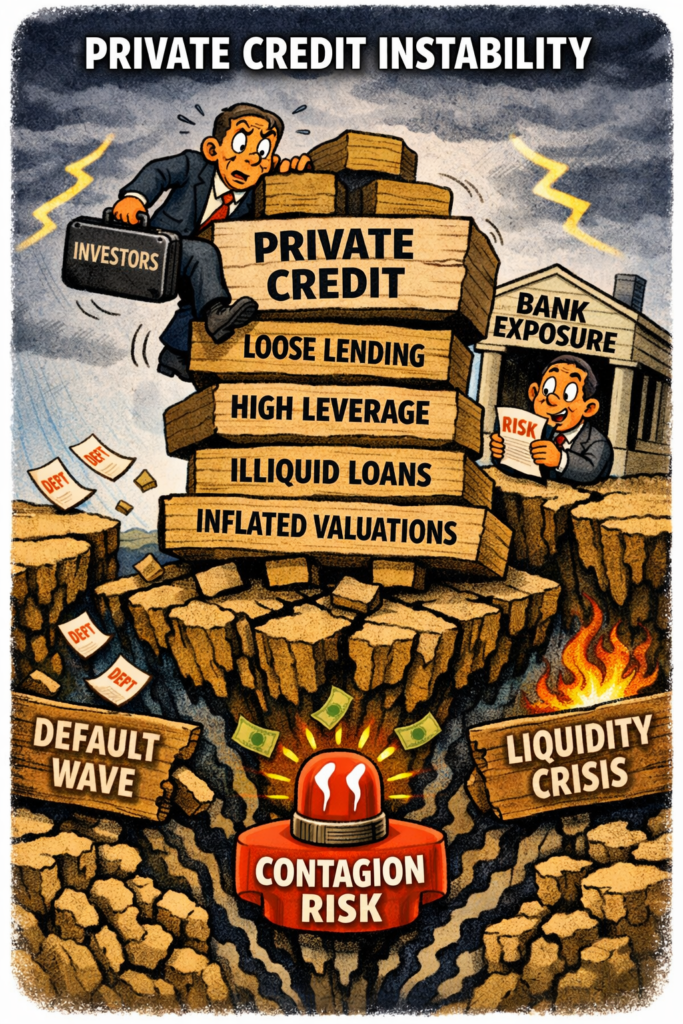
The biggest emerging credit risks sit outside the banking system and that is private credit, leveraged borrowers, and liquidity mismatches that could spill back into banks.

Private credit is now large, interconnected, and showing signs of strain. Rising defaults, deteriorating loan quality, and withdrawal caps at major funds point to mounting stress. Defaults could climb sharply, with Morgan Stanley reportedly warning they may reach 8%, far above historical norms.

A second risk is liquidity pressure. Funds are restricting redemptions as investors rush for the exit, exposing the fragility of semi‑liquid structures.

Finally, contagion risk is growing because banks finance private‑credit funds and pipelines. As analysts note, deeper interconnections mean a downturn could transmit stress back into the regulated system.

Conclusion

Banks are reporting strong profits because the rate environment, public transfers, and capital strategies have created a uniquely favourable backdrop.

But the model is fragile: as impairments rise and rates eventually fall, the sector may be approaching the end of its profit‑supercycle.

Private credit – Banks Say “Contained” — Markets Aren’t So Sure

Private credit concerns

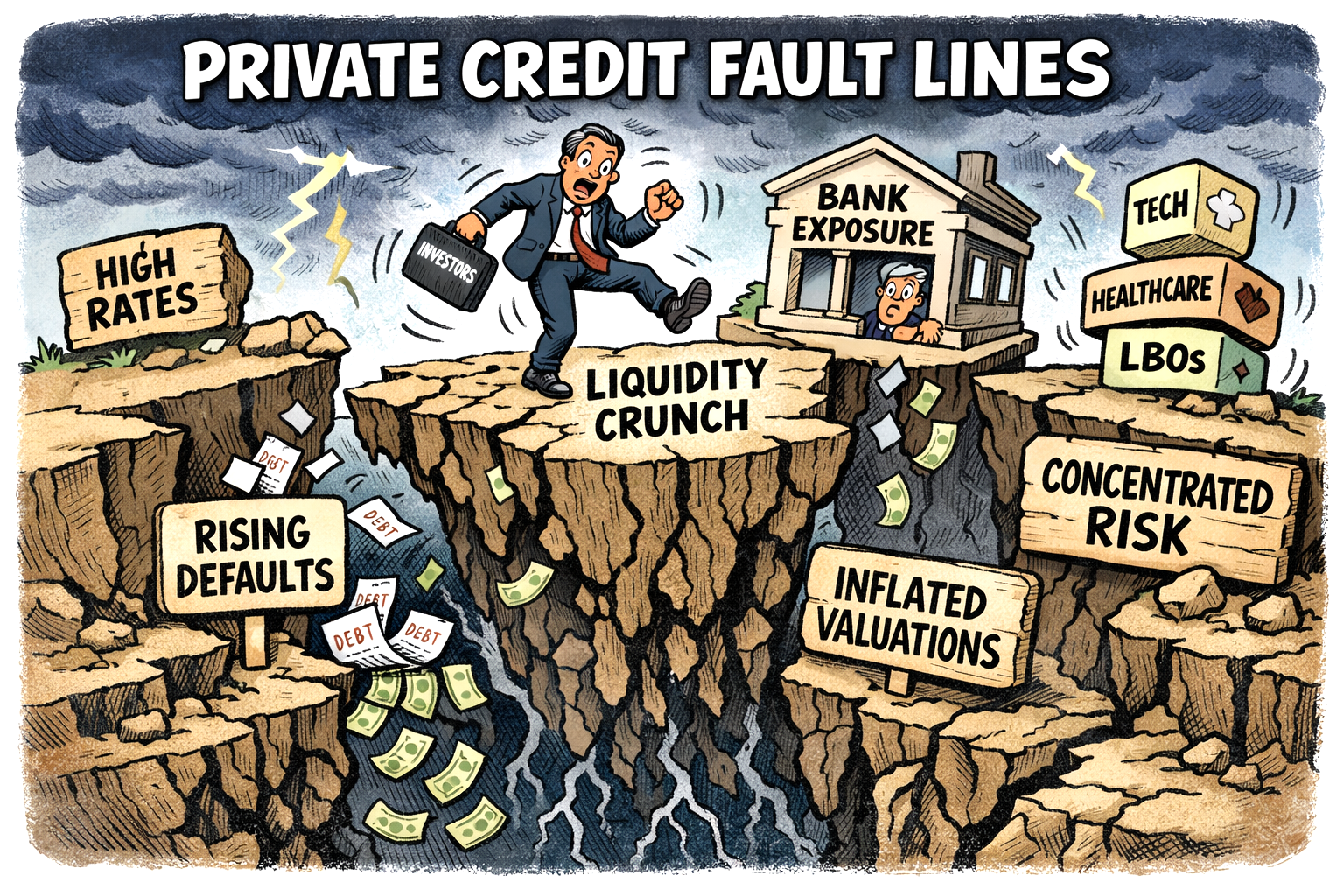
Private credit has become the fault line running beneath the banking system. And it’s now large enough to matter, opaque enough to worry investors, and now visible enough that banks can’t wave it away.

Complicated picture

European lenders spent this earnings season insisting their exposures are “well diversified” or “immaterial”, yet the numbers tell a more complicated story.

Barclays alone reportedly disclosed £15 billion of private‑credit exposure, part of a much larger £66 billion book tied to non‑bank financial intermediaries.

Its hit from the collapse of Market Financial Solutions — a specialist lender undone by alleged fraud — was small in accounting terms, but symbolically important. One cockroach rarely travels alone.

Structural

The deeper issue is structural. Private credit has ballooned into a parallel lending system, lightly regulated and increasingly interconnected with banks through financing lines, securitisations, and business‑development companies.

When these semi‑liquid vehicles face redemption pressure — as several have this year — the stress ricochets back into the banking system. UBS and Deutsche Bank both reportedly emphasised their underwriting standards, but neither disputed that liquidity strains are real.

What unnerves investors is not a wave of defaults — yet — but opacity. Bank of America’s latest survey shows investment‑grade investors are uneasy because they simply cannot see where the risks sit.

Software lending in the U.S., chemicals in Europe, and China‑driven price pressure all add sector‑specific fragility. High‑yield specialists, closer to the coalface, are oddly calmer; they know where the bodies usually fall.

Contained?

The banking system’s official line is that everything is contained. But containment depends on liquidity holding, valuations staying stable, and no further MFS‑style surprises emerging.

Private credit has grown faster than transparency, and faster than the regulatory perimeter. That mismatch — not any single default — is what now shadows the banks.

The issue

The central concern with private credit is simple: it has grown faster than the safeguards designed to contain it.

What was once a niche corner of finance is now a multi‑trillion‑pound shadow banking system whose risks are only partially visible to regulators, banks, or investors. That opacity is now becoming a problem.

Expansion

Private‑credit funds have expanded aggressively by offering speed, flexibility, and looser covenants than traditional banks. In a low‑rate world, that model looked benign. In a high‑rate world, it looks fragile.

Many borrowers were underwritten on assumptions that no longer hold: stable cashflows, cheap refinancing, and buoyant valuations. As rates stay elevated, those assumptions are breaking down.

Defaults

Defaults are rising, and recovery values are uncertain because loans are bespoke, illiquid, and rarely traded.

Liquidity

Liquidity is the second fault line. Private‑credit vehicles promise semi‑liquid access to investors while holding assets that cannot be sold quickly without taking a loss.

When redemptions pick up, funds resort to withdrawal gates, side pockets, or emergency financing lines from banks.

That is where the contagion risk emerges. Banks insist their exposures are modest, but they provide leverage, subscription lines, and warehousing facilities to the very funds now under pressure.

A liquidity squeeze in private credit can therefore boomerang back into the regulated system.

Valuation

Valuation risk is the third issue. Because loans are marked to model rather than market, losses can be slow to surface.

That delays recognition, masks stress, and encourages complacency. When reality finally intrudes — through a default, a refinancing failure, or a forced sale — the adjustment can be abrupt.

The final concern is concentration. Private credit is heavily exposed to software, healthcare, and sponsor‑backed roll‑ups. If one of these sectors turns, the losses will not be isolated.

Private credit is not about to collapse as such. But it is large, opaque, and increasingly interconnected — and that combination is rarely harmless.

Concerns about credit contagion are back as troubles in U.S. regional banks shake global markets

U.S. Bank Credit Woes!

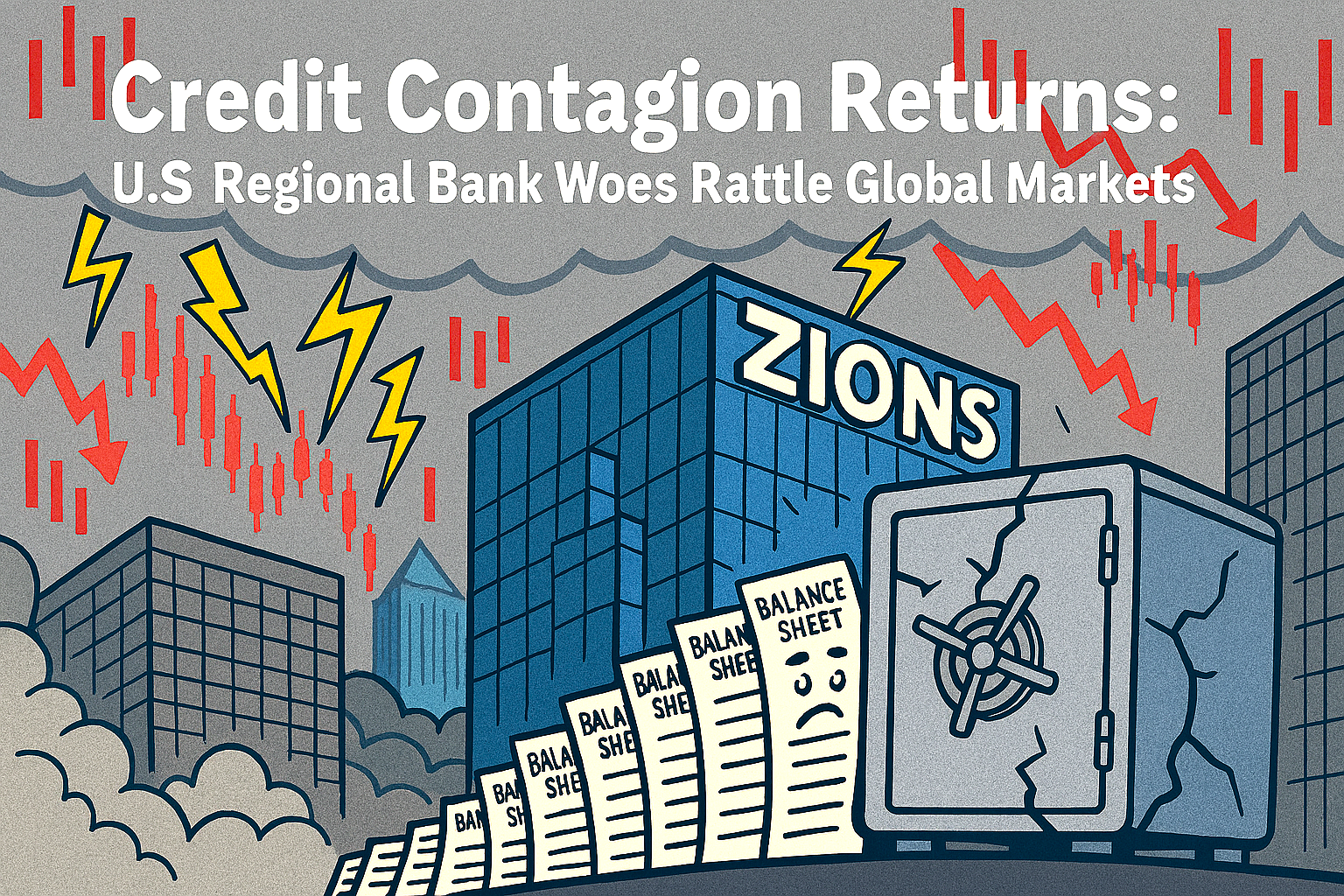
On Friday 17th October 2025, a fresh wave of credit concerns erupted across financial markets, triggered by troubling disclosures from U.S. regional lenders Zions Bancorporation and Western Alliance.

Both banks revealed significant exposure to deteriorating commercial real estate loans, reigniting fears of systemic fragility just months after the collapse of Silicon Valley Bank and Signature Bank.

The revelations sent shockwaves through Wall Street. Shares in Zions plunged over 11% in early trading, while Western Alliance dropped nearly 9%.

Larger institutions weren’t spared either—JP Morgan, Bank of America, and Citigroup all saw declines, as investors reassessed the health of the broader banking sector.

Volatile

The CBOE Volatility Index (VIX), often dubbed Wall Street’s ‘fear gauge’, spiked to its highest level since April, signalling a sharp uptick in investor anxiety.

The panic quickly spread across the Atlantic. UK lenders bore the brunt of the fallout, with Barclays tumbling 6.2%, Standard Chartered down 5.4%, and NatWest shedding 4.8%.

£13 billion loss to UK banks

In total, nearly £13 billion was reportedly wiped off the value of British banks in a single trading session. The FTSE 100 closed down 1.5%, its worst performance in over a month.

At the heart of the crisis lies commercial real estate—a sector battered by high interest rates, remote working trends, and declining occupancy. U.S. regional banks, which often hold concentrated portfolios of property loans, are particularly vulnerable.

Analysts warn that rising defaults could trigger a domino effect, undermining confidence in institutions previously deemed stable.

The Bank of England’s Financial Stability Report had already flagged elevated risks from global fragmentation and sovereign debt pressures. As did the IMF Financial Stability Report.

Credit outlook review

The events of Friday 17th October 2025 appear to validate those concerns, with Moody’s and other agencies now reviewing credit outlooks for multiple institutions.

While some commentators view the sell-off as a temporary overreaction, others see it as a harbinger of deeper trouble.

The symbolic resonance is hard to ignore: vaults cracking, balance sheets buckling, and trust—once again—on the brink. Why?

For editorial observers, the moment invites reflection. Is this merely a cyclical tremor, or the start of a structural reckoning?

Either way, the illusion of resilience has been punctured. And as markets brace for further disclosures, the spectre of contagion looms large.

Remember the sub-prime loans fiasco?

I thought banks were ‘funded and ring-fenced’ more now to prevent this from happening again.

UK house prices fall as lenders raise mortgage rates

House lenders increase rates

House prices declined in April 2024, with affordability pressures persisting for potential buyers, as reported by Nationwide.

The UK’s largest building society reported a 0.4% decrease in house prices compared to the previous month. The average cost of a home now stands at £261,962, which is 4% lower than in the summer of 2022 peak.

According to the report, the increase in borrowing costs was a significant factor in the recent drop in prices.

In recent days a string of lenders raised rates on new fixed-rate mortgage deals.

The rise was driven by expectations that the Bank of England (BoE) would implement fewer and more gradual interest rate reductions.

UK mortgage rates fall in January 2024

Mortgage rates down

Mortgage lenders have started 2024 by cutting interest rates.

The UK’s biggest lender, the Halifax, has cut some interest rates by nearly a full 1%, with other lenders expected to follow suit. HSBC has announced it will also make cuts in January.

Halifax is reducing its rates, with interest on a two-year fixed deal being cut by up to 0.83%. HSBC is due to reduce rates on its two-year fixed rate for remortgages (for someone with at least 40% equity in their home) falling below 4.5% for the first time since early June last year.

Mortgage rate chart October 2021 – January 2024

The Bank of England’s (BoE) benchmark interest rate has been held three times at 5.25%, analysts now expect the next move to be down.