
IBM’s ‘block of flats’ chip design pushes Moore’s Law into new territory

IBM chip stack design

IBM’s latest research breakthrough – a sub‑1nm chip architecture built like a “block of flats” – marks one of the most ambitious attempts yet to stretch Moore’s Law beyond its natural limits.

The company claims its new NanoStack design can pack almost 100 billion transistors onto a fingernail‑sized chip, a density that would have been unthinkable even a decade ago.

In early tests, the prototype delivered 50% higher performance and 70% better energy efficiency than IBM’s own 2nm technology, signalling a potential generational leap in computing power.

Moore’s Law at 50 years

For more than half a century, Moore’s Law – the observation that transistor counts double roughly every two years – has shaped the trajectory of the semiconductor industry.

But as transistors approach atomic scales, the physics has become unforgiving. Leakage, heat, and quantum effects increasingly threaten the neat exponential curve that once defined progress.

The industry’s response has been to move vertically: instead of squeezing more transistors across a flat surface, designers are now building upwards.

Verical stacking

IBM’s NanoStack takes this vertical shift to an extreme. Rather than simply elongating transistor structures, the company has begun stacking entire sheets of transistors on top of one another, creating a skyscraper‑like arrangement.

Professor Alan Woodward of the University of Surrey reportedly likens the shift to replacing a city of houses with a 100‑storey tower block – a vivid contrast to the 30–50‑storey equivalents being pursued by rivals such as Samsung and Intel.

The approach is bold, but it comes with engineering hazards. Heat rises through the stack, threatening performance and reliability. Layers that are too thin risk transistors failing to switch off cleanly, undermining the chip’s logic.

Obstacles

These are not trivial obstacles, and IBM acknowledges that commercial production remains several years away.

Yet the company argues that the architectural shift is essential if computing is to keep pace with the demands of AI, cloud workloads, and energy‑constrained data centres.

If NanoStack proves manufacturable at scale, it could represent the most significant extension of Moore’s Law since the industry moved from planar to FinFET designs.

The broader question is whether this vertical strategy can deliver multiple generations of improvement, or whether it is the final flourish before the industry must abandon transistor‑count metrics altogether.

For now, IBM has injected fresh momentum into a field long assumed to be running out of road – and reminded the industry that Moore’s Law may bend, but it is not yet broken.

Moore’s Law states

Moore’s Law is the principle that the number of transistors on a microchip doubles roughly every two years, leading to continual increases in computing power and efficiency.

Arm’s Bold Pivot: The AGI CPU Signals a New Era for British Chipmaking

ARM Agentic AI CPU

ARM has triggered one of the most dramatic shifts in its 35‑year history with the launch of its first in‑house data‑centre processor, the AGI CPU — a move that sent its shares surging 16% and reshaped expectations for the company’s future.

Long known for licensing energy‑efficient chip designs to the world’s biggest tech firms, ARM is now stepping directly into the silicon market, competing with the very customers that built its empire.

Major Tech Firms Using Arm Designs (AI & Mobile)

CompanyPrimary Use CaseArm-Based Technology
AppleMobile & on‑device AIA‑series (iPhone/iPad) and M‑series (Mac) chips
SamsungMobile, AI, IoTExynos processors
QualcommMobile & automotive AISnapdragon SoCs
GoogleAndroid ecosystem & edge AIPixel phones (Arm cores inside Tensor chips)
Amazon (AWS)Cloud compute & AI inferenceGraviton & Trainium/Inferentia (Arm Neoverse)
MetaAI infrastructureDeploying Arm-based AGI CPU
OpenAIAI inference & orchestrationEarly adopter of Arm AGI CPU
NvidiaAI data‑centre CPUsGrace CPU (Arm architecture)
OPPOMobile AIArm-based SoCs in Find series
vivoMobile AIArm-based SoCs in X‑series

Strong demand

The new AGI CPU is engineered for the rapidly expanding world of AI inference and agentic AI — workloads that demand vast CPU coordination rather than pure GPU horsepower.

Early demand appears strong. Meta has signed on as the first major customer, with OpenAI, Cloudflare and SAP also adopting the chip as they race to expand their AI infrastructure.

The financial implications are striking. ARM expects the AGI CPU alone to generate $15 billion in annual revenue by 2031, a figure that dwarfs the company’s 2025 revenue of $4 billion.

Significant shift

Analysts have described the announcement as the most significant strategic shift ARM has ever undertaken, noting that the revenue projections exceed even the most optimistic market estimates.

By moving into full chip production, ARM is broadening its market to include companies that previously had no interest in its traditional IP‑licensing model.

Executives say the chip will be competitively priced, offering an alternative for firms unable to build their own custom silicon.

For the UK, the launch marks a rare moment of industrial ambition in a sector dominated by American and Asian giants.

If ARM’s forecasts hold, the AGI CPU could become one of the most commercially successful chips ever produced by a British company — and a defining pillar of the AI age.

See more here about the new ARM AGI CPU

Nvidia Draws a Line Under Its Arm Ambitions with Full Share Sale

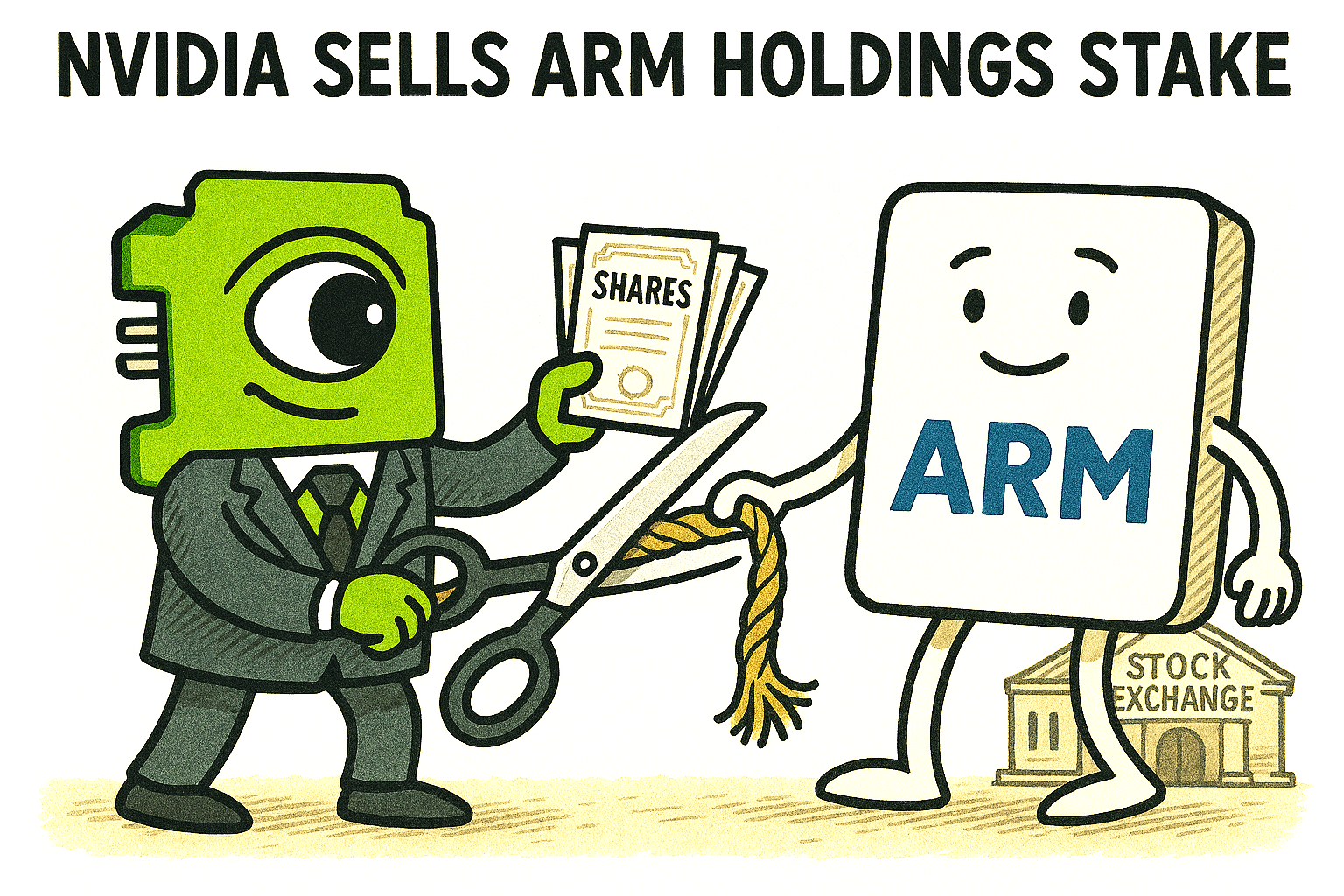
Nvidia sells ARM stock

Nvidia has formally severed its financial ties with Arm Holdings, selling the final tranche of its shares and closing the book on one of the semiconductor industry’s most ambitious — and ultimately unsuccessful — takeover attempts.

Regulatory filings reportedly show the chipmaker disposed of roughly 1.1 million Arm shares during the fourth quarter, a holding valued at around $140 million based on Arm’s recent market price.

Sale of entire ARM stake

The move brings Nvidia’s ownership of the British chip‑architecture specialist to zero, marking a symbolic end to a saga that began in 2020 when Nvidia launched a bold $40 billion bid to acquire Arm.

That deal, which would have reshaped the global semiconductor landscape, collapsed under intense regulatory scrutiny and resistance from major industry players concerned about competition and neutrality.

Despite the divestment, the relationship between the two companies is far from over. Nvidia remains a major licensee of Arm’s instruction‑set technology, which underpins its current and next‑generation CPU designs.

Strategic move

Analysts note that the sale appears to be strategic housekeeping rather than a shift in technological direction, especially given Nvidia’s rapid expansion across data‑centre, AI, and edge‑computing markets.

Arm’s shares initially wobbled on news of the disposal but quickly stabilised, even edging higher as investors interpreted Nvidia’s exit as a clearing of legacy baggage rather than a signal of weakening confidence in Arm’s long‑term prospects.

The company, now primarily owned by SoftBank, continues to push ahead with its growth strategy following its public listing.

For Nvidia, the sale represents a clean break from a failed acquisition that once promised to redefine the industry.

For Arm, it marks another step in its evolution as an independent powerhouse at the centre of global chip design. The strategic paths of both companies however, remain intertwined

Intel sells stake in UK chip designer Arm

Circuit board microchip

Intel has divested its 1.18 million share stake in the British chip company Arm Holdings, according to a regulatory filing.

Intel is undergoing significant restructuring and cost-cutting to address competitive challenges in the semiconductor industry.

The recent transaction, disclosed on Tuesday 13th August 2024, is believed to have earned Intel approximately $147 million, based on Arm’s average share price between April and June 2024.

This move away from Arm occurs during a challenging financial phase for Intel, as it embarks on what CEO Pat Gelsinger reportedly describes as “the most extensive restructuring of Intel since the memory microprocessor transition four decades ago.”

In early August, Intel announced a cost-reduction plan designed to save $10 billion. This includes the layoff of about 15,000 employees, the elimination of the fiscal fourth-quarter dividend, and a reduction in capital expenditures.

At the same time, Intel disclosed quarterly figures that fell short of expectations and provided conservative guidance for the upcoming quarter.

This announcement precipitated the steepest single-day decline in Intel’s stock value in half a century, plummeting 26%.

Intel one year chart as of 15th August 2024

Intel one year chart as of 15th August 2024

Arm issues light earnings guidance but latest results exceed expectations

Arm Holdings

Arm results exceeded expectations, but earnings guidance disappointed.

The chip-design company has ceased disclosing the quarterly shipment numbers of its chips.

Arm’s shares dropped over 13% in after-hours trading on Wednesday following the chip-architecture firm’s announcement of modest earnings projections for the current quarter and the entire fiscal year.

Shareholders report

Total revenue was a record $939 million, up 39% year-on-year

Royalty revenues were up and amounted to $467 million, this represents a 17% increase.

Licence and other revenue was $472 million, up 72% year-on-year.

Arm’s revenue increased by 39% year-on-year for the quarter ending 30th June 2024, as reported in a shareholder update. The net income reached $223 million, a significant rise from the previous year’s $105 million.

Arm has kept its full year forecast unchanged, projecting revenues between $3.8 billion and $4.1 billion.

For the upcoming fiscal Q2, Arm anticipates revenues ranging from $780 million to $830 million. This projection suggests no mid-range growth, contrasting with some analysts’ expectations of $804.1 million in revenue.

Arm Holdings one day share price mid-day 1st August 2024

Arm Holdings one day share price mid-day 1st August 2024

Is this German chipmaker about to gain more traction in the AI race

Ai microchip

While Nvidia continues to dominate the AI chip market headlines, Infineon, a German semiconductor company, is also making waves.

Infineon is capitalizing on the AI surge, aiming to generate billions in revenue through the sale of premium chips.

As AI applications proliferate, encompassing data centre servers and integrated chipsets for PCs and mobile devices, the demand for AI chips is skyrocketing. This trend has only one direction, and that is up.

Infineon is certainly one to watch – it may just become the next major player in the industry.

Others to watch: ARM Holdings, AMD and Intel

Arm Holdings share price drops

AI

UK chip designer Arm’s shares fell on Thursday 9th May 2024, subdued by revenue forecasts despite a strong sales quarter fueled by demand for AI applications.

Arm announced a 47% increase in fiscal Q4 revenue to $928 million on Wednesday.

This surge was propelled by its licensing business, which saw a 60% increase to $414 million for the quarter, attributed to several high-value licencing deals for AI chips.

Additionally, Arm’s royalty revenues rose 37% to $514 million year-over-year, thanks to the growing adoption of its new Armv9-based chips, which offer higher margins.

However, Arm’s revenue projection for 2025, estimated between $3.8 billion and $4.1 billion, did not meet investor expectations, with analysts anticipating $3.99 billion for the year.

What is Arm?

Contrary to chipmakers like Nvidia, which manufacture and market their own products, Arm creates the ‘architectures’ that form the foundation of chips.

These designs are then licenced to various chip manufacturers, including Qualcomm and Nvidia, with Arm earning royalties on each unit sold.

Originally founded in Cambridge, England, in 1990, Arm was an independent company listed in London until 2016, when it was acquired by Japanese tech investor SoftBank for $32 billion.

In September 2023, SoftBank listed Arm on the Nasdaq. Since its initial public offering, Arm’s share value has more than doubled, driven by the explosive demand for chips that power advanced generative AI applications, such as ChatGPT.

But this recent revenue forecast had a negative effect on its share price

Arm Holdings one year chart to 9th May 2024

The recent revenue forecast had a negative effect on its share price