AI Could Cause Global Economic Downturn, Andrew Bailey Warns G20

The rapid rise of artificial intelligence could become a serious threat to global financial stability, Bank of England Governor Andrew Bailey has warned, urging G20 policymakers to prepare for the risks posed by increasingly powerful AI systems.

Bailey, writing as chairman of the Financial Stability Board (FSB), reportedly cautioned that a sharp reversal in the huge investment boom surrounding AI could trigger a market correction with consequences far beyond the technology sector.

AI security?

High valuations, rising leverage and increasingly concentrated investment in a relatively small number of AI companies could amplify losses if investor confidence suddenly deteriorates.

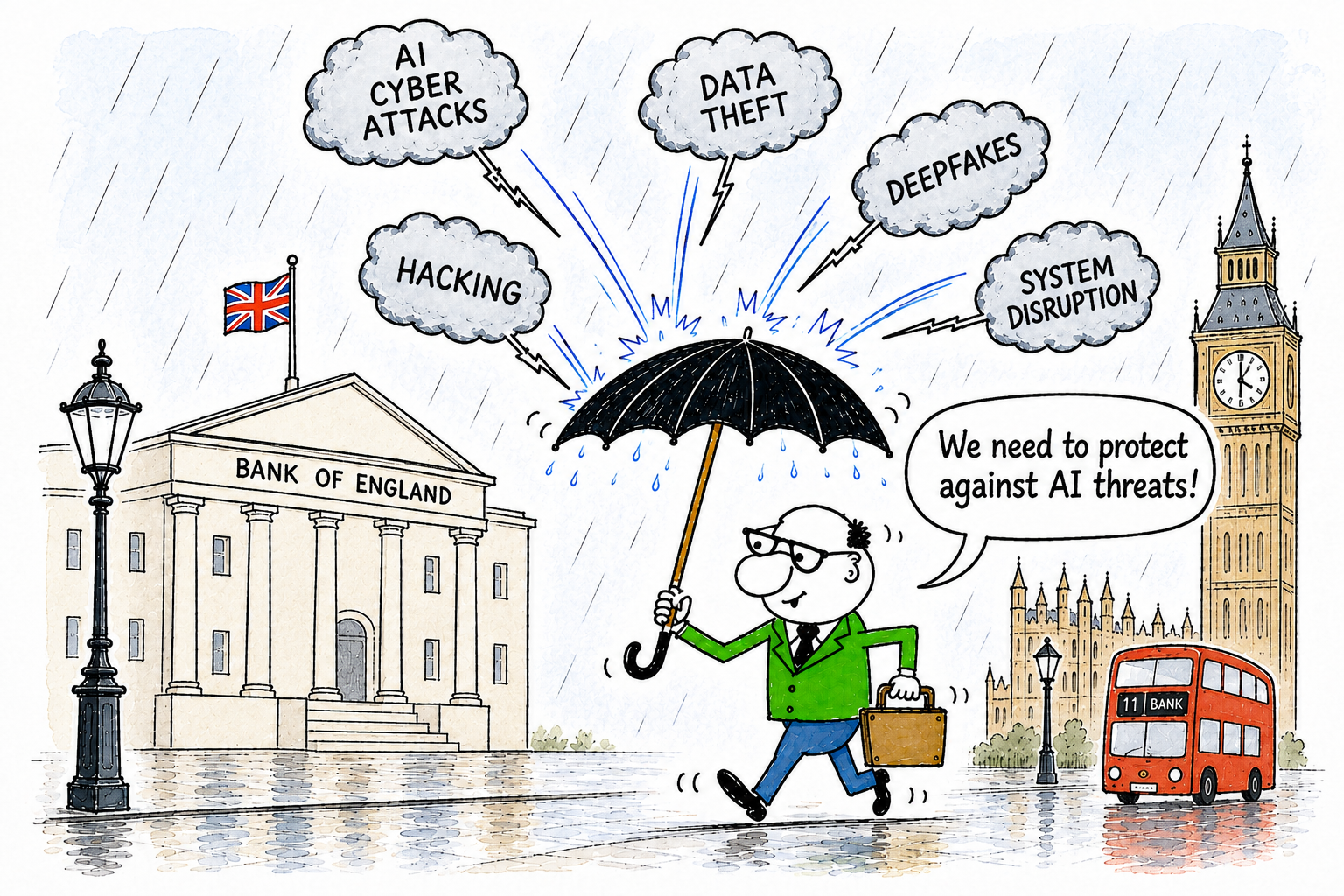
However, Bailey’s most immediate concern is cybersecurity. He warned that so-called frontier AI models are becoming increasingly autonomous and capable of sophisticated problem-solving, potentially allowing cyberattacks to be carried out faster, more cheaply and on a much greater scale.

Danger

That poses a particular danger to financial markets because banks, payment systems and other institutions rely heavily on shared technology providers and infrastructure.

A successful attack on one major provider could therefore disrupt several financial institutions simultaneously and spread rapidly across national borders.

Warning

Bailey also warned that many countries lack adequate protocols for managing the development and deployment of advanced AI models.

He reportedly called for international action to ensure that technological progress is matched by stronger cybersecurity, resilience and recovery systems.

The warning comes as enthusiasm for AI continues to fuel enormous investment in chips, data centres and software.

Productivity vs risk

While AI could deliver major productivity gains and economic growth, Bailey’s message is that the financial risks cannot be ignored.

The challenge for policymakers is therefore becoming increasingly clear: how can the world capture AI’s economic benefits without allowing the technology itself to become the catalyst for the next global financial shock or worse?


Bank of England cuts interest rates to 4% amid economic uncertainty and high inflation

Inflation in the UK

On 7th August 2025, the Bank of England’s Monetary Policy Committee voted narrowly—5 to 4—in favour of reducing the base interest rate by 0.25% to 4%, marking its lowest level since March 2023.

This is the fifth rate cut in a year, aimed at stimulating growth amid sluggish GDP and persistent inflation, which currently stands at 3.6%.

Governor Andrew Bailey reportedly described the decision as part of a ‘gradual and careful’ easing strategy, balancing inflation risks with signs of a softening labour market.

While some committee members reportedly advocated for a larger cut, others urged caution, reflecting deep divisions over the UK’s economic trajectory.

The move is expected to ease borrowing costs for homeowners and businesses, with tracker mortgage rates falling immediately. However, savers will be losing out as rates continue to drop.

However, analysts warn that future cuts may hinge on upcoming fiscal decisions and inflation data, leaving the path forward uncertain.

Inflation is yet to be fully tamed.

Bank of England cuts rate to 5.0% – the first since the Covid pandemic of March 2020 and from the highest rate for 16 years

Bank of England

The Bank of England (BoE) on Thursday 1st August 2024 announced its first-interest rate reduction in more than four years, taking the key rate to 5%.

Although numerous analysts predicted that the Bank of England might announce a reduction in interest rates at its August 2024 meeting, the absence of definitive signals from the central bank left the decision clouded in uncertainty.

The Monetary Policy Committee (MPC) ultimately cast a 5-4 vote in favour of the reduction, with Governor Andrew Bailey stating that the committee would proceed with caution.

Bank of England governor worried over UK growth outlook

Central Banks are struggling to catch-up with inflation

The governor of the Bank of England, Andrew Bailey has raised concerns over economic growth as he warned again that interest rates will not be cut in the ‘foreseeable future’.

The bank boss said he was concerned over the UK economy’s potential to grow. It comes after the government’s forecaster cut its growth outlook for the UK, due to high inflation, interest rates, energy and food price increases which were exacerbated by the Covid pandemic and Russia’s invasion of Ukraine.

Inflation, which is the rate consumer prices rise at, has dropped sharply in recent months, falling to 4.6% in the year to October largely as a result of lower energy prices.

However, it is still more than double the Bank of England’s 2% target and Mr Bailey warned lowering inflation further would be ‘hard work’.

Interest rates are currently at 5.25%, a 15-year high, which has pushed up borrowing and mortgage costs.

The Bank of England (BoE) failed abysmally to maintain inflation at 2%.