Anthropic launches Claude in Europe – its AI chatbot

AI Chatbot

Anthropic, the artificial intelligence (AI) startup backed by Amazon, reported on Monday 13th May 2024 that it’s launching its generative AI assistant Claude in Europe on Tuesday 14th May 2024.

Claude.ai will be accessible to both individuals and businesses via the web and an iPhone app. While it is already free on both platforms in the U.K., Anthropic states that this marks the product’s inaugural launch for users in the EU and non-EU nations such as, Switzerland, Norway and Iceland.

Anthropic is introducing a paid subscription-based version of its Claude assistant, named Claude Pro, which will provide users with access to all its models, including the highly advanced Claude 3 Opus.

In its announcement about launching Claude in European countries, Anthropic emphasized security and privacy as central aspects.

Earlier this year, the EU enacted the first significant global regulatory framework to govern AI.

With a 20,000% increase over the past decade – has Nvidia’s stock peaked?

NVIDIA Corporation (NVDA) has experienced remarkable growth over the past decade.

Historical stock price trends

As of 10th May 2024, NVIDIA’s closing stock price stood at: $898.78

As of 10th May 2024, NVIDIA’s closing stock price stood at: $898.78

NVIDIA’s stock reached an all-time high of $950.02 on 25th March 2024. The 52-week high stands at $974.00, which is 9.7% higher than the current share price. Conversely, the 52-week low was $280.46, which is considerably below the current price.

Annual percentage changes

In 2024, the average stock price reached $763.29, marking a year-to-date rise of 79.30%.

In 2023, NVIDIA’s stock price experienced a remarkable surge of 239.02%.

Conversely, in 2022, the stock price witnessed a decline of 50.27%.

Throughout the past decade, the stock has undergone considerable volatility, exhibiting both notable gains and significant losses.

Focus

NVIDIA began as a pioneer in PC graphics and has since expanded its focus to artificial intelligence (AI) solutions. Its GPUs (graphics processing units) are pivotal in AI, high-performance computing (HPC), gaming, and virtual reality (VR) platforms.

The company’s parallel processing capabilities, powered by thousands of computing cores, are vital for executing deep learning algorithms. Additionally, NVIDIA is active in emerging markets such as robotics and autonomous vehicles.

Market position

NVIDIA holds a dominant position in the Data Centre, professional visualization, and gaming markets. Its success is bolstered by strategic partnerships with leading cloud service providers and server vendors.

Financial performance

NVIDIA’s revenue and profit have seen substantial growth over time. Its emphasis on AI and new technologies suggests a strong potential for further expansion. In summary, despite NVIDIA’s stock achieving impressive gains, it is still influenced by market trends and technological changes.

Its peak status hinges on multiple elements such as industry movements, competitive landscape, and upcoming innovations. Investors are advised to meticulously assess these factors when determining the stock’s future prospects.

Considering a long-term investment yet expecting a downturn, it might be prudent to realise some profits now, given the enormous 20,000% surge in stock value.

Take some profit and buy again after a pull-back.

Arm reportedly to launch AI chips in 2025 as Softbank plan AI data centres

AI

Arm, with a 90% holding by SoftBank, is reportedly set to establish an AI chip unit with the goal of developing a prototype by spring 2025.

This initiative is aimed at catching up with the booming AI market, currently dominated by Nvidia.

Arm, alongside competitors such as AMD, Intel, and Qualcomm, is accelerating efforts to gain position in the AI sector.

SoftBank is negotiating with contract manufacturers, including Taiwan’s TSMC, to produce the AI chips. Mass production is expected to commence in autumn 2025.

Arm’s shares have surged by nearly 45% this year, bringing its market capitalization to over $113 billion.

The chip designer based in the U.K., plans to create an AI chip unit to develop a prototype by spring 2025.

Discussions are reportedly ongoing with contract manufacturers like Taiwan’s TSMC for the production of the AI chips. It was reported that production is anticipated to start in fall 2025.

Arm is responsible for designing the core architecture for these chips. The company licences its designs to companies including Qualcomm and Nvidia and earning royalty fees from each sale. The company asserts that 99% of high-end smartphones utilize Arm technology.

Ambition

Established by Japanese billionaire Masayoshi Son, SoftBank is heavily investing in AI. The company has new plans to allocate $960 million by the following year to enhance its generative AI computing capabilities. In June 2023, Son expressed SoftBank’s ambition to occupy a leading role in the AI revolution.

Reportedly, SoftBank aims to establish AI data centres equipped with proprietary chips throughout the U.S., Europe, Asia, and the Middle East by 2026.

For the fiscal year concluding in March 2024, SoftBank recorded a 7.24 billion Japanese Yen ($4.6 billion) profit in its Vision Fund.

This was the first profitable year for the principal tech investment division since 2021.

How to Pick Stocks: A Beginner’s Guide

Investing in individual stocks can be both thrilling and profitable, yet it carries inherent risks. To make informed decisions, it’s important to adhere to some fundamental steps.

Define Your Goals

Before diving into stock picking, consider your investment goals

Invest for the longer-term, it works!

KIS – Keep It Simple! Keep your investment strategies as simple as possible.

Generate income – For regular payouts, consider focusing on dividend-paying stocks.

Preserve capital – If your primary goal is to keep pace with inflation and safeguard your savings, consider opting for lower-risk investments.

Grow capital – If you’re a young investor aiming for long-term growth, you might consider higher-risk stocks, being cautious with your selections.

Invest for the long-term

Choose your investment strategy

Value Investing – Consider purchasing stocks that are undervalued and have been neglected by the market.

Growth Investing – Invest in companies that exhibit signs of success and have the potential for further advancement.

Momentum Investing – Dispose of underperforming assets and invest in successful ones by following market trends. Be ruthless – there is no room for emotion!

Pound-Cost Averaging – Gradually invest money into the market to reduce the impact of volatility. Look into investing in funds or unit trusts.

Stay informed

Before selecting individual stocks, it’s crucial to stay informed about broader economic trends. Consult financial news websites and specialized magazines to gauge the performance of various industries. For example, economic volatility or significant global incidents, such as the emergence of a new virus variant, can affect the stock market.

Pay close attention to economic announcements from central banks, like interest rate changes. Monitor the newswires regularly and track market trends.

Explore industries you understand

Focus on investing in sectors you understand well. For instance, if your expertise lies in technology, look towards tech companies. If renewable energy is your area of interest, consider stocks in that domain. Knowledge of the industry can lead to more informed evaluations of companies.

Assess company fundamentals

When evaluating a specific stock, consider the following

Financial Health – Examine the company’s balance sheet, income statement, and cash flow. Scrutinize the levels of company debt. Observe the sales and purchases by directors. Determine if they are financially stable.

Earnings Growth – Verify whether the company has demonstrated consistent growth in its earnings over time.

Valuation – Comparing a stock’s price-to-earnings (P/E) ratio with that of its industry peers is crucial for assessing its market value relative to its earnings.

Competitive Advantage – A company’s competitive edge can stem from a unique product, a strong brand, or other distinctive factors. These elements can set a business apart and enable it to outperform its rivals in the market.

After a general market downturn – there is usually a good opportunity to pick-up good companies at a knock down bargain price.

Diversify your portfolio

It’s wise not to concentrate all your resources in a single area. Diversify your investments across various sectors and asset classes. Look into exchange-traded funds (ETFs) or mutual funds to gain wider market exposure. Consider precious metals such as gold maybe and keep cash on the sidelines for those occasional deals that crop up from time to time.

In summary

Selecting stocks involves thorough research, patience, and a vision for the long-term. Keep in mind that all investments carry some level of risk – past performance is not indicative of future outcomes. It is advisable to seek guidance from a financial advisor prior to making any investment choices.


Remember, investing involves risk, and it’s essential to do thorough research and consider professional advice before making any investment decisions. 

RESEARCH! RESEARCH! RESEARCH!

Good luck with your stock-picking choices.

Arm Holdings share price drops

AI

UK chip designer Arm’s shares fell on Thursday 9th May 2024, subdued by revenue forecasts despite a strong sales quarter fueled by demand for AI applications.

Arm announced a 47% increase in fiscal Q4 revenue to $928 million on Wednesday.

This surge was propelled by its licensing business, which saw a 60% increase to $414 million for the quarter, attributed to several high-value licencing deals for AI chips.

Additionally, Arm’s royalty revenues rose 37% to $514 million year-over-year, thanks to the growing adoption of its new Armv9-based chips, which offer higher margins.

However, Arm’s revenue projection for 2025, estimated between $3.8 billion and $4.1 billion, did not meet investor expectations, with analysts anticipating $3.99 billion for the year.

What is Arm?

Contrary to chipmakers like Nvidia, which manufacture and market their own products, Arm creates the ‘architectures’ that form the foundation of chips.

These designs are then licenced to various chip manufacturers, including Qualcomm and Nvidia, with Arm earning royalties on each unit sold.

Originally founded in Cambridge, England, in 1990, Arm was an independent company listed in London until 2016, when it was acquired by Japanese tech investor SoftBank for $32 billion.

In September 2023, SoftBank listed Arm on the Nasdaq. Since its initial public offering, Arm’s share value has more than doubled, driven by the explosive demand for chips that power advanced generative AI applications, such as ChatGPT.

But this recent revenue forecast had a negative effect on its share price

Arm Holdings one year chart to 9th May 2024

The recent revenue forecast had a negative effect on its share price

FTSE 100 in record territory

The FTSE 100 soared past 8300, reaching a new record high amid busy trading as London markets reopened after the bank holiday.

A catch-up trading session is evident, with mainland-listed stocks having a robust session on Monday 7th May 2024 and continuing to rise. The FTSE reached around 8335 in intraday trading.

Wall Street also experienced another positive session, with the Dow Jones climbing for the fourth consecutive day following the Federal Reserve’s less aggressive stance, and the S&P 500 gaining too. Despite mixed results, earnings have bolstered risk appetite. The low U.S. job count has encouraged traders/investors to take heart that rate cuts will be on the agenda again soon, even if they are now late.

Bank of England

Attention will now turn to the Bank of England (BoE), which faces a decision on whether to guide the market towards a rate cut – the first in four years – or to exercise more patience. The consensus is that it’s premature for a cut this week, with August 2024 being the more likely date, although the Monetary Policy Committee’s (MPC) opinions vary.

Last month the Deputy Governor of the BoE, indicated his readiness to vote for a rate cut with little additional evidence of declining inflation, highlighting the ‘downside risks’ to the BoE’s February inflation forecast. In contrast, the Bank of England’s Chief Economist, expressed a more cautious stance in April regarding the initiation of rate cuts.

Inflation

Inflation is on a downward trajectory, expected to return to 2% in the next few months. CPI decreased from 3.4% to 3.2% between February and March 2024, and core inflation dropped from 4.5% to 4.2%. However, the BoE is likely to await April’s data before taking any decision.

Persistent wage growth of around 6% indicates continued strength in the labour market. Financial markets anticipate a Bank of England rate cut by August 2024, but it is believed the BoE may be prepared to act as early as June 2024, aligning with the anticipated policy move by the ECB.

Apple reportedly developing AI microchips for data centres

Apple

Apple, renowned for its innovative consumer electronics, is reported to be branching into artificial intelligence (AI).

Recent reports suggest the company is developing a project dubbed ‘Project ACDC,’ (Apple Chips in Data Centre) with the goal of creating specialized AI chips for data centres.

The AI race

AI applications are becoming ever more essential in our daily routines, prompting tech giants to vie for dominance in this arena. Apple, previously trailing behind its rivals in AI, is now channelling substantial investments to bridge the gap. Project ACDC marks Apple’s strategic endeavour to position itself as a key contender in AI processing.

The role of AI microchips

Traditionally, data centres have depended on general-purpose processors, like Intel Xeon or AMD EPYC, to manage diverse workloads. AI workloads, however, demand unique features such as extensive parallelism and high computational throughput. Specialized AI chips are crucial to meet these demands.

Apple’s AI chips, designed specifically for data centre servers, aim to efficiently expedite AI tasks. These chips will facilitate capabilities such as natural language processing, image recognition, and recommendation systems. With the development of its own AI chips, Apple seeks to secure a competitive edge in the AI technology race.

Collaborating with Taiwan Semiconductor Manufacturing Co.

Apple is said to be partnering with Taiwan Semiconductor Manufacturing Co. (TSMC) to design and produce AI chips. TSMC, a top semiconductor manufacturer, is recognized for its cutting-edge process technology. Although the release timeline for these chips is not specified, their development underscores Apple’s dedication to AI.

WWDC 2024 expectations

Rumors indicate that Apple may reveal AI-based features enabled by its new chips at the Worldwide Developers Conference (WWDC) in June 2024. Should this be accurate, it could mark a significant milestone for Apple’s AI initiatives.

In conclusion, Apple’s Project ACDC signifies an aggressive move towards AI supremacy. With ongoing investments in generative AI, we can anticipate significant advancements in the near future.

Apple announces largest-ever $110 billion share buyback

Apple

Apple shares rose by 7% in after-hours trading on Thursday 2nd May 2024, following the company’s announcement of fiscal second-quarter earnings that exceeded expectations, coupled with the unveiling of an expanded stock repurchase program.

The tech giant disclosed that its board has approved a new $110 billion share buyback plan, marking a 22% increase from the previous year’s $90 billion authorization and setting a record as the largest buyback in history, significantly surpassing Apple’s prior repurchase initiatives.

Apple one day chart 2nd May 2024

Apple accounts data summary to 30th March 2024

Revenue: $90.75 billion vs. $90.01 billion estimated 

iPhone revenue: $45.96 billion vs. $46.00 billion estimated 

iPad revenue: $5.6 billion vs. $5.91billion estimated 

Mac revenue: $7.5 billion vs. $6.86 billion estimated 

Other Products revenue: $7.9 billion vs. $8.08 billion estimated 

Services revenue: $23.9 billion vs. $23.27 billion estimated 

EPS: $1.53 vs. $1.50 estimated 

Gross margin: 46.6% vs. 46.6% estimated 

According to Apple’s latest results, iPhone sales have declined in nearly every global market. The tech giant reported that the overall demand for its smartphones decreased by over 10% in the first quarter of the year, with sales diminishing in all geographic regions except Europe.

Amazon triples profits in pin-point customer led focus

Stock chart up

Amazon’s Q1 earnings and revenue exceeded expectations, emphasised by the expansion of its advertising and cloud computing sectors.

  • Earnings per share: 98 cents vs. 83 cents expected
  • Revenue: $143.3 billion vs. $142.5 billion expected

The operating income surged over 200% to $15.3 billion in the period, significantly exceeding revenue growth, indicating that the company’s cost-reduction strategies and efficiency improvements are enhancing its financial performance.

AWS contributed to 62% of the total operating profit. The net income also saw a more than threefold increase to $10.4 billion, or 98 cents per share, up from $3.17 billion, or 31 cents per share, in the previous year. There was a 13% rise in sales from $127.4 billion the previous year.

One year Amazon chart May 2023 – April 2024

One year Amazon chart May 2023 – April 2024

Amazon expects a continued rise in profitability for the Q2, albeit at a more consistent pace. The company projects its operating income to range from $10 billion to $14 billion, marking an increase from the previous year’s $7.7 billion.

It’s all about the customer

Amazon is dedicated to enhancing customer experiences daily through innovative and advanced products and services. This commitment extends to consumers, brands, sellers, enterprises, developers and content creators alike.

Tesla’s stock jumps 15% after advanced driver-assistance tech test in China

Electric vehicle

Tesla’s shares surged on Monday 29th April 2024, marking their best performance since March 2021, following the company’s achievement in advancing its driver-assistance technology in China.

The stock closed 15% higher, buoyed by investor enthusiasm over Tesla CEO Elon Musk’s visit to China.

On Sunday 28th April 2024, Tesla announced that Chinese authorities had lifted restrictions on its vehicles after they met the nation’s data security standards.

This development has heightened anticipation for the imminent availability of Tesla’s Full Self-Driving (FSD) software in China, the world’s biggest market for electric vehicles.

Tesla share price closed at 194.05 after enjoying a 15% climb

Tesla share price closed at 194.05 after enjoying a 15% climb

BYD profits and sales fall

Electric vehicle

Chinese automotive giant BYD has experienced a decline in profits amid a slowdown in electric vehicle (EV) demand and a price war in the largest car market globally.

The company reported earnings of $630 million (£502 million) for the first quarter, a drop of over 47% from the previous quarter.

Competing with Elon Musk’s Tesla for the title of the world’s top EV seller, BYD recently fell behind as Tesla regained the lead earlier this month.

In the first quarter, BYD’s sales of battery-only vehicles fell to just over 300,000, a decrease from the last quarter of 2023’s record high of 526,000 units.

Intel shares fall after company provides weak forecast

Microchip stock chart

Intel shares fall after company provides weak forecast for earnings, but disappoints with sales.

The stock fell 8% in extended trading.

Monthly stock price chart for Intel Corp. March to April 2024

Monthly stock price chart for Intel Corp. March to April 2024

Intel actual versus consensus expectations for the quarter ended in March 2024:

Earnings per share: 18 cents vs. 14 cents expected

Revenue: $12.72 billion vs. $12.78 billion expected

For the second quarter, Intel anticipates earnings of 10 cents per share with a projected revenue of $13 billion. This projection is in contrast to analysts’ expectations, which predict earnings of 25 cents per share on sales amounting to $13.57 billion.

In the first quarter, Intel disclosed a net loss of $400 million, equivalent to 9 cents per share, as opposed to the previous year’s net loss of $2.8 billion, 66 cents per share.

Revenue was $12.7 billion versus $11.7 billion a year ago, a 9% year-over-year increase.

Darktrace has been sold to a private equity firm

Deal

Private equity firm Thoma Bravo has agreed to acquire Darktrace in a $5.32 billion (£4.25 billion) cash acquisition.

This translates to roughly $7.75 (£6.20) per share, which is a 44% premium over the company’s average share price as calculated over the last three months.

Darktrace, headquartered in Cambridge, focuses on cybersecurity, employing self-learning AI to counteract and automate reactions to cyber threats via its Darktrace ActiveAI Security Platform. The company caters to approximately 9,400 clients globally.

Thoma Bravo’s acquisition of Darktrace adds to its cybersecurity portfolio, which is currently estimated at around $45 billion in value. 

The loss of Darktrace from the London Stock Exchange (LSE) was described as ‘disappointing news.’ There have been calls for greater pro-business reforms to help maintain London’s attractiveness for technology companies.

Darktrace was established in 2013 by Invoke Capital, an investment firm led by Autonomy’s founder Mike Lynch. He now holds a 3.9% stake in Darktrace, positioning him to gain just over $200 million from its sale. His wife holds an additional 2.9%.

Concurrently, Lynch is entangled in a fraud trial in San Francisco. He is reportedly facing accusations of being the ‘driving force’ behind significant fraud at Autonomy.

Autonomy was the software company he co-founded and eventually sold to Hewlett-Packard for $11 billion (£8.6bn) in 2011.

The acquisition represents a significant development in the cybersecurity industry.

Microsoft cloud growth accelerates thanks to AI

Microsoft AI

Microsoft’s Q3 results surpassed estimates for both revenue and earnings.

But the revenue forecast for Q4 was less than anticipated, with the company reportedly projecting $64 billion, which is below the consensus of $64.5 billion – (only just).

Revenue: $61.86 vs. $60.80 billion expected

Earnings per share: $2.94 vs. $2.82 expected

Additionally, Microsoft is reportedly boosting its capital expenditures to acquire Nvidia graphics processing units, which are essential for training and operating artificial intelligence (AI) models.

Microsoft one month share price chart 2024

Microsoft one month share price chart 2024

Alphabet shares climbed 15% after issuing first-ever dividend

Alphabet

Alphabet announced on Thursday 25th April 2024 that it is issuing its first-ever dividend of 20 cents per share and that its board has authorised a stock repurchase of up to $70 billion.

This announcement follows Meta’s board authorising its own inaugural dividend in February. As of 31st March 2024, Alphabet, the parent company of Google, had $108 billion in cash and marketable securities.

After the announcement, which coincided with the release of first-quarter earnings that surpassed expectations, shares surged by 15% in after-hours trading.

Alphabet trading chart 25th April 2024

Alphabet trading chart 25th April 2024

Synthesia creates AI avatars that can convey human emotions

Avatar

AI startup Synthesia on Thursday 25th April 2024 announced its ‘Expressive Avatars’. These are AI-generated digital avatars that can express human emotions including happiness, sadness, and frustration.

Synthesia, supported by the tech giant Nvidia, reportedly secured an investment of $90 million in 2023, reaching a valuation close to $1 billion.

This video was created using the Synthesia platform, it took just two minutes to create.

Meta loses $200 billion in value despite good profits shown in latest figures

Stock down

Meta Platforms Inc. suffered a serious loss, witnessing its market value plummet by $200 billion.

The decline happened following the company’s first-quarter earnings call, during which CEO Mark Zuckerberg highlighted the company’s substantial investments in artificial intelligence (AI) and the Metaverse, instead of concentrating on immediate revenue streams.

Despite a 27% increase in revenue to $36.46 billion and a net income that more than doubled to a $12.37 billion (rounded), investors were unsettled by the company’s projections for future expenses.

Shares dropped by 15.5% as Zuckerberg outlined expensive future projects, including the expansion of business messaging and the integration of ads into AI interactions.

Meta’s stock took a 15% hit in extended trading, bringing its market capitalization down to around $1.2 trillion, still a high valuation. This highlights the unpredictable nature of tech stocks, especially during significant, unmonetized product development stages.

Meta 1 day chart 24th April 2024

Meta 1 day chart 24th April 2024

Zuckerberg’s prioritization of long-term growth over immediate profits is a gamble, placing a bet on AI and the Metaverse to transform digital interactions.

This strategy carries considerable financial risks, as the recent market reaction has shown. Meta’s future now depends on the successful deployment and monetization of these cutting-edge technologies.

Tesla shares jump after affordable model announcement despite revenue drop shown in latest accounts

Electric vehicle

Tesla’s profits have significantly decreased so far in 2024, prompting the company to accelerate the introduction of new models.

The company is also reducing its workforce by thousands in an effort to improve its financial outlook. The electric vehicle manufacturer reported earnings of $1.13 billion for the first quarter, a sharp decline from $2.51 billion in the previous year.

Job losses

Owned by billionaire Elon Musk, Tesla plans to lay-off over 6,000 workers across its Texas and California locations. The firm has been challenged by reduced demand and increased competition from more affordable Chinese imports, resulting in a 43% drop in its stock value throughout 2024.

This month, Tesla announced a 10% cut in its global workforce. Revenue figures for the first quarter of 2024 showed a total of $21.3 billion, falling short of the anticipated $22 billion.

However, Tesla’s shares saw a nearly 12.5% increase in after-hours trading following the announcement that the launch of new models would be moved up from the latter half of 2025. The company has yet to disclose the pricing for these upcoming vehicles.

On other Tesla matters…

Mr. Musk’s ‘compensation package’, previously valued at $56 billion, was rejected by a Delaware judge. The judge reportedly determined that Tesla’s directors failed to fulfill their duties to the company when they awarded Mr. Musk the payout.

With the decline in Tesla’s stock value, the compensation package is now estimated to be about $10 billion less, yet it remains larger than the GDP of many small countries.

Musk also appears to have his sights set on creating a Tesla manufacturing hub in India.

Tesla’s Cybertruck was reportedly recalled recently with a suspected accelerator pedal issue.

FTSE 100 closes at new all-time high

FTSE 100 Index

The UK FTSE 100 stock index has reached a new record closing price on Monday 22nd April 2024

The new all-time high was likely propelled by a weakening pound and reduced tensions in the Middle East. The FTSE 100 has been the laggard for many months.

The index concluded Monday at 8023 points, setting a new record and eclipsing its previous peak of 8012 from February of the preceding year.

At the close, it had risen by 1.62%, with retailers such as, Tesco, Sainsbury’s, M&S and Ocado being among the top gainers of the day.

The shares have gained from the depreciating pound since the London Stock Exchange index includes numerous companies with significant international operations.

A depreciated pound lowers the cost of exported goods for overseas buyers and boosts the value of international business transactions.

Update

On Tuesday morning 23rd April 2024 the FTSE 100 climbed to a new intraday high of: 8080

FTSE 100 5 day chart showing the intraday high of Tuesday morning 23rd April 2024

Meta’s new AI Chatbot has arrived

Meta announces new Chatbot assistant

Meta’s complimentary artificial intelligence (AI) assistant, known as Meta AI, is being introduced across its social media platforms, including WhatsApp, Instagram, Facebook, and Messenger.

The assistant is reportedly designed to respond to queries, craft animations, and produce ‘high-quality’ images, according to Meta CEO Mark Zuckerberg in a recent video posting.

Zuckerberg also noted that the company has integrated ‘real-time knowledge’ from Google and Microsoft’s Bing to enhance the assistant’s responses.

The development of Meta AI is based on the company’s most advanced large language model, Meta Llama 3, which was unveiled on the same day – Thursday 18th April 2024.

Surging tech stocks allow world’s largest sovereign wealth fund to post $110 billion profit in Q1

Wealth fund

Norway’s massive sovereign wealth fund reported a first-quarter profit of 1.21 trillion kroner ($109.9 billion) – bolstered by strong returns from its technology stock investments it was announced on Thursday 18th April 2024.

Established in the 1990s, Norway’s sovereign wealth fund, the largest in the world, invests the surplus revenue from the nation’s oil and gas sector. The fund has invested in over 8,800 companies across more than 70 countries to date.

AI chip demand helps TSMC beat Q1 revenue and profit forecast

AI chips pushing up stock market

TSMC stands as the world’s foremost producer of sophisticated processors, boasting clientele that includes industry giants like Nvidia and Apple

Unprecedented demand for AI chips is being led by the proliferation of large language models such as ChatGPT and Chinese equivalents.

Taiwan Semiconductor Manufacturing Company (TSMC) on Thursday 17th April 2024 beat revenue and profit expectations in the Q1. Strong demand for advanced microchips, especially those used in AI tech.

TSMC’s first-quarter results

  • Net revenue: 592.64 billion New Taiwan dollars ($18.87 billion), vs. NT$582.94 billion
  • Net income: NT$225.49 billion, vs. NT$213.59 billion

TSMC announced that its net revenue has increased by 16.5% from the previous year to NT$592.64 billion, and its net income has risen by 8.9% to NT$225.49 billion. The company has forecasted its revenue for the first quarter to be in the range of $18 billion to $18.8 billion.

As the world’s largest producer of advanced processors, TSMC serves high-profile clients including Nvidia and Apple.

Tesla to lay off over 10% of global workforce

Tesla charge EV point

The company intends to reduce its global workforce by over 10%, amounting to roughly 14,000 employees

As of December, Tesla had a total of 140,473 employees worldwide.

This decision is believed to be a response to the obstacles Tesla is encountering with slowing growth and operational effectiveness and cheaper competition.

In an internal memo, billionaire owner Elon Musk addressed the layoffs, acknowledging that it was a difficult decision but necessary for the company’s future. He emphasized the need to streamline operations and prepare for the next phase of growth. 

The layoffs have already begun and also include some key executives. 

Why?

Analysts offer diverse interpretations of the layoffs. Some perceive them as indicative of cost pressures stemming from Tesla’s investments in new models and artificial intelligence (AI).

The company’s delay in updating its aging vehicle lineup, coupled with high interest rates, has weakened consumer demand. Moreover, the influx of affordable electric vehicles, especially from China, such as BYD, has intensified the competition.

Efficiency drive?

While the layoffs indicate challenges, they also highlight Tesla’s dedication to adaptability and efficiency. As the electric vehicle (EV) industry progresses, Tesla strives to stay lean, innovative, and strategically positioned for ongoing growth. The company is scheduled to announce its quarterly earnings later this month, which analysts will scrutinize in the context of the recent workforce reductions.

In summary, Tesla’s layoffs are indicative of the intricate dynamics within the automotive sector, where innovation, cost control, and market forces converge.

The company’s capacity to steer through these complexities will determine its future prosperity.

Tesla share price year-to-date (April 2024)

Tesla share price year-to-date (April 2024)

Nvidia enters correction territory as stock falls from all-time high

AI

Nvidia, manufacturer of one of the most advanced graphics processing units (GPUs), has significantly benefited from the artificial intelligence (AI) surge due to the high demand for its microchips.

The company’s shares have fallen 10% from their recent all-time high, which was over $950. On Tuesday, 9th April 2024, the stock closed at $853.54, but it saw a slight recovery on Wednesday 10th April 2024, to $870.39.

Nvidia Corporation share price off recent all time high

Nvidia Corporation share price off recent all time high

On Tuesday, 9th April 2024, Intel, a competitor in the chipmaking industry, introduced a new AI chip named Gaudi 3. This chip is designed to drive large language models and stands as a contender against Nvidia’s most sophisticated chips.

U.S. inflation data coming in higher than expected along with a climb in treasuries has led to doubts of a Fed rate cut anytime soon.

These concerns combined together, pushed Nvidia and some other tech stocks lower.

The Nasdaq Composite drifted lower on the day

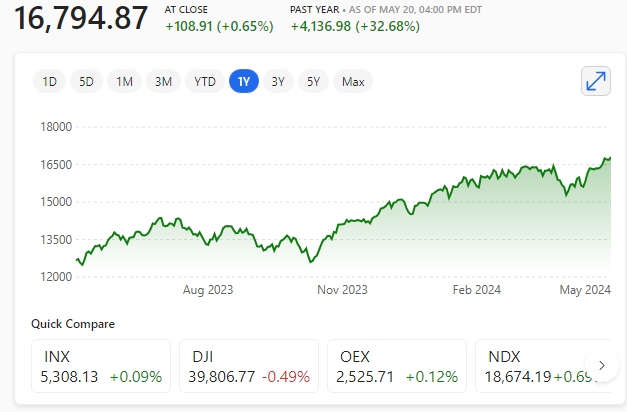
The Nasdaq Composite drifted lower

Is there an AI bubble in the stock market and if so – will it burst any time soon?

AI bubble about to burst?

The recent surge of interest in artificial intelligence (AI) has ignited a significant rally in technology stocks.

Firms engaged in AI development, such as semiconductor producers crucial to AI technology and cloud service providers offering the necessary computing infrastructure, have experienced significant returns.

The stock market is abuzz with excitement over artificial intelligence (AI). With technology stocks on the rise, some investors are questioning whether this signifies an AI bubble that could eventually pop.

The AI Rally Early Winners

In recent months, a select group of large U.S. companies has spearheaded advancements. These pioneers include semiconductor manufacturers critical for AI technology and cloud service providers equipped to commercialise it. The financial returns have been remarkable.

Not Your Typical Bubble 

Despite the rally, experts argue that we’re not in a traditional bubble.

  • Market Concentration: The market rally has shown a high level of concentration. A mere 15 companies have contributed to more than 90% of the returns in the S&P 500 Index from January to June. Given that these frontrunners are predominantly large corporations, the equity market has experienced an exceptional concentration of returns.
  • Valuations and Balance Sheets: Contrary to previous bubbles, such as the internet bubble of 2000, the valuations of today’s leading technology stocks are not overly inflated. These firms have strong balance sheets and deliver significant returns on investment. It’s probable that we are still in the initial phases of a new technological cycle, which may result in continued superior performance.
  • U.S. vs European Tech: Valuations in the U.S. technology sector have garnered an unusual premium compared to European tech companies. This highlights the significance of the AI narrative, considering that the majority of leading AI companies are based in the U.S.
  • Future Growth Assumptions: Investors seem to expect much higher future growth for these tech giants, despite rising rates.

The AI Bubble Debate 

Although tech stock valuations are high compared to historical standards, this doesn’t automatically indicate a bubble. The present price-to-earnings (P/E) ratio for the U.S. tech sector is indeed high, but context is key. The top seven US companies at the forefront of the generative AI industry have an average P/E ratio of 25.

Conclusion

The AI market has not reached bubble status as of now, but careful monitoring is essential. Staying vigilant about valuations, market dominance, and growth projections is important as we venture through this dynamic technological terrain, distinguishing genuine potential from mere speculation.

AI is here to stay, and this is just the beginning of a new ever powerful revolution.

Tech giant Samsung expects profits to jump by more than 900%

Semiconductor

Samsung Electronics anticipates its profits for the first quarter of 2024 to surge more than tenfold compared to the previous year.

This projection is due to the recovery in chip prices following a post-pandemic decline and a surge in demand for artificial intelligence (AI) related products.

As the world’s leading manufacturer of memory microchips, smartphones, and televisions, the South Korea-based Samsung reportedly plans to publish a comprehensive financial report on 30th April 2024.

Projected profit

The tech giant has projected that its operating profit for the January-March 2024 quarter soared to 6.6 trillion won ($4.9bn; £3.9bn), marking a 931% increase from the same period in 2023, surpassing analysts’ forecasts of approximately 5.7 trillion won.

Rebound in microchip prices

A rebound in global semiconductor prices, following a significant downturn the previous year, is expected to bolster its earnings. Over the past year, global memory microchip prices have reportedly increased by about 20%. The semiconductor division of Samsung typically generates the most revenue for the company.

The demand for semiconductors is projected to stay robust throughout the year, fueled by the expansion in AI technologies. Furthermore, the earthquake that struck Taiwan on 3rd April 2024 could potentially constrict the worldwide chip supply, possibly enabling Samsung to further elevate its prices.

Taiwan a key player

Taiwan houses several key chipmakers, including TSMC, which supplies Apple and Nvidia. Despite TSMC reporting minimal impact on its production from the earthquake, it did experience some operational disruptions.

Additionally, Samsung is poised to benefit from the sales of its newly launched flagship Galaxy S24 smartphones, introduced in January.