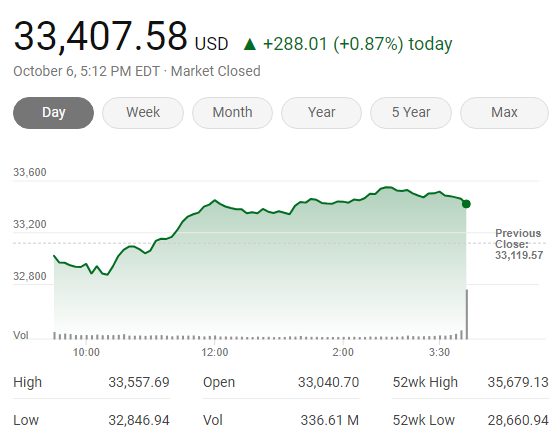
Stocks rallied Friday 6th October 2023 even after the release of stronger-than-expected U.S. jobs data and an increase in Treasury yields.
The U.S. economy added 336,000 jobs in September 2023, the Labour Department said. Economists expected 170,000 jobs.
Confused?
Stocks posted a surprise turnaround on Friday, 6th October 2023 after initially falling on a hotter-than-expected jobs report. At its session low, the Dow had fallen some 270 points, then surged by more than 400 points at in intraday trading. The Nasdaq and the S&P 500 also lost ground too only but then quickly recovered the losses.
Unclear
Traders were unclear as to the reason for the intraday reversal. Some noted it could be the softer wage number in the jobs report that made investors rethink their earlier bearish stance. Others noted the pullback in yields from the day’s highs.
Rally
The rally may just be because the market had been extremely oversold with the S&P 500 at one point in the week down more than 8% from its high earlier this year.
Yields initially surged after the report, with the 10-year Treasury rate trading near its highest level in 16 years. The benchmark rate later eased from those levels, but was still up around 6 basis points at 4.78%.
Extreme market movements maybe here for a while yet.
The latest U.S. jobs report for September 2023 was released on Friday, October 6, 2023.
The U.S. economy added 336,000 jobs last month, much more than expected, despite the Federal Reserve’s struggle to cool the world’s largest economy.
The unemployment rate was 3.8%, in line with August 2023. The data lifted hopes that the central bank will manage to guide the U.S. economy to a ‘soft landing’, where a recession is avoided. Bear in mind the Fed were late in dealing with the initial rise in inflation – so this battle has become harder and prolonged.
The job gains were the largest monthly rise since January 2023, and almost twice what economists had anticipated. Government and healthcare added the most jobs. The labour market still appears solid.
However, not all indicators were positive. The ADP’s national employment report showed that private-sector employers added only 89,000 jobs in September, far fewer than expected. Some factors outside the Fed’s control, such as the autoworker strike and the threat of a government shutdown, could yet damage the U.S. economy.
The labour force participation rate also remained low at 63.2%, indicating that many workers have yet to return to the labour market since the Covid19 pandemic of 2020.
The stock market is influenced by many factors, such as economic data, earnings reports, geopolitical events, investor sentiment, and technical indicators.
Some analysts have suggested that the recent sell-off in the market may have created some oversold conditions that could lead to a relief rally or a bounce back in the near future.
Stochastics oscillation
One of the technical indicators that some traders use to identify buy and sell signals is the stochastics oscillator, which measures the momentum of price movements. The stochastics oscillator consists of two lines: the %K line and the %D line.
The %K line shows the current position of the price relative to its high and low range over a certain period of time, usually 14 days. The %D line is a moving average of the %K line, usually a three-day average. When the %K line crosses above the %D line, it is considered a bullish signal, indicating that the price may be reversing from a downtrend to an uptrend.
When the %K line crosses below the %D line, it is considered a bearish signal, indicating that the price may be reversing from an uptrend to a downtrend.
80/20 analysis
The stochastics oscillator also has two levels: 20 and 80. When the %K line falls below 20, it means that the price is oversold, meaning that it has fallen too much and may be due for a rebound. When the %K line rises above 80, it means that the price is overbought, meaning that it has risen too much and may be due for a pullback.
Careful research before buying is paramount to successful trade
The FTSE 100 index, which tracks the performance of 100 large companies listed on the London Stock Exchange, has recently fallen below 20 on the stochastics oscillator, indicating that it may be oversold and ready for a bounce back.
No guarantee
However, this is not a guarantee, as other factors may also affect the market direction. Therefore, it is advisable to use stochastics in conjunction with other tools, such as trend lines, support and resistance levels, moving averages, and other technical indicators.
Additionally, some traders use different settings for the stochastics oscillator, such as changing the time period or the smoothing factor, to suit their own trading style and preferences. Always though, long term investing produces far better results over time as it smooths out the ‘ups and downs’.
In summary, there is no definitive answer to whether the stock market is building up to a major buy signal again right now, as different traders will have different opinions and strategies and views. But one possible way to gauge the market sentiment and momentum is to use the stochastics oscillator, which can provide some clues about potential reversals and opportunities in the market.
Note
This indicator should not be used in isolation, but rather in combination with other tools and analysis – it is just that, a tool. Good well-established companies that have good track records over many many years are a good place to look for long term returns. But even then, do your thorough research first.
So, what next?
The interest-rate/inflation correlation is crucial, because nominal company earnings grow faster when inflation is higher. That does not mean investors should welcome inflation, since higher inflation also means that future years’ earnings must be discounted at a higher rate.
But for many behavioural reasons, investors place greater weight on the negative impact of the greater discount rate than on the higher nominal earnings-growth rate that typically accompanies higher inflation.
Inflation illusion
Economists refer to this investor error as ‘inflation illusion’. Perhaps the seminal study documenting how this error impacts the stock market was conducted by Jay Ritter of the University of Florida and Richard Warr of North Carolina State University. They found that investors systematically undervalue stocks in the presence of high inflation.
Investors will make the same error, in reverse, when inflation and interest rates start to come down. That’s why the foundation of a likely big buy signal is currently being built.
Maybe the buy signal is about to go green for a quick buying opportunity. But be careful, in this environment it can switch again very quickly.
Remember, always do your own research carefully before buying.
The average rate on the popular 30-year fixed mortgage rose to 7.72% on Tuesday 3rd October 2023, according to latest data
Mortgage rates follow loosely the yield on the 10-year Treasury, which has been climbing this week following strong economic data. Rates have not been this high since the end of 2000.
At the beginning of this year, the 30-year fixed rate dropped mortgage to around 6%, creating a short-lived burst of activity in the spring 2023. But it began rising steadily again over the summer months, causing sales to drop, despite strong demand. The current trend appears to be even higher, with the possibility of rates reaching over 8%.
U.S. mortgage rates, which are close to 8% according to some sources. This is a very high level compared to the recent years, and it may have significant implications for the housing market and the economy.
Main points
Some experts believe that rates could reach 8% later by the end of October, and possibly stay at that level for the remainder of the year. Others, however, think that rates may stabilize or decline slightly if the economic growth slows down or inflation eases.
30 year fixed mortgage rate at 7.72%
The average rate on the popular 30-year fixed mortgage rose to 7.72% as of Oct. 3, according to Mortgage News Daily. This is the highest rate since 2000.
Rates are rising as more economic indicators point to a strong U.S. economy, which increases the likelihood of the Federal Reserve to hike rates further. The 10-year Treasury yield, which closely tracks the mortgage rates, reached 4.8% on Tuesday, the highest level since August 2007.
Hitting 8% will be like crossing a psychological barrier for many buyers, as it will increase their monthly payments and reduce their affordability. It may also dampen the demand for housing, which has already been affected by low inventory and high prices.
Some buyers are already seeing 8% mortgage rates, especially those who have high loan-to-value ratios, high balance-conforming loans, or non-qualified mortgage loans. These could also be borrowers with lower credit scores or non-prime borrowers.
The University of Exeter is offering a master’s degree in magic and occult science – (what is occult science?). Available from September 2024.
First course of its kind in the UK
The course is said to be one of the first of its kind in the UK and aims to explore the history and impact of witchcraft and magic around the world on society and science.
The course leader, Prof Emily Selove, reportedly said that the course was created following a recent surge in interest in magic and the occult, (worrying) – inside and outside of academia. She also said that the course would allow students to re-examine the assumption that the West is the place of rationalism and science, while the rest of the world is a place of magic and superstition.
Institute of Arab and Islamic Studies
The course will be offered in the Institute of Arab and Islamic Studies and will involve academics from various disciplines such as history, literature, philosophy, archaeology, sociology, psychology, drama, and religion.
Some of the modules that students can choose from include dragons in western literature and art, the legend of King Arthur, palaeography, Islamic thought, archaeological theory and practice and the depiction of women in the Middle Ages.
Preparing students for a ‘teaching’ career amongst other options
The university said that the course could prepare students for careers in teaching, counselling, mentoring, heritage and museum work, work in libraries, tourism, arts organisations or the publishing industry, among other areas of work.
And you get one of these too…
To be perfectly honest, I really do not know what to think. This is for real!
Bed bugs are small, blood-sucking insects that can infest homes, hotels, public transport, and other places where people sleep or rest. And Paris has its fair share at the moment.
They can cause skin irritation, allergic reactions, and psychological distress to their hosts. Bed bugs are not known to transmit any diseases, but they can be hard to irradicate once they establish.
Paris outbreak
According to some news reports, Paris is facing a ‘widespread’ outbreak that has been increasing over the past few years.
Some factors that may contribute to the problem
Lack of awareness and prevention measures among the public and the authorities.
Reduced use of pesticides, such as DDT, that were effective against bed bugs but harmful to the environment and human health.
Increased globalisation, tourism, and immigration, which facilitate the spread of bed bugs through luggage, clothing, and furniture.
Social media amplification of the problem, which may create panic and stigma.
Challenge
The bed bug issue in Paris may pose a challenge for the city’s image and reputation, especially as it prepares to host the 2024 Olympic Games. However, there are some solutions that can help prevent and control bed bug infestations.
Methods to control outbreaks
Washing and drying your clothes and bedding at high temperatures after travelling or suspecting an exposure to bed bugs.
Checking for signs of bed bugs before staying in a hotel or renting an apartment, such as dark spots, blood stains, or live insects on the mattress, sheets, or furniture.
Sealing cracks or crevices where bed bugs may hide or enter your home.
Avoiding bringing second-hand furniture or clothing into your home without inspecting them first.
Calling a professional pest control service if you find bed bugs in your home or workplace.
Not just for Paris – probably coming to a city near you too… and soon.
This will take some time to fix.
Imaginative artwork: Bed bugs are small, blood-sucking insects that can infest homes, hotels, public transport, and other places where people sleep or rest.
Walt Disney was an American animator, film producer and entrepreneur. A pioneer of the American animation industry, he introduced several developments in the production of cartoons. As a film producer, he holds the record for most Academy Awards earned and nominations by an individual.
‘You can dream, create, design, and build the most wonderful place in the world. But it requires people to make the dream a reality.’
Metro Bank shares have plunged by 25% after reports emerged that the bank is urgently seeking to raise millions to bolster its finances.
The bank is in talks with investors about raising £250m in equity financing and £350m in debt, while asset sales are also being considered to strengthen the lender’s balance sheet.
The bank’s shares have already suffered substantial falls in September after regulators refused to approve a request to lower the capital, or cash, requirements attached to its mortgage business.
It has been reported that the Metro Bank share price has dropped by 70% so far this year.
As of now, it’s unclear whether the bank will be able to secure the funding it needs. As much as £600 million has been muted as need in in some reports.
Is this a worrying sign of worse to come, or just a one-off?
Cryptocurrency company Ripple said on Wednesday 4th October 2023 that it has obtained a full licence to operate in Singapore, its Asia-Pacific headquarters since 2017.
‘We have hired exceptional talent and local leadership, doubling headcount over the past year and plan to continue growing our presence in a progressive jurisdiction like Singapore,‘ CEO Brad Garlinghouse said in a statement.
The new development comes less than four months after the Monetary Authority of Singapore granted an ‘initial in-principle’ approval in June 2023. With the full licence, Ripple will continue to provide regulated crypto payment services in Singapore.
Over 90% of Ripple’s business is outside of the U.S., and Singapore – and to a larger degree Asia Pacific – is one of its fastest growing region.
XRP Ripple Crypto digital coin and cross border payment system
The XRP ripple crypto coin is a digital currency that is used to facilitate fast and low-cost cross-border payments on the Ripple network.
The Ripple network is a decentralized system of servers that connects banks, payment providers, digital asset exchanges, and corporates. The XRP coin acts as a bridge currency between different fiat currencies and other digital assets.
The XRP coin has a fixed supply of 100 billion units and is distributed by Ripple Labs, the company behind the Ripple network.
He was a British statesman, soldier, and writer who served as Prime Minister of the United Kingdom twice, from 1940 to 1945 during the Second World War, and again from 1951 to 1955.
Great statesman
He is considered one of the best-known, and some say one of the greatest statesman of the 20th century. He was also a Nobel Prize winner in literature for his speeches and books.
He is famous for his inspiring quotes, such as ‘Never give in, never give in, never, never, never, never—in nothing, great or small, large or petty—never give in except to convictions of honour and good sense.‘
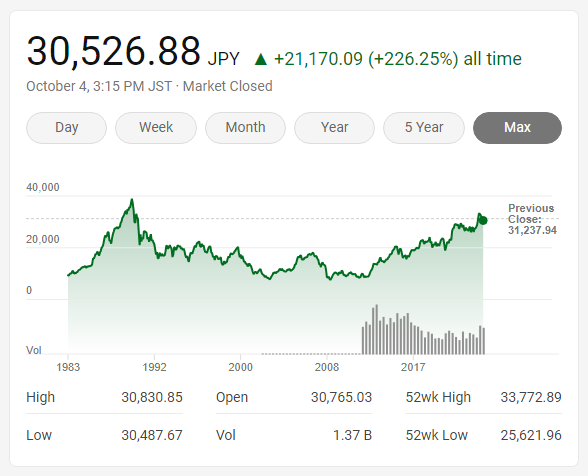
The Nikkei 225 index, is a stock market index for the Tokyo Stock Exchange.
The Nikkei 225 reached its all-time high on 29 December 1989, during the peak of the Japanese asset price bubble, when it reached an intra-day high of 38,957.44, before closing at 38,915.87. This was after a decade-long bull run throughout the 1980s, when the index grew sixfold.
Since then, the index has never surpassed this level, and has experienced several periods of decline and stagnation. As of October 4, 2023, the index closed at 30,526.88, down by 2.28% from the previous day and 8389 points off its all-time high.
Dow Jones Industrial Average (Dow) performance on 3rd October 2023.
The Dow fell more than 400 points, turning negative for the year. The main reason for the drop was the surge in U.S. Treasury yields, which reached their highest levels in 16 years.
Higher yields mean higher borrowing costs for businesses and consumers, which could hurt the economic recovery and the housing market.
S&P 500 on 3rd October 2023
Nasdaq on 3rd October 2023
The tech-heavy Nasdaq Composite gained a 0.7% on October 3rd, 2023, as some investors saw an opportunity to buy some of the high-growth stocks that had been under pressure recently.
According to recent news and scientific reports, Einstein was right again about how antimatter responds to gravity.
Antimatter is the opposite of ordinary matter, and it is very rare in the natural universe. Scientists have created antimatter in the laboratory and observed its behaviour under controlled conditions.
Antihydrogen Laser Physics Apparatus (ALPHA)
One of the experiments that tested Einstein’s theory of general relativity was the Antihydrogen Laser Physics Apparatus (ALPHA) at CERN in Switzerland.
The researchers used antihydrogen, which is the antimatter counterpart of hydrogen, the lightest element. They showed that antihydrogen falls downward due to gravity, just like ordinary hydrogen.
This confirms that matter and antimatter react to gravity in a similar way, as predicted by Einstein more than a hundred years ago.
The stock market has been experiencing some volatility and uncertainty in September and October 2023, as investors fret about inflation, interest rates, and the possibility of a U.S. recession.
Main facts affecting the current stock market
The month of October has produced some severe stock market crashes over the past century, such as the Bank Panic of 1907, the Wall Street Crash of 1929, and Black Monday 1987.
October has also marked the start of several major long-term stock market rallies, such as Black Monday itself and the 2002 nadir of the Nasdaq-100 after the bursting of the dot-com bubble.
The S&P 500 dropped 4.5% in September 2023 and finished the third quarter in the red.
The U.S. Treasury yield curve has been inverted for months – which is a historically strong recession indicator.
The Fed maintained interest rates at the current target range of between 5.25% and 5.5% in September 2023, but signalled that it may need to raise rates again to combat inflation.
The consumer price index gained 3.7% year-over-year in August 2023, down from peak inflation levels of 9.1% in June 2022 but still well above the Fed’s 2% long-term target.
The bond market is currently pricing in an 81.7% chance the Fed will choose not to raise rates again on 1st November 2023.
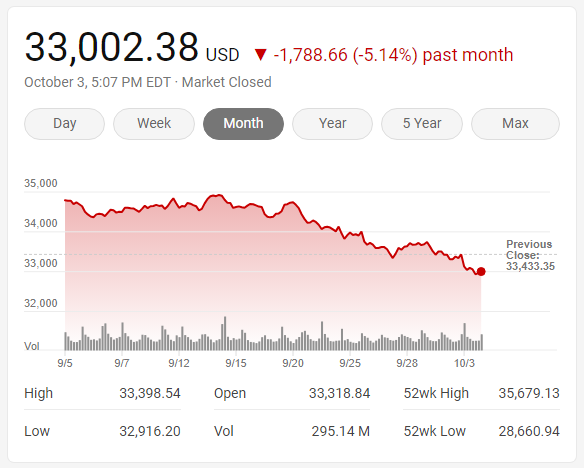
The Dow Jones Industrial Average was down at 33002, Tuesday 3rd October 2023.
Stocks fell as investors pulled money from equities and moved it to the hot bond market.
International markets also faced significant turmoil, sending mini shockwaves through global financial centres, which reverberated in equities.
The dollar rose to the highest since December and is heading towards the twelfth positive week in a row.
Uncertainty
Uncertainty in the U.S. political system is having a major affect too. Especially with the ousting of the speaker and the real fear of a government shutdown looming large.
The U.S. Treasury yields are the interest rates that the U.S. government pays to borrow money. The 10-year and 30-year Treasury yields are the most widely followed indicators of the long-term health of the U.S. economy and the expectations of inflation and growth.
10 year yield at 4.80%
According to the latest data, the 10-year Treasury yield surged to 4.80% on Tuesday, 3rd October 2023, which is the highest level since 12th October 2007.
30 year yield at 4.79
The 30-year Treasury yield rose to 4.79% on Monday, 2nd October 2023, which is the highest since 6th April 2010.
The main reasons for the rise in the Treasury yields
The strong U.S. economic data that showed that the labour market remains hot and the manufacturing sector rebounded in September 2023.
The Federal Reserve’s ‘higher for longer’ mantra signalled that the central bank would keep raising rates until inflation is under control.
The reduced demand for safe-haven assets as the U.S. government averted a shutdown over the weekend by passing a short-term stopgap funding measure.
Uncertainty at the heart of the U.S. political system.
The implications of higher Treasury yields
The higher borrowing costs could weigh on the economic growth and consumer spending in the future.
Higher inflation expectations could erode the purchasing power of the fixed-income investors and increase the risk of a bond market sell-off.
The higher interest rate differential could attract more foreign capital inflows into the U.S. dollar and strengthen its value against other currencies.
Gold value has been slipping in recent months of 2023 – here are some of the reasons gold prices fluctuate.
Dynamic market
Gold is a precious metal that is often seen as a safe haven investment and a store of value, but it is also subject to the forces of supply and demand, as well as many other factors that affect its price.
The gold market is complex and dynamic, and the price of gold can change quickly and unpredictably. Therefore, it is important to do your own research and analysis before investing in gold or any other asset.
Always do your research! Remember, RESEARCH! RESEARCH! RESEARCH!
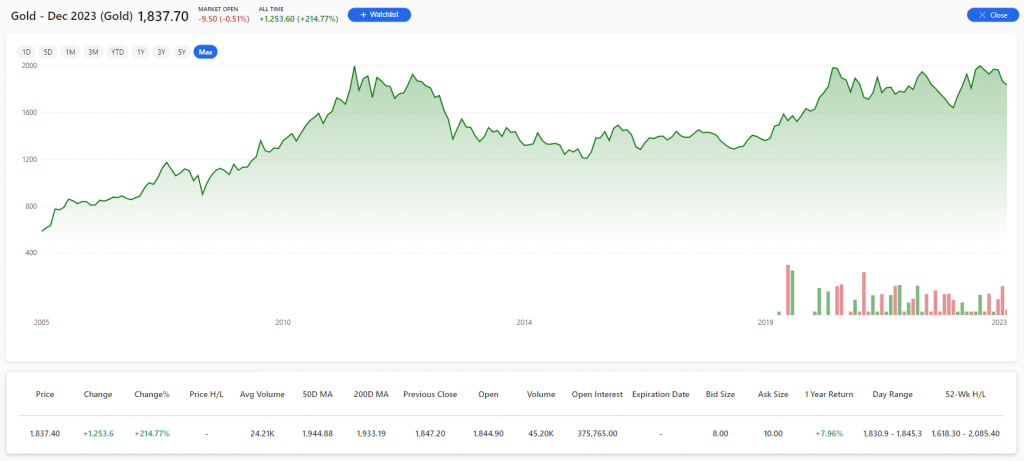
Gold price from 2005 – September 2023
The production costs of gold
The cost of mining, refining, and transporting gold can influence the supply and the price of gold. If the production costs are high, the gold miners may reduce their output or increase their selling price, which can affect the market balance and the gold price.
Money supply
The amount of money in circulation can affect the value of the currency and the inflation rate, which in turn can affect the demand and the price of gold. Generally, when the money supply increases, the currency value decreases and the inflation rate increases, which can boost the demand and the price of gold as a hedge.
Geopolitical stability
The political and economic events around the world can affect the market sentiment and the risk appetite of investors, which can influence the demand and the price of gold. Generally, when there is uncertainty, instability, or conflict, investors tend to seek safe-haven assets such as gold, which can increase the demand and the price of gold.
Jewellery and industrial demand
The demand for gold from the jewellery and industrial sectors can affect the market balance and the price of gold. Jewelry is the largest source of gold demand, especially in countries like India and China, where gold is culturally and traditionally valued. Industrial demand for gold comes from its use in various electronic and medical devices, such as smartphones, computers, and dentistry. The changes in the consumer preferences, the income levels, the technological innovations, and the environmental regulations can affect the demand and the price of gold from these sectors.
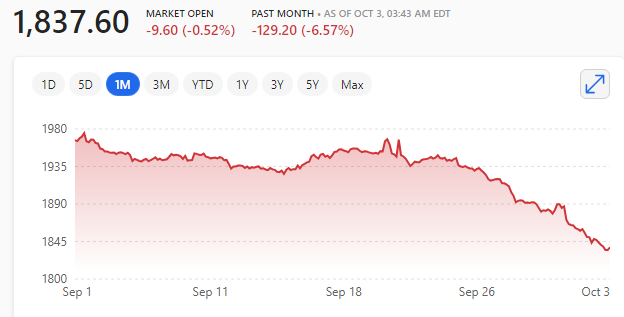
Gold price 3rd October 2023
Central bank actions
The actions of central banks around the world can affect the supply and the demand of gold, as well as the value of the currency and the interest rates, which can influence the price of gold. Central banks hold gold reserves as part of their foreign exchange assets, and they can buy or sell gold to diversify their portfolios, to manage their liquidity, or to intervene in the currency markets. Central banks can also affect the price of gold indirectly through their monetary policies, such as setting the interest rates, printing money, or buying bonds, which can affect the inflation expectations, the currency value, and the opportunity cost of holding gold.
Strength of the U.S. dollar
Gold is priced in U.S. dollars in most of the major trading exchanges around the world, so when the dollar rises against other currencies, gold becomes more expensive for foreign investors, reducing the demand for it. The U.S. dollar has been strengthening since, partly due to the Federal Reserve’s monetary tightening policy that has raised the interest rates and the attractiveness of U.S. Treasury securities.
Rise of global equities
Gold is often considered a hedge against inflation, currency devaluation, and the failure of other financial assets, but when the stock market is performing well, investors tend to shift their money from gold to equities, seeking higher returns and growth potential. The global stock market has been rallying since the bottom of the Covid-19 pandemic in March 2020, boosted by the roll-out of vaccines, the fiscal stimulus, and the economic recovery.
The Krugerrand
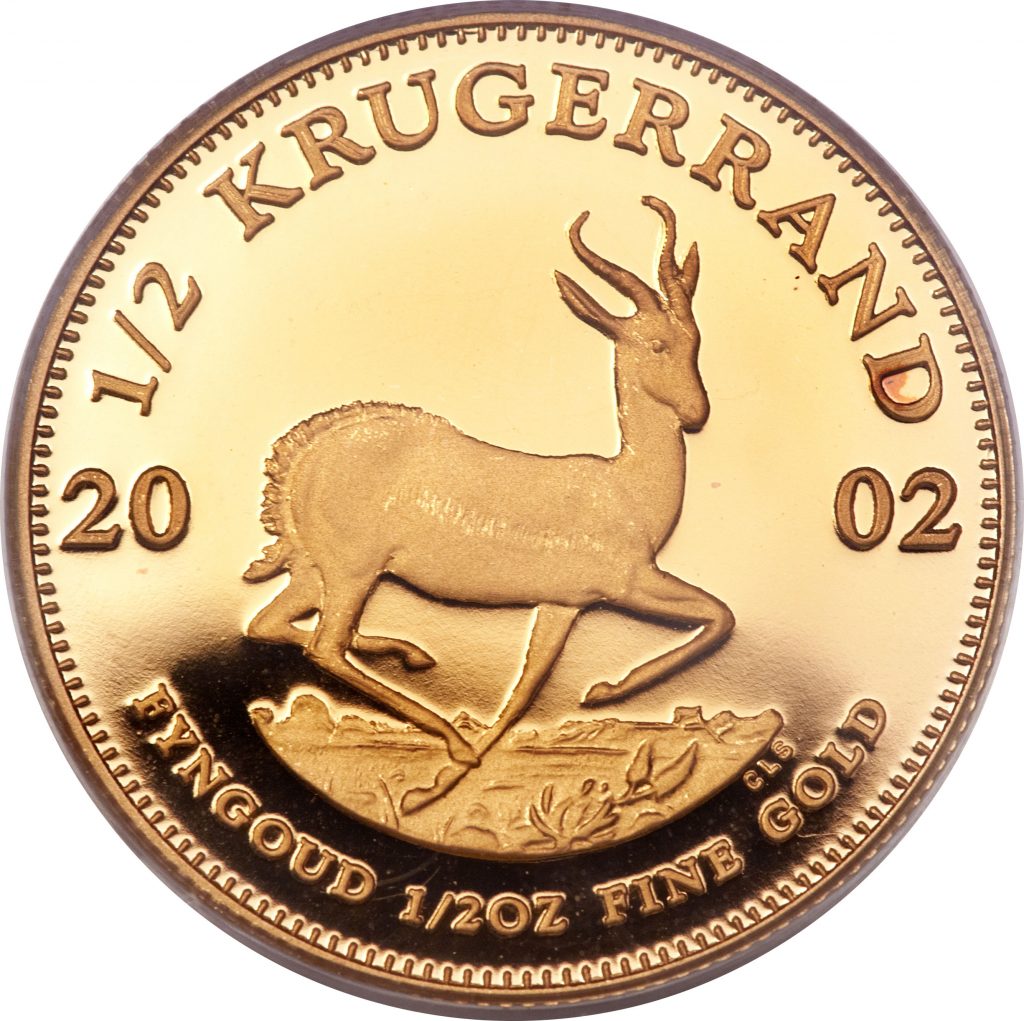
The Krugerrand is a South African coin, first minted on 3rd July 1967
Krugerrand gold coins are a type of bullion coin that were first minted in 1967 by the South African Mint. They are made of 22 karat gold and have a diameter of 32.77 mm and a thickness of 2.84mm. The obverse side features the portrait of Paul Kruger, the former president of the South African Republic, and the reverse side depicts a springbok, the national animal of South Africa. The name ‘krugerrand’ is a combination of ‘Kruger’ and ‘rand’, the currency of South Africa.
Krugerrand gold coins are popular among investors and collectors because they have a high gold content and are easy to trade. They are also legal tender in South Africa, although they do not have a fixed face value.
Decline of inflation expectations
Gold is also seen as a protection against the erosion of purchasing power caused by inflation, but when inflation expectations are low or falling, gold loses some of its appeal as an inflation hedge. The inflation expectations have been declining in recent months, partly due to the easing of supply chain disruptions, the moderation of energy prices, and the fading of the base effects from the previous year.
These are some of the main factors that have been weighing on the gold price lately, but there may be other reasons as well, such as the speculations, the market sentiments, and the geopolitical events that can influence the supply and demand of gold.
These are the seven largest U.S. listed companies in the technology sector.
Apple, Microsoft, Amazon, Alphabet, Nvidia, Tesla and Meta Platforms.
According to a report released Monday 2nd October 2023, these tech’ stocks have seen their valuation drop relative to the median stock in the S&P 500, making them more attractive for investors. The report says that the Magnificent 7 trade at 1.3 times their PEG ratio (price-to-earnings-to-long-term growth), versus 1.9 for the median S&P 500 stock.
This is the cheapest valuation in over six years – time to buy yet?
The report also highlights some positive drivers for these stocks, such as their strong sales growth, their ability to beat expectations, and their resilience to rising interest rates.
However, some analysts also warn that the dominance of these stocks could pose a risk for the broader market if something bad happens to tech’.
Do you know that laughter is good for your health?
Laughter can reduce stress, lower blood pressure, improve mood, and boost immunity. Laughter can also help you bond with others, as it is a form of social communication that shows positive emotions.
Laughter can even make you smarter, as it activates different parts of your brain and enhances creativity and learning.
Meta has announced a series of new chatbots to be used in its Messenger service.
Charming
The chatbots will have ‘personality’ and specialise in certain subjects, like holidays, and cooking. Let’s hope they haven’t been modelled on the company boss then.
It is the latest attempt in a chatbot ‘chat’ race between tech’ companies desperate to produce more accurate and personalised artificial intelligence. The chatbots are still a work in progress with ‘limitations’, said boss Mark Zuckerberg.
During Meta’s first in-person event since before the pandemic, Mr Zuckerberg said that it had been an ‘amazing year for AI’. The company is calling its main chatbot ‘Meta AI’ and can be used in messaging. For example, users can ask Meta AI questions in chat ‘to settle arguments’ or ask other questions.
It’s been touted as fun entertainment and not just question answering.
I wonder if these AI chatbots will be as good as the Metaverse rollout has been so far?
Zuckerberg’s ‘personality’ chatbots
Zuckerberg’s ‘personality’ chatbots are a new feature of Meta, the company formerly known as Facebook. They are artificial intelligence agents that can chat with users on Messenger, using the faces and voices of celebrities like Snoop Dogg, Kendall Jenner, and Tom Brady.
Chatbots with personality. God help us!
They are supposed to have different personalities and interests, such as sports, cooking, or music. Meta claims that they are for entertainment purposes only, and that they have limitations on what they can answer.
Critical
However, some critics have raised ethical and social concerns about these chatbots. They argue that they are creating “counterfeit people” that could deceive or manipulate users, especially young ones. They also question the consent and privacy of the celebrities whose identities are used by the chatbots. They warn that these chatbots could pose dangers to the authenticity and trustworthiness of online communication.
If you are curious about these chatbots, you can try them out on Messenger by searching for their names. But be aware that they are not real people, and that they may not give you accurate or reliable information. They are just products of Meta’s artificial intelligence technology, which is still a work in progress – a bit like the Metaverse.
Chatbot with creepy personality
All this wonderful AI tech and what do we do? Play games with it!
Why do we fart, and why is it funny and embarrassing too?
Farting is a natural and normal part of digestion that reflects the activity of the bacteria in your gut. You might also notice that you fart more when you eat certain foods that are more difficult to digest, such as beans or cabbage.
Farting can also be a sign of good health, as it means that your digestive system is working properly.
Some people may find farting funny or embarrassing, but it is nothing to be ashamed of. In fact, some cultures even celebrate farting as a form of humour or art. For example, in Japan, there is a traditional art form called ‘he-gassen, which means ‘fart battle‘. It depicts people farting at each other in various situations, such as war, politics, or even romance, would you believe.
Benefits of a good fart
Scientists have identified the bacterium that’s responsible for making us pass wind. They say it is also helping keep other more harmful and dangerous bacteria, such as salmonella from infecting your gut.
The Taurinivorans muris bacterium converts the food we eat into hydrogen sulphide – as smelly gas that stinks of rotten eggs. yes, you know the one – we’ve all done one! But the amazing thing is it acts a chemical soldier keeping bad bacteria at bay.
So, next time you pass wind – think of all the good it’s doing, even if it does stink a little!
The Xlinks Morocco-UK Power Project is a proposal to create a large-scale renewable energy complex in Morocco and feed the electricity to the UK via a long underwater cable.
Key facts
12 million solar panels, 530 wind turbines over 62 square miles.
The project aims to produce 10.5 GW of clean power from solar and wind facilities in Morocco’s Guelmim Oued Noun region. This is equivalent to about 10% of the UK’s electricity demand.
The project also plans to build a 20 GWh/5 GW battery storage facility to ensure a stable and reliable supply of electricity.
The project will use proven high-voltage direct current (HVDC) interconnector technology to transmit the electricity to the UK via a 3,800 km route under the seabed. The cable will connect to two locations in Devon and Wales, each with a capacity of 1.8 GW.
The project will create over 11,000 new green jobs in the UK and Morocco, and contribute to their renewable industrial ambitions. It will also diversify the UK’s energy sources and reduce its dependence on EU interconnectors, LNG imports, and biomass from North America.
The project is seeking a 25-year contract with the UK government to guarantee a fixed electricity price and secure financing for the £20 billion investment.
It hopes to start construction in 2024 and deliver power to the UK by 2028.
Entirely powered by sun and wind
The Xlinks Morocco-UK Power Project will be a new electricity generation facility entirely powered by solar and wind energy combined with a battery storage facility. Located in Morocco’s renewable energy rich region of Guelmim Oued Noun, it will be connected exclusively to Great Britain via 3,800km HVDC sub-sea cables.
Zero carbon power generation
When domestic renewable energy generation in the United Kingdom drops due to low winds and short periods of sun, the project will harvest the benefits of long hours of sun in Morocco alongside the consistency of its convection Trade Winds, to provide a firm but flexible source of zero-carbon electricity.
Apple said on Saturday 30th September 2023 that it will issue a software update that would address customer complaints about the latest iPhone 15 models, released just over a week ago, running hot.
The new iPhones were running hot because of a combination of bugs in iOS 17, bugs in apps, and a temporary set-up period that requires extra processing and therefore heat generation, Apple confirmed.
Statement from Apple
‘We have identified a few conditions which can cause iPhone to run warmer than expected. The device may feel warmer during the first few days after setting up or restoring the device because of increased background activity.’
‘We have also found a bug in iOS 17 that is impacting some users and will be addressed in a software update. Another issue involves some recent updates to third-party apps that are causing them to overload the system. We’re working with these app developers on fixes that are in the process of rolling out.‘
It has been suggested Rishi Sunak and Boris Johnson have overseen biggest tax rises since the Second World War
‘Fiscal responsibility’ – code words for ‘cock-up!’
Chancellor Jeremy Hunt and Prime Minister Rishi Sunak have stressed the need for ‘fiscal responsibility’ amid still-high inflation and rising debt costs.
According to the Institute for Fiscal Studies (IFS), by the time of the next general election, taxes will likely have risen to around 37% of national income, which is the highest level since comparable records began in the 1950’s.
The IFS said that this is equivalent to around £3,500 more per household, but it will not be shared equally across income group.
Health and Welfare massive tax burden
The IFS also said that this is not a direct consequence of the pandemic, but rather a result of decisions to increase government spending on health and welfare, and some unwinding of austerity. They predicted that this parliament would mark a decisive and permanent shift to a higher-tax economy.
Other think tanks, such as the Nuffield Foundation, have echoed this view and said that there will be strong pressure in future parliaments to raise taxes further to meet growing demand for public services.
Dissatisfied
Some Conservative MPs have expressed their dissatisfaction with the lack of tax cuts from the government, as they believe that reducing taxes is a key part of the party’s philosophy. Chancellor Jeremy Hunt and Prime Minister Rishi Sunak have stressed the need for fiscal responsibility amid still-high inflation and rising debt costs.
Lurching from one problem to the next
We saw this type of response under George Osborne during the ‘austerity’ period after the financial crisis of 2008. And now again, after Brexit and the pandemic. They were all Conservative governments.
Hunt has reportedly said it would be virtually impossible to cut taxes at the moment – no surprise there then!
Labour has criticised the government for clobbering the general public with tax rises and failing to deliver growth and wages.