

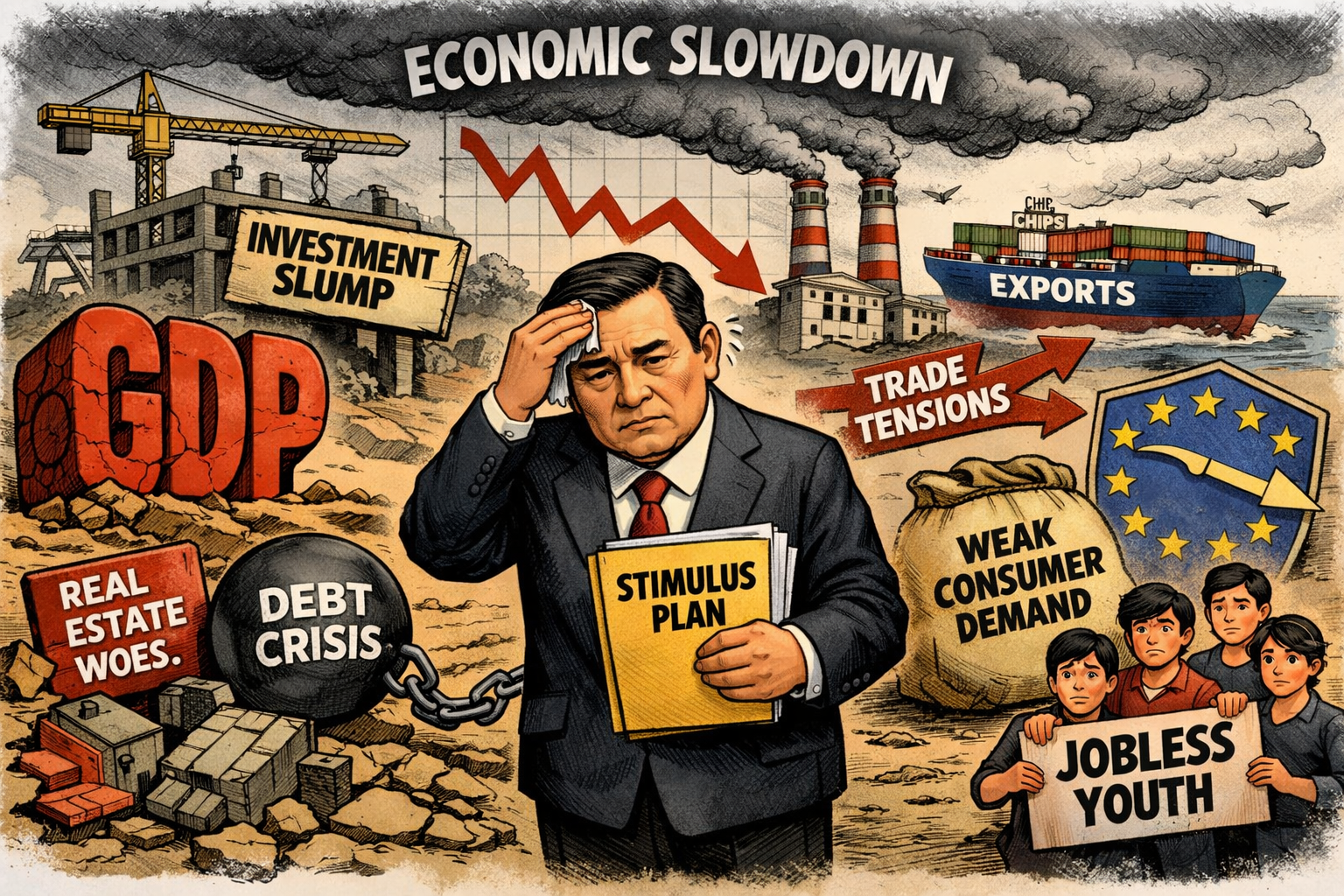
China’s second‑quarter performance marks a clear loss of momentum in an economy already struggling to find stable footing.
GDP grew 4.3% year‑on‑year, the slowest pace since late 2022 and below both economists’ expectations and Beijing’s modest full‑year target of 4.5%–5%.
Weaker investment
The weakness was driven primarily by a deepening collapse in investment, which has become the defining drag on China’s post‑pandemic recovery.
Urban fixed‑asset investment fell 5.7% in the first half of the year, a sharper decline than forecast. Real estate investment plunged 18%, infrastructure dropped 2.4%, and manufacturing slipped 1.2%.
Slow
Analysts attribute the slump to local governments diverting resources into debt restructuring, a shortage of viable new projects, and Beijing’s campaign to curb excess industrial capacity.
The result is an investment pullback described by economists as “unprecedented,” with some reportedly calling for a major expansion of government borrowing to stabilise growth.
Consumption remains fragile. Retail sales rose 1% in June, rebounding from May’s decline but still signalling weak household confidence amid pay cuts and job insecurity.
Two speed
Industrial output, however, accelerated to 5.3%, highlighting China’s two‑speed economy: strong production and exports powered by the global AI boom, contrasted with subdued domestic demand.
Policymakers reportedly warn of an “acute” imbalance between supply and demand.
China’s second‑quarter performance marks a clear loss of momentum in an economy already struggling to find stable footing.
GDP grew 4.3% year‑on‑year, the slowest pace since late 2022 and below both economists’ expectations and Beijing’s modest full‑year target of 4.5%–5%.
But 4.3% is a very healthy GDP.
Exports
Exports continue to outperform, driven by surging shipments of chips, computers, and power equipment. Yet this strength is straining relations with major partners.
China’s trade surplus with the EU widened 24%, raising the risk of renewed trade conflict despite a temporary truce.
Labour‑market pressures persist. Official unemployment held at 5%, but broader measures suggest joblessness closer to 10%, with youth unemployment still elevated despite methodological changes.
Overall, the data reinforce expectations that Beijing will likely need to intensify stimulus—potentially including rate cuts and expanded borrowing—to prevent the slowdown from becoming entrenched.