

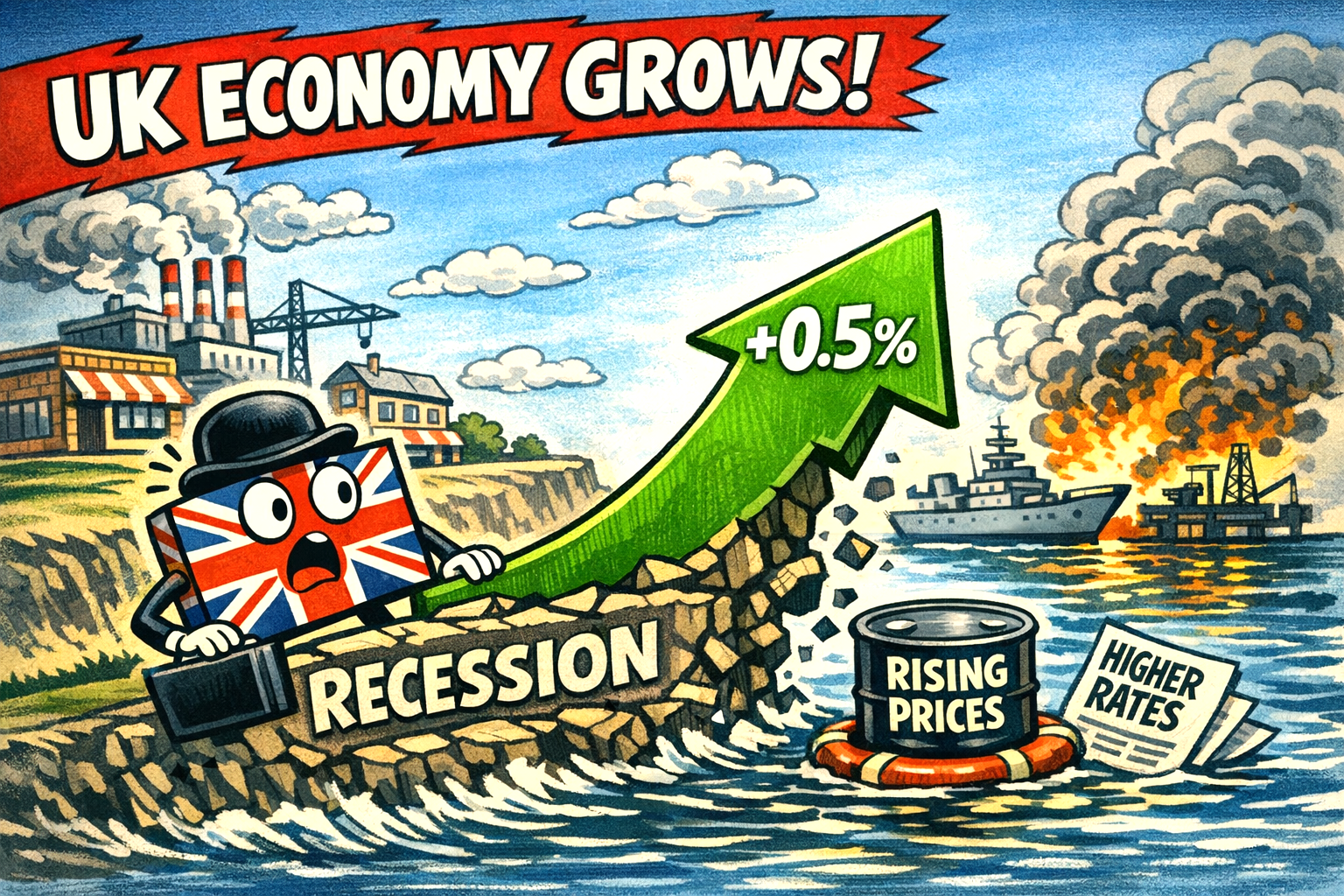
The UK economy experienced faster-than-expected growth in the period leading up to the Iran war – February 2026

UK Growth of 0.5% in February 2026

The ONS’s February 2026 figures delivered a rare upside surprise: UK GDP rose 0.5% month‑on‑month, the strongest expansion in more than two years and five times the consensus forecast of 0.1%.

How can forecasts be so wrong?

January2026 was also revised up to 0.1%, overturning the earlier flat reading. On the surface, this looks like the economy finally pulling out of its shallow recession.

In reality, it is a snapshot of momentum that has already been overtaken by events.

Services mani

The growth was broad‑based. Services, which make up over three‑quarters of the economy, expanded 0.5%, marking a fourth consecutive monthly rise.

Production also grew 0.5%, and construction jumped 1.0%. Even the three‑month measure—less noisy than monthly data—showed UK GDP up 0.5%, compared with 0.3% previously. This is the kind of balanced improvement policymakers have been waiting for.

But the timing matters. These numbers capture the economy before the U.S.-Israel-Iran conflict triggered a fresh energy shock at the end of February.

IMF downgrade

Since then, petrol, diesel and heating oil prices have surged, mortgage rates have ticked higher as markets price out rate cuts, and the IMF has downgraded the UK’s 2026 growth outlook to 0.8%.

So February’s strength is real—but it is also backward‑looking. The challenge now is whether any of that momentum survives the shock hitting households and firms this spring.
Why does the UK have a serious issue with jet fuel supply

UK jet fuel low

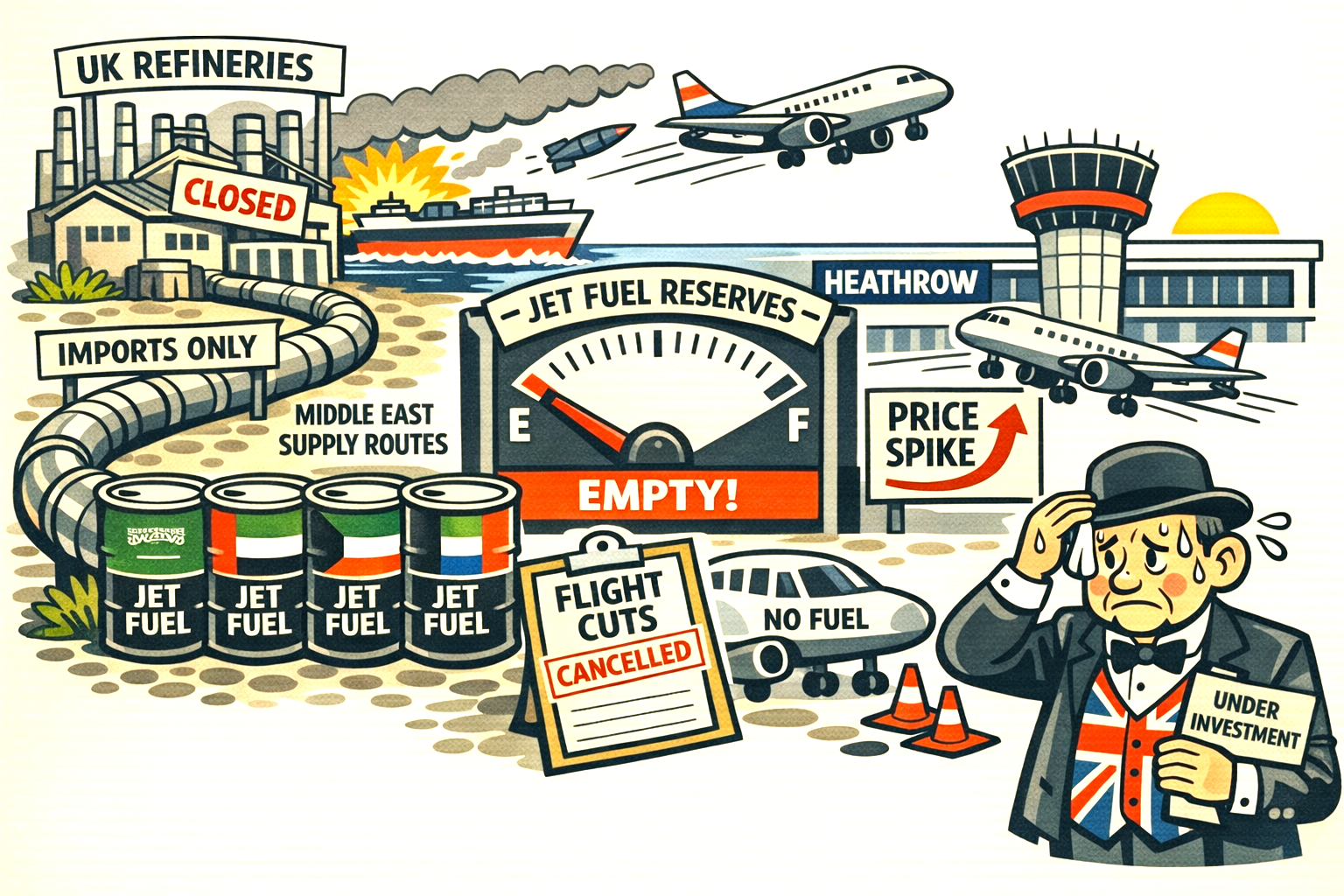
Britain’s jet fuel problem is the predictable result of a long, quiet erosion of refining capacity colliding with a geopolitical shock and decades of under investment.

The country now imports three times more kerosene than it produces, and the Middle East crisis has exposed just how thin those supply lines have become.

A system built on shrinking refineries

The UK once had 18 refineries; today it has just four. Closures at Lindsey and Grangemouth last year removed two critical plants, including Scotland’s only kerosene supplier.

The remaining refineries — Fawley, Humber, Pembroke and Stanlow — supply most domestic needs but cannot meet jet fuel demand.

Output has fallen 41% since 2000, driven by poor investment returns, high carbon costs, and the government’s push toward electrification reducing demand for other fuels.

This leaves Britain structurally dependent on imports for diesel and, crucially, kerosene.

The kerosene dependency

Jet fuel demand is unusually high because of Heathrow’s role as a global hub. In 2024, the UK was the second‑largest jet fuel consumer in the OECD, behind only the U.S.

Yet domestic production covers only a fraction of that. Britain reportedly imported around 3.1 times more kerosene than it produced in 2024.

And the sources of those imports are concentrated: 60% come from Saudi Arabia, the UAE and Kuwait, making the UK acutely exposed to any disruption in the Strait of Hormuz.

The real vulnerability: almost no stockpiles

Britain holds just one month’s worth of jet fuel reserves, far lower than most advanced economies. When Middle Eastern supply is threatened, the UK has no buffer.

European alternatives exist — notably the Netherlands and Antwerp — but prices have already doubled, and airlines are preparing to cut capacity.

The bigger picture

This is not a sudden crisis but the culmination of two decades of under‑investment, policy drift and over‑reliance on global markets.

Jet fuel is simply the first commodity where the structural weakness has become impossible to ignore.

The UK needs to get a grip!

A ‘systemic’ jet fuel shortage is brewing in Europe if the U.S. led Iran war crisis isn’t resolved soon.