

Walk into any British or European supermarket and you’ll see the same reassuring fiction printed on every packet: neat percentages, confident numbers, a promise of scientific clarity and colour coded convenience.
It is theatre. The modern food label is not a health tool — it is a relic of the 1970s – 1990s, embalmed in regulation and defended by an industry that knows honesty would collapse half its product line.
These labelling standards have undergone updates in the 1990’s and early and mid 2000’s but still they fundamentally sit out of date and therefore remain misleading.
Defunct food labelling system
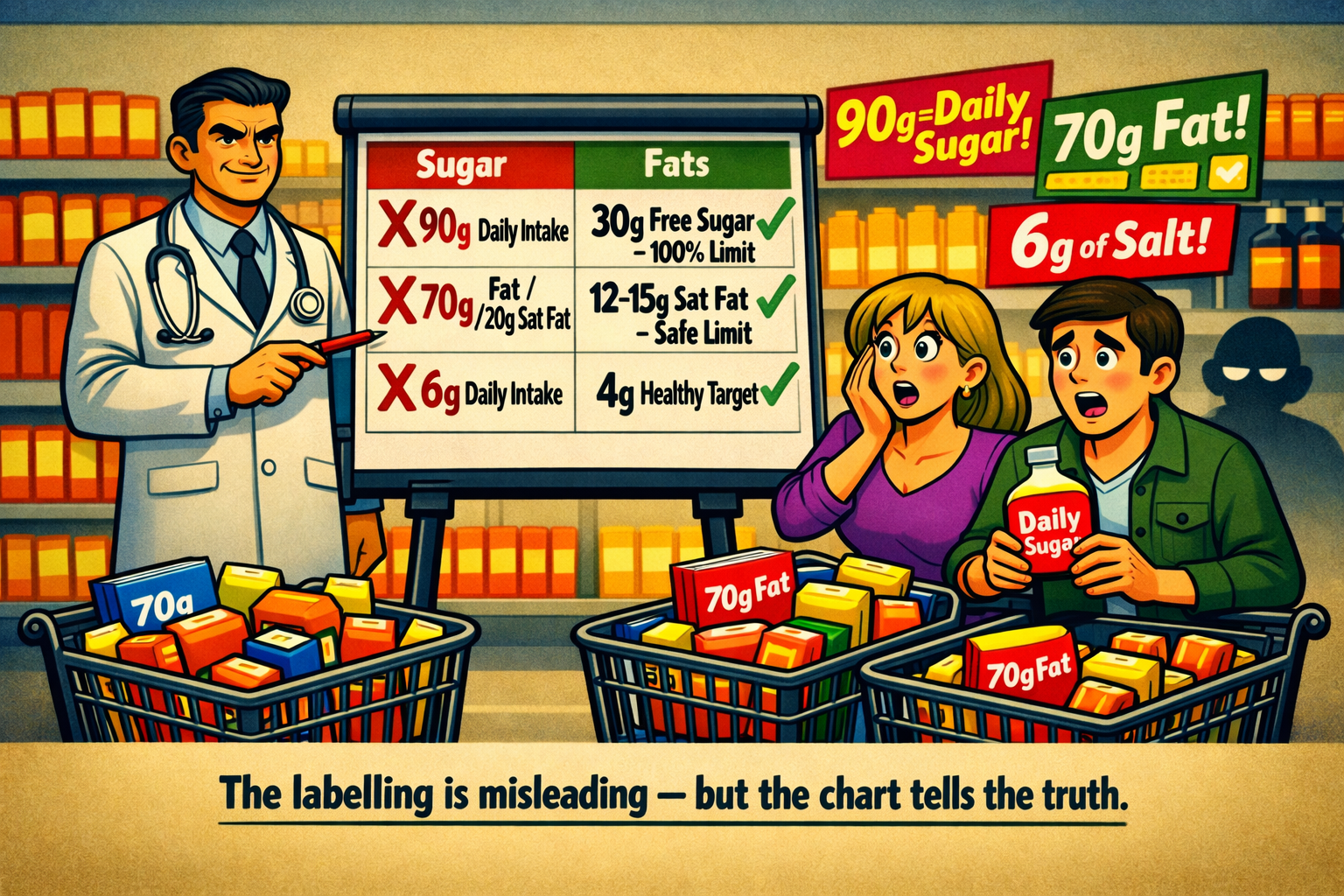
In the UK and EU, the entire labelling system still rests on a reference framework that includes 90 g of “sugars” per day, a number carried forward into EU Regulation 1169/2011 and still used in UK guidance after Brexit. That figure is not a modern health limit; it is a bureaucratic fossil.
Even though the label says “90 g total sugars”, it’s presented as if that number were a health benchmark.
In reality:
“Total sugars” mixes harmless natural sugars (lactose in milk, fructose in whole fruit) with harmful free sugars (added sugar, honey, syrups, juice).
The 90 g figure was never meant to represent a safe or recommended intake — it’s just a reference value for all sugars combined, created for packaging consistency.
Because the label doesn’t separate the types, it makes high‑sugar products look acceptable. A drink with 30 g of added sugar can appear to be only “⅓ of your daily intake,” when it’s actually 100 % of your real free‑sugar limit.
Even though it’s sold as ‘total’ sugar, the system labelling is misleading and outdated. It hides the distinction that matters most for health: free sugars vs natural sugars.
RI – reference intake, GDAs Guideline Daily Amounts, Fats, Saturated Fats, Sugars, Salt, and Calorific VALUES are relics of a by-gone age and desperately need updating to reflect our health standards now and not of the past.
30g of free sugars intake per day NOT 90g total
Today, the UK’s own scientific advisers recommend no more than 30 g of free sugars per day — one third of the value used on the label.
Yet the packaging continues to tell consumers that a drink containing 30 g of sugar represents “33% of your daily intake”. It is a mathematical truth wrapped around a public‑health deception.
Deception
This is not a rounding error. It is structural deception. A system that knowingly uses outdated reference values is not neutral — it is actively distorting consumer perception.
Informs parents that a cereal bowl full of sugar is “fine”.
Tells children that a bottle of fizzy drink is “OK” at these levels.
It makes adults think that they are staying “within their daily intake” while quietly pushing them into metabolic disease.
Lies
And sugar is only the most egregious example. The same legacy scaffolding props up the numbers for fat, saturated fat and salt. The 2,000 kcal baseline is generous for many adults.
The 70 g fat and 20 g saturated fat references are compromises from another era. The 6 g salt figure remains stubbornly high in a continent battling hypertension.
The label percentages are calculated against the 90 g total and not the 30 g limit. This is misleading. 90 g of total sugars is not 30 g of free sugars (added). The 90 g is far too high. It should be calculated on the 30 g figure as an added free sugar total.
Example: If you drink a can of cola, it contains approximately 35 g of added sugar. In terms of your daily ‘healthy’ allowance, you have consumed over 115% of your daily limit in just that one drink.
However, because regulations dictate that the label must be calculated against Total sugars of 90 g, the can of cola will read as on around 39% of your reference intake.
This allows for a higher sugar on a percentage basis, matching the misleading total sugar levels. Convenient for the food industry but shockingly bad for your health.
These numbers persist not because they are right, but because changing them would expose the truth: a vast proportion of the modern food supply is incompatible with modern health science.
Authorities know this but it has been calculated that approximately just 1% of the general population know
Governments know this. Industry knows this. Everyone involved understands that if labels were recalibrated to reflect current evidence — 30 g free sugars, lower salt, tighter saturated fat limits — supermarket shelves would light up like hazard boards.
Half the “family favourites” would show triple‑digit percentages. “Per portion” tricks would collapse. The quiet illusion of moderation would die overnight.
Broken
So the system stays broken. Regulators hide behind “reference intakes”. Manufacturers hide behind “portion sizes” no human actually eats.
Politicians hide behind the language of “consumer choice”. And the public — especially children — pay the price.
Rising obesity, fatty liver disease, overweight, type 2 diabetes and dental decay are not mysterious social trends. They are the predictable outcome of a labelling regime designed to soothe, not inform.
Scandal
This is a scandal. Not a dramatic one, but a slow, grinding, bureaucratic scandal — the kind that reshapes a population’s health without ever making the front page.
An honest labelling system would be simple: use current scientific limits, distinguish clearly between total and free sugars, and ban fictional portion sizes.
Until that happens, every label in the supermarket is a small act of misdirection — and we are raising a generation inside a nutritional hall of mirrors.
The health of a nation would be improved dramatically improved overnight by removing this disception.
We eat too much and these misleading labels encourage that problem.
It’s easily fixed.
Stop misleading the public and change the labelling to reflect our current deteriorating health in the UK and other countries too.
Eat less.
Fix the labels.