

UK and U.S. economic data roundup as of week ending 19th June 2026

UK U.S. June 2026 economic data

United Kingdom – Latest Data This Week to June 19th 2026

Labour market:

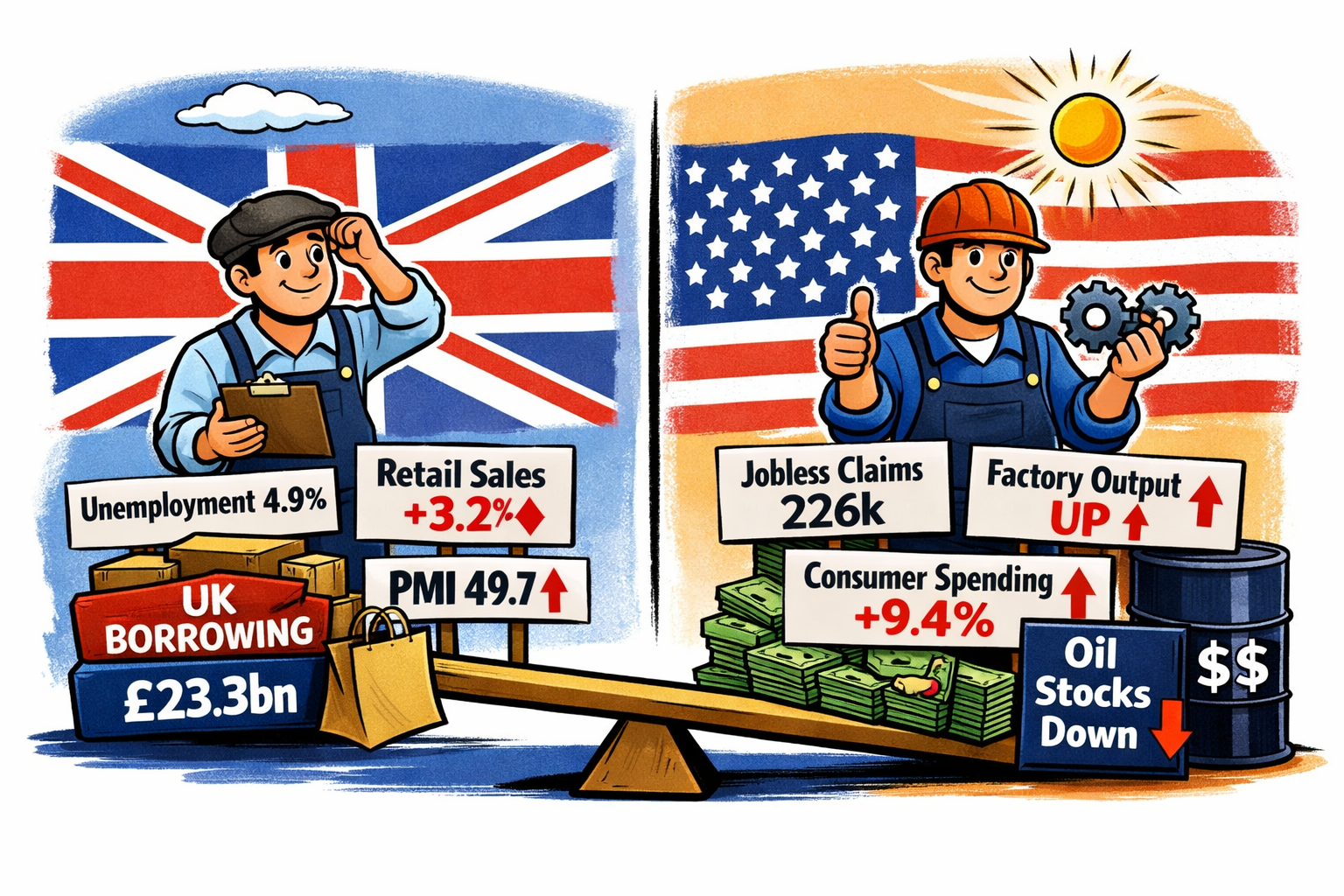
  • The UK unemployment rate for April 2026 held at 4.9%, slightly below the previous 5% reading. Average earnings including bonuses grew 4.4%, while earnings excluding bonuses rose 3.4%. Employment increased by 100,000 in April, although HMRC payrolls for May showed only a marginal +2,000 change.

Retail sales:

  • Retail sales rebounded strongly in May 2026, rising 1.2% month‑on‑month and 3.2% year‑on‑year, reversing April’s declines. Retail sales excluding fuel also rose 1.2% MoM and 4.6% YoY.

Public finances:

  • Public sector net borrowing (excluding banks) came in at £23.3bn in May, slightly worse than April’s revised figure.

Business activity:

  • Flash PMIs for June show mixed momentum:
    • Manufacturing PMI: 53.9 (expansion)
    • Services PMI: 49.3 (contraction)
    • Composite PMI: 49.7 (borderline contraction) These readings suggest the UK economy is losing some pace heading into summer.

United States – Latest Data This Week to 19th June 2026

Labour market:

  • Initial jobless claims for the week ending 13th June 2026 fell slightly to 226,000, broadly in line with expectations. Continuing claims rose to 1.81 million, indicating some softening in labour market conditions.

Manufacturing & business surveys:

  • The Philadelphia Fed Manufacturing Index jumped to 10.3 in June from –0.4, signalling a notable improvement in factory activity.
  • The S&P Global flash PMIs for June show:
    • Manufacturing: 55.1 (solid expansion)
    • Services: 50.7 (modest expansion)
    • Composite: 51.5 (steady growth) These point to a resilient US private‑sector backdrop.

Housing & consumer indicators:

  • Mortgage rates eased slightly, with the 30‑year rate dipping to 6.47%.
  • Redbook retail sales rose 9.4% YoY, suggesting firm consumer spending.

Capital flows & energy:

  • Net long‑term TIC flows for April registered $103.1bn, indicating strong foreign demand for US assets.
  • API data showed a sharp –8.33 million barrel draw in crude oil stocks, hinting at tighter near‑term supply.

Overall Pictures for UK and U.S.

  • UK: A mixed week — labour market steady but softening at the margins; retail sales surprisingly strong; PMIs signalling a mild loss of momentum; public borrowing still elevated.
  • US: Data broadly stronger — manufacturing rebounded, services steady, jobless claims stable, and consumer spending indicators show firm.

China’s manufacturing sector experiences decline amid Tariff chaos

China factory data

China’s manufacturing activity took an unexpected hit in May 2025, marking its steepest decline since September 2022.

The Caixin/S&P Global manufacturing PMI fell to 48.3, signalling contraction for the first time in eight months. This downturn comes as U.S. tariffs begin to weigh heavily on Chinese exports, dampening global demand and disrupting supply chains.

The latest data reveals that new export orders shrank for the second consecutive month, hitting their lowest level since July 2023.

Factory output also contracted for the first time since October 2023, reflecting the broader economic slowdown. Analysts attribute this slump to the reinstatement of sweeping U.S. tariffs, which were briefly halted before being reimposed by a federal appeals court.

Despite a temporary trade truce between the U.S. and China, tensions remain high, with both sides accusing each other of violating agreements.

The uncertainty surrounding trade policies has led Chinese manufacturers to cut jobs at the fastest pace since the start of the year, further exacerbating economic concerns.

China’s Premier Li Qiang has hinted at new policy tools, including unconventional measures to stabilise the economy. However, with tariffs set to remain high and structural challenges persisting, experts predict continued pressure on China’s industrial sector.

As the world’s second-largest economy grapples with these headwinds, the coming months will be crucial in determining whether Beijing can implement effective strategies to counteract the impact of tariffs and restore manufacturing momentum.

Caixin/S&P Global manufacturing PMI survey

The report was based on the Caixin/S&P Global manufacturing PMI survey, which is a private-sector survey that tracks China’s manufacturing activity.

This survey is conducted mid-month and covers over 500 mostly export-oriented businesses, making it distinct from China’s official PMI, which samples 3,000 companies and is compiled at month-end.

The Caixin PMI tends to focus more on small and medium-sized enterprises, whereas the official PMI aligns more closely with industrial output.

In May, the Caixin PMI fell to 48.3, marking its first contraction in eight months. The decline was largely driven by shrinking new export orders, which hit their lowest level since July 2023.

The survey also showed that employment in the manufacturing sector declined at the fastest pace since January, reflecting the broader economic slowdown.

One key difference between the Caixin PMI and the official PMI is their timing. The Caixin survey is conducted earlier in the month, meaning it may not fully capture policy changes or trade developments that occur later.

For example, economists noted that the effect of the tariff de-escalation in mid-May may not have been reflected in the Caixin PMI results

China manufacturing and Japan’s GDP contracts – Asia markets mixed

Economic data

Over the last weekend of June 2024, China released its official PMI figures, with the manufacturing PMI remaining at 49.5, the same as in May 2024, indicating a second consecutive month of contraction.

On Monday 1st July 2024, Japan adjusted its first-quarter GDP figures, showing a contraction of 2.9% year-on-year, a revision from the previously reported 1.8%.

Asia markets started the second half 2024 mixed as investors assessed June business activity data from China as well as Japan’s GDP revision.