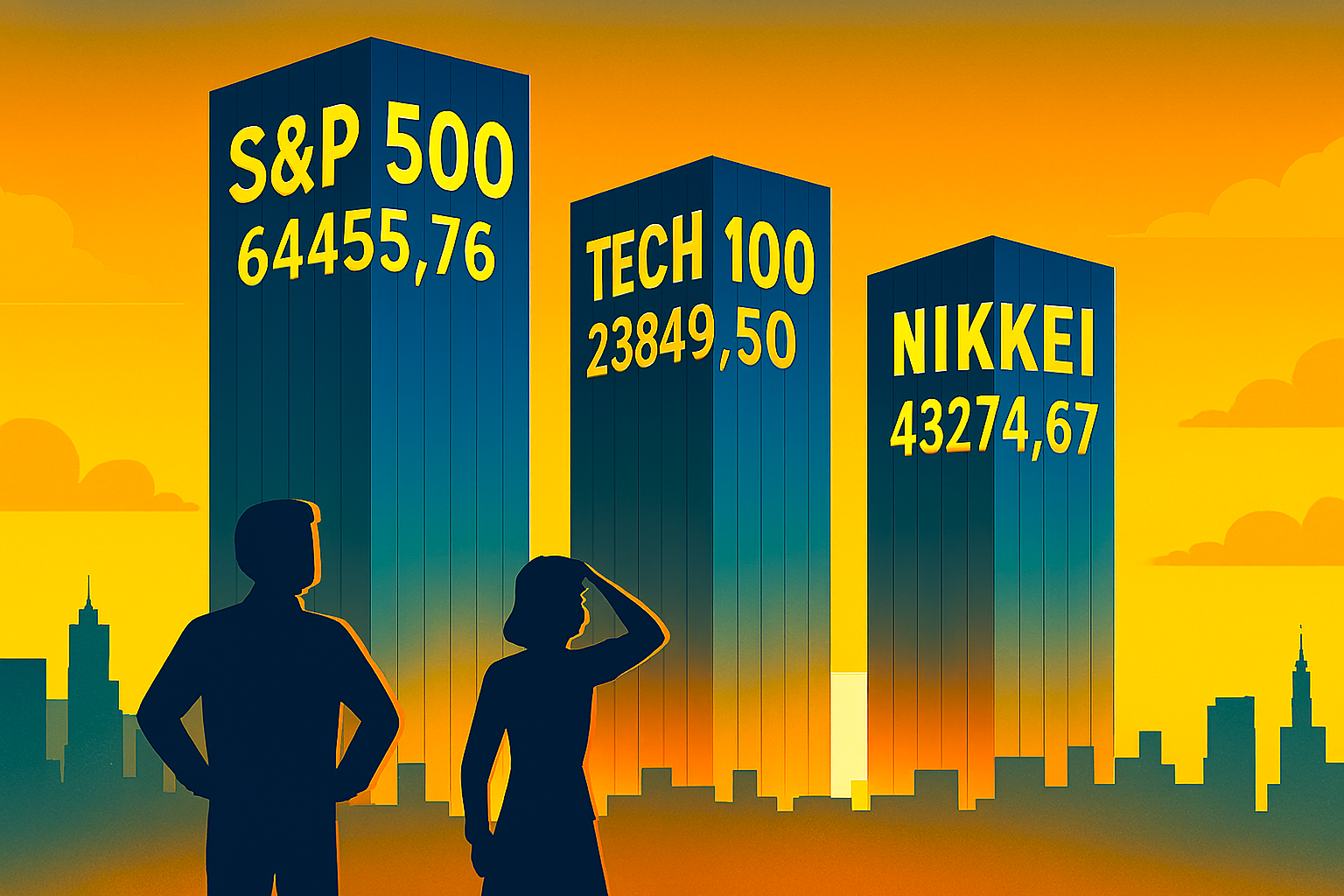
In a sweeping rally that spanned continents and sectors, major global indices surged to fresh record highs yesterday, buoyed by cooling inflation data,renewed hopes of U.S. central bank rate cuts, and easing trade tensions.
U.S. inflation figures released 12th August 2025 for July came in at: 2.7% – helping to lift markets to new record highs!
U.S. Consumer Price Index — July 2025
Metric
Value
Monthly CPI (seasonally adjusted)
+0.2%
Annual CPI (headline)
+2.7%
Core CPI (excl. food & energy)
+0.3% monthly, +3.1% annual
Despite concerns over Trump’s sweeping tariffs, the U.S. July 2025 CPI came in slightly below expectations (forecast was 2.8% annual).
Economists noted that while tariffs are beginning to show up in certain categories, their broader inflationary impact remains modest — for now.
Global Indices Surged to Record Highs Amid Rate Cut Optimism and Tariff Relief
Tuesday, 12 August 2025 — Taking Stock
📈 S&P 500: Breaks Above 6,400 for First Time
Closing Level: 6,427.02
Gain: +1.1%
Catalyst: Softer-than-expected U.S. CPI data (+2.7% YoY) boosted bets on a September rate cut, with 94% of traders now expecting easing.
Sector Drivers: Large-cap tech stocks led the charge, with Microsoft, Meta, and Nvidia all contributing to the rally.
💻 Nasdaq Composite & Nasdaq 100: Tech Titans Lead the Way
Nasdaq Composite: Closed at a record 21,457.48 (+1.55%)
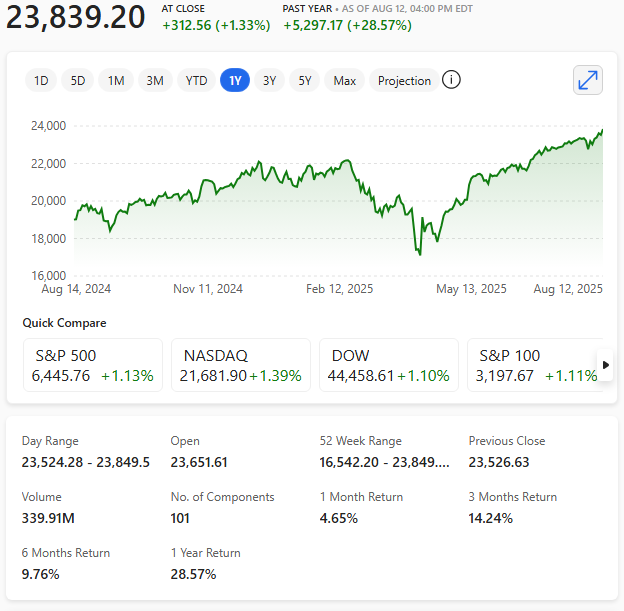
Nasdaq 100: Hit a new intraday high of 23,849.50, closing at 23,839.20 (+1.33%)
Highlights:
Apple surged 4.2% after announcing a $600 billion U.S. investment plan.
AI optimism continues to fuel gains across the Magnificent Seven stocks.
Nasdaq 100 chart 12th August 2025
Nasdaq 100 chart 12th August 2025
🧠 Tech 100 (US Tech Index): Momentum Builds
Latest High: 23,849.50
Weekly Gain: Nearly +3.7%
Outlook: Traders eye a breakout above 24,000, with institutional buying accelerating. Analysts note a 112% surge in net long positions since late June.
🇯🇵 Nikkei 225: Japan Joins the Record Club
Closing Level: 42,718.17 (+2.2%)
Intraday High: 43,309.62
Drivers:
Relief over U.S. tariff revisions and a 90-day pause on Chinese levies.
Strong earnings from chipmakers like Kioxia and Micron.
Speculation of expanded fiscal stimulus following Japan’s recent election results.
🧮 Market Sentiment Snapshot
Index
Record Level Reached
% Gain Yesterday
Key Driver
S&P 500
6,427.02
+1.1%
CPI data, rate cut bets
Nasdaq Comp.
21,457.48
+1.55%
AI optimism, Apple surge
Nasdaq 100
23,849.50
+1.33%
Tech earnings, institutional buying
Tech 100
23,849.50
+1.06%
Momentum, bullish sentiment
Nikkei 225
43,309.62
+2.2%
Tariff relief, chip rally
📊 Editorial Note: While the rally reflects strong investor confidence, analysts caution that several indices are approaching technical overbought levels.
The Nikkei’s RSI, for instance, has breached 75, often a precursor to short-term pullbacks.
President Donald Trump has announced a sweeping 100% tariff on imported semiconductors and microchips—unless companies are actively manufacturing in the United States.
The move, unveiled during an Oval Office event with Apple CEO Tim Cook, is aimed at turbocharging domestic production in a sector critical to everything from smartphones to defence systems.
Trump’s vow comes on the heels of Apple’s pledge to invest an additional $100 billion in U.S. operations over the next four years.
While the tariff exemption criteria remain vague, Trump emphasised that firms ‘committed to build in the United States’ would be spared the levy.
The announcement adds pressure to global chipmakers like Taiwan Semiconductor (TSMC), Nvidia, and GlobalFoundries, many of which have already initiated U.S. manufacturing projects.
According to the Semiconductor Industry Association, over 130 U.S.-based initiatives totalling $600 billion have been announced since 2020.
Critics warn the tariffs could disrupt global supply chains and raise costs for consumers, while supporters argue it’s a bold step toward tech sovereignty.
With AI, automotive, and defence sectors increasingly reliant on chips, the stakes couldn’t be higher.
Whether this tariff threat becomes a turning point or a trade war flashpoint remains to be seen.
Trump has a habit of unravelling as much as he ‘ravels’ – time will tell with this tariff too.
In a bold move reshaping the global AI landscape, Chinese startup Z.ai has launched GLM-4.5, an open-source model touted as cheaper, smaller, and more efficient than rivals like DeepSeek.
The announcement, made at the World Artificial Intelligence Conference in Shanghai, has sent ripples across the tech sector.
What sets GLM-4.5 apart is its lean architecture. Requiring just eight Nvidia H20 chips—custom-built to comply with U.S. export restrictions—it slashes operating costs dramatically.
By comparison, DeepSeek’s model demands nearly double the compute power, making GLM-4.5 a tantalising alternative for cost-conscious developers and enterprises.
But the savings don’t stop there. Z.ai revealed that it will charge just $0.11 per million input tokens and $0.28 per million output tokens. In contrast, DeepSeek R1 costs $0.14 for input and a hefty $2.19 for output, putting Z.ai firmly in the affordability lead.
Functionally, GLM-4.5 leverages ‘agentic’ AI—meaning it can deconstruct tasks into subtasks autonomously, delivering more accurate results with minimal human intervention.
This approach marks a shift from traditional logic-based models and promises smarter integration into coding, design, and editorial workflows.
Z.ai, formerly known as Zhipu, boasts an impressive funding roster including Alibaba, Tencent, and state-backed municipal tech funds.
With IPO ambitions on the horizon, its momentum mirrors China’s broader push to dominate the next wave of AI innovation.
While the U.S. has placed Z.ai on its entity list, stifling some Western partnerships, the firm insists it has adequate computing resources to scale.
As AI becomes a battleground for technological and geopolitical influence, GLM-4.5 may prove to be a powerful competitor.
China has reportedly voiced concerns about the security implications of Nvidia’s cutting-edge artificial intelligence chips, deepening the tech cold war between Beijing and Washington.
The caution follows increasing scrutiny of semiconductors used in defence, infrastructure, and digital surveillance systems—sectors where AI accelerators play an outsized role.
While no official ban has been announced, sources suggest that Chinese regulators are examining how Nvidia’s chips—known for powering generative AI and large language models—might pose risks to national data security.
At the core of the issue is a growing unease about foreign-designed hardware transmitting or processing sensitive domestic information, potentially exposing it to surveillance or manipulation.
In response, Chinese tech firms have been developing domestic alternatives, including chips from Huawei and Alibaba, though few match Nvidia’s sophistication or efficiency.
The situation highlights China’s larger strategy to reduce reliance on American technology, especially as AI becomes more integral to industrial automation, cyber defence, and public services.
It also underscores the dual-use dilemma of AI—where innovation in consumer tech can quickly scale into military applications.
While diplomatic channels remain frosty, the market implications are heating up. Nvidia’s shares dipped slightly on the news, and analysts predict renewed interest in sovereign chip initiatives across Asia.
For all the lofty aspirations of AI making the world smarter, it seems that suspicion—not cooperation—is the current driving force behind chip geopolitics.
As one observer quipped, ‘We built machines to think for us—now we’re worried they’re thinking too much, in all the wrong places’.
Nvidia reportedly denies there are any security concerns.
In a landmark moment for the tech industry, Microsoft has officially joined Nvidia in the exclusive $4 trillion market capitalisation club, following a surge in its share price after stellar Q4 earnings.
This accolade achieved on 31st July 2025 marks a dramatic shift in the hierarchy of global tech giants, with Microsoft briefly overtaking Nvidia to become the world’s most valuable company. But for how long?
The rally was fuelled by Microsoft’s aggressive investment in artificial intelligence and cloud infrastructure. Azure, its cloud platform, posted a 39% year-on-year revenue increase, surpassing $75 billion in annual sales.
The company’s Copilot AI tools, now boasting over 100 million monthly active users, have become central to its strategy, embedding generative AI across productivity software, development platforms, and enterprise services.
Microsoft’s transformation from a traditional software provider to an AI-first powerhouse has been swift and strategic. Its partnerships with OpenAI, Meta, and xAI, combined with over $100 billion in planned capital expenditure, signal a long-term commitment to shaping the future of AI utility.
While Nvidia dominates the hardware side of the AI revolution, Microsoft is staking its claim as the platform through which AI is experienced.
This milestone not only redefines Microsoft’s legacy—it redraws the map of pure tech power and reach the company has around the world.
This has been earned over decades of business commitment.
The U.S. stock market surged into July 2025 with a wave of optimism, as the S&P 500 and Nasdaq 100 both hit fresh all-time highs, while the Dow Jones Industrial Average continued its upward climb.
The S&P 500 closed at 6279, marking its fourth record close in five sessions, and the Nasdaq 100 soared to 22867, fueled by strength in AI and semiconductor stocks.
S&P 500 YTD chart
Nasdaq 100 YTD chart
Driving the rally was a stronger-than-expected June 2025 jobs report, which revealed 147,000 new positions added and an unemployment rate dipping to 4.1%.
This labour market resilience tempered expectations for a near-term Federal Reserve rate cut, but bolstered investor confidence in the economy’s momentum.
Tech giants like Nvidia and Microsoft led the charge, with Nvidia nearing a $4 trillion market cap amid surging demand for AI infrastructure.
Datadog spiked after being added to the S&P 500, and financials like JPMorgan Chase and Goldman Sachs hit lifetime highs.
The Dow, while slightly trailing its tech-heavy peers, posted steady gains and now hovers near its own record territory.
With trade optimism rising and President Trump’s tax-and-spending bill passed, Wall Street enters the holiday weekend riding a wave of bullish sentiment.
As U.S. equity markets continue their relentless climb, a growing number of stocks are flashing warning signs through one of the most widely followed technical indicators: the Relative Strength Index (RSI).
Designed to measure momentum, RSI values above 70 typically indicate that a stock is overbought and may be due for a pullback.
As of early July 2025, several high-profile U.S. companies have RSI readings well above this threshold, suggesting that investor enthusiasm may be outpacing fundamentals.
🔍 What Is RSI?
The RSI is a momentum oscillator that ranges from 0 to 100. Readings above 70 suggest a stock is overbought, while readings below 30 indicate it may be oversold. While not a crystal ball, RSI is a useful tool for identifying potential reversals or pauses in price trends.
🚨 Top 5 Overbought U.S. Stocks (as of 1st July 2025)
These companies have benefited from the ongoing AI and biotech booms, with Nvidia and AMD riding the wave of demand for next-gen chips, while Alnylam and Circle Internet Group have surged on strong earnings and innovation in their respective sectors.
📊 RSI Snapshot: Top 10 U.S. Stocks by RSI
Rank
Company
Ticker
RSI
Sector
1
Nvidia
NVDA
84.3
Semiconductors
2
Super Micro Computer
SMCI
82.7
Hardware
3
AMD
AMD
80.1
Semiconductors
4
Alnylam Pharmaceuticals
ALNY
78.9
Biotech
5
Circle Internet Group
CIRC
77.5
Internet Services
6
Mereo BioPharma Group
MPH
76.4
Biotech
7
AVITA Medical
AVH
75.2
Healthcare
8
Microsoft
MSFT
74.8
Software
9
Lumentum Holdings
LITE
73.6
Optical Tech
10
Workiva
WK
72.9
Cloud Software
📌 What This Means for Investors
While high RSI doesn’t guarantee a drop, it does suggest caution. Stocks like Nvidia and Super Micro may continue to rise in the short term, but their elevated RSI levels imply that momentum could stall or reverse if sentiment shifts or earnings disappoint.
Investors should consider pairing RSI with other indicators – such as MACD, volume trends, and earnings outlooks – before making decisions.
For long-term holders, these signals may simply be noise. But for traders, they’re a flashing yellow light.
In a remarkable show of investor confidence, the S&P 500 and Nasdaq Composite both reached new all-time highs on 30th June 2025.
The markets were buoyed by optimism around easing inflation, resilient corporate earnings, and renewed enthusiasm for the tech sector, especially AI.
The S&P 500 climbed to a record close of 6205, while the Nasdaq soared 1.2% to finish at 22679 marking its fourth consecutive record-breaking session.
S&P 3-month chart
S&P 3 month chart
Traders pointed to stronger-than-expected economic data and dovish commentary from the Federal Reserve as catalysts that reignited appetite for risk.
Tech giants led the charge, with chipmakers and AI-related firms once again at the forefront.
Nvidia, now the world’s most valuable publicly traded company, gained over 2%, while Apple, Microsoft, and Alphabet also notched solid gains.
The technology-heavy Nasdaq has been particularly responsive to momentum in artificial intelligence and next-generation computing, driving its meteoric rise in recent months.
Nasdaq 100 3-month chart
Nasdaq 100 3-month chart
From April 2025 Trump tariff melt-down to new highs in June 2025
Beyond tech, sectors such as consumer discretionary and industrials also saw modest gains, suggesting a broadening of the rally.
Analysts now debate whether this marks the beginning of a sustainable expansion or a potential overheating of equities.
Meanwhile, Treasury yields held steady, and oil prices ticked higher, signalling confidence in continued global demand.
With earnings season on the horizon, market watchers are closely monitoring corporate guidance to gauge whether valuations can justify further upside.
For now, though, the bulls are clearly in control – and Wall Street is basking in green.
Nvidia has once again claimed the title of the world’s most valuable publicly traded company, overtaking Microsoft with a staggering market capitalisation of $3.76 trillion.
This milestone follows a 4% surge in Nvidia’s share price, closing at an all-time high of $154.10.
The rally was fuelled by renewed investor enthusiasm for artificial intelligence. Analysts citing it as a ‘Golden Wave’ of generative AI adoption driving demand for Nvidia’s high-performance chips.
The company’s meteoric rise has been underpinned by its dominance in AI hardware, particularly its GPUs, which power everything from ChatGPT to enterprise-scale AI models.
Since bottoming out in early April 2025, Nvidia’s stock has soared more than 60%, far outpacing the broader tech market.
Founded in 1993 to produce graphics chips for gaming, Nvidia has transformed into the backbone of the AI revolution. Its accelerators are now essential infrastructure for companies like Microsoft, Meta, and Google.
Nvidia share price as of 25th June 2025 – a 3 month snapshot
Nvidia share price as of 25th June 2025 – a 3 month snapshot
Despite its rapid ascent, Nvidia’s valuation remains relatively modest compared to historical norms, trading at around 30 times projected earnings.
As the AI arms race intensifies, Nvidia’s position at the summit of global markets underscores the growing importance of its power in shaping the digital future.
AMD has officially lifted the curtain on its next-generation AI chip, the Instinct MI400, marking a significant escalation in the battle for data centre dominance.
Set to launch in 2026, the MI400 is designed to power hyperscale AI workloads with unprecedented efficiency and performance.
Sam Altman and OpenAI have played a surprisingly hands-on role in AMD’s development of the Instinct MI400 series.
Altman appeared on stage with AMD CEO Lisa Su at the company’s ‘Advancing AI’ event, where he revealed that OpenAI had provided direct feedback during the chip’s design process.
Altman described his initial reaction to the MI400 specs as ‘totally crazy’ but expressed excitement at how close AMD has come to delivering on its ambitious goals.
He praised the MI400’s architecture – particularly its memory design – as being well-suited for both inference and training tasks.
OpenAI has already been using AMD’s MI300X chips for some workloads and is expected to adopt the MI400 series when it launches in 2026.
This collaboration is part of a broader trend: OpenAI, traditionally reliant on Nvidia GPUs via Microsoft Azure, is now diversifying its compute stack.
AMD’s open standards and cost-effective performance are clearly appealing, especially as OpenAI also explores its own chip development efforts with Broadcom.
AMD’s one-year chart snap-shot
One-year AMD chart snap-shot
So, while OpenAI isn’t ditching Nvidia entirely, its involvement with AMD signals a strategic shift—and a vote of confidence in AMD’s growing role in the AI hardware ecosystem.
At the heart of AMD’s strategy is the Helios rack-scale system, a unified architecture that allows thousands of MI400 chips to function as a single, massive compute engine.
This approach is tailored for the growing demands of large language models and generative AI, where inference speed and energy efficiency are paramount.
AMD technical power
The MI400 boasts a staggering 432GB of next-generation HBM4 memory and a bandwidth of 19.6TB/sec—more than double that of its predecessor.
With up to four Accelerated Compute Dies (XCDs) and enhanced interconnects, the chip delivers 40 PFLOPs of FP4 performance, positioning it as a formidable rival to Nvidia’s Rubin R100 GPU.
AMD’s open-source networking technology, UALink, replaces Nvidia’s proprietary NVLink, reinforcing the company’s commitment to open standards. This, combined with aggressive pricing and lower power consumption, gives AMD a compelling value proposition.
The company claims its chips can deliver 40% more AI tokens per dollar than Nvidia’s offerings.
Big tech follows AMD
OpenAI, Meta, Microsoft, and Oracle are among the major players already integrating AMD’s Instinct chips into their infrastructure. OpenAI CEO Sam Altman, speaking at the launch event reportedly praised the MI400’s capabilities, calling it ‘an amazing thing‘.
With the AI chip market projected to exceed $500 billion by 2028, AMD’s MI400 is more than just a product—it’s a statement of intent. As the race for AI supremacy intensifies, AMD is betting big on performance, openness, and affordability to carve out a larger share of the future.
It certainly looks like AMD is positioning the Instinct MI400 as a serious contender in the AI accelerator space – and Nvidia will be watching closely.
The MI400 doesn’t just aim to catch up; it’s designed to challenge Nvidia head-on with bold architectural shifts and aggressive performance-per-dollar metrics.
Nvidia has long held the upper hand with its CUDA software ecosystem and dominant market share, especially with the popularity of its H100 and the upcoming Rubin GPU. But AMD is playing the long game.
Nvidia 0ne-year chart snapshot
Nvidia 0ne-year chart snapshot
By offering open standards like UALink and boasting impressive specs like 432GB of HBM4 memory and 40 PFLOPs of FP4 performance, the MI400 is pushing into territory that was once Nvidia’s alone.
Whether it truly rivals Nvidia will depend on a few key factors: industry adoption, software compatibility, real-world performance under AI workloads, and AMD’s ability to scale production and support.
But with major players like OpenAI, Microsoft, and Meta already lining up to adopt the MI400.
At London Tech Week, Nvidia CEO Jensen Huang made a striking statement: “The way you program an AI is like the way you program a person.” (Do we really program people or do we teach)?
This marks a fundamental shift in how we interact with artificialintelligence, moving away from traditional coding languages and towards natural human communication.
Historically, programming required specialised knowledge of languages like C++ or Python. Developers had to meticulously craft instructions for computers to follow.
Huang argues that AI has now evolved to understand and respond to human language, making programming more intuitive and accessible.
This transformation is largely driven by advancements in conversational AI models, such as ChatGPT, Gemini, and Copilot.
These systems allow users to issue commands in plain English – whether asking an AI to generate images, write a poem, or even create software code. Instead of writing complex algorithms, users can simply ask nicely, much like instructing a colleague or student.
Huang’s analogy extends beyond convenience. Just as people learn through feedback and iteration, AI models refine their responses based on user input.
If an AI-generated poem isn’t quite right, users can prompt it to improve, and it will think and adjust accordingly.
This iterative process mirrors human learning, where guidance and refinement lead to better outcomes.
The implications of this shift are profound. AI is no longer just a tool for experts – it is a great equalizer, enabling anyone to harness computing power without technical expertise.
As businesses integrate AI into their workflows, employees will need to adapt, treating AI as a collaborative partner rather than a mere machine.
This evolution in AI programming is not just about efficiency; it represents a new era where technology aligns more closely with human thought and interaction.
Saudi Arabia is making bold moves in artificial intelligence with a major acquisition from Nvidia.
The tech giant will be sending more than 18,000 of its latest GB300 Blackwell AI chips to Saudi-based company Humain, in a deal that marks a significant step toward the nation’s ambitions to become a global AI powerhouse.
The announcement was made by Nvidia CEO Jensen Huang during the Saudi-U.S. Investment Forum in Riyadh, as part of a White House-led trip that included President Donald Trump and other top CEOs.
Humain, backed by Saudi Arabia’s Public Investment Fund, plans to use the chips to develop large-scale AI models and establish cutting-edge data centers.
The chips will be deployed in a 500-megawatt facility, making it one of the largest AI computing projects in the region. Nvidia’s Blackwell AI chips are among the most advanced in the industry, used in training sophisticated AI models and powering data-intensive applications.
Saudi Arabia’s investment in AI technology aligns with its long-term vision of transforming its economy beyond traditional industries. With plans to expand its data infrastructure and deploy several hundred thousand Nvidia GPUs in the future, the country is positioning itself as a major AI hub in the Middle East.
As AI continues to shape global industries, Saudi Arabia’s investment signals a broader shift in how nations are competing for dominance in the AI revolution.
Nvidia’s involvement underscores the strategic importance of AI chips, not just in business, but in international relations as well.
The stock market experienced another sharp Trump tariff related downturn Wednesday 16th April 2025, driven by a tech-heavy sell-off continuing to rattle investors.
The Nasdaq Composite plunged by 3%, while the Dow Jones Industrial Average shed nearly 700 points, marking one of the most significant declines in recent months.
Concerns over tariffs and inflation were amplified by Federal Reserve Chair Jerome Powell’s remarks about the tariff uncertainty, which highlighted the challenging economic landscape.
Tech stocks bore the brunt of the sell-off, with semiconductor companies like Nvidia and AMD leading the decline. Nvidia’s announcement of a $5.5 billion quarterly charge related to export restrictions on its chips to China added to the sector’s woes.
Powell’s comments on tariffs exacerbated market fears, as he warned of potential stagflation—a scenario where inflation rises while economic growth slows.
This sentiment was echoed across trading floors, with investors grappling with the implications of ongoing trade tensions and restrictive policies.
As the market inches closer to bear territory, the focus remains on navigating these turbulent times.
The sell-off underscores the fragility of investor confidence and the pivotal role of technology in shaping market dynamics
On Monday 14th April 2025, the stock market experienced a notable mini rally, driven by the tech sector’s resurgence following a weekend announcement of a temporary tariff pause.
Major tech companies like Apple, Nvidia, and Amazon saw significant gains, with Apple shares surging by 7.5%. The Nasdaq Composite, heavily weighted with tech stocks, climbed 1.9%, while the S&P 500 rose 1.5%.
This rally marked a stark contrast to the volatility of the previous week, where tariff uncertainties had sent shockwaves through the market.
The tariff pause, although temporary and restricted to 20%, helped to alleviate immediate concerns about rising costs for consumers and businesses.
Importers were spared from choosing between absorbing higher expenses or passing them on to customers. This relief was particularly impactful for companies reliant on Chinese manufacturing, as the exemptions covered a wide range of tech products.
Market analysts noted that the rally was not just a reaction to the tariff news but also a reflection of the tech sector’s resilience.
Despite facing challenges earlier in the year, tech companies have continued to innovate and adapt, maintaining their position as a driving force in the U.S. and world economies.
However, the rally’s sustainability remains uncertain. The administration’s mixed messages about future tariffs have left investors cautious.
While Monday’s gains were encouraging, the broader market continues to grapple with the unpredictability of trade policies.
The stock market was smashed for a second day Friday 4th April 2025 after China retaliated with new tariffs on U.S. goods, sparking fears President Donald Trump has ignited a global trade war that will lead to a global recession.
Stock market damage
The Dow Jones Industrial Average dropped 2,231.07 points, or 5.5%, to 38,314.86 on Friday 4th April 2025, the biggest decline since June 2020 during the Covid-19 pandemic.
This follows a 1,679-point decline on Thursday 3rd April 2025 and marks the first time ever that it has shed more than 1,500 points on consecutive days.
The S&P 500 collapsed 5.97% to 5,074.08, the biggest decline since March 2020. The benchmark shed 4.84% on Thursday 3rd April 2025 and is now down more than 17% off its recent high.
The Nasdaq Composite, home to many well-known tech companies that sell to China and manufacture there as well, dropped 5.8%, to 15,587.79.
This follows a nearly 6% drop on Thursday 3rd April 2025 and takes the index down by 22% from its December 2024 record – pushing it into a bear market.
The selling was wide ranging with only 14 members of the S&P 500 higher on the day. Major market indexes closed at their lows of the session.
China’s commerce ministry said the country will impose a 34% levy on all U.S. products, disappointing investors who had hoped countries would negotiate with Trump before retaliating.
Technology stocks led the massive rout Friday
Apple shares slumped 7%, bringing its loss for the week to 13%.
Nvidia dropped 7% during the session.
Tesla fell 10%.
All three companies have large exposure to China and are among the hardest hit from Beijing’s retaliatory tariffs.
The bull market is dead, and it was destroyed by self-inflicted wounds!
Stocks sold off sharply on Friday 28th March 2025, pressured by growing uncertainty on U.S. trade policy as well as a grim outlook on inflation
The Dow Jones Industrial Average closed down 715 points at 41,583. The S&P 500 lost 1.97% to close 5,580 ending the week down for the fifth time in the last six weeks. The Nasdaq Composite plunged 2.7% to 17,322.
Shares of several technology giants also fell putting pressure on the broader market. Google-parent Alphabet lost 4.9%, while Meta and Amazon each shed 4.3%.
This week, the S&P 500 lost 1.53%, while the 30-stock Dow shed 0.96%. The Nasdaq declined by 2.59%. With this latest losing week, Nasdaq is now on pace for a more than 8% monthly decline, which would be its worst monthly performance since December 2022.
Dow Jones one-day chart (28th March 2025)
Dow Jones one-day chart (28th March 2025)
Stocks took a leg lower on Friday after the University of Michigan’s final read on consumer sentiment for March 2025 reflected the highest long-term inflation expectation since 1993.
Friday’s core personal consumption expenditures price index also came in hotter-than-expected, rising 2.8% in February and reflecting a 0.4% increase for the month, stoking concerns about persistent inflation.
Economists had reportedly been looking for respective numbers of 2.7% and 0.3%. Consumer spending accelerated 0.4% for the month, below the 0.5% forecast, according to fresh data from the Bureau of Economic Analysis.
The market is getting squeezed by both sides. There is uncertainty about reciprocal tariffs hitting the major exporting sectors like tech alongside concerns about a weakening consumer facing higher prices
Trump’s tariffs push will hit the U.S. harder than Europe in the short term, it has been reported.
Japan’s Nikkei enters correction as Trump’s tariff assault drives sell-off in Asia markets
U.S. tech giants are making bold strides in the development of humanoid robots, signalling a transformative shift in the robotics industry
Companies like Tesla, Google, Microsoft, and Nvidia are investing heavily in this cutting-edge technology, aiming to create machines that mimic human movement and behaviour.
These humanoid robots are envisioned to revolutionise industries ranging from manufacturing to healthcare, offering solutions to labor shortages and enhancing productivity.
Tesla’s Optimus project is a prime example of this ambition. CEO Elon Musk has announced plans to produce thousands of these robots, designed to perform repetitive and physically demanding tasks.
Optimus robots are expected to integrate seamlessly into factory settings, reducing the need for human intervention in hazardous environments.
Similarly, Boston Dynamics, known for its agile robots, continues to push the boundaries of what humanoid machines can achieve, focusing on tasks that require precision and adaptability.
The integration of artificial intelligence (AI) is a driving force behind these advancements. AI enables robots to learn from their environments, adapt to new tasks, and interact with humans in more intuitive ways.
Companies like Nvidia are leveraging their expertise in AI and machine learning are helping to develop robots capable of complex decision-making and problem-solving.
However, challenges remain. High production costs, limited battery life, and safety concerns are significant hurdles that need to be addressed before humanoid robots can achieve widespread adoption.
Despite these obstacles, the potential benefits are immense. From assisting the elderly to performing intricate surgeries, humanoid robots could redefine the boundaries of human capability.
As U.S. tech giants continue to innovate, the race to dominate the humanoid robotics market intensifies.
Tesla Optimus Gen 2
With China and other nations also making significant investments, the competition is fierce. Analysts warn that U.S. firms could lose out to China, which aims to replicate its success with electric vehicles in the robotics space race.
The future of humanoid robots promises to be a fascinating blend of technology, creativity, and global collaboration
U.S. companies that may benefit from this AI humanoid tech advancement
Tesla: Known for its Optimus humanoid robot project, Tesla is pushing boundaries in robotics and AI.
Google (Alphabet): A leader in AI and robotics research, with projects aimed at enhancing humanoid capabilities.
Microsoft: Investing in AI technologies that support robotics and automation.
Nvidia: Provides advanced AI chips and systems crucial for humanoid robot development.
Boston Dynamics: Famous for its agile robots like Atlas, focusing on precision and adaptability.
Agility Robotics: Creator of Digit, a humanoid robot designed for logistics and manufacturing.
Meta (Facebook): Exploring humanoid robots for social and interactive applications.
Apple: Investing in robotics and AI for potential humanoid advancements.
Amazon: Developing robots like Astro for home monitoring and other tasks.
Figure AI: Innovating humanoid robots like Figure 02 for various industries.
Bill Gates on AI
Bill Gates has shared some fascinating insights about AI recently. He reportedly believes that within the next decade, AI will transform many industries, making specialised knowledge widely accessible.
For example, he predicts that AI could provide high-quality medical advice and tutoring, addressing global shortages of doctors and educators.
Gates has also described this shift as the ‘age of free intelligence,’ where AI becomes a commonplace tool integrated into everyday life. While he acknowledges the immense potential of AI to solve global challenges – like developing breakthrough treatments for diseases and innovative solutions for climate change – he also recognises the disruptive impact it could have on jobs and the workforce.
Despite these concerns, Gates remains optimistic about AI’s ability to drive innovation and improve lives.
He has emphasised that certain human activities, like playing sports or hosting talk shows, will likely remain uniquely human.
However, despite all these predictions from powerful tech leaders – it does beg the question, do these ultra rich CEOs predict the future, or simply make it?
What if Quantum Physics coincides and collides with the ‘full’ arrival of AI and humanoid robots
Quantum computing could enhance the capabilities of AI-powered robots by solving complex optimisation problems, improving machine learning algorithms, and enabling real-time decision-making.
For instance, robots equipped with quantum sensors could navigate intricate environments, detect subtle changes in their surroundings, and interact with humans in more intuitive ways.
This fusion could revolutionise industries such as healthcare, manufacturing, and space exploration. Imagine humanoid robots performing intricate surgeries with precision, managing large-scale logistics, or exploring distant planets with advanced problem-solving abilities.
However, this convergence also raises ethical and societal questions. The potential for such powerful technologies to disrupt industries, impact employment, and challenge privacy norms must be carefully managed.
Collaboration between scientists, policymakers, and ethicists will be crucial to ensure these advancements benefit humanity as a whole.
The intersection of quantum physics, AI, and humanoid robotics is not just a technological milestone – it’s a glimpse into a future where the boundaries of human capability and machine intelligence blur.
It’s an exciting, albeit complex future humans are creating.
But will AI surpass human intelligence – and if it does what then for the human civilisation?
Chinese tech giant Baidu has released two new free-to-use artificial intelligence models as it vies to regain its leading position in the country’s fiercely competitive AI space
The Baidu models launched on Sunday 16th March 2025 included the company’s first reasoning-focused model and come ahead of plans to move towards an open-source strategy.
However, analysts reportedly said that while the release of the models is a positive development for Baidu, they also highlight how it is playing catch up as its Ernie bot – one of China’s earliest versions of a ChatGPT-like chatbot – struggles to gain widespread adoption.
‘The new models make Baidu more competitive since the company has been lagging behind in a reasoning model release’, one expert is reported as saying.
A reasoning model is a large language model that breaks down tasks into smaller pieces and considers multiple approaches before generating a response. It is designed to process complex problems in a similar way to humans.
Chinese startup DeepSeek upended the global AI race and transformed China’s ecosystem in January when it released its R1 reasoning model, which rivalled American competitors despite costing a fraction of the price.
Nvidia recently reported its Q4 results, showcasing impressive growth driven by strong demand for AI technology.
The company achieved a record quarterly revenue of $39.3 billion, marking a 78% increase from the previous year.
This growth was primarily fuelled by the success of Nvidia’s Blackwell AI supercomputers, which saw billions of dollars in sales in their first quarter.
The data centre segment, which constitutes the bulk of Nvidia’s revenue, also performed exceptionally well, generating $35.60 billion, up 16% from the previous quarter. Nvidia’s adjusted earnings per share for Q4 were $0.89, surpassing analysts’ expectations of $0.84.
Looking ahead, Nvidia provided strong guidance for Q1, forecasting revenue of $43 billion, which exceeds market expectations of $42.05 billion. The company also projected a gross margin of 70.60% for the upcoming quarter.
The first-quarter forecast indicates a year-over-year growth of approximately 65%, a deceleration from the 262% annual growth recorded in the same period the previous year.
Nvidia’s CEO, Jensen Huang reportedly highlighted the rapid advancements in AI technology and the company’s successful ramp-up of Blackwell AI supercomputers as key drivers of this growth.
Despite facing competition from Chinese AI firms like DeepSeek, Nvidia remains optimistic about the demand for its AI chips.
The company’s robust performance and positive outlook signal continued growth and innovation in the AI sector.
DeepSeek’s impact probably isn’t yet fully reflected in U.S. stocks
The ramifications of the Chinese startup DeepSeek, with its promise of delivering cheaper and more energy-efficient alternatives to harness artificial intelligence (AI), have yet to be fully reflected in U.S. equities.
If DeepSeek ends up delivering a less costly way forward – it will make it much easier and cheaper for smaller more typical companies to create AI ‘agents’ or AI opportunities for their businesses.
Under this scenario there will be ‘useful’ and meaningful benefits from DeepSeek that could bring huge earnings potential for a broader mix of companies beyond the current AI heavyweights through greater efficiencies and productivity from less-expensive AI solutions.
It also put huge sums being pledged for AI infrastructure by U.S. mega cap tech companies under a microscope. Rather than back down, the U.S. spending race has intensified.
Meta’s Chief Executive Mark Zuckerberg spoke a week ago of spending ‘hundreds of billions of dollars’ on AI infrastructure in the coming years, after pledging $60 billion to $65 billion on AI this year.
Alphabet announced AI investment for 2025, a bigger figure than Wall Street was anticipating.
Google forecast $75 billion in capital expenditures in 2025, a bigger figure than Wall Street was anticipating.
Microsoft reported its cloud and AI spending grew 95% in its fiscal second quarter to $22.6 billion.
Amazon has reported big AI investment too.
The spending frenzy on anything AI sends the market into a spin. How much more has to be spent before we see capital expenditures reduced or decrease is anyone’s guess right now – but current levels of AI expenditure are high, and returns will be expected.
“When is enough, enough?”
Or more to the point you might ask – when is ‘enough’ too much?
Fresh AI-spending commitments helped lift shares of Nvidia on while we saw a slump for Tesla shares in the week.
China this week saw the U.S. slap new 10% tariffs, while Canada and Mexico saw Trump threaten but delay 25% tariffs by 30 days. China retaliated in kind.
Catching up with the ‘Magnificent Seven’
Despite the high scrutiny on AI stocks, there is also much renewed focus from investors on other areas of the market.
There has been a bit of a rotation – while tech has been under pressure, defensive and rate-sensitive parts of the market have been gaining. This seems to be an emerging pattern.
But there should be reason for caution. For one thing, the growth rate of ‘Magnificent Seven’ earnings has been tailing off in recent quarters, especially since the group reached a 61% yearly rate in the fourth quarter of 2023 – the spend on AI investment has yet to fully appreciate the full return.
Forward analysts’ expectations have this percentage reportedly closer to 16% to 18% for the end of this year.
But that also would move the group closer to the roughly 12% to 13% yearly growth rate expected for the rest of the companies in the S&P 500 index, potentially making the high valuations of the ‘Magnificent Seven’ tougher to justify.
One of the most surprising things of the past couple of weeks, given the news around DeepSeek and shocks on the trade front, is the fact that stocks were still close to their all-time highs.
The market is pretty resilient right now, but tech stocks are sitting at a very high valuation – a pullback is due, even a correction (in my opinion).
The arrival of DeepSeek creates an alternative ‘cheaper’ AI option and that will unravel the status quo.
Single-stock ETFs betting heavily on Nvidia’s blistering rally plunged, tracking losses in the AI chip makers shares, calling into question the reliability of the leveraged investment strategy.
The GraniteShares 2x Long NVDA Daily ETF (NVDL) fell nearly 34% overnight. The Direxion Daily NVDA Bull 2x Shares ETF (NVDU) and T-Rex 2X Long Nvidia Daily Target ETF (NVDX) plunged 33.8% and 33.77% respectively. All three funds reported their largest loss in a single day, according to data from FactSet.
Conversely, funds betting against Nvidia like the GraniteShares 2x Short NVDA Daily ETF (NVDL) rose more than 33%.
This sell-off has been a difficult lesson for investors who have seen Nvidia as invincible and have taken aggressive bets on its growth without understanding the risks of single stock ETFs.
The funds were designed to deliver twice the performance of Nvidia on a single-day basis.
It could be a matter of time before some of them implode depending on the intensity of market movements of individual stocks.
Single stock ETFs come with a huge risk and huge upside – we just witnessed the downside.
It’s so volatile – a day after the fall Nvidia regained some 9% of its one-day loss. Remarkable loss, exceptional recovery too?
U.S. technology stocks plunged as Chinese startup DeepSeek sparked concerns over competitiveness in AI and America’s lead in the sector, triggering a global sell-off
DeepSeek launched a free, open-source large-language model in late December 2024, claiming it was developed in just two months at a cost of under $6 million.
The developments have stoked concerns about the large amounts of money big tech companies have been investing in AI models and data centres.
DeepSeek is a Chinese artificial intelligence startup that has recently gained significant attention in the AI world. Founded in 2023 by Liang Wenfeng, DeepSeek develops open-source large language models. The company is funded by High-Flyer, a hedge fund also founded by Wenfeng.
The AI models from DeepSeek have demonstrated impressive performance, rivaling some of the best chatbots in the world at a fraction of the cost. This has caused quite a stir in the tech industry, leading to significant drops in the stock prices of major AI-related firms.
The company’s latest model, DeepSeek-V3, is known for its efficiency and high performance across various benchmarks.
DeepSeek’s emergence challenges the notion that massive capital expenditure is necessary to achieve top-tier AI performance.
The company’s success has led to a re-evaluation of the AI market and has put pressure on other tech giants to innovate and reduce costs.
Stocks rose on Wednesday 22nd January 2024 with the S&P 500 reaching a new all-time high, as technology shares including Nvidia and Oracle surged on optimism surrounding artificial intelligence and President Donald Trump’s new term in office.
The S&P 500 advanced after hitting an intraday record of 6,100.81, exceeding the last milestone touched in December 2024 before pulling back. The index closed at 6,086.37, slightly below its all-time closing high.
S&P 500 one-month chart as of Wednesday 22nd January 2024
S&P 500 one-month chart as of Wednesday 22nd January 2024
The S&P’s move to an all-time high comes as investors witnessed a December 2024 pullback. Despite the index ending last year with a 23% gain, the S&P 500 shed 2.5% in December 2024, as traders fretted that the Federal Reserve wouldn’t be able to cut rates as much as anticipated.
That lacklustre performance bled into the first few trading sessions of 2025, but some data indicating modest easing on the inflation front and good earnings results have helped the market recover.
Nvidia is pushing the boundaries of AI technology with its new mini-AI computer, Project DIGITS, recently unveiled at CES 2025
Priced at $3,000, this mini powerhouse aims to bring cutting-edge AI capabilities to individual desks, making it accessible for AI researchers, data scientists, and students who need to develop and test AI models locally.
At the heart of Project DIGITS is Nvidia’s GB10 Grace Blackwell Superchip, a remarkable component that promises up to 1 petaflop of AI performance. This level of computational power enables the mini-AI computer to run large AI models with up to 200 billion parameters, making it suitable for some of the most complex AI tasks.
The computer features 128GB of unified DDR5X memory and up to 4TB of NVMe storage, ensuring that users have ample space and speed to handle data-intensive applications. This combination of memory and storage is particularly beneficial for those who work with large datasets or need to run multiple AI experiments simultaneously.
One of the standout feature of Project DIGITS is its focus on local AI development. By providing a powerful AI platform that doesn’t rely on cloud infrastructure, Nvidia is addressing the needs of developers who require immediate, on-demand AI capabilities. This local approach not only offers faster performance but also enhances data privacy and security, as sensitive data doesn’t need to be transmitted over the internet.
Nvidia’s Project DIGITS is set to be available from Nvidia and its manufacturing partners starting in May 2025. With its impressive specifications and focus on local AI development, this mini-AI supercomputer is poised to become an essential tool for those looking to innovate and iterate on AI projects. Whether you’re an AI enthusiast, a seasoned data scientist, or a curious student, Project DIGITS promises to bring powerful AI capabilities directly to your workspace.
Howard Marks, a widely respected value investor and co-founder of Oaktree Capital Management, recently issued a memo highlighting several cautionary signs of a potential bubble in the stock market.
Marks, who famously foresaw the dot-com bubble, pointed out that today’s high market valuations could lead to poor returns over the long term or even sharp declines in the near term.
Marks reportedly noted that the S&P 500’s current price-to-earnings (P/E) ratio is around 22, which is near the top of the historical range. He explained that higher P/E ratios have historically led to lower returns in the long run.
Marks also expressed concern about the enthusiasm surrounding new technologies like AI, which has driven up the prices of companies like Nvidia.
Marks emphasized that investors should not be indifferent to today’s market valuations and should be cautious about the potential for a market correction.
He also raised questions about the role of automated buying from passive investors and the presumption that the largest companies will always succeed.
The S&P 500 index witnessed big gains right from the start of 2024. In the first quarter of the year, it jumped up 10.20%. That’s around more than 10 times its average gain since 2000.
However, the momentum couldn’t be sustained as the S&P added 3.9% and 5.5% in the second and third quarter of 2024. In any other year, investors might not have been disappointed with those figures. But the index’s first-quarter performance set expectations so high that subsequent quarters seemed to pale in comparison.
In the final quarter of 2024, the S&P limped to a gain of just 1.9%. Making things worse, we did not get a 2024 Santa rally.
Of course, a gain is a good. But it’s hard not to e just a little disappointed when looking back at the highs we enjoyed in early 2024.
That said, a relatively weak end to the year wasn’t enough to dent the gains of the S&P 500 in the early part of 2024, where the index surged 23.30%. The index recorded no fewer than 57 record closes and this on the back of a 24.2% rise in 2023.
Big tech and Artificial intelligence stocks (the Magnificent Seven in particular) were behind much of 2024′s gains. Shares of Nvidia were up by around 171%, while Broadcom jumped 108%. To place this in context – the Magnificent 7’ stocks were responsible for more than half the S&P 500′s 2024 gain. It does beg the question – is the initial AI hype over for now or is there more to come? Has AI settled for the moment?
Uncertainties await the markets in 2025. Investors will have to contend with the incoming Trump administration’s policies, possibly higher-than-expected interest rates for the year, which in turn are keeping Treasury yields elevated, among other headwinds.