Why Global Stocks Are Hitting Records Despite an Uncertain Middle East Backdrop

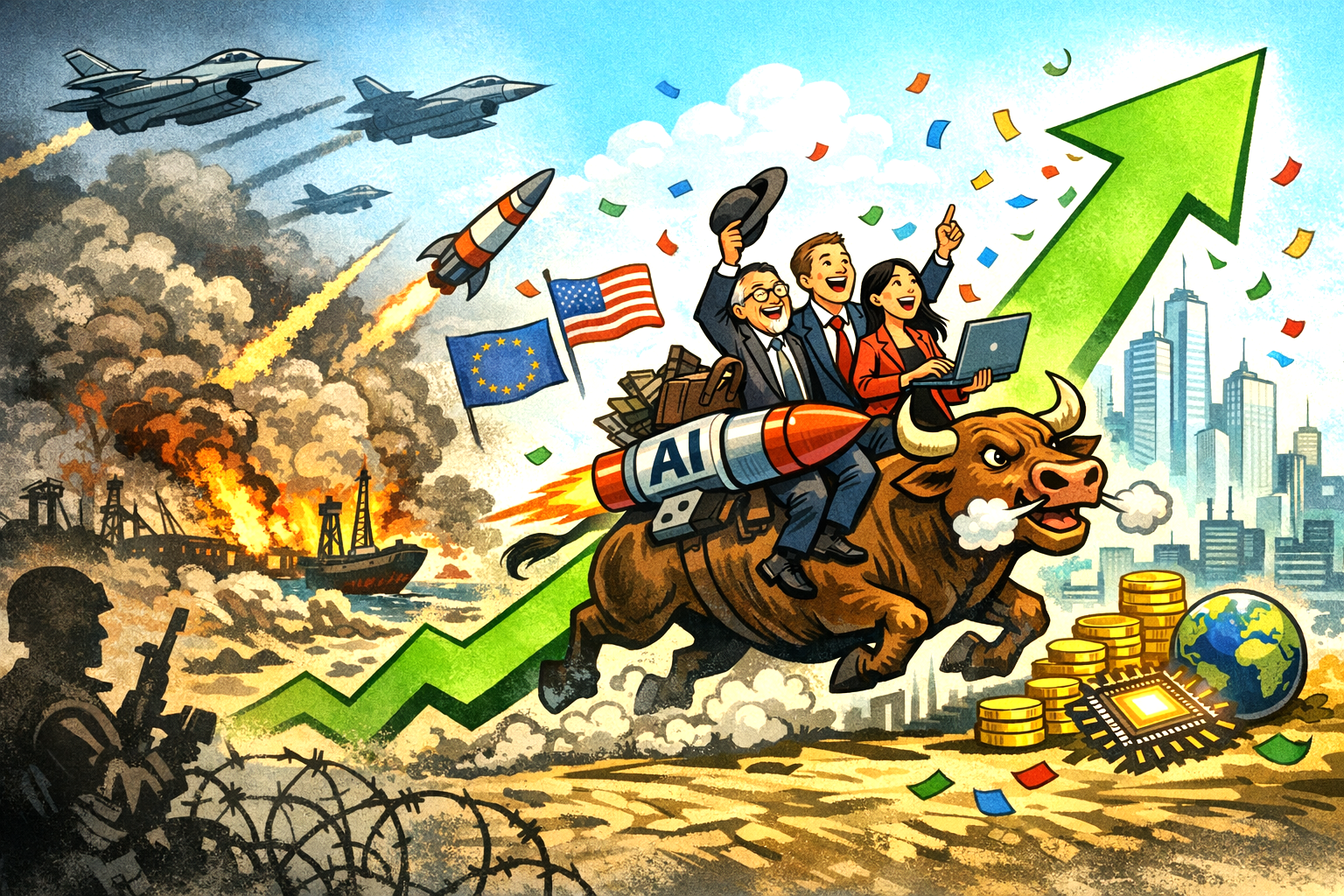
Global stock hit record highs!

Global equities have staged a striking recovery, erasing the losses triggered by the U.S.–Israel–Iran conflict and pushing into fresh record territory.

On the surface, this looks counter‑intuitive: the ceasefire remains fragile, diplomatic progress is uneven, and the threat of renewed escalation still hangs over the Strait of Hormuz. Yet markets have not only stabilised — they have surged.

It’s the AI boom stupid

The explanation lies less in geopolitics and more in positioning, psychology, and the gravitational pull of the AI boom.

The first phase of the conflict saw investors pile into defensive trades: higher oil, a stronger dollar, and a broad de‑risking across equities.

That created a sizeable war‑risk premium. Once even the possibility of a ceasefire emerged, that premium unwound at speed.

Analysts note that the rebound has been driven primarily by the rapid reversal of hedges rather than any fundamental improvement in the geopolitical outlook.

In other words, markets had priced in a worst‑case scenario — and when that scenario didn’t immediately materialise, the snap‑back was violent.

Short covering

This shift in sentiment was amplified by short‑covering, particularly among hedge funds that had positioned for prolonged disruption to energy flows.

As soon as investors judged the conflict likely to remain contained, the earlier sell‑off looked excessive. That alone was enough to propel global indices back above pre‑war levels. But it wasn’t the only force at work.

The macro backdrop has also proved more resilient than feared. U.S. labour market data has held up, and expectations for Federal Reserve rate cuts later in the year remain intact.

AI investment

Crucially, the AI‑driven investment cycle continues to dominate equity performance. Surging demand for compute, improving funding conditions, and strong earnings momentum in technology have provided a powerful counterweight to geopolitical anxiety.

For many investors, the structural growth story in AI simply outweighs the cyclical risks emanating from the Middle East.

Some caution

Still, the rally is not unqualified. Bond markets remain more cautious, with real yields and inflation expectations signalling that the risk of an energy‑driven slowdown has not disappeared.

And as peace talks wobble, equities have already begun to give back some gains — a reminder that this is a conditional rally, not a complacent one.

Markets may be hitting records, but they are doing so with one eye firmly on the horizon. The shadow of the conflict hasn’t lifted; investors have simply decided, for now, that it is not the dominant story.

U.S. Markets Hit New Highs Friday 17th April 2026 Amid Confusion Over the Strait of Hormuz and Presidential Chatter

U.S. markets hit new highs as announcements are clouded in smoke

U.S. equity markets surged to fresh record highs on Friday 17th April 2026, propelled less by economic fundamentals and more by a swirl of contradictory geopolitical signals and a single, highly visible social media post from the President of the United States.

The result was a rally that looked exuberant on the surface yet rested on information that remained unverified, disputed, or only partially understood.

Market makers, investors and traders can’t possibly verify that this information is safe to trade – it’s a bet – and this isn’t good for the stock market.

The world deserves better – this is not investing!

Catalyst

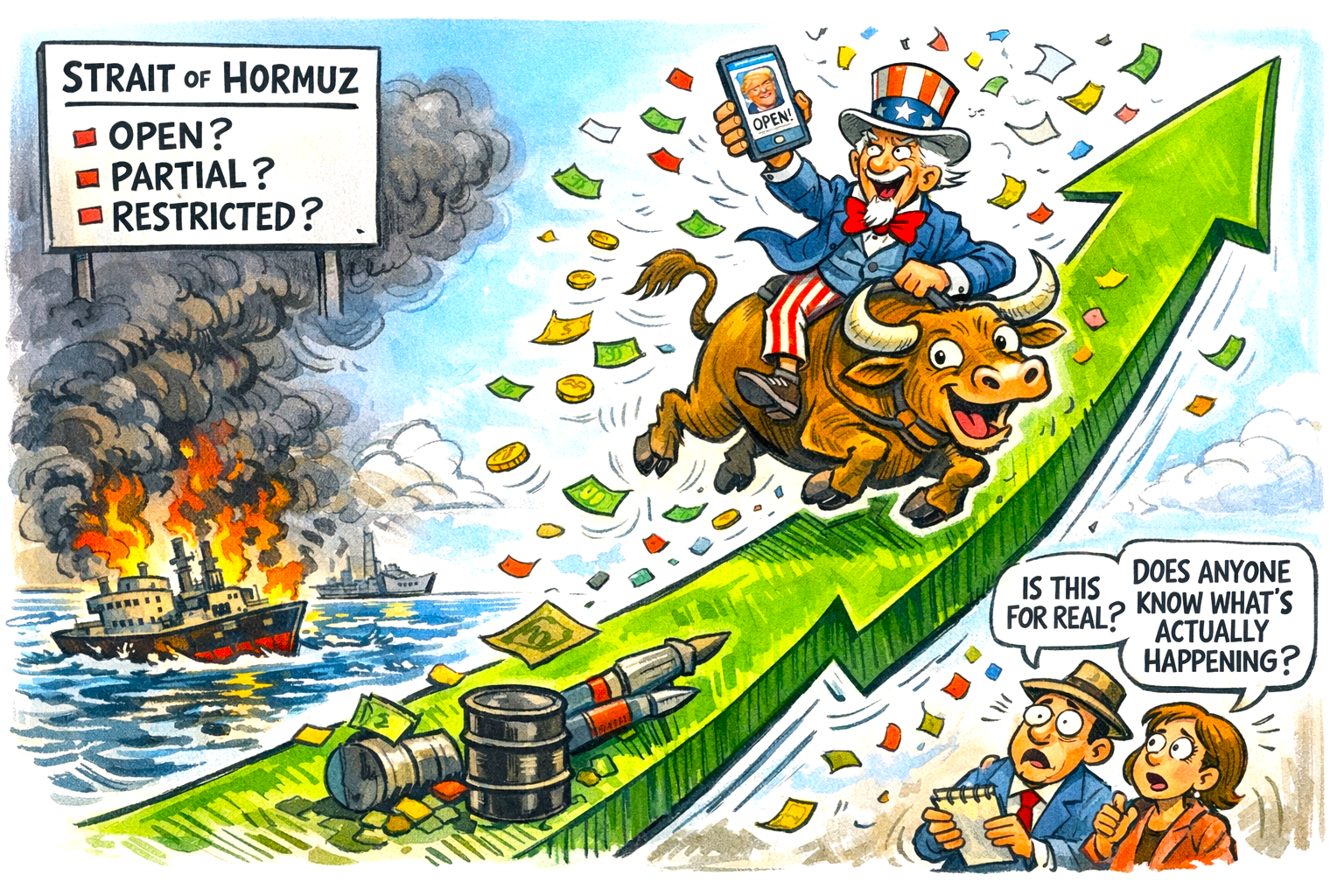
The catalyst was a presidential declaration that the Strait of Hormuz — a critical artery for global oil shipments — was “open”. The statement landed with the force of breaking news, despite the absence of confirmation from defence officials, maritime authorities, or international partners.

It was also reported that the U.S. would maintain its blockade of the Strait of Hormuz?

Reports circulating throughout the day suggested a more complicated reality: some sources described partial reopening, others spoke of restricted passage, and several indicated that conditions remained unstable.

In short, the facts were not settled.

Markets, however, behaved as though they were.

Melt-up driven by social media posts

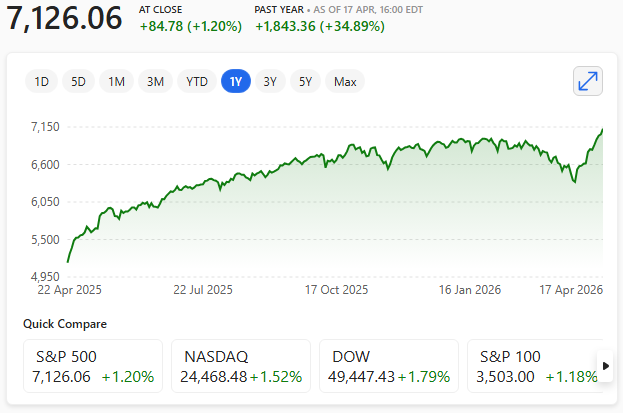
Within minutes of the President’s post, U.S. index futures spiked sharply. By the closing bell, the S&P 500, Nasdaq, and Dow had all notched new highs.

S&P 500 closes a record high 17th April 2026

Traders reportedly described the move as a “headline‑driven melt‑up”, a familiar pattern in recent months/years in which presidential commentary — rather than institutional communication — becomes the primary driver of intraday sentiment.

The sensitivity is not new. Analysts have repeatedly noted that markets respond quickly to presidential statements on energy, security, and trade, even when the underlying information remains contested.

What made Friday’s rally notable was the scale of the reaction relative to the uncertainty surrounding the Strait itself. Oil prices fell, risk appetite surged, and equity markets behaved as though a major geopolitical bottleneck had been definitively resolved.

Structural vulnerability

Critics argued that this dynamic reflects a structural vulnerability: when markets move first and verify later, volatility becomes a feature rather than a flaw. Supporters countered that traders simply price information as it arrives, regardless of its source.

What is clear is that the rally was driven not by data releases, earnings results, or policy announcements, through the ‘accepted and usual channels’ but by social media messages amplified across global financial systems.

Whether the Strait of Hormuz is fully open, partially open, or operating under constraints remains to be clarified.

The markets, however, have already made up their mind — at least for now.

The ‘news’ is good or ‘bad’ enough to make money!

U.S. stock market credibility is being eroded daily – bit by bit.

This has to stop!

No intent is suggested

Update

Iran fired shots at vessels trying to exit the Strait of Hormuz over the weekend. And now the U.S. has attacked a vessel under the Iranian flag casting doubt on renewed talks. The fragile ceasefire expires Wednesday 22nd April 2026 – unless Trump extends this and does a TACO!

There has also reportedly been talk of a 60-day extension – but that was before these latest problems.

No intent is suggested.

Iran’s 2026 Energy Crises: Echoes of the 1970s in a New Era of Risk

U.S. Israel Iran War 2026

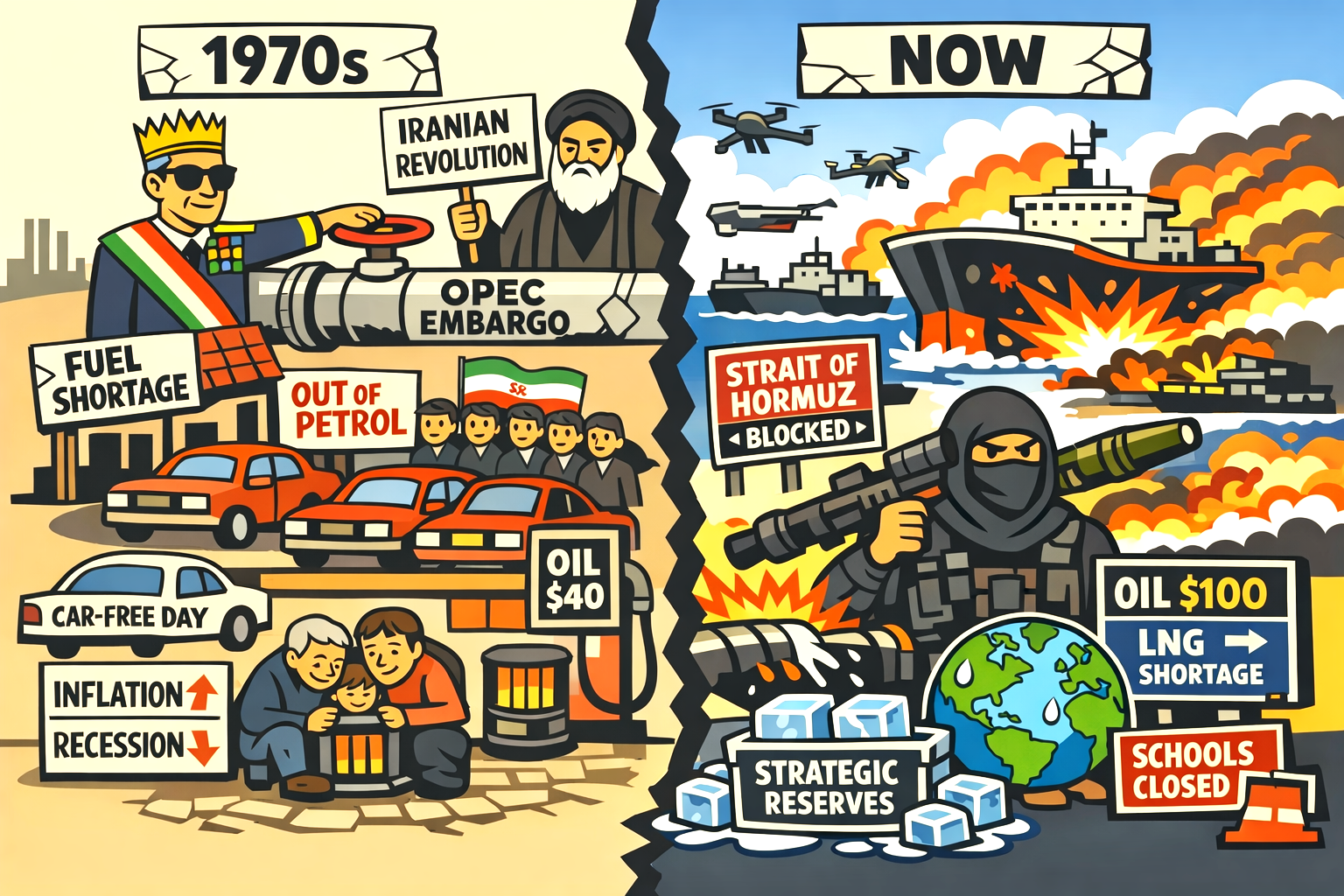
The 1970s crises were triggered by political embargoes and revolution, causing sharp but smaller supply cuts and extreme price spikes.

Today’s crisis is driven by war, infrastructure attacks, and the near‑closure of the Strait of Hormuz, producing a larger supply disruption, though price rises so far have been less extreme.

Energy shock

The energy shocks of the 1970s remain some of the most disruptive economic events of the modern age. Triggered first by an embargo and later by revolution, they exposed how deeply the global economy depended on Middle Eastern oil.

Half a century later, Iran still sits at the centre of global energy anxiety — but the nature of the threat has shifted.

The world is no longer facing an outright supply collapse, yet the structural vulnerabilities that defined the 1970s have not disappeared. They have simply evolved.

Yom Kippur War

The first major shock came in 1973, when Arab oil producers cut exports to countries supporting Israel during the Yom Kippur War.

The result was a sudden loss of roughly seven per cent of global supply. Prices quadrupled, queues formed at petrol stations, and governments imposed rationing, car‑free days, and speed‑limit reductions.

The economic fallout was severe: inflation surged while growth stalled, creating the era‑defining condition of stagflation.

A second blow followed in 1979, when the Iranian Revolution removed millions of barrels per day from the market. Prices tripled once again, and the world was forced to confront the fragility of its energy systems.

IEA

The International Energy Agency was created in direct response, tasked with coordinating emergency measures and strategic reserves.

These two crises set the benchmark for what an energy shock looks like — sudden, sharp, and globally destabilising.

Today’s risks are different. The world is not experiencing a supply loss on the scale of the 1970s, but the potential for disruption remains high.

Strait of Hormuz

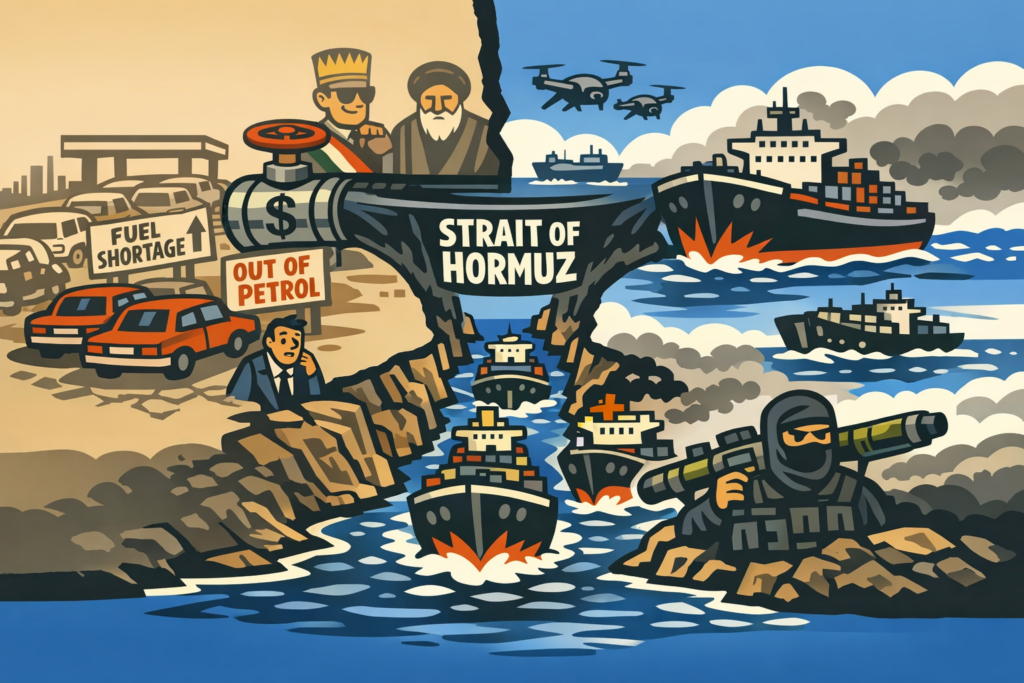
The Strait of Hormuz, through which around a fifth of global oil flows, is a strategic chokepoint vulnerable to conflict, tanker seizures, and infrastructure attacks.

Iran has repeatedly threatened to close or disrupt the strait during periods of tension, and even limited incidents in recent years have pushed prices higher.

Markets remain acutely sensitive to any sign that the corridor could be compromised.

Diverse energy

Unlike the 1970s, modern economies have more diversified energy systems, larger strategic reserves, and a growing share of renewables.

Yet these advantages do not eliminate risk; they merely soften it. A serious disruption in the Gulf would still send shockwaves through global markets.

The comparison between then and now is not one of scale but of structure. The 1970s showed how quickly energy can become a lever of geopolitical power.

Today’s world is more resilient, but no less exposed. The lesson endures: when a single region holds the key to global supply, the world remains only one crisis away from another shock.

We also need to ask – how and why this happened again!

What’s your answer?

How the crises affected the UK in the 1970s

The 1970s energy crisis had a profound and lasting impact on the United Kingdom, reshaping its economy, politics, and industrial relations.

When global oil prices quadrupled after the 1973 OPEC embargo, Britain was already struggling with domestic energy tensions.

Coal remained the backbone of electricity generation, and the miners’ dispute with Edward Heath’s government over pay and working conditions collided with the global fuel shock.

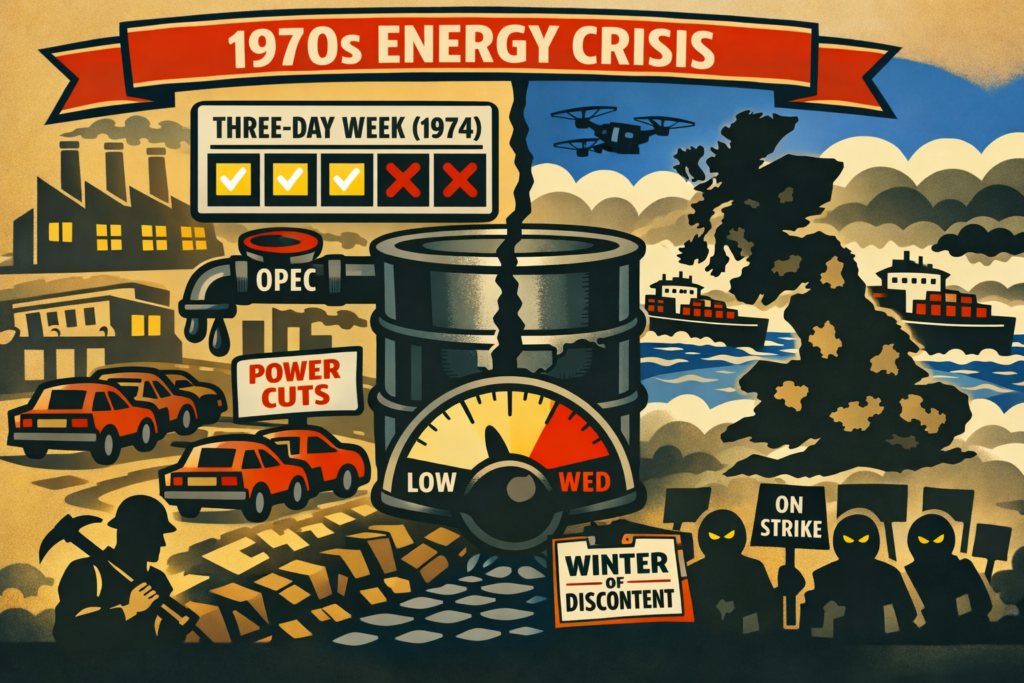
As coal output fell and oil costs soared, the government-imposed emergency measures — most famously the Three‑Day Week in early 1974, limiting commercial electricity use to conserve power. It led to the Winter of Discontent.

Power Cuts

Factories shut down, television broadcasts ended early, and households faced rolling power cuts. Inflation surged, unemployment rose, and the economy slowed sharply.

The crisis deepened public frustration with the Conservative government, contributing to Heath’s defeat in the February 1974 general election.

Trade Union Turmoil

The turmoil also strengthened trade unions, whose strikes became a defining feature of the decade.

By the late 1970s, another oil shock — triggered by the Iranian Revolution — compounded Britain’s economic malaise, leading to the “Winter of Discontent” and paving the way for Margaret Thatcher’s election in 1979.

In short, the 1970s energy crisis exposed Britain’s dependence on imported fuel and unstable domestic supply, ushering in years of inflation, industrial unrest, and political upheaval that reshaped the country’s economic direction for decades.


Steady February 2026 UK Inflation Masks Rising Risks from Iran Conflict

UK inflation before war shock filters through

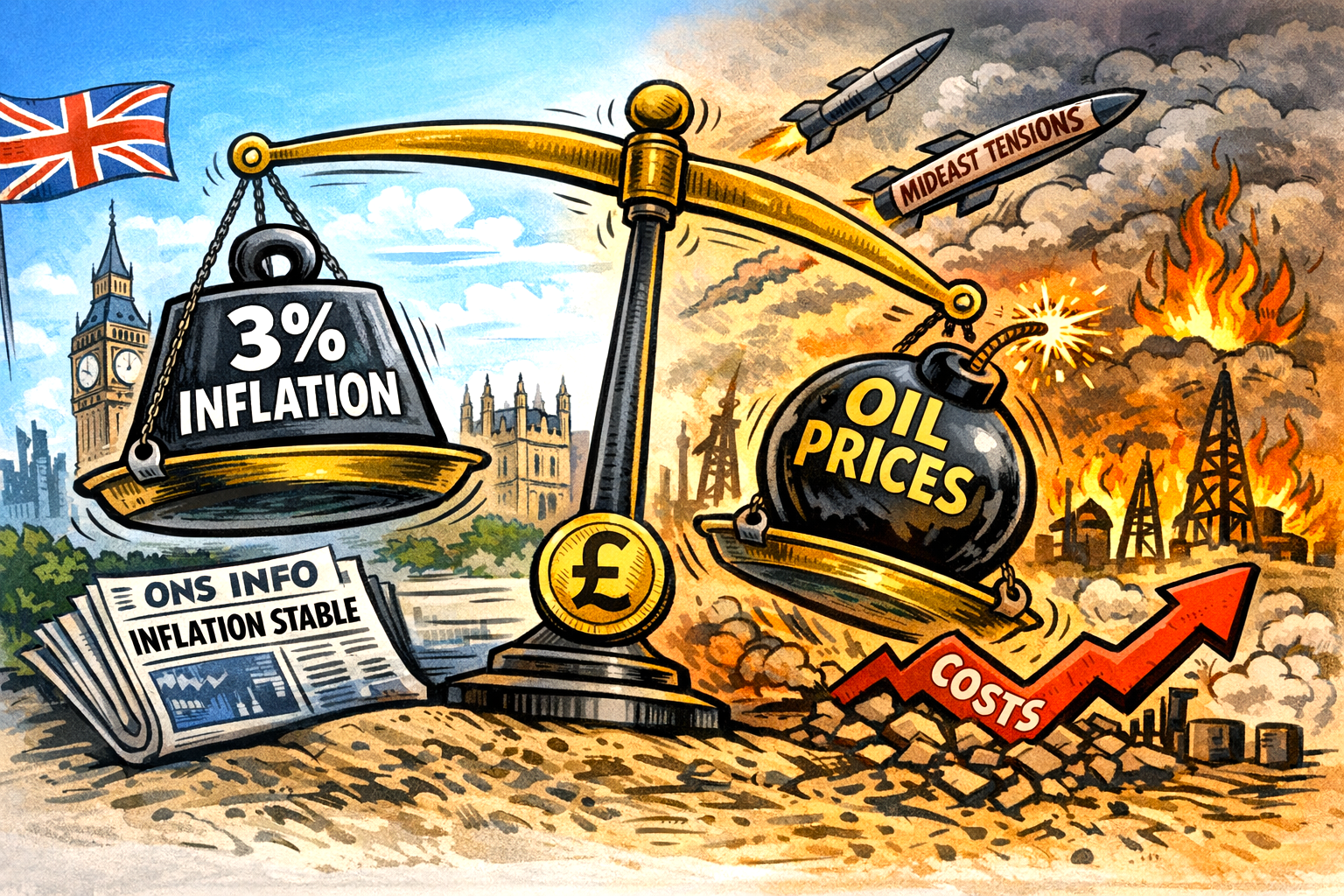
The UK’s inflation rate remained unchanged at 3% in February, according to the latest figures from the Office for National Statistics.

After months of gradual easing, the pause reflects a delicate moment for the UK economy, with price pressures beginning to shift beneath the surface.

Clothing was the biggest upward driver, with prices rising this year after falling during the same period in 2025.

This was offset by cheaper petrol, though those figures were captured before the recent surge in global oil prices triggered by the outbreak of war involving Iran.

While inflation is far below the peaks seen a few years ago, households are still contending with the reality that prices continue to rise—just more slowly.

ONS data

The ONS also introduced supermarket scanner data for the first time, offering a more accurate picture of food costs.

Economists warn that the conflict‑driven spike in oil and gas prices could push inflation higher again later in the year, with some forecasts suggesting a potential rise towards 4.6%.

Businesses already reliant on fuel, such as regional bus operators, report steep cost increases that may soon feed through to consumers.

The government insists it is working to ease cost‑of‑living pressures, though global events may limit its room for manoeuvre.

The Market’s Coiled Spring: Why Ultra‑Tight Ranges Rarely End Quietly

Coiled spring - pure stock market energy

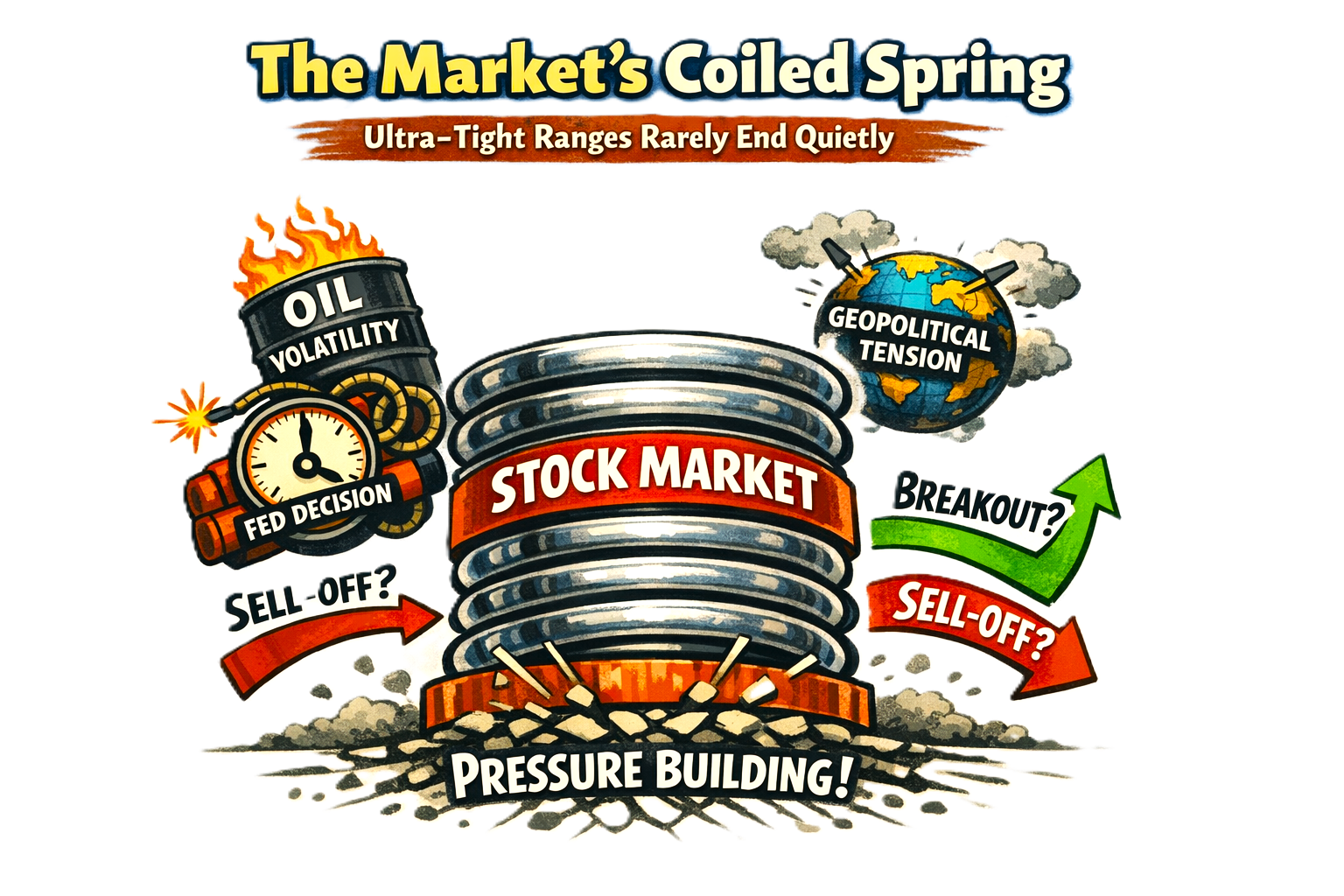
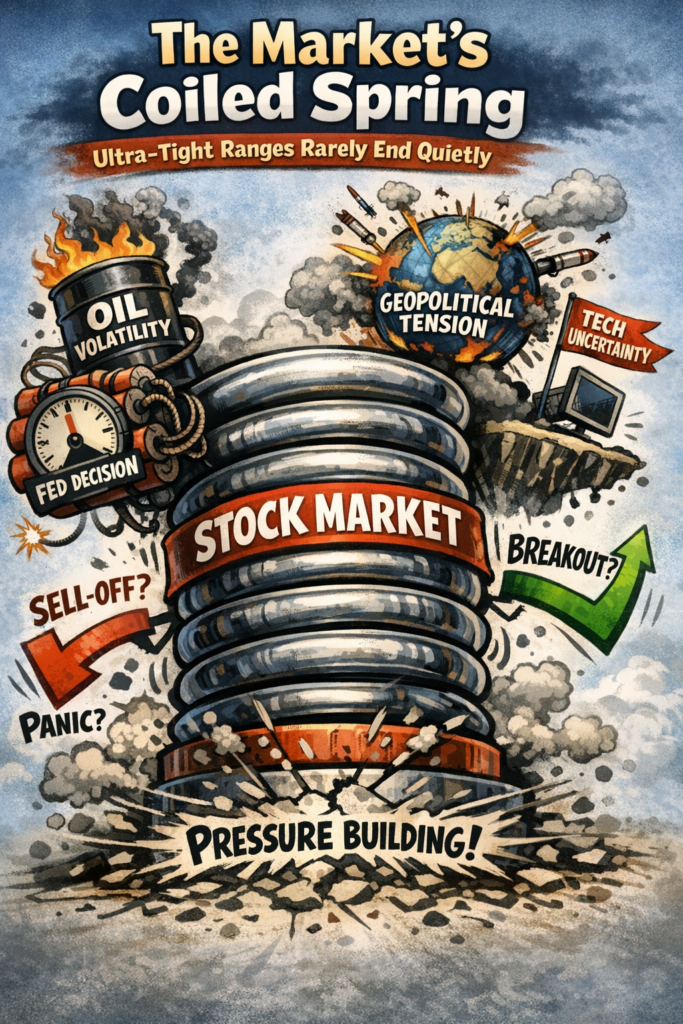
Markets rarely sit still without reason. When they do — as they have in recent sessions, grinding sideways in an ultra‑tight range — it signals not calm but compression.

Price action becomes like a coiled spring: energy building, tension rising, and traders waiting for the moment when restraint snaps into motion.

This week’s narrow trading bands reflect a market holding its breath. Geopolitical tension in the Middle East, oil volatility, and a Federal Reserve decision all loom over investors, yet equities have refused to break down.

Futures are edging higher, European indices are opening firmer, and even the tech wobble — with Nvidia’s muted reaction to its latest showcase — hasn’t derailed broader sentiment

Tight range – a waiting game.

Historically, such tight ranges rarely resolve with a whimper. When volatility is suppressed for too long, the eventual breakout tends to be sharp and directional. The question, of course, is which way.

Right now, the evidence suggests upward. Markets have absorbed war‑driven oil swings, shrugged off hedge‑fund losses, and continued to find buyers on dips.

Breadth is stabilising, and risk appetite — surprisingly resilient given the backdrop — is creeping back into European and Asian sessions.

That doesn’t guarantee a bullish surge, but it does suggest the path of least resistance is higher.

Fed tone

If the Fed avoids surprising investors and signals comfort with the current trajectory, the spring is more likely to uncoil to the upside.

A dovish‑leaning tone could ignite a breakout as sidelined capital rushes back into equities. Conversely, a hawkish shock would release the same stored energy — but violently downward.

The market is coiled. The catalyst is imminent. And when the range finally breaks, it won’t be subtle.

You know, it almost doesn’t matter what disasters are ongoing in the world – the stock market just wants to win and go up!

Just how bad does it have to be before the stock market corrects? And what will be the catalyst to make that happen?

Debt, credit concerns, geopolitical tension, political scandal, Epstein, a rogue nuclear attack, AI failure, war or just another Trump tariff scenario?

Who knows? And does anybody really care as long as ‘making money’ isn’t interrupted.