


Why are central banks selling gold now after a massive buying spree

Central banks offload gold

Central banks are selling gold now for one blunt reason: they need cash, and gold is the most liquid, pain‑free asset they can dump without triggering a credibility crisis.

The news wires report— “liquidity pressures”, “emerging‑market currency volatility”, “increased spending requirements” — but the underlying mechanics are more structural and revealing – they need the cash!

Central banks have swung from record gold accumulation to noticeable selling because the global system has shifted from long‑term hedging to short‑term survival.

The war in the Gulf has tightened liquidity, pushed up government spending, and destabilised emerging‑market currencies, forcing policymakers to turn their most liquid reserve into cash.

Gold is the one asset they can sell quickly without signalling panic, and that is shaping behaviour across dozens of reserve banks.

War, liquidity and the need for dollars

The Hormuz conflict has driven up energy costs, disrupted shipping and forced governments to spend more on defence and subsidies.

Emerging‑market central banks, already under pressure from currency volatility, need hard currency to intervene in FX markets and stabilise their economies. Selling gold provides instant access to dollars without dumping sovereign bonds or burning through already‑thin reserves.

A falling gold price creates a window

Gold has slipped around 12% from its January 2026 peak, entering a contraction phase despite geopolitical risk. For reserve managers, that is a cue to realise gains from the 2022–25 buying spree while prices remain historically high.

Selling now avoids being forced to sell later at distressed levels if the conflict deepens or fiscal pressures worsen. It will be bought back again at a later time.

The buffer they built is now being used

The record buying of recent years was driven by fears of sanctions, inflation and geopolitical fragmentation.

Those purchases created a cushion that can now be drawn down. The shift to selling does not signal a loss of faith in gold; it reflects the reality that reserves accumulated for stability are now being used to fund stability.

The deeper story is not about gold at all, but about a global system under strain: governments facing rising costs, currencies under pressure, and central banks forced to prioritise liquidity over long‑term positioning.

This is why central banks hold gold.
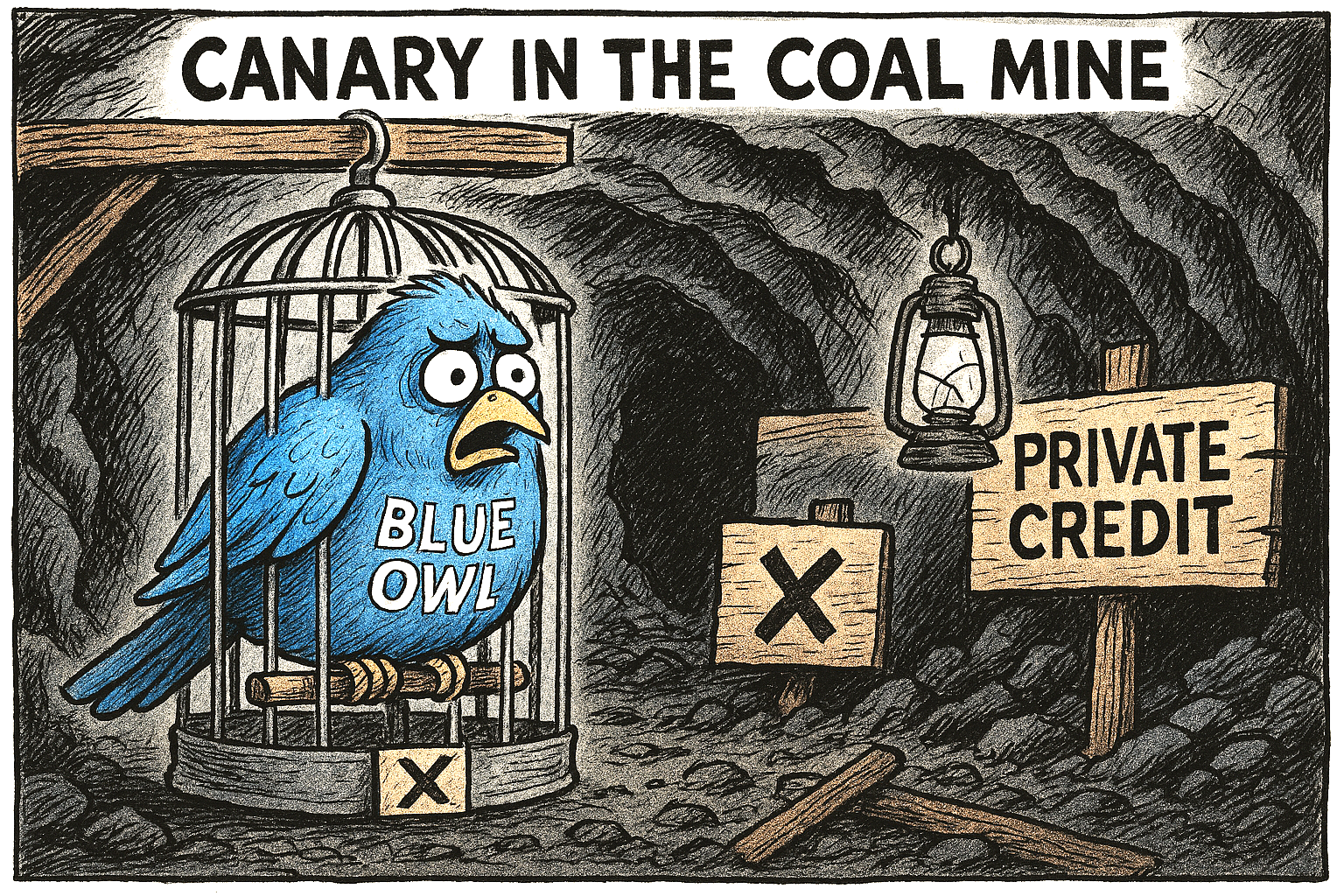
Blue Owl’s Redemption Freeze Sends Shockwaves Through Private Credit

Canary in a coal mine - possible credit crunch warning

Blue Owl’s decision to halt investor withdrawals at one of its flagship retail‑focused private credit vehicles has sent a jolt through a market long celebrated for its resilience.

The move, centred on Blue Owl Capital Corporation II (OBDC II), marks one of the most significant stress signals yet in the rapidly expanding private credit sector.

Redemption

The firm confirmed that investors in OBDC II will no longer be able to redeem shares on a quarterly basis, ending a mechanism that previously allowed withdrawals of up to 5% of net asset value each quarter.

The redemption facility had already been paused in November 2025 as withdrawal requests accelerated, but the permanent halt represents a decisive shift.

To meet liquidity needs and prepare for a partial return of capital, Blue Owl has sold a substantial portion of its loan book.

Reportedly around $600 million of assets were offloaded from OBDC II as part of a wider $1.4 billion sale across three funds, with the firm planning to return 30% of the fund’s value to investors by the end of March.

Reaction

Markets reacted swiftly. Shares in Blue Owl fell between 6% and 10% across recent trading sessions, touching their lowest levels in more than two years.

The sell‑off was fuelled not only by the redemption freeze but also by broader concerns about the firm’s exposure to software‑sector borrowers — an area facing valuation pressure and heightened sensitivity to disruption from artificial intelligence.

The episode has reignited debate about the structural vulnerabilities of private credit, a market now estimated at $1.8 trillion.

The model relies on illiquid loans packaged into vehicles that promise periodic liquidity to investors — a mismatch that works only as long as redemption requests remain manageable.

Blue Owl’s move suggests that, under stress, even well‑established managers may be forced into asset sales or wind‑down scenarios.

Contagion?

Contagion fears quickly spread across the sector. Shares of major alternative‑asset managers, including Apollo, Blackstone and TPG, all declined sharply as investors reassessed liquidity risks in retail‑facing credit products.

For now, Blue Owl insists that capital will continue to be returned through loan repayments and asset sales.

But the permanent closure of redemptions at OBDC II stands as a stark reminder: the private credit boom is entering a more volatile phase, and liquidity — once taken for granted — is becoming the industry’s most fragile commodity.