
One of the least‑discussed forces helping to shape the current U.S.–Iran confrontation is the quiet revolution beneath American soil.
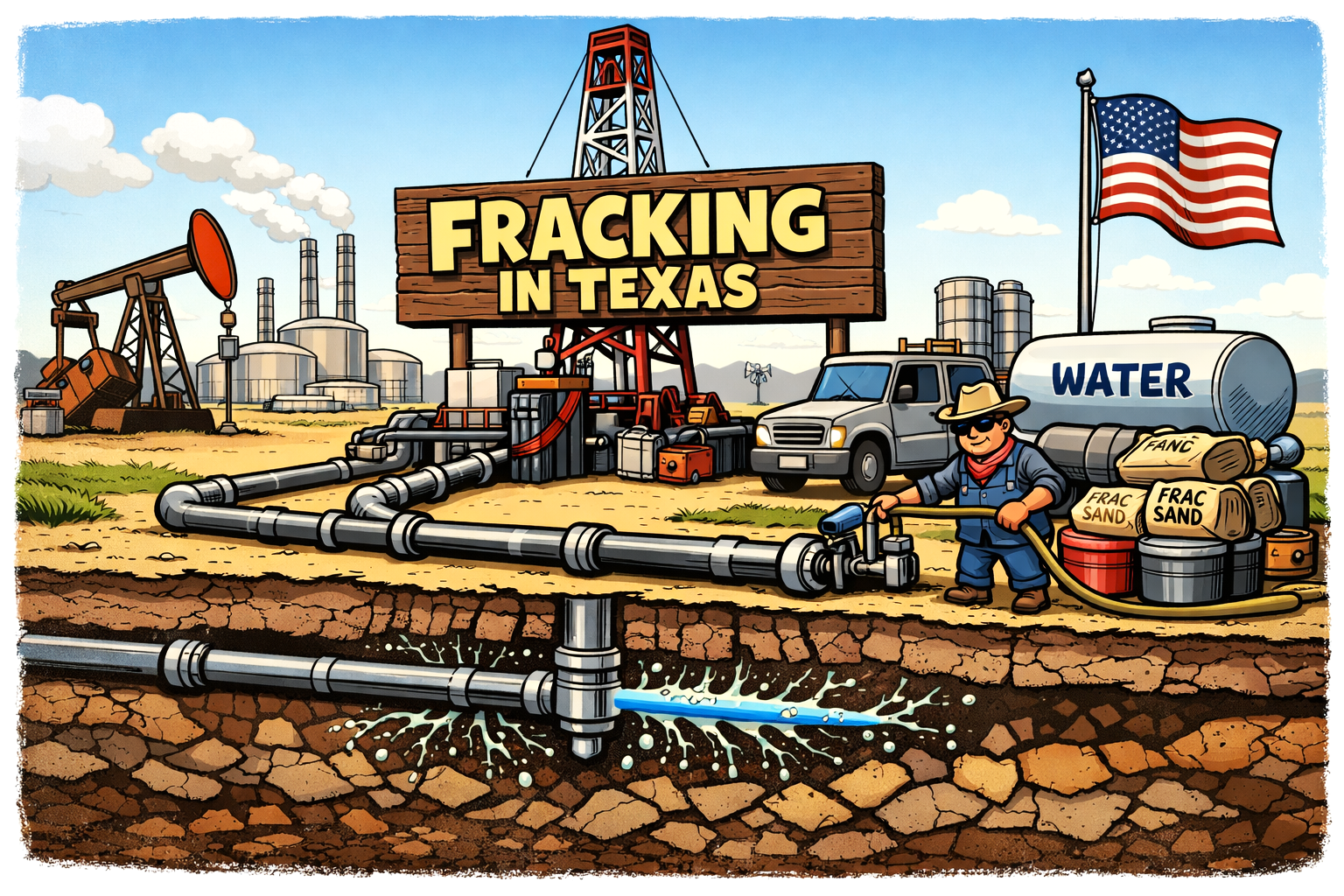
Over the past decade, hydraulic fracturing transformed the United States from a vulnerable energy importer into the world’s largest oil and gas producer.
Pumped up
Nowhere has this shift been more dramatic than in Texas, where the Permian Basin alone pumps more oil than many OPEC members. This surge has not only reshaped global markets — it has altered Washington’s strategic outlook.
The United States now exports record volumes of crude oil and liquefied natural gas, with outbound shipments regularly exceeding 4 million barrels per day.
The conflict with Iran isn’t impacting oil production in the U.S.—if anything, it has boosted output and increased overseas sales.
This would have been unthinkable twenty years ago, when U.S. foreign policy was constrained by dependence on Middle Eastern supply.
U.S. Shale Boom
Today, the shale boom has given Washington a buffer: even severe disruption in the Strait of Hormuz would no longer threaten the U.S. economy in the way it once did.
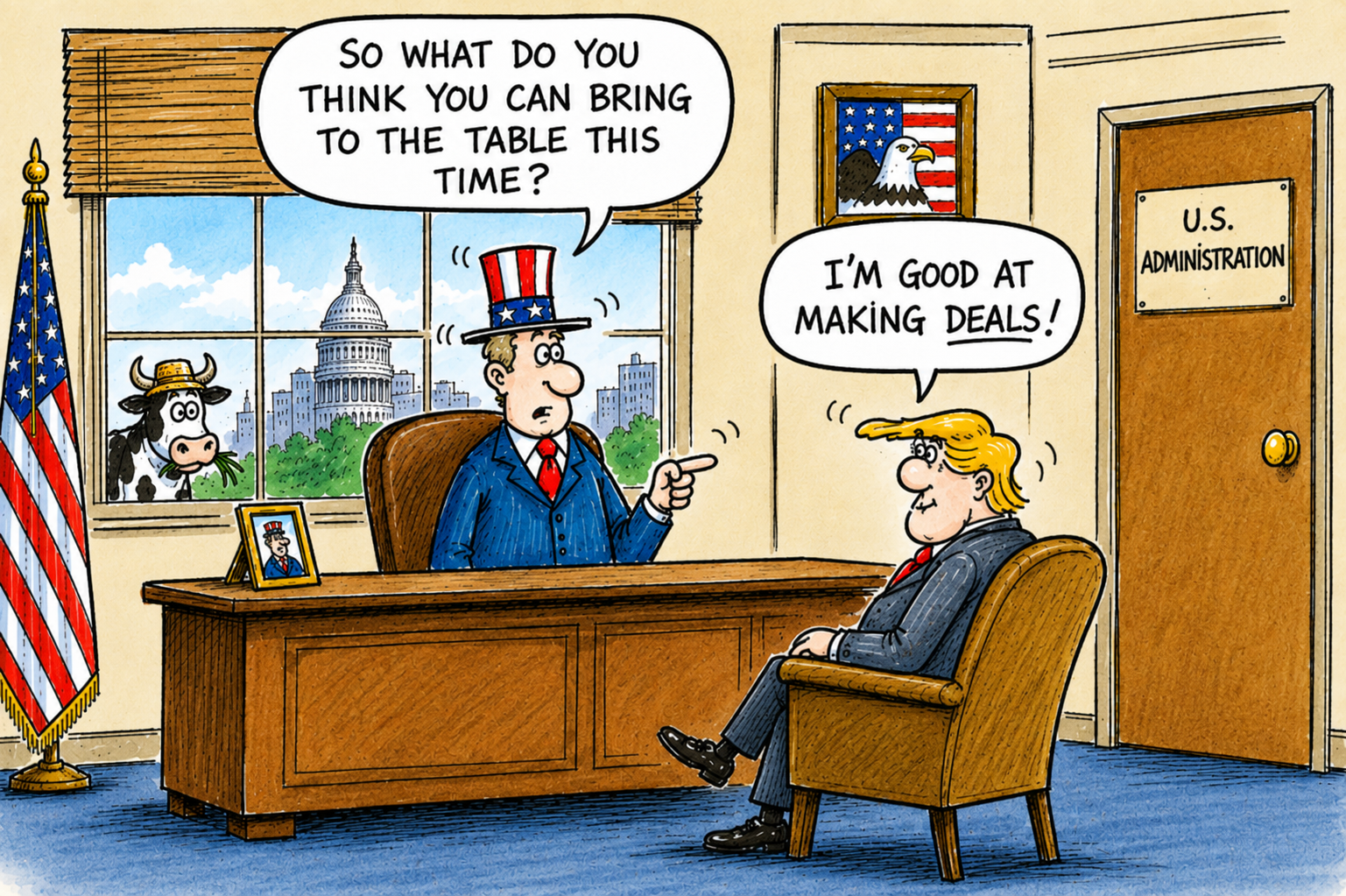
This energy independence has had political consequences. Analysts note that President Trump’s willingness to escalate against Iran — including strikes, sanctions, and naval deployments — is partly rooted in the belief that the U.S. can withstand an oil shock far better than its rivals.
Iran, by contrast, relies heavily on oil revenues and is already weakened by sanctions. A prolonged disruption to its exports hurts Tehran far more than Washington.
Texas fracking plays directly into this dynamic. The combination of horizontal drilling, high‑pressure fracturing, and vast shale formations has created a production engine capable of rapid growth.
When global prices rise, U.S. shale responds within months, softening the blow to consumers and limiting the geopolitical leverage of traditional producers.
Texas Asset
In effect, the Permian Basin has become a strategic asset — a domestic shock absorber that reduces the economic risks of confrontation abroad.
Critics argue that this new confidence borders on complacency. A major conflict in the Gulf would still send global prices sharply higher, with knock‑on effects for inflation, supply chains, and allied economies.
But there is no doubt that the fracking boom has changed the psychology of U.S. power. For the first time in modern history, America can contemplate a showdown in the Middle East without fearing an immediate energy crisis at home.
Texas may not be the reason the U.S. is confronting Iran — but it has certainly made the White House feel far safer doing so.
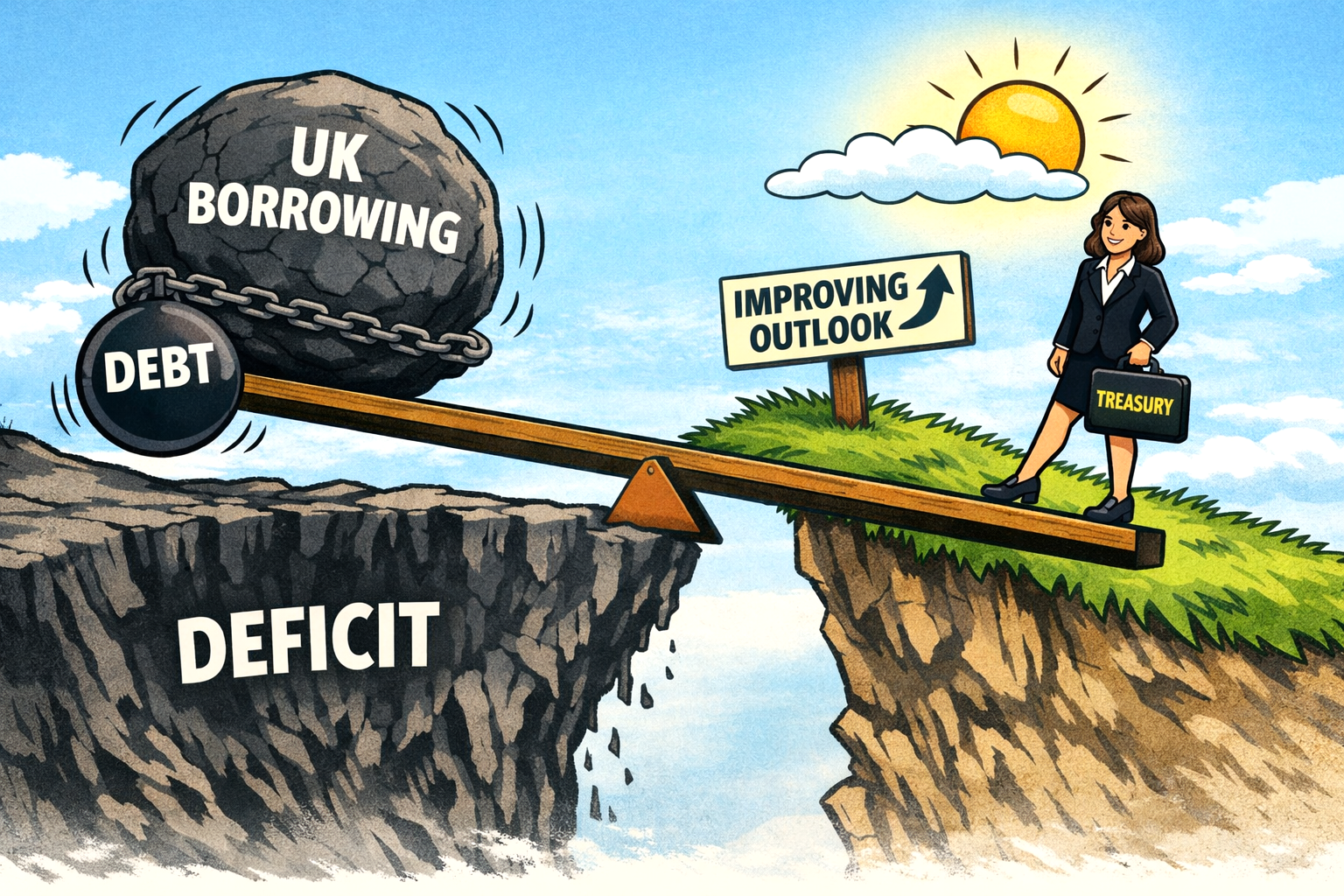
The latest public finance figures show that government borrowing has dropped to a lower‑than‑forecast level, helped by stronger tax receipts and easing inflationary pressures.
While the precise numbers will be scrutinised in the coming days, the headline outcome marks a modest but meaningful improvement in the UK’s fiscal position.
Softer inflation and lower interest rates
Analysts note that softer inflation has reduced the government’s debt‑interest bill, particularly on index‑linked gilts, which had surged during the inflation spike of the past two years.
The fall in borrowing also reflects a stabilising labour market and firmer wage growth, which have supported income‑tax and National Insurance receipts.
At the same time, lower market interest rates — driven by expectations of further Bank of England cuts after recent reductions to 3.75% — have eased short‑term financing costs for the Treasury.
High debt level
However, economists caution that the improvement should not be overstated. UK debt remains historically high, and pressures on public services, welfare spending, and capital investment persist.
Moreover, with growth still subdued and geopolitical risks keeping energy markets volatile, the fiscal outlook remains vulnerable to external shocks.
Even so, today’s figures provide the Chancellor with a welcome narrative shift: after years of deteriorating public finances, the government can point to early signs of stabilisation — albeit from a challenging starting point.
What the real data shows (ONS, published 23rd April 2026)
The latest ONS release confirms that UK government borrowing has indeed come in lower than expected, and the scale of the improvement is now clear:
Annual borrowing: £132.0 billion in the year to March 2026 — £19.8 billion lower than the previous year — £0.7 billion below the OBR forecast — Lowest level since 2022–23
March borrowing: £12.6 billion — £1.4 billion lower than March 2025 — Lowest March figure since 2022
Borrowing as % of GDP: — 4.3%, the lowest since 2019–20
The U.S./ Iran / Israel conflict with undoubtably hold the economy back as the effect has yet to fully filter through.
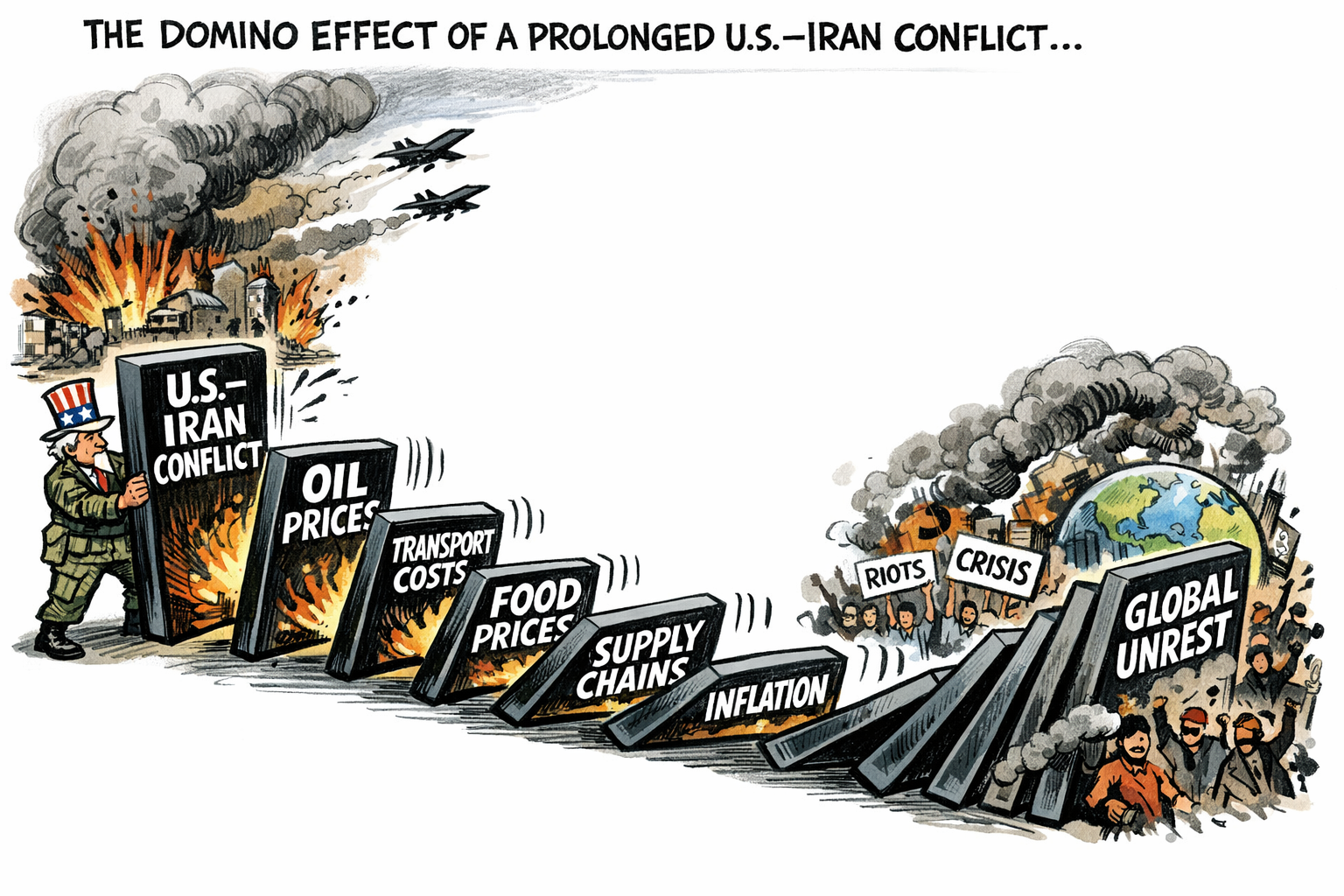
If the U.S.–Iran conflict drags on for weeks or months, the global impact will extend far beyond oil markets. Energy prices are only the first domino.
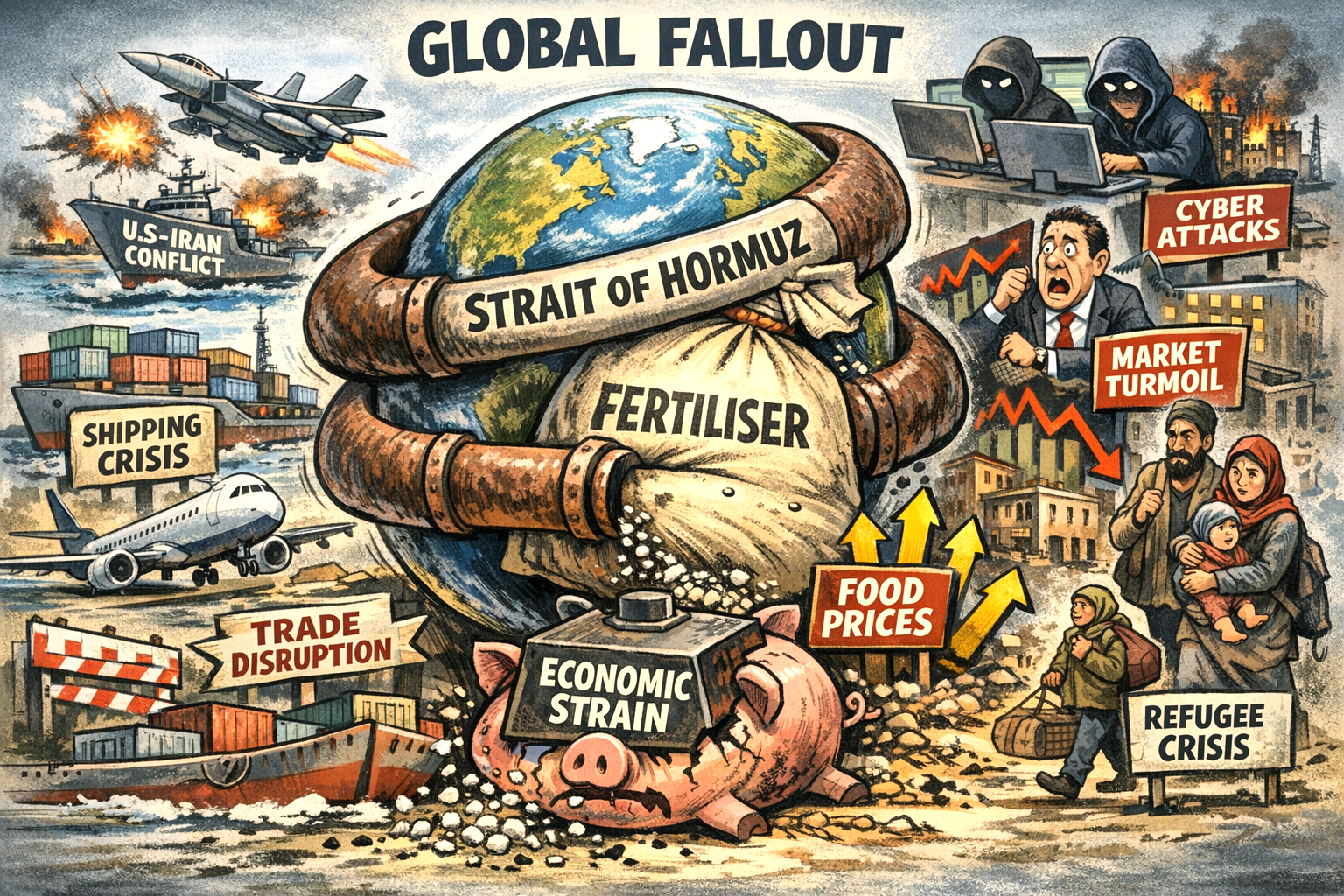
The deeper, more destabilising effects emerge through shipping disruption, fertiliser shortages, food‑price inflation, financial volatility, cyber escalation, and regional political instability.
For the UK — already wrestling with structural food‑system fragility — the conflict becomes a real‑world stress test.
This report outlines 15 potential major knock‑on effects that would shape the global economy if the conflict becomes protracted.
1. Global Shipping Disruption
The Strait of Hormuz is not just an oil artery; it is a global shipping chokepoint. As vessels reroute or halt operations:
Container shipping delays spread across Asia, Europe and the Gulf.
War‑risk insurance premiums spike for all vessels.
Freight costs rise, feeding into non‑energy inflation.
This is the mechanism by which a regional conflict becomes a global economic event.
2. Aviation and Travel Disruption
Iranian retaliation has already included strikes on Gulf airports and hotels. If this continues:
Airlines reroute or cancel flights across the Gulf, South Asia and East Africa.
Longer flight paths increase fuel burn and fares.
Tourism in the UAE, Oman, Bahrain and potentially Turkey contracts sharply.
Aviation is one of the fastest channels through which geopolitical instability hits consumers.
3. Financial Market Volatility
Markets dislike uncertainty, and this conflict delivers it in abundance.
Investors flee to gold, the dollar and U.S. Treasuries.
Emerging markets face capital outflows.
Equity volatility rises in shipping, aviation and manufacturing sectors.
The longer the conflict persists, the more entrenched this volatility becomes.
4. Fertiliser Disruption: The Hidden Trigger
Over one‑third of global fertiliser trade moves through the Strait of Hormuz. With shipments stranded:
Urea, ammonia, phosphates and sulphur prices surge.
Farmers worldwide face higher input costs.
Lower fertiliser availability leads to reduced crop yields.
This is the beginning of a food‑system shock that unfolds over months, not days.
5. Global Food‑Price Inflation
As fertiliser shortages ripple through agriculture:
Wheat, rice, maize and oilseed yields fall.
Livestock feed becomes more expensive, pushing up meat, dairy and egg prices.
Food‑importing regions face acute pressure.
Grain futures markets become more volatile.
This is how a conflict becomes a global cost‑of‑living crisis.
UK Exposure
The UK is particularly vulnerable because:
It imports a large share of its fertiliser and food.
Its agricultural sector is energy‑intensive.
Supermarket supply chains are sensitive to freight and insurance costs.
Bread, cereals, dairy and meat are the first categories to feel the squeeze.
6. Supply Chain Strain Beyond Food and Energy
A prolonged conflict disrupts:
Petrochemicals
Plastics
Fertilisers
Industrial metals
Gulf‑based manufacturing and logistics
This feeds into higher costs for everything from packaging to electronics.
7. Corporate Investment Freezes
Businesses hate uncertainty. Expect:
Delays or cancellations of Gulf megaprojects.
Slower investment in petrochemicals, logistics and tech hubs.
Reduced appetite for Gulf‑exposed assets.
This undermines diversification efforts like Saudi Vision 2030.
8. Cyber Escalation
Iran has a long history of cyber retaliation. Likely developments include:
Attacks on Western banks, utilities and government systems.
Disruptions to Gulf infrastructure, including airports and desalination plants.
Rising cybersecurity costs for businesses globally.
Cyber conflict is asymmetric, deniable and cheap — making it a likely pressure valve.
9. Regional Political Destabilisation
The killing of senior Iranian leadership has already shaken the region.
Possible outcomes include:
Internal instability within Iran.
Escalation involving Hezbollah, Iraqi militias, Syrian factions and the Houthis.
Pressure on Gulf monarchies if civilian infrastructure continues to be targeted.
This is where the conflict risks widening beyond its initial theatre.
10. Migration and Humanitarian Pressures
If the conflict intensifies:
Refugee flows from Iran, Iraq and Syria could rise.
Europe — especially Greece, Turkey and the Balkans — faces renewed border pressure.
Humanitarian budgets shrink as Western states divert funds to defence.
This adds a political dimension to the economic fallout.
11. Insurance Market Stress
War‑risk insurance is already spiking.
Expect:
Higher premiums for shipping, aviation and energy infrastructure.
Reduced insurer appetite for Gulf‑exposed assets.
Knock‑on effects on global trade costs and consumer prices.
Insurance is a silent amplifier of geopolitical risk.
12. Higher Global Borrowing Costs
Sustained conflict spending creates:
Budgetary strain for the U.S., UK, EU and Gulf states.
Reduced fiscal space for domestic programmes.
Higher global borrowing costs as markets price in sustained uncertainty.
This tightens financial conditions worldwide.
13. Pressure on Emerging Markets
Countries heavily reliant on imported energy or food face:
Worsening trade balances
Currency depreciation
Higher inflation
Greater risk of sovereign stress
This is especially acute in South Asia, North Africa and parts of Latin America.
14. Strain on Multilateral Institutions
A prolonged conflict diverts attention and resources from:
Climate finance
Development aid
Humanitarian relief
Global health programmes
Institutions already stretched by Ukraine, Gaza and climate disasters face further overload.
15. The Strategic Reordering of Alliances
A drawn‑out conflict may accelerate geopolitical realignment:
Gulf states hedge between Washington and Beijing.
India and Turkey pursue more independent foreign policies.
Europe faces renewed pressure to define its own security posture.
Russia benefits from higher energy prices and Western distraction.
This is the long‑term consequence: a shift in the global balance of power.
Conclusion: A Conflict That Radiates Far Beyond Oil
If the U.S.–Iran war limps on, the world will feel it in supermarket aisles, shipping lanes, financial markets and political systems.
The most consequential knock‑on effect is not oil — it is fertiliser. That is the hinge on which global food security turns.
For the UK, the conflict exposes the fragility of a food system dependent on imports, long supply chains and energy‑intensive agriculture.
This is not just a Middle Eastern conflict. It is a global economic event in slow motion.
If the Israel-Hamas conflict further intensifies, the risks to the global economy are growing, economist Mohamed el-Erian reportedly said Monday 30th October 2023.
The impact on global markets was initially limited, as investors viewed the conflict as contained. However, the prospect of a regional spillover has added to a sense of unease.
‘The longer this conflict goes on, the more likely it will escalate. The higher the risk of escalation, the higher the risk of contagion to the rest of the world in terms of economics and finance’, el-Erian said.