Apple has entered the artificial intelligence race with the announcement of its version of AI – Apple Intelligence on Monday 10th June 2024, in its attempt to catch up in the AI race.
Reportedly to use it on your phone, you’ll need at least the high-end iPhone 15 Pro from this year’s lineup.
According to Apple’s website, Apple Intelligence will also be compatible with devices equipped with the M1 chip, including the iPad Air, iPad Pro, and Macs.
Apple Intelligence, set to launch in beta this autumn, will offer a variety of features. It will be able to proofread and rewrite your text in different tones, create personalized emojis known as ‘Genmoji,‘ and search for specific messages on your iPhone.
Additionally, it will summarize and transcribe phone calls, manage priority notifications, and integrate OpenAI’s ChatGPT for enhanced Siri responses.
Nothing new here then, just AI features already available elsewhere. Hopefully it will have a decent Apple AI make-over when it finally and fully arrives across all Apple products and platforms.
Apple isn’t leading in AI… yet – it’s just following for now!
The British computing startup Raspberry Pi is aiming to raise £166 million ($211.2 million) from its initial public offering in London on Tuesday 11th June 2024.
The company, known for its compact single-board computers, has set its share price at 280 pence each. Conditional dealing of Raspberry Pi shares will commence on Tuesday, allowing specific investors, such as institutional buyers, to begin trading.
Based on the pricing of its shares, the company is valued at around £542 million.
This is a rare win for London’s stock exchange which has struggled to attract technology listings in recent time, losing out to the U.S.
In early morning trading Tuesday 11th June 2024 – Raspberry Pi shares climbed over 30%
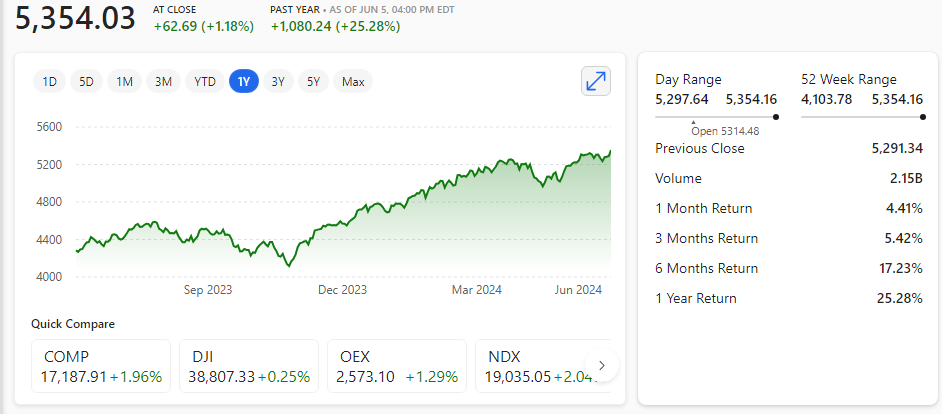
The S&P 500 reached a new high as Nvidia surpassed the $3 trillion mark for the first time, and the anticipation of an interest rate cut grew due to softer-than-expected job data.
S&P 500 all-time high as of 5th June 2024
S&P 500 all-time high as of 5th June 2024
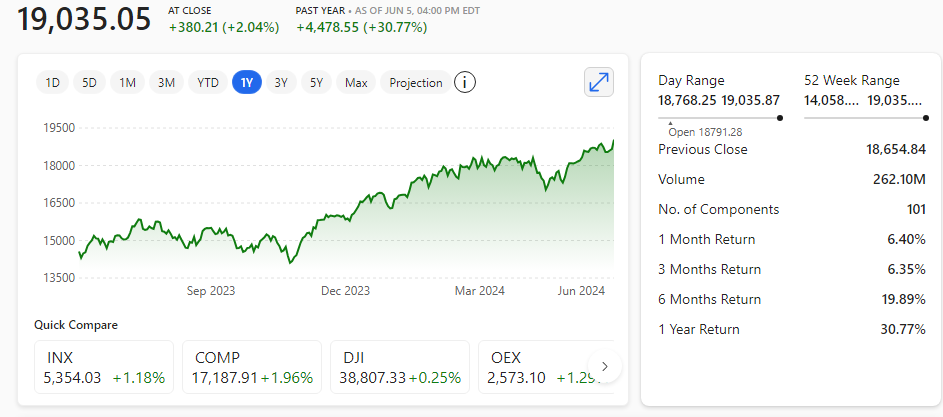
Similarly, the Nasdaq 100 and Nasdaq Composite achieved new record highs
Nasdaq 100 as of 5th June 2024
Nasdaq Comp as of 5th June 2024
AI boom catapults Nvidia passed Apple’s market cap’ valuation
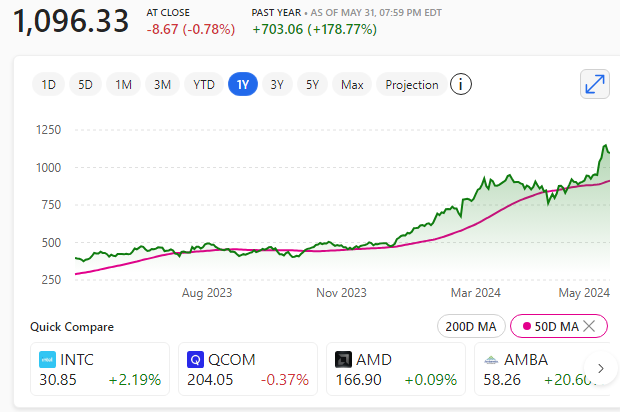
Nvidia’s shares have surged 24% following its impressive earnings report in May, in contrast to Apple’s shares, which have increased by only 5% this year amid a slowdown in sales growth in recent months.
Nvidia one year share price as of 5th June 2024
Nvidia one year share price as of 5th June 2024
Nvidia Market Cap at $3.01 trillion as of 5th June 2024
Kneron, a startup specializing in artificial intelligence chips, unveiled its latest products on Wednesday 4th June 2024.
The company aims to exploit the growing world-wide interest in AI and provide an alternative to industry heavyweights such as Nvidia and AMD.
The company, headquartered in Taiwan and supported by American semiconductor leader Qualcomm and major iPhone assembler Foxconn, introduced the KNEO 330, its second-generation ‘edge GPT’ server.
GPT, short for generative pre-trained transformer, is an AI algorithm trained on vast datasets capable of generating text and images, with OpenAI’s ChatGPT being the world leader right now.
Intel announced its new Xeon 6 processors at the Computex tech conference in Taiwan on Tuesday 4th June 2024.
This announcement coincides with the recent launches of new artificial intelligence chips by rivals Nvidia and AMD on Sunday and Monday 2nd and 3rd June 2024 – as they compete for dominance in the rapidly growing industry.
Intel is making efforts to catch up with Nvidia and AMD, having been relatively absent from the AI surge that led tech giants such as Meta, Microsoft, and Google to purchase a significant number of Nvidia chips.
This comes half a year after Intel’s release of its 5th Gen Intel Xeon processors for data centre workloads and a couple of months following the announcement of the Gaudi 3 processor for AI model training and deployment.
Intel also disclosed that the Gaudi 2 and Gaudi 3 AI accelerators are priced lower than those of its competitors.
Furthermore, Intel shared architectural details of its forthcoming Lunar Lake processors, aimed at expanding the AI PC category. These processors, slated for release in the third quarter, are set to rival Nvidia’s and AMD’s offerings tailored for AI PCs.
While Nvidia and AMD focus on chip design, Intel stands out by both designing and manufacturing its chips. Nevertheless, Intel’s foundry business has faced challenges, with its operating loss widening to $7 billion in 2023 compared to the previous year.
ThousandEyes, Cisco’s internet monitoring division, has introduced a new suite of AI-driven features known as Digital Experience Assurance, or DXA, on Tuesday 4th June 2024.
The firm asserts that this new AI technology will allow customers to not only monitor but also automatically address issues affecting network quality.
Describing itself as the ‘Google Maps’ of the internet, Cisco ThousandEyes offers a comprehensive, end-to-end perspective of every user and application across all networks.
Established 15 years prior, the company has been heavily investing in AI technology in recent years.
ThousandEyes is now implementing significant AI-centric modifications to its platform, which are designed to enhance its clients’ oversight of network quality and robustness.
Bitcoin miners have been diversifying operations into artificial intelligence (AI) due to several key factors.
Since Bitcoin halving, miners have been searching for more lucrative income streams as AI and crypto industries collide.
Revenue shift
The revenue from crypto mining, especially Bitcoin, has significantly decreased in recent months. After the ‘Bitcoin halving’ event in April 2024, rewards earned by Bitcoin miners were cut by 50%. As a result, miners have been seeking alternative revenue streams.
AI boom
Following the unveiling of ChatGPT by OpenAI in November 2022, there has been a significant increase in the demand for AI computation and infrastructure. This surge has led to a flurry of investments in AI models and startups, presenting miners with new opportunities to transition into the AI sector.
Energy access
Bitcoin miners are progressively turning to ‘stranded energy site’s – these are locations with surplus or untapped energy for mining operations. At the same time, they are channelling investments into AI at more stable sites. This strategic move enables them to leverage the potentially higher returns from AI.
Core Scientific
Core Scientific, a Bitcoin mining company, has recently entered into a 12-year agreement with cloud provider CoreWeave to supply infrastructure for AI applications. This partnership is anticipated to generate in excess of $3.5 billion in revenue over the duration of the contract. CoreWeave, supported by Nvidia, offers rental of graphics processing units (GPUs) essential for AI model training.
In conclusion, Bitcoin miners are increasingly adopting AI to adjust to the evolving market dynamics and to uncover new revenue streams beyond conventional mining. The merging of AI and the cryptocurrency industry offers promising prospects for both fields.
AMD announced new artificial intelligence chips on Monday 3rd June 2024, aiming to position itself as a leader in the market alongside competitors such as Nvidia and Intel.
“AI is our number one priority and we’re at the beginning of an incredibly exciting time for the industry as AI transforms virtually every business, improves our quality of life, and reshapes every part of the computing market,” chair and CEO Lisa Su reportedly commented during the Computex tech conference.
The company unveiled the Ryzen AI 300 series for next-generation AI laptops. The line is anticipated to compete directly with Intel’s upcoming Lunar Lake and Qualcomm’s Snapdragon X. And in partnership with Microsoft, these new AI chips will power laptops equipped with the tech giant’s AI chatbot Copilot.
AMD has unveiled the new Ryzen 9000 series for desktops, inferred as ‘the world’s fastest consumer PC processors’ for gaming and content creation.
The series is due for release in July 2024, following closely on the heels of AMD’s April announcement of new processors capable of running AI workloads – the Ryzen Pro 8040 for laptops and the Ryzen Pro 8000 for desktops.
Nvidia has revealed its latest generation of AI chips, coming just months after the release of its preceding model.
This rapid succession underscores the intense competition within the AI chip market and Nvidia’s relentless effort to maintain its leading position.
CEO Jensen Huang has now committed to unveiling new AI chip technology annually, accelerating the company’s prior biannual pace. The latest AI chip architecture, named ‘Rubin,’ is set to follow the ‘Blackwell’ model announced in March 2024, which is currently in production and anticipated to be delivered to customers the latter part of 2024.
Huang’s unveiling of the Rubin has seemingly hastened Nvidia’s already rapid AI chip development.
Nvidia has committed to launching new AI chip designs annually, a cadence Huang reportedly referred to as a ‘one-year rhythm‘ during his Sunday 2nd June 2024 announcement. Previously, the company was committed to updating its chips every two years. But such is the speed and fierce competition of AI development, that original decision has become quickly out-dated.
The swift transition from Blackwell to Rubin, taking less than three months, highlights the intense competition in the AI chip market and Nvidia’s race to maintain its leading position.
AMD and Intel are two major competitors playing catch-up in the AI race.
Singapore is actively addressing the dual challenges of the increasing demand for artificial intelligence (AI) and the pressure on energy resources. The nation recently unveiled a green data centre roadmap to bolster its digital economy aspirations.
Growing AI Demand and Energy Strain
With the increasing demand for digital and AI computation, the requirement for data centre capacity has grown. This heightened demand is exerting pressure on national energy networks, calling for urgent attention.
Goals
The Green Data Centre plan is designed to deliver a minimum of 300 megawatts of extra capacity. Singapore’s strategy includes improving energy efficiency in all data centres, implementing energy-efficient IT equipment, and providing incentives or grants to promote resource efficiency.
Sustainability
Singapore acknowledges the substantial contribution of data centres to its ICT sector’s emissions, accounting for 82% of the sector’s emissions and 7% of the nation’s total electricity consumption. By prioritizing energy efficiency, renewable energy, and sustainability, Singapore strives to maintain its position as a premier digital hub while reducing its environmental impact.
International status
Singapore’s data centers capitalize on the nation’s global standing as a commercial and digital centre. The city-state ranks as the second-largest data center market in Southeast Asia and holds the sixth position in the Asia-Pacific region.
In conclusion, Singapore’s focus on green data centres demonstrates its pledge to sustainable development amidst increasing energy needs driven by AI. With an emphasis on energy efficiency and renewable energy, Singapore seeks to harmonize technological progress with ecological stewardship.
The UK’s data protection authority, the Information Commissioner’s Office (ICO), is reportedly making inquiries into a new screenshot feature available from Microsoft.
This feature, known as Recall, is a component of the Copilot+ suite and aims to take encrypted snapshots of a user’s laptop screen at intervals, storing them on the device. The ICO is examining the feature to determine the privacy protections in place.
Recall is designed to enable users to search their computer usage history using natural language, effectively creating a type of photographic memory of their activity. Concerns have been voiced about the feature’s potential to become a ‘privacy nightmare’ due to its ability to capture sensitive information. Microsoft has clarified that Recall is a voluntary feature, giving users the choice over the snapshots it collects. The data is kept on the local device and is inaccessible to Microsoft or others without access to the device.
The ICO’s investigation aims to ensure that companies thoroughly evaluate and address any risks to individual rights and freedoms prior to launching new technologies. Microsoft has reiterated its dedication to privacy and security, noting that these principles were integral to the development of Recall. The company has also indicated that users can specify the snapshots collected by Recall and that Microsoft Edge’s private browsing mode is not included.
Awareness of software features and privacy settings is crucial for users, particularly regarding personal data handling. The ICO’s inquiries represent a move towards addressing privacy concerns and safeguarding user data.
Amazon is reportedly set to launch an enhanced version of its long-standing voice assistant this year, which will be available for a monthly fee, according to sources.
This new service reportedly will not be part of the Amazon Prime subscription. The news emerges as OpenAI introduced a chatbot capable of engaging in two-way conversations, contrasting with Alexa’s current common uses such as setting kitchen timers and providing weather updates.
Now what’s wrong with that – that’s how I use my Alexa!
This quote emphasizes the importance of flexibility and learning in the face of new situations, a key aspect of what it means to be intelligent.
It’s a reminder that intelligence isn’t just about knowledge or cognitive ability, but also about how we use that knowledge to navigate and grow within our ever-changing world
Leading technology companies, such as Microsoft, Amazon, and OpenAI, have united under a significant international accord for artificial intelligence (AI) safety measures, established at the Seoul AI Safety Summit on Tuesday 21st May 2024.
Following the agreement, firms from various nations, including the UK, China, Canada, the U.S., France, South Korea, and the United Arab Emirates, have pledged to voluntarily commit to the secure development of their cutting-edge AI models.
Framework
AI model developers who have not already done so agreed to issue safety frameworks that detail how they will address the challenges posed by their advanced models, including the prevention of technology misuse by malicious entities.
These frameworks will feature ‘red lines’ that tech companies will establish to delineate the types of risks associated with advanced AI systems that are deemed ‘unacceptable.’ These risks encompass, but are not limited to, automated cyberattacks and the potential for bioweapons.
Kill switch
In the event of such dire scenarios, companies have declared their intention to introduce a ‘kill switch’ that would halt the development of their AI models should they be unable to ensure the mitigation of these risks.
“It is unprecedented for so many prominent AI firms from diverse regions of the world to concur on identical commitments regarding AI safety,” Rishi Sunak, the UK Prime Minister reportedly said on Tuesday 21st May 2024.
He further noted that these commitments would guarantee that the world’s foremost AI companies will maintain transparency and accountability concerning their safe AI development strategies.
This agreement builds upon a prior set of pledges made in November 2023 by entities engaged in the creation of generative AI software.
The involved companies have consented to seek feedback on these standards from ‘trusted actors,’ which include their respective national governments when suitable, prior to their publication in anticipation of the forthcoming AI summit – the AI Action Summit scheduled to take place in France in early 2025.
On Tuesday 21st May 2024, European Union member states reached a consensus on the world’s first significant law to regulate artificial intelligence, a move echoed by institutions globally to implement controls on the technology.
The EU Council announced it has granted final approval for the AI Act, a pioneering regulation designed to establish the first extensive framework for artificial intelligence.
The EU Commission is authorized to impose fines on companies violating the AI Act, up to 35 million euros ($38 million) or 7% of their annual worldwide turnover, whichever is greater.
Microsoft is promoting new computers equipped with advanced chips, engineered to operate the new artificial intelligence (AI) capabilities embedded in the Windows operating system.
On Monday 20th May 2024, Microsoft unveiled a Surface Laptop and a Surface Pro tablet, both featuring a Qualcomm chip capable of executing AI tasks both online and offline.
The new Microsoft Copilot+ PCs feature chips designed by ARM and are powered by Qualcomm’s Snapdragon X Elite and X Plus chips, which are also based on ARM architecture. These Snapdragon-powered PCs represent the initial series of devices under the Copilot+ PC brand, introducing over 20 models from various manufacturers, such as Acer.
The partnership between Microsoft, Qualcomm, and PC manufacturers is focused on providing superior processing and quick response times, with these ARM-based chips being integral to the new AI designs.
In addition, manufacturers like Lenovo, Dell, HP, Asus, Acer, and Samsung are launching AI-ready PCs featuring Qualcomm’s Snapdragon X Elite and X Plus processors. These processors offer extended battery life and compatibility with Microsoft’s Copilot AI chatbot.
Microsoft’s powerful AI vision – some tech information
Windows PCs designed for AI, known as Copilot+ PCs, are fitted with new, powerful chips capable of an astounding 40+ TOPS, ensuring all-day battery life and access to cutting-edge AI models.
Promoted as the fastest and most intelligent Windows PCs ever created, they boast features like Recall, Cocreator, and Live Captions, which can translate audio from over 40 languages into English.
These devices include sleek, lightweight, and elegantly designed models from Microsoft Surface and OEM partners such as Acer, ASUS, Dell, HP, Lenovo, and Samsung. Pre-orders are now open, with availability starting on June 18 and prices reportedly beginning at $999. This represents a major shift in the Windows platform, placing AI at the forefront of PC architecture.
This progress is a big part of Microsoft’s wider initiative to drive AI innovation onto devices, enhancing the AI capabilities that are already present in the cloud through Copilot.
This is a massive development in the deployment of AI to the masses.
Baidu, one of China’s leading search engine firms, surpassed analysts’ revenue forecasts for the Q1 on Thursday 16th May 2024.
This was predominately due to a recovery in advertising revenue and a surge in demand for its AI-driven cloud products.
The company announced a revenue of 31.51 billion yuan ($4.37 billion) for the quarter ending 31st March 2024, exceeding the average analyst projection of 31.21 billion yuan, according to a latest dataset.
Shares of Baidu listed in the U.S. saw an approximate 3% increase in premarket trading.
The tech giant has been actively enhancing its sales efforts focused on AI-centric products and services.
Google is advancing the frontiers of artificial intelligence (AI) with its new release, Gemini 1.5 Flash, which is set to transform our online information interactions.
Unveiled at Google I/O 2024, this latest model enhances sophisticated features with rapid performance and efficiency. The new AI Chatbot was unveiled on 15th May 2024.
The Gemini 1.5 Flash is engineered for exceptional speed, processing queries with reduced latency, which makes it perfectly suited for real-time applications.
Context Understanding
Similar to its forerunner, Gemini 1.5 Pro, Flash is adept at contextual understanding. It is capable of interpreting user prompts through multiple modalities such as text, images, video, and speech.
Smaller Scaled Version
Google also introduced a scaled-down version called Gemini 1.5 Nano, which runs locally on devices.
AI quick answers
A prominent feature of Gemini 1.5 Flash is the AI Overviews integration. These ‘precis’ summaries deliver rapid responses to intricate inquiries. Users are presented with a topical overview and pertinent links for additional research. The AI Overviews feature is currently being introduced to U.S. users, with worldwide availability anticipated by the end of the year.
Future of Google search
Gemini 1.5 Flash is Google’s latest endeavour to improve search experiences. Whether it’s for research, planning, or brainstorming, this AI model simplifies the process. With the advent of generative AI, Google Search is becoming increasingly potent, enabling users to effortlessly access reliable information.
OpenAI has just unveiled its latest flagship model, GPT-4o. This remarkable model can reason across audio, vision, and text in real time.
Multimodal interaction
GPT-4o accepts any combination of text, audio, and image as input and generates corresponding outputs in any of these modalities. It’s a step toward more natural human-computer interaction.
Fast response time
GPT-4o can respond to audio inputs in as little as 232 milliseconds, with an average of 320 milliseconds – similar to human conversation speed.
Improved language understanding
It matches GPT-4 Turbo performance on English text and code, with significant improvements in non-English languages. Plus, it’s 50% cheaper in the API.
Vision and audio understanding
GPT-4o excels in understanding images and audio compared to existing models.
Training
Unlike previous Voice Mode (which used separate models), GPT-4o is trained end-to-end across text, vision, and audio. This means it processes all inputs and outputs using the same neural network.
Exploring capabilities
OpenAI is still exploring what GPT-4o can do and its limitations. It’s a promising step toward more versatile AI interactions.
Anthropic, the artificial intelligence (AI) startup backed by Amazon, reported on Monday 13th May 2024 that it’s launching its generative AI assistant Claude in Europe on Tuesday 14th May 2024.
Claude.ai will be accessible to both individuals and businesses via the web and an iPhone app. While it is already free on both platforms in the U.K., Anthropic states that this marks the product’s inaugural launch for users in the EU and non-EU nations such as, Switzerland, Norway and Iceland.
Anthropic is introducing a paid subscription-based version of its Claude assistant, named Claude Pro, which will provide users with access to all its models, including the highly advanced Claude 3 Opus.
In its announcement about launching Claude in European countries, Anthropic emphasized security and privacy as central aspects.
Earlier this year, the EU enacted the first significant global regulatory framework to govern AI.
NVIDIA Corporation (NVDA) has experienced remarkable growth over the past decade.
Historical stock price trends
As of 10th May 2024, NVIDIA’s closing stock price stood at: $898.78
As of 10th May 2024, NVIDIA’s closing stock price stood at: $898.78
NVIDIA’s stock reached an all-time high of $950.02 on 25th March 2024. The 52-week high stands at $974.00, which is 9.7% higher than the current share price. Conversely, the 52-week low was $280.46, which is considerably below the current price.
Annual percentage changes
In 2024, the average stock price reached $763.29, marking a year-to-date rise of 79.30%.
In 2023, NVIDIA’s stock price experienced a remarkable surge of 239.02%.
Conversely, in 2022, the stock price witnessed a decline of 50.27%.
Throughout the past decade, the stock has undergone considerable volatility, exhibiting both notable gains and significant losses.
Focus
NVIDIA began as a pioneer in PC graphics and has since expanded its focus to artificial intelligence (AI) solutions. Its GPUs (graphics processing units) are pivotal in AI, high-performance computing (HPC), gaming, and virtual reality (VR) platforms.
The company’s parallel processing capabilities, powered by thousands of computing cores, are vital for executing deep learning algorithms. Additionally, NVIDIA is active in emerging markets such as robotics and autonomous vehicles.
Market position
NVIDIA holds a dominant position in the Data Centre, professional visualization, and gaming markets. Its success is bolstered by strategic partnerships with leading cloud service providers and server vendors.
Financial performance
NVIDIA’s revenue and profit have seen substantial growth over time. Its emphasis on AI and new technologies suggests a strong potential for further expansion. In summary, despite NVIDIA’s stock achieving impressive gains, it is still influenced by market trends and technological changes.
Its peak status hinges on multiple elements such as industry movements, competitive landscape, and upcoming innovations. Investors are advised to meticulously assess these factors when determining the stock’s future prospects.
Considering a long-term investment yet expecting a downturn, it might be prudent to realise some profits now, given the enormous 20,000% surge in stock value.
Arm, with a 90% holding by SoftBank, is reportedly set to establish an AI chip unit with the goal of developing a prototype by spring 2025.
This initiative is aimed at catching up with the booming AI market, currently dominated by Nvidia.
Arm, alongside competitors such as AMD, Intel, and Qualcomm, is accelerating efforts to gain position in the AI sector.
SoftBank is negotiating with contract manufacturers, including Taiwan’s TSMC, to produce the AI chips. Mass production is expected to commence in autumn 2025.
Arm’s shares have surged by nearly 45% this year, bringing its market capitalization to over $113 billion.
The chip designer based in the U.K., plans to create an AI chip unit to develop a prototype by spring 2025.
Discussions are reportedly ongoing with contract manufacturers like Taiwan’s TSMC for the production of the AI chips. It was reported that production is anticipated to start in fall 2025.
Arm is responsible for designing the core architecture for these chips. The company licences its designs to companies including Qualcomm and Nvidia and earning royalty fees from each sale. The company asserts that 99% of high-end smartphones utilize Arm technology.
Ambition
Established by Japanese billionaire Masayoshi Son, SoftBank is heavily investing in AI. The company has new plans to allocate $960 million by the following year to enhance its generative AI computing capabilities. In June 2023, Son expressed SoftBank’s ambition to occupy a leading role in the AI revolution.
Reportedly, SoftBank aims to establish AI data centres equipped with proprietary chips throughout the U.S., Europe, Asia, and the Middle East by 2026.
For the fiscal year concluding in March 2024, SoftBank recorded a 7.24 billion Japanese Yen ($4.6 billion) profit in its Vision Fund.
This was the first profitable year for the principal tech investment division since 2021.
Scientists have recently achieved a remarkable breakthrough by creating pure silicon, which could pave the way for quantum computing
The world’s purest silicon
Researchers have developed an ultra-pure form of silicon, known as silicon-28 (Si-28), which is fundamental for ‘silicon-spin qubits’ in quantum computers. This advancement addresses a major challenge in quantum computing: the ‘fragile quantum coherence.’
Quantum computers tend to accumulate errors quickly due to slight environmental changes, affecting their dependability.
Quantum bits, or qubits, are analogous to classical computer bits but are extremely sensitive to environmental interference.
Technical
Current quantum computers, even when cooled to near absolute zero, can only maintain error-free operation for a very short time.
This new technique generates qubits by embedding phosphorus atoms into crystals of pure, stable silicon. A concentrated silicon beam then directs onto a silicon chip, replacing impurities with pure silicon.
As a result, the impurity levels in silicon have been significantly reduced, from 4.5% to a mere 0.0002%.
David Jamieson, a project co-supervisor from the University of Melbourne, mentioned that the team achieved this level of purity using a standard piece of equipment – an ion implanter – that’s typically found in semiconductor fabrication laboratories.
Richard Curry, a professor at The University of Manchester where extensive research took place, believes that this advancement could accelerate the development of operational quantum computers. Processes that might have taken a decade to complete could now be accomplished in potentially half that time or less.
Potential impact
Practical quantum computers have the potential to revolutionize numerous fields
Energy Optimization: They can solve intricate problems related to energy.
Artificial Intelligence: Quantum computers may significantly boost AI capabilities.
Drug Discovery: They could expedite drug development and molecular simulations.
Communication: They can enhance encryption and communication protocols.
The creation of the world’s purest silicon represents a significant step forward in the development of large-scale quantum computers.
UK chip designer Arm’s shares fell on Thursday 9th May 2024, subdued by revenue forecasts despite a strong sales quarter fueled by demand for AI applications.
Arm announced a 47% increase in fiscal Q4 revenue to $928 million on Wednesday.
This surge was propelled by its licensing business, which saw a 60% increase to $414 million for the quarter, attributed to several high-value licencing deals for AI chips.
Additionally, Arm’s royalty revenues rose 37% to $514 million year-over-year, thanks to the growing adoption of its new Armv9-based chips, which offer higher margins.
However, Arm’s revenue projection for 2025, estimated between $3.8 billion and $4.1 billion, did not meet investor expectations, with analysts anticipating $3.99 billion for the year.
What is Arm?
Contrary to chipmakers like Nvidia, which manufacture and market their own products, Arm creates the ‘architectures’ that form the foundation of chips.
These designs are then licenced to various chip manufacturers, including Qualcomm and Nvidia, with Arm earning royalties on each unit sold.
Originally founded in Cambridge, England, in 1990, Arm was an independent company listed in London until 2016, when it was acquired by Japanese tech investor SoftBank for $32 billion.
In September 2023, SoftBank listed Arm on the Nasdaq. Since its initial public offering, Arm’s share value has more than doubled, driven by the explosive demand for chips that power advanced generative AI applications, such as ChatGPT.
But this recent revenue forecast had a negative effect on its share price
Arm Holdings one year chart to 9th May 2024
The recent revenue forecast had a negative effect on its share price
Intel shares fall after company provides weak forecast for earnings, but disappoints with sales.
The stock fell 8% in extended trading.
Monthly stock price chart for Intel Corp. March to April 2024
Monthly stock price chart for Intel Corp. March to April 2024
Intel actual versus consensus expectations for the quarter ended in March 2024:
Earnings per share: 18 cents vs. 14 cents expected
Revenue: $12.72 billion vs. $12.78 billion expected
For the second quarter, Intel anticipates earnings of 10 cents per share with a projected revenue of $13 billion. This projection is in contrast to analysts’ expectations, which predict earnings of 25 cents per share on sales amounting to $13.57 billion.
In the first quarter, Intel disclosed a net loss of $400 million, equivalent to 9 cents per share, as opposed to the previous year’s net loss of $2.8 billion, 66 cents per share.
Revenue was $12.7 billion versus $11.7 billion a year ago, a 9% year-over-year increase.