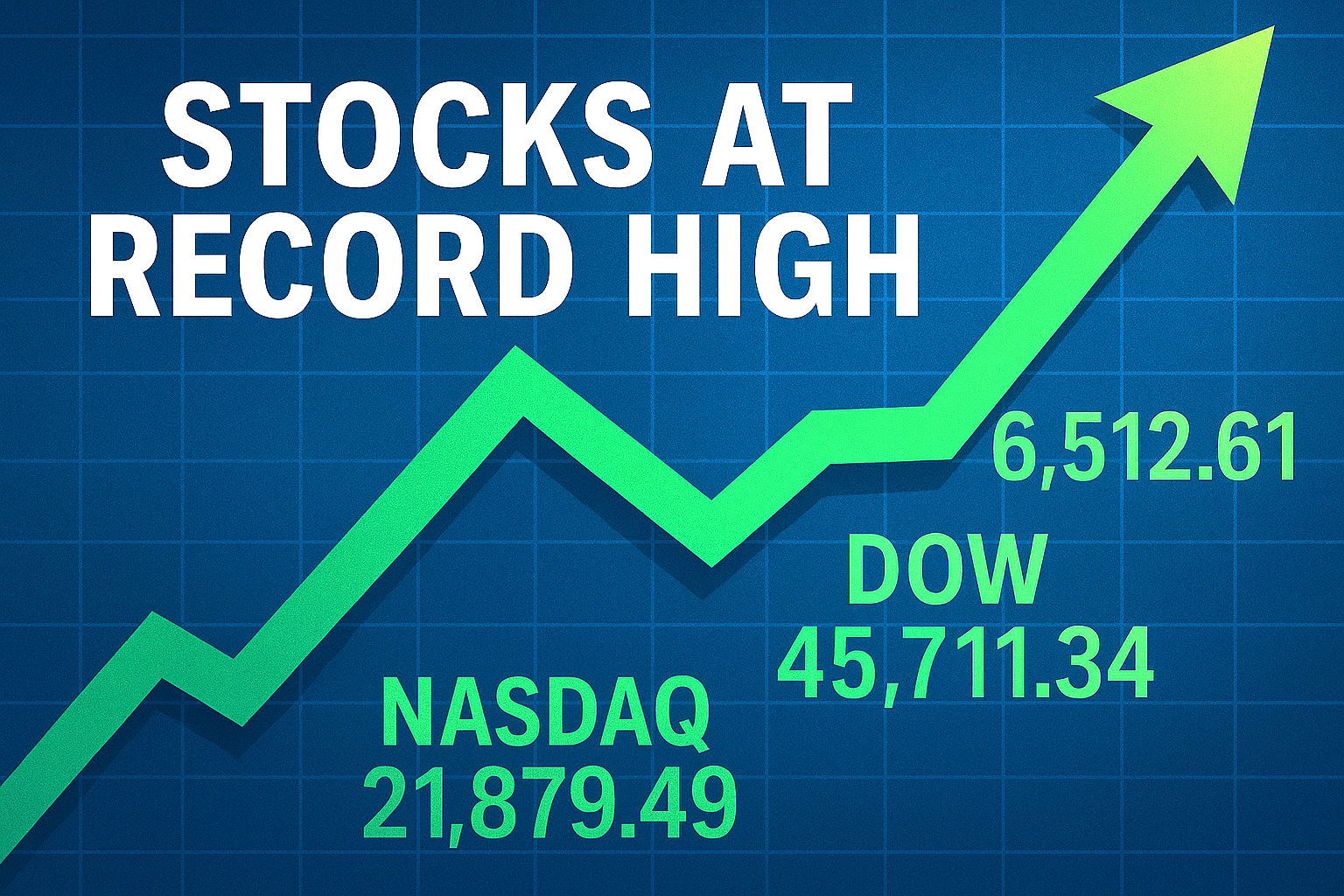
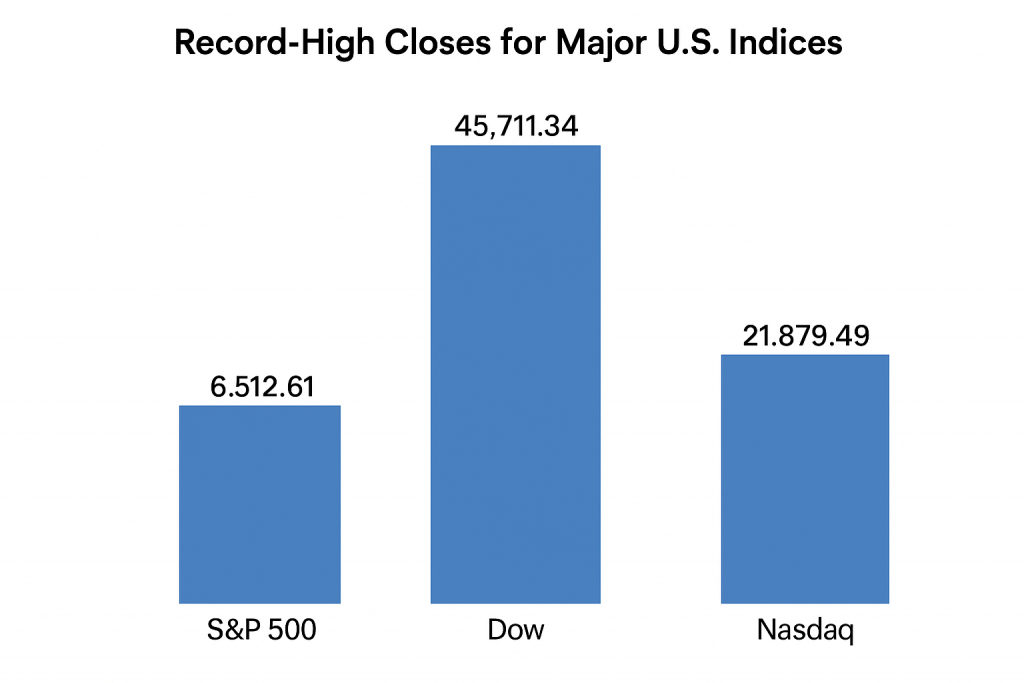
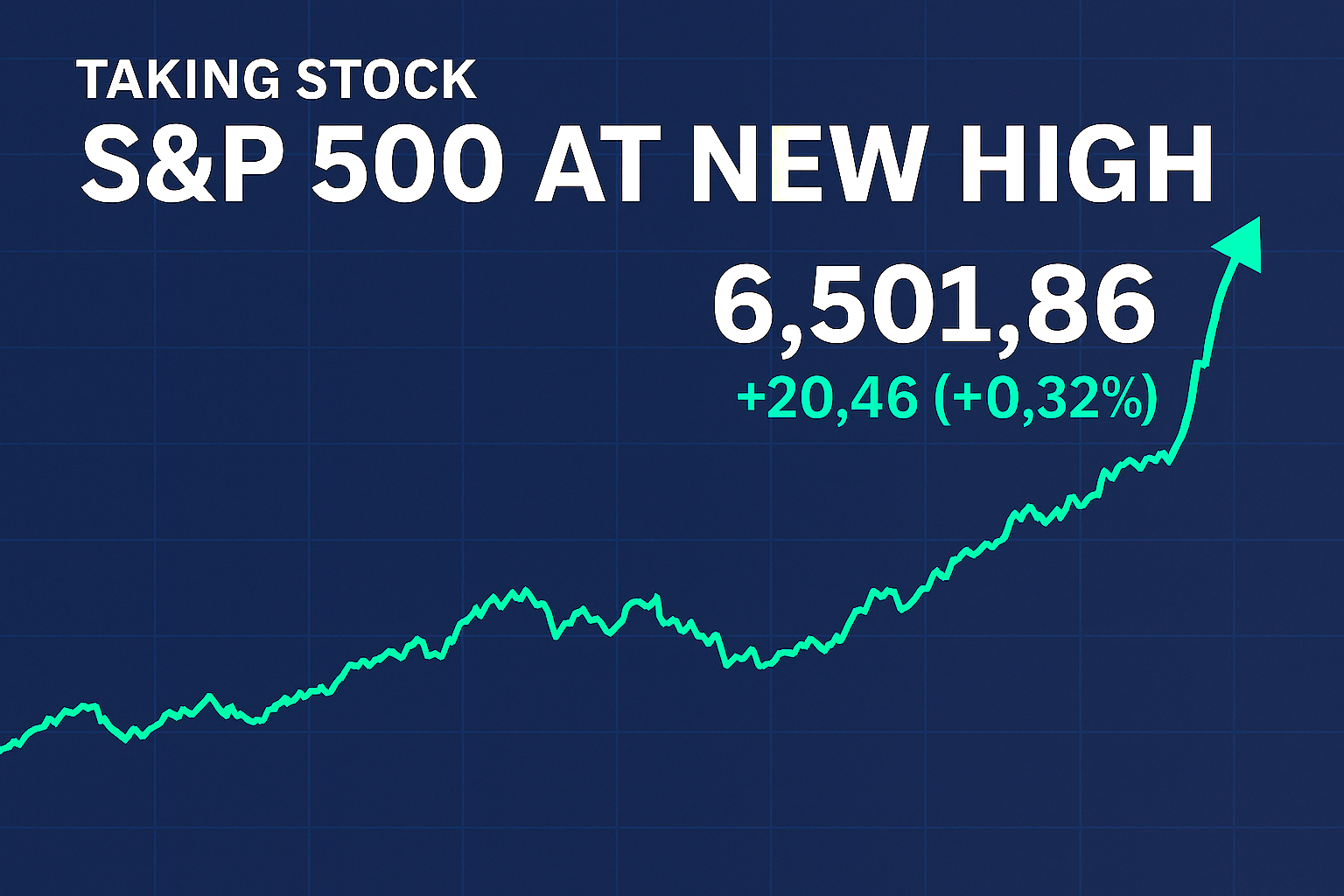
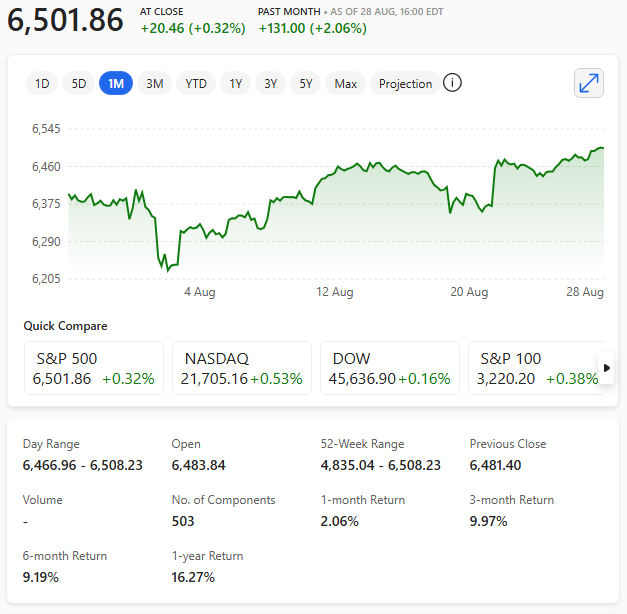
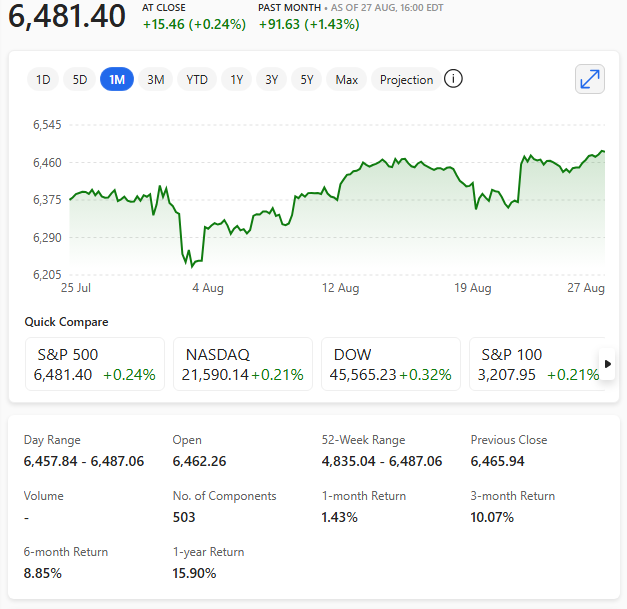
The S&P 500 closed at a fresh all-time high of 6,481.40, on 27th August 2025, marking a milestone driven largely by investor enthusiasm around artificial intelligence and anticipation of Nvidia’s earnings report.
This marks the index’s highest closing level ever, surpassing its previous record from 14th August 2025.
Here’s what powered the rally
🧠 AI Momentum: Nvidia, which now commands over 8% of the S&P 500’s weighting, has become a bellwether for AI-driven growth. Despite closing slightly down ahead of its earnings release, expectations for ‘humongous revenue gains’ kept investor sentiment buoyant.
💻 Tech Surge: Software stocks led the charge, with MongoDB soaring 38% after raising its profit forecast.
🏦 Fed Rate Cut Hopes: Comments from New York Fed President John Williams reportedly hinted at a possible rate cut in September, helping ease bond yields and boost equities.
🔋 Sector Strength: Energy stocks rose 1.15%, leading gains across 8 of the 11 S&P sectors.
S&P 500 at all-time record 27th August 2025
Even with Nvidia’s post-bell dip, the broader market seems to be pricing in sustained AI growth and a more dovish Fed stance.
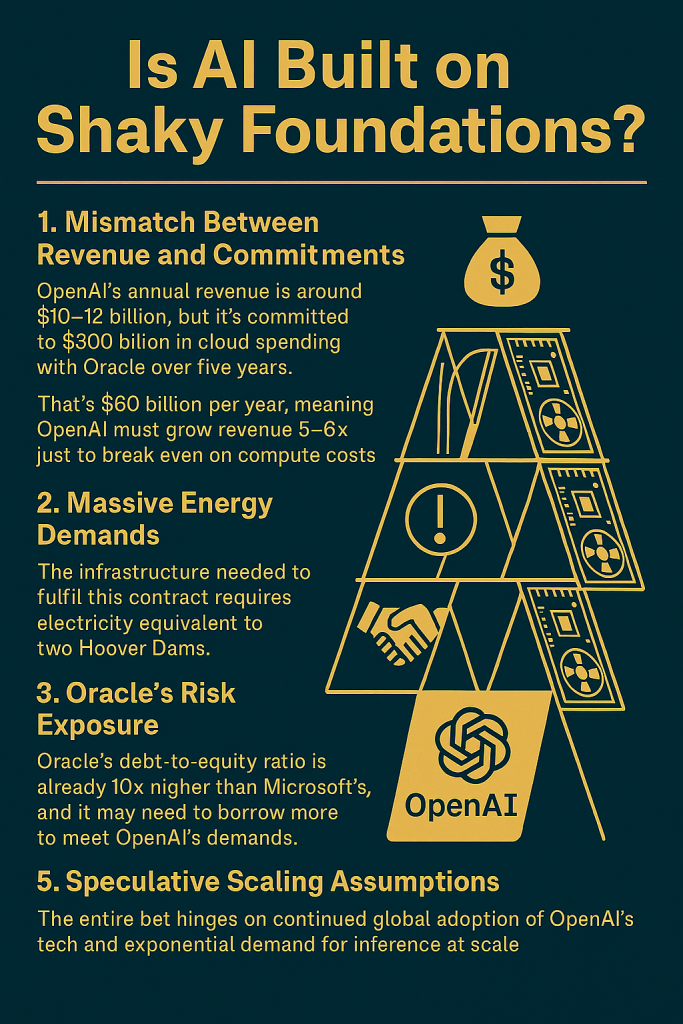
Nvidia forecasts decelerating growth after a two-year AI Boom. A cautious forecast from the world’s most valuable company raises worries that the current rate of investment in AI systems might not be sustainable.
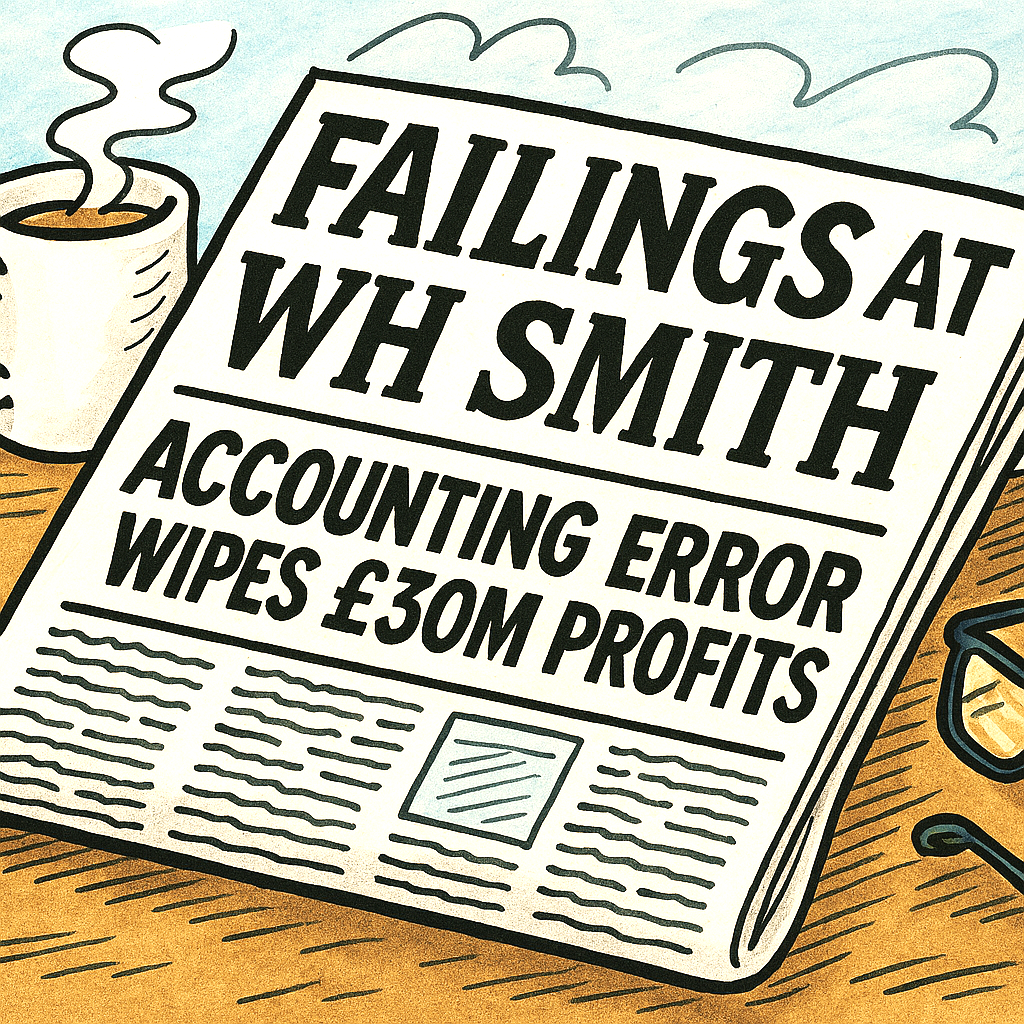
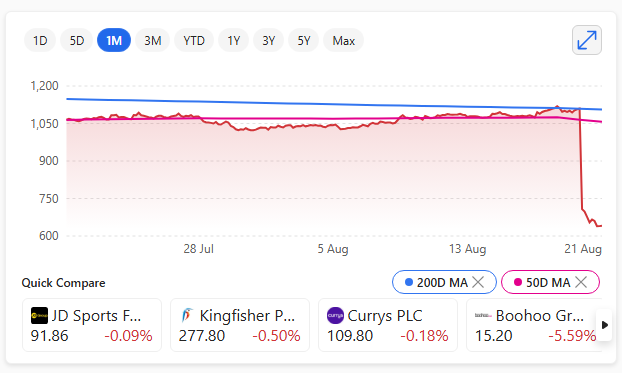
WH Smith’s attempt to reinvent itself as a sleek, travel-focused retailer has hit turbulence, with a £30 million profit overstatement in its North American division sending shares into a 42% nosedive.
The error, stemming from premature recognition of supplier income, has triggered a full audit review and left investors ‘sobbing into their cornflakes’, as one analyst reportedly put it. Not nice!
The timing couldn’t be worse. Having sold off its UK High Street arm earlier this year, WH Smith was banking on its overseas operations to deliver growth.
Instead, the company now expects just £25 million in North American trading profit—less than half its original forecast.
The reputational damage is compounded by the fact that supplier income, often tied to promotional deals, is notoriously tricky to account for.
WH Smith’s misstep suggests not just a lapse in judgement, but a systemic failure in financial controls.
Table of events
Metric
Details
📊 Profit Overstatement
£30 million
🧾 Cause of Error
Premature recognition of supplier income
🇺🇸 Affected Division
North America
📉 Share Price Impact
42% drop
📉 Revised Profit Forecast
£25 million (down from £54 million)
🕵️♂️ Audit Response
Full review initiated by Deloitte
🏪 Strategic Context
WH Smith sold UK High Street arm earlier in 2025
📦 Supplier Income Risk
Often tied to promotional deals; hard to track
This isn’t merely a spreadsheet error—it’s a strategic setback. The retailer’s pivot to travel hubs was meant to offer high-margin stability, buoyed by a captive audience.
But the accounting blunder casts doubt on the robustness of its operational oversight, especially in a market as competitive as the U.S.
With Deloitte now combing through the books, W H Smith faces a long road to restore investor confidence.
For a brand that once prided itself on reliability, this episode is a reminder that even legacy names can falter when ambition outpaces accountability.
W H Smith share price (one-month chart) 21st August 2025
Let’s hope the next chapter isn’t written in red ink.
As BIG tech poaches top AI talent, these companies are stripped to the bone as the tech talent is being hollowed out!
In the race to dominate artificial intelligence, America’s tech giants are vacuuming up talent at an unprecedented pace.
But behind the headlines of billion-dollar acquisitions and flashy AI demos lies a quieter crisis. The creation of ‘zombie companies’ — startups left staggering and soulless after their brightest minds are poached by Big Tech.
These zombie firms aren’t dead, but they’re no longer truly alive either. They continue to operate, maintain websites, and pitch to investors, yet their core innovation engine has stalled. The problem isn’t just brain drain — it’s brain decapitation.
When a startup loses its founding engineers, lead researchers, or visionary product designers to the likes of Google, Meta, or Microsoft, what remains is often a shell with no clear path forward.
The allure is understandable. Big Tech offers salaries that dwarf startup equity, access to massive compute resources, and the prestige of working on frontier models. But the downstream effect is corrosive.
Startups, once the lifeblood of AI experimentation, are now struggling to retain talent long enough to reach product maturity. Some pivot to consultancy, others limp along with outsourced development, and many quietly fold — their IP absorbed, their vision diluted.
This phenomenon is particularly acute in the U.S., where venture capital encourages rapid scaling but rarely protects against talent attrition. The result is a growing class of companies that exist more for optics than output — kept alive by inertia, legacy funding, or the hope of acquisition.
They clutter the innovation landscape, making it harder for truly disruptive ideas to gain traction.
Ironically, Big Tech’s hunger for talent may be undermining the very ecosystem it depends on. By stripping startups of their creative lifeblood, it risks turning the AI sector into a monoculture. This culture is then dominated by a few players, with fewer voices and less diversity of thought.
The solution isn’t simple. It may require new funding models, stronger incentives for retention, or even regulatory scrutiny of talent acquisition practices.
But one thing is clear: if the U.S. wants to remain the global leader in AI, it must find a way to nurture its startups — not just harvest them.
Otherwise, the future of innovation may be haunted by the walking dead.
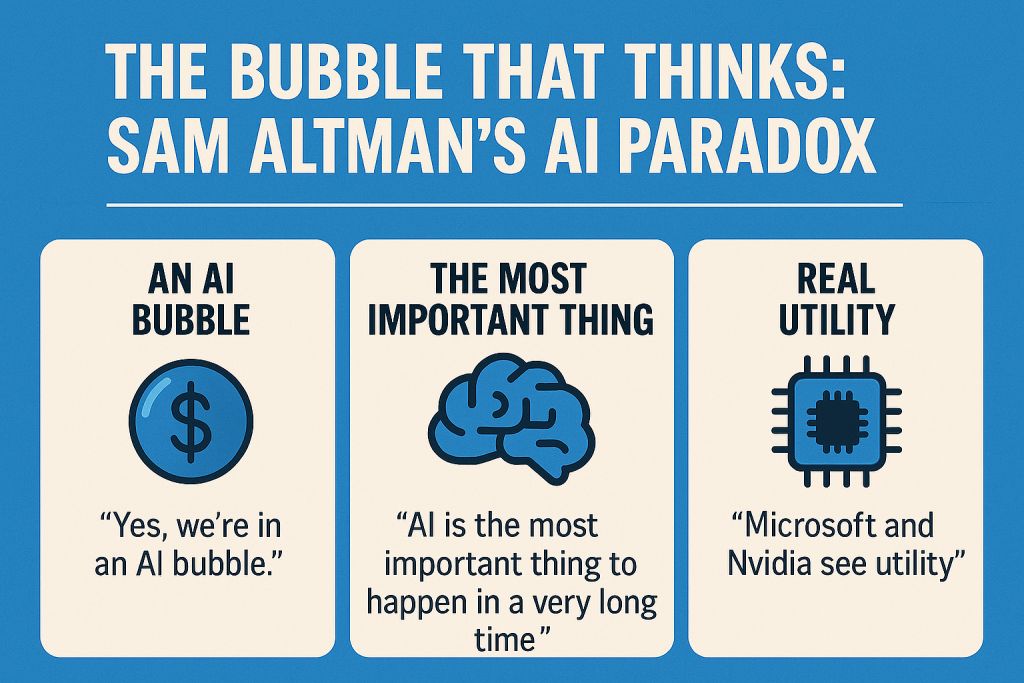
Sam Altman, CEO of OpenAI, has never been shy about bold predictions. But his latest remarks strike a curious chord reportedly saying: ‘Yes, we’re in an AI bubble’.
‘And yes, AI is the most important thing to happen in a very long time’. It’s a paradox that feels almost ‘Altmanesque’—equal parts caution and conviction, like a person warning of a storm while building a lighthouse.
Altman’s reported bubble talk isn’t just market-speak. It’s a philosophical hedge against the frothy exuberance that’s gripped Silicon Valley and Wall Street alike.
With AI valuations soaring past dot-com levels, and retail investors piling into AI-branded crypto tokens and meme stocks, the signs of speculative mania are hard to ignore.
Even ChatGPT, OpenAI’s flagship product, boasts 1.5 billion monthly users—but fewer than 1% pay for it. That’s not a business model—it’s a popularity contest.
Yet Altman isn’t calling for a crash. He’s calling for clarity. His point is that bubbles form around kernels of truth—and AI’s kernel is enormous.
From autonomous agents to enterprise integration in law, medicine, and finance, the technology is reshaping workflows faster than regulators can blink.
Microsoft and Nvidia are pouring billions into infrastructure, not because they’re chasing hype, but because they see utility. Real utility.
Still, Altman’s warning is timely. The AI gold rush has spawned a legion of startups with dazzling demos and dismal revenue. This is likely the Dotcom ‘Esque’ reality – many will fail.
Many are burning cash at unsustainable rates, betting on future breakthroughs that may never materialise. Investors, Altman suggests, need to recalibrate—not abandon ship, but stop treating every chatbot as the next Google.
What makes Altman’s stance compelling is its duality. He’s not a doomsayer, nor a blind optimist. He’s a realist who understands that transformative tech often arrives wrapped in irrational exuberance. The internet had its crash before it changed the world. AI may follow suit.
So, is this a bubble? Yes. But it’s a bubble with brains. And if Altman’s lighthouse holds, it might just guide us through the fog—not to safety, but to something truly revolutionary.
In the meantime, investors would do well to remember hype inflates, but only utility sustains.
And Altman, ever the ‘paradoxical prophet’, seems to be betting on both.
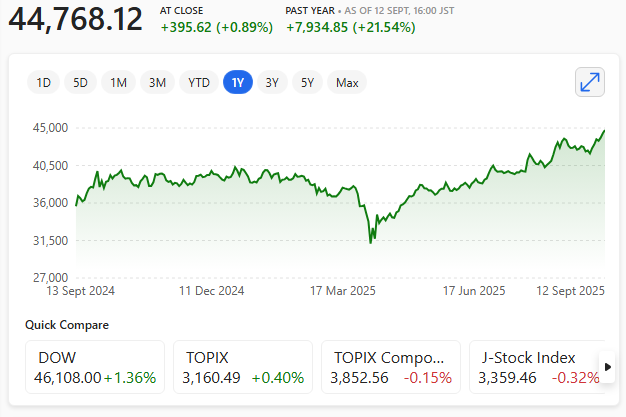
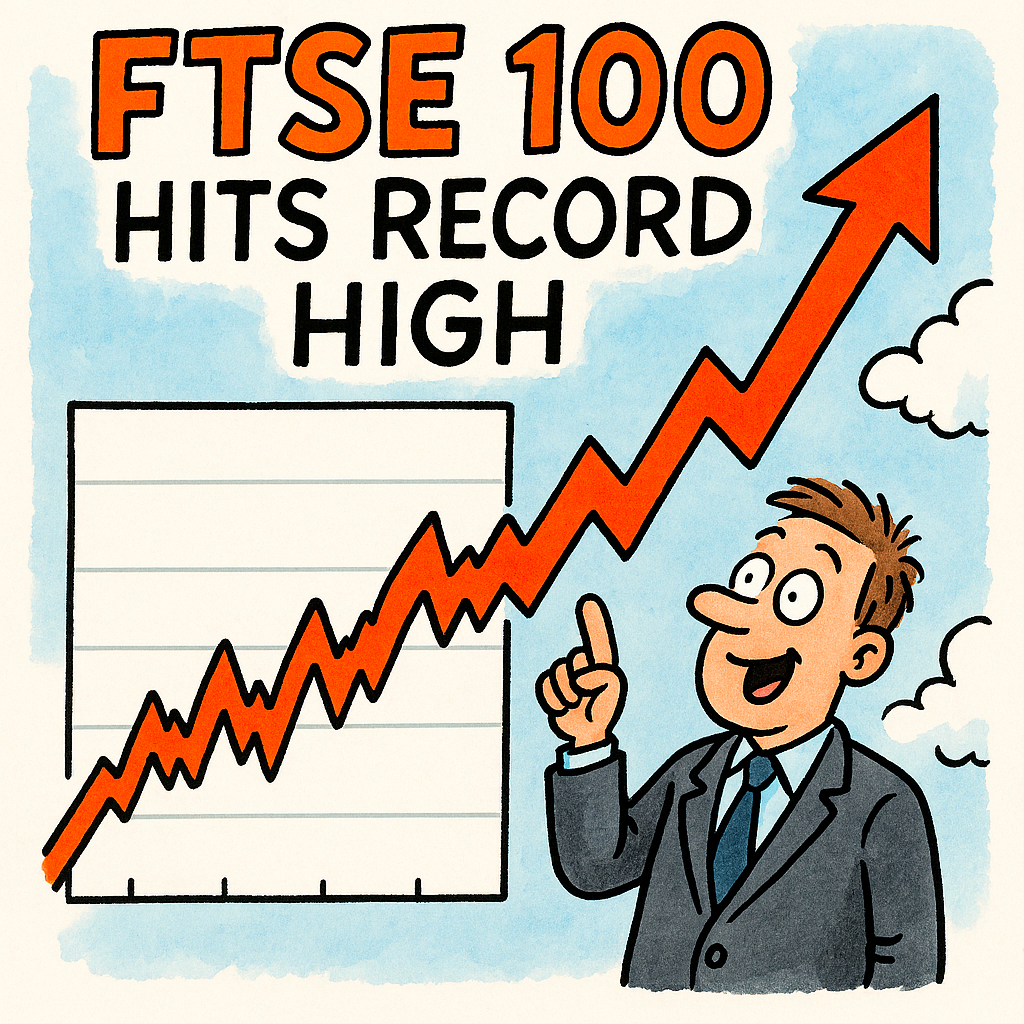
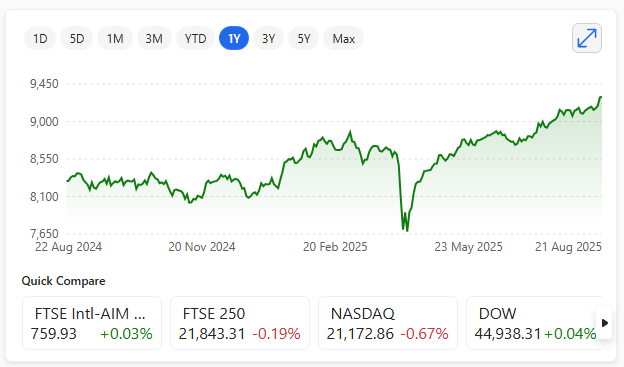
On 20 August 2025, the FTSE 100 hit a new all-time intraday high of 9,301.19, surpassing its previous records.
It closed the day at 9,288.14, up 1.1%—a strong finish despite hotter-than-expected UK inflation and a tech sell-off dragging down Wall Street.
The rally was driven by gains in heavyweight stocks like AstraZeneca, HSBC, Unilever, BAT, RELX, and Lloyds, plus a standout 5.6% surge from ConvaTec Group following its $300 million buyback announcement
FTSE 100 hits new all-time record on 20th August 2025
Where is the standard for the tariff line? Is this fair on the smaller businesses and the consumer? Money buys a solution without fixing the problem!
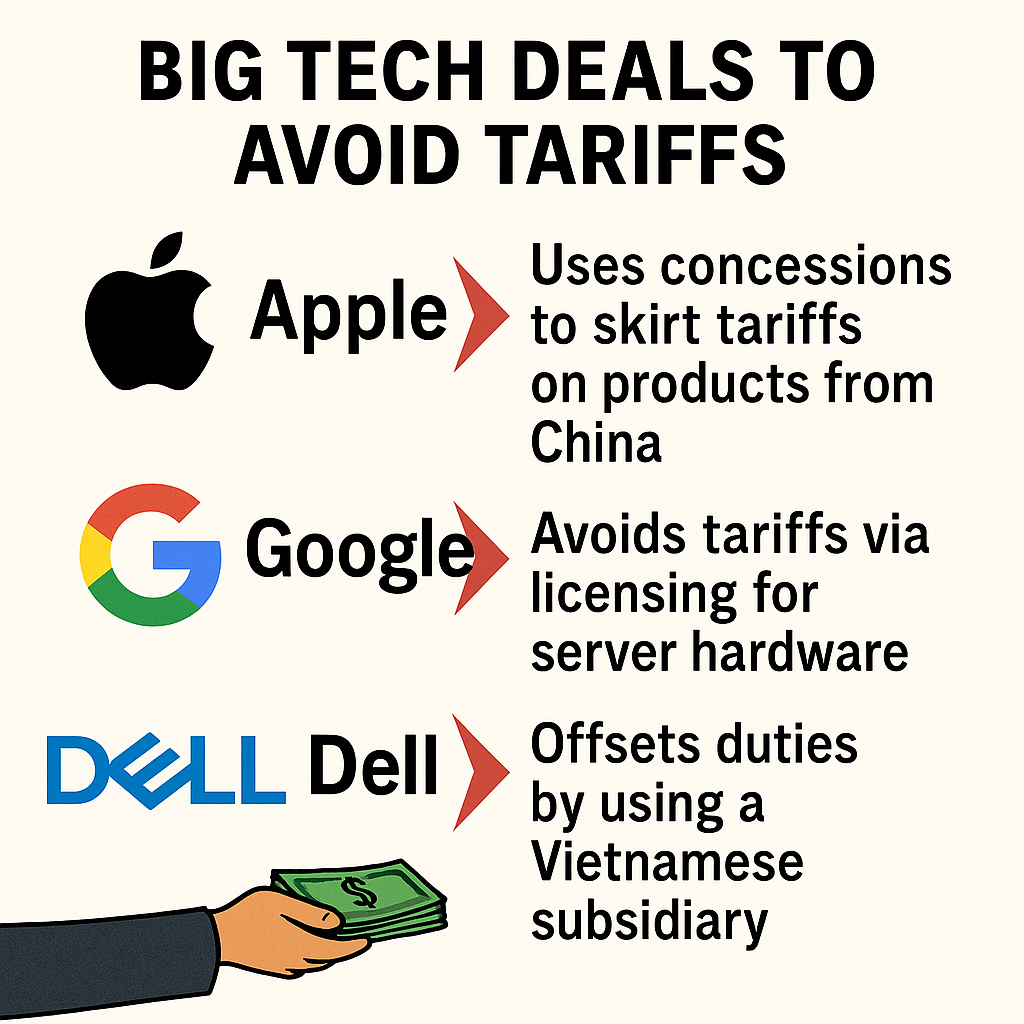
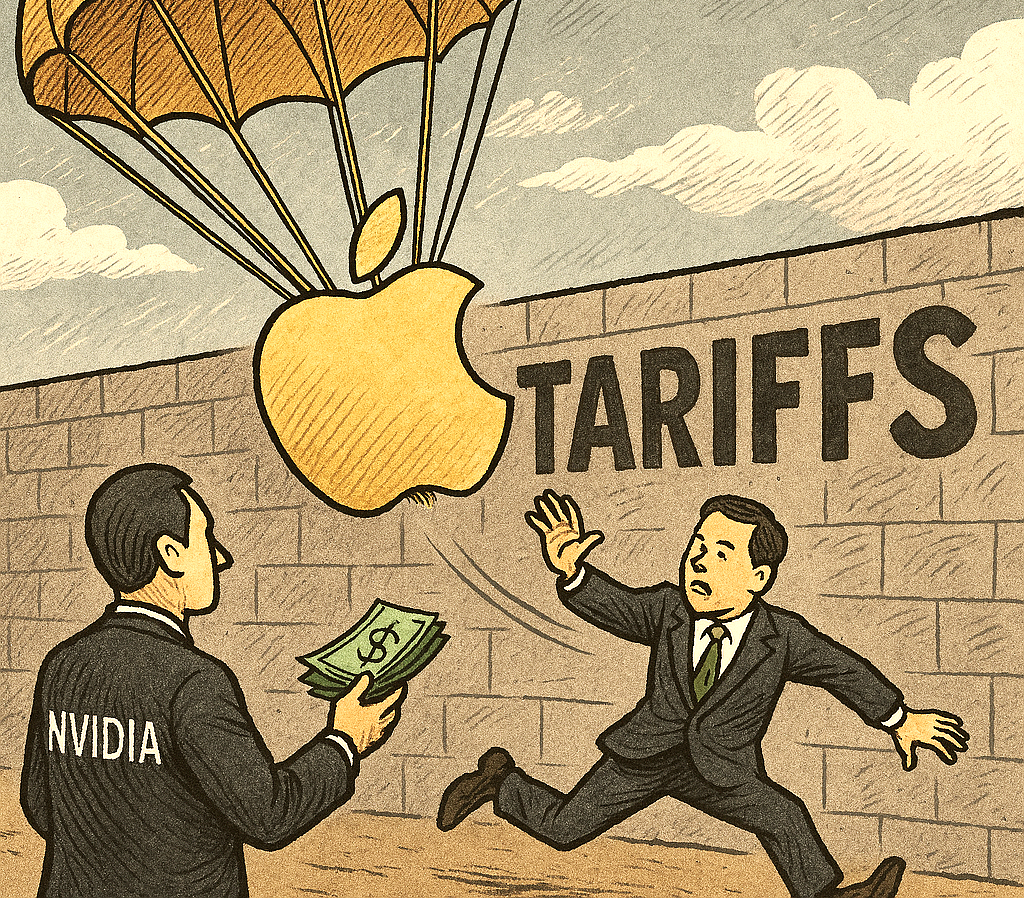
Nvidia and AMD have struck a deal with the U.S. government: they’ll pay 15% of their China chip sales revenues directly to Washington. This arrangement allows them to continue selling advanced chips to China despite looming export restrictions.
Apple, meanwhile, is going all-in on domestic investment. Tim Cook announced a $600 billion U.S. investment plan over four years, widely seen as a strategic move to dodge Trump’s proposed 100% tariffs on imported chips.
🧩 Strategic Motives
These deals are seen as tariff relief mechanisms, allowing companies to maintain access to key markets while appeasing the administration.
Analysts suggest Apple’s move could trigger a ‘domino effect’ across the tech sector, with other firms following suit to avoid punitive tariffs.
Tariff avoidance examples
⚖️ Legal & Investor Concerns
Some critics call the Nvidia/AMD deal a “shakedown” or even unconstitutional, likening it to a tax on exports.
Investors are wary of the arbitrary nature of these deals—questioning whether future administrations might play kingmaker with similar tactics.
Big Tech firms are striking strategic deals to sidestep escalating tariffs, with Apple pledging $600 billion in U.S. investments to avoid import duties, while Nvidia and AMD agree to pay 15% of their China chip revenues directly to Washington.
These moves are seen as calculated trade-offs—offering financial concessions or domestic reinvestment in exchange for continued market access. Critics argue such arrangements resemble export taxes or political bargaining, raising concerns about legality and precedent.
As tensions mount, these deals reflect a broader shift in how tech giants navigate geopolitical risk and regulatory pressure.
In a sweeping rally that spanned continents and sectors, major global indices surged to fresh record highs yesterday, buoyed by cooling inflation data,renewed hopes of U.S. central bank rate cuts, and easing trade tensions.
U.S. inflation figures released 12th August 2025 for July came in at: 2.7% – helping to lift markets to new record highs!
U.S. Consumer Price Index — July 2025
Metric
Value
Monthly CPI (seasonally adjusted)
+0.2%
Annual CPI (headline)
+2.7%
Core CPI (excl. food & energy)
+0.3% monthly, +3.1% annual
Despite concerns over Trump’s sweeping tariffs, the U.S. July 2025 CPI came in slightly below expectations (forecast was 2.8% annual).
Economists noted that while tariffs are beginning to show up in certain categories, their broader inflationary impact remains modest — for now.
Global Indices Surged to Record Highs Amid Rate Cut Optimism and Tariff Relief
Tuesday, 12 August 2025 — Taking Stock
📈 S&P 500: Breaks Above 6,400 for First Time
Closing Level: 6,427.02
Gain: +1.1%
Catalyst: Softer-than-expected U.S. CPI data (+2.7% YoY) boosted bets on a September rate cut, with 94% of traders now expecting easing.
Sector Drivers: Large-cap tech stocks led the charge, with Microsoft, Meta, and Nvidia all contributing to the rally.
💻 Nasdaq Composite & Nasdaq 100: Tech Titans Lead the Way
Nasdaq Composite: Closed at a record 21,457.48 (+1.55%)
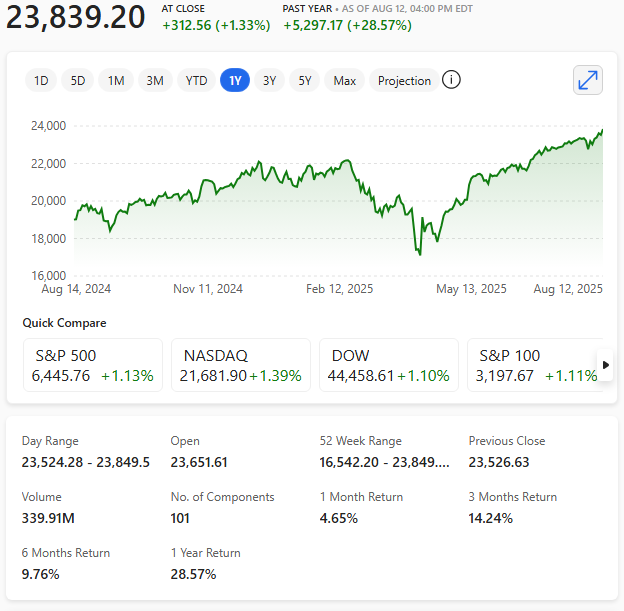
Nasdaq 100: Hit a new intraday high of 23,849.50, closing at 23,839.20 (+1.33%)
Highlights:
Apple surged 4.2% after announcing a $600 billion U.S. investment plan.
AI optimism continues to fuel gains across the Magnificent Seven stocks.
Nasdaq 100 chart 12th August 2025
🧠 Tech 100 (US Tech Index): Momentum Builds
Latest High: 23,849.50
Weekly Gain: Nearly +3.7%
Outlook: Traders eye a breakout above 24,000, with institutional buying accelerating. Analysts note a 112% surge in net long positions since late June.
🇯🇵 Nikkei 225: Japan Joins the Record Club
Closing Level: 42,718.17 (+2.2%)
Intraday High: 43,309.62
Drivers:
Relief over U.S. tariff revisions and a 90-day pause on Chinese levies.
Strong earnings from chipmakers like Kioxia and Micron.
Speculation of expanded fiscal stimulus following Japan’s recent election results.
🧮 Market Sentiment Snapshot
Index
Record Level Reached
% Gain Yesterday
Key Driver
S&P 500
6,427.02
+1.1%
CPI data, rate cut bets
Nasdaq Comp.
21,457.48
+1.55%
AI optimism, Apple surge
Nasdaq 100
23,849.50
+1.33%
Tech earnings, institutional buying
Tech 100
23,849.50
+1.06%
Momentum, bullish sentiment
Nikkei 225
43,309.62
+2.2%
Tariff relief, chip rally
📊 Editorial Note: While the rally reflects strong investor confidence, analysts caution that several indices are approaching technical overbought levels.
The Nikkei’s RSI, for instance, has breached 75, often a precursor to short-term pullbacks.
Despite the scale and aggression of Donald Trump’s 2025 tariff attack—averaging approximately 27% and targeting nearly 100 countries—financial markets have shown a surprisingly muted response.
Here’s a breakdown of why that might be
🧠 1. Markets Have Priced in the Chaos
Trump’s protectionist rhetoric and erratic trade moves have been a fixture since his first term. Investors have grown desensitized to tariff threats and now treat them as part of the geopolitical noise.
The April ‘Liberation Day’ announcement triggered initial volatility, but subsequent delays, exemptions, and partial deals (e.g. with the UK, EU, Japan) softened the blow.
🧮 2. Selective Impact and Exemptions
Tariffs are not blanket: electronics, smartphones, and some pharmaceuticals are exempt.
Countries like the UK and Australia face relatively low rates (10%), while others like Brazil and Switzerland are hit harder (50% and 39%).
For India, even the steep 50% tariff affects only 4.8% of its global exports.
🔄 3. Supply Chain Adaptation
Companies are already pivoting manufacturers are reshoring or shifting production to tariff-friendly countries like Vietnam and Bangladesh.
Agri-tech and automation investments are helping offset cost pressures in affected sectors.
💰 4. Short-Term Pain, Long-Term Strategy
The US expects $2.4 trillion in tariff revenue by 2035, despite $587 billion in dynamic losses.
Investors are recalibrating portfolios toward resilient sectors (semiconductors, automation) and geographic diversification.
🧊 5. Political Fatigue and Uncertainty Premium
Trump’s tariff moves are seen as political theatre, especially with his threats often followed by renegotiations or delays.
Markets may be holding back deeper reactions until retaliatory measures (especially from China) fully materialise.
Where now?
These tariffs spanned sectors from automotive and pharmaceuticals to semiconductors—where a 100% duty was imposed unless firms manufactured in the U.S.
While Trump framed the measures as a push to revive domestic industry and reduce trade deficits, critics argued they were legally dubious and economically disruptive, with a federal court later ruling them unconstitutional.
Despite the aggressive scope, global markets showed surprising resilience, suggesting investors had grown desensitised to Trump’s brinkmanship and were instead focusing on broader economic signals.
There are increasingly credible signs that U.S. stocks may be heading into a deeper adjustment phase.
Here’s a breakdown of the key indicators and risks that suggest the current stumble could be more than a seasonal wobble. It’s just a hypothesis, but…
S&P 500 clinging to its 200-day moving average: While the long-term trend remains intact, short-term averages (5-day and 20-day) have turned negative.
Volatility Index (VIX) rising: A 7.61% surge in the 20-day average VIX suggests growing unease, even as prices remain elevated.
Diverging ADX readings: The S&P 500’s ADX (trend strength) is weak at 7.57, while the VIX’s ADX is strong at 45.37—classic signs of instability brewing.
🧠 Sentiment & Positioning: Optimism with Defensive Undercurrents
Investor sentiment is bullish (40.3%), but rising put/call ratios and a complacent Fear & Greed Index hint at hidden caution.
Historical parallels: Similar sentiment setups preceded corrections in 2021 and 2009. We’re not at extremes yet, but the complacency is notable.
🌍 Macroeconomic Risks: Tariffs, Fed Policy, and Structural Headwinds
Tariff escalation: Trump’s recent executive order raised effective tariffs to 15–20%, with new duties on rare earths and tech-critical imports.
Labour market weakening: July’s jobs report showed just 73,000 new jobs, with massive downward revisions to prior months. Unemployment ticked up to 4.2%.
Fed indecision: The central bank is split, with no clear path on rate cuts. This uncertainty is amplifying volatility.
Structural drag: Reduced immigration and R&D funding are eroding long-term growth potential.
🛡️ Strategic Implications: How Investors Are Hedging
Defensive sectors like utilities, healthcare, and gold are gaining traction.
VIX futures and Treasury bonds are being used to hedge against volatility.
Emerging markets with trade deals (e.g., Vietnam, Japan) may outperform amid global realignment.
🗓️ Seasonal Weakness: August and September Historically Slump
August is the worst month for the Dow since 1988, and the second worst for the S&P 500 and Nasdaq.
Wolfe Research reportedly notes average declines of 0.3% (August) and 0.7% (September) since 1990.
While the broader market still shows resilience—especially in mega-cap tech—the underlying signals point to fragility.
Elevated valuations, weakening macro data, and geopolitical uncertainty are converging. A deeper correction isn’t guaranteed, but the setup is increasingly asymmetric: limited upside, growing downside risk.
President Donald Trump has announced a sweeping 100% tariff on imported semiconductors and microchips—unless companies are actively manufacturing in the United States.
The move, unveiled during an Oval Office event with Apple CEO Tim Cook, is aimed at turbocharging domestic production in a sector critical to everything from smartphones to defence systems.
Trump’s vow comes on the heels of Apple’s pledge to invest an additional $100 billion in U.S. operations over the next four years.
While the tariff exemption criteria remain vague, Trump emphasised that firms ‘committed to build in the United States’ would be spared the levy.
The announcement adds pressure to global chipmakers like Taiwan Semiconductor (TSMC), Nvidia, and GlobalFoundries, many of which have already initiated U.S. manufacturing projects.
According to the Semiconductor Industry Association, over 130 U.S.-based initiatives totalling $600 billion have been announced since 2020.
Critics warn the tariffs could disrupt global supply chains and raise costs for consumers, while supporters argue it’s a bold step toward tech sovereignty.
With AI, automotive, and defence sectors increasingly reliant on chips, the stakes couldn’t be higher.
Whether this tariff threat becomes a turning point or a trade war flashpoint remains to be seen.
Trump has a habit of unravelling as much as he ‘ravels’ – time will tell with this tariff too.
Taiwan Semiconductor Manufacturing Co. (TSMC), the world’s largest contract chipmaker, on 5th August 2025 has reportedly uncovered a serious internal breach involving its 2-nanometer chip technology, one of the most advanced processes in the semiconductor industry.
🔍 What Happened
TSMC detected unauthorised activities during routine monitoring, which led to the discovery of potential trade secret leaks.
Several former employees are suspected of attempting to access and extract proprietary data related to the 2nm chip development and production.
The company has reportedly taken strict disciplinary action, including terminations, and has initiated legal proceedings under Taiwan’s National Security Act, which protects core technologies from unauthorized use.
🧠 Why It Matters
The alleged leak doesn’t just constitute corporate espionage—it has strategic implications. Taiwan’s National Security Act categorises such breaches under core tech theft, permitting aggressive legal action and severe penalties.
With chip supremacy increasingly viewed as a geopolitical asset, this saga is more than just workplace misconduct—it’s a digital arms race.
The 2nm process is a breakthrough in chip design, offering:
35% lower power consumption
15% higher transistor density compared to 3nm chips
These chips are crucial for AI accelerators, high-performance computing, and next-gen smartphones—markets expected to dominate sub-2nm demand by 2030.
A leak of this magnitude could allow competitors to replicate or leapfrog TSMC’s proprietary methods, threatening its technological edge and market dominance.
Moreover, company design secrets are potentially at stake, and this would seriously damage these businesses as their hard work in R&D is stolen.
⚖️ Legal & Strategic Response
TSMC has reaffirmed its zero-tolerance IP policy, stating it will pursue violations to the fullest extent of the law.
The case is now under legal investigation.
While TSMC’s official line is firm—’zero tolerance for IP breaches’—investors are jittery.
The company’s shares dipped slightly amid concerns about reputational damage and longer-term supply chain vulnerabilities.
Analysts expect limited short-term impact on production timelines, but scrutiny over internal controls may rise.
Wall Street is soaring on artificial intelligence optimism—but underneath the record-breaking highs lies a growing sense of déjà vu.
From stretched valuations and speculative fervour to market concentration reminiscent of the dot-com era, financial analysts and institutional veterans are asking: are we already inside a tech bubble?
Valuations Defying Gravity
At the heart of the rally are the so-called ‘Magnificent Seven’—mega-cap tech firms like Nvidia, Microsoft, Apple and Alphabet—whose forward price-to-earnings ratios have now surpassed even the frothiest moments of the 1999–2001 bubble.
Apollo Global strategist Torsten Slok has reportedly warned that current AI-driven valuations are more ‘stretched’ than ever, citing metrics that exceed dot-com records in both scale and speed.
Nvidia and Microsoft now sit atop the S&P 500 with a combined market cap north of $8 trillion. Yet much of this valuation is being driven by expected future profits—not current ones.
Bulls argue the fundamentals are stronger this time, but even they admit this rally is fragile and increasingly top-heavy.
A Narrow Rally, Broad Exposure
While the S&P 500 has reached historic highs, the gains are increasingly concentrated among just 10 companies—accounting for nearly 40% of the index’s value.
The remaining 490 firms are moving sideways, or not at all. Bank of America’s Michael Hartnett reportedly called it the ‘biggest retail-led rally in history’, pointing to looser trading rules and margin exposure pulling everyday investors into risky tech plays.
In policy circles, reforms allowing private equity in retirement accounts and easing restrictions on day trading are amplifying volatility.
The Trump administration’s push to deregulate retail trading could worsen systemic fragility if investor sentiment turns.
Signs of Speculation
Meme stocks and penny shares are surging again. Cryptocurrency-adjacent firms are issuing AI-branded tokens.
Goldman Sachs indicators show speculative trading activity at levels only previously seen in 2000 and 2021. Yet merger activity remains robust, and consumer spending is strong—two counterweights that bulls cite as proof the rally may be sustained.
The Core Debate: Hype vs. Reality
Is AI the new internet—or just another tech bubble? Or both? It does seem to carry more utility than the early days of the internet did?
The Bubble View: Today’s valuations are divorced from earnings reality, driven by retail exuberance and algorithmic momentum rather than solid fundamentals.
The Bullish Case: Unlike the dot-com era, many of today’s tech firms are cash-rich, profitable, and genuinely transforming industry workflows.
Wells Fargo’s Chris Harvey reportedly believes the S&P 500 could hit 7,007 by year-end—driven by strong margins in tech and corporate earnings resilience.
But even he acknowledges risks if the AI hype fails to materialise into sustainable profit flows.
Bottom Line
Wall Street may be on the brink of another rebalancing moment. Whether this rally evolves into a crash, correction, pullback or a paradigm shift could depend on investor patience, regulatory restraint—and whether tech firms can actually deliver the future they’re pricing in.
Apple has once again defied expectations, posting a record-breaking $94.04 billion in revenue for its fiscal third quarter ending 28th June 2025.
However, not all segments thrived. iPad revenue dipped to $6.58 billion, and wearables saw a decline to $7.4 billion. Still, Apple’s gross margins expanded to 46.5%, and net profit hit $23.4 billion.
Summary
📈 Record SalesApple made $94.04 billion this quarter, its best performance since 2021. That’s a 10% jump from last year.
📱 Best-Selling Product iPhones were the star—bringing in $44.58 billion, up over 13%. Macs also did well, with $8.05 billion in sales.
💼 Services Boom Apple’s apps, subscriptions, and digital content made $27.42 billion, a new high.
📉 Weaker Spots iPad sales fell to $6.58 billion, and wearables (like AirPods and Apple Watch) dropped to $7.4 billion.
💰 Profits & Payouts Apple earned $23.43 billion in profit and will pay shareholders a $0.26 dividend on 14th August.
🌍 Big Changes To avoid tariff issues, Apple is shifting production to places like India and Vietnam. It spent $800 million on tariffs this quarter, with more expected.
🧠 Looking Ahead Apple is going big on AI, with over 20 new features and a smarter Siri on the horizon.
In a landmark moment for the tech industry, Microsoft has officially joined Nvidia in the exclusive $4 trillion market capitalisation club, following a surge in its share price after stellar Q4 earnings.
This accolade achieved on 31st July 2025 marks a dramatic shift in the hierarchy of global tech giants, with Microsoft briefly overtaking Nvidia to become the world’s most valuable company. But for how long?
The rally was fuelled by Microsoft’s aggressive investment in artificial intelligence and cloud infrastructure. Azure, its cloud platform, posted a 39% year-on-year revenue increase, surpassing $75 billion in annual sales.
The company’s Copilot AI tools, now boasting over 100 million monthly active users, have become central to its strategy, embedding generative AI across productivity software, development platforms, and enterprise services.
Microsoft’s transformation from a traditional software provider to an AI-first powerhouse has been swift and strategic. Its partnerships with OpenAI, Meta, and xAI, combined with over $100 billion in planned capital expenditure, signal a long-term commitment to shaping the future of AI utility.
While Nvidia dominates the hardware side of the AI revolution, Microsoft is staking its claim as the platform through which AI is experienced.
This milestone not only redefines Microsoft’s legacy—it redraws the map of pure tech power and reach the company has around the world.
This has been earned over decades of business commitment.
It looks like investor sentiment is shifting away from obsessing over tariffs—though not because they’ve disappeared.
Instead, there’s a growing sense that tariffs may be settling into a predictable range, especially in the U.S., where President Trump signalled a blanket rate of 15–20% for countries lacking specific trade agreements.
Here’s how that’s playing out
🌐 Why Investors Are Moving On
Predictability over Panic: With clearer expectations around tariff levels, markets may no longer treat them as wildcards.
Muted Market Reaction: The recent U.S.-EU trade deal barely nudged the S&P 500 or European indexes after moving the futures initially, signalling tariffs aren’t the hot trigger they once were.
Economists Cooling Expectations: Revisions to tariff impact estimates suggest future trade deals might not generate outsized optimism on Wall Street.
📈 Effects on the Markets
Focus Shift: Investors are turning to earnings—particularly from the ‘Magnificent Seven’ tech giants—and macroeconomic data for momentum.
Cautious Optimism: While stocks haven’t rallied hard, they’re not dropping either. Traders seem to be waiting for a new catalyst, like U.S. consumer strength or signs of a bull phase in certain indexes.
Geopolitical Undercurrents: A new deadline for Russia to reach a peace deal and threats of ‘secondary tariffs’ could still stir volatility, depending on how global partners react.
So, in short tariffs aren’t gone, but they’ve become background noise. Investors are tuning in to the next big signals.
If you’re keeping an eye on retail, tech earnings, or commodity flows, this shift could have ripple effects worth dissecting.
RELX plc stands today as one of the UK’s most quietly formidable global enterprises, a testament to strategic reinvention and technological foresight.
Originally formed in 1993 from the merger of Reed International and Dutch giant Elsevier NV, RELX evolved from a conventional publishing conglomerate into a data-driven, analytics-centric powerhouse.
Reed owned IPC Magazines and published UK comics from 1950’s through to the 1980’s.
The company’s history lies in print—academic journals, legal texts, and trade publications—but its future is unequivocally digital.
Today, RELX operates across four primary segments: Risk, Legal, Scientific & Medical, and Exhibitions. Through subsidiaries such as LexisNexis and Elsevier, it delivers critical decision-support tools to professionals in law, healthcare, insurance, and research.
Notably, more than 80% of its revenue is now derived from digital and data-based services, reflecting both market demand and RELX’s methodical transition away from legacy publishing models.
Its financials underscore this shift. In 2024, RELX reported revenues of *£9.43 billion and net income of *£1.93 billion, with strong margins driven by scalable analytics platforms.
The company currently ranks as the seventh-largest member of the FTSE 100 and reportedly boasts operations in over *180 countries.
RELX YTD chart (GBP)
AI impact
The incorporation of artificial intelligence (AI) has been pivotal. From intelligent legal drafting in Lexis+ AI to conversational medical search via Elsevier’s ClinicalKey AI, RELX deploys AI not just as a productivity tool but as a cornerstone of value creation.
Its proprietary data reserves — legal databases, scientific journals, and risk profiles — offer an unmatched training ground for high-integrity, professional-grade AI models.
However, success in AI comes with responsibility. RELX maintains rigorous governance frameworks to ensure responsible usage, mitigate bias, and comply with evolving privacy laws.
The company faces ongoing scrutiny in high-stakes domains like law and healthcare, but its approach to retrieval-augmented generation and citation-based validation reflects a commitment to safety and transparency.
Looking ahead, RELX is well-positioned to lead the next wave of enterprise AI adoption. As regulatory frameworks tighten and clients demand greater interpretability, RELX’s blend of curated data, ethical oversight, and domain-specific AI could prove a defining advantage.
With planned buybacks of *£1.5 billion and continuing acquisitions in analytics, the company appears both financially robust and strategically attuned to future demands.
Segment
AI Impact
Notes
Legal (LexisNexis)
✅ Transformative
Lexis+ AI enables intelligent drafting, summarisation, and conversational legal search—boosting lawyer productivity and accuracy.
Risk & Analytics
✅ Enhanced Precision
AI tools help insurers and banks detect fraud, assess risk, and comply with regulations more efficiently.
Scientific & Medical (Elsevier)
✅ Smarter Research
Scopus AI and ClinicalKey AI offer summarised insights and conversational search for researchers and clinicians.
Exhibitions (RX)
⚖️ Mixed but improving
AI helps with attendee targeting and logistics, but this segment is less data-driven and more event-dependent. Still, it’s recovering post-pandemic.
Summary
🧠 What RELX Does
RELX provides information-based analytics and decision tools across four major segments:
Risk: LexisNexis Risk Solutions helps insurers, banks, and governments assess fraud, identity, and compliance risks.
Scientific, Technical & Medical (STM): Elsevier delivers research platforms like ScienceDirect and Scopus, serving academics and healthcare professionals.
Legal: LexisNexis Legal & Professional offers legal research, analytics, and workflow tools.
Exhibitions: RX Global runs major trade shows like New York Comic Con and the London Book Fair.
📈 Financial Highlights
2024 Revenue: £9.43 billion, up 3% year-on-year*
Net Income: £1.93 billion*
EBITDA Margin: ~39.5%—a sign of strong operational efficiency*
Digital Dominance: Over 80% of revenue now comes from electronic and data-driven product*
🧬 AI & Innovation
RELX has leaned heavily into AI-powered analytics, especially in legal and risk segments. JPMorgan recently upgraded its legal growth forecast to 10% annually, citing the transformative potential of Agentic AI and tools like Protégé.
🏛️ Market Position
FTSE 100 Rank: 7th largest company by market cap
Global Reach: Serves clients in 180+ countries*
Stock Performance: Up ~120% over five years*
🧩 Strategic Moves
Buybacks: £1.5 billion planned for 2025, with £150 million already completed*
Recent Acquisitions: Two in H1 2025 totaling £61 million, focused on expanding analytics capabilities*.
In summary, RELX exemplifies the art of reinvention—rooted in publishing heritage, powered by digital innovation, and poised to shape the ethical evolution of AI across critical professional fields.
The S&P 500 closed above 6,300 for the first time in history on Monday 21st July 2025, while the Nasdaq Composite notched yet another record, finishing at 20,974.17.
Investor enthusiasm for upcoming tech earnings has eclipsed broader concerns over looming global tariffs, fuelling a rally in major indexes.
Despite marginal losses in the Dow Jones Industrial Average, the tech-heavy Nasdaq rose 0.38% while the S&P 500 climbed 0.14%, buoyed by gains in heavyweights like Meta Platforms, Alphabet, and Amazon.
With over 60 S&P 500 companies having reported so far this earnings season, more than 85% have exceeded expectations, according to FactSet.
S&P 500 and Nasdaq Comp at new record highs 21st July 2025
Alphabet shares advanced over 2% ahead of Wednesday’s results, and Tesla headlines the ‘Magnificent Seven’ group expected to drive the bulk of earnings growth this quarter. And not necessarily for the right reason.
Analysts reportedly expect the group to deliver 14% growth year-on-year, far outpacing the remaining S&P constituents’ average of 3.4%.
S&P 500
Despite tariff tensions simmering — with the U.S. setting a 1st August deadline for levy enforcement — investor sentiment remains bullish.
Bank of America estimates Q2 earnings are tracking a 5% annual increase, suggesting resilience amid geopolitical headwinds.
Strategists warn of potential volatility, as earnings surprises or policy shifts could spark swift market reactions.
Still, some analysts see space for further upside, projecting a potential S&P climb to 6,600 before any meaningful pullback.
As the tech titans prepare to report, all eyes are on whether optimism can keep the rally alive — or if tariffs will return to centre stage.
From FANG stocks, MAG 7 stocks to AI – the tech titans just keep giving.
Since a little after Donald Trump’s declaration of ‘Liberation Day’ and renewed tariff threats, global markets have shown a remarkable degree of indifference.
While equities dipped briefly in April, investors appear increasingly unshaken by the looming 1st August deadline.
Several factors underpin this resilience. First, market participants have grown accustomed to political brinkmanship.
Traders now view tariff announcements as bargaining tools rather than certainties, adopting a wait-and-see approach before pricing in long-term consequences.
The episodic nature of past trade spats has dulled their impact, especially without immediate legislative backing and with Trump often pulling back last minute or extending deadlines.
The media have labelled this … TACO!
TACO – Trump Always Chickens Out: Definition – A satirical acronym coined by financial commentators to describe Donald Trump’s predictable pattern of announcing aggressive tariffs, then softening or delaying them under market pressure.
Second, economic fundamentals remain firm. Corporate earnings continue to surpass expectations, and key indicators—such as job growth and consumer spending—suggest sustained momentum in major economies.
As a result, the tariff narrative has taken a back seat to earnings reports and central bank manoeuvres.
Third, diversification strategies have matured since the 2018–2020 trade wars. Many multinationals have already restructured supply chains, buffered risk through regional trade agreements, and hedged exposure to volatile sectors.
This strategic evolution makes markets less sensitive to unilateral tariff threats, especially if they lack multilateral support.
Analysts note that Trump’s rhetoric still carries weight politically, but the financial world operates on evidence, not headlines. As one strategist quipped, ‘Markets don’t trade on bluster; they trade on impact’.
That’s all very well – but markets can be fickle and reflect sentiment too.
With investors focused on earnings and monetary policy, tariff drama may remain background noise—unless policy becomes policy.
Until then, the markets seem content to roll with it!
The S&P 500 soared to a new all-time closing high of 6297 on Thursday 17th July 2025, lifted by strong earnings from AI chipmakers and upbeat economic data.
Nvidia, Microsoft, and Amazon led the charge, as enthusiasm around artificial intelligence and cloud infrastructure continued to fuel investor appetite.
The rally was supported by June 2025 retail sales, which exceeded expectations, and growing speculation that the Federal Reserve may cut interest rates in September 2025.
The index rose around 0.54% on the day, marking its fifth straight gain and pushing its year-to-date return above 13%.
S&P 500 one-year chart
Meanwhile, the VIX volatility index is around 17 slightly elevated but still well below its long-term average.
This suggests a modest uptick in hedging activity, though overall market sentiment remains confident.
VIX YTD chart
VIX YTD chart
With inflation cooling and tech earnings impressing, the S&P’s breakout sets the stage for a potentially exuberant summer — though analysts caution that valuations are stretched and a pullback could emerge if momentum fades.
Bitcoin hit a new milestone on 14th July 2025, reaching an unprecedented $123,091.61.
This marks the digital currency’s highest level to date, building on months of momentum driven by institutional buying, regulatory optimism, and a flood of capital from exchange-traded funds.
The rally comes amid growing confidence in cryptocurrencies as lawmakers in Washington debate the GENIUS Act, a pivotal piece of legislation that could cement Bitcoin’s role in mainstream finance. Market sentiment has been overwhelmingly bullish, with analysts citing a ‘flight to digital safety’ as global uncertainties mount.
However, since the peak, Bitcoin’s ascent has shown signs of levelling off. Profit-taking among investors appears to have introduced temporary friction, prompting a modest dip in trading volumes.
Several large wallets moved substantial holdings to exchanges, hinting at short-term sell-offs. Yet the decline has been measured, and there’s little indication of widespread panic.
Some traders interpret this plateau not as weakness, but consolidation.
With volatility baked into its DNA, Bitcoin continues to command attention from both seasoned investors and curious newcomers.
Whether it resumes its march toward $125,000 or cools off remains to be seen—but for now, the market is watching, waiting, and calculating its next move.
Despite President Donald Trump’s renewed push for sweeping tariffs, global markets appear unfazed.
Trump issued letters to 14 countries – including Japan, South Korea, and Malaysia—outlining new import levies ranging from 25% to 40%, set to take effect on 1st August 2025. More letters then followed.
Yet, major indices like the FTSE 100 and Nikkei 225 barely flinched, with some even posting modest gains.
So, who’s right—the president or the markets?
Trump insists tariffs are essential to redress trade imbalances and bring manufacturing back to the U.S. The EU also faces higher tariffs.
He’s floated extreme measures, including a 200% tariff on pharmaceuticals and a 50% levy on copper.
His administration argues these moves will strengthen domestic industry and reduce reliance on foreign supply chains.
However, investors seem to be betting on a familiar pattern: Trump talks tough but ultimately softens under pressure. Analysts have dubbed this the ‘TACO’ trade—Trump Always Chickens Out.
His own comments have added to the ambiguity, calling the August deadline ‘firm, but not 100% firm’.
The economic logic behind the tariffs is being questioned. Tariffs are paid by importers—often U.S. businesses and consumers—not foreign governments.
This could lead to higher prices and inflation, especially in sectors like healthcare and electronics. Some economists warn of recessionary risks for countries like Japan and South Korea.
In short, markets may be right to remain calm—for now. But if Trump follows through, the impact could be far-reaching.
With trade negotiations still in flux and only two deals (UK and Vietnam) finalised, the next few weeks will be critical. Investors may be wise not to ignore the warning signs entirely.
Whether this is brinkmanship or a genuine shift in trade policy, the stakes are high—and the clock is ticking.
In a historic moment for global markets, NVIDIA has become the first publicly traded company to reach a staggering $4 trillion market capitalisation, underscoring its pivotal role in the artificial intelligence revolution.
The chipmaker’s shares climbed to an all-time high of $164 this week, fuelled by relentless investor enthusiasm for AI technologies.
Originally known for its graphics processing units (GPUs) tailored to gaming, NVIDIA has transformed into the backbone of the AI boom.
Its high-performance chips now power everything from large language models to autonomous systems, making it indispensable to tech giants like Microsoft, Meta, and Alphabet.
Since the debut of ChatGPT in late 2022, NVIDIA’s stock has surged nearly 900%, outpacing both the broader market and its semiconductor peers.
The company’s meteoric rise is backed by explosive financials. In the first quarter of 2025 alone, NVIDIA reported $44.1 billion in revenue, with its data centre division contributing over 88% of that figure.
Analysts attribute this growth to the insatiable demand for AI infrastructure, with firms investing tens of billions in data centres and cloud computing.
Despite geopolitical headwinds, including export restrictions to China and tariff uncertainties, NVIDIA has demonstrated remarkable resilience.
Its valuation now exceeds the combined worth of the Canadian and Mexican stock markets and is just shy of India’s GDP. It is also larger than the UK’s GDP. Is this valuation sustainable?
As AI continues to reshape industries, from healthcare to finance, NVIDIA stands at the forefront, not just as a chipmaker, but as a symbol of technological ascendancy. Whether this dominance is sustainable remains to be seen, but for now, Wall Street has crowned its new titan.
And with AI showing no signs of slowing, NVIDIA’s ascent may be just the beginning of a new era in market leadership.
But what really is NVIDIA’s true value – is it overpriced?
Many analysts argue that NVIDIA is currently overvalued, at least by traditional metrics. For example, AlphaSpread estimates itsintrinsic value at around $112.25, while its market price hovers near $158, suggesting it’s overvalued by roughly 29%.
Nvidia one-year share price chart at new high as of 9th July 2025
Similarly, a discounted cash flow (DCF) analysis from TheStreet indicates the stock may be worth 8% less than its current price.
But here’s the twist: NVIDIA isn’t just any stock. It’s the dominant force in AI hardware, with over 80% market share in data centre accelerators.
That kind of monopoly in a rapidly expanding sector makes traditional valuation models look a bit… well, quaint.
Some investors argue that its growth trajectory and pricing power justify the premium, especially with AI demand scaling across industries.
Still, others caution that the hype may be outpacing fundamentals. To justify its current valuation, NVIDIA would need to generate over $1.2 trillion in cash flow over the next 20 years—an ambitious target even for a tech titan.
So is it overpriced?
If you’re a value investor, probably yes. If you’re betting on AI transforming the world and NVIDIA staying at the centre of it, maybe not.
When will the companies investing in AI see the returns on their investment?
The U.S. stock market surged into July 2025 with a wave of optimism, as the S&P 500 and Nasdaq 100 both hit fresh all-time highs, while the Dow Jones Industrial Average continued its upward climb.
The S&P 500 closed at 6279, marking its fourth record close in five sessions, and the Nasdaq 100 soared to 22867, fueled by strength in AI and semiconductor stocks.
S&P 500 YTD chart
Nasdaq 100 YTD chart
Driving the rally was a stronger-than-expected June 2025 jobs report, which revealed 147,000 new positions added and an unemployment rate dipping to 4.1%.
This labour market resilience tempered expectations for a near-term Federal Reserve rate cut, but bolstered investor confidence in the economy’s momentum.
Tech giants like Nvidia and Microsoft led the charge, with Nvidia nearing a $4 trillion market cap amid surging demand for AI infrastructure.
Datadog spiked after being added to the S&P 500, and financials like JPMorgan Chase and Goldman Sachs hit lifetime highs.
The Dow, while slightly trailing its tech-heavy peers, posted steady gains and now hovers near its own record territory.
With trade optimism rising and President Trump’s tax-and-spending bill passed, Wall Street enters the holiday weekend riding a wave of bullish sentiment.
Tesla reported just 384,122 vehicle deliveries in Q2 2025 – a noticeable 14% slide year-on-year, and its steepest decline on record.
While some anticipated turbulence, the results managed to slightly exceed analyst expectations, prompting a surprising 5% climb in the stock.
Tesla YTD chart
Tesla YTD chart (July 2025)
So, what’s driving this cooldown in momentum?
🇨🇳 China’s EV powerhouses: BYD alone reportedly registered over 1 million battery-electric sales, outpacing Tesla with fresher and more affordable options.
⏳ Delayed evolution: The promised $25K ‘Model Q’ has yet to appear, leaving Tesla’s aging lineup vulnerable.
⚖️ Demand vs. production imbalance: Tesla built 410,244 cars – more than it sold – indicating inventory build-up.
🗺️ Regional whiplash: European and Chinese demand wavered, though China showed signs of late-quarter recovery.
🧨 CEO controversies: Elon Musk’s high-profile political entanglements, including his stint with the DOGE department and ties to Trump – stirred public backlash and dented brand sentiment.
Still, Wall Street is keeping one eye on Tesla’s future bets: autonomous driving and robotaxis.
Despite the rough quarter, some analysts argue that the dip could mark a cyclical bottom before a strategic pivot.
As U.S. equity markets continue their relentless climb, a growing number of stocks are flashing warning signs through one of the most widely followed technical indicators: the Relative Strength Index (RSI).
Designed to measure momentum, RSI values above 70 typically indicate that a stock is overbought and may be due for a pullback.
As of early July 2025, several high-profile U.S. companies have RSI readings well above this threshold, suggesting that investor enthusiasm may be outpacing fundamentals.
🔍 What Is RSI?
The RSI is a momentum oscillator that ranges from 0 to 100. Readings above 70 suggest a stock is overbought, while readings below 30 indicate it may be oversold. While not a crystal ball, RSI is a useful tool for identifying potential reversals or pauses in price trends.
🚨 Top 5 Overbought U.S. Stocks (as of 1st July 2025)
These companies have benefited from the ongoing AI and biotech booms, with Nvidia and AMD riding the wave of demand for next-gen chips, while Alnylam and Circle Internet Group have surged on strong earnings and innovation in their respective sectors.
📊 RSI Snapshot: Top 10 U.S. Stocks by RSI
Rank
Company
Ticker
RSI
Sector
1
Nvidia
NVDA
84.3
Semiconductors
2
Super Micro Computer
SMCI
82.7
Hardware
3
AMD
AMD
80.1
Semiconductors
4
Alnylam Pharmaceuticals
ALNY
78.9
Biotech
5
Circle Internet Group
CIRC
77.5
Internet Services
6
Mereo BioPharma Group
MPH
76.4
Biotech
7
AVITA Medical
AVH
75.2
Healthcare
8
Microsoft
MSFT
74.8
Software
9
Lumentum Holdings
LITE
73.6
Optical Tech
10
Workiva
WK
72.9
Cloud Software
📌 What This Means for Investors
While high RSI doesn’t guarantee a drop, it does suggest caution. Stocks like Nvidia and Super Micro may continue to rise in the short term, but their elevated RSI levels imply that momentum could stall or reverse if sentiment shifts or earnings disappoint.
Investors should consider pairing RSI with other indicators – such as MACD, volume trends, and earnings outlooks – before making decisions.
For long-term holders, these signals may simply be noise. But for traders, they’re a flashing yellow light.
In a remarkable show of investor confidence, the S&P 500 and Nasdaq Composite both reached new all-time highs on 30th June 2025.
The markets were buoyed by optimism around easing inflation, resilient corporate earnings, and renewed enthusiasm for the tech sector, especially AI.
The S&P 500 climbed to a record close of 6205, while the Nasdaq soared 1.2% to finish at 22679 marking its fourth consecutive record-breaking session.
S&P 3-month chart
S&P 3 month chart
Traders pointed to stronger-than-expected economic data and dovish commentary from the Federal Reserve as catalysts that reignited appetite for risk.
Tech giants led the charge, with chipmakers and AI-related firms once again at the forefront.
Nvidia, now the world’s most valuable publicly traded company, gained over 2%, while Apple, Microsoft, and Alphabet also notched solid gains.
The technology-heavy Nasdaq has been particularly responsive to momentum in artificial intelligence and next-generation computing, driving its meteoric rise in recent months.
Nasdaq 100 3-month chart
From April 2025 Trump tariff melt-down to new highs in June 2025
Beyond tech, sectors such as consumer discretionary and industrials also saw modest gains, suggesting a broadening of the rally.
Analysts now debate whether this marks the beginning of a sustainable expansion or a potential overheating of equities.
Meanwhile, Treasury yields held steady, and oil prices ticked higher, signalling confidence in continued global demand.
With earnings season on the horizon, market watchers are closely monitoring corporate guidance to gauge whether valuations can justify further upside.
For now, though, the bulls are clearly in control – and Wall Street is basking in green.