Federal Reserve members, in their most recent meeting, gave little indication of cutting interest rates anytime soon, particularly as inflation remains well above their goal of 2%, according to minutes released Tuesday 21st November 2023.
The detail of the meeting held 31st October – 1st November 2023, showed that Federal Open Market Committee (FOMC) members are still concerned that inflation could be stubborn or move higher, and that more may need to be done.
They indicated that policy would need to stay ‘restrictive’ at the very least, inflation is on a convincing move back to the central bank’s 2% goal.
It was reported Friday 17th November 2023 by the city-state’s central bank that Singapore will be piloting the live issuance and use of wholesale central bank digital currencies in 2024.
During the pilot, the Monetary Authority of Singapore, (MAS) will partner with local banks to pilot the use of wholesale CBDCs to facilitate domestic payments.
What is a CBDC?
A CBDC is a digital form of a country’s fiat currency, issued and regulated by the central bank or monetary authority of that country. CBDCs are different from cryptocurrencies, which are decentralized and not backed by any government.
Singapore is one of the countries that has been actively exploring the potential of CBDCs, both for wholesale and retail purposes. Wholesale CBDCs are meant for interbank transactions and cross-border payments, while retail CBDCs are meant for general public use and everyday payments.
CBDC MAS timeline
In November 2021, the Monetary Authority of Singapore (MAS) launched Project Orchid, a retail CBDC project that aims to build the infrastructure and test the use cases for a digital Singapore dollar. The project will explore the concept of purpose-bound digital Singapore dollars, which allow senders to specify how and where the money will be used.
In August 2021, MAS announced Project Dunbar, a wholesale CBDC project that involves the collaboration of the Reserve Bank of Australia, Bank Negara Malaysia, and South African Reserve Bank. The project will develop prototypes of shared platforms for cross-border transactions using multiple CBDC’s.
In June 2021, MAS published a monograph on the economic considerations of a retail CBDC in the Singapore context. The monograph concluded that there is no urgent case for a retail CBDC in Singapore, but MAS wants to be prepared in case the situation changes in the future.
In April 2021, MAS extended the regulatory sandbox for Project Ubin, a wholesale CBDC project that started in 2016. Project Ubin has successfully demonstrated the feasibility of using blockchain technology for clearing and settlement of payments and securities.
Singapore to pilot use of wholesale central bank digital currencies in 2024
In March 2021, MAS joined the Multiple CBDC (m-CBDC) Bridge initiative, a wholesale CBDC project that involves the Bank of Thailand, the Hong Kong Monetary Authority, and the Bank for International Settlements. The project will explore the use of distributed ledger technology to enable real-time cross-border transactions using multiple CBDC’s.
Process
Banks will issue tokenized bank liabilities in the form of claims in balance sheets. Retail customers can then use the tokenized bank liabilities in transactions with merchants, who will then credit these bank liabilities with their respective banks. Tokenization refers to the process of issuing a digital form of an asset on a blockchain.
The CBDC will then be automatically transferred to the merchant as a form of payment during the transaction.
Many central banks are testing and exploring their own digital currencies, includung the UK and U.S.
European Central Bank President Christine Lagarde on Friday 17th November 2023 reportedly said that Europe is now at a critical juncture, with deglobalization, demographics and decarbonization looming on the horizon.
Fragmentation
‘There are increasing signs that the global economy is fragmenting into competing blocs’, she said at the European Banking Congress, according to a transcript.
Focusing on Europe, she said that a continuous decline in the population of working age looks set to start as early as 2025, alongside climate disasters that are increasing every year.
Her answer to these shocks was that massive investment would be needed in a short space of time, requiring what she called a ‘generational effort‘.
Barriers
‘As new trade barriers appear, we will need to reassess supply chains and invest in new ones that are safer, more efficient and closer to home‘, Lagarde reportedly said.
‘As our societies age, we will need to deploy new technologies so that we can produce greater output with fewer workers. Digitalization will help. And as our climate warms, we will need to advance the green transition without any further delays‘.
Shoppers bought less food and fuel in October 2023 as they were hit by rising living costs and poor weather, according to ONS data.
The volume of products sold last month fell by 0.3% to the lowest level since February 2021 when large parts of the UK were in Covid lockdowns. Retail sales had been expected to grow in October 2023.
Demand for other goods was also lower, the ONS reported.
The CNBC/NRF Retail Monitor, which tracks card transactions, also reported a drop in consumer spending in October 2023, with retail sales, excluding autos and petrol/diesel, falling by 0.08%, and core retail, which also removes restaurants, declining by 0.03%.
The report suggested that the consumer took a spending break ahead of the holiday season, amid rising inflation, supply chain disruptions, and labour shortages.
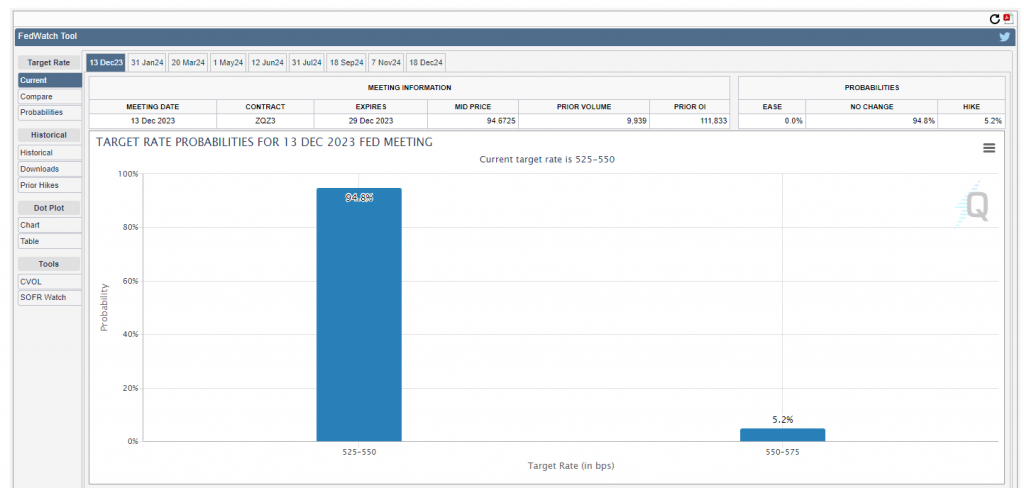
Observing the data available at CME FedWatch the stock market does not seem to expect the Fed to start cutting rates aggressively anytime soon, this opinion is based on the current pricing data of the fed-funds futures market.
According to the CME FedWatch Tool, the probability of a rate cut in the next FOMC meeting on 13th December 2023 is very low. It is likely interest rates will be left unchanged.
The market seems to expect the Fed will hold the current rate of 5.25% until at least March 2024, but will then gradually lower it to 4.75% by December 2024.
The market seems to be more optimistic about the U.S. economic outlook and the Fed’s ability to control inflation. The mood on rates has been buoyed recently with inflation data coming in better than expected.
It is highly likely that the Fed will have to cut rates more aggressively in 2024 and 2025 to stimulate the economy and avoid a potential prolonged recession.
UK inflation fell to 4.6% in October 2023, down from 6.7% in September 2023.
This is the lowest rate of price increases since 2021 and the bigger than expected fall should provide some relief to UK households gripped by the cost-of-living crisis.
The main factors that contributed to the drop in inflation were largely due to lower energy prices, food and non-alcoholic drink prices, and airfares. Economists suggested that the main reason inflation fell from its peak of 11.1% in October 2022 was due to the fall in the energy price cap, which limits what suppliers can charge consumers per unit of energy.
However, the UK still has the highest inflation rate of any G7 country, and some economists warn that the Bank of England (BoE) may need to raise interest rates to prevent inflation from rising again.
Target hit
The UK government will no doubt rejoice today as the end-of-year 5% has been achieved earlier than expected. But don’t party too early, the actual target is 2%. There is a limit to how much credit ministers can take for the fall as energy prices settle.
The FTSE100 was happy, it climbed some 100 points in morning trade.
U.S. Inflation was flat in October from the previous month, providing a positive sign that high prices are finally easing their tight grip on the U.S. economy. Is this also a green light for the Federal Reserve to stop raising interest rates.
The consumer price index (CPI) was flat in October 2023 from the previous month but up 3.2% from a year ago. Both were below analysts’ estimates, sparking a major stock market rally.
Excluding volatile food and energy prices, the core CPI rose 0.2% and 4%, against the forecast of 0.3% and 4.1%. The annual rate was the smallest increase since September 2021.
The flat reading on the headline CPI came as energy prices declined 2.5% for the month, offsetting a 0.3% increase in the food index.
Traders do not anticipate that the Fed will raise interest rates in December 2023, according to data from the CME Group.
Traders do not anticipate that the Fed will raise interest rates in December 2023, according to data from the CME Group.
U.S. Treasury yields fall
U.S. Treasury yields fell on Tuesday 14th November 2023 as key inflation data showed a surprisingly ‘soft’ change in prices last month.
The 10-year Treasury yield fell to about 4.45%. The 2-year Treasury yield fell more to under 4.9%.
Good data
Inflation stabilising, yields falling and equities up – are the stars aligning for a stock market rally leading into Christmas 2023?
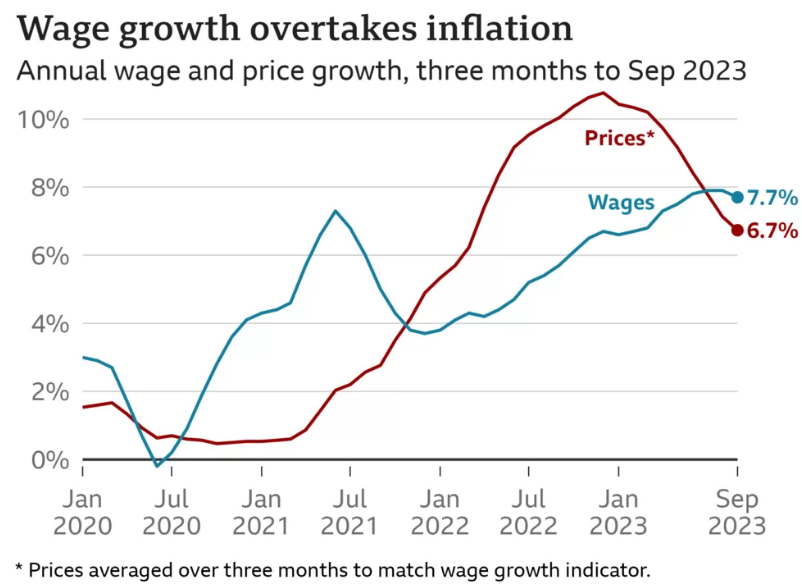
Pay growth has outstripped inflation by the most since 2021, in a further sign that the pressure on living costs may be starting to ease.
Regular pay rose at an annual rate of 7.7% between July and September 2023, official figures show; higher than average inflation over the same three months.
But job vacancies fell for the 16th month in row, in a worrying sign that the jobs market is weakening. Between August and October 2023, the estimated number of vacancies in the UK fell to 957000, down 58000 – although the Office for National Statistics (ONS) said the total remains well above pre-pandemic levels.
Data Source: Office for National Statistics Data
UK pay outstrips inflation by highest amount for two years
The UK’s unemployment rate was largely unchanged between July to September 2023 at 4.2%, according to ONS data.
The U.K. economy flatlined in the third quarter, initial figures showed Friday 10th November 2023.
Gross domestic product (GDP) showed zero quarterly growth in the three months to the end of September 2023, following an increase of 0.2% in the previous quarter. In annual terms, the UK’s Q3 GDP was 0.6% higher than in the same period in 2022.
Services sector output dropped 0.1% on the quarter, but the decline was offset by a 0.1% increase in construction performance, while the production sector flatlined.
U.K. Chancellor of the Exchequer Jeremy Hunt said high inflation remains the ‘single greatest barrier to economic growth’ in the country, with the consumer price index remaining at 6.7% year-on-year in September 2023.
UK economy flatlines as inflation sticks at 6.7% year-on-year as at September 2023.
‘The best way to sustainably grow our economy right now is to stick to our plan and knock inflation on its head’, Hunt reportedly said.
It’s useful to know the government have a plan, even though they were very late to the inflation party! Guess they were sidetracked with all the other parties at No.10!
‘The Autumn Statement will focus on how we get the economy growing healthily again by unlocking investment, getting people back into work and reforming our public services so we can deliver the growth our country needs’.
Up until September 2023, the Bank of England (BoE) raised interest rates 14 consecutive times to try to influence the UK ‘product and service’ price climb.
Red flags
Interest rates are now at a 15-year high of 5.25%, and are expected to remain high for some time to come. Bank Governor Andrew Bailey reportedly said last week it was ‘much too early’ to be considering rate cuts.
Thank you Governor Baily – it so comforting and reassuring to know that the very people who missed the red inflation flags are still in charge of policy.
Transitory?
Remember, the BoE and others originally suggested inflation would be transitory – I suppose it is, if given years to move back down. What did you think was going to happen after all that borrowing and the country crawling back to work after the pandemic.
Nice job guys! Don’t forget to collect your paycheque on the way out!
Moody’s, a credit rating agency, lowered its ratings outlook on the United States to negative from stable.
This means that Moody’s sees a higher risk of a downgrade in the future, which could affect the borrowing costs and confidence of the U.S. government.
Moody’s actions
The main reasons for Moody’s action are the rising deficits and debt levels of the U.S., as well as the continued political polarization that hampers effective policymaking. Moody’s also cited the impact of the Covid-19 pandemic and the recent failures of some U.S. banks as factors that have worsened the environment for the U.S. government and the banking system in general.
Warning!
Moody’s warned that the U.S.’s deficits are likely to remain ‘very large’. It also warned that ‘continued political turmoil or polarization’ in Congress further increases the risk the U.S. will not be able to reach consensus on a fiscal plan to slow the decline in debt affordability‘.
Moody’s still maintains a triple ‘A’ (AAA) credit rating on the U.S. government debt, which is the highest possible rating, but warns of the challenges and uncertainties that the U.S. faces in restoring its fiscal strength and stability.
The ‘AAA‘ rating is at risk.
U.S. government on brink of shutdown, again
The federal government is on the brink of another shutdown, with just a week left for the Republican-led House, Democratic-led Senate and Biden White House to reach a breakthrough on funding.
Fed Chair Jerome Powell reportedly said he and his colleagues remain steadfast in getting policy in line with their 2% inflation target, but ‘we are not confident that we have achieved such a stance’.
He stressed the Fed nevertheless can be cautious as the risks between doing too much and too little have come into closer balance.
Federal Reserve Chairman Jerome Powell reportedly said Thursday 9th November 2023 that he and his fellow policymakers are encouraged by the slowing pace of inflation but are unsure whether they’ve done enough to keep the momentum going.
Inflation battle
Speaking a little more than a week after the central bank voted to hold rates steady, Powell said in remarks aimed at the International Monetary Fund (IMF) gathering in Washington, D.C., that more work could be ahead in the battle against high prices.
The statement comes with inflation still well above the Fed’s long-standing goal but also considerably below its peak levels in the first half of 2022. After 11 U.S. rate hikes, we have witnessed the most aggressive policy tightening since the early 1980s, the FOMC have increased rates from pretty much zero to a range of 5.25%-5.5%.
Those increases have coincided with the Fed’s preferred inflation gauge, the core personal consumption expenditures price index, to fall to an annual rate of 3.7%, from 5.3% in February 2022. The more widely followed consumer price index peaked above 9% in June of last year.
Progress
Powell referenced the progress the economy has made. Gross domestic product (GDP) accelerated at a ‘quite strong’ 4.9% annualised pace Q3 2023, though Powell also said the expectation is for growth to ‘moderate in coming quarters’. He described the economy as ‘just remarkable’ in 2023 in the face of a broad expectation that a recession was inevitable.
Nothing like a massive ‘self-pat’ on the back for a job well-done? Remember the Fed’s initial analysis? IT was for inflation to be ‘transitory’. They didn’t get that right either.
Futures pricing, according to the CME Group, suggested there’s less than a 10% chance that the FOMC will approve a final rate hike at its Dec. 12-13, 2023, meeting, even though committee members in September pencilled in an additional 0.25% rise before the end of 2023.
Impression drawing of Fed Chair. The Fed is ‘not confident’ according to Jerome Powell.
Traders anticipate the Fed will start cutting rates next year, probably around June 2024.
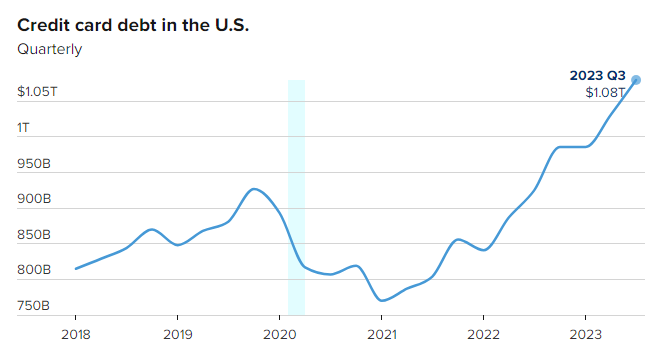
U.S. citizens now owe $1.08 trillion on their credit cards, according to a new report on household debtfrom the Federal Reserve Bank of New York.
U.S. Household Debt Rises to $17.29 Trillion Led by Mortgage, Credit Card, and Student Loan Balances
Total household debt rose by 1.3% to reach $17.29 trillion in the third quarter of 2023, according to the latest Quarterly Report on Household Debt and Credit.
Mortgage balances increased to $12.14 trillion, credit card balances to $1.08 trillion, and student loan balances to $1.6 trillion.
Auto loan balances increased to $1.6 trillion, continuing the upward trajectory seen since 2011. Other balances, which include retail credit cards and other consumer loans, were effectively flat at $0.53 trillion. Delinquency transition rates increased for most debt types, except for student loans.
The market reaction to the U.S. jobs report comes down to a simple observation: bad news is good news, as long as it is not too bad.
Stocks rallied sharply after the Labour Department said nonfarm payrolls rose by 150,000 in October 2023, 20,000 fewer than expected but a difference caused mostly by the auto strikes, which appear to be over – a case of bad news is good news.
For the Federal Reserve, the relatively constrained job creation coupled with wage gains nearly in line with expectations adds up to a scenario in which the central bank doesn’t really have to do anything.
The Fed finally got what it’s been looking for – a meaningful slowdown in the labour market.
South Korea stocks surged on Monday, 6th November 2023 after the country imposed a ban on short selling, while most Asia-Pacific markets took the lead from a lighter than expected U.S. jobs report that helped reduce interest rate expectations.
Financial decision makers in South Korea said short selling will be banned until the end of June 2024. Short selling is when a trader sells borrowed shares to buy back at a lower price and pocket the difference.
There is some evidence that AI could create the next financial crisis, according to some experts and regulators.
AI scenarios
AI could increase the complexity and opacity of financial markets, making it harder to monitor and prevent systemic risks. For example, AI could enable new forms of market manipulation, fraud, or cyberattacks that could destabilize the financial system.
AI could create feedback loops or cascading effects that could amplify shocks and cause contagion across different sectors and regions. For example, AI could trigger flash crashes or sudden liquidity shortages that could spread rapidly and disrupt market functioning.
AI could create new sources of concentration and interdependence that could increase the vulnerability of the financial system. For example, AI could create a reliance on a few dominant data providers, platforms, or models that could fail or malfunction.
AI bots could take control of a stock trading platform or worse a stock exchange.
These are some of the possible scenarios that AI could create the next financial crisis. However, there are many potential benefits and opportunities that AI could bring to the financial sector, such as enhancing efficiency and innovation and even enhancing easier access and personal financial control for millions of investors and savers.
AI could lead to the next financial crash! It could also enhance personal financial control.
The Bank of England (BoE) announced its latest interest rate decision on Thursday, 2nd November 2023 to hold the bank rate at 5.25%.
The Bank of England’s (BoE) Monetary Policy Committee (MPC) voted by a majority of 5-4 to maintain Bank Rate at 5.25%, the highest level in 15 years. However, four members preferred to increase the bank rate, to 5.5%.
The MPC also voted unanimously to reduce the stock of UK government bond purchases held for monetary policy purposes by £100 billion over the next twelve months, to a total of £658 billion.
The BoE’s decision was influenced by the weak economic outlook, the high inflation rate, and the uncertainty surrounding the Covid-19 pandemic and the Brexit saga.
The BoE said that the UK economy was likely to contract by 0.5% in Q3 2023, and that underlying growth in the second half of 2023 was also likely to be weaker than expected. The BoE also warned that there was a 50% chance of a recession in the next year (50/50). I think even I could guess with odds at 50/50.
2% target inflation to be hit by Q2 2025
The BoE also said that inflation, which was 6.7% in September 2023, was expected to peak at around 7% in Q4 2023, before falling back to the 2% target by 2025 Q2. The BoE said that the inflation spike was largely driven by temporary factors, such as higher energy and food prices, and that it would not respond to it.
The Bank of England was behind the curve calling it transitory. Can we trust any future forecasts?
The BoE’s decision was in line with the market expectations, as most analysts and investors had predicted that the BoE would keep rates on hold.
The UK supercomputer project is a major initiative by the UK government to boost the country’s capabilities in artificial intelligence, weather forecasting, climate research and other highly important scientific research projects.
The project involves building and connecting two new supercomputers across the UK: Isambard-AI and Dawn.
Dawn will be a new supercomputer cluster at the University of Cambridge, delivered by a partnership with Dell and UK SME StackHPC. It will be powered by over 1,000 Intel chips that use water-cooling to reduce power consumption. It will target breakthroughs in fusion energy, healthcare and climate modelling.
The UK supercomputer project is part of a £300 million investment from the government to create a new national Artificial Intelligence Research Resource for the country. The project is expected to be completed by summer 2024.
The investment comes as the UK hosts an AI safety summit in Bletchley Park, home of World War II codebreakers.
These announcements are all part of the £1 billion supercomputer plan launched in May 2023.
The U.S. central bank has held its key interest rate at its current 22-year high as it seeks to stabilise price increases, which had recently reached near-record levels.
The Federal Reserve’s rate remains at 5.25%-5.5%.
The bank has been raising interest rates in an attempt to tame the economy and slow inflation, (the rate at which prices rise). Recent data showed the U.S. economy grew faster than expected.
Raising interest rates is a way for central banks tackle rising inflation. The idea is that by raising interest rates and making it more expensive to borrow, consumers will spend less and that would lead to slower price rises. In the U.S. however, the consumer is not slowing down. This may lead to higher rates, or higher for longer which in turn could push the U.S. into a recession.
The bank had faced criticism, with some suggesting that holding interest rates at higher levels could put the U.S. economy at risk of entering a recession.
House prices had the biggest monthly rise in October for more than a year, according to the Nationwide Building Society.
However, they were still down sharply on a year ago, the UK’s biggest building society noted. The rise in prices was most likely due to there not being enough properties to meet demand.
However, activity in the housing market is still extremely slow, as buyers struggle with higher mortgage rates.
Interest rates, which underpin mortgage pricing, have moderated recently but they are still well above the lows of 2021. The Bank of England has raised interest rates from lows of around 0.1% to 5.25% in its inflation battle.
According to the latest data from Eurostat, the statistical office of the European Union, the euro area annual inflation was 2.9% in October 2023, down from 4.3% in September 2023.
The main factor behind the decline in inflation was a sharp drop in energy prices, which fell by some 15% year-on-year in October 2023, compared to a 10.7% decrease in September.
The euro area economy also contracted by 0.1% in the third quarter of 2023, after growing by 0.6% in the second quarter, according to preliminary estimates from Eurostat. This puts the eurozone on the brink of recession, as high interest rates and weak demand weigh on the economic activity.
However, some analysts argue that the ECB’s monetary policy is too tight and risks choking off the recovery. They suggest that the ECB should adopt a more flexible approach and consider cutting rates or expanding its bond-buying programme if the economic outlook worsens.
Core inflation
Core inflation which excludes volatile food and energy prices dropped to 4.2% year-on-year in October 2023 from 4.5% in September 2023, according to European Union statistics agency Eurostat.
The agency also revealed Tuesday that the euro zone economy contracted by 0.1% in the third quarter, according to initial estimates, below consensus estimates for GDP to be unchanged from the previous quarter.
Predicition
The ECB expects the euro zone economy to grow by just 0.7% this year, by 1% in 2024 and 1.5% in 2025.
If the Israel-Hamas conflict further intensifies, the risks to the global economy are growing, economist Mohamed el-Erian reportedly said Monday 30th October 2023.
The impact on global markets was initially limited, as investors viewed the conflict as contained. However, the prospect of a regional spillover has added to a sense of unease.
‘The longer this conflict goes on, the more likely it will escalate. The higher the risk of escalation, the higher the risk of contagion to the rest of the world in terms of economics and finance’, el-Erian said.
The UK government said it intends to bring a number of crypto asset activities under the same regulations that govern banks and other financial services firms.
Regulating a broad suite of crypto activities, such as trading, lending, and custody services.
Strengthening rules for crypto trading platforms and requiring them to have admission and disclosure documents.
Introducing a crypto market abuse regime to prevent manipulation and fraud.
Enhancing oversight of stablecoins, which are digital tokens pegged to fiat currencies or other assets.
The government’s consultation paper is open for feedback until January 31, 2024.
The government said it is committed to embracing technological change and innovation, while mitigating the most significant risks posed by crypto-assets.
According to the latest data from the U.S. Bureau of Economic Analysis, the U.S. GDP grew at a 4.9% annual pace in Q3 of 2023, better than expected.
This was the fastest quarterly advance in nearly two years, driven by robust consumer spending, increased inventories, exports, residential investment and government spending.
Challenges
The U.S. economy faced several challenges in the third quarter, such as high interest rates, inflation pressures, and global headwinds, but still managed to overcome them and show strong growth.
However, some analysts expect a slowdown in the fourth quarter and in early 2024, especially if the Federal Reserve implements another interest rate hike and the housing market remains sluggish and if consumer spending shows signs of slowing.
GDP and Inflation
The GDP report also showed that inflation rose 3.7% in September 2023, down from 9.1% in June, but still above the Fed’s 2% target. The Fed is expected to keep its policy tight and may announce a tapering of its bond-buying program next week.
The Nasdaq is a stock market index that tracks the performance of over 3,000 companies, mostly in the technology sector.
Correction
A correction is a term used to describe a decline of 10% or more from a recent peak in the price of an asset. The Nasdaq entered correction territory on Wednesday 25th October 2023, as it closed at 12,922, which was 10% lower than its previous high of 14,358 on 19th July 2023.
The main reason for the Nasdaq’s correction is believed to be the rise in long-term Treasury yields, which increased the borrowing costs for companies and reduced the attractiveness of growth stocks. The 10-year Treasury yield rose to 4.95% on Wednesday 25th October 2023, the highest level since June 2021. Higher interest rates also make future earnings for tech companies much more difficult.
Disappointing Q3 results
Another factor that contributed to the Nasdaq’s correction was the disappointing third-quarter earnings reports from some of the biggest tech companies, such as Alphabet (Google), Amazon, and Meta (Facebook fame).
These companies reported lower-than-expected revenue growth, profit margins, and cloud computing performance, which weighed on their stock prices and dragged down the Nasdaq. Investors expect more, especially with AI – now the new kid-on-the-block.
Concerns
The Nasdaq’s correction has raised concerns among investors about the outlook for the tech sector and the broader stock market. However, some analysts have argued that the correction could be a healthy and temporary adjustment that creates buying opportunities for long-term investors.
They have pointed out that the Nasdaq is still up 22.5% year-to-date as of Wednesday 25th October 2023, and that the fundamentals of the tech industry remain strong despite the challenges posed by inflation, regulation, yields and competition.
The inflation rate in Argentina is extremely high and has surpassed 100% for the first time since the early 1990’s. The inflation rate for consumer prices in Argentina was 138.28% in September 2023, based on the CPI values for the last 12 months.
This means that the prices of many goods and services have more than doubled since 2022. The main factors that contributed to this increase were the rise in food prices, especially meat, due to adverse weather conditions and a drought, as well as the economic difficulties and policy divisions that have plagued the country for years.
Argentina has been receiving bailout funds from the International Monetary Fund (IMF), but it has not been able to contain inflation, which has eroded the purchasing power of many people and pushed them into poverty.
The inflation rate in Argentina is one of the highest in the world and has a negative impact on its economic growth and social stability.
Map of Argentina
Map of Argentina
Argentina is the second largest country in South America, the fourth largest in the Americas, and the eighth largest in the world.