China’s AI Tech Surge Puts Pressure on America’s AI Dominance

Robots line up for AI battle

For much of the modern AI era, the United States has held a clear advantage in frontier research, compute infrastructure, and commercial deployment.

Silicon Valley’s combination of elite talent, abundant capital, and world‑class semiconductor design created an environment where breakthroughs could scale at extraordinary speed.

Challenge

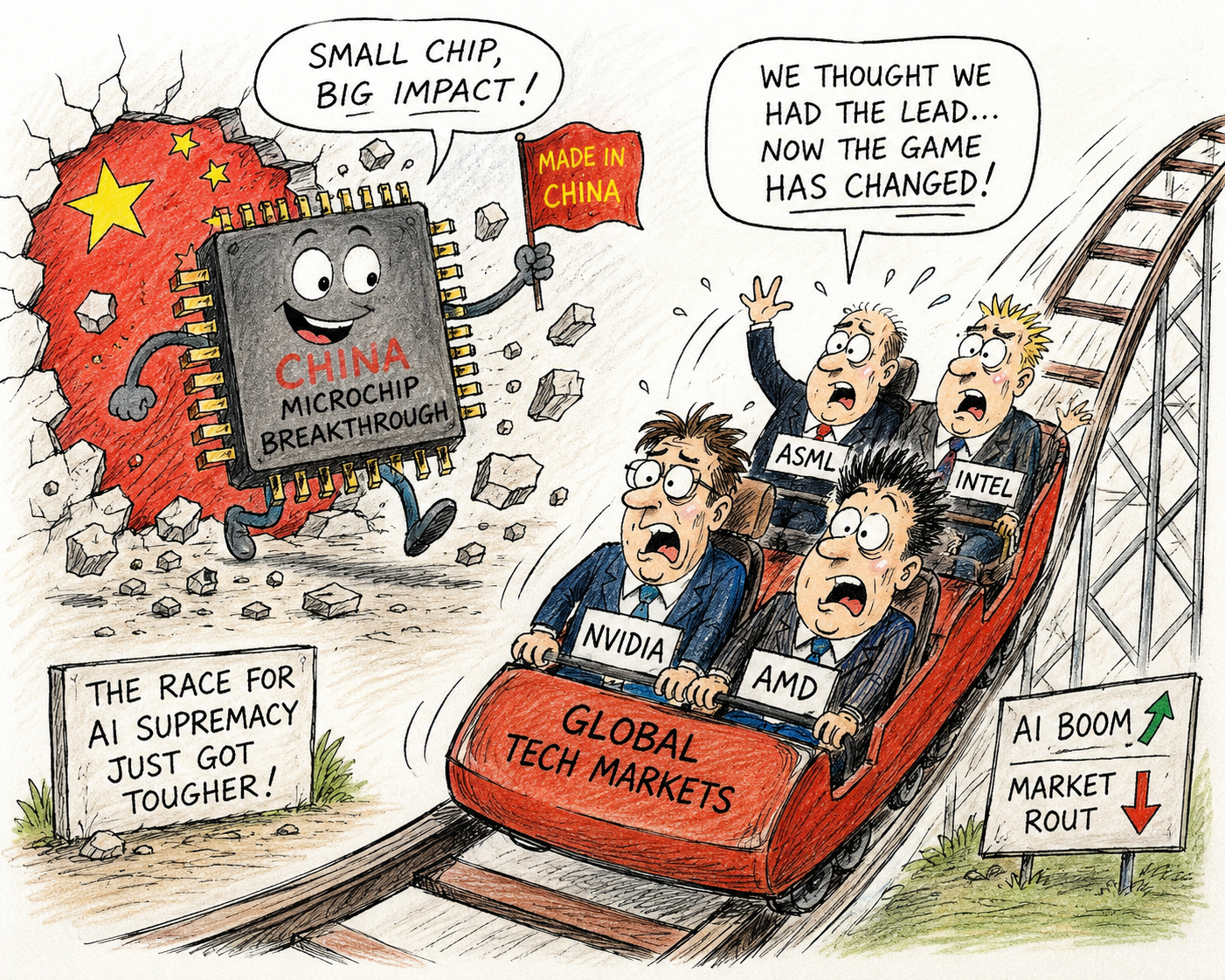
That dominance, however, is no longer uncontested. China’s accelerating push into advanced AI is reshaping the global technological landscape and posing the most credible challenge yet to America’s leadership.

China’s strategy is not built on a single breakthrough but on coordinated national effort. Beijing has spent years aligning universities, state‑backed funds, and private‑sector giants around a shared objective: achieving self‑sufficiency in critical technologies and becoming a global AI powerhouse.

Competitive

Companies such as Huawei, Baidu, Alibaba and Tencent are now producing increasingly competitive large models, while domestic chipmakers are narrowing the performance gap with U.S. suppliers despite export controls.

Crucially, China’s AI ecosystem benefits from scale and cost advantages that the U.S. cannot easily replicate.

Massive data availability, lower energy costs, and vertically integrated supply chains allow Chinese firms to train and deploy models at prices that appeal to developing economies.

For many countries, especially those already reliant on Chinese infrastructure, adopting a Chinese AI stack is becoming a pragmatic economic choice rather than a geopolitical statement.

Investment returns?

This shift is occurring just as U.S. tech giants embark on unprecedented spending cycles. Hyperscalers are pouring hundreds of billions of dollars into data centres, specialised chips, and model training.

The U.S. and its massive BIG Tech Spending Spree – Feeding the AI Habit

While this investment underscores America’s determination to stay ahead, it also raises questions about sustainability.

Investors are increasingly asking whether such vast capital expenditure can deliver long‑term returns in a world where China is offering cheaper, rapidly improving alternatives.

The emerging reality is not one of immediate American decline but of a genuinely multipolar AI landscape. The U.S. still leads in foundational research, top‑tier talent, and cutting‑edge semiconductor design.

Yet China’s rise represents a powerful economy that has mounted a serious challenge to the technological frontier.

The global AI race is no longer defined by a single centre of gravity. Instead, two competing ecosystems — one market‑driven, one reportedly state‑directed — are shaping the future of intelligent technology.

The outcome will influence not only economic power but the digital architecture of much of the world.

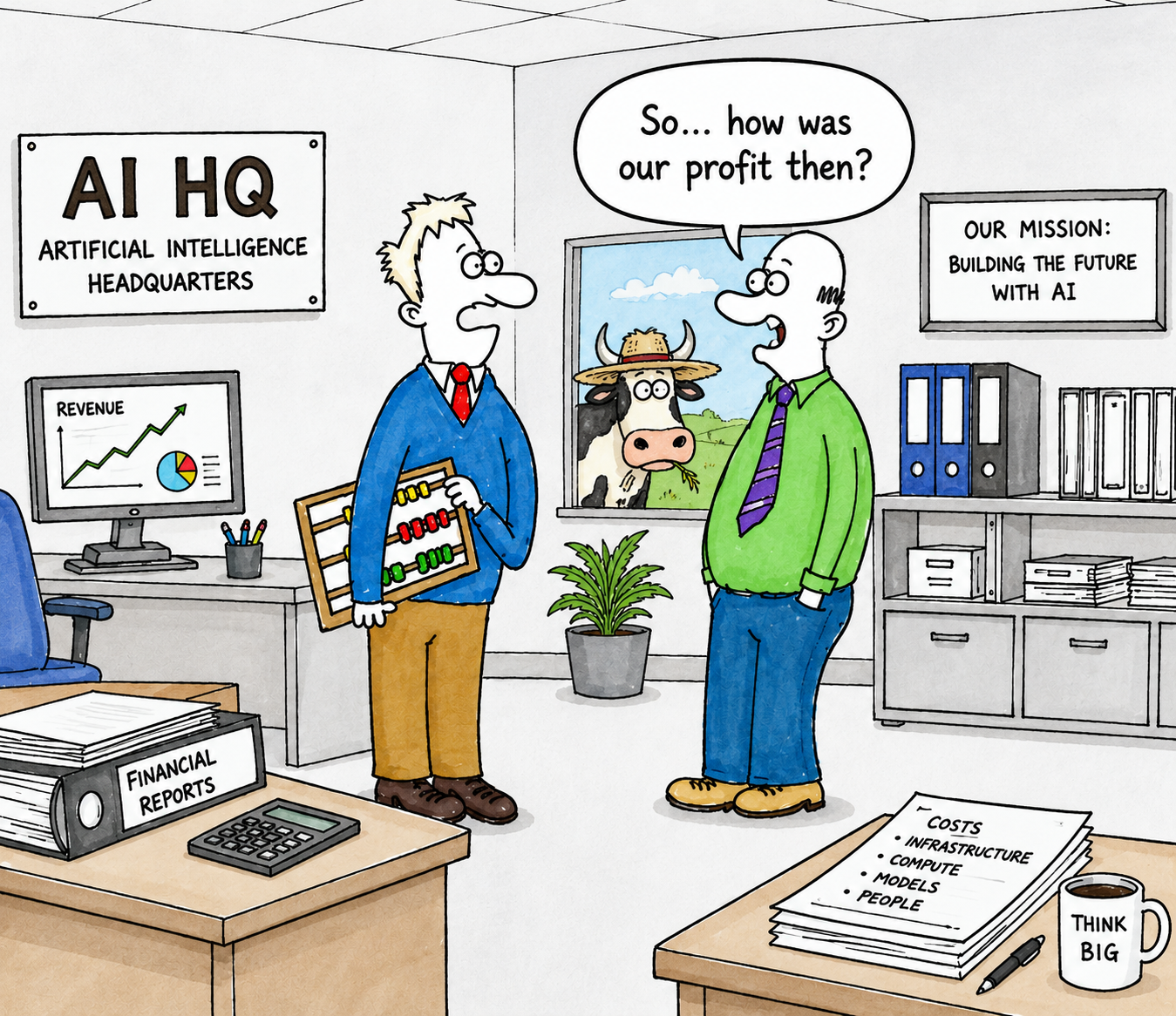
Can Hyperscalers Really Justify Their Colossal AI Capex?

Hyperscalers AI investment

The world’s largest cloud providers are engaged in one of the most expensive technological races in history.

Amazon, Microsoft, Meta and Alphabet are collectively on track to spend as much as $700 billion on AI‑related capital expenditure this year — a figure that rivals the GDP of mid‑sized nations and has understandably rattled investors.

The question now dominating markets is simple: can hyperscalers justify this level of spending, and should analysts remain so bullish on their stocks?

A Binary Bet on the Future of AI

The scale of investment has shifted the AI build‑out from a strategic growth initiative to what some analysts describe as a binary corporate bet. As some analysts suggest, the leap in capex — up roughly 60% year‑on‑year — means the payoff must be both rapid and substantial.

If monetisation fails to keep pace, the consequences could be of severe concern.

This is compounded by the fact that hyperscalers are now consuming nearly all of their operating cash flow to fund AI infrastructure, compared with a decade‑long average of around 40%. That shift alone explains the recent market jitters.

Why Analysts Remain Upbeat

Despite the turbulence, many analysts still argue the long‑term fundamentals remain intact. One reason is that hyperscalers are pre‑selling data‑centre capacity before it is even built, effectively locking in revenue ahead of deployment.

That dynamic supports the bullish view that AI demand is not only real but accelerating.

There is also a belief that as AI tools become embedded across consumer and enterprise workflows, willingness to pay will rise sharply.

If that scenario plays out, today’s eye‑watering capex could look prescient rather than reckless.

The Real Risk: Timelines

The challenge is timing. Much of the infrastructure being deployed — from chips to data‑centre hardware — has a useful life of just three to five years.

That gives hyperscalers a narrow window to recoup investment before the next upgrade cycle hits.

Without clearer monetisation strategies and firmer payback timelines, investor anxiety is likely to persist.

AI capex justification?

Hyperscalers can justify their AI capex — but only if demand scales as quickly as they expect and monetisation becomes more transparent.

Analysts may be right to stay bullish, but the margin for error is shrinking. In the coming quarters, clarity will matter as much as capital.

Baidu brings OpenClaw AI to its search app, unlocking new tools for 700 million users

Baidu and OpenClaw link up

Baidu has begun integrating the fast‑rising AI agent OpenClaw directly into its flagship search app, opening the door for 700 million monthly users to access advanced task‑automation tools just ahead of China’s Lunar New Year holiday.

The move marks one of the company’s most significant consumer‑facing upgrades in years, as competition intensifies among Chinese tech giants racing to commercialise AI at scale.

Until now, OpenClaw — an Austrian‑developed, open‑source agent — was primarily accessed through chat platforms such as WhatsApp and Telegram.

Baidu rollout

Baidu’s rollout means users who opt in will be able to message the agent within the search app to handle everyday digital tasks, from scheduling and file organisation to writing code.

The company is also extending OpenClaw’s capabilities across its wider ecosystem, including e‑commerce and cloud services.

The timing is strategic. Lunar New Year is one of the most competitive periods for user acquisition in China’s internet sector, and Baidu’s rivals are also accelerating their AI deployments.

Alibaba, for example, has woven its Qwen chatbot into platforms such as Taobao and Fliggy, enabling end‑to‑end shopping journeys without leaving the app — a shift that has already generated more than 120 million consumer orders in a six‑day period this month.

Popularity surge

OpenClaw’s surge in popularity reflects a broader trend: AI agents are moving beyond conversational novelty and into practical automation, capable of navigating apps, managing email and performing multi‑step online tasks.

Yet the rapid adoption has also drawn warnings from cybersecurity firms, including CrowdStrike, about the risks of granting such agents deep access to enterprise systems.

For Baidu, the integration signals a clear intent to keep pace with global AI leaders while reinforcing its dominance in China’s search market.

For users, it marks the arrival of a more hands‑on, task‑driven AI era — one embedded directly into the tools they already rely on daily, with instant access to millions of users.

Alphabet’s 100‑Year Bond: Ambition, Appetite and Anxiety in the AI Debt Boom

Alphabet's 100-year Sterling Bond for pensions

Alphabet’s decision to issue a 100-year sterling bond has captured the attention of global markets, not only because of its rarity but also because of what it signals about the escalating competition in artificial intelligence.

100 year sterling bond

A century-long bond denominated in pounds is an extraordinary financing move, particularly for a technology company.

It reflects both investor confidence in Alphabet’s long-term prospects and the scale of capital now required to compete in the AI era.

On the surface, the benefits are clear. Locking in funding for 100 years at today’s rates provides financial certainty. Alphabet can secure vast sums of capital without facing refinancing risk for generations.

In an industry defined by rapid change and enormous upfront costs — from data centres and semiconductor procurement to specialised AI chips and energy infrastructure — patient capital is invaluable.

Sterling

The sterling denomination also diversifies Alphabet’s funding base beyond U.S. dollar markets, potentially appealing to European institutional investors seeking stable, long-duration assets.

The bond may also be interpreted as a strategic signal. By committing to long-term financing, Alphabet demonstrates confidence in its ability to generate cash flows well into the next century.

It reinforces the company’s image as a durable, infrastructure-like enterprise rather than a volatile technology stock.

For investors such as pension funds and insurers, a 100-year instrument from a highly rated issuer can offer predictable returns in a world where long-term yield is scarce.

Cyclical

However, the move is not without shortcomings. Committing to fixed debt obligations over such an extended horizon reduces flexibility. While Alphabet currently enjoys strong balance sheet metrics, the technology sector is notoriously cyclical.

A century is an eternity in innovation terms. Business models, regulatory frameworks and geopolitical dynamics may shift dramatically.

Future generations of management will inherit the obligation, regardless of whether today’s AI investments deliver the expected returns.

More broadly, the bond feeds concern about a debt-fuelled AI arms race. As technology giants pour tens of billions into AI research, chip design and cloud infrastructure, borrowing is becoming an increasingly prominent tool.

If rivals respond with similar long-dated issuance, the sector’s leverage could rise meaningfully. In a downturn or if AI monetisation disappoints; heavy debt burdens could amplify financial strain.

Ultimately, Alphabet’s 100-year sterling bond embodies both ambition and risk. It underlines the immense capital demands of the AI revolution while raising questions about whether today’s competitive fervour is encouraging companies to stretch their balance sheets too far in pursuit of technological dominance.

Systemic anxiety

The deeper anxiety is systemic. With Oracle, Amazon, Microsoft and others also scaling up borrowing, total tech‑sector issuance is projected to hit $3 trillion over five years.

Some analysts warn this resembles a late‑cycle credit boom, where investors chase thematic excitement rather than sober fundamentals.

Alphabet’s century bond may be a masterstroke of timing — or a marker of excess.

Either way, it crystallises the tension at the heart of the AI revolution: extraordinary promise, financed by extraordinary debt.

Why a Sterling Bond?

Alphabet issued its 100‑year sterling bond to tap deep UK demand for ultra‑long‑dated assets, especially from pension funds seeking to match long‑term liabilities.

The sterling market offered strong appetite, with orders reportedly reaching nearly ten times the £1 billion on offer.

It also formed part of Alphabet’s broader multi‑currency fundraising drive to finance massive AI‑related capital spending, including data‑centre expansion.

Issuing in sterling diversified its investor base, reduced reliance on U.S. dollar markets, and signalled confidence in its long‑term stability as a quasi‑infrastructure‑scale business.

It’s all debt; however you look at it!

Alibaba Steps Into ‘Physical AI’ With New Robotics Model

AI robotics model

China’s Alibaba has taken a decisive step into the fast‑emerging field of ‘physical AI’ with the launch of a new foundation model designed specifically to power real‑world robots.

The model, known as RynnBrain*, marks one of the company’s most ambitious moves since restructuring its cloud and research divisions, and signals China’s intention to compete directly with the United States in embodied artificial intelligence.

Unlike traditional large language models, which operate entirely in digital environments, RynnBrain is built to interpret and act within the physical world.

It combines vision, language and spatial reasoning, enabling robots to recognise objects, understand their surroundings and plan multi‑step actions.

DAMO Acadamy

In demonstrations released by Alibaba’s DAMO Academy, the model guided a robot through tasks such as identifying fruit and sorting it into containers — a deceptively simple exercise that requires sophisticated perception and motor control.

The company describes RynnBrain as a ‘general‑purpose embodied intelligence model’, capable of supporting a wide range of robotic applications, from warehouse automation to domestic assistance.

Crucially, Alibaba has opted to open‑source the model, a strategic decision that invites global developers to build on its capabilities and accelerates the creation of a broader ecosystem around Chinese robotics research.

Physical AI

The timing is significant. Over the past year, major technology firms including Google, Nvidia and OpenAI have begun to emphasise physical AI as the next frontier of artificial intelligence.

The shift reflects a growing belief that the most transformative applications of AI will not be confined to screens, but will instead involve machines that can navigate, manipulate and collaborate within human environments.

Alibaba’s entry adds competitive pressure to a field already heating up. While U.S. companies currently dominate embodied AI research, China has made robotics a national priority, viewing it as a strategic industry with implications for manufacturing, logistics and economic resilience.

RynnBrain

By releasing RynnBrain openly, Alibaba positions itself as both a contributor to global research and a catalyst for domestic innovation.

The launch also highlights a broader trend: the convergence of AI models with physical systems. As robots become more capable and more affordable, the line between software intelligence and mechanical action is beginning to blur.

RynnBrain is an early example of this shift — a model designed not just to understand language or images, but to translate that understanding into purposeful action.

Whether Alibaba’s approach will reshape the global robotics landscape remains to be seen, but the message is clear: the race to build the brains of future machines is accelerating, and China intends to be at the forefront.

Other Major Players in Physical AI

Physical AI — AI that can perceive, reason and act in the real world — has become the next strategic battleground for global tech giants. Alibaba is far from alone.

Several companies are racing to build the ‘general‑purpose robot brain’.

Below are the most significant players.

1. Google DeepMind

Focus: Embodied AI, robotics‑ready multimodal model’s Key systems:

RT‑2 (Robotic Transformer)

Gemini‑based robotics extensions

Google has been working on robotics for over a decade. RT‑2 was one of the first models to show that a language model could directly control a robot arm, interpret objects, and perform multi‑step tasks.

DeepMind is now integrating robotics capabilities into the Gemini family.

2. OpenAI

Focus: General‑purpose embodied intelligence Key systems:

OpenAI Robotics (revived internally)

Vision‑language‑action research

OpenAI paused robotics in 2020 but has quietly restarted the programme. Their models are being trained to understand video, track objects and perform physical tasks. They are also working with hardware partners to test embodied versions of their models.

3. Nvidia

Focus: The infrastructure layer for physical AI Key systems:

  • Nvidia Isaac (robotics platform)
  • Cosmos models
  • Omniverse simulation

Nvidia is not building consumer robots; it is building the entire ecosystem for everyone else. Its simulation tools, training environments and robotics‑ready AI models are becoming the backbone of the industry.

4. Tesla

Focus: Humanoid robotics Key system:

  • Optimus (Tesla Bot)

Tesla is training its robot using the same AI stack as its autonomous driving system. The company claims Optimus will eventually perform factory and household tasks.

It is one of the most visible attempts to build a general‑purpose humanoid robot.

5. Amazon

Focus: Warehouse automation and domestic robotics Key systems:

  • Proteus (autonomous warehouse robot)
  • Astro (home robot)

Amazon is integrating multimodal AI into its logistics robots and experimenting with home assistants that can navigate physical spaces.

6. Figure AI

Focus: General‑purpose humanoid robots’ Key system:

  • Figure 01

Backed by OpenAI, Microsoft and Nvidia, Figure is developing a humanoid robot designed to perform everyday tasks.

Their recent demos show robots manipulating objects and responding to natural language instructions.

7. Boston Dynamics

In partnership with Google’s DeepMind Boston Dynamics is also building a ‘foundation model intelligence’ robot brain.

The Big Picture

Alibaba is entering a field dominated by U.S. companies, but the global race is wide open. Physical AI is becoming the next strategic platform — the equivalent of smartphones in the 2000s or cloud computing in the 2010s.

*RynnBrain explained

RynnBrain is Alibaba’s open‑source ‘physical AI‘ framework designed to give robots far more capable real‑world intelligence, enabling them to plan, navigate, and manipulate objects across dynamic environments such as factories and homes.

Developed by the company’s DAMO Academy, it competes directly with Google’s Gemini Robotics and Nvidia’s Cosmos‑Reason models, with Alibaba claiming stronger benchmark performance.

The system is released openly on platforms like GitHub and Hugging Face, offered in configurations from lightweight 2‑billion‑parameter models to advanced mixture‑of‑experts variants, and includes specialised versions—Plan, Nav, and CoP—targeting manipulation, navigation, and spatial reasoning respectively.

Its launch signals China’s ambition to lead global robotics and embodied AI development.

Anthropic Pushes the Frontier Again with Claude Opus 4.6

Claude Opus 4.5

Anthropic has unveiled Claude Opus 4.6, its most capable AI model to date, marking a significant leap in long‑context reasoning, autonomous agent workflows, and enterprise‑grade coding performance.

The release arrives during a turbulent moment for the global software sector, with markets reacting sharply to fears that Anthropic’s accelerating capabilities could reshape entire categories of knowledge work.

At the heart of Opus 4.6 is a 1‑million‑token context window, a first for Anthropic’s Opus line and a direct response to long‑standing limitations around ‘context rot’ in extended tasks.

Benchmarks

Early benchmarks show a dramatic improvement in maintaining accuracy across vast documents and complex, multi‑step workflows.

This expanded capacity enables the model to analyse large codebases, regulatory filings, or research archives in a single pass—an ability already drawing interest from enterprise users.

Perhaps the most striking development is Anthropic’s progress in agentic systems. Claude Code and the company’s Cowork framework now support coordinated ‘agent teams’, allowing multiple Claude instances to collaborate on sophisticated engineering challenges.

In one internal experiment, a team of 16 Claude agents built a complete Rust‑based C compiler capable of compiling the Linux kernel—producing nearly 100,000 lines of code with minimal human intervention.

Agentic shift

This agentic shift is reshaping expectations around AI‑driven software development. Anthropic positions Opus 4.6 not merely as a tool but as a foundation for autonomous, multi‑agent workflows that can plan, execute, and refine complex tasks over extended periods.

The company highlights improvements in reliability, coding precision, and long‑running task stability as core differentiators.

With enterprise adoption already representing the majority of Anthropic’s business, Opus 4.6 signals a decisive step toward AI systems that operate as high‑level collaborators rather than assistants.

As markets digest the implications, one thing is clear: Anthropic is accelerating the transition from ‘AI that helps’ to AI that works alongside you—and sometimes, entirely on its own.

Legal profession

Anthropic is pushing aggressively into the legal domain, positioning Claude as a high‑precision research and drafting partner for firms handling complex regulatory workloads.

The latest models emphasise long‑context accuracy, allowing lawyers to ingest entire case bundles, contracts, or disclosure sets without losing coherence.

Anthropic has also expanded constitutional AI safeguards, aiming to reduce hallucinations in high‑stakes legal reasoning.

Early adopters report gains in due‑diligence speed, contract comparison, and regulatory interpretation, particularly in financial services and data‑protection work.

While not a substitute for legal judgement, Claude is rapidly becoming a force multiplier for teams managing heavy document‑driven tasks.

Nintendo Switch: The Highly Successful Hybrid Console That Rewrote the Company’s Future

Nintendo Switch - super successful!

Nearly a decade after its launch, the Nintendo Switch has secured its place as the company’s most successful console, surpassing 155 million units sold and overtaking the long‑standing record held by the Nintendo DS.

It is a milestone that reflects not only commercial strength but a dramatic turnaround in Nintendo’s modern history.

Arrival of the Switch

When the Switch arrived in 2017, Nintendo was emerging from the disappointment of the Wii U, a console hampered by confused messaging and fierce competition. Investor confidence had waned, and the company’s valuation had slipped.

The Switch needed to be more than a hit — it needed to redefine Nintendo’s trajectory. It did exactly that.

The hybrid design proved transformative. By merging handheld and home console experiences into a single device, Nintendo unified two previously separate audiences and simplified its hardware strategy.

Success

Analysts have long argued that this consolidation was central to the Switch’s runaway success, allowing Nintendo to focus its creative and commercial energy on one platform rather than splitting resources across two.

Software, as ever, played a decisive role. First‑party titles such as Mario Kart 8 Deluxe, Animal Crossing: New Horizons, and a steady stream of Mario, Zelda and Pokémon releases kept the console culturally relevant.

Movie

The pandemic years accelerated demand further, while the 2023 Super Mario Bros. film reignited interest in Nintendo’s characters and, by extension, the Switch itself.

Nintendo’s broader strategy — expanding its intellectual property into theme parks, films, merchandise and collaborations — created a feedback loop that continually pushed new audiences toward the console.

With the Switch 2 already breaking internal sales records, Nintendo appears intent on repeating the formula.

But the original Switch remains the system that rescued, redefined and ultimately revitalised one of gaming’s most iconic companies.

Crypto Crash 2026!

Crypto chaos!

The crypto markets have entered one of their most turbulent phases since the 2022 downturn, and the shockwaves are rippling far beyond digital‑asset circles.

What’s unfolding right now is not just another correction but a full‑scale confidence crisis, fuelled by regulatory pressure, liquidity stress, and a sharp reversal in investor sentiment.

Collapse

At the centre of the storm is the sudden collapse in major token prices. Bitcoin has plunged after months of stagnation, breaking through key psychological floors and triggering a cascade of automated sell‑offs.

Ethereum has followed suit, dragged down by concerns over declining network activity and the unwinding of leveraged positions across decentralised finance platforms.

Altcoins, as usual, have suffered the most, with many losing more than half their value in a matter of days.

Regulators have added fuel to the fire. Several governments have announced new enforcement actions targeting exchanges, stablecoin issuers, and offshore trading platforms.

Jittery

Markets were already jittery, but the latest wave of investigations has amplified fears that the era of lightly regulated crypto speculation is coming to an abrupt end.

For institutional investors—who had cautiously re‑entered the market over the past two years—this has been enough to send them back to the sidelines.

Liquidity

Liquidity is evaporating as a result. Major exchanges are reporting thinner order books, wider spreads, and surging withdrawal volumes.

Some platforms have temporarily halted certain services to stabilise operations, which has only deepened public anxiety.

Retail traders, many of whom returned during the 2025 bull run, are now facing steep losses and scrambling to exit positions.

Yet amid the chaos, a familiar pattern is emerging. Developers continue to build, long‑term holders remain unfazed, and venture capital is quietly positioning for the next cycle.

Crypto has weathered dramatic crashes before, and each downturn has ultimately reshaped the industry rather than destroyed it.

The question now is not whether the sector will survive, but what form it will take when the dust finally settles.

China’s Tech Rout: The AI Effect Moves to Centre Stage

Tech and AI stocks hit bear territory on the Hong Kong Hang Seng

China’s Hong Kong‑listed tech stocks have slipped decisively into a bear market, with the Hang Seng Tech Index now more than 20% below its October 2025 peak.

The downturn is being driven by a potent mix of tax concerns and global anxiety over the disruptive pace of artificial intelligence.

China’s Hong Kong‑listed technology sector has entered a sharp reversal after last year’s rally, with the Hang Seng Tech Index falling and officially breaching bear‑market territory.

The decline reflects a broader shift in sentiment as investors reassess the risks facing the sector.

AI Disruption and Global Risk Aversion

While tax worries have been widely cited, the global ‘AI effect’ is proving equally influential. Investors are increasingly concerned that rapid advances in artificial intelligence could reshape competitive dynamics across the tech landscape.

Companies perceived as lagging in AI development face heightened scrutiny, while uncertainty over regulatory responses adds further pressure.

This has contributed to a wave of risk aversion, particularly toward Chinese firms already navigating geopolitical and policy headwinds.

Policy Anxiety and VAT Concerns

Fears of potential tax hikes — including a possible increase in value‑added tax on internet services — have amplified the sell‑off.

Recent VAT changes in telecom services have made markets more sensitive to policy signals, prompting investors to reassess earnings expectations for major platform companies.

A Reversal of Momentum

The speed of the downturn has surprised many, given the strong rebound seen in 2025. Yet the combination of AI‑driven uncertainty, shifting regulatory expectations, and global market caution has created a challenging backdrop for Chinese tech stocks.

With sentiment fragile, analysts warn that volatility may persist until investors gain clearer visibility on both policy direction and the sector’s ability to adapt to accelerating AI disruption.

Is it coming to western stocks – especially in the U.S.?

It’s certainly possible that a similar dynamic could wash across Western markets, though not necessarily in the same form.

The extraordinary concentration of returns in a handful of U.S. mega‑cap AI leaders has created a structural imbalance: if investors begin to doubt the durability of AI‑driven earnings, or if regulatory pressure intensifies, the correction could be sharp because so much capital is leaning in the same direction.

Europe, meanwhile, faces a different vulnerability — a chronic under‑representation in frontier AI, which could leave its tech sector exposed if global capital rotates aggressively toward firms with demonstrable AI scale.

None of this guarantees a bear market, but the ingredients are present: stretched valuations, high expectations, and a technology cycle moving faster than many business models can adapt.

U.S. software companies are gradually feeling the impact—how long before the U.S. AI sector experiences a correction?

The Coming Crunch: Could AI Face a Global Memory Shortage?

Looming AI memory shortage

The rapid acceleration of artificial intelligence has created an unexpected bottleneck that few outside the semiconductor world saw coming.

A potential shortage of the high‑bandwidth memory (HBM) that modern AI systems depend upon has become a real issue.

As models grow larger and more capable, their appetite for memory grows even faster. The result is a looming constraint that could shape the pace, cost, and direction of AI development over the next five to ten years.

The issue

At the centre of the issue is the simple fact that AI models are no longer limited by compute alone. Training and running advanced systems require vast quantities of specialised memory capable of moving data at extraordinary speeds.

Only a handful of manufacturers produce HBM, and scaling production is slow, expensive, and technically demanding.

Even with aggressive investment, supply cannot instantly match the explosive demand driven by AI labs, cloud providers, and data centres.

The growing number of companies building on these models is only adding to the concerns.

If shortages intensify, the effects could ripple widely. Training costs may rise as competition for memory pushes prices higher.

Smaller companies could find themselves priced out of cutting‑edge development, deepening the divide between the largest AI players and everyone else. Hardware roadmaps might slow, forcing engineers to prioritise efficiency over sheer scale.

AI deceleration?

In the most constrained scenarios, progress in frontier AI could decelerate simply because the physical components required to build it are unavailable.

Is this crisis inevitable? Not necessarily. The semiconductor industry has a long history of overcoming supply constraints through innovation, investment, and new fabrication techniques.

Alternative memory architectures, improved model‑compression methods, and more efficient training strategies are already being explored.

Yet the demand curve remains steep, and the next few years will test whether supply chains can keep pace with AI’s ambitions.

A genuine memory crunch is not guaranteed, but it is plausible enough that the industry is treating it seriously.

If nothing else, it highlights a truth often forgotten in the excitement created around new technological developments, in this case… AI.

Even the most advanced intelligence still relies on very real, very finite physical infrastructure.

SpaceX–xAI: A New Age Industrial Giant

IPO for SpaceX and xAI

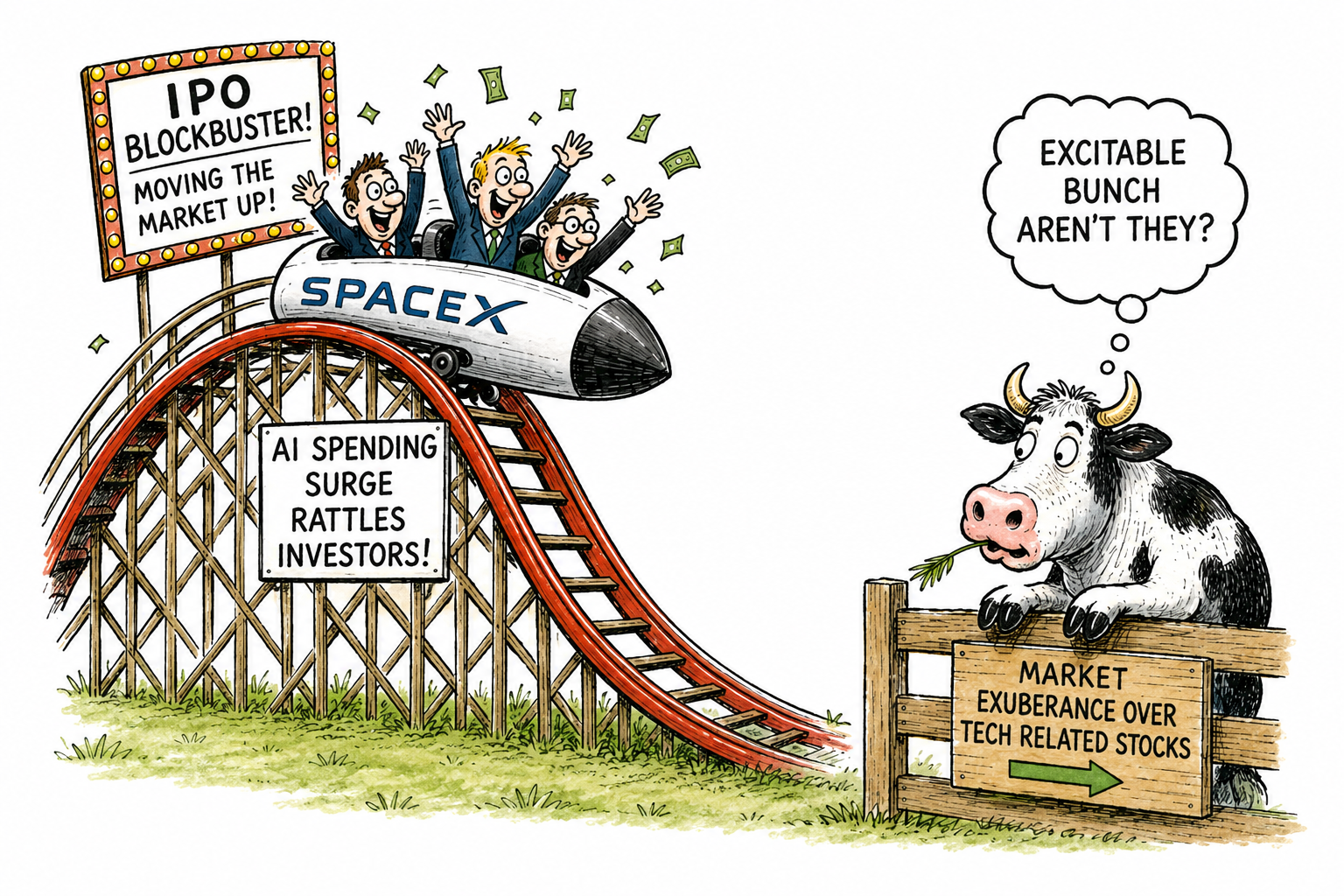
Elon Musk’s decision to fold xAI into SpaceX has set the stage for what could become one of the largest and most closely watched IPOs in market history.

The move signals a bold attempt to fuse advanced artificial intelligence with orbital infrastructure, satellite communications, and Musk’s wider technological ecosystem.

Elon Musk’s merger of SpaceX with his artificial intelligence venture xAI marks a decisive shift in the trajectory of both companies.

Integrated power

The combined entity is now positioned as a vertically integrated powerhouse spanning rockets, space‑based internet, direct‑to‑mobile communications, and frontier AI research.

Musk has described the unified structure as an ‘innovation engine’ capable of accelerating progress both on Earth and beyond.

The strategic logic is clear: AI requires immense computational resources, and Musk believes space‑based compute will become the most cost‑effective solution within a few years.

By bringing xAI under SpaceX’s umbrella, he gains the ability to scale AI training using satellite infrastructure while consolidating governance, data flows, and long‑term capital planning.

A Trillion‑Dollar Listing on the Horizon

The merged company is expected to pursue an IPO valued at roughly $1.25 trillion, with share pricing estimates placing it among the most valuable listings ever attempted.

Early reports suggest the offering could raise as much as $50 billion, instantly making it one of the largest capital‑market events in history.

Such a valuation reflects not only SpaceX’s dominance in commercial launch and satellite internet, but also the rapid rise of xAI’s Grok chatbot and its integration with Musk’s social platform, X.

The consolidation also concentrates financial scrutiny, with analysts noting that the new structure brings unprecedented transparency demands for a company that has historically operated privately.

Innovation

One of the most radical implications of SpaceX absorbing xAI is the potential to relocate data centres into orbit.

Musk has long argued that space-based compute could dramatically reduce cooling costs, thanks to the natural vacuum and thermal dissipation of low Earth orbit.

By leveraging Starlink’s satellite mesh and SpaceX’s launch cadence, the merged entity could deploy AI training clusters above the atmosphere—sidestepping terrestrial energy constraints and redefining the economics of large-scale artificial intelligence.

This vision, while technically ambitious, aligns with Musk’s broader strategy of vertical integration and frontier infrastructure.

The Stakes

If successful, the IPO will redefine the market landscape for both aerospace and artificial intelligence.

It represents a bet that the future of AI will be built not just in data centres, but in orbit—an audacious vision even by Musk’s standards.

The Rise of OpenClaw and the New Era of AI Agents

Agent AI

A new generation of artificial intelligence is taking shape, and at its centre sits OpenClaw — a fast‑evolving framework that embodies the shift from monolithic AI models to agile, task‑driven agents.

While large language models once dominated the conversation, the momentum has clearly moved toward systems that can reason, plan, and act with far greater autonomy. OpenClaw is emerging as one of the most intriguing examples of this transition.

Appeal

OpenClaw’s appeal lies in its modular design. Instead of relying on a single, all‑purpose model, it orchestrates multiple specialised components that collaborate to complete complex workflows.

This mirrors how real teams operate: one agent may handle research, another may draft content, and a third may evaluate quality or flag risks. The result is a system that behaves less like a tool and more like a coordinated digital workforce.

Defining trend

This shift is not happening in isolation. Across the industry, AI agents are becoming the defining trend. Companies are racing to build systems that can manage inboxes, run businesses, write and deploy code, or even negotiate with other agents.

The ambition is no longer to create a chatbot that answers questions, but an autonomous entity capable of executing multi‑step tasks with minimal human intervention.

OpenClaw stands out because it embraces openness and experimentation. Developers can plug in their own models, customise behaviours, and build agent ‘stacks’ tailored to specific industries.

Adoption

Early adopters in media, finance, and logistics are already exploring how these agents can streamline research, automate reporting, or coordinate supply‑chain decisions.

The promise is efficiency, but also creativity: agents that can generate ideas, test them, and refine them without constant supervision.

Of course, the rise of agentic AI brings challenges. Questions around safety, reliability, and accountability are becoming more urgent. An agent that can act independently must also be constrained responsibly.

Challenge

The industry is now grappling with how to balance autonomy with oversight, ensuring that these systems remain aligned with human goals and values.

Even with these concerns, the trajectory is unmistakable. OpenClaw and its peers represent a decisive step toward AI that is not merely reactive but proactive — capable of taking initiative, managing complexity, and collaborating with humans in more meaningful ways.

As these systems mature, they are likely to reshape not just how we work, but how we think about intelligence itself.

If you want to explore how this trend could influence your editorial or creative workflows, I’m ready to dive deeper with you.

The Rise of Young Entrepreneurs Fuelled by AI Confidence

Entrepreneurs embracing AI

A new generation of entrepreneurs is stepping forward with a level of confidence that feels markedly different from previous waves of start‑ups.

What sets them apart is not just ambition or access to technology, but a deep, intuitive understanding of artificial intelligence.

AI as a tool

For many young founders, AI is no longer a mysterious tool reserved for specialists; it is a natural extension of how they think, create, and solve problems.

Teenagers and twenty‑somethings who grew up experimenting with machine‑learning apps, chatbots, and automation platforms now see AI as a practical ally rather than an abstract concept.

This familiarity lowers the psychological barrier to entrepreneurship. Instead of wondering how to start a business, they ask what they can build with the tools already at their fingertips.

One of the most striking shifts is the speed at which ideas move from concept to prototype. Young entrepreneurs routinely use AI to draft business plans, test branding concepts, analyse markets, and even simulate customer behaviour.

It’s the greatest ‘what if’ analysis ever!

Tasks that once required expensive consultants or weeks of manual work can now be completed in hours. This acceleration doesn’t just save time; it encourages experimentation. When the cost of failure drops, creativity expands.

AI also levels the playing field. A single founder can now perform the work of a small team, using automation to handle customer support, content creation, scheduling, and data analysis.

This empowers young people who may lack capital or industry connections but possess strong digital instincts. They can launch lean, agile ventures that scale quickly without the traditional overheads.

Education is evolving too. Many young entrepreneurs learn through online communities, open‑source projects, and hands‑on tinkering rather than formal training.

Discipline

This self‑directed highly disciplined learning style aligns perfectly with AI tools that reward curiosity and rapid iteration. As a result, these founders often approach business with a hybrid mindset: part technologist, part creative, part strategist.

Of course, challenges remain. Ethical considerations, data privacy, and the risk of over‑reliance on automation require thoughtful navigation.

Responsible

Yet this generation appears unusually aware of these issues, often building transparency and responsibility into their ventures from the outset.

What’s emerging is a landscape where youth is not a disadvantage but a strategic advantage. Their fluency with AI allows them to imagine possibilities others overlook and to act on those ideas with unprecedented speed.

In many ways, they are not just starting businesses with AI—they are redefining what entrepreneurship looks like in an AI world.

Cisco chief warns of an AI bubble — but reportedly says the long‑term winners will be huge

AI boom bubble!

Cisco’s chief executive, Chuck Robbins, has issued one of the clearest assessments yet of the frenzy surrounding artificial intelligence, arguing that the sector is ‘probably’ in bubble territory even as it lays the foundations for a technological shift larger than the internet itself.

Speaking in a recent interview, Robbins said the scale of investment pouring into AI start‑ups and infrastructure mirrors the exuberance of the late‑1990s dot‑com era.

Back then, vast sums of capital chased unproven ideas, leading to a dramatic market crash. Yet the companies that survived went on to define the modern digital economy.

Caution!

Robbins believes AI is following a similar trajectory: inflated expectations today, followed by a period of painful consolidation, and ultimately a handful of dominant players reshaping global industries.

He cautioned that many firms currently attracting funding will not endure. The rush to build models, platforms and specialised hardware has created what he described as ‘inevitable carnage’ ahead, as weaker businesses fail to convert hype into sustainable products.

Even so, he stressed that the underlying technology is transformative, with applications spanning healthcare, manufacturing, cybersecurity and national infrastructure.

Embedded AI

Cisco itself is deeply embedded in the AI supply chain, providing networking systems capable of handling the enormous data flows required to train and deploy advanced models.

Robbins said demand for high‑performance infrastructure continues to accelerate, driven by cloud providers and enterprises racing to integrate AI into their operations.

Despite the risks, he argued that dismissing AI as a passing bubble would be a mistake. The coming shake‑out, he suggested, is simply part of the cycle that accompanies every major technological revolution.

Once the dust settles, the companies that remain will be those with genuine innovation, strong business models and the capacity to scale globally.

Is This a Make‑or‑Break Year for OpenAI?

Where is OpenAI's profit?

OpenAI enters 2026 in a paradoxical position: simultaneously one of the fastest‑growing technology companies in history and one of the most financially strained.

With annualised revenue now exceeding $20 billion, the company has clearly proven global demand for generative AI. Yet the central question remains unresolved: where is the profit, and is this the year OpenAI must prove its business model is sustainable?

The company’s revenue trajectory has been extraordinary. Annual recurring revenue rose from $2 billion in 2023 to $6 billion in 2024, before leaping past $20 billion in 2025.

This growth reflects the rapid embedding of ChatGPT into enterprise workflows and the expansion of compute capacity, which has roughly tripled each year. But the same infrastructure powering this boom is also the source of OpenAI’s financial dilemma.

Costs

Compute costs have ballooned at a rate that rivals — and in some projections exceeds — revenue growth. Analysts estimate cumulative losses could reach $143 billion by 2029 if current spending patterns continue.

The company’s burn rate, driven by massive GPU procurement and long‑term energy commitments, has been described as ‘immense’ even by industry standards Benzinga.

OpenAI’s long‑term infrastructure deals, totalling more than 26 gigawatts of future compute capacity, underline the scale of its ambition — and its financial exposure.

To counterbalance these costs, OpenAI is experimenting with new revenue streams, including the introduction of advertising within ChatGPT for U.S. users.

This marks a strategic shift from pure subscription and enterprise licensing toward a more diversified, consumer‑scale monetisation model.

Make or break?

So is 2026 a make‑or‑break year? In many ways, yes. OpenAI has proven demand, scale, and cultural impact. What it has not yet proven is that generative AI can be profitable at planetary scale.

This year will test whether the company can convert extraordinary growth into a sustainable business — or whether its costs will continue to outpace even its most impressive revenue milestones.

Has AI Investment Gone Too Far Too Fast? A Quick Look at Hype Reality and Returns

Bubble and turmoil

Few technologies have attracted capital as aggressively as artificial intelligence. In just a few years, AI has shifted from a promising research frontier to the centrepiece of global corporate strategy.

Yet as investment has surged, so too has scepticism. Many analysts now argue that the pace of spending has outstripped both practical readiness and measurable returns.

Recent research suggests that the era of uncritical AI enthusiasm is giving way to a more sober assessment.

Implementation

Capgemini’s findings indicate that businesses are moving from experimentation to implementation, but they also reveal that firms are increasingly focused on proving real value rather than chasing novelty.

This shift reflects a broader concern: despite tens of billions poured into generative AI, a striking proportion of organisations report no financial return at all.

Some studies suggest that as many as 95% of generative AI investments have yet to produce measurable gains.

This disconnect between investment and outcome has fuelled claims that AI has been over‑hyped. The comparison to the telecom‑fibre boom of the early 2000s is becoming more common, particularly as much of the AI infrastructure build‑out is debt‑funded.

Transformative

The risk is not that AI lacks long‑term utility—few doubt its transformative potential—but that the current wave of spending is misaligned with operational readiness, data quality, and realistic deployment timelines.

At the same time, it would be simplistic to declare the AI boom a bubble destined to burst. Many leaders argue that the scale of investment is necessary to meet future demand for data centres, chips, and agentic AI systems.

Indeed, some firms are already shifting focus from generative AI to more autonomous, productivity‑driven agentic models, which may offer clearer paths to return on investment.

Long-term potential vs short term hype

The truth likely lies between the extremes. AI has undoubtedly been over‑sold in the short term, with inflated expectations and rushed adoption leading to disappointing early results.

But the long‑term case remains strong. As tools mature, integration improves, and organisations learn to measure value beyond simple cost savings, returns may begin to justify the extraordinary capital outlay.

For now, the market is entering a more pragmatic phase—one where hype gives way to accountability, and where the winners will be those who invest not just heavily, but wisely.

Less expensive and simpler AI systems may arrive before these huge investments materialise a decent return.

U.S. AI vs China AI – the difference

China and U.S. AI

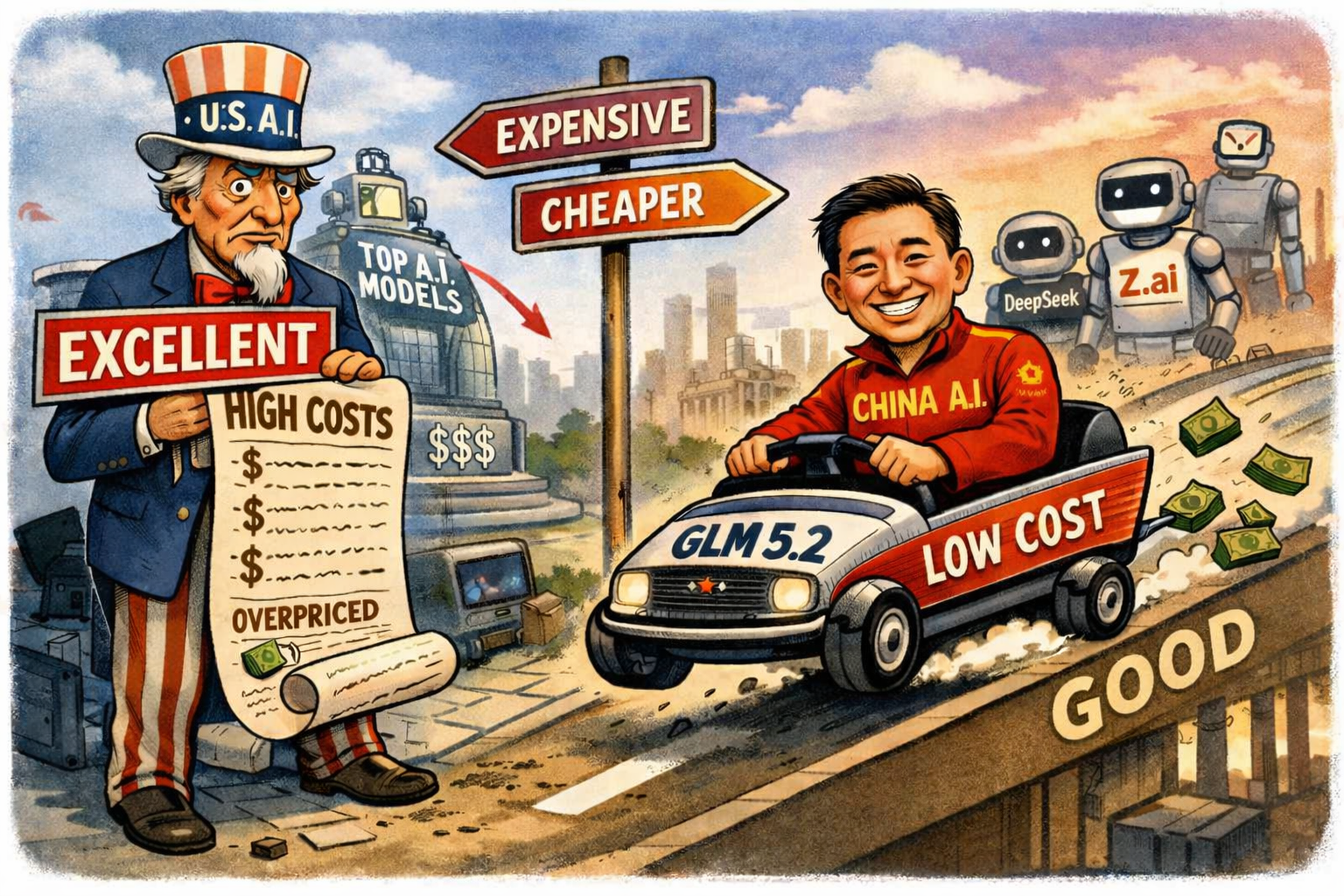
China’s AI industry has indeed cultivated a reputation for ‘doing more with less’, while the U.S. has poured vast sums into AI development, raising concerns about overinvestment and inflated valuations.

The contrast lies not only in the scale of funding but also in the efficiency and strategic focus of each country’s approach.

The U.S. Approach: Scale and Spending

The United States remains the global leader in AI infrastructure, driven by massive private investment and access to advanced computing resources.

Venture capital deals in U.S. AI and robotics startups have more than quadrupled since 2023, surpassing $160 billion in 2025.

This surge has produced headline-grabbing valuations, such as humanoid robotics firms raising billions in single rounds. Yet analysts warn of bubble risks, with valuations often detached from sustainable revenue models.

The U.S. strategy prioritises scale: building the largest models, securing the most powerful GPUs, and attracting top-tier talent.

This has led to breakthroughs in generative AI and large language models, but at extraordinary cost.

Estimates suggest that OpenAI alone has spent over $100 billion on development. Critics argue this reflects a ‘more is better’ philosophy, where innovation is equated with sheer financial muscle.

China’s Approach: Efficiency and Restraint

China, by contrast, has invested heavily but with a different emphasis. In 2025, Chinese AI investment is reportedly projected at $98 billion, far below U.S. levels.

Yet Chinese firms have achieved notable progress by focusing on cost-efficient innovation. For example, AI2 Robotics developed a model requiring less than 10% of the parameters used by Alphabet’s RT-2, demonstrating a commitment to leaner, more resource-conscious design.

Foreign investors are increasingly drawn to China’s cheaper valuations, which are roughly one-quarter of U.S. equivalents.

This efficiency stems from lower research costs, government-led initiatives, and a culture of frugality shaped by regulatory pressures and limited access to advanced hardware.

Rather than chasing scale, Chinese firms often prioritise practical applications and affordability, enabling broader adoption across industries.

Doing More with Less?

The evidence suggests that China has achieved competitive outcomes with far fewer resources, while the U.S. has arguably overpaid in pursuit of dominance.

However, the U.S. still leads in infrastructure, talent, and global influence. China’s strength lies in its ability to innovate under constraints, turning scarcity into efficiency.

Ultimately, the question is not whether one side has ‘overinvested’ or ‘underinvested’, but whether their strategies align with long-term sustainability.

The U.S. risks a bubble fuelled by excess capital, while China’s leaner approach may prove more resilient. In this sense, China is indeed ‘doing more with less’—but whether that will be enough to surpass U.S. dominance remains uncertain.

Bubble vulnerability

The sheer scale of U.S. AI investment has left the industry vulnerable to bubble shock, as valuations and spending appear increasingly detached from sustainable returns.

Analysts warn that the U.S. equity market is showing signs of an AI-driven bubble, with trillions poured into data centres, chips, and generative models at unprecedented speed.

While this has fuelled rapid innovation, it has also created irrational exuberance reminiscent of the dot-com era, where hype outpaces monetisation.

If growth expectations falter or capital tightens, the U.S. could face sharp corrections across tech stocks, credit markets, and employment, exposing the fragility of an industry built on extraordinary but potentially unsustainable levels of investment.

China’s humanoid robots are coming for Elon Musk’s Tesla $1 trillion dollar payday

China humanoid robot challenge

Elon Musk’s $1 trillion Tesla payday is tightly bound to the rise of humanoid robots—and China’s role in their production may determine whether his vision succeeds.

Elon Musk’s record-breaking compensation package, worth up to $1 trillion, hinges on Tesla’s transformation from an electric vehicle pioneer into a robotics powerhouse.

At the centre of this ambition is Optimus, Tesla’s humanoid robot, designed to walk, learn, and mimic human actions. Musk envisions deploying one million robots within the next decade, a scale that would redefine both Tesla’s business model and the global labour market.

Yet the road to mass production likely runs directly through China. While Tesla engineers designed prototype Optimus in the United States, China dominates the industrial infrastructure and critical components needed for large-scale deployment.

Robot installations in China

In 2023 alone, China reportedly installed over 290,000 industrial robots, more than the rest of the world combined, and reached a robot density of 470 per 10,000 workers, surpassing Japan and Germany.

This aggressive expansion is reportedly backed by state subsidies, low-cost financing, and mandates requiring provincial governments to integrate automation into their restructuring plans.

For Musk, this creates both opportunity and risk. On one hand, China’s manufacturing ecosystem offers the scale and efficiency necessary to bring Optimus to market at competitive costs.

On the other, Beijing’s strict regulations on humanoid robots introduce uncertainty, with geopolitical permission becoming the most unpredictable factor in Tesla’s robot revolution.

If Musk can navigate these challenges, Optimus could anchor Tesla’s evolution into a robotics giant, securing the milestones required for his trillion-dollar payday, and beyond.

But if Chinese competitors or regulatory hurdles slow progress, Tesla risks losing ground in the very sector Musk believes will make work ‘optional’ and money ‘irrelevant’.

In short, the robots coming from China are not just machines—they are very much the ‘key code’ to Musk’s trillion-dollar future.

Never underestimate Elon Musk.

When Markets Lean Too Heavily on High Flyers

The AI trade

The recent rebound in technology shares, led by Google’s surge in artificial intelligence optimism, offered a welcome lift to investors weary of recent market sluggishness.

Yet beneath the headlines lies a more troubling dynamic: the increasing reliance on a handful of mega‑capitalisation firms to sustain broader equity gains.

Breadth

Markets thrive on breadth. A healthy rally is one in which gains are distributed across sectors, signalling confidence in the wider economy. When only one or two companies shoulder the weight of investor sentiment, the picture becomes distorted.

Google’s AI announcements may well justify enthusiasm, but the fact that its performance alone can swing indices highlights a fragility in the current market structure.

This concentration risk is not new. In recent years, the so‑called ‘Magnificent Seven‘ technology giants have dominated returns, masking weakness in smaller firms and traditional industries.

While investors cheer the headline numbers, the underlying reality is that many sectors remain subdued. Manufacturing, retail, and even parts of the financial industry are not sharing equally in the rally.

Over Dependence

Over‑dependence on highflyers creates two problems. First, it exposes markets to sudden shocks: if sentiment turns against one of these giants, indices can tumble disproportionately.

Second, it discourages capital from flowing into diverse opportunities, stifling innovation outside the tech elite.

For long‑term stability, investors and policymakers alike should be wary of celebrating narrow gains. A resilient market requires participation from a broad base of companies, not just the fortunes of a few.

Google’s success in AI is impressive, but true economic strength will only be evident when growth spreads beyond the marquee names.

Until then, the market remains vulnerable, propped up by giants whose shoulders, however broad, cannot carry the entire economy indefinitely.

Google launches Gemini 3: Multimodal power and agentic tools

AI Gemini 3

Google has introduced Gemini 3, its most advanced AI model to date, delivering stronger reasoning across text, images, audio, and video.

Announced on 18th November 2025, it shipped simultaneously across Search, the Gemini app, AI Studio, Vertex AI, and developer tools, reflecting a tightly coordinated release and broad immediate availability.

Gemini 3 centres on Gemini 3 Pro with a new Deep Think reasoning mode aimed at higher‑intensity tasks.

Accuracy

Google emphasises reduced prompt‑dependence and improved accuracy, with early benchmarks and analyst reactions highlighting competitive gains versus recent frontier models.

The rollout arrives roughly eight months after Gemini 2.5, underscoring the rapid rise of Google’s AI development.

Alongside the model, Google unveiled Antigravity, an agent‑first coding environment that enables task‑level planning and execution within familiar IDE workflows.

Antigravity integrates Gemini 3 Pro and supports agentic development across end‑to‑end software tasks, with early coverage generation strong productivity features and immediate developer interest.

Nano Banana Pro

Google’s image stack also advanced with Nano Banana Pro (Gemini 3 Pro Image), reportedly improving text rendering, edit consistency, and high‑resolution output up to 4K.

The launch coincided with a notable Alphabet share price lift, signalling market confidence in Google’s AI strategy.

Google’s Gemini 3 sent Alphabet’s share price sharply higher, closing at $318.47, up 6.3% from the previous day.

The surge reflected investor enthusiasm for the model’s multimodal capabilities and enterprise integration, with analysts noting it as a decisive achievement in the AI race.

AI effect

The rally spilled over into other AI‑linked stocks: Nvidia rose 2.1% to $182.55 on strong GPU demand, while IBM gained 2.2% to $304.12 after highlighting quantum computing progress.

In contrast, Microsoft edged up only 0.4% to $474.00, as analysts flagged concerns about capital intensity in its AI investments.

Overall, the Gemini 3 announcement revived momentum across the AI market sector, with Alphabet leading the charge and peers benefiting from renewed confidence in AI’s commercial potential.

Nvidia Q3 results were very strong – but does the AI bubble reside elsewhere – such as with the debt driven AI data centre roll out – and crossover company deals?

AI debt

Nvidia’s Q3 results show strength, but the real risk of an AI bubble may lie in the debt-fuelled data centre boom and the circular crossover deals between tech giants.

Nvidia’s latest quarterly earnings were nothing short of spectacular. Revenue surged to $57 billion, up 62% year-on-year, with net income climbing to nearly $32 billion. The company’s data centre division alone contributed $51.2 billion, underscoring how central AI infrastructure has become to its growth.

These figures have reassured investors that Nvidia itself is not the weak link in the AI story. Yet, the question remains: if not Nvidia, where might the bubble be forming?

Data centre roll-out

The answer may lie in the debt-driven expansion of AI data centres. Building hyperscale facilities requires enormous capital outlays, not only for GPUs but also for power, cooling, and connectivity.

Many operators are financing this expansion through debt, betting that demand for AI services will continue to accelerate. While Nvidia’s chips are sold out and cloud providers are racing to secure supply, the sustainability of this debt-fuelled growth is less certain.

If AI adoption slows or monetisation lags, these projects could become overextended, leaving balance sheets strained.

Crossover deals

Another area of concern is the crossover deals between major technology companies. Nvidia’s Q3 was buoyed by agreements with Intel, OpenAI, Google Cloud, Microsoft, Meta, Oracle, and xAI.

These arrangements exemplify a circular investment pattern: companies simultaneously act as customers, suppliers, and investors in each other’s AI ventures.

While such deals create momentum and headline growth, they risk masking the true underlying demand.

If much of the revenue is generated by companies trading capacity and investment back and forth, the market could be inflating itself rather than reflecting genuine end-user adoption.

Bubble or not to bubble?

This dynamic is reminiscent of past bubbles, where infrastructure spending raced ahead of proven returns. The dot-com era saw fibre optic networks built faster than internet businesses could monetise them.

Today, AI data centres may be expanding faster than practical applications can justify. Nvidia’s results prove that demand for compute is real and immediate, but the broader ecosystem may be vulnerable if debt levels rise and crossover deals obscure the true picture of profitability.

In short, Nvidia’s strength does not eliminate bubble risk—it merely shifts the spotlight elsewhere. Investors and policymakers should scrutinise the sustainability of AI infrastructure financing and the circular nature of tech partnerships.

The AI revolution is undoubtedly transformative, but its foundations must rest on genuine demand rather than speculative debt and self-reinforcing deals.

Nvidia’s Latest Financial Results – Q3 2025

Nvidia AI chips dominate

Nvidia has once again (unsurprisingly) defied expectations, reporting record-breaking third-quarter results that underscore its dominance in the artificial intelligence chip market.

Nvidia’s Latest Financial Results

Nvidia announced revenue of $57 billion for the quarter ending 26th October 2025, a 62% increase year-on-year and up 22% from the previous quarter.

Net income surged to $31.9 billion, a remarkable 65% rise compared with last year. Earnings per share came in at $1.30, comfortably ahead of analyst forecasts of $1.26.

The company’s data centre division was the star performer, generating $51.2 billion in revenue, up 25% from the previous quarter and 66% year-on-year.

This reflects the insatiable demand for Nvidia’s Blackwell AI chips, which CEO Jensen Huang reportedly described it as ‘off the charts‘ with cloud GPUs effectively sold out.

Market Impact and Outlook

Shares of Nvidia rose sharply following the announcement, adding to a 39% gain in 2025 so far. Analysts had anticipated strong results, but the scale of growth exceeded even bullish expectations.

Options markets had priced in a potential 7% swing in Nvidia’s stock after earnings, highlighting investor sensitivity to its performance.

Looking ahead, Nvidia has issued guidance of $65 billion in revenue for the fourth quarter, signalling continued momentum.

Huang reportedly emphasised that AI demand is compounding across both training and inference, creating what he called a ‘virtuous cycle’ for the industry.

Strategic Significance

Nvidia’s results reinforce its position at the centre of the global AI boom. Its chips power everything from large language models to robotics, and the company is benefiting from widespread adoption across industries.

With margins above 73%, Nvidia is not only growing rapidly but also maintaining enviable profitability.

The figures highlight how Nvidia has become more than a semiconductor company—it is now a cornerstone of the digital economy.

As AI applications proliferate, Nvidia’s ability to scale production and meet demand will be critical in shaping the next phase of technological transformation.

In short: Nvidia’s Q3 results show explosive growth, record revenues, and a confident outlook, cementing its role as the leading force in AI hardware.

Nvidia CEO reportedly remarked

‘There’s been a lot of talk about an AI bubble‘, Nvidia CEO Jensen Huang reportedly told investors. ‘From our vantage point, we see something very different’.

As to what that means exactly is up to you to decipher. Regardless of what the AI industry has to offer in the future, from an investor’s point of view, Nvidia’s earnings are clearly something to celebrate.

Is AI in a bubble, or not?

Anthropic’s ‘connected’ AI deal and others too

Anthropic's AI valuation

Anthropic has reportedly struck major deals with Microsoft and Nvidia. On Tuesday 18th November 2025, Microsoft announced plans to invest up to $5 billion in the startup, while Nvidia will contribute as much as $10 billion. According to a reports, this brings Anthropic’s valuation to around $350 billion. Wow!

Google has unveiled its newest AI model, Gemini 3. According to Alphabet CEO Sundar Pichai, it will deliver desired answers with less prompting.

This update comes just eight months after the launch of Gemini 2.5 and is reported to be available in the coming weeks.

Money keeps flowing

Money keeps flowing into artificial intelligence companies but out of AI stocks

In what seems like yet another case of mutual ‘back-scratching’, Microsoft and Nvidia are set to invest a combined $15 billion in Anthropic, with the OpenAI rival agreeing to purchase computing power from its two newest backers.

Lately, a large chunk of AI news feels like it boils down to: ‘Company X invests in Company Y, and Company Y turns around and buys from Company X’.

That’s not entirely correct or fair. There are plenty of advancements in the AI world that focus on actual development rather than investments. Google recently introduced the third version of Gemini, its AI model.

Anthropic’s valuation has surged to around $350 billion, propelled by a landmark $15 billion investment from Microsoft and Nvidia.

Anthropic, the AI start-up founded in 2021 by former OpenAI employees, has rapidly ascended into the ranks of the world’s most valuable companies, more than doubling its worth from $183 billion just a few months earlier.

A valuation of $350 billion for a company only 4 years old is astounding!

The deal reportedly sees Microsoft commit up to $5 billion and Nvidia up to $10 billion. Anthropic has agreed to purchase an extraordinary $30 billion in Azure compute capacity and additional infrastructure from Nvidia.

This strategic alliance is not merely financial; it signals a deliberate diversification of Microsoft’s AI ecosystem beyond its reliance on OpenAI. And Nvidia strengthens its dominance in AI hardware.

Anthropic’s valuation has reached $350 billion, following the massive $15 billion investment from Microsoft and Nvidia, which positions the company among the most valuable in the world.

This astronomical figure reflects both the scale of its partnerships — including $30 billion in Azure compute commitments and Nvidia’s cutting-edge hardware.

The valuation underscores both the intensity of the global AI race and the confidence investors place in Anthropic’s safety-conscious approach to artificial intelligence.

Yet, it also raises questions about whether such astronomical figures reflect genuine long-term value. Or is it the froth of an overheated market.

Hyperscalers keep pumping the money into AI but are they getting the justified returns yet? Probably not yet – but it will come in the future.

But by then, it will be time to upgrade the system as it develops and so more money will be pumped in

Pichai Warns of AI Bubble: Google Not Immune to Market Correction

AI Bubble caution

Google CEO Sundar Pichai has warned that no company, including his own, will be immune if the current AI bubble bursts.

He described the boom as both extraordinary and irrational, urging caution amid soaring valuations and investment hype

In a recent interview, Google’s chief executive Sundar Pichai offered a sobering perspective on the rapid expansion of artificial intelligence.

Profound Tech Creation

While he reportedly reaffirmed his belief that AI is ‘the most profound technology humanity has developed‘, he acknowledged growing concerns that the sector may be overheating.

According to Pichai, the surge in investment and valuations has created an atmosphere of exuberance that risks tipping into irrationality.

Pichai stressed that if the so-called AI bubble were to collapse, no company would escape unscathed. Even Google, one of the world’s most powerful technology firms, would feel the impact.

Remember Dot-Com?

He likened the current moment to past speculative cycles, such as the dot-com boom, where innovation was genuine, but market expectations outpaced reality.

Despite these warnings, Pichai emphasised that the long-term potential of AI remains intact.

He argued that professions across the board—from teaching to medicine—will continue to exist, but success will depend on how well individuals adapt to using AI tools.

In his view, the technology will reshape industries, but the hype surrounding short-term gains could distort investment flows and create instability.

His comments arrive at a time when Silicon Valley is grappling with questions about sustainability. Tech stocks have surged on AI optimism, yet analysts caution that inflated valuations may not reflect the true pace of adoption.

Pichai’s intervention serves as both a reality check and a reminder: AI is transformative, but it is not immune to market corrections.

For investors and innovators alike, the message is clear—embrace AI’s promise but prepare for turbulence if the bubble bursts.

Bitcoin’s Bear Market and Its Impact on Crypto in General

Bitcoin in a bear market

Bitcoin has officially entered a bear market, having fallen more than 25% from its October peak of $126,000.

This downturn is rippling across the wider crypto sector, dragging Ethereum, Solana, and other altcoins into steep declines as investor sentiment turns risk-off.

Bitcoin’s recent plunge below $95,000 marks a decisive shift into bear market territory. After reaching an all-time high of $126,000 in early October, the cryptocurrency has shed over a quarter of its value in just six weeks.

Analysts point to a combination of factors: fading hopes of Federal Reserve rate cuts, heavy outflows from Bitcoin ETFs, and broader weakness in technology. The sell-off has erased all of Bitcoin’s 2025 gains, leaving traders cautious and fearful.

This downturn is not isolated. Ethereum has dropped more than 30% from its highs, while Solana and Cardano have suffered double-digit losses.

The total crypto market capitalisation has fallen by approximately $1 trillion since October, underscoring how tightly correlated altcoins remain to Bitcoin’s trajectory.

When the flagship asset falters, liquidity drains across the sector, amplifying volatility.

Investor psychology has shifted dramatically. The ‘buy the dip’ mentality that defined earlier rallies is giving way to defensive strategies, with many now selling into strength rather than accumulating.

Long-term holders have reportedly offloaded hundreds of thousands of BTC in recent weeks, intensifying downward momentum. Meanwhile, ETF outflows — exceeding $1.6 billion in just three days — highlight waning institutional confidence.

Snapshot of CoinMarketCap Fear Gauge

For the broader crypto ecosystem, Bitcoin’s bear market signals a period of consolidation and caution. Altcoins, often more volatile, are likely to experience sharper swings.

Yet history suggests that such downturns can reset valuations, paving the way for healthier growth once macroeconomic conditions stabilise.

For now, however, the market remains firmly in risk-off mode, with Bitcoin leading the retreat.

The crypto sector faces nearing a $1 trillion wipeout, with investor sentiment shifting from optimism to fear.

Even AI Firms Voice Concern Over Bubble Fears

AI bubble

For some time now, talk of an ‘AI bubble‘ has largely come from investors and financial analysts. Now, strikingly, some of the loudest warnings are coming from inside the industry itself.

At the Web Summit in Lisbon, senior executives from companies such as DeepL and Picsart reportedly admitted they were uneasy about the soaring valuations attached to artificial intelligence ventures. Sam Altman of OpenAI has also sounded warnings of AI overvaluation.

DeepL’s chief executive Jarek Kutylowski reportedly described current market conditions as ‘pretty exaggerated’ and suggested that signs of a bubble are already visible.

Picsart’s Hovhannes Avoyan reportedly echoed the sentiment, criticising the way start‑ups are being valued despite having little or no revenue. He reportedly coined the phrase ‘vibe revenue’ to describe firms being backed on hype rather than substance.

These remarks highlight a paradox. On one hand, demand for AI services remains strong, with enterprises expected to increase adoption in 2026.

On the other, the financial side of the sector looks overheated. Investors such as Michael Burry have accused major cloud providers of overstating profits, while banks including Goldman Sachs and Morgan Stanley have warned of potential corrections.

The tension reflects a broader question: can the industry sustain its rapid expansion without a painful reset?

Venture capital forecasts suggest trillions will be poured into AI data centres over the next five years, yet some insiders argue that the scale of spending is unnecessary.

Even optimists concede that businesses are struggling to integrate AI effectively, meaning the promised returns may take longer to materialise.

For now, the AI sector stands at a crossroads. The technology’s transformative potential is undeniable, but the financial exuberance surrounding it may prove unsustainable.

If the warnings from within the industry are correct, the next chapter of the AI story could be less about innovation and more about value correction.