A time travel party organised by Stephen Hawking in 2009.
This was an experiment that Hawking conducted to test the possibility of backward time travel. He invited people from the future to attend a reception at his university, but he did not send out the invitations until after the party. He hoped that someone from the future would find the invitation and use a wormhole time machine to come back and prove that time travel is possible.
However, no one showed up at his party. He said that he liked simple experiments and champagne. He also said that he had experimental evidence that time travel is not possible. He explained that warping space and time could trigger a bolt of radiation that would destroy the spaceship and maybe the space-time itself.
Is time travel to the future possible?
Based on the current scientific understanding, time travel to the past seems to be very unlikely, if not impossible. There are many paradoxes and inconsistencies that arise from the idea of changing the past.
Stephen Hawking organised a time travel party in 2009
Time travel to the future, however, may be possible, but only in a limited sense. According to the theory of relativity, time passes at different rates depending on the speed and gravity of the observer. This means that someone who travels very fast or near a massive object could experience less time than someone who stays still or far away from the mass.
Time dilation
This is called time dilation, and it has been experimentally confirmed. However, this does not allow the traveller to return to their original time, as they would have aged less than the rest of the world.
So, in summary, time travel is unlikely, but it is acknowledged that there are some intriguing possibilities and mysteries that remain to be explored.
Leaders at some of the world’s leading artificial intelligence (AI) companies are expecting a form of AI on a par with, or even exceeding human intelligence to arrive sometime in the near future. But what it will eventually look like and how it will be applied are unknown.
Artificial General Intelligence or AGI is coming soon
Leaders from OpenAI, Microsoft and Google’s DeepMind, and many other major tech companies debated the risks and opportunities presented by AI at the World Economic Forum in Davos, Switzerland in January 2024.
AI has become the talk of ‘town’ around the world through 2023, mainly due to the success of ChatGPT, OpenAI’s popular generative AI chatbot, brought to us by Microsoft. Generative AI tools, like ChatGPT, are powered large language models, algorithms trained on vast quantities of data, but are not AGI.
Executives at some of the world’s leading artificial intelligence companies see ‘artificial general intelligence,’ or AGI, a hypothesized form of AI with intelligence on a par or better than humans. This prospect is both exciting and worrying.
Concern
AI and AGI have created concern among governments, corporations and public consultation groups worldwide, owing to the risks around the lack of transparency of AI systems; social manipulation through computer algorithms; job losses due to increased automation; surveillance; and data privacy and worse… the lack of human control!
Extinction event possible
Many industry leaders in technology have warned that AI could lead to an ‘extinction-level’ event where machines become so powerful they get out of control and wipe out humanity.
A new powerful AI is coming but the techies have no clue as to what it will look like
Several prominent technology leaders, including Elon Musk and Steve Wozniak for example, have called for a pause in AI development, stating that a moratorium would be beneficial in allowing society to catch up.
Turing test
AI chatbots like ChatGPT have passed the Turing test, a test called the ‘imitation game,’ which was developed by British computer scientist Alan Turing to determine whether someone is communicating with a machine and a human. The one big area where AI is lacking is common sense.
It has been reported on many occasions, that the tech world is taking steps to ensure that the AI race doesn’t lead to a ‘Hiroshima moment.‘
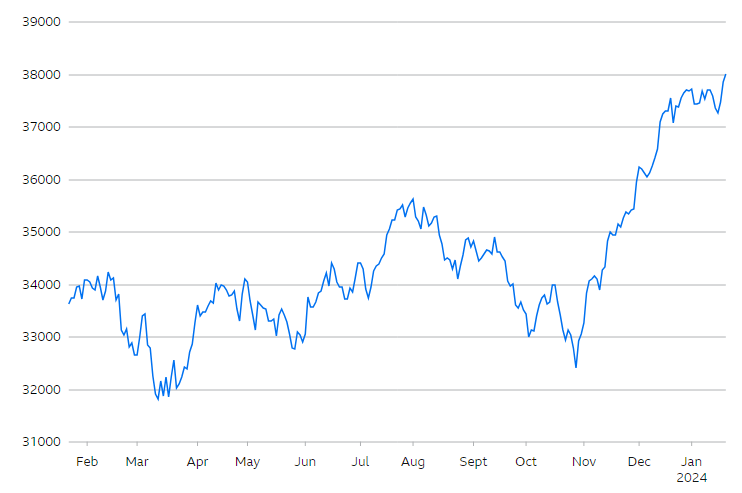
The Dow Jones Industrial Average (DJIA) reached a new high on 22nd January 2024, closing at 38,001.81 points
One year chart for the Dow Jones Industrial Average (DJIA)
The Dow Jones Industrial Average (DJIA) reached a new high on 22nd January 2024, closing at 38,001.81 points
The index reached 38109.20 points in intraday trading. Recently the S&P500 and the Nasdaq set new highs.
The Dow
The Dow Jones is a market index that tracks the performance of 30 large US companies. It is also known as the Dow Jones Industrial Average (DJIA) or simply ‘the Dow’.
The DJIA is one of the oldest and most widely followed stock market indicators in the world. It reflects the health and sentiment of the U.S. economy and business sector.
The index was created in 1896 by Charles Dow and Edward Jones, who were journalists at The Wall Street Journal. The first calculation was done on 30th June 1896, with a base value of 40.
Some 128 years later, the index has a value of 38001 – a record high!
The Nasdaq 100 climbed to a new high of: 17314 on 19th January 2024
Nasdaq 100 hits new record high 19th January 2024
The NASDAQ 100 Index is a widely used benchmark for the performance of the technology sector in the U.S. market.
It consists of 100 of the largest non-financial companies listed on the NASDAQ stock exchange. Some of the top components of the index are Apple Inc., Microsoft Corporation, Amazon.com Inc., Alphabet Inc., and Meta Inc.
Some analysts however are warning that the Nasdaq is due a correction.
It is up around 20% from a low point in late October 2023 and some analysts warn that the tech sector is overvalued and may face a correction.
The S&P 500 index reached a new all-time high of 4,839.81 on Friday, January 19, 2024.
This was the first time the index closed above its previous high set January 3rd 2022. The rally was driven by strong earnings from the magnificent 7 tech giants such as Nvidia and Microsoft.
The expectation of a Fed interest rate cut later this year also helped the S&P500 break new ground.
In the short scale system, which is commonly used in the UK, United States and most English-speaking countries, 1 billion is written as 1,000,000,000 or 109. This means that 1 billion is equal to 1 thousand million.
In the long scale system, which is commonly used in continental Europe and some other parts of the world, 1 billion is written as 1,000,000,000,000 or 1012. This means that 1 billion is equal to 1 million million.
Fun facts
If you tried to count to 1 million at an approximate rate of 1 number per second, it would take around 11 days. And that would be without sleeping or taking a rest in between the marathon quest. But if you were to count to 1 billion it would take you… wait for it… a cool 32 years!
But just imagine this, if you attempted to count to 1 trillion (1000,000,000,000) or 1012 at the same rate of 1 number per second and without sleep, rest or mistakes – it would take you about… 31,710 years! Give or take a year.
A little bit more
A million and 1 billion sound like BIG numbers, they are. But just how big…
Imagine this: 1 million seconds is roughly equal to 1 week. But, 1 billion seconds equates to about 33 years!
It’s true – or at least it was for a 1930’s BBC broadcaster
Apparently, the story goes that the most boring news day was 18th April 1930. Imagine turning on your radio ready to hear the news bulletin only to hear a BBC radio presenter announce, ‘There is no news!’
Can’t ever imagine that happening now – 24 hour news nonsense fills up all the gaps!
China, which consumes over half of the global coal demand and produces over 4 billion tonnes of coal per year.
India, which consumes about 14% of the global coal demand and produces over 900 million tonnes of coal per year.
The United States, which consumes about 9% of the global coal demand and produces over 600 million tonnes of coal per year.
Japan, which consumes about 3% of the global coal demand but imports most of its coal.
These countries accounted for about 82% of the global coal production in 2021 according to 2021 data set. China alone produced more than half of the world’s coal, followed by India with nearly 10%.
Global coal use in 2023 hits few high
Global coal use in 2023 has hit a record high, surpassing 8.5 billion tons for the first time, on the back of strong demand in countries like India and China, said IEA. These countries are the world’s largest consumers of the dirtiest fossil fuel, and continued modernization puts their energy consumption on a rapid growth trajectory.
China
China and India’s growing economies will continue to fuel demand for coal even as they set ambitious renewable energy targets, according to experts.
While China is the world’s largest energy consumer, India is ranked third globally, and both countries are the top consumers of coal as they strive to fuel economic growth.
Global coal usage in 2023hit a record high, surpassing 8.5 billion tons for the first time, on the back of strong demand in emerging and developing countries such as India and China, IEA noted in a recent report.
China’s electricity sector has been in the throes of a clean revolution over the past few years, with an almost five-fold growth in wind and solar generation since 2015. As a result, the share of coal generation has fallen by 17 percentage points, from 78% in 2000 to 61% in 2022.
China has suffered from drought in recent years, which reduced hydroelectric power generation in its southern provinces. To maintain the necessary power output, the country had to turn to coal.
United States
By contrast, U.S., which is the world’s second largest consumer of coal, has seen a decrease in its usage of the fuel. According to the Institute for Energy Economics and Financial Analysis, the amount of coal that the superpower consumes each day recorded a 62% drop from 2.8 million to 1.1 million tons a day.
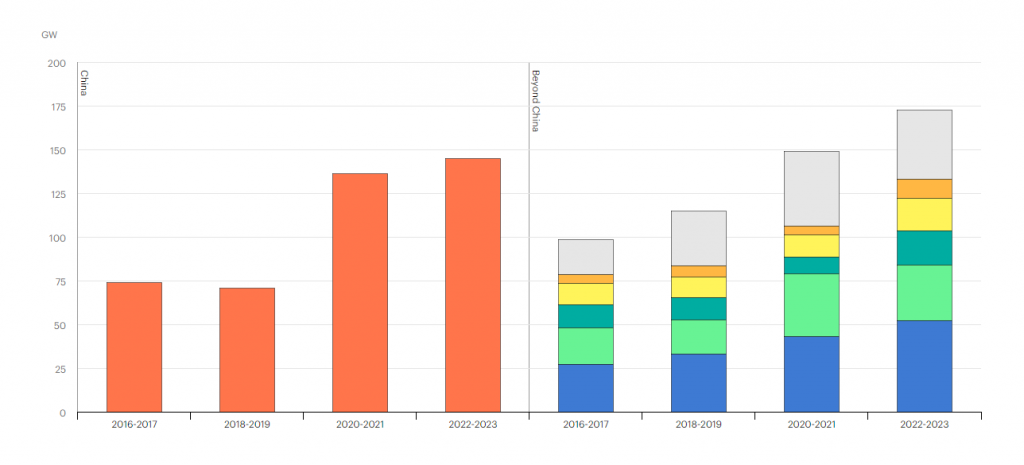
75% of India’s power is derived via coal-fired plants. Coal accounts for 61% of China’s power generation, even though the country is recognized as the indisputable leader in renewable energy expansion. It has been adding new projects to the grid almost as fast as the rest of the world combined in 2022 and has ambitions of becoming carbon neutral by 2060.
Annual average capacity additions by country and region, 2016-2023
India’s coal production rose to 893 million tons during the financial year ending March 2023, jumping nearly 15% from a year earlier. China’s raw coal production in 2023 went up by 2.9% compared with the same period in 2022.
There are no signs of a slowdown, with the IEA saying coal consumption in India and Southeast Asia is projected to grow significantly.
Coal won’t go!
But the lack of reliability of renewables means coal has still very much been a critical fallback option for the two countries.
Top five coal producing countries in the world
China: 4,126.0 million tonnes
India: 762.0 million tonnes
Indonesia: 614.0 million tonnes
United States: 523.8 million tonnes
Australia: 467.1 million tonnes
Five of the Greenest energy producers in the world
Sweden
Norway
Denmark
Finland
Switzerland
The greenest were based on these five criteria: carbon emissions, energy transition, green society, clean innovation, and climate policy.
Top countries by renewable energy production
China: 2,271.9 TWh (28.2% of total electricity)
United States: 804.8 TWh (20.5% of total electricity)
Brazil: 491.9 TWh (83.3% of total electricity)
Canada: 433.6 TWh (66.9% of total electricity)
India: 303.5 TWh (24.5% of total electricity)
Note: three of the world’s worst offenders of fossil fuel use are also in the top five for energy production by renewables – China, U.S. and India.
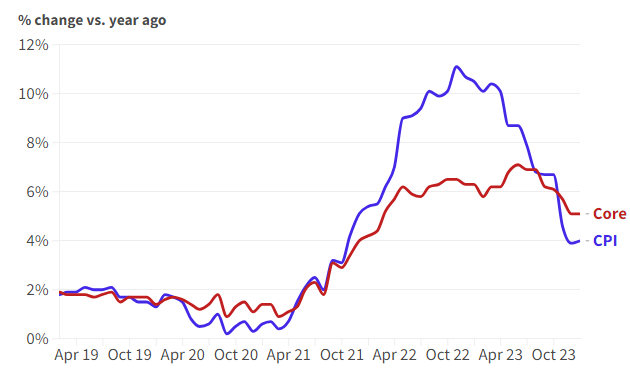
Inflation, rose marginally to 4% in December, up from 3.9% in November 2023.
Economists had forecast a slight fall but unexpected rises in alcohol and tobacco prices were behind the surprise rise.
However, with energy bills predicted to come down in 2024, there are still expectations of interest rate cuts later this year.
On target still for 2%?
As we have seen in the Germany, the U.S., and France, inflation does not fall in a straight line, ‘but our plan is working and we should stick to it,‘ Jeremy Hunt reportedly said in a statement.
UK inflation from April 2019 to December 2023
UK inflation from April 2019 to December 2023
Unprepared for both the start and the end of the pandemic
Increases in the cost of energy and food costs, started by pandemic lockdowns ending exasperated further by Russia’s invasion of Ukraine and more recently the conflict in Israel have put household finances under extreme pressure.
The UK and other countries were woefully underprepared for all of these events as they ‘began’ and at the ‘end’. We did not prepare to come out of them – there was no exit plan!
Markets and traders are still expecting BoE to cut its base rate in 2024 due to the fast-falling inflation rate. It peaked at 11.1% in October 2022 – and now sits at 4%.
The question is: will the economic recovery be good enough to allow the Bank of England to start cutting rates?
The UK interest rate currently sits at 5.25%.
‘What’s inflation?’ ‘Dunno, but my beer’s gone up!’
According to the Bloomberg Billionaires Index, Elon Musk is the wealthiest person in the world, with an estimated net worth of $243.46 billion USD as of 8th Jan 2024.
Musk is the founder and CEO of Tesla and SpaceX, X and X.ai as well as the co-founder of PayPal and Neuralink. He made his fortune from various business ventures, starting from a web software company called Zip 2 that he sold in 1999 for around $307 million. He also inherited some wealth from his father, who owned an emerald mine in South Africa.
Think about this for a moment
It’s a little difficult to imagine such wealth so, maybe think of it like this… If you had been given $10,000 every day since the birth of Jesus Christ, 2024 years ago – you would have accumulated some $7.4 billion (without interest and leap years etc).
So, Mr Elon Musk has a net worth of around $243 billion and you would have $7.4 billion and that equates to only 3% of his current wealth.
Or, if you had been given $10,000 every day since the pyramids were built in Egypt around 4500 years ago – you would have accumulated $16.4 billion. That’s still only 6.75% of Elon Musk’s current wealth.
One last thought
A recent report conducted by Oxfam calculated that just 5 of the world’s richest men (including Musk) are worth $869 billion between them.
Your $16.4 billion accumulated over 4500 years would equate to less than 2% of that combined wealth.
Now that’s crazy!
Final thought
8 of the top 10 current billionaires made their money in…technology.
Please note:figures are estimated, but it perfectly demonstrates my point.
The world’s five richest men have increased their combined fortune from $405 billion in March 2020 to $869 billion in November 2023, according to a report from Oxfam.
Wealth increased at a rate of $14 million per hour for 5 people
A report by the charity highlighted the wealth of Tesla CEO Elon Musk, LVMH boss Bernard Arnault and family, Amazon founder Jeff Bezos, Oracle founder Larry Ellison, and investor Warren Buffett.
Oxfam is calling for restrictions on ‘corporate power’ to reduce the massive inequality between the super-rich and the rest of society. Two of the suggestions to correct the inequality is through capping CEO pay and introducing taxes on permanent wealth and excess profits.
This report was released to coincide with the Davos meeting as the rich and wealthy business leaders and bankers gather.
Oxfam says
Fortunes of five richest men have shot up by 114% since 2020.
Oxfam predicts the world could have its first-ever trillionaire in just a decade while it would take more than two centuries to end poverty.
A billionaire is running or the principal shareholder of 7 out of 10 of the world’s biggest corporations.
148 top corporations made $1.8 trillion in profits, 52% up on 3-year average, and dished out huge payouts to rich shareholders while hundreds of millions faced cuts in real-term pay.
Oxfam urges a new era of public action, including public services, corporate regulation, breaking up monopolies and enacting permanent wealth and excess profit taxes.
Japan’s Nikkei 225 index set a new record in nearly 34 years last week, breaking the 35000 barrier for the first time since February 1990. Its all-time high of 38915 was hit in December 1989? That’s a 35 year old record!
Some analysts think that the long-term prospects for the Japanese markets look good.
The Nikkei 225 index is a benchmark of the Japanese stock market. It is composed of 225 large companies listed on the Tokyo Stock Exchange. The index has been fluctuating between 20000 and 30000 points for most of the past decade. It recovered from the lows of the global financial crisis in 2008 and 2009.
According to some market strategists, the Nikkei 225 index could reach 40000 points in the next 12 months. Fundamentals are ‘pointing in the right direction’ and investor interest in Japan is increasing.
This would breach the Nikkei’s all-time high of 38915 reached in December 1989. However, others suggest the rally will struggle somewhere between 36000 and the all-time high. This suggest that much of the good news is already priced in.
I think I could probably have guessed that too. The Nikkei hasn’t reached the original high of 1989 for 35 years!
New rules and risk assessments for UK Crypto traders
Coinbase and Gemini, for example, are among cryptocurrency exchanges that now require U.K. users to fill out risk assessments. These questionnaires are designed to test their financial knowledge.
The measures are a response to new rules in the UK. The rules require crypto companies to clearly inform users of the risks involved in trading cryptocurrencies. If a customer fails to successfully complete the requests, they will be prevented from trading with their crypto account.
Risk warning
Crypto.com, Coinbase, Gemini and other cryptocurrency exchanges are warning UK users that they’ll need to complete investment questionnaires. Thes are aimed at testing their financial knowledge before being allowed to trade.
The companies have told UK users they are required to complete a declaration about what type of investor they are. Traders are required to respond to a set of questions on financial services to permit use of their platforms.
Clients’ declaration
In the client’s declaration section, users are asked to select their investor profile. A trader is directed to inform the company of their financial status.
Questions such as: are you a high-net-worth customer earning above £100,000 per annum or with a net worth of more than £250,000? Or, are you a ‘restricted investor’ who won’t invest more than 10% of their assets. If clients do not complete the requests, they are prevented from trading crypto related products.
The financial questionnaires, require users to respond to numerous questions about the range of products available. They want the client to fully understand the potential volatility of crypto assets.
Strict rules to protect the retail trader
Since the UK passed the Financial Services and Markets Act, companies that offer crypto assets and certain types of digital currency, known as stablecoins, are now covered by UK law.
These are the same rules as those that govern traditional financial services and are aimed at protecting the retail trader.
Bitcoin rose in volatile trading on Thursday 11th January 2024 after the Securities and Exchange Commission gave the green light for the first-ever spot Bitcoin ETFs to trade in the U.S.
Approval
The Bitcoin ETF approval is a massive achievement for the crypto industry as a whole, which first attempted to launch a Bitcoin ETF some 10 years ago.
Grayscale’s big legal win against the SEC in August 2023 over the regulator’s refusal to let it convert its popular Bitcoin Trust (GBTC) into an ETF breathed fresh optimism into the idea.
Volatile
Following the SEC’s decision, Bitcoin’s value fell then gained some traction, as expected by traders. However, the volume of inflows into the new funds remains to be seen, Bitcoin ETFs are still widely expected to increase demand for the cryptocurrency and drive Bitcoin higher.
It would be unwise to make too much of these Bitcoin price moves in the short-term, but the approval is likely going to lead to some longer-term price increases. Now that the bitcoin ETF speculation has come to fruition it looks like traders may rotate to alternative cryptocurrencies such as Ether to prepare for future market developments.
Altcoin ETFs
The SEC is due to give decisions on spot ETH ETF applications beginning in May 2024. BlackRock, Invesco and Ark Invest are among the firms in line for approval, as well as Grayscale.
The opportunity to be in at the beginning will not want to be missed by these companies.
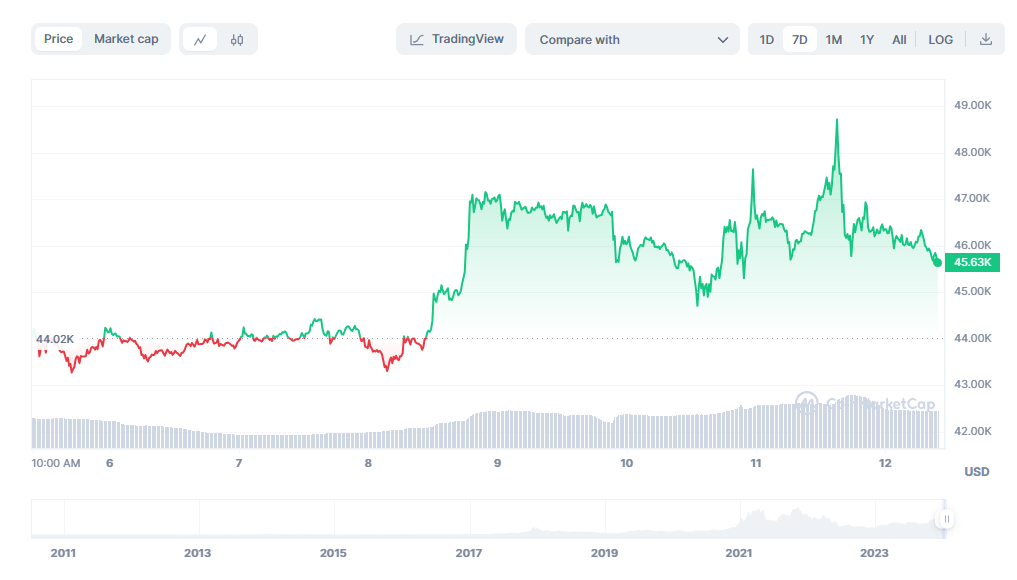
Bitcoin 7-day chart 6th January – 12th January 2024
Bitcoin 7-day chart from 6th January – 12th January 2024
Cathie Wood says $1.5 million Bitcoin bull case is now more likely
Ark’s Invests Cathie Wood said the approval of Bitcoin Exchange-Traded Funds (ETF) in the U.S. convinced her even more that the world’s largest cryptocurrency ‘Bitcoin’ could hit her crazy bullish target of $1.5 million.
For her bull case, the ARK Invest boss sees Bitcoin hitting $1.5 million by 2030. Her base case is in the $600,000 range, she reportedly said.
‘We think the probability of the bull case has increased with this SEC approval. This is a green light.’ ‘It is the first global decentralized digital rules based … monetary system in history.
It is a very big idea.
Win! Win! then…?
Bitcoin 7-day chart from 6th January – 12th January 2024
Bitcoin 7-day chart from 6th January – 12th January 2024
Stocks moved lower Thursday 11th January 2024, reflecting the higher-than-expected December 2023 inflation data.
The S&P 500 in early trade edged lower by around 0.7%, while the Nasdaq Composite dropped nearly 0.8%. The Dow Jones Industrial Average dropped by 0.6%. The S&P 500 briefly touched 4800 after climbing above its record high of 4,796.
Higher than expected
December’s consumer price index figure came out slightly higher-than-expected, reflecting a 0.3% increase in consumer prices for the month, pushing the annual rate to 3.4%.
Core CPI, excluding volatile food and energy prices, came out in line with expectations, however, pointing to persistent, but easing inflation pressures. The new inflation data figures suggests that future interest rate cuts may be slower to come.
This move up in CPI is an absolute reminder of the unpredictable nature of economic recovery.
After years of regulatory rejection, the U.S. Securities and Exchange Commission on Wednesday 10th January 2024 finally approved the Bitcoin EFT.
It has approved what are known as ‘spot’ Bitcoin Exchange-Traded Funds (ETFs), which can be purchased by anyone from pension funds to retail investors. This now means that some of the biggest asset managers in the world, including BlackRock and Fidelity can trade a crypto related ETF.
Now, instead of using a crypto asset exchange such as Binance, Coinbase or Kraken to purchase and hold a token like Bitcoin, traders can now trade a ‘spot’ Bitcoin ETF for direct exposure to the digital asset market.
It may also mean that investors could pay lower fees than they would if they bought the digital currency from a crypto exchange directly.
Basically, it is now cheaper than ever to buy Bitcoin – but is this positive for the long-term?
Crypto fans can now invest in Exchange-Traded Funds (ETFs) – but what exactly are they?
A Bitcoin ETF allows investors to buy a product that tracks the price of Bitcoin through the same method they already use to buy stocks and other existing products. This also reduces additional worry of managing their crypto related holdings, which typically involves maintaining a cryptocurrency wallet and a safe storage system to safeguard that investment.
But what exactly is an ETF?
ETFs are holdings or portfolios that allow investors to ‘bet’ on multiple assets, without having to buy any themselves. Traded on stock exchanges like shares, their value depends on how the overall portfolio performs in real time.
An ETF could comprise a combination of gold and silver bullion, for example, or a mixture of shares in both big technology and energy companies. Some ETFs already contain Bitcoin indirectly – but a spot Bitcoin ETF will buy the cryptocurrency directly, ‘on the spot’, at its current live price, throughout the trading day.
Bitcoin, the first cryptocurrency
Based on an idea by someone called, Satoshi Nakamoto, Bitcoin was the first cryptocurrency and remains the most valuable and famous to-date. Its price is often seen as a barometer for the whole industry of thousands of other coins (altcoins), tokens and products built on the same blockchain technology.
Art illustration of Bitcoin blockchain
And with an influx of new money, many expect a surge in interest in cryptocurrency technology in general.
How will the decision affect cryptocurrency adoption and is this decentralisation as originally intended?
Some say this decision shows the existing ‘old financial school’ establishment is finally taking Bitcoin seriously, at least as a speculative asset. For those who consider Bitcoin legitimate ‘digital gold’, what better proof could there be than the biggest wealth-management institutions flocking to buy, and now overseen by regulators?
Others say cryptocurrency is about rejecting traditional financial systems in favour of a decentralised, people-powered alternative. And investment bankers buying Bitcoin just to get rich on U.S. dollars is not what Satoshi Nakamoto had in mind.
But judging from the chatter on social media, the prevailing sentiment is expecting the new cash injection will make existing Bitcoin investors and owners rich.
What are the risks to future investors?
It is possible to lose all of your investment
The price of Bitcoin can change rapidly and often without warning or explanation – it is a volatile asset. So investors will need to be aware when investing in ETFs linked to a digital coin.
Art illustration of Bitcoin trading
But ETFs are often sold as high-risk, high-reward products anyway. It is EXTREMELY high risk – don’t do it if you don’t understand it and even if you do, or think you do – BE CAREFUL! These products can rip the shirt off your back!
Cyber-crime risk
Another potential risk is cyber-crime. Bitcoin and other cryptocurrencies have been the subject of huge and costly attacks that have seen crypto companies drained of sometimes hundreds of millions of dollars overnight. And if the likes of Blackrock become major holders of Bitcoin, their cyber-security will be tested in ways never before. Let’s hope their security systems are extremely robust.
Cost of mining coins
Another downside is the heavy cost to the environment is that Bitcoin use a massive number of powerful computers around the world, to process transactions on the blockchain ledger and to create coins – this is known as mining.
Renewable energy use is growing – but it remains to be seen how investment companies will tackle the environmental cost of Bitcoin.
Be careful
ETFs are here now – but BE CAREFUL when entering a Bitcoin related ETF trade or investment, or any type of ETF for that matter. If it goes wrong, you will lose your money, and quickly.
The Magnificent Seven is a term coined to describe the seven most valuable and popularly owned tech companies in the U.S. stock market.
It was also a 1960’s movie…
The Seven
Apple (AAPL)
The world’s largest software company, known for its iPhone, iPad, Mac, Apple Watch, AirPods, and other devices, as well as its services such as iCloud, Apple Music, Apple TV+, and App Store.
Microsoft (MSFT)
The world’s largest software company, known for its Windows operating system, Azure cloud services, LinkedIn social media platform, Office professional software suite, and Xbox gaming brand.
Alphabet (GOOGL)
The parent company of Google, the world’s leading search engine, as well as other businesses such as YouTube, Google Cloud, Google Maps, Google Ads, and Waymo.
Amazon (AMZN)
The world’s largest online retailer, as well as a leading provider of cloud computing services through Amazon Web Services (AWS), and a major player in digital entertainment through Amazon Prime Video, Amazon Music, and Kindle.
Meta Platforms (META)
The former Facebook, the world’s largest social media network, as well as the owner of other popular platforms such as Instagram, WhatsApp, Messenger, and Oculus.
Nvidia (NVDA)
The world’s leading manufacturer of graphics processing units (GPUs), which are used for gaming, artificial intelligence, cloud computing, and cryptocurrency mining, as well as other products such as Nvidia Shield, GeForce Now, and Omniverse.
Tesla (TSLA)
The world’s most valuable automaker, known for its electric vehicles, battery products, solar panels, and self-driving technology, as well as its visionary founder and CEO, Elon Musk.
Market dominance
These seven companies are not only dominant in their respective fields, but also at the forefront of innovation and growth in the tech sector. They collectively make up some 30% of the S&P 500 index and more than half of the Nasdaq 100 index.
They have also delivered impressive returns for investors over the past five years, with Nvidia and Tesla leading the pack with more than 800% gains. The Magnificent Seven are often compared to the FAANG stocks, which include four of the seven companies, but exclude Microsoft, Nvidia, and Tesla, and include Netflix instead.
Some analysts suggest that the Magnificent Seven capture the current state and future potential of the tech industry. But is it now time to rotate out of tech into other areas that have been neglected. I wouldn’t be surprised to see the bull market charge on but with other ‘less’ loved companies leading the way.
It has been calculated that the combined market cap value of these seven companies is some $9 trillion.
Bitcoin jumped briefly on Tuesday 9th January 2024 after a post on the U.S. markets SEC regulator’s ‘X’ account post said it had approved the Exchange-Traded Funds (ETF’s) in the cryptocurrency.
This was a big news event for the cryptocurrency community and for the wider investment world. Large and small investors have been eagerly awaiting this news for months. When it finally arrived, it turned out to be fake.
U.S. regulators are expected to make an announcement on the new ETF’s this week.
The social media platform ‘X’ refuted the accusation that its systems had been the reason for the ‘compromise’.
Fake post
The fake news post appeared on the SEC’s official X account shortly after 16:00 Washington time (21:00 GMT). It said the regulator ‘grants approval for #Bitcoin ETFs for listing on all registered national securities exchanges.’ The post was immediately on the general social media radar and business news outlets.
SEC’s chair Gary Gensler quickly posted a message correcting the erroneous announcement on his personal ‘X’ account: “The @SECGov twitter account was compromised, and an unauthorized tweet was posted. The SEC has not approved the listing and trading of spot Bitcoin exchange-traded products.”
‘The SEC has determined that there was unauthorized access to and activity on the @SECGov x.com account by an unknown party for a brief period of time shortly after 4 pm ET. and that the unauthorized access has been terminated,’ it was reported.
Bitcoin jumped
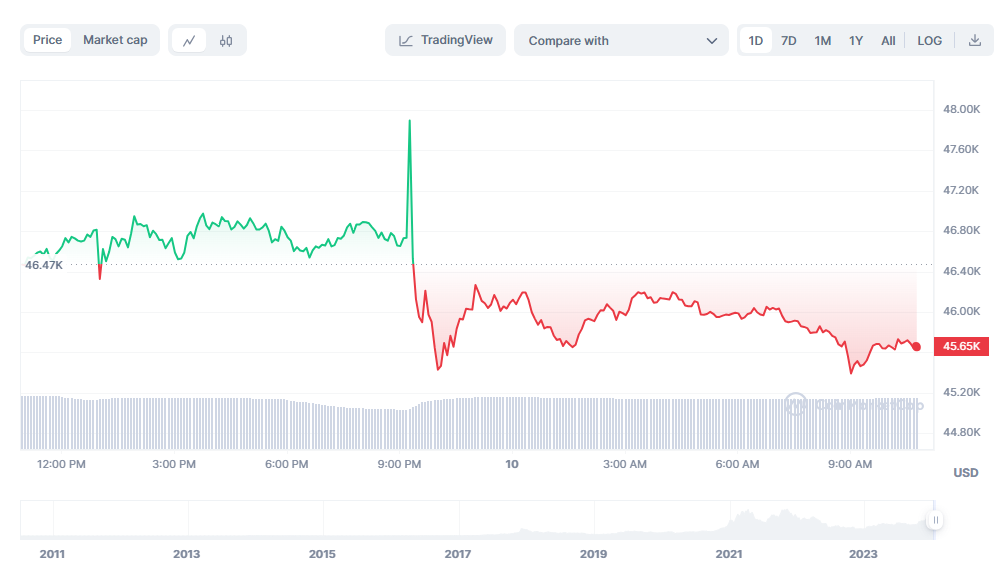
Bitcoin jumped to touch $48,000 (£37,800) immediately after the erroneous post before falling back to around $45,500
Bitcoin jumped to ouch $48,000 (£37,800) immediately after the erroneous post before falling back to around $45,000
Investors are eagerly anticipating an SEC announcement on the potential approval of spot Bitcoin ETFs, which is expected this week.
It would mark a key milestone for the cryptocurrency market in gaining acceptance to mainstream financial markets.
Did you know that there are more moves in a game of chess than there are atoms in the Universe?
Well, it’s true.
The universe is so vast it is just mind bogglingly impossible to imagine how many atoms make it up. The estimated number of atoms in the universe is calculated at 10 to the power of 80 (1080).
But, the number of moves in a chess game is far greater coming in at a massive 10 to the power of 120 (10120).
This is known as the ‘Shannon number’.
So, there are more moves in a game of chess than there are atoms in the universe, as we know it Jim!
Crypto related stocks climbed Monday 8th January 2024 as the price of Bitcoin increased again to its highest level since April 2022.
Crypto exchange Coinbase rose 3%, while Block and Robinhood, which also offer Bitcoin trading services, added 3% and 5%, respectively. Mining stocks enjoyed gains too: Marathon Digital and Riot Platforms advanced some 8% each. CleanSpark and Iris Energy both added 6%.
ETF decision closer
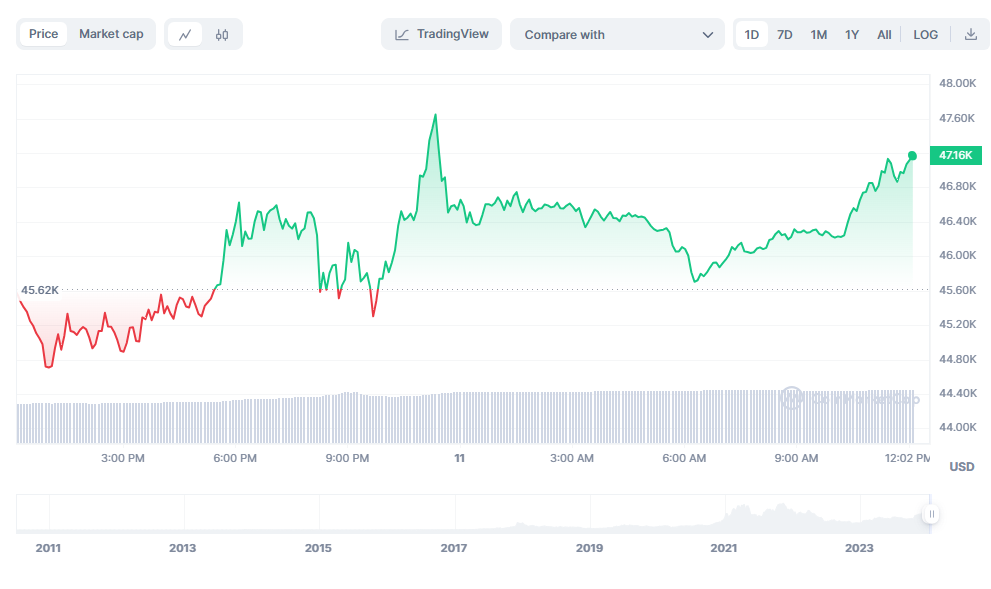
Bitcoin rallied above $47,000 as BlackRock, Grayscale and other potential Bitcoin ETF issuers submitted final updates to the Securities and Exchange Commission (SEC), that bolstered investors’ confidence that a likely positive decision is due soon.
Bitcoin 24-hour chart Monday 8th – Tuesday 9th January 2024
According the High Pay Centre, a thinktank that campaigns for fairer pay, the average pay of FTSE 100 chief executives is 103 times the £33,000 average salary for full-time UK workers.
This means that by lunchtime on the third working day of 2024, a FTSE 100 company boss will have been paid more than a UK worker’s full annual salary.
So, this means that it takes approximately just three working days for a CEO to earn the FULL years pay of an average worker in the UK.
The study also shows that the pay gap between bosses and workers has increased since 2020, as executive pay has risen by 9.5% while worker pay has risen by only 6%.
Shocking inequality
This is a disturbing example of inequality in the UK workplace, which has been exacerbated by the cost-of-living crisis and the strike action by many low-paid workers.
Some economists have called for UK government to intervene and reduce the unfair pay gap, such as putting workers on company boards, taxing wealth more fairly, and working with employers and unions to create better living standards.
Wealth creators
There is a place for wealth creators but not for greedy wealth takers. We need businesses to be successful to maintain good levels of employment. But unnecessary wealth greed has no place in our modern society.
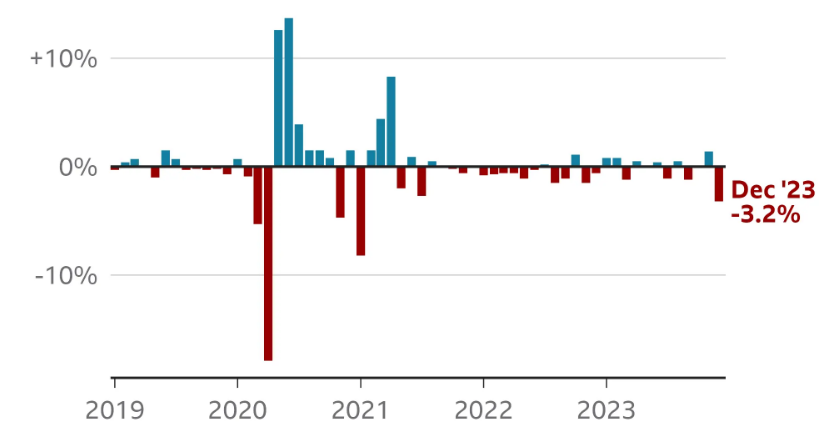
The U.S. labour market accumulated strong gains as the pace of hiring was greater than expected, dampening the chance of an early rate cut.
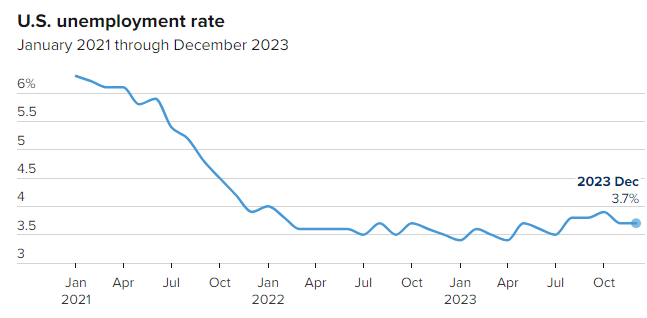
December’s jobs report showed that 216,000 jobs were added for the month while the unemployment rate remained steady at 3.7%. Estimates were in the region of 170,000 as analysts were looking for their ‘goldilocks figure.
Job boost from U.S. government
The hiring boost came from a gain of 52,000 in government jobs and another 38,000 in health care-related occupations.
Average hourly earnings rose 0.4% on the month and were up 4.1% from the same period 2023, both higher than the respective estimates for 0.3% and 3.9%.
U.S. unemployment chart Jan 2021 – December 2023
S&P500 and Nasdaq
The S&P500 and Nasdaq recovered some early 2024 losses as the fresh data encouraged the debate and chance of a rate cut again. Later however, the strong U.S. jobs growth dampened the likelihood of rate a cut anytime soon. Yields were on the rise again.
Strong streak
Government hiring drove the gains, which extended one of the strongest streaks of job creation on record. The job growth has confounded forecasters expecting job losses as higher borrowing costs slowed the economy.