

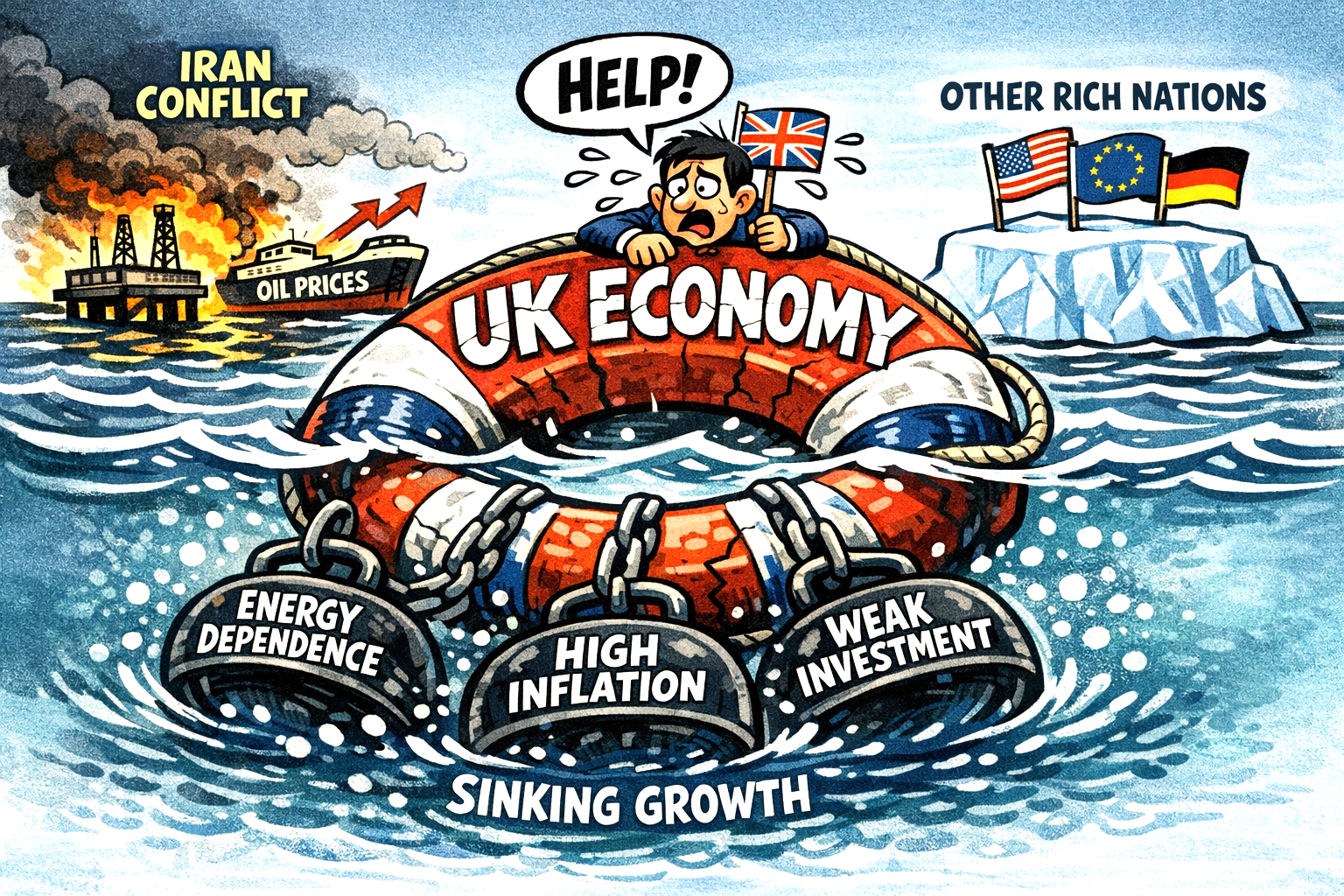
UK economy will be hit hardest by the U.S.-Israel Iran war warns the IMF

UK Economy damaged by U.S. Iran War

The IMF’s warning that the UK would suffer the sharpest growth hit among rich economies from an Iran‑related war is rooted in a simple structural reality.

Britain is unusually exposed to energy‑price shocks, yet unusually weak in the buffers that normally absorb them according to the IMF.

Why the UK will be hit harder than its peers

The UK enters this crisis with three vulnerabilities

  • High dependence on imported energy. North Sea output has declined for years, leaving Britain reliant on global LNG markets. When Middle Eastern supply is disrupted, LNG prices spike first and hardest. The U.S. and eurozone have deeper domestic energy bases or cheaper pipeline access.
  • A structurally fragile inflation profile. The UK’s inflation has been stickier than that of other G7 economies, driven by food, energy and services. A renewed oil shock feeds directly into household bills and transport costs, forcing the Bank of England to keep rates higher for longer.
  • Weak productivity and stagnant investment. Britain has less momentum to absorb an external shock. When energy prices rise, UK firms cut back faster, and consumers retrench more sharply.
  • UK Government policy. Ed Miliband and his ‘likely’ misguided staunch defence of Net Zero policies and expensive energy costs have left the UK seriously exposed to shocks – such as this.

The IMF’s logic

The Fund argues that a prolonged disruption in the Strait of Hormuz would push global oil prices sharply higher.

For the UK, this translates into

  • Higher wholesale gas costs, because LNG markets reprice off oil‑linked benchmarks.
  • A renewed inflation surge, delaying rate cuts and tightening financial conditions.
  • A squeeze on real incomes, hitting consumption—the UK’s main growth engine.
  • A fall in business investment, already one of the weakest in the OECD.

The IMF’s modelling suggests that the UK’s growth rate could fall more steeply than that of the U.S., Germany or France because those economies either have stronger industrial bases, more resilient energy systems or more fiscal space to cushion the blow.

The broader picture

This is less about geopolitics and more about structural brittleness. A global energy shock exposes the UK’s unresolved weaknesses: high import dependence, fragile inflation dynamics and a decade of under‑investment.

Clean energy gold rush for natural hydrogen

Natural hydrogen

The natural hydrogen gold rush is captivating attention worldwide as a potential game-changer in the quest for cost-effective, low-carbon energy sources.

Countries such as the U.S., Canada, Australia, France, Spain, Colombia, and South Korea are actively engaged in exploratory efforts for geological hydrogen.

What Is Natural Hydrogen?

Natural hydrogen, also referred to as white or gold hydrogen, is hydrogen gas that occurs naturally beneath the Earth’s surface. It is thought to form from high-temperature reactions between water and minerals rich in iron.

Unlike current hydrogen production, which is mainly produced using fossil fuel, natural hydrogen holds promise as a cleaner option.

Why the Hype?

Hydrogen is often reported as a potential energy source for transitioning away from fossil fuels. Yet, the methods used to produce it frequently result in substantial greenhouse gas emissions.

Green hydrogen, produced by splitting water into hydrogen and oxygen using renewable electricity, is an exception. Unfortunately, its development has been hindered by high costs and economic challenges.

Geologic hydrogen is a ‘natural’ hydrogen. Companies are now actively exploring this untapped resource. Countries like Australia, France, Spain, U.S., Canada, Colombia, and South Korea.

Research by Rystad Energy reportedly suggests that forty companies were actively searching for geologic hydrogen deposits by the end 2023. That’s up from just 10 in 2020. The term ‘white gold rush’ has emerged from this surge in interest.

Potential Impact

Advocates hope that natural hydrogen could be a gamechanger in the clean energy transition.

Although it’s not an entirely novel concept, interest in geologic hydrogen is gaining traction. Both researchers and corporations are eager to explore its possibilities.

As the exploration unfolds, the world looks on with eager anticipation. Hopefully natural hydrogen will play a significant role in shaping a more sustainable energy future.

The natural hydrogen will have to be mined and that in itself may bring environmental issues. Remember the concerns fracking created?