

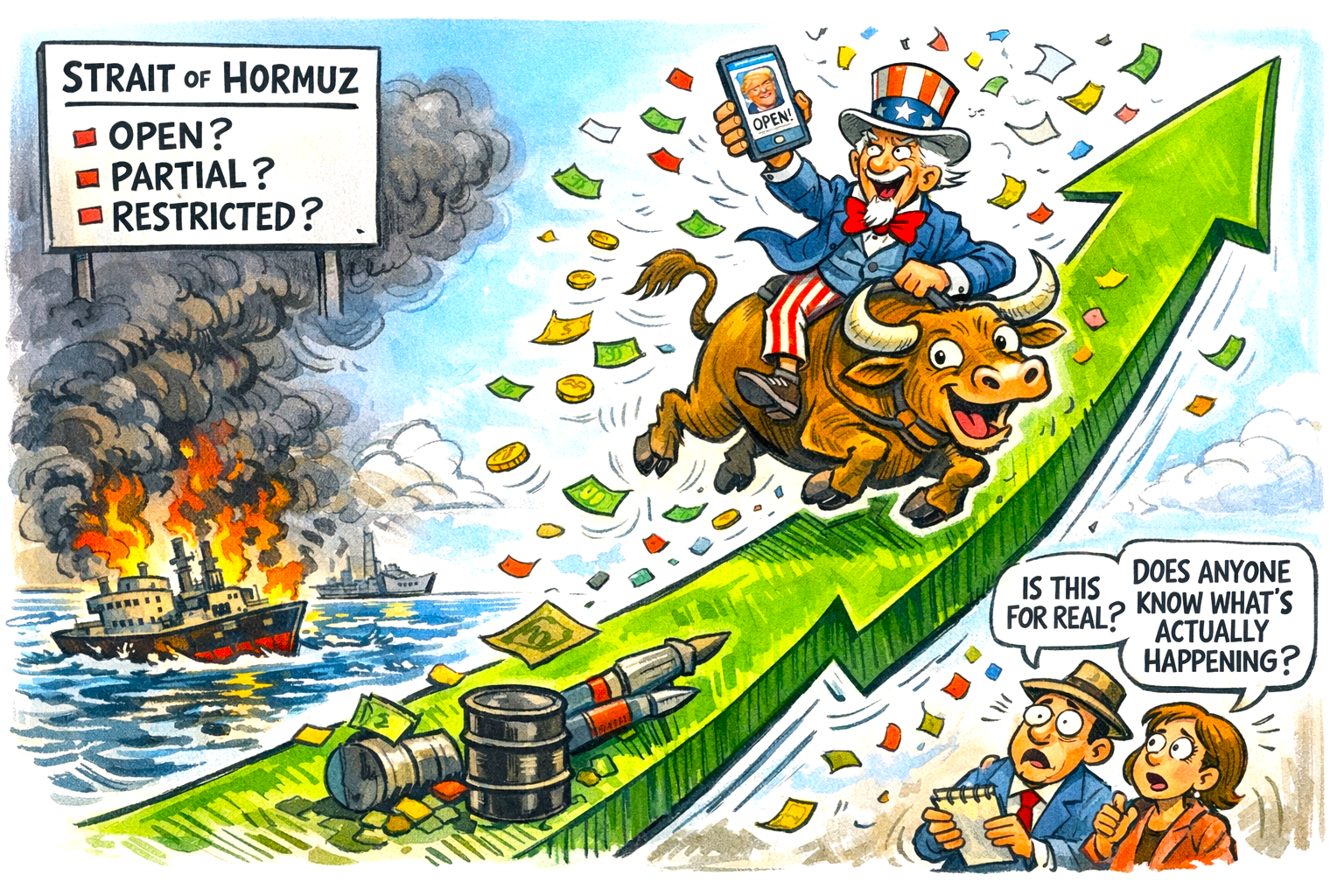
U.S. Markets Hit New Highs Friday 17th April 2026 Amid Confusion Over the Strait of Hormuz and Presidential Chatter

U.S. markets hit new highs as announcements are clouded in smoke

U.S. equity markets surged to fresh record highs on Friday 17th April 2026, propelled less by economic fundamentals and more by a swirl of contradictory geopolitical signals and a single, highly visible social media post from the President of the United States.

The result was a rally that looked exuberant on the surface yet rested on information that remained unverified, disputed, or only partially understood.

Market makers, investors and traders can’t possibly verify that this information is safe to trade – it’s a bet – and this isn’t good for the stock market.

The world deserves better – this is not investing!

Catalyst

The catalyst was a presidential declaration that the Strait of Hormuz — a critical artery for global oil shipments — was “open”. The statement landed with the force of breaking news, despite the absence of confirmation from defence officials, maritime authorities, or international partners.

It was also reported that the U.S. would maintain its blockade of the Strait of Hormuz?

Reports circulating throughout the day suggested a more complicated reality: some sources described partial reopening, others spoke of restricted passage, and several indicated that conditions remained unstable.

In short, the facts were not settled.

Markets, however, behaved as though they were.

Melt-up driven by social media posts

Within minutes of the President’s post, U.S. index futures spiked sharply. By the closing bell, the S&P 500, Nasdaq, and Dow had all notched new highs.
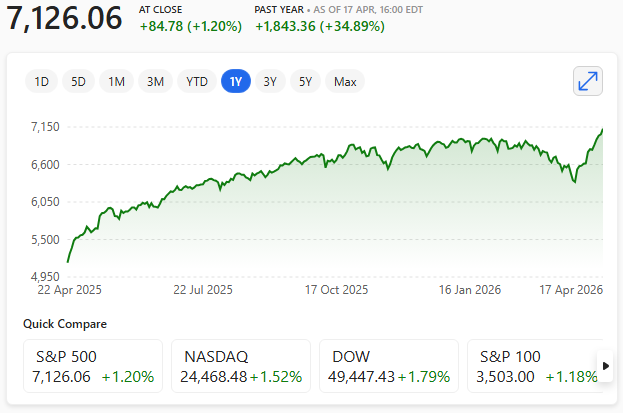
S&P 500 closes a record high 17th April 2026

Traders reportedly described the move as a “headline‑driven melt‑up”, a familiar pattern in recent months/years in which presidential commentary — rather than institutional communication — becomes the primary driver of intraday sentiment.

The sensitivity is not new. Analysts have repeatedly noted that markets respond quickly to presidential statements on energy, security, and trade, even when the underlying information remains contested.

What made Friday’s rally notable was the scale of the reaction relative to the uncertainty surrounding the Strait itself. Oil prices fell, risk appetite surged, and equity markets behaved as though a major geopolitical bottleneck had been definitively resolved.

Structural vulnerability

Critics argued that this dynamic reflects a structural vulnerability: when markets move first and verify later, volatility becomes a feature rather than a flaw. Supporters countered that traders simply price information as it arrives, regardless of its source.

What is clear is that the rally was driven not by data releases, earnings results, or policy announcements, through the ‘accepted and usual channels’ but by social media messages amplified across global financial systems.

Whether the Strait of Hormuz is fully open, partially open, or operating under constraints remains to be clarified.

The markets, however, have already made up their mind — at least for now.

The ‘news’ is good or ‘bad’ enough to make money!

U.S. stock market credibility is being eroded daily – bit by bit.

This has to stop!

No intent is suggested

Update

Iran fired shots at vessels trying to exit the Strait of Hormuz over the weekend. And now the U.S. has attacked a vessel under the Iranian flag casting doubt on renewed talks. The fragile ceasefire expires Wednesday 22nd April 2026 – unless Trump extends this and does a TACO!

There has also reportedly been talk of a 60-day extension – but that was before these latest problems.

No intent is suggested.

S&P 500 closes above 5500 for the first time

S&P Bull run record

On 2nd July 2024, the S&P 500 reached a significant milestone, closing above 5500 for the first time in its history.

This impressive achievement has prolonged the blistering rally of 2024, during which the index has reached 32 record highs. Since July 2023, the S&P 500 index has surged by more than 1000 points.

The rise in U.S. equities has been propelled by robust corporate earnings, the artificial intelligence (AI) boom, and the anticipation of interest rate reductions. Although some analysts warn that the market might be stretched too far, others are forecasting additional increases.

Many analysts have now raised their target for the S&P 500 to end the year at around 5700.

One year S&P 500 chart July 2023 to July 2024

One year S&P 500 chart July 2023 to July 2024

The unloved stock market rally: exploring why many investors are hesitant to embrace this record-breaking run

Unloved rally

The unloved rally: A paradox

The S&P 500 and Nasdaq have been reaching all-time highs with remarkable frequency, notching nearly thirty record days in 2024, including four in the past week. Despite this stellar performance, a considerable number of investors remain hesitant. Let’s explore the reasons behind this paradox.

Lingering recession fears

The recollection of the 2022 bear market continues to trouble investors. The swift escalation of monetary policy by the Federal Reserve at that time generated widespread uncertainty and apprehension. This has led many investors to maintain a cautious stance, concerned that the past may repeat, even amidst a surging market. Maybe less of us expected the AI driven stock buying frenzy to scale such highs so quickly?

Scepticism

Investors are inherently sceptical. Amidst a relentless market rally, uncertainty emerges. Can this be sustained? Is a correction looming? This scepticism may hinder investors from wholeheartedly participating in a bull market, despite what the statistics indicate.

Emotional baggage

Investment isn’t solely a game of numbers; it’s equally a matter of emotions (although it shouldn’t be). Investors bearing the scars of past losses may find their emotional baggage weighing heavily on their decisions. The fear of experiencing another market crash can cloud rational judgement, leading them to forgo opportunities for potential gains.

The ‘easy money’

The stock market’s significant rise from the lows of 2022 has convinced some that the phase of ‘easy money’ is over. Investors who did not capitalize on the early stages of the rally might think they have missed out, causing hesitation to engage fully. That’s where I am right now – but waiting for a ‘pullback’.

Navigating the dilemma

For individuals caught between caution and the fear of missing out (FOMO), the following strategies could be considered.

Diversification

Distribute your investments among various asset classes. Diversification serves to reduce risk and acts as a safeguard against the unpredictability of the market.

Long-term perspective

Keep in mind that investing is akin to a marathon, not a sprint. It’s important to concentrate on long-term objectives instead of short-term market movements.

Education

Inform yourself about market cycles, historical patterns, and the effects of monetary policy. This should empower more informed decision-making.

Professional advice

Consult a financial advisor who can guide you based on your individual circumstances and risk tolerance.

Conclusion

The current stock market rally, though not widely embraced, offers both opportunities and challenges. Investors are tasked with finding the right balance between exercising caution and capitalizing on potential growth. As the market climbs, it’s essential to be aware of our biases and emotions. Only then can we approach the rally with a more informed viewpoint.

Disclaimer: This article provides general insights and should not be considered personalised financial advice. Always consult a professional before making investment decisions.

Remember: Always do your own diligent and careful research.

RESEARCH! RESEARCH! RESEARCH!

All hail the rally?

U.S. stocks rally

U.S. stocks have had a good year in 2023, and a great start to 2024 with new record highs being set.

Many major indices have recorded double-digit gains. However, some analysts have warned that the rally may not last, as it has been driven by a few large-cap technology and growth stocks, while many other sectors and regions have lagged behind. 

A stock market rally is a broad and rapid rise in share prices, often defined as a 20% increase from a recent low. 

This could indicate a lack of breadth and sustainability in the rally, and potentially signal a market pullback, correction or even a crash in the future.

Bull bear, bull?

Chartists with their technical analysis might see a pattern that points to a substantial upside, but they should not get too carried away with their own observations, right now would be a sensible time for markets to find level ground, if only temporarily. 

The bullish view is that the ‘laggards’ should catch up the ‘mega cap’ stalwarts once again. The bearish view is that the ‘mega cap’ stocks’ will realise they’ve gone too far and need to ride back to the rest of the market. Too few stocks in the same sector hold the balance of power – go check out the Magnificent 7 or even the old FANG stocks.

Catch-up

Either way, there ought to be an opportunity for underrepresented sectors and industries to gain lost ground.

The question is, will there be a pause to allow laggards to catch-up, or will the mega caps simply continue on their march?