
Iran’s 2026 Energy Crises: Echoes of the 1970s in a New Era of Risk

U.S. Israel Iran War 2026

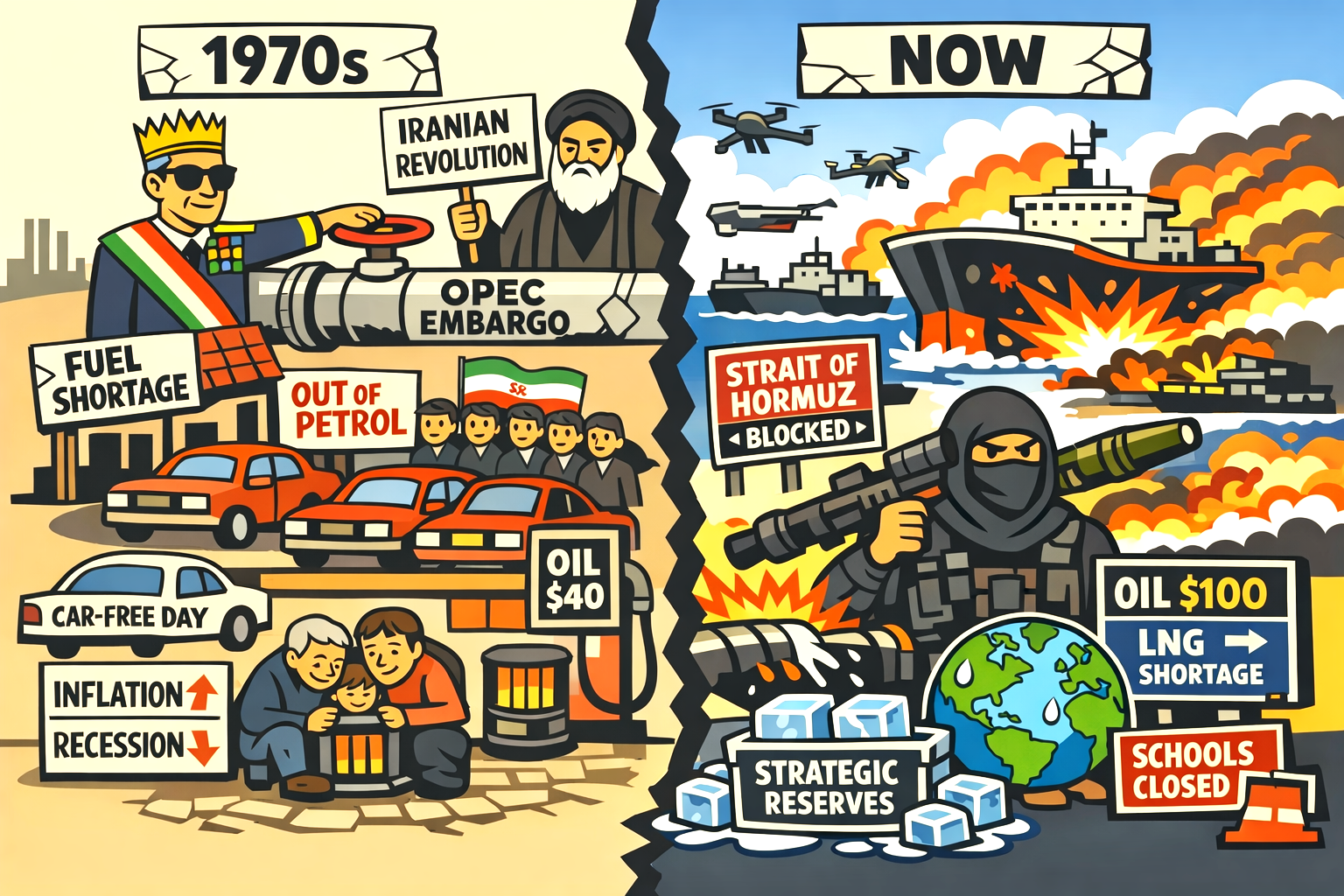
The 1970s crises were triggered by political embargoes and revolution, causing sharp but smaller supply cuts and extreme price spikes.

Today’s crisis is driven by war, infrastructure attacks, and the near‑closure of the Strait of Hormuz, producing a larger supply disruption, though price rises so far have been less extreme.

Energy shock

The energy shocks of the 1970s remain some of the most disruptive economic events of the modern age. Triggered first by an embargo and later by revolution, they exposed how deeply the global economy depended on Middle Eastern oil.

Half a century later, Iran still sits at the centre of global energy anxiety — but the nature of the threat has shifted.

The world is no longer facing an outright supply collapse, yet the structural vulnerabilities that defined the 1970s have not disappeared. They have simply evolved.

Yom Kippur War

The first major shock came in 1973, when Arab oil producers cut exports to countries supporting Israel during the Yom Kippur War.

The result was a sudden loss of roughly seven per cent of global supply. Prices quadrupled, queues formed at petrol stations, and governments imposed rationing, car‑free days, and speed‑limit reductions.

The economic fallout was severe: inflation surged while growth stalled, creating the era‑defining condition of stagflation.

A second blow followed in 1979, when the Iranian Revolution removed millions of barrels per day from the market. Prices tripled once again, and the world was forced to confront the fragility of its energy systems.

IEA

The International Energy Agency was created in direct response, tasked with coordinating emergency measures and strategic reserves.

These two crises set the benchmark for what an energy shock looks like — sudden, sharp, and globally destabilising.

Today’s risks are different. The world is not experiencing a supply loss on the scale of the 1970s, but the potential for disruption remains high.

Strait of Hormuz

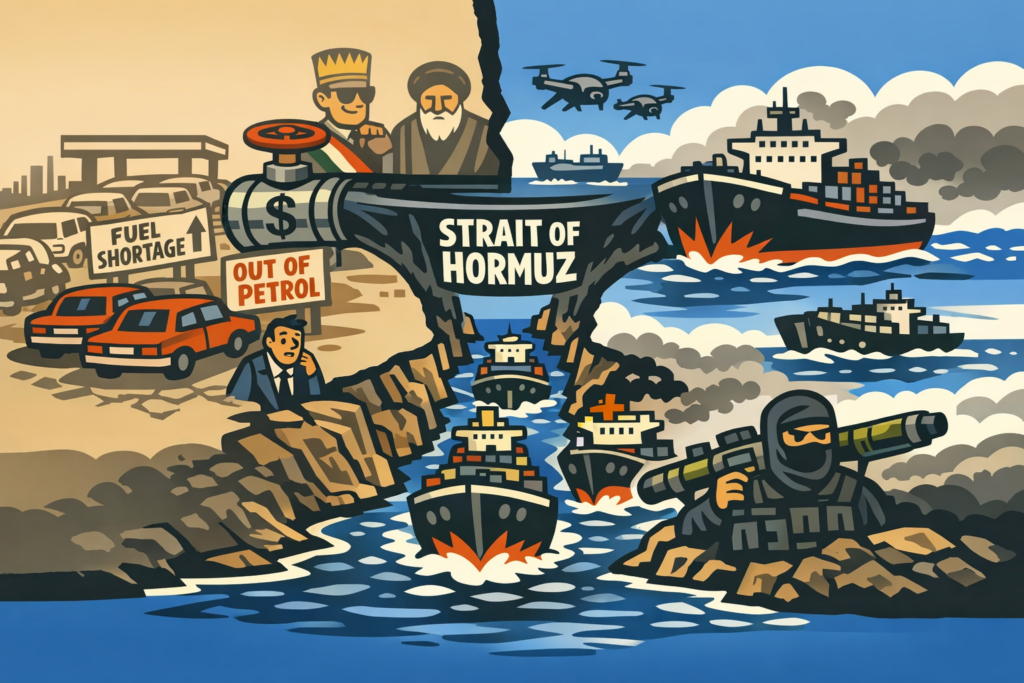
The Strait of Hormuz, through which around a fifth of global oil flows, is a strategic chokepoint vulnerable to conflict, tanker seizures, and infrastructure attacks.

Iran has repeatedly threatened to close or disrupt the strait during periods of tension, and even limited incidents in recent years have pushed prices higher.

Markets remain acutely sensitive to any sign that the corridor could be compromised.

Diverse energy

Unlike the 1970s, modern economies have more diversified energy systems, larger strategic reserves, and a growing share of renewables.

Yet these advantages do not eliminate risk; they merely soften it. A serious disruption in the Gulf would still send shockwaves through global markets.

The comparison between then and now is not one of scale but of structure. The 1970s showed how quickly energy can become a lever of geopolitical power.

Today’s world is more resilient, but no less exposed. The lesson endures: when a single region holds the key to global supply, the world remains only one crisis away from another shock.

We also need to ask – how and why this happened again!

What’s your answer?

How the crises affected the UK in the 1970s

The 1970s energy crisis had a profound and lasting impact on the United Kingdom, reshaping its economy, politics, and industrial relations.

When global oil prices quadrupled after the 1973 OPEC embargo, Britain was already struggling with domestic energy tensions.

Coal remained the backbone of electricity generation, and the miners’ dispute with Edward Heath’s government over pay and working conditions collided with the global fuel shock.

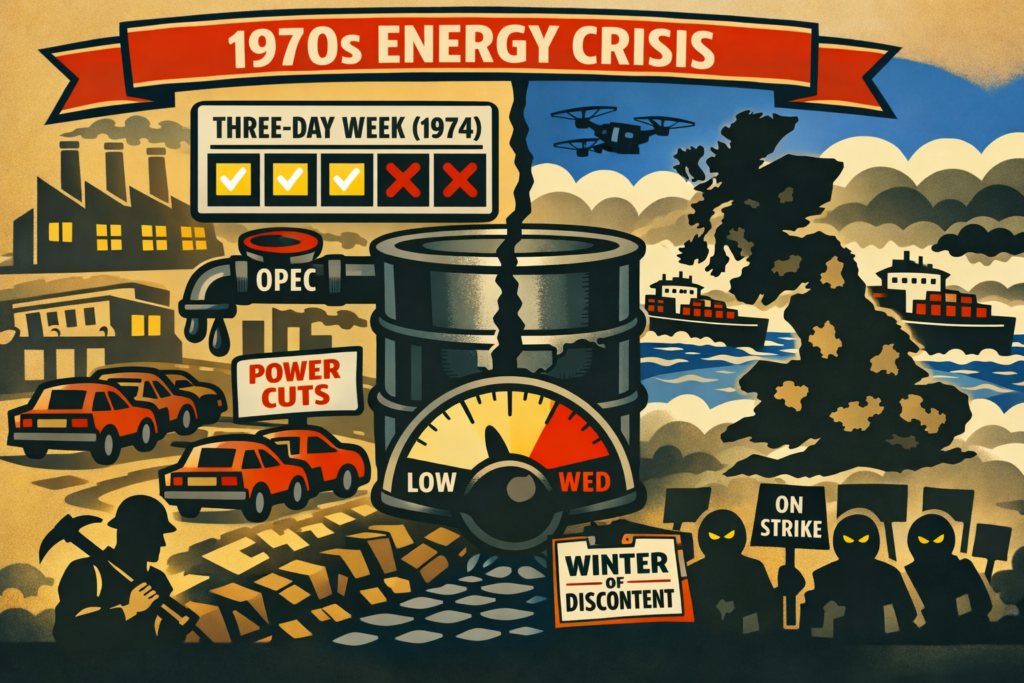
As coal output fell and oil costs soared, the government-imposed emergency measures — most famously the Three‑Day Week in early 1974, limiting commercial electricity use to conserve power. It led to the Winter of Discontent.

Power Cuts

Factories shut down, television broadcasts ended early, and households faced rolling power cuts. Inflation surged, unemployment rose, and the economy slowed sharply.

The crisis deepened public frustration with the Conservative government, contributing to Heath’s defeat in the February 1974 general election.

Trade Union Turmoil

The turmoil also strengthened trade unions, whose strikes became a defining feature of the decade.

By the late 1970s, another oil shock — triggered by the Iranian Revolution — compounded Britain’s economic malaise, leading to the “Winter of Discontent” and paving the way for Margaret Thatcher’s election in 1979.

In short, the 1970s energy crisis exposed Britain’s dependence on imported fuel and unstable domestic supply, ushering in years of inflation, industrial unrest, and political upheaval that reshaped the country’s economic direction for decades.

Heat is on at COP28

CO28

United Nations’ biggest and most important annual climate conference to-date, gets underway as the United Arab Emirates on Wednesday 29th November 2023 defended what it described as ‘fake news’ designed to undermine its work as the host of the COP28 climate conference.

The UAE organizers slammed a number of ‘fake press‘ releases in the name of COP28. Among them, a letter claiming COP28 president-designate Sultan Al-Jaber was due to step down from his position as chief executive of state oil giant the Abu Dhabi National Oil Co. (ADNOC).

Al-Jaber’s appointment as COP28 president-designate had provoked a furious backlash from climate activists when it was first announced. He reportedly pushed back over reports earlier in the week that said the UAE planned to use its role as the host of the climate summit as a platform to lobby foreign government officials for oil and gas deals.

Even so, the COP28 summit, which starts on Thursday 30th November 2023 and is scheduled to run through to 12th December 2023. I will provide a critical forum for government officials, business leaders and campaign groups to accelerate action to tackle the climate crisis. Let’s hope there is no further rolling back on previous pledges such as the UK’s government announcement to increase the number of North Sea oil and gas exploration and recovery licences.

OPEC

Meanwhile, also on Thursday 30th, the influential Organization of Petroleum Exporting Countries (OPEC) and its allies will convene to decide the next production policy steps in a delayed meeting caused by the conflict in the Middle East.

COP28
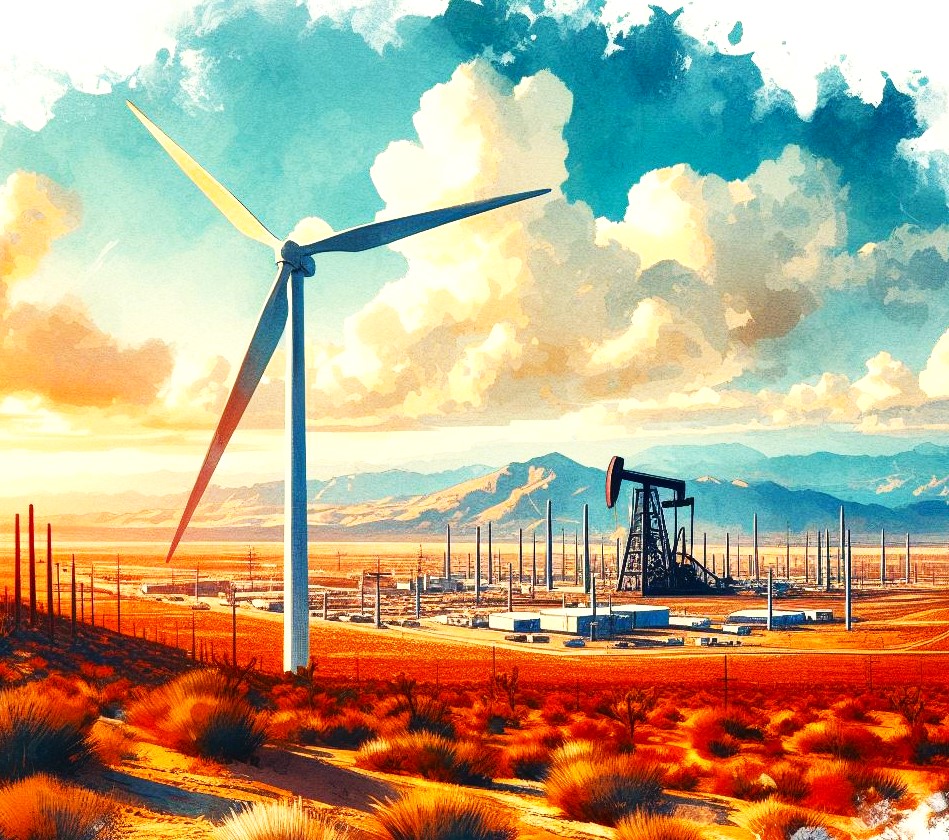
Art illustration of renewable and fossil fuel energy – Heat is on at COP28

UAE, one of the world’s major oil producers and a key OPEC+ component, is keen to burnish its reputation as a champion of the transition to green energy.

Tangible climate action though is the best way to push back all scepticism and cynicism. Now is as good as any time to start.

Production cuts will come – some analysts predict $100 a barrel.

The world is not ready to relinquish its thirst for oil and gas… just yet. It is still hungry for traditional power – and renewables is not ready to take over.