
Suspicious Market Timing Raises Fresh Questions Over Alleged Potential Insider Trading During the U.S.–Iran Crisis

Alleged Potential Insider trading storm erupts

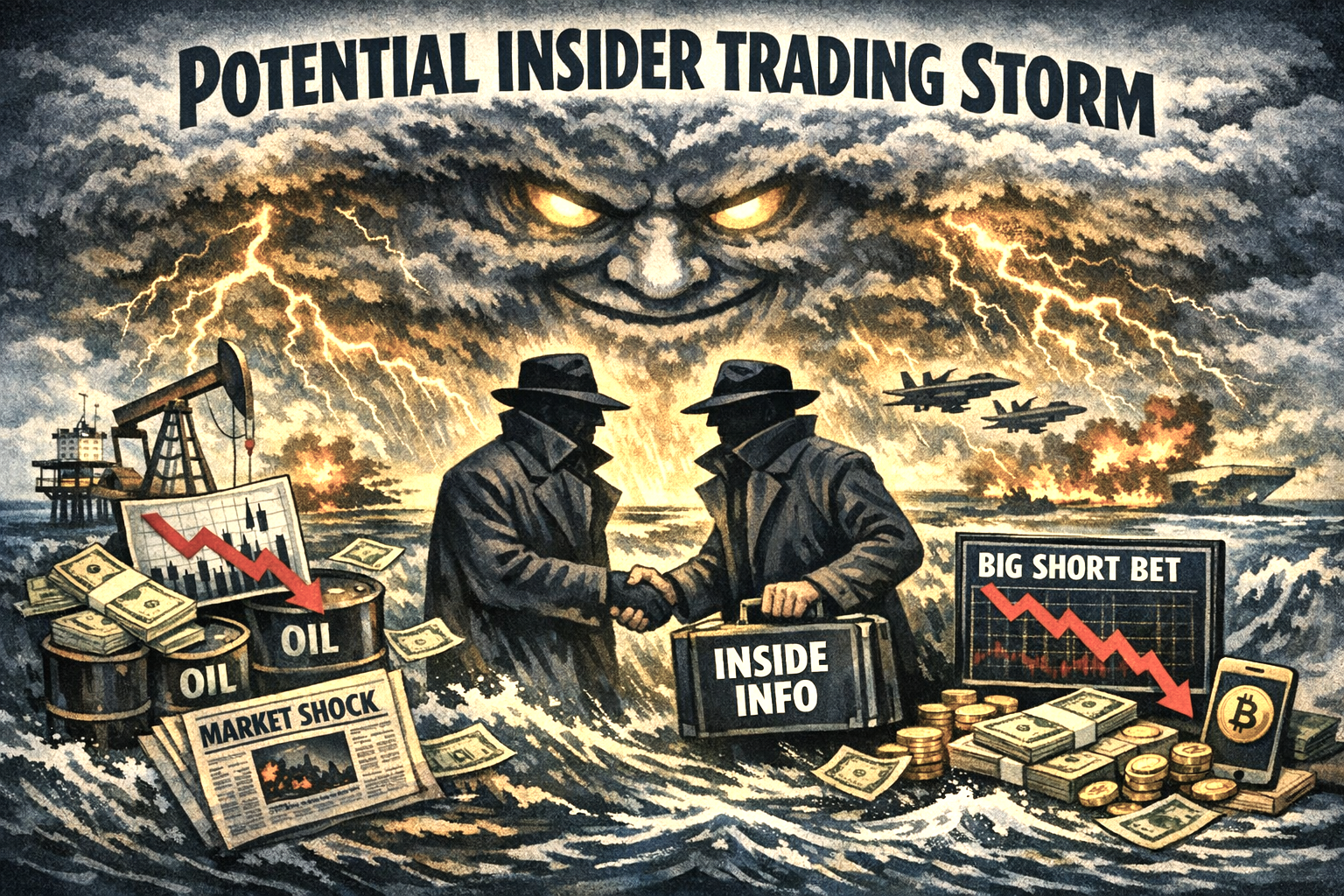
Allegations of suspiciously timed trades have intensified in recent weeks as analysts, journalists, and regulators examine a series of market moves that coincided—sometimes to the minute—with major announcements about the U.S.–Iran conflict.

While no wrongdoing has been proven, the pattern has become difficult for commentators to ignore and calls for formal investigation are growing louder. Can these trades and market movement be explained as coincidence?

Potential ‘speculative’ trading?

Many media outlets are also highlighting anomalies. For instance, it has been reported that Wealth manager Rachel Winter indicated traders appeared to take out contracts positioned to profit from falling oil prices just minutes before a presidential post claiming “productive” talks with Iran—timing she described as “speculation about insider trading” and worthy of investigation.

This episode was not isolated. Multiple outlets have documented at least two major bursts of unusually large oil futures trades placed shortly before conflict‑related announcements.

On 17th April 2026, it was reported that roughly $760 million in Brent crude short positions were executed around 20 minutes before Iran’s foreign minister declared the Strait of Hormuz “completely open” following a ceasefire—an announcement that sent oil prices sharply lower.

Analysts at the London Stock Exchange Group reportedly described the volume as “completely atypical,” nearly nine times normal levels.

Earlier in March 2026, it has been reported that traders placed around $500 million in positions shortly before the White House delayed planned strikes on Iran’s energy sector.

A similar pattern emerged on 7th April 2026, when roughly $950 million was positioned for falling oil prices hours before another ceasefire announcement.

These repeated bursts—each ahead of market‑moving news—have fuelled concerns that some traders ‘may’ have had access to information not yet public. Or was it a good guess – a coincidence even?

Reports of ‘unusual’ trading patterns

These reports align with broader commentary. The Independent noted that at least 6 million barrels’ worth of Brent and WTI contracts were suddenly sold in the two minutes before a presidential post about “productive” talks—again raising questions about advance knowledge.

Meanwhile, The London Economic reported that around $580 million in oil bets were placed 15 minutes before the same announcement, with market strategists calling the timing “really abnormal” for a day with no scheduled events.

Even outside traditional markets, anomalies have surfaced. Blockchain analysts identified six newly funded crypto wallets that made nearly £780,000 by betting—hours before explosions were reported—that the U.S. would strike Iran on 28th February 2026.

Across all these cases, commentators stop short of asserting intent. But the clustering of high‑stakes trades immediately before geopolitical announcements has created a clear narrative: the market signals are too sharp, too well‑timed, and too frequent to dismiss without scrutiny.

No intent is suggested – it could just be coincidence?
A Sudden Surge: Markets, Messaging, Manipulation and the Shadow of Insider Trading

Insider trading?

Financial markets are no strangers to volatility, but even seasoned traders were taken aback by the extraordinary price action that unfolded recently.

Just a minute

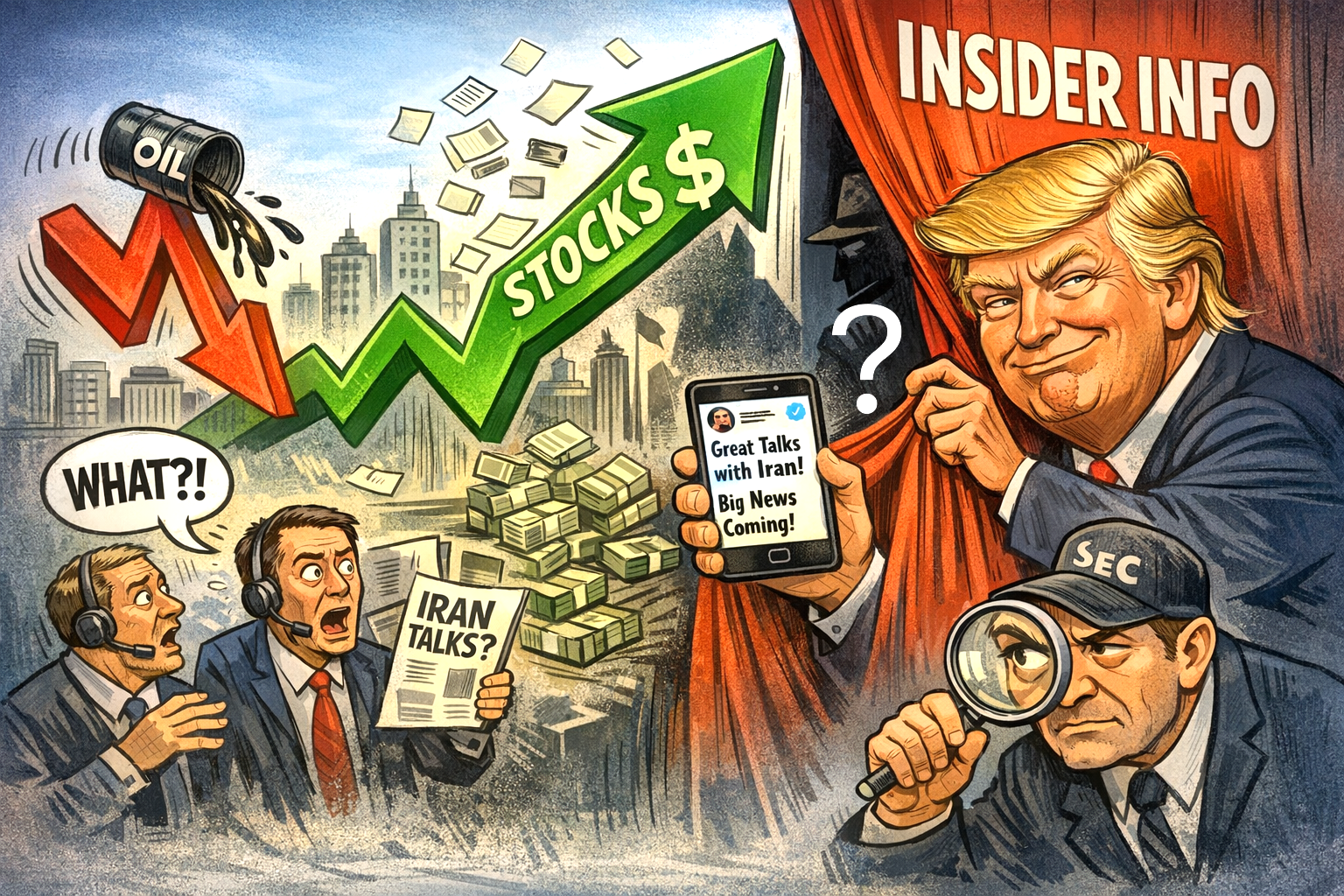
In the space of minutes, global indices lurched upwards, oil prices collapsed, and billions of dollars shifted across the financial system — all triggered by a single, unexpected announcement from President Trump claiming “productive talks” with Iran.

What followed was a whiplash-inducing reversal, a diplomatic denial from Tehran, and a growing chorus of questions about whether the market’s initial leap was quite as spontaneous as it appeared.

Spike

The sequence of events is now well documented. In the quiet pre‑market hours, trading volumes in S&P 500 futures and crude oil contracts suddenly spiked.

These were not the tentative probes of retail traders or the routine adjustments of algorithmic systems. They were large, directional, and unusually well‑timed.

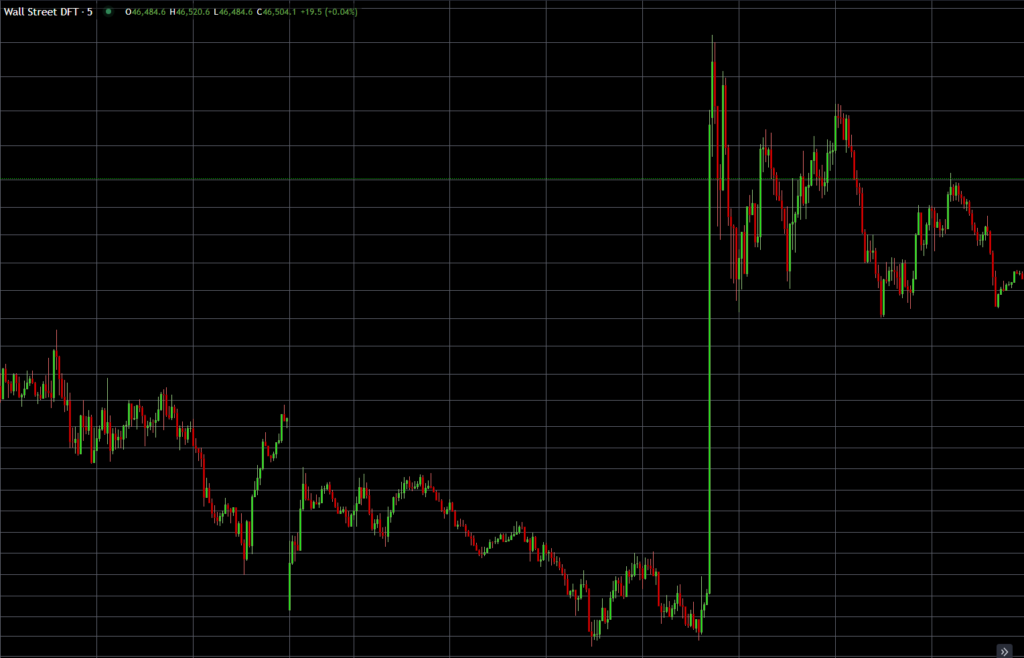
Snapshot of Wall Street DFT (Dow Jones Industrial Average) demonstrating the spike in question

Minutes later, Trump posted his statement about progress with Iran — a geopolitical development with obvious implications for equities and energy markets.

Instant

Prices reacted instantly. Equities surged. Oil tumbled. Within the hour, Iran publicly denied that any such talks had taken place, prompting a partial reversal of the earlier moves. Maybe we should draw a distinction between ‘talks’ and ‘messages’.

It is the precision of the trades placed before the announcement that has raised eyebrows. Markets do not move in anticipation of news that does not exist in the public domain.

Yet someone, somewhere, positioned themselves perfectly for the impact of Trump’s message posted on social media.

Fortuitous coincidence or deliberate manipulation?

Scale

The scale of the trades suggests institutional capability; the timing suggests foreknowledge. Whether that foreknowledge was legitimate, accidental, or illicit is now the central question.

Speculation about insider trading is inevitable in such circumstances, but it is important to distinguish between suspicion and proof. Political announcements are not governed by the same disclosure rules that apply to corporate earnings or mergers.

Presidents are not bound by quiet periods. Their advisers, however, are. So are the staff, intermediaries, and diplomatic channels through which sensitive information flows.

Obligation to investigate

If anyone in that chain traded — or tipped off someone who did — regulators will be obliged to investigate.

There is also a broader concern about the integrity of market‑moving communication. If Iran’s denial is accurate, and no talks occurred, then the market reacted to a statement that may not have reflected reality.

Even without malicious intent, such episodes undermine confidence in the informational foundations on which markets depend. When a single message can add or erase trillions in value, the accuracy and reliability of that message become matters of systemic importance.

Suspicion

For now, the episode sits in an ambiguous space: suspicious, but unproven; dramatic, but not unprecedented. Markets will move on, as they always do.

Yet the questions raised yesterday will linger — about transparency, about the porous boundaries between politics and finance, and about the unseen hands that sometimes seem to move just a little too quickly.

Does the idea that Trump ‘massages’ the market carry any weight?

It’s a fair question, and one that keeps resurfacing because the pattern is hard to ignore.

The idea that Trump “massages” the markets isn’t a conspiracy theory in itself — it’s an observation that his public statements often have immediate, dramatic financial consequences.

The real issue is whether those consequences are accidental, strategic, or exploited by people with advance knowledge.

A coincidence? You decide.