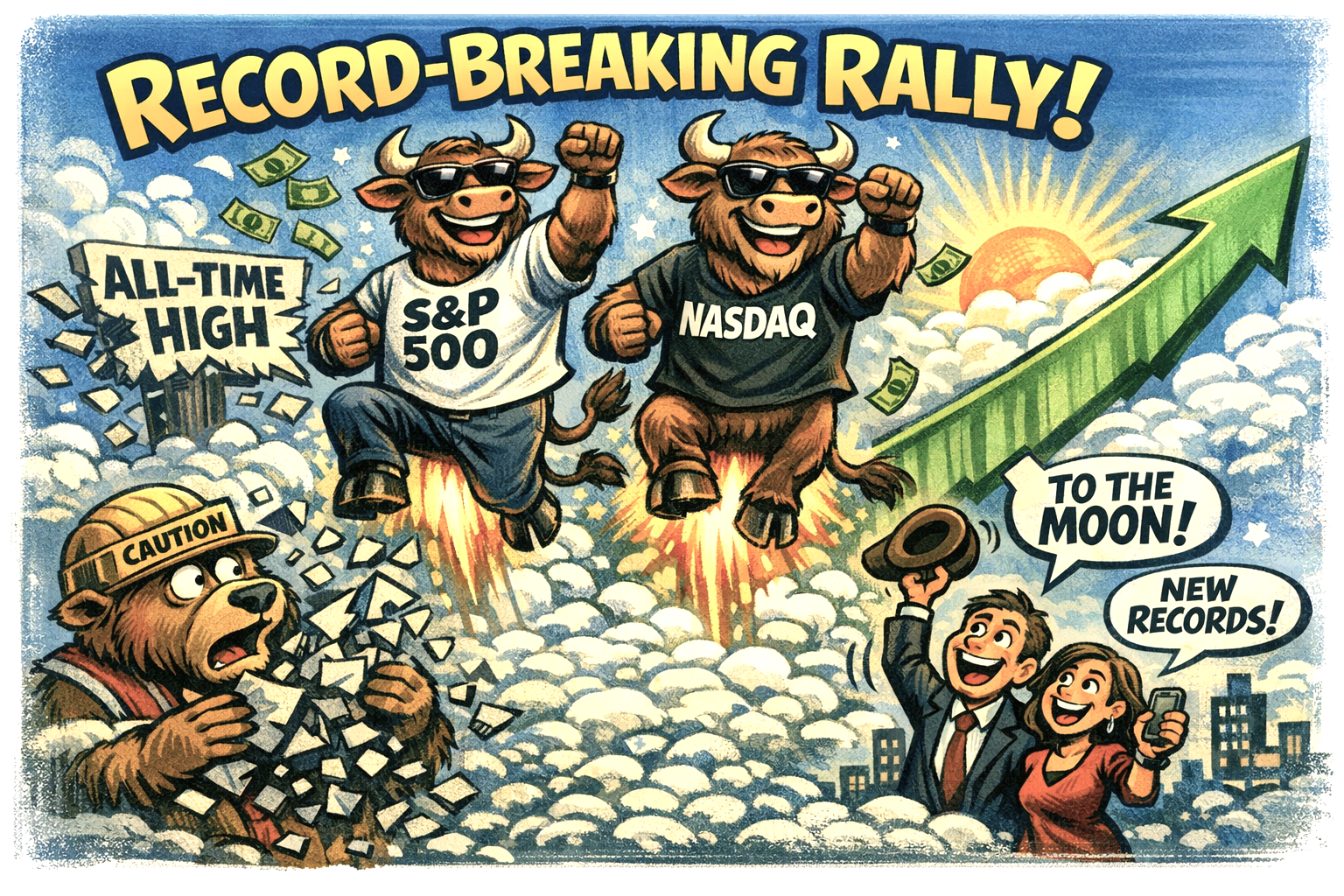
Wall Street ended April on a strong note as both the S&P 500 and the Nasdaq Composite closed at new record highs on 30th April 2026.
Investors pushed major indices higher for a second consecutive session, encouraged by resilient corporate earnings and renewed confidence in the technology sector.
The S&P 500 finished at 7,209, surpassing its previous peak set only days earlier. The Nasdaq Composite also broke new ground, closing at 24,892 after strong gains in semiconductor and cloud‑computing stocks.
Index
Close (30 Apr 2026)
Previous Record Close
New Record?
S&P 500
7,209.01
7,173.91
Yes
Nasdaq Composite
24,892.31
24,887.10
Yes
Market sentiment was buoyed by expectations that the Federal Reserve will maintain its current policy stance, with inflation data showing signs of stabilising.
April’s performance caps a remarkable start to the year for U.S. equities, driven largely by robust demand for AI‑related technologies.
While analysts warn that valuations are becoming stretched, investors appear comfortable extending the rally as earnings continue to justify optimism.
U.S. equity markets surged to fresh record highs on Friday 17th April 2026, propelled less by economic fundamentals and more by a swirl of contradictory geopolitical signals and a single, highly visible social media post from the President of the United States.
The result was a rally that looked exuberant on the surface yet rested on information that remained unverified, disputed, or only partially understood.
Market makers, investors and traders can’t possibly verify that this information is safe to trade – it’s a bet – and this isn’t good for the stock market.
The world deserves better – this is not investing!
Catalyst
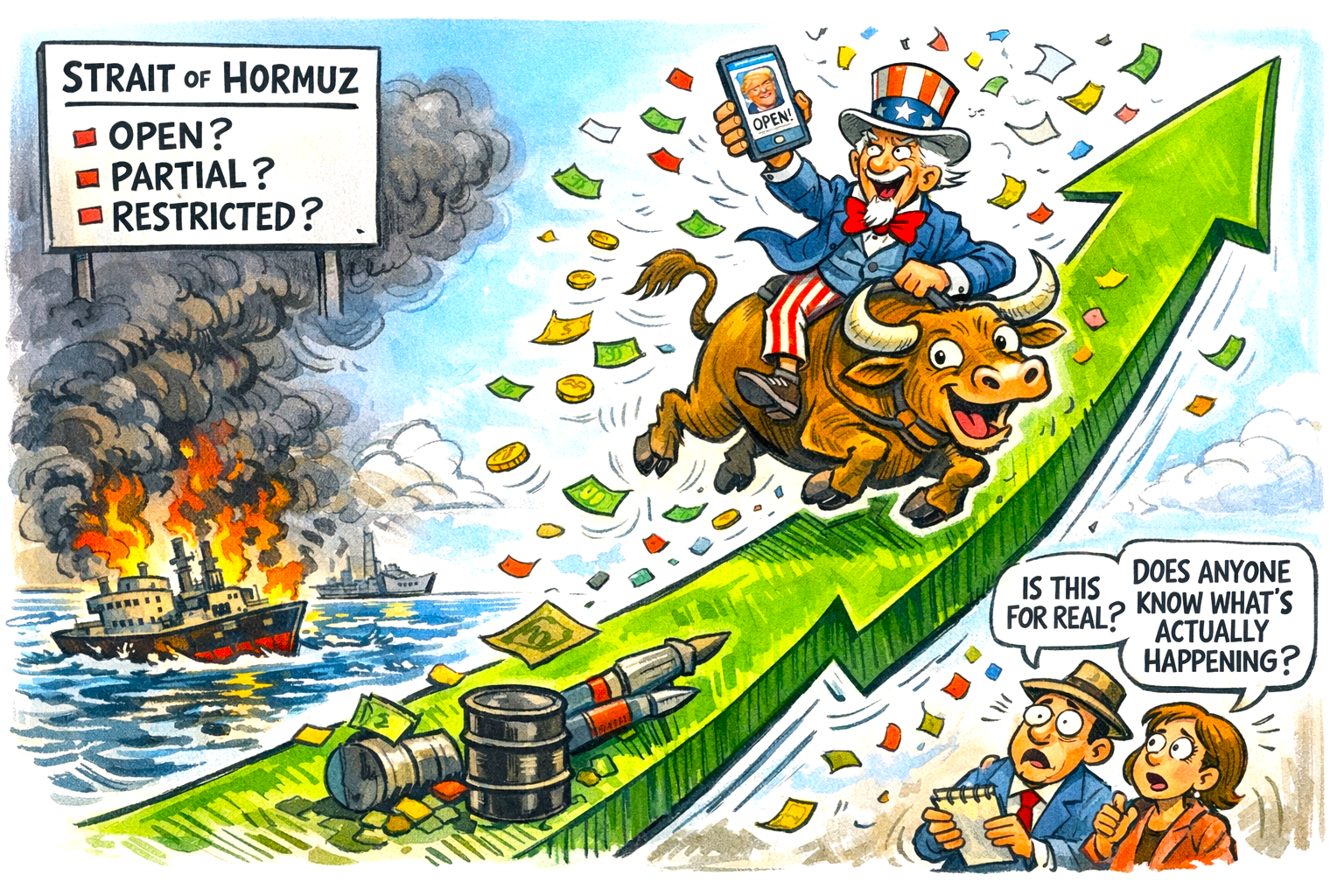
The catalyst was a presidential declaration that the Strait of Hormuz — a critical artery for global oil shipments — was “open”. The statement landed with the force of breaking news, despite the absence of confirmation from defence officials, maritime authorities, or international partners.
It was also reported that the U.S. would maintain its blockade of the Strait of Hormuz?
Reports circulating throughout the day suggested a more complicated reality: some sources described partial reopening, others spoke of restricted passage, and several indicated that conditions remained unstable.
In short, the facts were not settled.
Markets, however, behaved as though they were.
Melt-up driven by social media posts
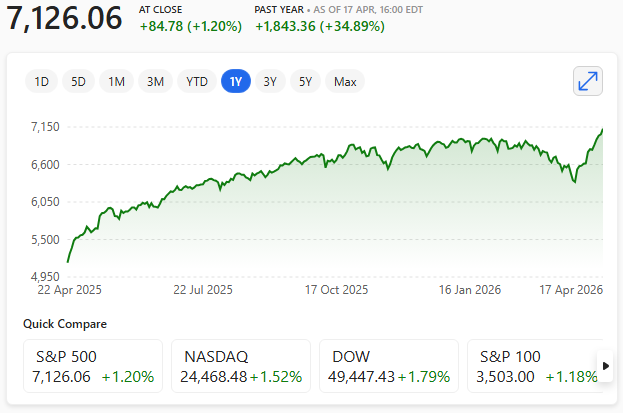
Within minutes of the President’s post, U.S. index futures spiked sharply. By the closing bell, the S&P 500, Nasdaq, and Dow had all notched new highs.
S&P 500 closes a record high 17th April 2026
Traders reportedly described the move as a “headline‑driven melt‑up”, a familiar pattern in recent months/years in which presidential commentary — rather than institutional communication — becomes the primary driver of intraday sentiment.
The sensitivity is not new. Analysts have repeatedly noted that markets respond quickly to presidential statements on energy, security, and trade, even when the underlying information remains contested.
What made Friday’s rally notable was the scale of the reaction relative to the uncertainty surrounding the Strait itself. Oil prices fell, risk appetite surged, and equity markets behaved as though a major geopolitical bottleneck had been definitively resolved.
Structural vulnerability
Critics argued that this dynamic reflects a structural vulnerability: when markets move first and verify later, volatility becomes a feature rather than a flaw. Supporters countered that traders simply price information as it arrives, regardless of its source.
What is clear is that the rally was driven not by data releases, earnings results, or policy announcements, through the ‘accepted and usual channels’ but by social media messages amplified across global financial systems.
Whether the Strait of Hormuz is fully open, partially open, or operating under constraints remains to be clarified.
The markets, however, have already made up their mind — at least for now.
The ‘news’ is good or ‘bad’ enough to make money!
U.S. stock market credibility is being eroded daily – bit by bit.
This has to stop!
No intent is suggested
Update
Iran fired shots at vessels trying to exit the Strait of Hormuz over the weekend. And now the U.S. has attacked a vessel under the Iranian flag casting doubt on renewed talks. The fragile ceasefire expires Wednesday 22nd April 2026 – unless Trump extends this and does a TACO!
There has also reportedly been talk of a 60-day extension – but that was before these latest problems.