
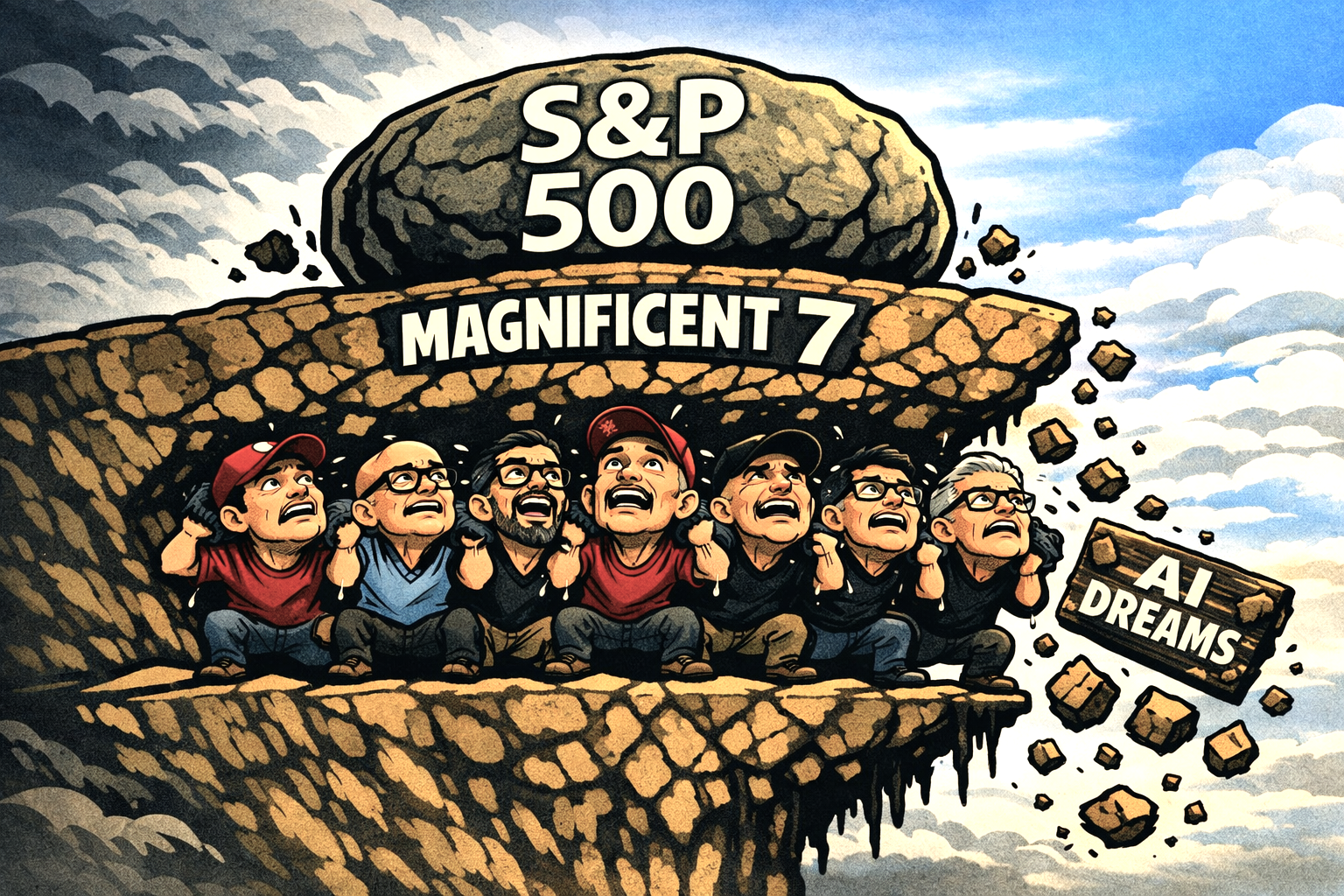
What Happens to the S&P 500 if the Magnificent Seven Fail to Deliver on AI?

Mag 7 holding up the S&P 500 to the tune of almost 35% value of the entire S&P 500

The S&P 500 has never been so dependent on so few companies. The Magnificent Seven — Microsoft, Apple, Nvidia, Alphabet, Amazon, Meta and Tesla — now account for roughly one‑third of the entire index’s value – that’s 33% of the whole S&P 500 vlauation.

Their dominance is not simply a reflection of current earnings power; it is a collective bet on an AI‑centred future that investors assume will transform productivity, reshape industries and justify valuations that stretch far beyond historical norms.

If one, several, or all of these companies fail to deliver the AI revolution that markets have priced in, the consequences for the S&P 500 would be immediate, structural and potentially severe.

Mild

The mildest scenario is a stumble by one or two members. If Apple’s device strategy falters, or Tesla’s autonomy narrative weakens further for instance, the index absorbs the shock.

A 3–5% pullback is plausible, driven by mechanical index weighting rather than systemic fear. Investors already expect uneven performance within the group, and the remaining leaders could offset the disappointment.

Major

The more destabilising scenario is a collective slowdown among the AI infrastructure leaders – Microsoft, Nvidia and Alphabet. These firms sit at the centre of the global capex cycle.

If cloud AI demand proves slower, less profitable or more niche than expected, the market would be forced to reassess the entire economic promise of generative AI.

In this case, the S&P 500 could see a 10–15% correction as valuations compress, volatility spikes and passive flows unwind years of momentum.

Dramatic

The most dramatic outcome is a broad failure of the AI ‘sector’ itself. If the promised productivity gains do not materialise, if enterprise adoption stalls, or if regulatory and cost pressures erode margins, the S&P 500 would face a structural reset.

With a third of the index priced for exponential growth, a collective disappointment could trigger a decline of 20% or more.

This would not resemble a cyclical recession; it would be a leadership collapse similar to the dot‑com unwind, but with far greater concentration and far more passive capital tied to the winners.

The uncomfortable truth is that the S&P 500’s trajectory is now inseparable from the Magnificent Seven. If they deliver, the index continues to defy gravity. If they falter, the market must rebuild a new narrative — and a new set of leaders — from the ground up.

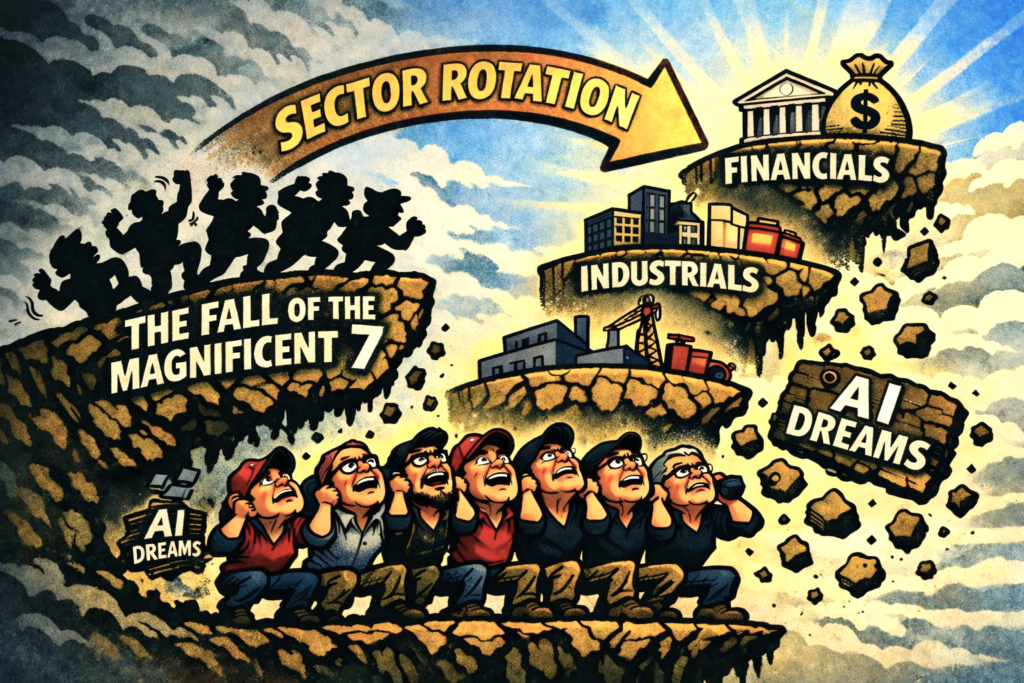
If the Magnificent Seven Lose Their Grip, Who Rises Next?

For years, the S&P 500 has been defined by the gravitational pull of the Magnificent Seven. Their dominance has shaped index performance, investor psychology and the entire narrative arc of global markets.

If these companies lose momentum — whether through slower AI adoption, regulatory pressure, margin compression or simple over‑expectation — leadership will not disappear.

It will rotate. And the beneficiaries are already hiding in plain sight.

Alternative investment to AI

The first and most obvious winners would be Energy and Utilities. As AI enthusiasm cools, investors tend to rediscover the appeal of tangible cash flow. Energy companies, with their dividends and pricing power, become natural refuges.
Utilities, often dismissed as dull, regain relevance as defensive anchors in a more volatile market. If AI‑driven data‑centre demand slows, the sector’s cost pressures ease, improving margins.

Next in line are Industrials and Infrastructure. A retreat from speculative tech would likely redirect capital towards physical productivity — logistics, construction, defence, electrification and manufacturing modernisation.

These sectors have been quietly compounding earnings while Silicon Valley has monopolised attention. If the market shifts from promise to proof, industrials become the new growth story.

Healthcare and Pharmaceuticals would also rise. Their earnings cycles are largely independent of AI hype, driven instead by demographics, innovation and regulatory frameworks. When tech stumbles, healthcare’s stability becomes a premium rather than an afterthought.

Biotech, in particular, benefits from capital rotation when investors seek uncorrelated growth.

Financials stand to gain as well. A correction in mega‑cap tech would rebalance passive flows, giving banks and insurers a larger share of index‑tracking capital. Higher rates and wider spreads already support the sector; a shift away from tech simply amplifies the effect.

Finally, Consumer Staples would reassert themselves. In a market recalibrating after an AI disappointment, investors gravitate towards predictable earnings. Food, beverages and household goods regain their defensive premium as volatility rises.

The broader truth is simple: if the Magnificent Seven falter, the S&P 500 does not collapse — it redistributes. Leadership moves from code to concrete, from speculative multiples to operational reality. The market has always found new champions. It will again.
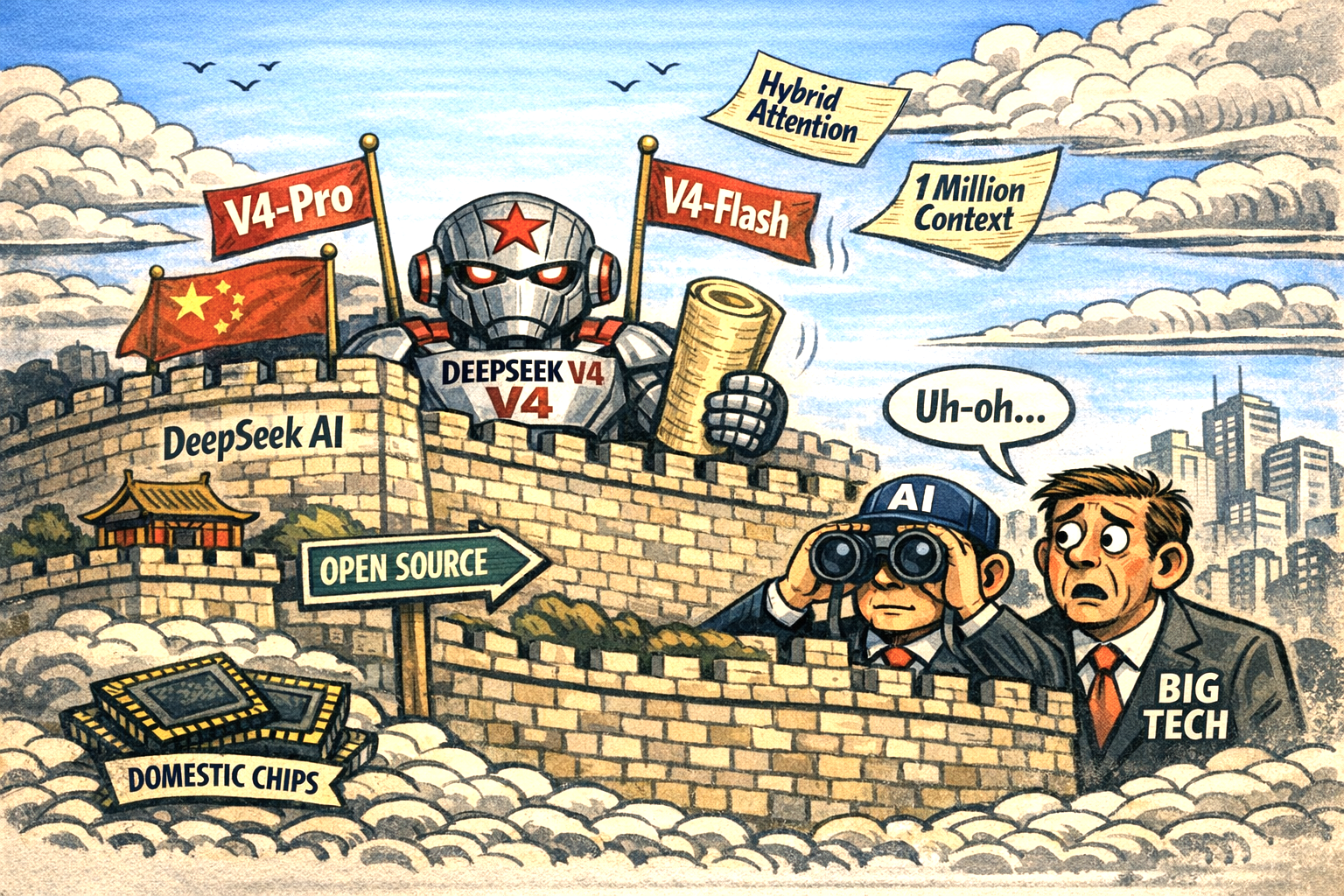
DeepSeek releases preview of Open Source V4 AI Model

DeepSeek V4 AI

DeepSeek’s newly released V4 model marks a significant step forward in open‑source AI, combining long‑context capability with major architectural upgrades.

DeepSeek V4 arrives as a preview release, offering two variants — V4‑Pro and V4‑Flash — both designed to push the boundaries of efficiency and reasoning performance.

The headline feature is the one‑million‑token context window, enabling the model to process and retain far larger bodies of information than previous generations.

Positioning

This positions V4 as a strong contender in tasks requiring extended reasoning, research support, and complex agentic workflows.

The V4 series introduces a refined Hybrid Attention Architecture, combining compressed sparse and heavily compressed attention mechanisms to dramatically reduce computational overhead.

DeepSeek claims this approach cuts inference FLOPs and KV‑cache requirements to a fraction of those seen in earlier models, making long‑context operation more practical and cost‑effective.

V4‑Pro, the flagship model, includes a maximum reasoning‑effort mode, which the company says significantly advances open‑source reasoning performance and narrows the gap with leading closed‑source systems.

Meanwhile, V4‑Flash offers a more economical, faster alternative while retaining strong capability across everyday tasks.

Accelerating AI ambition

The release underscores China’s accelerating AI ambitions. DeepSeek’s earlier R1 model shook global markets with its low‑cost, high‑performance profile, and V4 continues that trajectory — now optimised for domestic chips and supported by growing local hardware ecosystems.

With open‑source availability and aggressive efficiency gains, DeepSeek V4 strengthens the company’s position as one of the most closely watched challengers in the global AI race.

And it’s far cheaper than its peers and not so power hungry either.

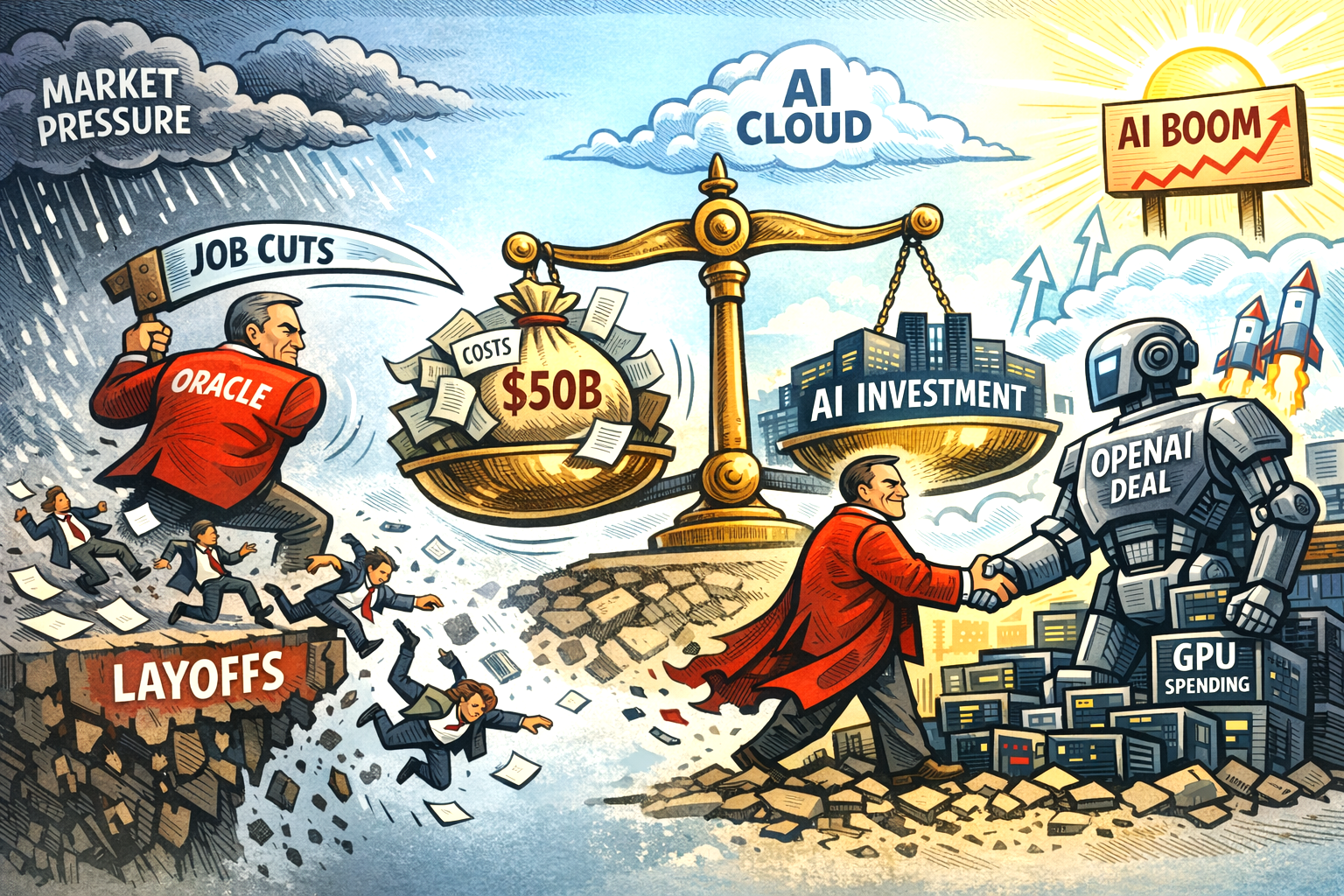
Oracle Cuts Deep as AI Pivot Forces a Reckoning

Oracle's AI Axe

Oracle is swinging hard at its own workforce as the company races to reposition itself as an AI‑infrastructure contender.

Thousands of roles are being eliminated, a drastic move that reflects the sheer financial pressure of trying to keep up with hyperscale rivals in the most capital‑intensive tech shift in decades.

The company’s share price has slumped 25% this year, with investors increasingly uneasy about soaring data‑centre spending and the heavy debt required to fund it.

Oracle has already raised $50 billion to bankroll new GPU‑ready facilities, but unlike Amazon or Microsoft, it lacks the cushion of vast cloud scale.

The result: a balance sheet under strain and a leadership team forced into tough decisions.

Future

Oracle’s remaining performance obligations have ballooned to more than half a trillion dollars, fuelled by major AI partnerships including a huge deal with OpenAI.

But those future revenues don’t solve today’s cash‑flow squeeze. Analysts estimate that cutting 20,000 to 30,000 jobs could free up as much as $10 billion — enough to keep the AI build‑out moving without further rattling the markets.

Oracle is betting that a leaner organisation now will buy it the runway to compete later. The question is whether the cuts arrive in time to match the speed of the AI race.

Stock rises.

Arm’s Bold Pivot: The AGI CPU Signals a New Era for British Chipmaking

ARM Agentic AI CPU

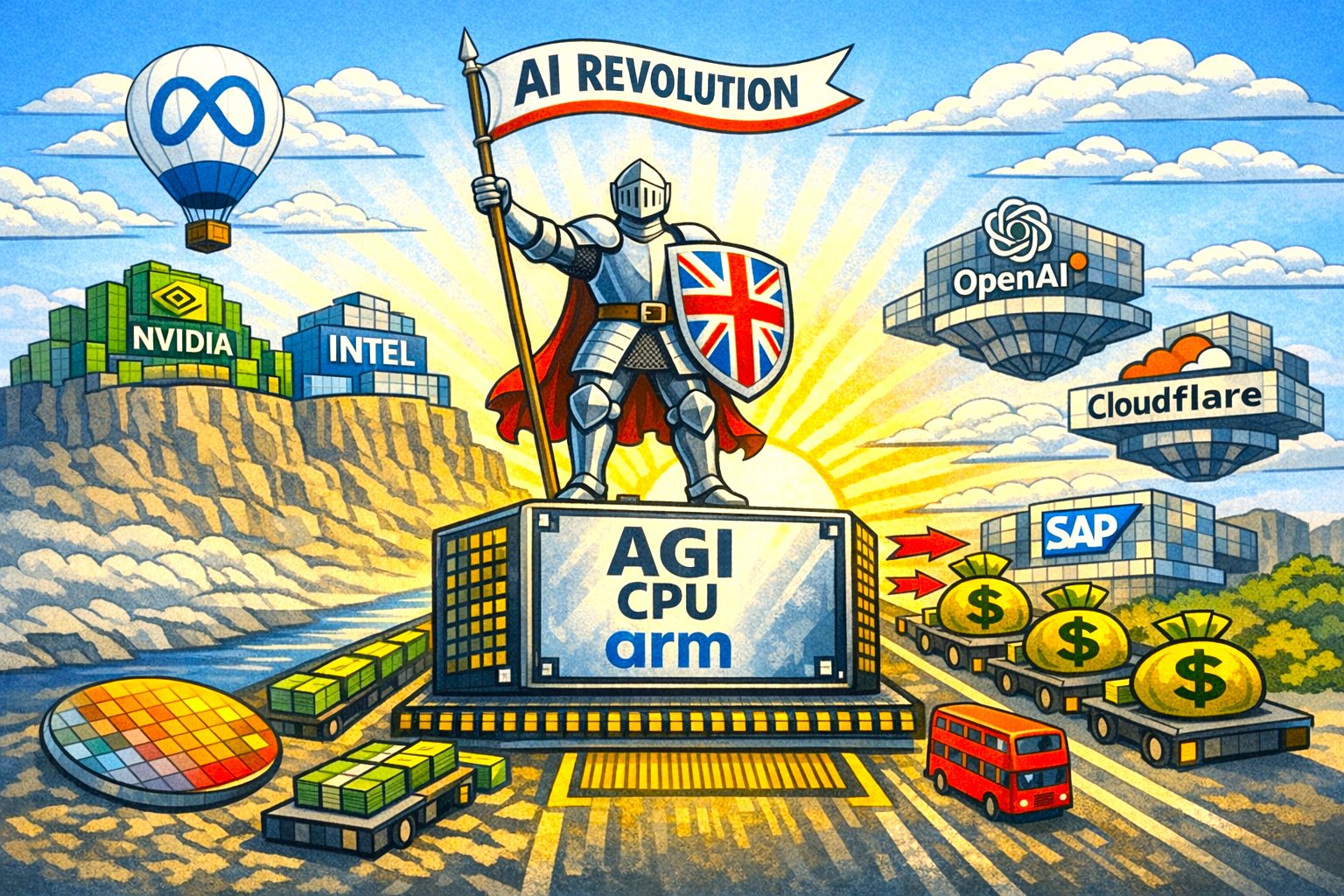
ARM has triggered one of the most dramatic shifts in its 35‑year history with the launch of its first in‑house data‑centre processor, the AGI CPU — a move that sent its shares surging 16% and reshaped expectations for the company’s future.

Long known for licensing energy‑efficient chip designs to the world’s biggest tech firms, ARM is now stepping directly into the silicon market, competing with the very customers that built its empire.

Major Tech Firms Using Arm Designs (AI & Mobile)

CompanyPrimary Use CaseArm-Based Technology
AppleMobile & on‑device AIA‑series (iPhone/iPad) and M‑series (Mac) chips
SamsungMobile, AI, IoTExynos processors
QualcommMobile & automotive AISnapdragon SoCs
GoogleAndroid ecosystem & edge AIPixel phones (Arm cores inside Tensor chips)
Amazon (AWS)Cloud compute & AI inferenceGraviton & Trainium/Inferentia (Arm Neoverse)
MetaAI infrastructureDeploying Arm-based AGI CPU
OpenAIAI inference & orchestrationEarly adopter of Arm AGI CPU
NvidiaAI data‑centre CPUsGrace CPU (Arm architecture)
OPPOMobile AIArm-based SoCs in Find series
vivoMobile AIArm-based SoCs in X‑series

Strong demand

The new AGI CPU is engineered for the rapidly expanding world of AI inference and agentic AI — workloads that demand vast CPU coordination rather than pure GPU horsepower.

Early demand appears strong. Meta has signed on as the first major customer, with OpenAI, Cloudflare and SAP also adopting the chip as they race to expand their AI infrastructure.

The financial implications are striking. ARM expects the AGI CPU alone to generate $15 billion in annual revenue by 2031, a figure that dwarfs the company’s 2025 revenue of $4 billion.

Significant shift

Analysts have described the announcement as the most significant strategic shift ARM has ever undertaken, noting that the revenue projections exceed even the most optimistic market estimates.

By moving into full chip production, ARM is broadening its market to include companies that previously had no interest in its traditional IP‑licensing model.

Executives say the chip will be competitively priced, offering an alternative for firms unable to build their own custom silicon.

For the UK, the launch marks a rare moment of industrial ambition in a sector dominated by American and Asian giants.

If ARM’s forecasts hold, the AGI CPU could become one of the most commercially successful chips ever produced by a British company — and a defining pillar of the AI age.

See more here about the new ARM AGI CPU

The Future of Agentic AI – Tools for Automation

Agentic AI

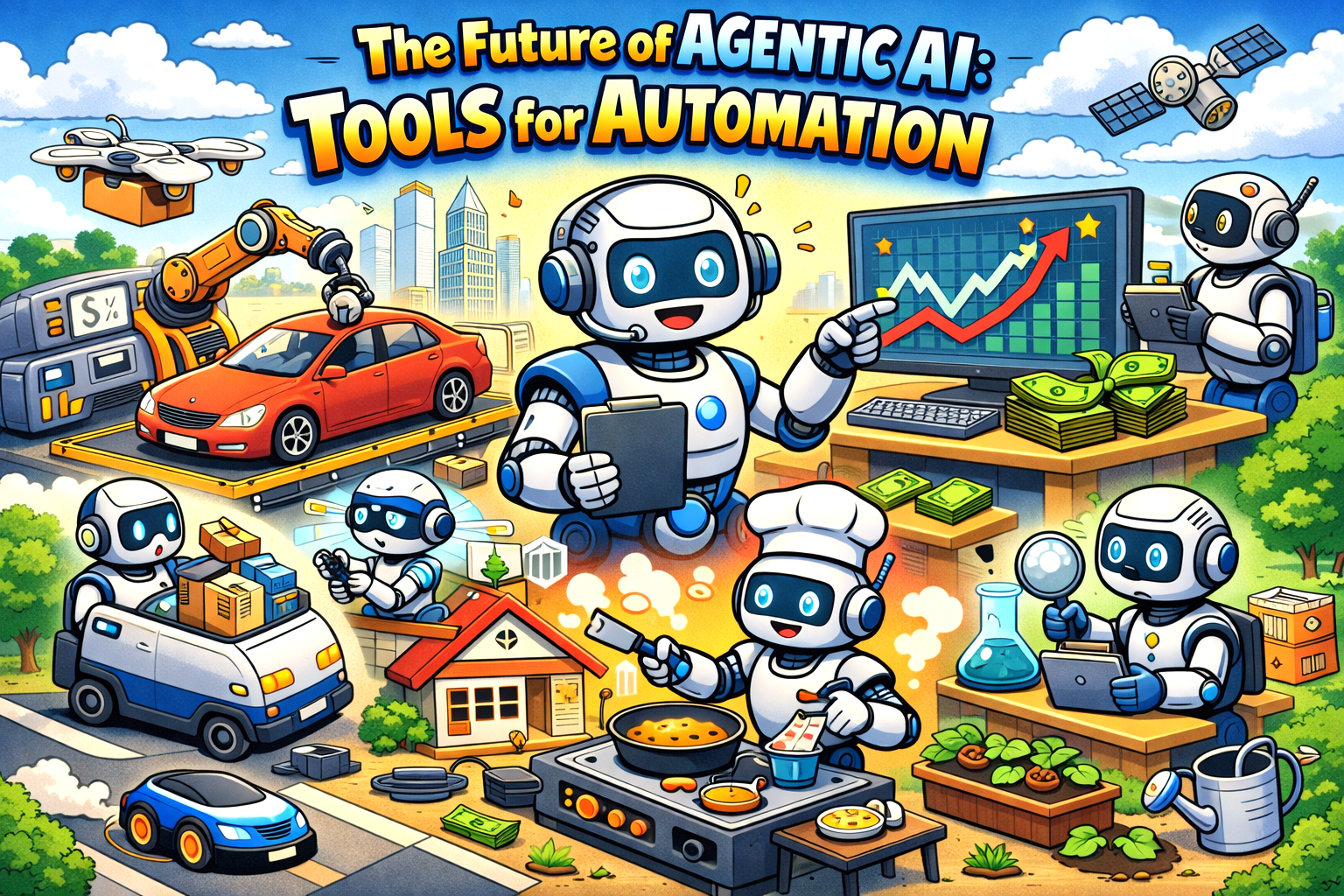
Agentic AI is rapidly shifting from a speculative idea to a practical force reshaping how work gets done.

Unlike traditional AI systems, which wait passively for instructions, agentic AI can plan, act, and adapt within defined boundaries.

It is not simply a smarter chatbot; it is a system capable of taking initiative, coordinating tasks, and pursuing goals on behalf of its user.

This evolution marks a profound turning point in how we think about automation, creativity, and human–machine collaboration.

Agentic AI colleagues

The first major change is the move from reaction to autonomy. Today’s AI assistants excel at answering questions or generating content, but they still rely on constant prompting.

Agentic AI, by contrast, can break down a complex objective into smaller steps, choose the best tools for each stage, and execute them with minimal oversight. This transforms AI from a passive helper into an active collaborator.

For individuals and small teams, it promises a level of operational leverage previously reserved for large organisations with dedicated staff.

A second shift lies in the emergence of multi‑modal competence. Agentic systems will not be confined to text. They will navigate interfaces, analyse documents, draft communications, and even orchestrate workflows across multiple platforms.

In effect, they will behave more like digital colleagues—capable of understanding context, maintaining continuity, and adapting to changing priorities. The result is a new category of labour: cognitive automation that complements rather than replaces human judgement.

However, the rise of agentic AI also raises important questions. Autonomy introduces risk. If an AI can take action, it must do so safely, transparently, and within clear constraints.

On guard

Guardrails will be essential—not only technical safeguards, but also cultural norms around delegation, accountability, and trust. The future will require a balance between empowering AI to act and ensuring humans remain firmly in control of outcomes.

Another challenge is the shifting nature of expertise. As agentic AI handles more administrative and procedural work, human value will increasingly lie in strategic thinking, creativity, and ethical decision‑making.

This is not a loss but a rebalancing. Freed from routine tasks, people can focus on higher‑order work that genuinely benefits from human insight.

The organisations that thrive will be those that treat AI not as a shortcut, but as a catalyst for deeper, more meaningful contribution.

Future use of agents

Looking ahead, the most exciting aspect of agentic AI is its potential to democratise capability. A single individual could run a publication, a business, or a research project with the operational efficiency of a small team.

Barriers to entry will fall. Innovation will accelerate. And the line between “solo creator” and “organisation” will blur.

Agentic AI is not the end of human agency; it is an extension of it. The future belongs to those who learn to work with these systems—setting direction, providing judgement, and letting AI handle some of the heavy lifting.

Far from replacing us, agentic AI may finally give us the space to think, create, and lead with clarity.

Alibaba’s Qwen 3.5 Marks a Strategic Shift Toward AI Agents

Qwen 3.5 AI agent

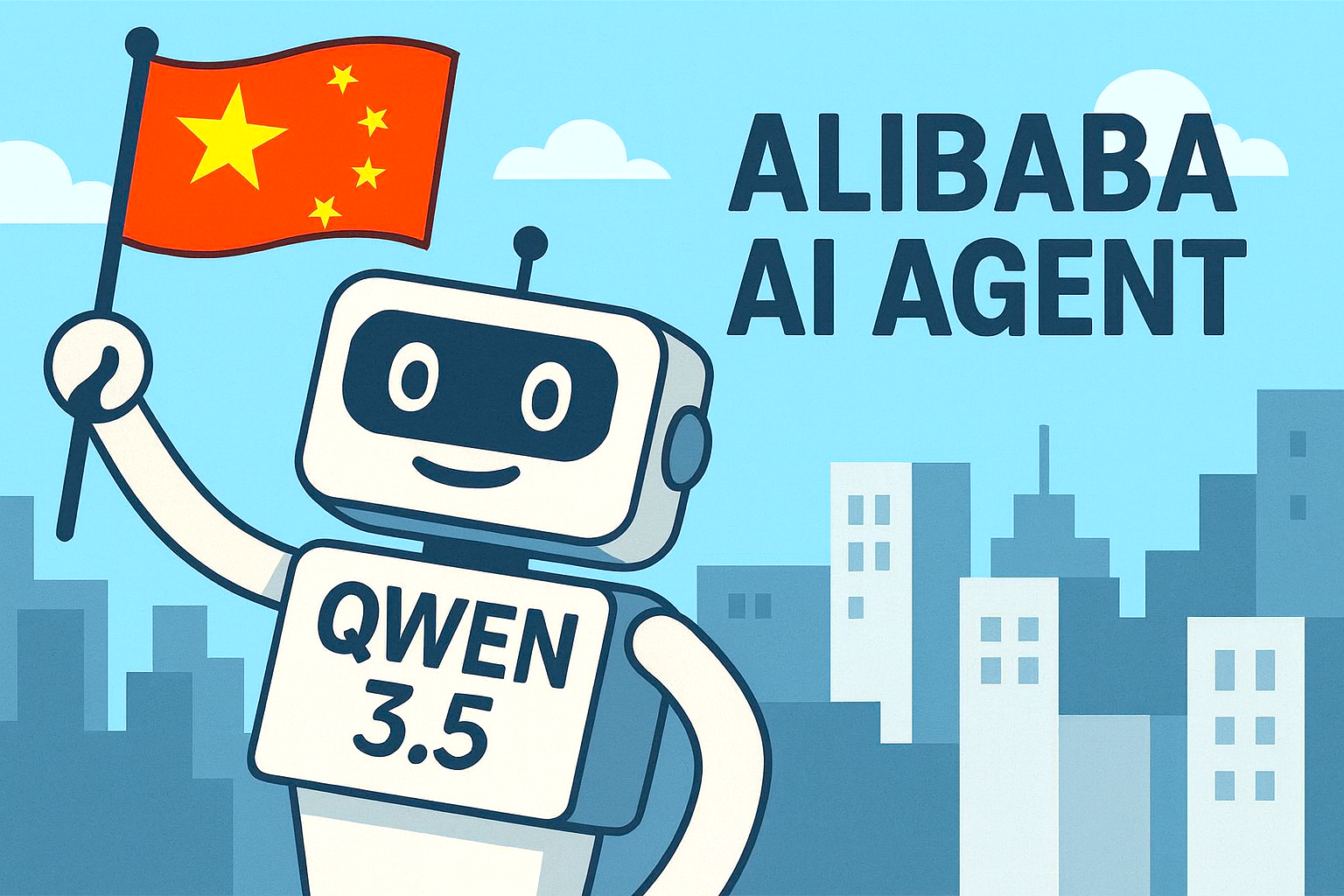
Alibaba has unveiled Qwen 3.5, its latest large language model series, signalling a decisive shift in China’s increasingly competitive AI landscape.

Released on the eve of the Chinese New Year, the new model arrives with both open‑weight and hosted versions, giving developers the option to run the system on their own infrastructure or through Alibaba’s cloud platform.

The company emphasises that Qwen 3.5 delivers improved performance and lower operating costs compared with earlier iterations, while introducing ‘native multimodal capabilities’ that allow it to process text, images, and video within a single system.

Ability

What sets Qwen 3.5 apart is its focus on agentic behaviour — the ability for AI systems to take actions, complete multi‑step tasks, and operate with minimal human supervision.

This trend has accelerated globally following recent releases from Anthropic and other U.S. based developers, prompting Chinese firms to respond rapidly.

Alibaba says Qwen 3.5 is compatible with popular open‑source agent frameworks such as OpenClaw, which has surged in adoption among developers seeking more autonomous AI tools.

Capable

The open‑weight version features 397 billion parameters, fewer than Alibaba’s previous flagship model, yet the company claims significant gains in reasoning and benchmark performance.

It also supports 201 languages and dialects — a notable expansion that reflects Alibaba’s ambition to position Qwen as a global‑ready platform rather than a purely domestic competitor.

With rivals like ByteDance and Zhipu AI launching their own upgraded models, Qwen 3.5 underscores how China’s AI race is evolving from chatbot development to full‑scale autonomous agents — a shift that could reshape software markets and business models worldwide.

China’s AI Tech Surge Puts Pressure on America’s AI Dominance

Robots line up for AI battle

For much of the modern AI era, the United States has held a clear advantage in frontier research, compute infrastructure, and commercial deployment.

Silicon Valley’s combination of elite talent, abundant capital, and world‑class semiconductor design created an environment where breakthroughs could scale at extraordinary speed.

Challenge

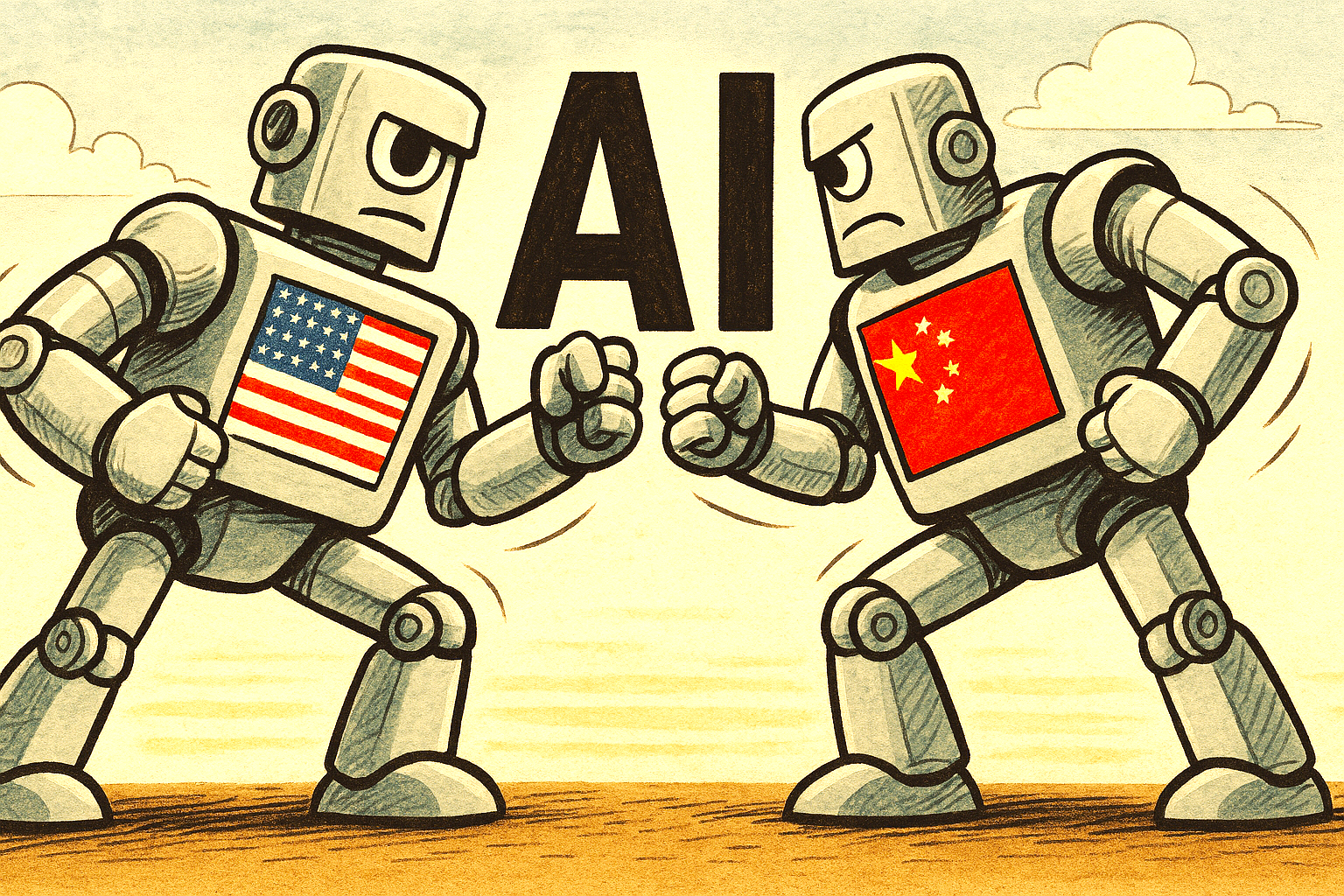
That dominance, however, is no longer uncontested. China’s accelerating push into advanced AI is reshaping the global technological landscape and posing the most credible challenge yet to America’s leadership.

China’s strategy is not built on a single breakthrough but on coordinated national effort. Beijing has spent years aligning universities, state‑backed funds, and private‑sector giants around a shared objective: achieving self‑sufficiency in critical technologies and becoming a global AI powerhouse.

Competitive

Companies such as Huawei, Baidu, Alibaba and Tencent are now producing increasingly competitive large models, while domestic chipmakers are narrowing the performance gap with U.S. suppliers despite export controls.

Crucially, China’s AI ecosystem benefits from scale and cost advantages that the U.S. cannot easily replicate.

Massive data availability, lower energy costs, and vertically integrated supply chains allow Chinese firms to train and deploy models at prices that appeal to developing economies.

For many countries, especially those already reliant on Chinese infrastructure, adopting a Chinese AI stack is becoming a pragmatic economic choice rather than a geopolitical statement.

Investment returns?

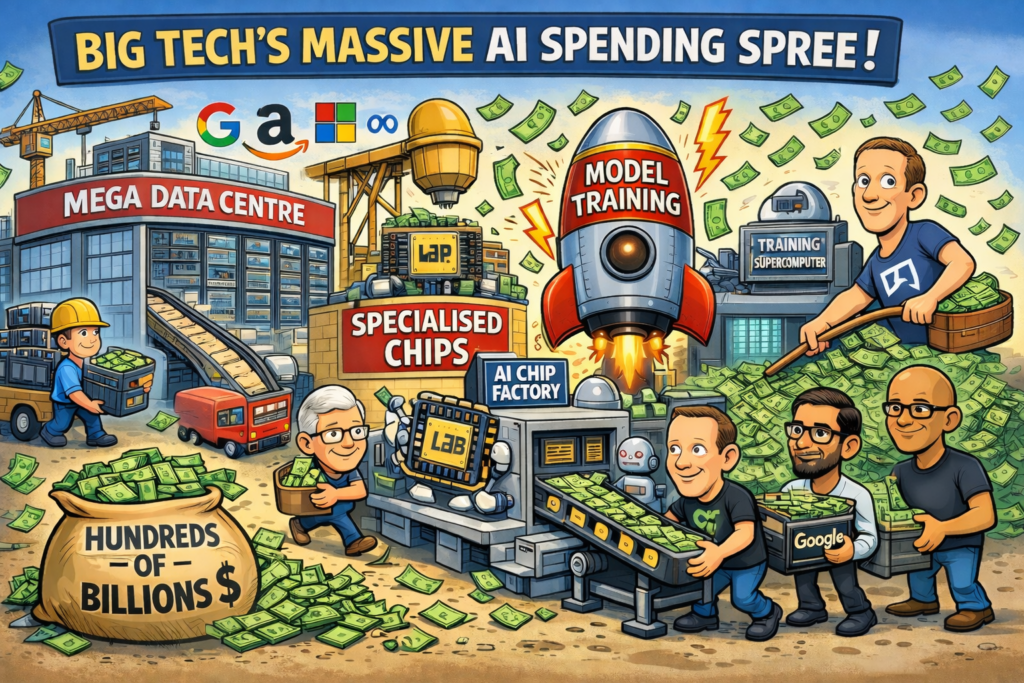
This shift is occurring just as U.S. tech giants embark on unprecedented spending cycles. Hyperscalers are pouring hundreds of billions of dollars into data centres, specialised chips, and model training.

The U.S. and its massive BIG Tech Spending Spree – Feeding the AI Habit

While this investment underscores America’s determination to stay ahead, it also raises questions about sustainability.

Investors are increasingly asking whether such vast capital expenditure can deliver long‑term returns in a world where China is offering cheaper, rapidly improving alternatives.

The emerging reality is not one of immediate American decline but of a genuinely multipolar AI landscape. The U.S. still leads in foundational research, top‑tier talent, and cutting‑edge semiconductor design.

Yet China’s rise represents a powerful economy that has mounted a serious challenge to the technological frontier.

The global AI race is no longer defined by a single centre of gravity. Instead, two competing ecosystems — one market‑driven, one reportedly state‑directed — are shaping the future of intelligent technology.

The outcome will influence not only economic power but the digital architecture of much of the world.

Anthropic Pushes the Frontier Again with Claude Opus 4.6

Claude Opus 4.5

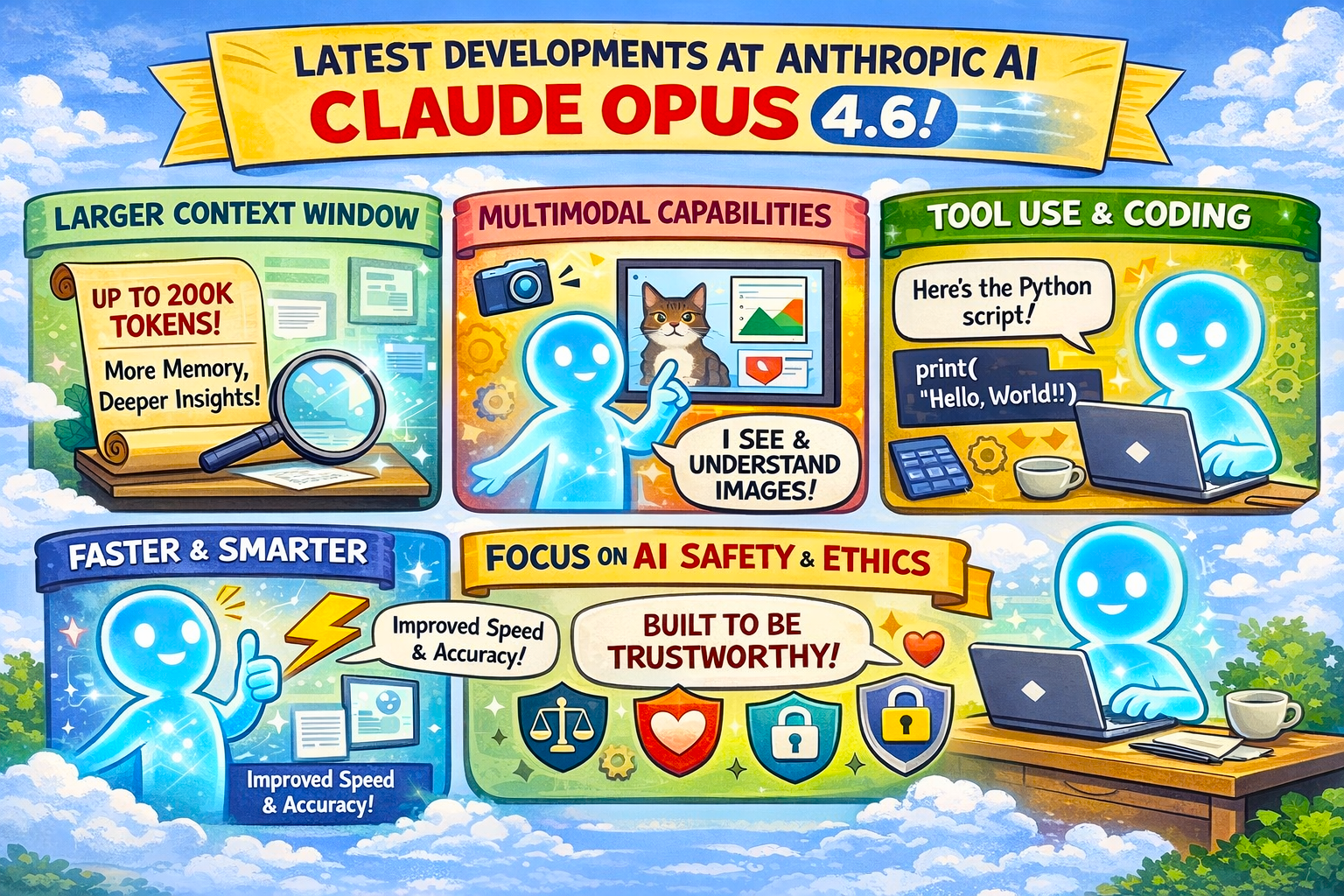
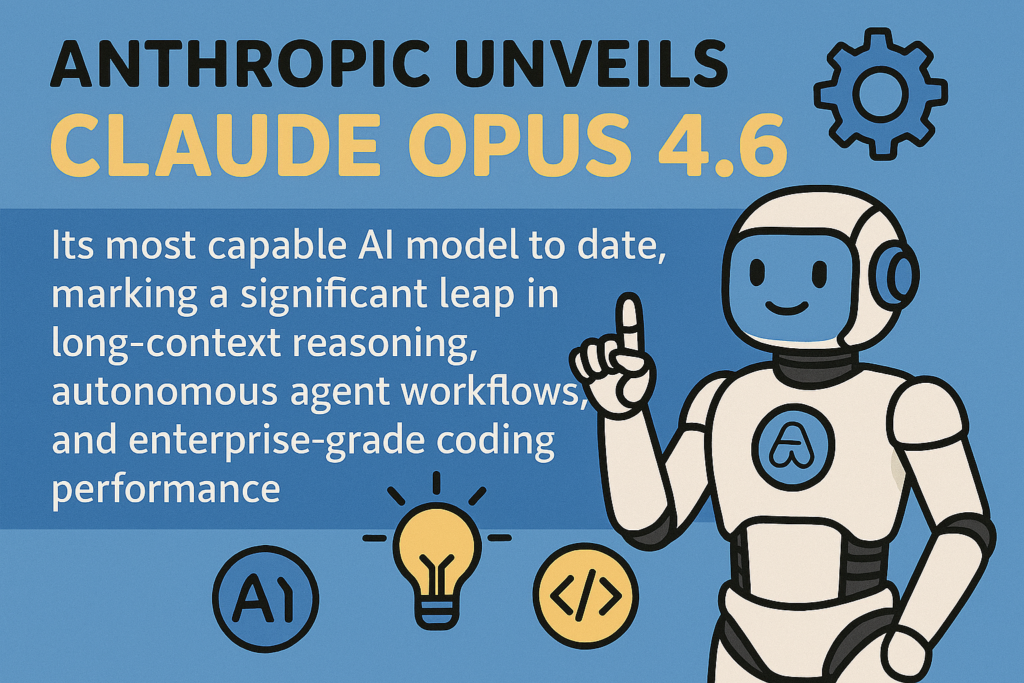
Anthropic has unveiled Claude Opus 4.6, its most capable AI model to date, marking a significant leap in long‑context reasoning, autonomous agent workflows, and enterprise‑grade coding performance.

The release arrives during a turbulent moment for the global software sector, with markets reacting sharply to fears that Anthropic’s accelerating capabilities could reshape entire categories of knowledge work.

At the heart of Opus 4.6 is a 1‑million‑token context window, a first for Anthropic’s Opus line and a direct response to long‑standing limitations around ‘context rot’ in extended tasks.

Benchmarks

Early benchmarks show a dramatic improvement in maintaining accuracy across vast documents and complex, multi‑step workflows.

This expanded capacity enables the model to analyse large codebases, regulatory filings, or research archives in a single pass—an ability already drawing interest from enterprise users.

Perhaps the most striking development is Anthropic’s progress in agentic systems. Claude Code and the company’s Cowork framework now support coordinated ‘agent teams’, allowing multiple Claude instances to collaborate on sophisticated engineering challenges.

In one internal experiment, a team of 16 Claude agents built a complete Rust‑based C compiler capable of compiling the Linux kernel—producing nearly 100,000 lines of code with minimal human intervention.

Agentic shift

This agentic shift is reshaping expectations around AI‑driven software development. Anthropic positions Opus 4.6 not merely as a tool but as a foundation for autonomous, multi‑agent workflows that can plan, execute, and refine complex tasks over extended periods.

The company highlights improvements in reliability, coding precision, and long‑running task stability as core differentiators.

With enterprise adoption already representing the majority of Anthropic’s business, Opus 4.6 signals a decisive step toward AI systems that operate as high‑level collaborators rather than assistants.

As markets digest the implications, one thing is clear: Anthropic is accelerating the transition from ‘AI that helps’ to AI that works alongside you—and sometimes, entirely on its own.

Legal profession

Anthropic is pushing aggressively into the legal domain, positioning Claude as a high‑precision research and drafting partner for firms handling complex regulatory workloads.

The latest models emphasise long‑context accuracy, allowing lawyers to ingest entire case bundles, contracts, or disclosure sets without losing coherence.

Anthropic has also expanded constitutional AI safeguards, aiming to reduce hallucinations in high‑stakes legal reasoning.

Early adopters report gains in due‑diligence speed, contract comparison, and regulatory interpretation, particularly in financial services and data‑protection work.

While not a substitute for legal judgement, Claude is rapidly becoming a force multiplier for teams managing heavy document‑driven tasks.

Claude Sonnet 4.5: Anthropic’s Leap Toward Autonomous Intelligence

Anthropic AI Claude

Anthropic has unveiled Claude Sonnet 4.5, its most advanced AI model to date—described by the company as ‘the best coding model in the world’.

Released in September 2025, Sonnet 4.5 marks a significant evolution in agentic capability, safety alignment, and real-world task execution.

Designed to power Claude Code and enterprise-grade AI agents, Sonnet 4.5 excels in long-context coding, autonomous software development, and complex business workflows.

Benchmark

In benchmark trials, the model reportedly sustained 30+ hours of uninterrupted coding, outperforming its predecessor Opus 4.1 and rival systems like GPT-5 and Gemini 2.52.

Anthropic’s emphasis on safety is equally notable. Sonnet 4.5 underwent extensive alignment training to reduce sycophancy, deception, and prompt injection vulnerabilities.

It now operates under Anthropic’s AI Safety Level 3 framework, with filters guarding against misuse in sensitive domains such as chemical or biological research.

New features include ‘checkpoints’ for code rollback, file creation within chat (spreadsheets, slides, documents), and a refreshed terminal interface.

Developers can now build custom agents using the Claude Agent SDK, extending the model’s reach into autonomous task orchestration4.

Anthropic’s positioning is clear: Claude Sonnet 4.5 is not merely a chatbot—it’s a colleague. With pricing held at $3 per million input tokens and $15 per million output tokens, the model is accessible yet formidable.

As AI enters its ‘super cycle’, Claude Sonnet 4.5 signals a shift from conversational novelty to operational necessity.

Whether this heralds a renaissance or a reckoning remains to be seen—but for now, Anthropic’s latest release sets a new benchmark for intelligent autonomy.