Chinese tech giant Baidu will partner Samsung to integrate its Ernie chatbot capabilities into Galaxy S24 smartphones.
The collaboration with Baidu will facilitate Samsung’s latest Galaxy S24 smartphone series with advanced features such as advanced typesetting, real-time call translation and intelligent summarization.
Samsung recently revealed its latest Galaxy S24 lineup with AI-powered features as it attempts to overtake the Apple iPhone.
In 2023 Apple became the biggest smartphone vendor by shipments in China for the first time.
Last year, Honor, a spin-off from Chinese company Huawei, held the second spot with almost a 17% market share, followed by Vivo, Huawei and then Oppo.
One of the biggest changes in 2023 was Huawei’s return to the top five in China in the Q4. The iphone has been one of the world’s best-selling selling products of all time.
Since the introduction of the Appleiphone in 2007 by Steve Jobs, its inventor and company joint founder, it has gone on to sell 2.3 billion and has over 1.5 billion ‘active’ users. Not bad for a product that investors initially called ‘dead on arrival’ due to lack of interest and sales.
Nokia 3310
In 2007 the Nokia 3310 was the clear market leader and easily king of the mobile phone market. Nokia sold 7.4 million units in 2007 – Apple sold just 1.4 million. Nokia was the ‘go to product’. But not for long.
Oh my, how things have changed. Apple is the now the world’s best-selling product (not just the world’s best-selling phone) – with Nokia and many others left trailing in the dust.
Apple app store
It was the apps that done it; having a product that could be any number of different ‘products’ in one and held in your hand was a game changer – and that changed the world.
The rest is history.
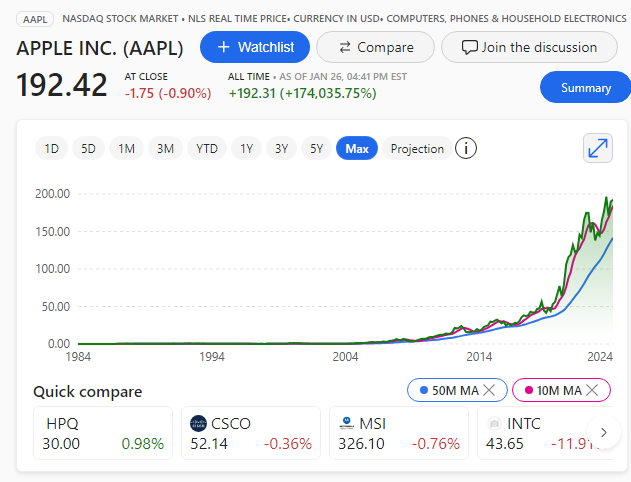
Apple share price chart from 1984 (the year the Apple Macintosh was introduced)
Apple share price chart from 1984 (the year the Apple mac was introduced)
The U.S. economy grew at a much faster pace than expected in the final three months of 2023.
The U.S. easily avoided a recession that many had forecast as inevitable, the U.S. Commerce Department reported Thursday 25th January 2024.
Gross domestic product (GDP), a measure of all the goods and services produced, increased at a 3.3% annualised rate in the final quarter of 2023, according to data from the Commerce Department.
Core prices for personal consumption expenditures (PCE), a preferred measure by the Federal Reserve as a longer-term inflation calculation, rose 2% for the period, while the rate was 1.7%.
On an annual basis, the PCE price index rose 2.7%, down from 5.9% a year ago, while the core figure excluding food and energy posted a 3.2% increase annually, compared with 5.1%.
Good news
Inflation falling, GDP rising, stabilizing interest rates and no recession thus far the U.S. economy is looking rock-solid despite all the negativity.
Turkey’s central bank on Thursday 25th January 2024 hiked its key interest rate to 45%.
It comes amid an ongoing struggle against double-digit inflation for Turkey’s policymakers, with the rate hike the latest step in that ongoing fight.
30 Turkish Lira to 1 U.S. dollar
Inflation in Turkey increased nearly 65% year-on-year in December 2023, up from 62% in November, and the country’s currency, the lira, hit a new record low against the U.S. dollar earlier in January 2024 at 30 Lira to $1.
Analysts predict this will be the last hike for some time, especially with local elections approaching in March 2024
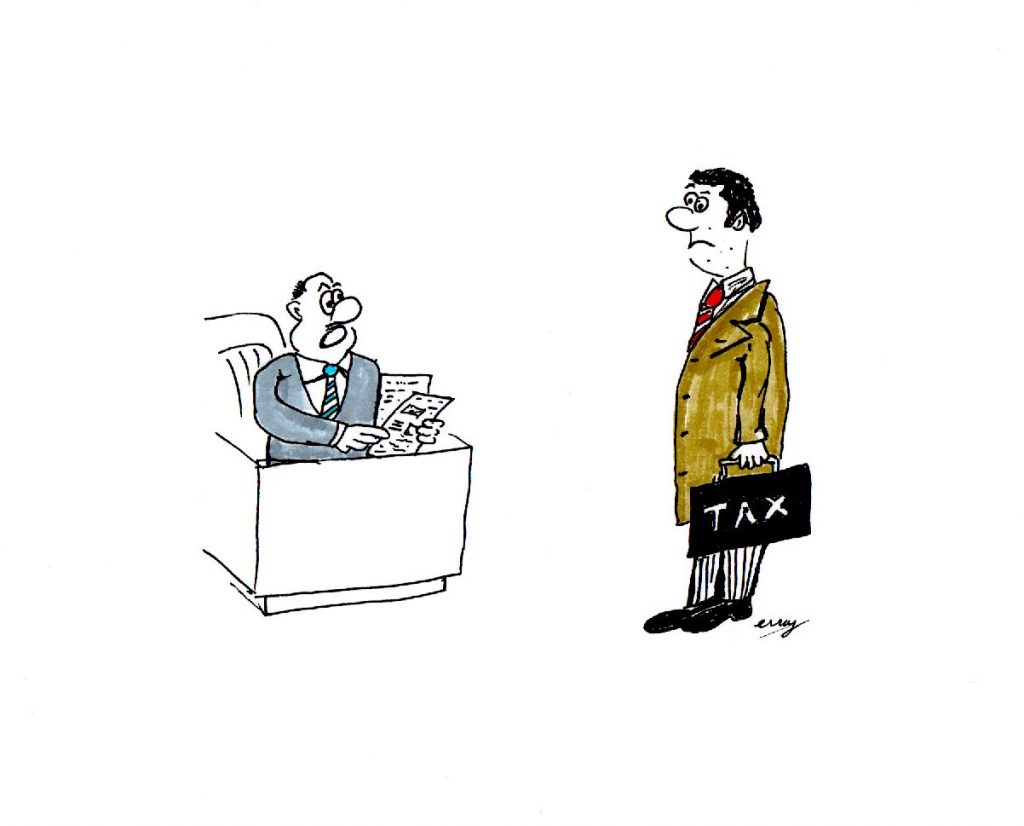
Spinning the benefits of a tax cut scenario as Chancellor Jeremy Hunt hints at further tax cuts
The Chancellor, Jeremy Hunt, has given strong hints that he wants to cut taxes in the spring Budget.
Mr Hunt reportedly said that countries with lower taxes have more ‘dynamic, faster growing economies.‘ Didn’t Liz Truss say something like that too? But of course, she didn’t ‘cost it out’ in her mini budget apparently – but she also wanted lower taxes for growth none-the-less.
Autumn statement
In the Autumn Statement, the chancellor reduced national insurance for workers by 2% and announced tax relief for businesses. If inflation falls, followed by lower interest rates, Mr Hunt may consider he has scope for further tax cuts.
At the World Economic Forum, in Davos, Switzerland – he was also reported to have said that the: ‘direction of travel’ indicates that economies growing faster than the UK, in North America and Asia tend to have lower taxes. ‘I believe fundamentally that low-tax economies are more dynamic, more competitive and generate more money for public services like the NHS,’ he reportedly said.
It is widely expected that the chancellor will focus on income tax in the upcoming Budget due on 6th March 2024
Lower than expected government borrowing last month has increased the possibility of tax cuts in the Budget, analysts say.
UK Borrowing fell to £7.8bn in December 2023, the Office for National Statistics (ONS) indicated. Interest payments dropped sharply due to a faster than expected decline in inflation. Analysts said the latest figures could give the chancellor more wiggle room for tax cuts.
December’s borrowing figure was £8.4bn less than a year earlier, and the lowest figure for the month since 2019.
Interest payments on government debt fell to £4bn, down by £14.1bn from December 2022.
Microsoft’s market cap surpassed $3 trillion in intraday trading Wednesday after the stock climbed more than 1% and hit around $404 per share. The stock lost some ground throughout the day to close at: $402 per share.
The achievement comes nearly two weeks after Microsoft eclipsed Apple as the world’s most valuable public company on 12th January 2024. However, Apple has reclaimed top spot – its market cap closed at around $3.01 trillion on Wednesday 24th January 2024.
Microsoft share price 24th January 2024 – $402.00, 1year chart
Microsoft share price 24th January 2024 – $402.00, 1 year chart
Microsoft shares are up more than 7% year to date as investors remain bullish about the company’s investments in artificial intelligence.
It is strongly expected that Microsoft will deliver good results in the Q2 earnings report, because of its leadership position gained in generative AI.
Microsoft due to announce Q2 figures on 30th January 2024
Microsoft due to announce Q2 figures on 30th January 2024
Bitcoin climbed to touch $49,000 after the SEC recently gave the go ahead for the Bitcoin ETF. The last time I checked it was at $39,000 (23rd January 2024). Oh, dear me – the dramatic pain of volatility.
Bitcoin volatility has increased after the launch of the first spot Bitcoin ETFs in the United States. The price of Bitcoin (BTC) rocked wildly, reaching a high of $49,000 and a low of $46,000 in just hours of trading.
Liquidation
This caused liquidations of millions in the Bitcoin market. Some analysts predict that the ETFs will bring more institutional investors and liquidity to the Bitcoin market, while others warn of the risks and challenges of the new investment vehicle.
Bitcoin ETFs are funds that track the price of Bitcoin and trade on stock exchanges, allowing investors to gain exposure to Bitcoin without buying or storing it directly.
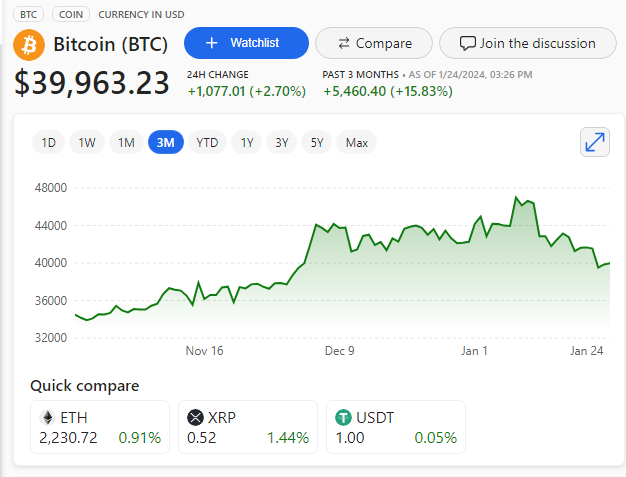
Bitcoin chart – 3 months 24th January 2024 at 15:26
Bitcoin chart – 3 months 24th January 2024 at 15:26
A time travel party organised by Stephen Hawking in 2009.
This was an experiment that Hawking conducted to test the possibility of backward time travel. He invited people from the future to attend a reception at his university, but he did not send out the invitations until after the party. He hoped that someone from the future would find the invitation and use a wormhole time machine to come back and prove that time travel is possible.
However, no one showed up at his party. He said that he liked simple experiments and champagne. He also said that he had experimental evidence that time travel is not possible. He explained that warping space and time could trigger a bolt of radiation that would destroy the spaceship and maybe the space-time itself.
Is time travel to the future possible?
Based on the current scientific understanding, time travel to the past seems to be very unlikely, if not impossible. There are many paradoxes and inconsistencies that arise from the idea of changing the past.
Stephen Hawking organised a time travel party in 2009
Time travel to the future, however, may be possible, but only in a limited sense. According to the theory of relativity, time passes at different rates depending on the speed and gravity of the observer. This means that someone who travels very fast or near a massive object could experience less time than someone who stays still or far away from the mass.
Time dilation
This is called time dilation, and it has been experimentally confirmed. However, this does not allow the traveller to return to their original time, as they would have aged less than the rest of the world.
So, in summary, time travel is unlikely, but it is acknowledged that there are some intriguing possibilities and mysteries that remain to be explored.
Leaders at some of the world’s leading artificial intelligence (AI) companies are expecting a form of AI on a par with, or even exceeding human intelligence to arrive sometime in the near future. But what it will eventually look like and how it will be applied are unknown.
Artificial General Intelligence or AGI is coming soon
Leaders from OpenAI, Microsoft and Google’s DeepMind, and many other major tech companies debated the risks and opportunities presented by AI at the World Economic Forum in Davos, Switzerland in January 2024.
AI has become the talk of ‘town’ around the world through 2023, mainly due to the success of ChatGPT, OpenAI’s popular generative AI chatbot, brought to us by Microsoft. Generative AI tools, like ChatGPT, are powered large language models, algorithms trained on vast quantities of data, but are not AGI.
Executives at some of the world’s leading artificial intelligence companies see ‘artificial general intelligence,’ or AGI, a hypothesized form of AI with intelligence on a par or better than humans. This prospect is both exciting and worrying.
Concern
AI and AGI have created concern among governments, corporations and public consultation groups worldwide, owing to the risks around the lack of transparency of AI systems; social manipulation through computer algorithms; job losses due to increased automation; surveillance; and data privacy and worse… the lack of human control!
Extinction event possible
Many industry leaders in technology have warned that AI could lead to an ‘extinction-level’ event where machines become so powerful they get out of control and wipe out humanity.
A new powerful AI is coming but the techies have no clue as to what it will look like
Several prominent technology leaders, including Elon Musk and Steve Wozniak for example, have called for a pause in AI development, stating that a moratorium would be beneficial in allowing society to catch up.
Turing test
AI chatbots like ChatGPT have passed the Turing test, a test called the ‘imitation game,’ which was developed by British computer scientist Alan Turing to determine whether someone is communicating with a machine and a human. The one big area where AI is lacking is common sense.
It has been reported on many occasions, that the tech world is taking steps to ensure that the AI race doesn’t lead to a ‘Hiroshima moment.‘
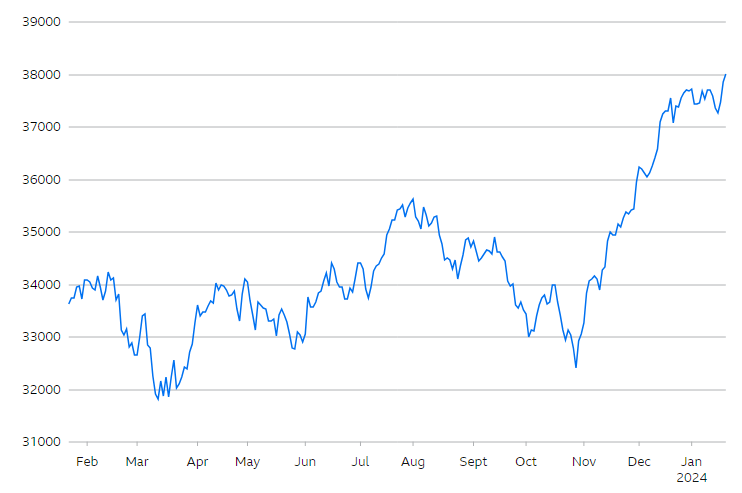
The Dow Jones Industrial Average (DJIA) reached a new high on 22nd January 2024, closing at 38,001.81 points
One year chart for the Dow Jones Industrial Average (DJIA)
The Dow Jones Industrial Average (DJIA) reached a new high on 22nd January 2024, closing at 38,001.81 points
The index reached 38109.20 points in intraday trading. Recently the S&P500 and the Nasdaq set new highs.
The Dow
The Dow Jones is a market index that tracks the performance of 30 large US companies. It is also known as the Dow Jones Industrial Average (DJIA) or simply ‘the Dow’.
The DJIA is one of the oldest and most widely followed stock market indicators in the world. It reflects the health and sentiment of the U.S. economy and business sector.
The index was created in 1896 by Charles Dow and Edward Jones, who were journalists at The Wall Street Journal. The first calculation was done on 30th June 1896, with a base value of 40.
Some 128 years later, the index has a value of 38001 – a record high!
The Nasdaq 100 climbed to a new high of: 17314 on 19th January 2024
Nasdaq 100 hits new record high 19th January 2024
The NASDAQ 100 Index is a widely used benchmark for the performance of the technology sector in the U.S. market.
It consists of 100 of the largest non-financial companies listed on the NASDAQ stock exchange. Some of the top components of the index are Apple Inc., Microsoft Corporation, Amazon.com Inc., Alphabet Inc., and Meta Inc.
Some analysts however are warning that the Nasdaq is due a correction.
It is up around 20% from a low point in late October 2023 and some analysts warn that the tech sector is overvalued and may face a correction.
The S&P 500 index reached a new all-time high of 4,839.81 on Friday, January 19, 2024.
This was the first time the index closed above its previous high set January 3rd 2022. The rally was driven by strong earnings from the magnificent 7 tech giants such as Nvidia and Microsoft.
The expectation of a Fed interest rate cut later this year also helped the S&P500 break new ground.
In the short scale system, which is commonly used in the UK, United States and most English-speaking countries, 1 billion is written as 1,000,000,000 or 109. This means that 1 billion is equal to 1 thousand million.
In the long scale system, which is commonly used in continental Europe and some other parts of the world, 1 billion is written as 1,000,000,000,000 or 1012. This means that 1 billion is equal to 1 million million.
Fun facts
If you tried to count to 1 million at an approximate rate of 1 number per second, it would take around 11 days. And that would be without sleeping or taking a rest in between the marathon quest. But if you were to count to 1 billion it would take you… wait for it… a cool 32 years!
But just imagine this, if you attempted to count to 1 trillion (1000,000,000,000) or 1012 at the same rate of 1 number per second and without sleep, rest or mistakes – it would take you about… 31,710 years! Give or take a year.
A little bit more
A million and 1 billion sound like BIG numbers, they are. But just how big…
Imagine this: 1 million seconds is roughly equal to 1 week. But, 1 billion seconds equates to about 33 years!
It’s true – or at least it was for a 1930’s BBC broadcaster
Apparently, the story goes that the most boring news day was 18th April 1930. Imagine turning on your radio ready to hear the news bulletin only to hear a BBC radio presenter announce, ‘There is no news!’
Can’t ever imagine that happening now – 24 hour news nonsense fills up all the gaps!
China, which consumes over half of the global coal demand and produces over 4 billion tonnes of coal per year.
India, which consumes about 14% of the global coal demand and produces over 900 million tonnes of coal per year.
The United States, which consumes about 9% of the global coal demand and produces over 600 million tonnes of coal per year.
Japan, which consumes about 3% of the global coal demand but imports most of its coal.
These countries accounted for about 82% of the global coal production in 2021 according to 2021 data set. China alone produced more than half of the world’s coal, followed by India with nearly 10%.
Global coal use in 2023 hits few high
Global coal use in 2023 has hit a record high, surpassing 8.5 billion tons for the first time, on the back of strong demand in countries like India and China, said IEA. These countries are the world’s largest consumers of the dirtiest fossil fuel, and continued modernization puts their energy consumption on a rapid growth trajectory.
China
China and India’s growing economies will continue to fuel demand for coal even as they set ambitious renewable energy targets, according to experts.
While China is the world’s largest energy consumer, India is ranked third globally, and both countries are the top consumers of coal as they strive to fuel economic growth.
Global coal usage in 2023hit a record high, surpassing 8.5 billion tons for the first time, on the back of strong demand in emerging and developing countries such as India and China, IEA noted in a recent report.
China’s electricity sector has been in the throes of a clean revolution over the past few years, with an almost five-fold growth in wind and solar generation since 2015. As a result, the share of coal generation has fallen by 17 percentage points, from 78% in 2000 to 61% in 2022.
China has suffered from drought in recent years, which reduced hydroelectric power generation in its southern provinces. To maintain the necessary power output, the country had to turn to coal.
United States
By contrast, U.S., which is the world’s second largest consumer of coal, has seen a decrease in its usage of the fuel. According to the Institute for Energy Economics and Financial Analysis, the amount of coal that the superpower consumes each day recorded a 62% drop from 2.8 million to 1.1 million tons a day.
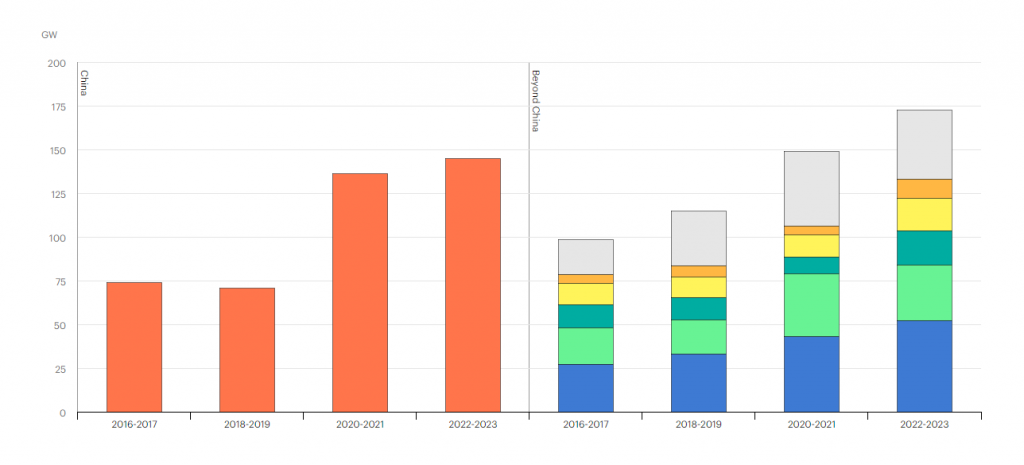
75% of India’s power is derived via coal-fired plants. Coal accounts for 61% of China’s power generation, even though the country is recognized as the indisputable leader in renewable energy expansion. It has been adding new projects to the grid almost as fast as the rest of the world combined in 2022 and has ambitions of becoming carbon neutral by 2060.
Annual average capacity additions by country and region, 2016-2023
India’s coal production rose to 893 million tons during the financial year ending March 2023, jumping nearly 15% from a year earlier. China’s raw coal production in 2023 went up by 2.9% compared with the same period in 2022.
There are no signs of a slowdown, with the IEA saying coal consumption in India and Southeast Asia is projected to grow significantly.
Coal won’t go!
But the lack of reliability of renewables means coal has still very much been a critical fallback option for the two countries.
Top five coal producing countries in the world
China: 4,126.0 million tonnes
India: 762.0 million tonnes
Indonesia: 614.0 million tonnes
United States: 523.8 million tonnes
Australia: 467.1 million tonnes
Five of the Greenest energy producers in the world
Sweden
Norway
Denmark
Finland
Switzerland
The greenest were based on these five criteria: carbon emissions, energy transition, green society, clean innovation, and climate policy.
Top countries by renewable energy production
China: 2,271.9 TWh (28.2% of total electricity)
United States: 804.8 TWh (20.5% of total electricity)
Brazil: 491.9 TWh (83.3% of total electricity)
Canada: 433.6 TWh (66.9% of total electricity)
India: 303.5 TWh (24.5% of total electricity)
Note: three of the world’s worst offenders of fossil fuel use are also in the top five for energy production by renewables – China, U.S. and India.
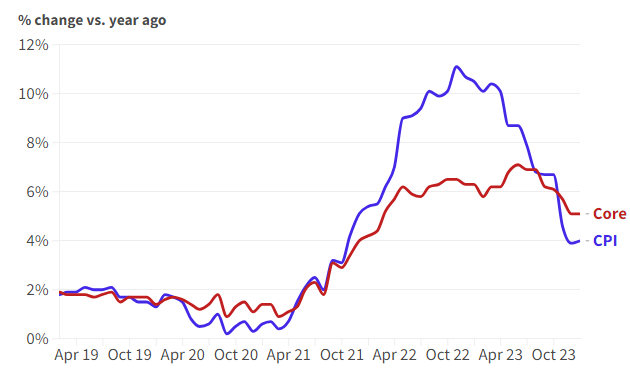
Inflation, rose marginally to 4% in December, up from 3.9% in November 2023.
Economists had forecast a slight fall but unexpected rises in alcohol and tobacco prices were behind the surprise rise.
However, with energy bills predicted to come down in 2024, there are still expectations of interest rate cuts later this year.
On target still for 2%?
As we have seen in the Germany, the U.S., and France, inflation does not fall in a straight line, ‘but our plan is working and we should stick to it,‘ Jeremy Hunt reportedly said in a statement.
UK inflation from April 2019 to December 2023
UK inflation from April 2019 to December 2023
Unprepared for both the start and the end of the pandemic
Increases in the cost of energy and food costs, started by pandemic lockdowns ending exasperated further by Russia’s invasion of Ukraine and more recently the conflict in Israel have put household finances under extreme pressure.
The UK and other countries were woefully underprepared for all of these events as they ‘began’ and at the ‘end’. We did not prepare to come out of them – there was no exit plan!
Markets and traders are still expecting BoE to cut its base rate in 2024 due to the fast-falling inflation rate. It peaked at 11.1% in October 2022 – and now sits at 4%.
The question is: will the economic recovery be good enough to allow the Bank of England to start cutting rates?
The UK interest rate currently sits at 5.25%.
‘What’s inflation?’ ‘Dunno, but my beer’s gone up!’
According to the Bloomberg Billionaires Index, Elon Musk is the wealthiest person in the world, with an estimated net worth of $243.46 billion USD as of 8th Jan 2024.
Musk is the founder and CEO of Tesla and SpaceX, X and X.ai as well as the co-founder of PayPal and Neuralink. He made his fortune from various business ventures, starting from a web software company called Zip 2 that he sold in 1999 for around $307 million. He also inherited some wealth from his father, who owned an emerald mine in South Africa.
Think about this for a moment
It’s a little difficult to imagine such wealth so, maybe think of it like this… If you had been given $10,000 every day since the birth of Jesus Christ, 2024 years ago – you would have accumulated some $7.4 billion (without interest and leap years etc).
So, Mr Elon Musk has a net worth of around $243 billion and you would have $7.4 billion and that equates to only 3% of his current wealth.
Or, if you had been given $10,000 every day since the pyramids were built in Egypt around 4500 years ago – you would have accumulated $16.4 billion. That’s still only 6.75% of Elon Musk’s current wealth.
One last thought
A recent report conducted by Oxfam calculated that just 5 of the world’s richest men (including Musk) are worth $869 billion between them.
Your $16.4 billion accumulated over 4500 years would equate to less than 2% of that combined wealth.
Now that’s crazy!
Final thought
8 of the top 10 current billionaires made their money in…technology.
Please note:figures are estimated, but it perfectly demonstrates my point.
The world’s five richest men have increased their combined fortune from $405 billion in March 2020 to $869 billion in November 2023, according to a report from Oxfam.
Wealth increased at a rate of $14 million per hour for 5 people
A report by the charity highlighted the wealth of Tesla CEO Elon Musk, LVMH boss Bernard Arnault and family, Amazon founder Jeff Bezos, Oracle founder Larry Ellison, and investor Warren Buffett.
Oxfam is calling for restrictions on ‘corporate power’ to reduce the massive inequality between the super-rich and the rest of society. Two of the suggestions to correct the inequality is through capping CEO pay and introducing taxes on permanent wealth and excess profits.
This report was released to coincide with the Davos meeting as the rich and wealthy business leaders and bankers gather.
Oxfam says
Fortunes of five richest men have shot up by 114% since 2020.
Oxfam predicts the world could have its first-ever trillionaire in just a decade while it would take more than two centuries to end poverty.
A billionaire is running or the principal shareholder of 7 out of 10 of the world’s biggest corporations.
148 top corporations made $1.8 trillion in profits, 52% up on 3-year average, and dished out huge payouts to rich shareholders while hundreds of millions faced cuts in real-term pay.
Oxfam urges a new era of public action, including public services, corporate regulation, breaking up monopolies and enacting permanent wealth and excess profit taxes.
Japan’s Nikkei 225 index set a new record in nearly 34 years last week, breaking the 35000 barrier for the first time since February 1990. Its all-time high of 38915 was hit in December 1989? That’s a 35 year old record!
Some analysts think that the long-term prospects for the Japanese markets look good.
The Nikkei 225 index is a benchmark of the Japanese stock market. It is composed of 225 large companies listed on the Tokyo Stock Exchange. The index has been fluctuating between 20000 and 30000 points for most of the past decade. It recovered from the lows of the global financial crisis in 2008 and 2009.
According to some market strategists, the Nikkei 225 index could reach 40000 points in the next 12 months. Fundamentals are ‘pointing in the right direction’ and investor interest in Japan is increasing.
This would breach the Nikkei’s all-time high of 38915 reached in December 1989. However, others suggest the rally will struggle somewhere between 36000 and the all-time high. This suggest that much of the good news is already priced in.
I think I could probably have guessed that too. The Nikkei hasn’t reached the original high of 1989 for 35 years!