On Monday, 25th March 2024, the European Union initiated its first investigation under the new Digital Markets Act, targeting Apple, Alphabet, and Meta for potential tech legislation breaches.
Statement
“Today, the Commission has opened non-compliance investigations under the Digital Markets Act (DMA) into Alphabet’s rules on steering in Google Play and self-preferencing on Google Search, Apple’s rules on steering in the App Store and the choice screen for Safari and Meta’s ‘pay or consent model” – the Commission said in a statement.
China has reportedly prohibited the use of U.S. processors from both AMD and Intel in government computers and servers. The directive is designed to encourage the use of domestic alternatives.
Chinese government agencies are now required to choose ‘safe and reliable’ domestic alternatives for these chips. The sanctioned list features processors from Huawei and the state supported firm Phytium, both of which face bans in the U.S.
In addition to processors, China is now also restricting Microsoft Windows on government devices, opting instead for domestically produced operating systems.
These guidelines are part of a broader tech trade battles between China and the U.S. While the impact on Intel and AMD remains to be seen, it’s clear that China is taking aggressive steps to reduce reliance on U.S. built technology.
The global tech landscape continues to evolve, and these decisions have far-reaching implications for both countries and the industry as a whole.
U.S. and China trade tensions are unlikely to recede anytime soon.
This quote is about what you are made of – it’s about what is on the ‘inside’ and not the visible circumstances that surround you or your life on the ‘outside’.
Cold welding is a fascinating phenomenon that allows metals to bond in space
Cold Welding: In the vacuum of space, two metal pieces can fuse without heat or flame when they come into contact. This occurs because:
Metallic Bonds: Metals consist of positively charged ions immersed in a sea of free-moving electrons, which are essential for bonding atoms within the metal.
Oxide Layer: On Earth, metals typically develop an oxide layer on their surfaces due to exposure to air, preventing them from bonding directly.
In Space: Without oxygen in space to create an oxide layer, touching metal pieces can merge through their metallic bonds, forming one solid piece.
Practical Implications
In practice, such occurrences are rare on Earth due to irregularities and the presence of a protective oxide layer.
Even in space, this oxide layer persists unless it is intentionally removed. If it were to be polished away, the metals could indeed weld together.
Designers of satellites and spacecraft must take this into account when selecting metal components for space missions.
Designers of satellites and spacecraft must consider this when selecting metal parts for space missions.
Although it’s not as straightforward as magnets sticking together, cold welding in space is truly possible!
Japan’s Nikkei 225 index briefly surpassed 41000, reaching a new all-time high on Friday 22nd March 2024, as the nation’s inflation rate reportedly accelerated in February 2024. Other Asia-Pacific markets experienced declines.
The headline inflation rate in Japan for February 2024 was reported at 2.8%, an increase from the 2.2% recorded in January 2024. The core inflation rate, which excludes the cost of fresh food, also rose to 2.8% from the 2% reported the previous month.
In its monetary policy statement, the Bank of Japan (BoJ)stated that it aims to achieve the price stability target of 2% in a sustainable and stable manner.
The Nikkei retreated to close just below 41000, ending up at 40888
The Nikkei retreated to close just below 41000, ending up at 40888
A serious problem or a technical glitch? I call it the donut theory – where everything is perceived as good until… but it isn’t – when you can’t even buy a donut!
Recent issues highlight a growing problem
Due to a payment acceptance issue, the bakery chain Greggs has closed some of its outlets. Patrons encountered certain branches that were either shut or only accepted cash.
This incident comes after card payment systems failed at Sainsbury’s and Tesco on Saturday 16th March 2024, and at McDonald’s on Friday 15th March 2024, and at many other outlets over recent months. Instore shopping and home deliveries were all affected.
Failures
The recent system failures experienced by major UK retailers like Sainsbury’s, Tesco, and even McDonald’s have indeed raised concerns. While these incidents may seem isolated, they highlight broader issues related to technology infrastructure, reliance on digital systems, and the impact of such failures on businesses and consumers.
Potential implications and issues with system failures. We are so dependent on the ‘system’.
Dependency on Technology
Modern businesses heavily rely on technology for operations, from inventory management to payment processing. When systems fail, it disrupts daily operations, affecting customer satisfaction and revenue.
The recent incidents underscore the need for robust backup systems, redundancy, and thorough testing of software updates.
Customer Experience and Trust
System outages can frustrate customers who rely on these services. Delays in grocery deliveries or inability to pay via contactless methods can lead to dissatisfaction.
Trust in a brand can erode if such incidents occur frequently. Customers may seek alternatives or lose confidence in the retailer’s ability to provide reliable services.
Financial Impact
System failures can result in financial losses due to missed sales, refunds, and operational disruptions.
Companies invest significant resources in maintaining and upgrading their technology infrastructure. Failures can be costly both in terms of immediate losses and long-term reputation damage.
Cybersecurity Concerns
System glitches may raise questions about cybersecurity. While not all incidents are related to security breaches, any disruption can make consumers wary.
Retailers must continuously assess and enhance their security measures to protect customer data and prevent unauthorized access.
Supply Chain Vulnerabilities
Supermarkets are part of complex supply chains. System failures can impact suppliers, logistics, and distribution networks.
Ensuring resilience across the entire supply chain is crucial to prevent cascading effects.
Regulatory Compliance
Retailers must comply with regulations related to data protection, payment processing, and consumer rights. System failures could lead to legal and regulatory challenges.
Recent Cyberattacks and System Failures in the UK
Cyberattacks will all have malicious intent, such as accessing, changing, or destroying sensitive information; extorting money from users via ransomware; or interrupting normal business processes.
The digital age has brought unprecedented convenience and efficiency to our lives. However, it has also introduced new challenges, particularly in the realm of cybersecurity and system reliability. In the UK, several high-profile incidents have underscored these challenges. Here are ten recent serious cyberattacks and system failures that have occurred since 2022.
System Failures
NHS IT Failures: In December 2023, the Health Services Safety Investigations Body (HSSIB) reported that IT failures in the NHS have resulted in patient harm and even deaths. Urgent action is needed to address these issues.
Failing IT Infrastructure in the NHS: A report highlighted that the failing IT infrastructure is undermining safe healthcare in the NHS.
Failed Government IT Project: A failed government IT project to upgrade NHS computer systems in England ended up becoming one of the ‘worst and most expensive contracting fiascos’ in public sector history.
Abandoned NHS Patient Record System: In September 2013, an NHS patient record system, which would have been the world’s largest non-military IT system, was abandoned. The failed centralised e-record system cost the taxpayer over £10 billion.
Cyberattacks
Ransomware Attack on NHS: A ransomware attack on a software supplier hit the NHS across the UK, and there were fears that patient data may have been the target.
Ransomware Attack on Greater Manchester Police: The Greater Manchester police force fell victim to a ransomware hack, exposing details of officers’ name badges such as ranks, photos, and serial numbers.
Ransomware Attack on Royal Mail: The Royal Mail was affected by a ransomware attack.
Ransomware Attack on Capita: Outsourcing firm Capita was hit by a ransomware attack.
Ransomware Attack on Barts Health NHS Trust: The Barts Health NHS trust was affected by a ransomware attack.
Ransomware Attack on Redcar and Cleveland Council: In 2020, Redcar and Cleveland council fell victim to a ransomware attack and was locked out of its systems for almost three weeks.
Cyber-Attack on UK VoIP Providers: An ‘unprecedented’ and coordinated cyber-attack struck multiple UK-based providers of voice over internet protocol (VoIP) services.
Hackney Borough Council Cyber-Attack: Hackney Borough Council was hit by a cyber-attack which led to significant disruption to services and IT systems.
Exchange Email Hack: In March 2021, hundreds of UK companies were compromised as part of a global campaign linked to Chinese hackers.
Hacking of 23andMe Profiles: In December 2023, there was a hack of 6.9 million profiles at genetic test firm 23andMe.
Booking.com Customer Hacking: In November 2023, hackers increased attacks on Booking.com customers
And there have been many more. Whatever the reason; system failures or cyberattacks – the UK needs to seriously update and improve its resources and defences or suffer the serious consequences.
These incidents serve as a stark reminder of the importance of robust cybersecurity measures and reliable IT systems. As we continue to rely more heavily on digital systems, it is crucial that we learn from these incidents and take the necessary steps to prevent similar occurrences in the future.
Conclusion
In summary, while individual incidents may not indicate a systemic crisis, they serve as reminders for businesses and local authorities to invest in robust technology, disaster recovery plans, and proactive risk management. As technology continues to evolve, addressing these challenges becomes even more critical.
The U.S. has reportedly initiated a significant lawsuit against Apple, alleging that the technology giant has monopolised the smartphone market and stifled competition.
The Justice Department claims that Apple has misused its dominance over the iPhone App Store to ‘lock in’ customers and developers. The company is also accused of taking unlawful measures to obstruct applications perceived as competitive threats and to degrade the appeal of competing products.
Apple has pledged to ‘vigorously’ contest the lawsuit and refutes the allegations.
A slowdown in iPhone sales in China, the reported dumping of an EV project, no iPhone AI interface to speak of and now a U.S. lawsuit to defend. Is Apple’s ‘crown of dominance‘ slipping ever-so-slightly?
The surge in gold prices continues, reaching a new peak on Thursday 21st March 2024, with predictions of further increases as central banks around the world persist in acquiring significant amounts of bullion.
Some analysts believe the gold price could climb as high as $2300 per ounce in the latter half of 2024, particularly if the U.S. Federal Reserve lowers interest rates as anticipated. Currently, gold reached around $2209 on Thursday morning 21st March 2024.
Gold price movement over 1 month
Gold price movement over 1 month
Typically, gold prices have an inverse correlation with interest rates. When interest rates fall, gold becomes more attractive than fixed-income investments like bonds, which offer lower returns when rates are low.
On Wednesday, 20th March 2024, the three major U.S. indices soared to record all-time closing highs after the Federal Reserve decided to maintain rates and kept its ‘expectations’ for three rate cuts by the end of 2024.
The Dow Jones Industrial Average surged 401.37 points to close at 39,512. The S&P 500 finished at 5224, breaching the 5200 level for the first time. The Nasdaq Composite climbed 1.25% to end at 16369.
Federal Reserve
The Federal Reserve kept rates steady but announced plans for three reductions before the year’s end, echoing its previous projection from December 2023. However, the central bank noted that it requires more substantial evidence of inflation subsiding before commencing any interest rate cuts.
Futures continued their historic ascent into Thursday21st March 2024.
The tyre industry is marked by fierce competition, static growth, and slim profit margins. But that is about to change.
In recent years, the total market value has consistently hovered around $50 billion, with an annual growth rate of approximately 2%, according to research. However, the advent of electric vehicles (EVs) is creating new possibilities.
Due to their substantial weight and rapid acceleration, EVs typically wear out tires around 20% quicker than vehicles with internal combustion engines, research suggests. Additionally, the cost of these tyres is roughly 50% higher.
Additional technical challenges encompass mitigating tyre noise, which becomes significantly more discernible inside of an otherwise quiet electric vehicle (EV) and enhancing an EV’s driving range. Research conducted by Michelin reportedly indicates that tyre selection can influence an EV’s range by 10% to 15%.
Summary Electric Vehicle (EV) Tyre Wear
Weight and Acceleration: EVs are heavier due to their batteries, and they often have quick acceleration.
Wear Rate: On average, EV tyres tend to wear down about 20% faster than internal combustion engine (ICE) vehicle tyres.
Cost: EV-specific tyres can be more expensive, costing approximately 50% more than regular tyres.
EV tyres are more expensive, and you get less use from them – remember to factor this into your purchasing decision.
In February 2024, inflation decreased to 3.4%, a decline from January’s 4%, moving closer to the Bank of England’s self-imposed target of 2%
This reduction signifies that the cost of living is increasing at its least rapid rate since September 2021, when it was recorded at 3.1%.
Since reaching a peak of 11.1% in October 2022, the highest in 40 years, inflation has been on a steady decline. In the big inflation picture, that’s a pretty good result.
It has only taken around 16 months to move the rate from 11.1% (a 40-year high) down to just 1.4% above the BoE’s target of 2%.
The primary factor contributing to this decrease, as reported by the Office for National Statistics (ONS), is the deceleration of food price inflation.
Bitcoin extended its slide on Tuesday 19th March 2024, dropping more than $10,000 from its all-time high last week.
The cryptocurrency went below $63000. Last week it climbed to a record $73679.
The move helped drag other cryptocurrencies lower. Ether lost more than 5% and was recently trading at $3,287.58 after topping $4,000 last week for – a drop some analysts predicted following the network’s *Dencun upgrade. The token tied to Solana fell 8%, Dogecoin lost 7% and XRP slipped 2%.
*Dencun introduces a scaling technology called proto-danksharding. This feature aims to drastically reduce transaction fees on Layer 2 (L2) rollups like Pontem’s SuperLumio, Optimism, and Arbitrum. By efficiently managing large data chunks, *proto-danksharding streamlines transaction processing, particularly for L2 solutions.
*Proto-Danksharding, also known as EIP-4844, is an intermediate step toward achieving a truly scalable Ethereum blockchain. Proto-Danksharding aims to make transactions on Layer 2 as cheap as possible for users and ultimately scale Ethereum to handle over 100,000 transactions per second. It serves as a precursor to full Danksharding.
In summary, Proto-Danksharding paves the way for more efficient and cost-effective Layer 2 solutions, enhancing Ethereum’s scalability and usability.
Bitcoin volatile pullback – profit taking
Bitcoin’s decline started last week when traders began to capitalize on profits following its approximately 70% surge from the beginning of the year to its peak last Wednesday. Data from CryptoQuant indicates a significant increase in investors liquidating their Bitcoin holdings for profit on 12th March 2024.
CoinMarketCap chart demonstrating Bitcoin volatility over 7-day period dropping below $63000
CoinMarketCap chart demonstrating Bitcoin volatility over 7-day perioddropping below $63000
Moreover, the act of securing profits resulted in a surge of long position liquidations for leveraged Bitcoin investments. Centralised exchanges witnessed approximately $122 million in long position liquidations on Monday, as per analysis from Bitcoin exchanges.
The previous week saw nearly $372 million worth of long liquidations over the span of three days.
Bitcoin ETFs
The introduction of spot Bitcoin ETFs in the U.S. earlier this year has significantly contributed to the rally of Bitcoin. This surge began even before the ETFs were officially launched, spurred by the anticipation of their regulatory approval. Concurrently, growing interest from investors and a higher demand for Bitcoin have led to increased leverage and amplified volatility.
Investors and analysts caution that traders ought to proceed with care in March due to the anticipated volatile price movements and a surge in trading volumes, which could result in a deviation from Bitcoin’s sustained upward trend.
Tread with extreme care – or DON’T TREAD AT ALL! Bitcoin is an extremely volatile asset and too unpredictable to trade for my liking.
In a move that reverberated across global financial markets, the Bank of Japan (BOJ) recently bid farewell to its negative interest rate policy – the last of its kind in the world. This decision marks a pivotal moment in the realm of central banking and has far-reaching implications for economies and investors worldwide.
The Negative Interest Rate Saga
To understand the significance of this shift, let’s rewind the clock. Japan, grappling with deflation for years, embarked on an ambitious economic experiment known as ‘Abenomics’ in 2013. The strategy combined massive government spending with unconventional monetary measures. The BOJ, under the leadership of then-Prime Minister Shinzo Abe, injected liquidity into the system by purchasing bonds and other assets. The goal? Achieve a 2% inflation target and kickstart growth.
Among these measures was the adoption of negative interest rates. The idea was simple: discourage banks from hoarding excess reserves and encourage lending. However, the path to higher inflation proved elusive, and the BOJ found itself navigating uncharted waters.
The Change
Fast forward to 2024. Japan’s economy has experienced a moderate recovery, prompting policymakers to reassess their strategic options. The Bank of Japan (BOJ) has elevated its short-term interest rate from minus 0.1% to a range between zero and 0.1%. This adjustment marks the first increase in rates since 2007, representing a significant, even a ‘seismic’ policy shift.
The Effect
Policy Pivot: The BOJ acknowledges that negative rates have played their part. With improving wages and corporate profits, the time is ripe for a change. The new rate range signals a departure from the era of ultra-accommodative policies.
Global Implications: Japan now stands as the last central bank to exit negative rates. For years, central bankers worldwide wielded cheap money and unconventional tools. Now, the tide turns. The era of negative rates draws to a close, and other central banks take note.
Market Response: Tokyo’s Nikkei 225 index responded positively, gaining 0.7%. The Japanese yen weakened against the dollar. Investors recalibrate their strategies, adjusting to a world where negative rates are no longer the norm. The Nikkei is sitting close to or at its all-time high!
Nikkei 225 3 month chart at: 40003 – close to its recent new all-time high of 40109
Nikkei 225 3 month chart at: 40003 – close to its recent new all-time high of 40109
The future?
As the BOJ takes its first step toward policy normalization, questions abound. Will further rate adjustments follow? How will markets adapt? And what does this mean for global liquidity?
One thing is certain: The decision of the Bank of Japan resonates beyond the confines of the nation. It heralds the beginning of a new era in which central banks adjust their strategies, economies establish stability, and investors once more chart a course through unfamiliar territory.
Within the chronicles of monetary history, the cessation of negative rates at the Bank of Japan will be marked as a pivotal moment. As the final details of this policy transition are solidified, the global community observes, prepared for the forthcoming developments.
Disclaimer: The views expressed in this article do not constitute financial advice. Readers are encouraged to consult professional advisors before making any investment decisions.
Nvidia have announced a new generation of artificial intelligence chips and software for running AI models. It’s called: The Blackwell B200 GPU
Blackwell B200 GPU
The Blackwell B200 is the successor to Nvidia’s Hopper H100 and H200 GPUs.
It represents a massive generational leap in computational power.
AI Performance: The B200 GPU delivers 4 times the AI training performance and 30 times the inference performance compared to its predecessor.
Transistor Count: It packs an impressive 208 billion transistors, more than doubling the transistor count of the existing H100.
Memory: The B200 features 192GB of HBM3e memory with an impressive bandwidth of 8 TB/s.
Architecture: The Blackwell architecture takes over from H100/H200.
*Dual-Die Configuration: The B200 is not a single GPU in the traditional sense. Instead, it consists of two tightly coupled die, functioning as one unified CUDA GPU. These chips are linked via a 10 TB/s NV-HBI connection to ensure coherent operation.
*Dual-die packaging technology is used to pack two integrated circuit chips in one single package module. It doubles functionality levels.
Process Node: The B200 utilizes TSMC’s 4NP process node, a refined version of the 4N process used by Hopper H100 and Ada Lovelace architecture GPUs.
The Blackwell B200 is designed for data centres and AI workloads but will likely be available to expect consumer in the future, although these may differ significantly from the data centre model.
Grace Blackwell GB200 Superchip:
Nvidia’s GB200 Grace Blackwell Superchip, with two B200 graphics processors and one Arm-based central processor
This superchip pairs the Grace CPU architecture with the updated Blackwell GPU.
It’s another addition to Nvidia’s lineup, combining CPU and GPU power for advanced computing tasks.
Nvidia continues to push the boundaries of accelerated computing, and these new GPUs promise remarkable performance improvements for AI and other workloads.
Onwards and upwards for Nvidia and the advancement of AI.
Apple is reportedly engaged in negotiations to acquire a licence for Google’s Gemini, a generative AI platform, with the intention of integrating it into iPhones. These ongoing discussions may result in Gemini enhancing iPhone software with new features later this year.
The terms, branding, and implementation details have not been finalised. This potential partnership could significantly impact the AI capabilities of future iPhones.
Microsoft: Pioneering Supercomputing for the AI future
In the ever-evolving landscape of technology, Microsoft stands out as a global supercomputing firm that’s making significant strides in the field of artificial intelligence (AI). With a vision to empower developers and organizations, Microsoft has invested heavily in creating cutting-edge infrastructure that fuels AI research and development.
The Azure Supercomputer: A Game-Changer
At the heart of Microsoft’s commitment lies the Azure Supercomputer, a powerhouse designed specifically for training massive AI models. This supercomputer, one of the top five publicly disclosed supercomputers in the world, represents a collaborative effort between Microsoft and OpenAI.
Its mission is to unlock the potential of AI across various domains, from natural language processing to computer vision.
A Platform for Innovation
Microsoft’s commitment extends beyond narrow AI advancements. They aim to democratise access to large AI models and infrastructure. By providing a platform for developers, researchers, and organizations, they will foster innovation and accelerate breakthroughs.
Imagine personalised medicine, self-driving cars, and data-driven decision-making, all powered by supercomputing capabilities.
The Exascale Race
Supercomputing isn’t just about raw power; it’s about solving complex problems. Microsoft joins the global race toward exascale computing, where machines perform a quintillion (1018) calculations per second. Imagine simulating climate change, predicting earthquakes, curing serious illnesses, solving nuclear fusion energy all with remarkable speed and accuracy.
Isambard-AI: UK’s Ambitious Project
While Microsoft leads the charge, other players are also making waves. The UK’s Isambard-AI, named after the legendary engineer Isambard Kingdom Brunel, aims to be ten times faster than the country’s current fastest supercomputer. It’s a testament to the growing importance of supercomputing in AI research.
Conclusion
Microsoft’s commitment to supercomputing and AI isn’t just about numbers—it’s about shaping the future. As we stand on the cusp of technological revolutions, these giants pave the way for a smarter, more connected world.
In 2018, Byju Raveendran’s edtech company, Byju’s, was the darling of India’s start-up scene.
It was valued at a staggering $22 billion. However, recent times have seen its fortunes take a dramatic downturn.
Financial Crisis and Valuation Plunge
Once India’s leading privately-held company, Byju’s is now regarded as a cautionary tale. Investment company BlackRock recently slashed its valuation to a mere $1 billion.
The company faced mounting debt, unhappy investors, and lawsuits by lenders. Its valuation plummeted.
Leadership Turmoil
In February, many shareholders voted to remove Byju Raveendran as CEO during an extraordinary general meeting (EGM). Reportedly, allegations of ‘management failures’ led to this decision.
Raveendran and his family dispute the allegations, challenging the vote’s validity in court. The High Court temporarily halted the implementation of the resolutions passed in the EGM.
Legal and Financial Crises
Byju’s has been struggling with a growing number of legal and financial challenges. These include: investigations by India’s financial crimes agency, layoffs, delayed salaries, and a liquidity crisis.
Customers have reportedly accused the company of pressure selling, coercing parents into buying courses they couldn’t afford.
Missed Financial Deadlines
In January, Byju’s reported a consolidated loss of around 82 billion rupees ($1 billion) for 2022. The company is yet to present its audited accounts for 2023.
The company’s struggle to pay salaries due to a lack of funds has further exacerbated its woes.
Global Expansion and Acquisitions
Byju’s expanded globally, acquiring other edtech start-ups and firms. However, these ambitious moves came at a cost.
Initially focused on online tutoring for schoolchildren and competitive exam preparation in India, Byju’s later introduced learning apps in various Indian languages.
Rights Issue and Cash Crunch
The current standoff between Byju’s and its investors revolves around a rights issue. Byju’s proposed raising up to $200 million through this issue, inviting existing shareholders to purchase additional new shares in the company.
The pandemic darling became infected
Through the pandemic, as schools were forced to close, the business kept growing and expanding – until it all started to unravel.
It used to be India’s top private firm with a $22bn (£17.38bn) valuation, but now some see it as a warning for local start-ups, after investment firm BlackRock cut its worth to $1bn.
Byju’s, once a rising star, now faces a massive task and fight back to regain its former glory.
Walt Whitman was an influential American poet, essayist, and journalist. His work significantly impacted American literature, and he is often referred to as the father of free verse.
More than a fifth of working-age adults in the UK are currently not actively seeking employment, according to recent figures.
The economic inactivity rate during the period from November 2023 to January2024 stood at 21.8%, a slight increase compared to the previous year. This means that approximately 9.2 million people aged between 16 and 64 are neither employed nor actively searching for jobs. The total figure has risen by over 700,000 since before the onset of the coronavirus pandemic.
Several factors contribute to this problem
Long-Term Illness: Approximately one-third of the working-age population not participating in the labour force cite long-term illness as the primary reason for their inactivity. Health-related issues have kept a significant portion of the population away from work.
The pandemic: of 2020 caused work flight. 700,000 extra out of the workplace since the coronavirus pandemic Covid 19 hit the UK in 2020.
Students and Education: Students pursuing education are often classified as economically inactive. Their focus on studies and lack of job-seeking activity contribute to this category.
Care Responsibilities: Individuals who care for family members or manage household responsibilities fall into this bracket. Caring duties can be time-consuming and prevent active job hunting.
People with Disabilities: Those with disabilities may face barriers in accessing employment opportunities. Accommodations and inclusive policies are essential to address this issue.
Early Retirement: Some adults choose early retirement, and once retired, they rarely express a desire to return to work. This group contributes significantly to the inactive population.
Discouraged Workers: Individuals who have given up on job searches due to discouragement or lack of suitable opportunities are also part of this category.
Gender Gap: Historically, more women have been classified as economically inactive compared to men. However, this gap has narrowed over the years as more women have entered the workforce.
Age Trends: Recent data indicates that while the number of economically inactive individuals due to illness has decreased, there has been an increase among those aged 16 to 34. Mental health issues are believed to be a contributing factor in this age group.
Persistently high level
The persistently high level of economic inactivity poses challenges for the UK economy. As the country emerges from the pandemic, addressing workforce shortages becomes crucial. Measures such as reducing National Insurance Contributions and extending free childcare services aim to encourage people to seek employment or increase their working hours.
More effort is needed to further incentivise workforce participation, if not, the UK economy will suffer for many more years than would otherwise be necessary.
Elon Musk sparked intense debate on the trajectory of artificial intelligence (AI) after he shared a clip from the Joe Rogan Experience podcast via his X account.
In the video, futurist Raymond Kurzweil explored the future of artificial intelligence (AI), proposing that it might soon outstrip human intellect.
Elon Musk, noted for his candid opinions on AI, echoed Kurzweil’s forecast by stating, ‘AI will likely be more intelligent than any individual human by next year.’ Furthermore, he speculated that by 2029, AI could surpass the combined intelligence of all humanity.
Screen capture of Elon Musk’s post on X
Artificial General Intelligence
Artificial General Intelligence (AGI), capable of outperforming human intelligence, has recently drawn widespread attention from technology leaders worldwide, especially with the advent of sophisticated AI systems such as ChatGPT, Bing AI, and Gemini. Despite its increasing prominence, a unified definition of AGI remains elusive. Typically, AGI is understood to be a phase in AI evolution where the system can undertake any human task, potentially excelling beyond human expertise in certain domains.”
In the realm of technology leadership, a broad range of views exists on the feasibility and consequences of Artificial General Intelligence (AGI). While some leaders speculate about the timeline for AGI’s realization, others doubt its eventual occurrence. Opinions also differ on whether AGI will lead to beneficial progress or present risks to human society. Comprehending the varied stances of tech leaders sheds light on the active debate regarding AGI and its prospective influence on society.
Musk’s choice to disseminate the podcast excerpt has intensified the discourse on AI advancement’s ramifications. His use of his platform to broadcast Kurzweil’s insights has sparked additional discussion and contemplation about artificial intelligence’s revolutionary capabilities.
His tweet has ignited wider conversations concerning the swift advancement of technology and its significant consequences for the future of humanity.
Raymond Kurzweil
Raymond Kurzweil, born 1948, is an American computer scientist, author, inventor, and futurist renowned for his contributions to various fields, including optical character recognition (OCR), text-to-speech synthesis, speech recognition technology, and electronic keyboard instruments.
Through his comprehensive body of work, Kurzweil has researched a variety of subjects including health, artificial intelligence (AI), transhumanism, the technological singularity, and futurism.
The European Union (EU) has made history by approving the world’s first comprehensive regulatory framework for artificial intelligence (AI).
Artificial Intelligence Act
Known as the Artificial Intelligence Act, this groundbreaking legislation is expected to serve as a global signpost for other governments grappling with how to regulate this fast-developing technology.
The AI Act takes a risk-based approach, categorizing AI applications based on their risk levels. It prohibits certain high-risk uses, emphasizes transparency, and aims to keep AI development human centric. This landmark regulation should help set a precedent for responsible AI deployment worldwide.
The regulation is expected to become enforceable in May 2024, after passing final checks and receiving endorsement from the European Council.
Oxford University, founded in the 12th century, stands as a beacon of scholarship and tradition. Its roots trace back to 1096 during William II’s reign. The university is approximately 230 years older than the Aztec Empire.
Teaching would have likely existed in some form within its hallowed halls. Imagine those early scholars, their minds ablaze with curiosity, gathering under the ancient spires.
Now, let’s compare this age to another remarkable entity: the Aztec civilization. The Aztecs flourished around the 14th century. Their vibrant culture, intricate temples, and awe-inspiring pyramids came some 230 years after the university was established.
Imagine the scene: while Oxford’s dons debated philosophy, the Aztecs were constructing Tenochtitlan, their magnificent capital. As Oxford’s colleges took shape, the Aztecs were creating intricate codices and performing sacred rituals.
Oxford University, with its nine centuries of continuous existence, predates the Aztec Empire by several lifetimes: a testament to the enduring quest for knowledge across civilizations.
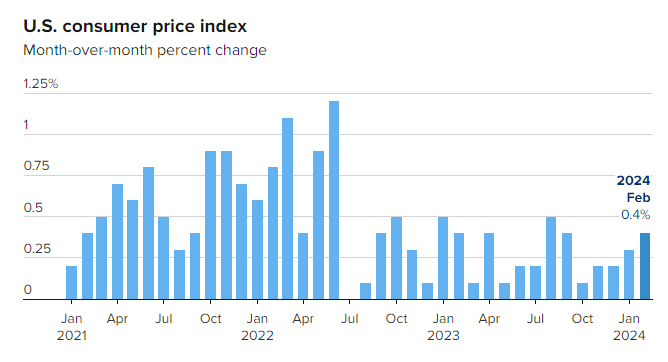
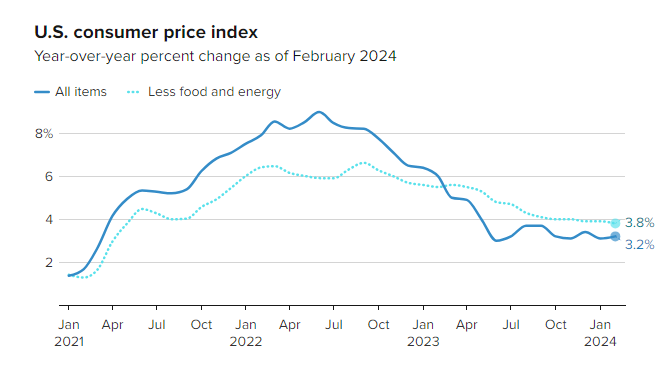
The U.S. Consumer Price Index, a comprehensive gauge of the cost of goods and services, rose by 0.4% for the month and increased by 3.2% compared to the previous year.
The annual rate was marginally higher than expected. The monthly rate was slightly above the forecast of 0.3%. This may likely direct the Federal Reserve to hold off on an interest rate reduction, at least until the summer of 2024. What will Wall Street make of it?
The core Consumer Price Index increased by 0.4% monthly and recorded an annual rise of 3.8%. Both figures exceeded forecasts by one-tenth of a percentage point.
An increase of 2.3% in energy costs contributed to the rise in the overall inflation figure. Food prices remained mostly unchanged for the month, while housing expenses saw a further increase of 0.4%.
U.S. consumer price index data for February 2024– Month on month
U.S. consumer price index data for February 2024 – Year on year
The World Wide Web (WWW), the invention attributed to Tim Berners-Lee while working at CERN, was conceived on 12th March 1989. This makes the World Wide Web 35 years old today.
It is important to recognise that the Web and the Internet are two different entities; the Web is a service that functions via the Internet, a worldwide network of interconnected computer networks. Whereas the Internet is the system.
The first successful communication between a Hypertext Transfer Protocol (HTTP) client and server through the Internet took place in mid-November 1989.
The Web has since evolved significantly, with the release of the first web browser and server, and the development of HTML, CSS, and JavaScript, which have shaped the modern digital experience.
First website
The inaugural website was launched at CERN and became accessible on 20th December 1990. Tim Berners-Lee developed this site to disseminate information about the World Wide Web project. In August 1991, it was made available to the public. Today, it is still possible visit this site, offering an intriguing look into the web’s nascent stages.
The internet
The internet, as we know it today, began to evolve in the mid-20th century. This era, known as the Information Age, Digital Age, or Computer Age, is characterised by a transition from traditional industry to an economy driven by information technology. This shift commenced in the 1940s and 1950s. The invention of the transistor in 1947 and the optical amplifier in 1957 were pivotal developments that propelled the advent of the internet.
The term ‘internet’ commonly denotes the worldwide system of interconnected computer networks that utilize the Internet protocol suite (TCP/IP) to connect devices globally. It is an extensive network comprising private, public, academic, business, and government networks of local to global systems.
ARPANET
Since the ARPANET’s inception, which is the internet’s precursor, the internet has been in existence for over 50 years. The ARPANET was conceived in the late 1960s and became operational in 1969. The internet is approximately 55 years old.
Art illustration depicting users on the World Wide Web – 35 years old today, 12th March 2024
The ARPANET, also known as the Advanced Research Projects Agency Network, represented the first wide-area packet-switched network featuring distributed control and was among the earliest to adopt the TCP/IP protocol suite.
These innovations laid the groundwork for what would become the Internet. Initiated by the U.S. Department of Defence’s Advanced Research Projects Agency (ARPA), the primary goal of ARPANET was to connect computers at Pentagon-funded research institutions via telephone lines, facilitating resource sharing and communication across distant computers.
The project commenced in 1966, with the initial computers being connected in 1969. By 1971, the network was operational and underwent rapid expansion. ARPANET was instrumental in introducing several protocols pivotal in today’s Internet communication, including the Network Control Protocol (NCP) and subsequently, TCP/IP.
Following the advent of the wider Internet, which ARPANET played a crucial role in catalyzing, the network was officially decommissioned in 1990.
Happy Birthday WWW and thank you Tim-Burners-Lee (I think)
Let’s see how far artificial intelligence (AI) becomes embedded in the next generation of the World Wide Web and of further internet development. Will the big tech companies of today still be running the AI projects of tomorrow?
Bitcoin has been on a remarkable ascent! It soared past the $72,000 mark on Monday 11th March 2024, setting a new all-time record.
This surge is attributed to a growing demand for new spot exchange-traded funds (ETFs), which have been approved for listing in the U.S. by some of the world’s largest financial firms.
The market for these ETFs is expected to reach $62 billion in the next two or three years. The cryptocurrency keeps surprising everyone with its value, which has grown to an amazing $1.42 trillion and is still rising… again!
Bitcoin moved off its all-time record shortly after achieving it.