

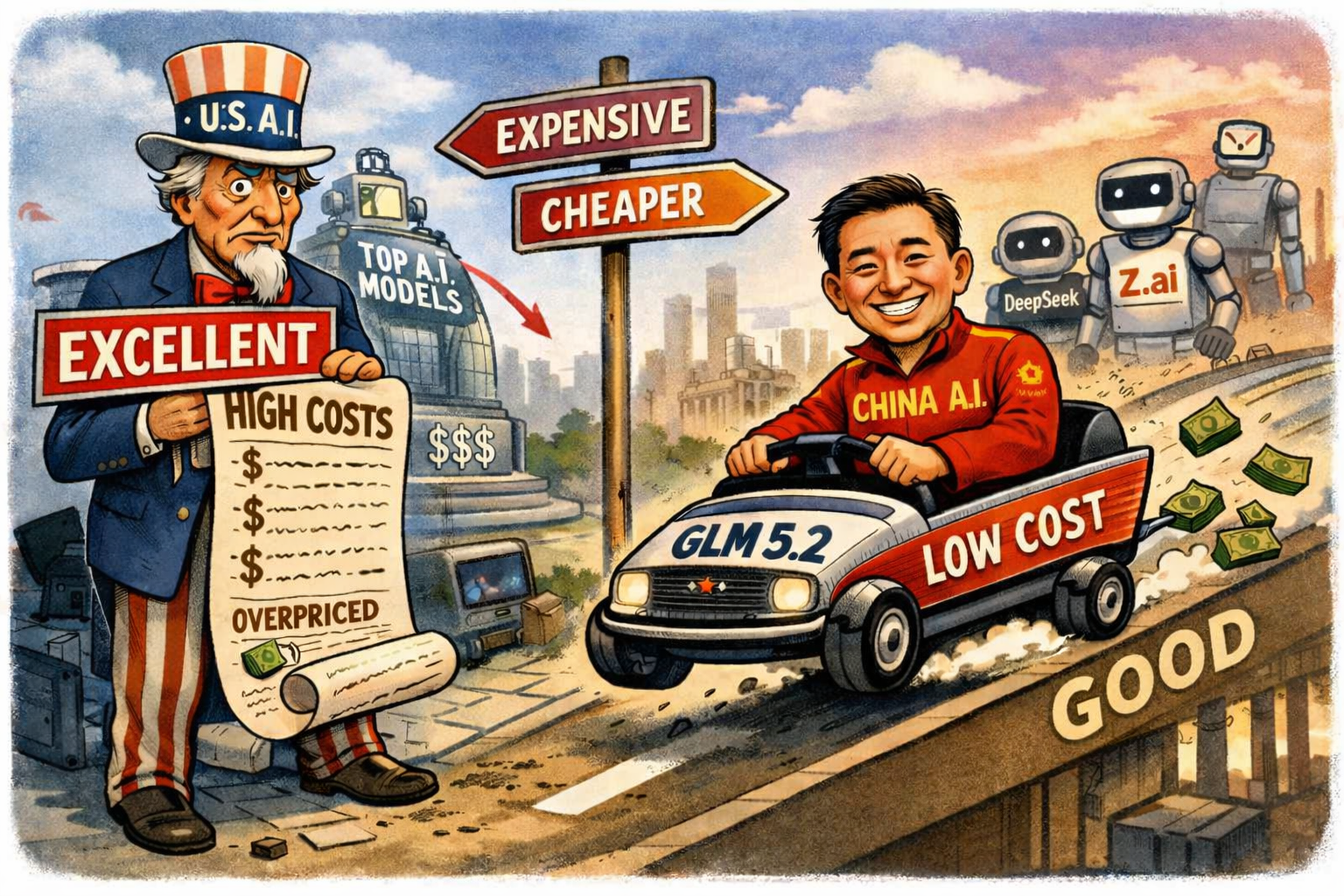
As Chinese AI models gain ground, the centre of gravity in the global AI market is shifting — and U.S. firms, investors, and regulators are being forced to confront uncomfortable questions about cost, capability, and competitive advantage.
Chinese systems such as GLM‑5.2, DeepSeek, and Qwen have moved from curiosities to credible alternatives. GLM‑5.2, developed by Zhipu AI, is an open‑weight large language model designed for agentic tasks, reasoning, and enterprise automation.
Traction
It has gained traction because it delivers performance close to top‑tier U.S. proprietary models at a fraction of the cost.
Benchmarks show it landing within a percentage point of Anthropic’s Opus on certain agentic tests, while being dramatically cheaper to run.
For companies under pressure to scale AI workloads without exploding cloud bills, that price‑performance ratio is irresistible.
The consequences for U.S. AI are already visible. First, token‑price inflation from OpenAI and Anthropic has created a widening gap between cost and perceived return.
Capable and cheaper
Many firms report that frontier‑model pricing is “overdone” relative to the incremental gains in capability. When a model that costs 70–90% less can handle 80–95% of tasks, CFOs start asking hard questions.
This is not a collapse in demand for U.S. AI, but a likely recalibration: frontier models are becoming premium tools reserved for the most complex workloads, while cheaper Chinese models absorb the bulk of routine inference.