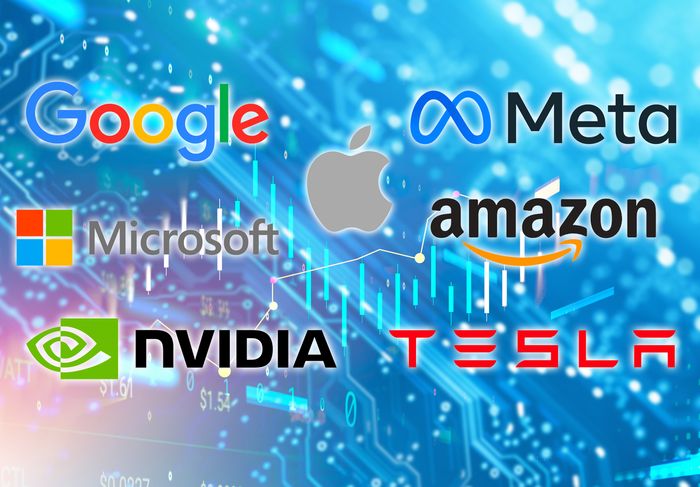
These are the seven largest U.S. listed companies in the technology sector.
Apple, Microsoft, Amazon, Alphabet, Nvidia, Tesla and Meta Platforms.
According to a report released Monday 2nd October 2023, these tech’ stocks have seen their valuation drop relative to the median stock in the S&P 500, making them more attractive for investors. The report says that the Magnificent 7 trade at 1.3 times their PEG ratio (price-to-earnings-to-long-term growth), versus 1.9 for the median S&P 500 stock.
This is the cheapest valuation in over six years – time to buy yet?
The report also highlights some positive drivers for these stocks, such as their strong sales growth, their ability to beat expectations, and their resilience to rising interest rates.
However, some analysts also warn that the dominance of these stocks could pose a risk for the broader market if something bad happens to tech’.
Luddites were a group of workers who protested against the use of machinery that threatened their livelihoods in the early 19th century in Britain. They were not opposed to technology in general, but to the specific machines that were ‘taking away their livelihoods’.
They attacked factories and smashed machines that were replacing their jobs with cheaper and less skilled labour.
BIG tech Luddite comparison – is AI the latest threat?
Some people have compared the Luddites to the modern movements that resist the effects of Big Tech and artificial intelligence (AI) on workers’ lives. They argue that these technologies are creating a new wave of automation that is displacing workers, eroding their rights, and increasing inequality.
They also point out that the Luddites had the support of a majority of English people and eventually led to changes in the law that improved workers’ conditions.
Progress?
However, others have criticized this comparison as inaccurate or misleading. They claim that the Luddites were not successful in stopping technological progress, and that their actions were violent and destructive.
Technology will create new jobs
They also suggest that the Luddite fallacy, which refers to the belief that technological progress causes mass unemployment, has been proven wrong by history. They contend that technology can create new opportunities and benefits for workers, as long as society adapts and regulates it properly.
The question of whether a new modern Luddite rebellion can rise against Big Tech is not a simple one. It depends on how we define Luddites, how we evaluate the impacts of technology, and how we respond to the challenges and opportunities it presents.
Reports suggest as much as $3 trillion is waiting on the sidelines to be invested in tech’.
AI FOMO
The reasoning is that AI is driving a fear of missing out (FOMO). We could very well be experiencing the fourth industrial revolution right now, and it is AI-driven. Strategically, companies can’t just sit around and wait. There’s a window where if they don’t join in or realise the potential and grab the opportunity, they’ll miss out.
IPO’s
Three of the biggest initial public offerings (IPO) in the tech’ sector in nearly two years raised some $6 billion collectively in less than a week. Nvidia has attracted much attention with the AI driven interest it has created recently.
While a handful of tech IPOs and one big acquisition wouldn’t have been much cause for celebration in previous years, they are a welcome return after the drought of pandemic-era hit investment.
The IPO market for tech was effectively shut down until Arm Holdings, Instacart and Klaviyo opened the investors door again. Merger activity such as that driven by Microsoft Corp., OpenAI ChatGPT and Activision Blizzard Inc. is helping to lift up the appetitie for investment again. And it’s pretty much AI induced.
Money ready to go
Some analysts suggest there is $3 trillion sitting on the sidelines ready to invest, mostly held by Big Tech and private equity companies. The fascination with artificial intelligence (AI) and fear of missing out (FOMO) will create massive AI led tech investing opportunities. Everyone will want a slice of this cake.
This could very well be the biggest transformational spending wave that we’ve seen in years and certainly since the internet arrived in 1995.
Just look out for that ‘bubble’ again – it will pop! But much money will be made before that happens and then again after.
The Magnificent Seven is a term to describe seven tech’ stocks that have been surging in 2023.
Meta Platforms (formerly Facebook), the social media giant that also owns Instagram, WhatsApp, and Oculus.
Apple, the maker of the iPhone, iPad, Mac, Apple Watch, AirPods, and other popular devices and services including cloud and Apple TV streaming service.
Amazon, the e-commerce leader that also operates AWS, Prime Video, Alexa, and Whole Foods.
Alphabet, the parent company of Google, YouTube, Gmail, Google Cloud, and Waymo.
Microsoft, the software company that owns Windows, Office, Azure, LinkedIn, Xbox, and Teams.
Nvidia, the semiconductor company that produces graphics cards, gaming devices, data center solutions, and AI platforms.
Tesla, the electric vehicle maker that also develops solar panels, batteries, and autonomous driving technology.
Dominant
These seven stocks are considered to be dominant in their respective fields and have strong growth prospects driven by innovation and artificial intelligence (AI).
They have outperformed the broader market and attracted many investors who are looking for exposure to the tech’ sector. Some analysts believe that these stocks will continue to lead the market in the future, while others caution that they may face regulatory challenges, competition, or valuation issues.
Approximate combined market cap of the Magnificent Seven tech stocks
The approximate combined market cap value of the Magnificent Seven as of September 2023 is approximately $11.8 trillion.
Apple: $2.5 trillion
Microsoft: $2.3 trillion
Alphabet: $1.9 trillion
Amazon: $1.7 trillion
Nvidia: $0.8 trillion
Meta Platforms: $0.9 trillion
Tesla: $0.7 trillion
Note that these values will change over time as the stock prices fluctuate.
A way to trade the tech sector is through funds
There are many funds that can trade tech stocks, depending on your investment objectives, risk tolerance, and preferences.
Technology mutual funds: These are funds that invest in a diversified portfolio of technology companies across different industries, such as software, hardware, internet, cloud, biotech, and more. Technology mutual funds can offer exposure to the growth potential of the tech sector, as well as reduce the volatility and risk of investing in individual stocks.
Some examples of technology mutual funds are Fidelity Select Technology Portfolio (FSELX), Columbia Global Technology Growth Fund (CGTYX), and Schwab U.S. Large-Cap Growth Index Fund (SCHG).
Which tech fund to invest in?
Technology exchange-traded funds (ETFs): These are funds that track an index of technology stocks and trade on an exchange like a stock. Technology ETFs can offer low-cost and convenient access to the tech sector, as well as allow investors to choose from different themes, such as cybersecurity, artificial intelligence (AI), cloud computing and more.
Some examples of technology ETFs are Invesco QQQ Trust (QQQ), Technology Select Sector SPDR Fund (XLK), and VanEck Vectors Semiconductor ETF (SMH).
Technology index funds: These are funds that replicate the performance of a specific technology index, such as the Nasdaq 100, the S&P 500 Information Technology Index, or the Morningstar U.S. Technology Index. Technology index funds can offer broad and passive exposure to the tech sector, as well as low fees and high tax efficiency.
Some examples of technology index funds are Fidelity NASDAQ Composite Index Fund (FNCMX), Vanguard Information Technology Index Fund Admiral Shares (VITAX), and iShares Morningstar U.S. Technology ETF (IYW).
NOTE: These are not recommendations. Investments may go up or down. Your money is at risk!
Arm is a British semiconductor and software design company that is known for its Arm processors, which are widely used in smartphones, tablets, laptops, and other devices. Arm was founded in 1990 as a joint venture between Acorn Computers, Apple Computer, and VLSI Technology. The company was originally called Advanced RISC Machines, but later changed its name to Arm Ltd in 1998.
In 1985, the first Arm silicon chip was created by Acorn engineers Sophie Wilson and Steve Furber, who designed a 32-bit processor with a simple and elegant instruction set.
In 1990, Arm was spun off from Acorn as a separate company, with Apple as a major investor. Arm’s first product was the ARM6 processor, which was used in Apple’s Newton personal digital assistant.
Impression of the Apple Newton PDA device
In 1993, Arm introduced the ARM7 processor, which became one of the most successful embedded processors in history. It was used in devices such as the Nokia 6110 mobile phone, the Nintendo Game Boy Advance, and the Lego Mindstorms robotics kit.
In 1994, Arm launched the ARM9 processor family, which offered higher performance and lower power consumption than previous generations. The ARM9 was used in devices such as the Sony PlayStation Portable, the Palm Treo smartphone, and the Amazon Kindle e-reader.
In 1997, Arm introduced the ARM10 processor family, which featured a superscalar architecture and a floating-point unit. The ARM10 was used in devices such as the Apple iPod, the Samsung Galaxy S smartphone, and the Raspberry Pi computer.
In 1998, Arm changed its name from Advanced RISC Machines to Arm Ltd, reflecting its global expansion and recognition.
In 1999, Arm launched the ARM11 processor family, which featured a vector floating-point unit and a TrustZone security extension. The ARM11 was used in devices such as the iPhone 3G, the Nintendo DS, and the Raspberry Pi Zero.
In 2000, Arm became a public company, listing on the London Stock Exchange and the Nasdaq. The company raised £213 million in its initial public offering.
In 2001, Arm introduced the Cortex processor family, which offered a range of performance, power, and cost options for different applications. The Cortex processors are used in devices such as the Samsung Galaxy S10, the Apple Watch, and the Tesla Model 3.
In 2005, Arm acquired Artisan Components, a provider of physical intellectual property (IP) for chip design. This enabled Arm to offer a complete solution for system-on-chip (SoC) development.
In 2006, Arm announced the Mali graphics processing unit (GPU) family, which complemented its CPU offerings with high-performance graphics capabilities. The Mali GPUs are used in devices such as the Huawei Mate 20 Pro, the Oculus Quest, and the Samsung Smart TV.
Artistic image of ARM chip
In 2009, Arm partnered with IBM, Samsung, Texas Instruments, and others to form the Linaro consortium, which aimed to improve the Linux software ecosystem for Arm-based devices.
In 2010, Arm unveiled the Cortex-A15 processor, which was the first Arm processor to support virtualization and big.LITTLE technology. The Cortex-A15 was used in devices such as the Google Nexus 10, the LG G3, and the Nintendo Switch.
In 2011, Arm announced the Cortex-M0+ processor, which was the world’s most energy-efficient microcontroller. The Cortex-M0+ was used in devices such as the Arduino Nano 33 IoT, the Fitbit Flex 2, and the Nest Thermostat.
In 2012, Arm launched the Cortex-A53 and Cortex-A57 processors, which were the first Arm processors to support the 64-bit ARMv8 architecture. The Cortex-A53 and Cortex-A57 were used in devices such as the iPhone 6s, the Samsung Galaxy S6 Edge+, and the Microsoft Surface Pro X.
In 2013, Arm acquired Geomerics, a developer of real-time lighting technology for video games. This enhanced Arm’s graphics portfolio with dynamic illumination and global illumination effects.
In 2014, Arm introduced the Cortex-A72 processor, which delivered a 50% performance improvement over the previous generation. The Cortex-A72 was used in devices such as the Huawei P9, the Xiaomi Mi 5s Plus, and the Amazon Fire HD 10.
In 2015, Arm announced the Cortex-A35 processor, which was the most efficient Arm processor for smartphones and tablets. The Cortex-A35 was used in devices such as the Nokia 2.1, the Samsung Galaxy J2 Core, and the Lenovo Tab M7.
In 2016, Arm was acquired by SoftBank Group for £24.3 billion, becoming a subsidiary of the Japanese conglomerate. The deal was motivated by SoftBank’s vision of investing in technologies that would drive the future of artificial intelligence (AI), internet of things (IoT), and smart cities.
In 2017, Arm launched Project Trillium, a suite of machine learning (ML) solutions that included an ML processor , an object detection processor , and an open-source software framework. The Project Trillium products aimed to enable low-power and high-performance ML applications on edge devices.
In 2018, Arm unveiled the Cortex-A76 processor , which offered a 35% performance boost over its predecessor. The Cortex-A76 was used in devices such as the OnePlus 7T, the Huawei MateBook D14, and the Acer Chromebook Spin 13.
In 2019, Arm announced the Cortex-A77 processor , which improved on its predecessor with a higher clock speed, a larger cache, and better branch prediction . The Cortex-A77 was used in devices such as the Samsung Galaxy S20, the Asus ROG Phone II, and the Lenovo Yoga C940.
In 2020, Arm introduced the Cortex-X1 processor , which was its most powerful CPU design to date. The Cortex-X1 was designed to deliver peak performance for premium device , such as flagship smartphones, laptops and gaming consoles. The Cortex-X1 was used in devices such as the Samsung Galaxy S21 Ultra, the Xiaomi Mi 11, and the Google Pixel 6.
In 2021, Arm launched the Cortex-A78C processor , which was optimized for high-performance computing (HPC) applications. The Cortex-A78C featured up to eight CPU cores , a larger L3 cache, and support for ECC memory. The Cortex-A78C was used in devices such as the Samsung Galaxy Book Pro, the HP Elite Folio , and the Acer Chromebook Spin 513.
Microchip
In 2022, Arm unveiled the Cortex-A710 processor, which was its first big core to support the Armv9 architecture. The Cortex-A710 offered a 30% energy efficiency improvement over its predecessor, as well as enhanced security and ML features. The Cortex-A710 was used in devices such as the OnePlus 10 Pro, the Huawei MatePad Pro 2, and the Microsoft Surface Laptop Studio.
In 2023, Arm announced the Immortalis GPU family , which was its next-generation graphics solution that included hardware-based ray-tracing and variable rate shading capabilities . The Immortalis GPUs aimed to deliver realistic and immersive graphics for gaming, VR and AR applications on mobile devices . The Immortalis GPUs were used in devices such as the Samsung Galaxy S22 Ultra , the Sony Xperia 1 IV, and the Oculus Quest 3.
Powerful world presence
Arm is a leading semiconductor and software design company that has revolutionized the computing industry with its innovative and efficient processor architectures. Arm’s processors power billions of devices across various domains, such as mobile, IoT, AI, HPC, and gaming. Arm has been at the forefront of technological advancements for over three decades, delivering performance, energy efficiency, and security to its customers and partners.
Arm is a subsidiary of SoftBank Group and has a massive global presence.
The U.S. will ban American investment in some areas of China’s high-tech sector, including artificial intelligence, adding to strained relations between the two superpowers.
U.S. firms will also be invited to disclose what investments they make in China in high-tech sectors.The much-anticipated move gives the U.S. government new power to screen foreign dealings by private companies. The U.S. said the measure would be narrowly targeted. However, it is poised to further chill economic relations between the world’s two largest economies. China has reportedly said it was ‘very disappointed‘. The U.S. ‘has continuously escalated suppression and restrictions on China‘. He added that White House claims that the US was not seeking to hurt China’s economy or separate the two countries did not match its actions. ‘We urge the US side to honour its words‘.
Biden order
The order by U.S. President Biden formally kicks off the push to introduce rules to restrict, even prevent American businesses from investing in firms from ‘countries of concern‘ that are active in advanced semiconductors, quantum computing and certain areas of artificial intelligence.
The government will also require U.S. firms to notify the Treasury Department of investments in firms working on a wider range of artificial intelligence and semiconductor technology.
U.S. restriction on AI related tech knowledge to China
The rules are not expected to apply to ‘portfolio’ investments, in which firms invest passively in companies via the stock market, but are focused on active investments made by private equity and venture capital businesses. They will now enter a public ‘reflection’ period, which is expected to further clarify what kinds of investments are off-limits. The rules are not expected to go into effect for sometime yet. This new ‘order’ is quite a big deal.
In a briefing with reporters, senior administration officials said the measure was a ‘national security action, not an economic one‘. They said the U.S. remained committed to open investment.
Investment control
Controls on outbound investment are rare among advanced economies, currently present only in Japan and Korea, according to a 2022 report.
In the U.S., prior restrictions on China trade have relied on limiting sales of sensitive technology by U.S. firms and screening Chinese investments in American companies. The Trump administration had also barred investments in firms tied to China’s military.
The latest measure has widespread support in Washington, where it is seen as fixing a regulatory gap concerning financial flows that risks allowing American money and know-how to to flow into China.
International support
The U.S. has been trying to build international support for the investment curbs with some signs of success.
Prime Minister Rishi Sunak in May 2023 said the UK government would consider curbs on outbound investment; the European Commission put forward a proposal focused on investments in sensitive technologies earlier this summer. It is not clear how significantly the order would affect flows of investment.
China was the number two destination for foreign investment in 2022, behind the U.S., but many reports suggest money flowing into the country from the U.S. and elsewhere has dropped sharply as geopolitical relations sour. In the UK, a recent survey by the Institute of Directors found that one in five UK importers had already switched investments away from the country due to geopolitical tensions.
Gallium and Germanium considered critical elements required in the production of microchips
Treasury Secretary Janet Yellen, who visited China in July 2023 in an attempt to ease tensions, said last month she did not think the coming curbs would have a fundamental impact on the investment climate in the country.
Will these measures likely damage the U.S. in the future by escalating issues and restricting the U.S. from other shared advancements in technology – only time will tell.
Tech’ rivalry
U.S. and China are two of the world’s leading powers in artificial intelligence (AI) and semiconductors, which are essential components for many AI applications such as self-driving cars, smart phones, and cloud computing. However, the two countries have also been engaged in a fierce competition and rivalry over these technologies, as they seek to gain an edge in innovation, security, and economic growth. Some of the issues that have caused tensions between U.S. and China include trade disputes, intellectual property theft, cyberattacks, human rights violations, and military expansion.
AI chips
AI semiconductors are designed to perform complex calculations and tasks that require high levels of intelligence, such as natural language processing, computer vision, and machine learning.
These chips can be classified into two types: general-purpose chips that can run various AI algorithms, and specialized chips that are optimized for specific AI functions or domains.
AI stands for Artificial Intelligence, which is the ability of machines to perform tasks that normally require human intelligence. AI can involve various aspects of cognition, such as perceiving, reasoning, learning, problem-solving, and even creativity.
Types of AI
AI can be classified into different types based on the level of intelligence and the scope of tasks that machines can perform. One common way to categorise AI is by using the following four types:
Narrow AI: This is the most common and basic type of AI, which refers to machines that can perform specific tasks very well, but cannot generalize to other domains or situations. Examples of narrow AI include speech recognition, face recognition, web search engines, recommendation systems, self-driving cars, and chess-playing programs.
General AI: This is the type of AI that aims to achieve human-like intelligence across a wide range of domains and tasks. General AI would be able to understand and learn from any kind of data, reason and solve problems, communicate and interact with humans, and exhibit common sense and creativity. However, general AI does not exist yet, and it is considered a long-term goal of AI research.
Super AI: This is the type of AI that would surpass human intelligence in all aspects, including speed, memory, knowledge, creativity, and wisdom. Super AI would be able to outperform humans in any task and domain, and potentially pose existential risks to humanity. Super AI is also a hypothetical concept that has not been achieved or proven yet.
Artificial neural networks: This is a type of AI that mimics the structure and function of biological neural networks, which are the basis of human brain activity. Artificial neural networks consist of layers of interconnected nodes that process information and learn from data. Artificial neural networks are widely used for various applications of AI, such as computer vision, natural language processing, machine learning, and deep learning.
Applications of AI
AI has many applications in various fields and industries, such as:
Healthcare: AI can help diagnose diseases, analyze medical images, design drugs, assist surgeries, monitor patients, and provide personalized care.
Education: AI can help personalize learning, assess students’ progress, provide feedback, tutor students, grade assignments, and create educational content.
Business: AI can help optimize operations, enhance customer service, automate tasks, analyze data, generate insights, improve decision making, and increase productivity.
Entertainment: AI can help create music, art, games, movies, and other forms of entertainment.
AI can also help recommend content to users based on their preferences and behaviour.
Security: AI can help detect threats, prevent cyberattacks, enhance surveillance, identify frauds, enforce laws, and protect privacy.
Social: AI can help communicate with humans through natural language processing and speech synthesis. AI can also help understand human emotions and behavior through sentiment analysis and facial expression recognition.
Challenges and limitations of AI
AI also faces many challenges and limitations that need to be addressed by researchers and users. Some of these include:
Ethical: AI raises many ethical issues such as bias, fairness, accountability, transparency, privacy, human dignity, and social impact. How can we ensure that AI is aligned with human values and does not harm humans or society?
Technical: AI still faces many technical challenges such as scalability, robustness, explainability, interpretability, generalization, and adversarial attacks. How can we improve the performance, reliability, and security of AI systems?
Societal: AI also has many societal implications such as employment, education, regulation, governance, and collaboration. How can we adapt to the changes and opportunities that AI brings to our lives, work, and society?
AI is here to stay – it’s all about how we use it for the betterment of ‘humankind’. Please, let’s use it safely, responsibly and for the good!
Big tech companies heavily involved in the development of AI products