Nvidia has recently announced its latest high-end chip, the GH200 Grace Hopper Superchip, which is designed for training AI models at giant scale.
The GH200 is a breakthrough accelerated CPU that combines the NVIDIA Grace™ and Hopper™ architectures using NVIDIA® NVLink®-C2C to deliver a CPU+GPU coherent memory model for AI and HPC applications. The superchip delivers up to 10X higher performance for applications running terabytes of data, enabling scientists and researchers to reach unprecedented solutions for the world’s most complex problems.
The technical bit
The GH200 features 72 cores of Grace CPU outfitted with 480 GB of ECC LPDDR5X memory, as well as the GH100 compute GPU that is paired with 141 GB of HBM3E memory that comes in six 24 GB stacks and uses a 6,144-bit memory interface.
The GH200 also has a new 900 gigabytes per second (GB/s) coherent interface, which is 7X faster than PCIe Gen5, and supercharges accelerated computing and generative AI with HBM3 and HBM3e GPU memory. The GH200 can run all NVIDIA software stacks and platforms, including NVIDIA AI Enterprise, HPC SDK, and Omniverse™.
Nvidia unveils its newest GH200 high-end AI Superchip.
The GH200 is available as part of the NVIDIA DGX GH200, a massive memory supercomputer that fully connects 256 GH200 Superchips into a singular GPU. The DGX GH200 offers 144 terabytes (TB) of shared memory with linear scalability for giant AI models.
The DGX GH200 is a turnkey data centre-class solution that includes integrated software and white-glove services from NVIDIA, from design to deployment, to speed the ROI of AI.
The DGX GH200 is the only AI supercomputer that offers a massive, shared memory space of 144TB across 256 NVIDIA Grace Hopper Superchips, providing developers with nearly 500X more memory to build giant models.
Apple and generative AI technology is a topic that has been generating a lot of interest and speculation lately.
According to various reports, Apple is working on developing its own large language model and chatbot, which could potentially enhance its products and services with new features and capabilities. However, some analysts and experts have also raised questions about whether Apple has missed an opportunity to be a leader in the generative AI field, as it seems to be lagging behind its competitors such as Google, Microsoft, and OpenAI.
Apple uses AI in its products but hasn’t launched a generative AI product along the lines of OpenAI’s ChatGPT or Google Bard. Instead, Apple’s AI is used for improving photos and autocorrecting text.
$1 billion per year plan
Apple is on track to spend $1 billion per year on developing its generative artificial intelligence products, Bloomberg reported.
Apple is looking to use AI to improve Siri, Messages and Apple Music.
The spending comes as the company plays catch-up to some competitors who have already debuted new AI products and features, such as Google, Microsoft and Amazon.
Apple was caught flat-footed when ChatGPT and other AI tools took the technology industry by storm.
Generative AI
Generative AI is a subfield of artificial intelligence that focuses on creating content such as text, images, videos, music, and more, based on data and algorithms. One of the most popular examples of generative AI is ChatGPT, a chatbot that can respond to questions and other prompts in a natural and human-like way.
Watercolour artwork impression – ChatGPT was released by OpenAI in 2022, and since then, it has been widely used and improved by various companies and researchers.
ChatGPT was released by OpenAI in 2022, and since then, it has been widely used and improved by various companies and researchers.
Apple slow response
Apple, on the other hand, has been relatively quiet about its generative AI efforts, until recently. In October 2023, Bloomberg reported that Apple was internally testing a ‘ChatGPT-like’ chatbot nicknamed ‘Apple GPT’, but it had not devised a clear strategy for releasing generative AI tools to the public. Apple’s CEO Tim Cook also confirmed that the company was working on generative AI for years, but it was approaching it ‘really thoughtfully and think about it deeply’ because of the potential risks and challenges.
Potential challenges Apple faces in developing and deploying generative AI
Privacy
Apple has always been more cautious than its competitors in handling user data, and it has built its reputation on being a privacy-focused company. However, generative AI requires a lot of data to train and improve its models, which could pose a dilemma for Apple. How can it balance the need for data with the respect for user privacy? How can it ensure that its generative AI does not leak or misuse personal information?
Design
Apple is known for its elegant and intuitive design philosophy, which applies to both its hardware and software products. However, generative AI is a complex and unpredictable technology, which could challenge Apple’s design principles. How can it make its generative AI features easy to use and understand for its customers? How can it avoid confusing or misleading users with its generative AI outputs?
Ethics
Apple has always been mindful of the social and ethical implications of its products, and it has often taken a stance on issues such as human rights, environmental sustainability, and diversity. However, generative AI could raise new ethical concerns, such as bias, misinformation and manipulation. But then that is a common problem for all generative AI systems.
Generative AI could raise new ethical concerns, such as bias, misinformation and manipulation.
These are some of the questions that Apple needs to answer before it can launch its generative AI products to the public. It is possible that Apple is taking its time to address these issues carefully and thoroughly, as it has done in the past with other technologies such as Face ID or Apple Pay. However, it is also possible that Apple has missed an opportunity to be a pioneer in the generative AI field, as it has done in the past with other technologies such as smart speakers or cloud computing.
While Apple is working on its generative AI projects internally, its competitors are already offering generative AI.
Google
Google has integrated its large language model LaMDA into various products and services, such as Google Assistant, Google Photos, Google Docs, Google Translate etc. LaMDA can generate natural and conversational responses to any query or prompt, as well as create images and videos based on text descriptions.
Microsoft
Microsoft has acquired OpenAI’s ChatGPT technology and made it available through its Azure cloud platform. ChatGPT can be used by developers and businesses to create chatbots, voice assistants, content generators, and more. Microsoft has also integrated ChatGPT into some of its products such as Outlook, Teams, PowerPoint, and more.
Amazon
Amazon has launched Alexa Conversations, a feature that allows Alexa users to have more natural and engaging conversations with the voice assistant. Alexa Conversations can also leverage Amazon’s vast e-commerce data to provide personalized recommendations and suggestions to users.
These are just some examples of how generative AI is being used by Apple’s competitors.
Robot chatting to human chatbot online
Apple has missed an opportunity to be a leader in the generative AI field by being too slow or too cautious in developing and deploying its own generative AI products.
However, it is highly likely that Apple is waiting for the right moment to surprise everyone with its innovative and unique generative AI features that will set it apart from its competitors.
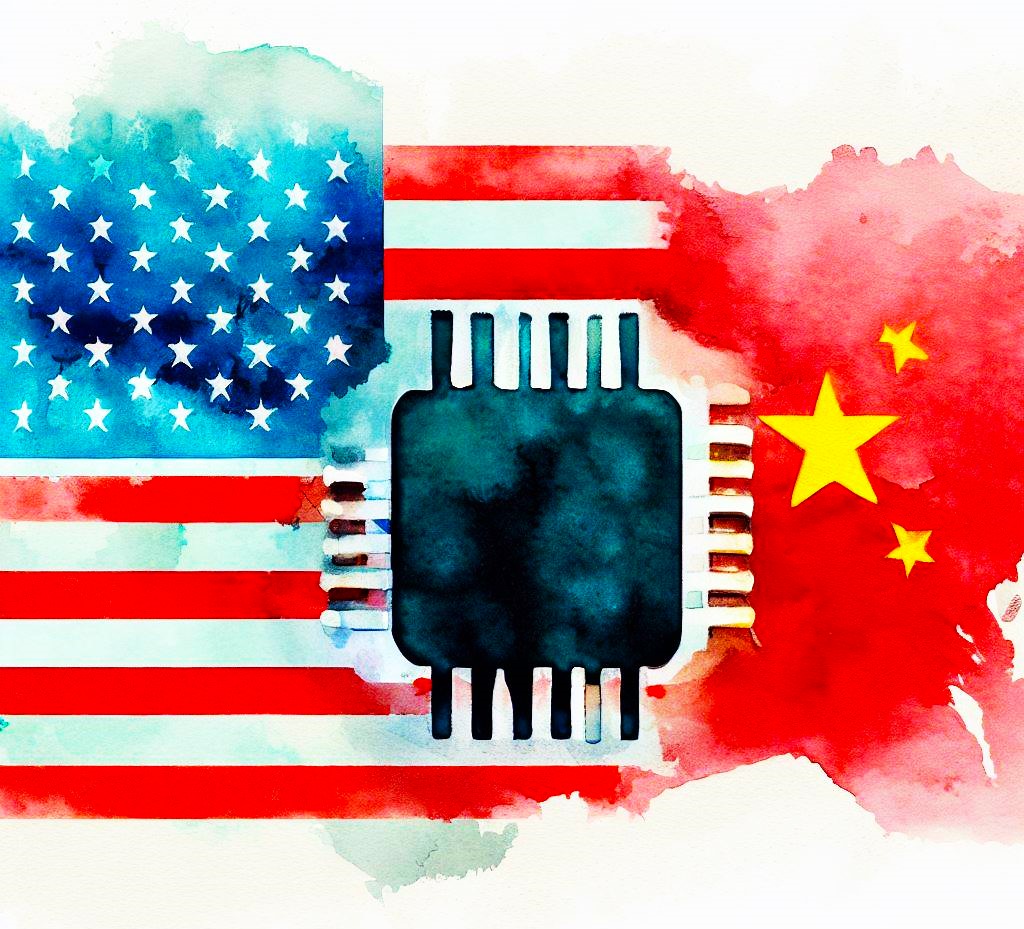
The curbs are aimed at closing loopholes that became apparent after the U.S. announced export curbs on microchips in October 2022. The restrictions are designed to prevent China’s military from importing advanced semiconductors or equipment.
Nvidia has said in a filing that the new export restrictions will block sales of two high-end artificial intelligence chips it created for the Chinese market – A800 and H800. It said that one of its gaming chips will also be blocked.
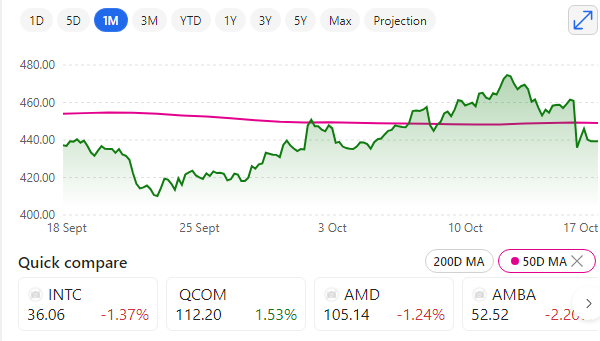
Nvidia Corp one month chart – closed at 439.38 17th October 2023
Although the curbs also affect other chip makers, analysts believe Nvidia will be hit the hardest because China accounts for up to 25% of its revenues from data centre chip sales. Nvidia’s shares, which are considered a star stock, fell by as much as 4.7% in the wake of the announcement.
Semiconductor Industry Association
The Semiconductor Industry Association, which represents 99% of the U.S. semiconductor industry by revenue, said in a statement that the new measures are ‘overly broad‘ and ‘risk harmingthe U.S. semiconductor structure without advancing national security as they encourage overseas customers to source elsewhere’.
China reacts
A spokesperson for the Chinese embassy also said that it ‘firmly opposes‘ the new restrictions, which also target Iran and Russia and go into effect in 30 days.
Nvidia stock falls after restrictions on AI chip exports from U.S. to China
Two months ago, China retaliated by restricting exports of two materials, gallium and germanium, which are key to the semiconductor industry.
The materials are ‘minor metals‘, meaning that they are not usually found on their own in nature, and are often the by-product of other processes. It’s not only the U.S., Japan and the Netherlands – which is home to key chip equipment maker ASML – have also imposed chip technology export restrictions on China.
Fallout
The constant ‘fall-out’ between the world’s two biggest economies has raised concerns over the rise of so-called ‘resource nationalism‘ – a practice where governments hoard critical materials to exert influence over other countries.
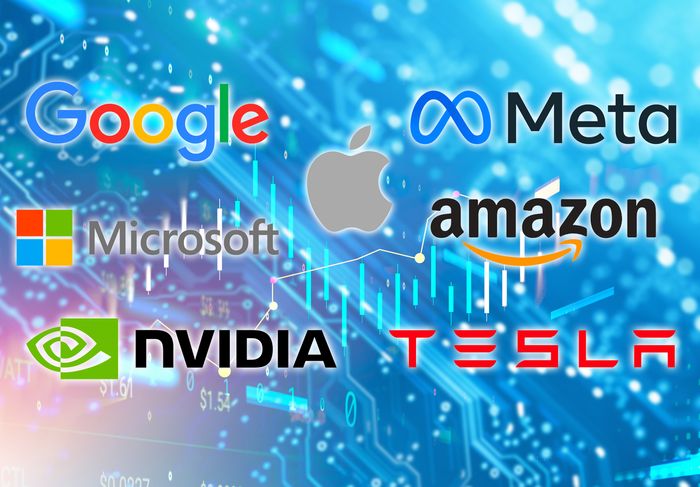
These are the seven largest U.S. listed companies in the technology sector.
Apple, Microsoft, Amazon, Alphabet, Nvidia, Tesla and Meta Platforms.
According to a report released Monday 2nd October 2023, these tech’ stocks have seen their valuation drop relative to the median stock in the S&P 500, making them more attractive for investors. The report says that the Magnificent 7 trade at 1.3 times their PEG ratio (price-to-earnings-to-long-term growth), versus 1.9 for the median S&P 500 stock.
This is the cheapest valuation in over six years – time to buy yet?
The report also highlights some positive drivers for these stocks, such as their strong sales growth, their ability to beat expectations, and their resilience to rising interest rates.
However, some analysts also warn that the dominance of these stocks could pose a risk for the broader market if something bad happens to tech’.
Reports suggest as much as $3 trillion is waiting on the sidelines to be invested in tech’.
AI FOMO
The reasoning is that AI is driving a fear of missing out (FOMO). We could very well be experiencing the fourth industrial revolution right now, and it is AI-driven. Strategically, companies can’t just sit around and wait. There’s a window where if they don’t join in or realise the potential and grab the opportunity, they’ll miss out.
IPO’s
Three of the biggest initial public offerings (IPO) in the tech’ sector in nearly two years raised some $6 billion collectively in less than a week. Nvidia has attracted much attention with the AI driven interest it has created recently.
While a handful of tech IPOs and one big acquisition wouldn’t have been much cause for celebration in previous years, they are a welcome return after the drought of pandemic-era hit investment.
The IPO market for tech was effectively shut down until Arm Holdings, Instacart and Klaviyo opened the investors door again. Merger activity such as that driven by Microsoft Corp., OpenAI ChatGPT and Activision Blizzard Inc. is helping to lift up the appetitie for investment again. And it’s pretty much AI induced.
Money ready to go
Some analysts suggest there is $3 trillion sitting on the sidelines ready to invest, mostly held by Big Tech and private equity companies. The fascination with artificial intelligence (AI) and fear of missing out (FOMO) will create massive AI led tech investing opportunities. Everyone will want a slice of this cake.
This could very well be the biggest transformational spending wave that we’ve seen in years and certainly since the internet arrived in 1995.
Just look out for that ‘bubble’ again – it will pop! But much money will be made before that happens and then again after.
The Magnificent Seven is a term to describe seven tech’ stocks that have been surging in 2023.
Meta Platforms (formerly Facebook), the social media giant that also owns Instagram, WhatsApp, and Oculus.
Apple, the maker of the iPhone, iPad, Mac, Apple Watch, AirPods, and other popular devices and services including cloud and Apple TV streaming service.
Amazon, the e-commerce leader that also operates AWS, Prime Video, Alexa, and Whole Foods.
Alphabet, the parent company of Google, YouTube, Gmail, Google Cloud, and Waymo.
Microsoft, the software company that owns Windows, Office, Azure, LinkedIn, Xbox, and Teams.
Nvidia, the semiconductor company that produces graphics cards, gaming devices, data center solutions, and AI platforms.
Tesla, the electric vehicle maker that also develops solar panels, batteries, and autonomous driving technology.
Dominant
These seven stocks are considered to be dominant in their respective fields and have strong growth prospects driven by innovation and artificial intelligence (AI).
They have outperformed the broader market and attracted many investors who are looking for exposure to the tech’ sector. Some analysts believe that these stocks will continue to lead the market in the future, while others caution that they may face regulatory challenges, competition, or valuation issues.
Approximate combined market cap of the Magnificent Seven tech stocks
The approximate combined market cap value of the Magnificent Seven as of September 2023 is approximately $11.8 trillion.
Apple: $2.5 trillion
Microsoft: $2.3 trillion
Alphabet: $1.9 trillion
Amazon: $1.7 trillion
Nvidia: $0.8 trillion
Meta Platforms: $0.9 trillion
Tesla: $0.7 trillion
Note that these values will change over time as the stock prices fluctuate.
A way to trade the tech sector is through funds
There are many funds that can trade tech stocks, depending on your investment objectives, risk tolerance, and preferences.
Technology mutual funds: These are funds that invest in a diversified portfolio of technology companies across different industries, such as software, hardware, internet, cloud, biotech, and more. Technology mutual funds can offer exposure to the growth potential of the tech sector, as well as reduce the volatility and risk of investing in individual stocks.
Some examples of technology mutual funds are Fidelity Select Technology Portfolio (FSELX), Columbia Global Technology Growth Fund (CGTYX), and Schwab U.S. Large-Cap Growth Index Fund (SCHG).
Which tech fund to invest in?
Technology exchange-traded funds (ETFs): These are funds that track an index of technology stocks and trade on an exchange like a stock. Technology ETFs can offer low-cost and convenient access to the tech sector, as well as allow investors to choose from different themes, such as cybersecurity, artificial intelligence (AI), cloud computing and more.
Some examples of technology ETFs are Invesco QQQ Trust (QQQ), Technology Select Sector SPDR Fund (XLK), and VanEck Vectors Semiconductor ETF (SMH).
Technology index funds: These are funds that replicate the performance of a specific technology index, such as the Nasdaq 100, the S&P 500 Information Technology Index, or the Morningstar U.S. Technology Index. Technology index funds can offer broad and passive exposure to the tech sector, as well as low fees and high tax efficiency.
Some examples of technology index funds are Fidelity NASDAQ Composite Index Fund (FNCMX), Vanguard Information Technology Index Fund Admiral Shares (VITAX), and iShares Morningstar U.S. Technology ETF (IYW).
NOTE: These are not recommendations. Investments may go up or down. Your money is at risk!
Chip design firm Arm on 5th September 2023 submitted an updated filing for its upcoming initial public offering on the New York Stock Exchange, setting a price range between $47 and $51. Only 9.4% of Arm’s shares will be freely traded on the NYSE.
Arm was previously listed in London and New York, before SoftBank acquired it for $32 billion in 2016.
Chip design firm Arm on Tuesday is looking to acquire as much as $4.87 billion in its upcoming initial public offering on the New York Stock Exchange, according to the new filing.
The deal could value the company at as much as $52 billion
As a British company, Arm qualifies as a foreign private issuer in the U.S. and its shares will count as American depositary shares, or ADS’s. It is reported that the company will list some 95.5 million ADS’s at a price range of between $47 and $51. At the upper end of that range it is estimated that Arm will likely raise up to $4.87 billion. At the lower end, the IPO would fetch $4.49 billion of fresh capital for Arm. It could do even better.
Institutional funds
When the company floats in New York, it will look to enjoy a very deep pool of professional institutional funds. Arm seeks to ramp up its investments in research and development, particularly as it pursues growth in the artificial intelligence (AI) space with some of its newer chips. The company recently released new chips specifically targeted at AI and machine learning use cases.
Arm seeks up to $52 billion valuation in U.S. IPO
Upper end
At the upper end of the pricing range, Arm would also touch a total valuation of $52 billion or more. Only 9.4% of Arm’s shares will be freely traded on the New York Stock Exchange, with SoftBank expected to own roughly 90.6% of the company’s outstanding shares after the completion of the IPO.
Arm’s listing is set to be the biggest technology IPO of the year. Investors are hoping that the listing could breathe new life into an IPO market that has been ‘slack’ since 2022.
250 billion chips globally
Arm says its energy-efficient processor designs and software platforms are integrated into more than 250 billion chips globally, into products ranging from sensors and smartphones to supercomputers.
The company estimates it enjoys approximately 48.9% share of the market for semiconductor design. Other players, such as Intel and AMD, have raced to catch up on designing their own chip architectures, but have struggled so far.
U.K. misses out… again
The U.K. government had originally hoped Arm would list on the London Stock Exchange, but the company instead dealt a major blow to Britain’s ambitions to become the leading global tech hub by opting for New York. The U.S. financial center has a deep institutional investor base and analysts who have a close understanding of the technology sector.
BIG interest
Chip design firm Arm said in a Tuesday filing that Apple, Google parent Alphabet, Nvidia and other technology companies are interested in buying up to $735 million in its shares as it seeks to go public on Nasdaq.
The investments might not happen, but the fact that these companies are considering them underlines the importance of Arm, whose designs are used for processors in data center servers, consumer devices and industrial products.
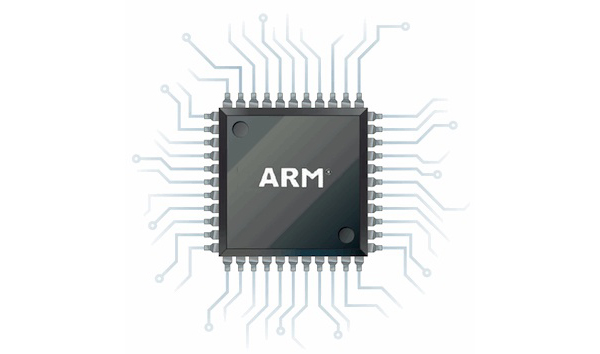
Arm chip – some 250 billion chips globally
Chip makers Intel, Samsung and TSMC are interested in investing alongside the three trillion-dollar technology companies, along with AMD and MediaTek, which make chip designs based on Arm architectures. Cadence Design Systems and Synopsys, which make electronic design automation software for processor development, have also expressed interest, according to a revised prospectus for Arm’s shares sale. This IPO could easily be the biggest of the 2023!
As part of the deal, Arm could wind up with a $52 billion market capitalization and almost $5 billion in new cash.
This is likely to be the biggest IPO of 2023
It is estimated that there will be about 19 billion devices using the Arm processor in the world by the end of 2023.
Arm target
The market share of Arm across different technology markets worldwide, which was 90% for mobile application processors, 34% for embedded computing, and 5% for data center and cloud in 2019.
Arm has a target of increasing its market share to more than 90%, 50%, and 25% respectively by 2028.
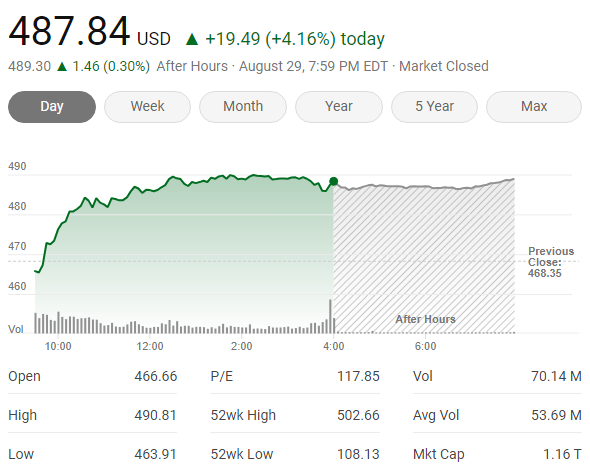
Nvidia shares rose 4.2% Tuesday 29th August 2023 to close at a record high, after the company announced a partnership with Google that could expand distribution of its artificial intelligence technology (AI).
The stock’s bountiful run continued, now up 234% in 2023, making it by far the best performer in the S&P 500. Facebook parent Meta is second in the index, up 148% so far this year.
The record close comes less than a week after the company said quarterly revenue doubled from a year earlier and gave a forecast indicating that sales this period could rise 170% on an annual basis. The day after the better-than-expected earnings report, the stock climbed to a record intraday high of $502.66 before declining later in the afternoon.
Nvidia’s business is booming because its graphics processing (GPU’s) are being gobbled up by cloud companies, government agencies and startups to train and deploy generative AI models like the technology deployed in OpenAI’s ChatGPT as fasta as Nvidia can make them.
NVIDIA stock chart
Nvidia announcment
On Tuesday 29th August 2023, Nvidia CEO Jensen Huang appeared at a Google conference to announce an AI agreement between the two companies.
Through the partnership, Google’s cloud customers will have greater access to technology powered by Nvidia’s powerful H100 GPUs.
‘Our expanded collaboration with Google Cloud will help developers accelerate their work with infrastructure, software and services that supercharge energy efficiency and reduce costs’, the Nvidia CEO reportedly said in a blog post.
Nvidia’s GPUs are also available on competing cloud platforms from Amazon and Microsoft.
Technology giant Nvidia reports its sales have hit a record after more than doubling as demand for its artificial intelligence (AI) chips take off!
It figures
The company says revenue jumped to above $13.5bn (£10.6bn) for the three months to the end of June. Nvidia also expects sales to perform very well in the current quarter and plans to buy back $25bn of its stock. The firm’s shares rose by more than 6.5% in extended trading in New York, adding to their huge gains this year. Nvidia also said it expects revenue of around $16bn for the three months to the end of September 2023.
That is substantially higher than Wall Street expected and would equate to a rise of around 170%, compared to the same time last year.
Even before 23rd August’s figures, Nvidia’s stock price had more than tripled for the year, making it the top performer in the S&P 500. It’s share price jumped to around $500 after hours, a level that would mark a record if it closes there on 24th August 2023. Its prior closing high was $474.94 on 18th July 2023.
‘A new computing era has begun’, Nvidia’s chief executive, Jensen Huang, said in a statement. ‘Companies worldwide are transitioning from general-purpose to accelerated computing and generative AI’, he reportedly added.
Strong performance
The strong performance was driven by Nvidia’s data centre business, which includes AI chips.
The power of Nvidia’s AI microchips
Revenue for that unit came in at more $10.3bn, a rise of more than 170% from year ago, as cloud computing service providers and large consumer internet companies snapped up its next-generation processors.
This year, Nvidia’s stock market value has jumped to more than $1 trillion as its shares more than tripled in value, mking it the fifth publicly traded U.S. company to join the so-called ‘Trillion dollar club’, along with Apple, Amazon, Alphabet and Microsoft.
AI ‘mania’ helps Nvidia
Nvidia have been making micro chips for a long time and it’s only really been in the last couple of years that the market has caught on.
Nvidia was originally known for making the type of computer chips that process graphics, particularly for computer games. They have been making chips for a long time and have now become the leader in AI chip design and manufacture.
Now Nvidia’s hardware is the foundation for most AI applications, with one report suggesting it had cornered 95% of the market for machine learning.
ChatGPT which generates human-like responses to user queries within seconds was trained using 10,000 of Nvidia’s graphics processing units clustered together in a supercomputer belonging to Microsoft.
AI products are expected to dramatically change how we use computers and the role they play in our lives.