Alibaba Steps Into ‘Physical AI’ With New Robotics Model

AI robotics model

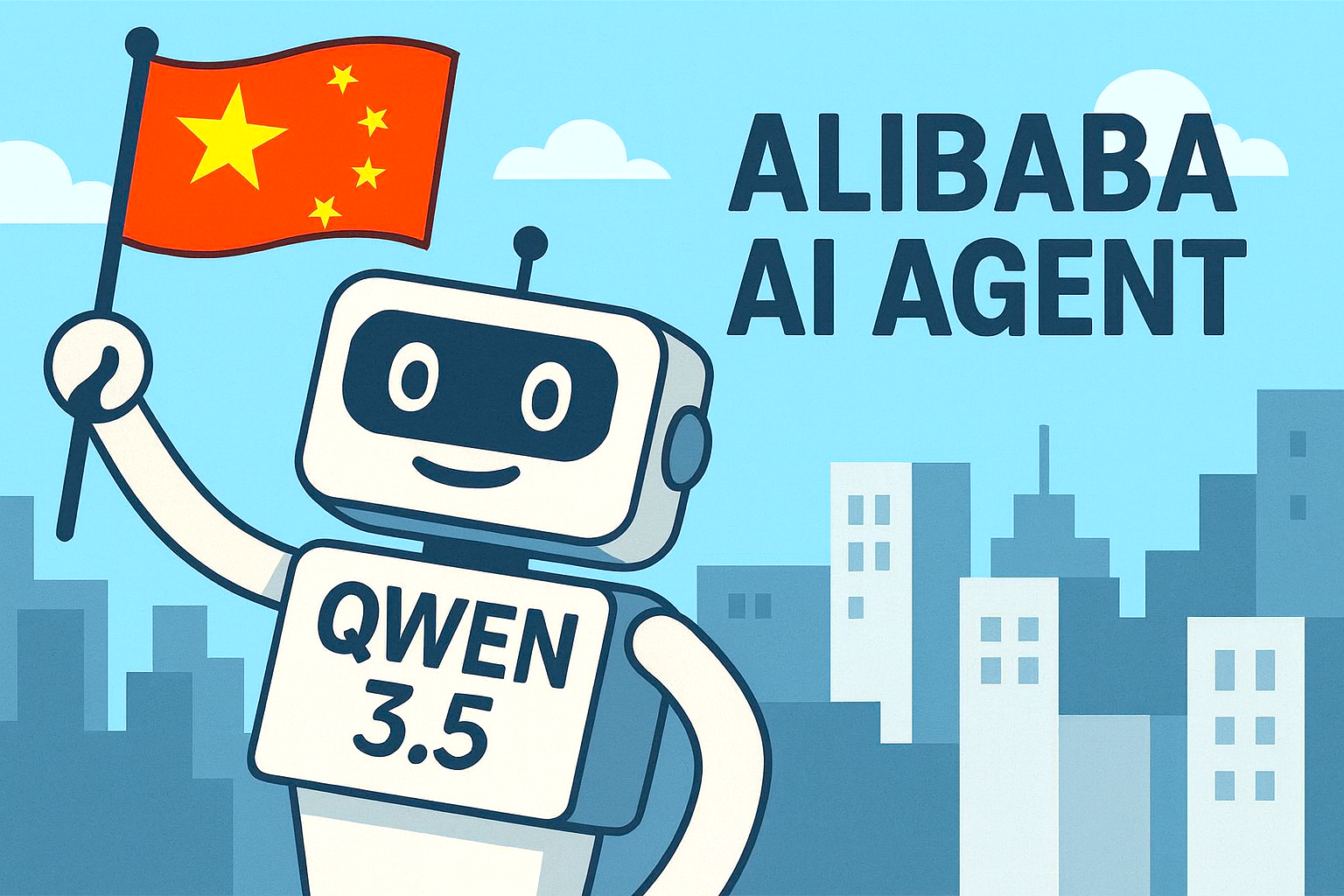
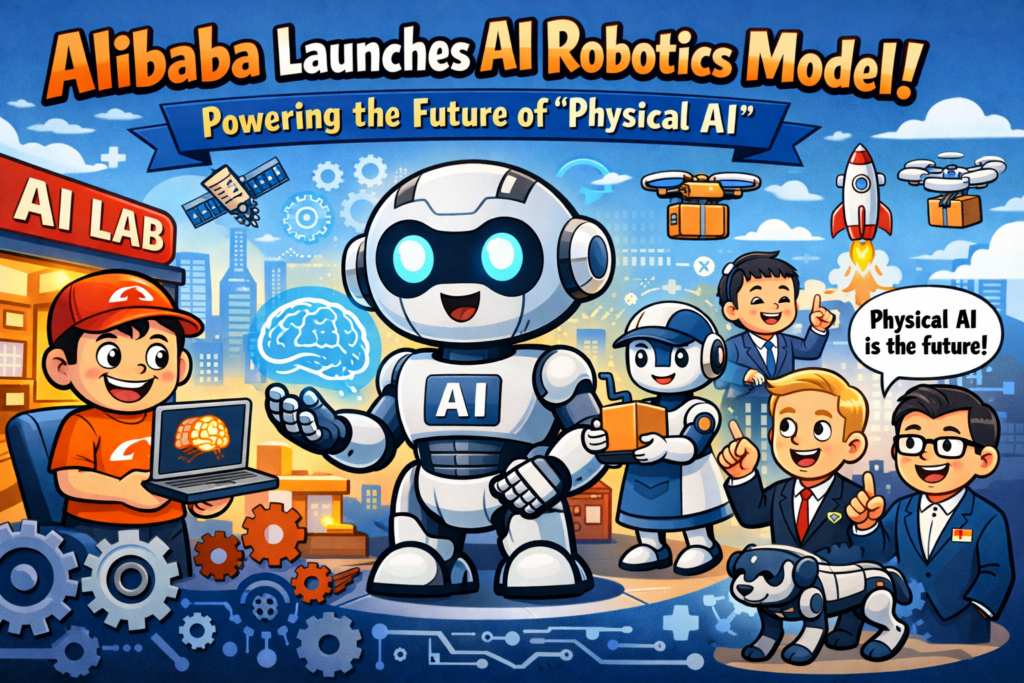
China’s Alibaba has taken a decisive step into the fast‑emerging field of ‘physical AI’ with the launch of a new foundation model designed specifically to power real‑world robots.

The model, known as RynnBrain*, marks one of the company’s most ambitious moves since restructuring its cloud and research divisions, and signals China’s intention to compete directly with the United States in embodied artificial intelligence.

Unlike traditional large language models, which operate entirely in digital environments, RynnBrain is built to interpret and act within the physical world.

It combines vision, language and spatial reasoning, enabling robots to recognise objects, understand their surroundings and plan multi‑step actions.

DAMO Acadamy

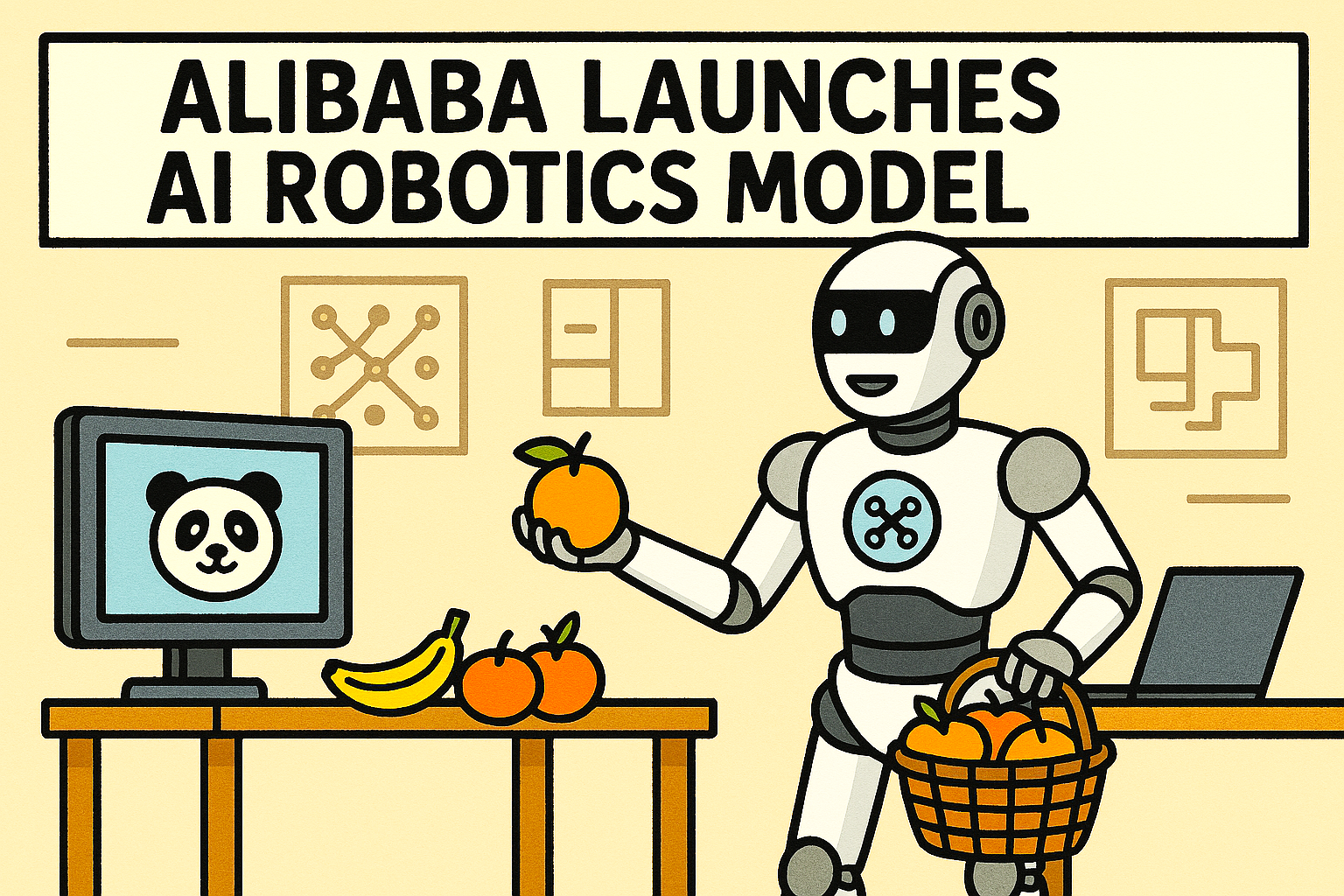
In demonstrations released by Alibaba’s DAMO Academy, the model guided a robot through tasks such as identifying fruit and sorting it into containers — a deceptively simple exercise that requires sophisticated perception and motor control.

The company describes RynnBrain as a ‘general‑purpose embodied intelligence model’, capable of supporting a wide range of robotic applications, from warehouse automation to domestic assistance.

Crucially, Alibaba has opted to open‑source the model, a strategic decision that invites global developers to build on its capabilities and accelerates the creation of a broader ecosystem around Chinese robotics research.

Physical AI

The timing is significant. Over the past year, major technology firms including Google, Nvidia and OpenAI have begun to emphasise physical AI as the next frontier of artificial intelligence.

The shift reflects a growing belief that the most transformative applications of AI will not be confined to screens, but will instead involve machines that can navigate, manipulate and collaborate within human environments.

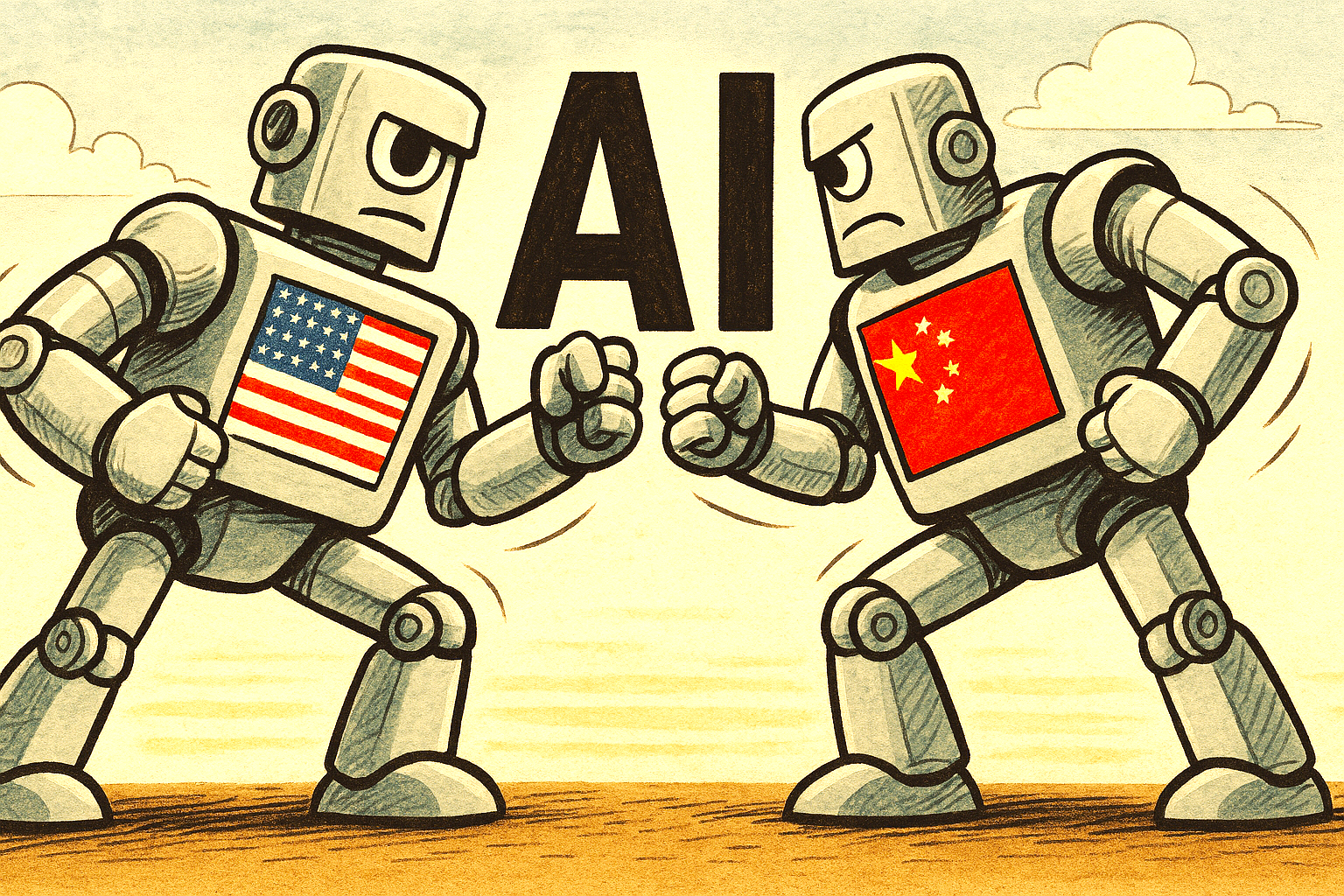
Alibaba’s entry adds competitive pressure to a field already heating up. While U.S. companies currently dominate embodied AI research, China has made robotics a national priority, viewing it as a strategic industry with implications for manufacturing, logistics and economic resilience.

RynnBrain

By releasing RynnBrain openly, Alibaba positions itself as both a contributor to global research and a catalyst for domestic innovation.

The launch also highlights a broader trend: the convergence of AI models with physical systems. As robots become more capable and more affordable, the line between software intelligence and mechanical action is beginning to blur.

RynnBrain is an early example of this shift — a model designed not just to understand language or images, but to translate that understanding into purposeful action.

Whether Alibaba’s approach will reshape the global robotics landscape remains to be seen, but the message is clear: the race to build the brains of future machines is accelerating, and China intends to be at the forefront.

Other Major Players in Physical AI

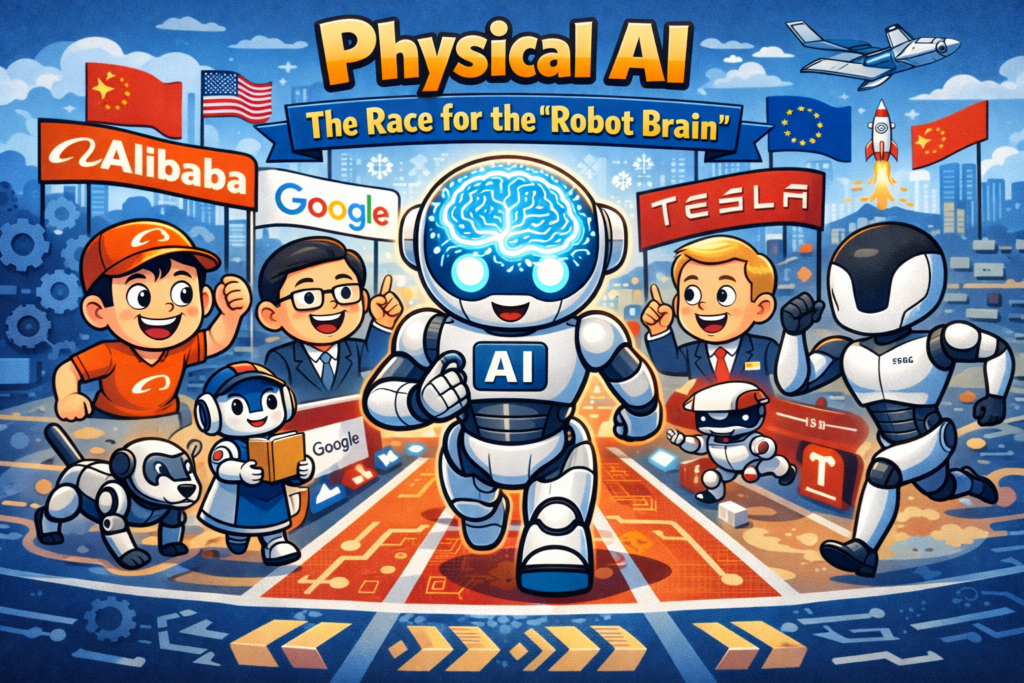
Physical AI — AI that can perceive, reason and act in the real world — has become the next strategic battleground for global tech giants. Alibaba is far from alone.

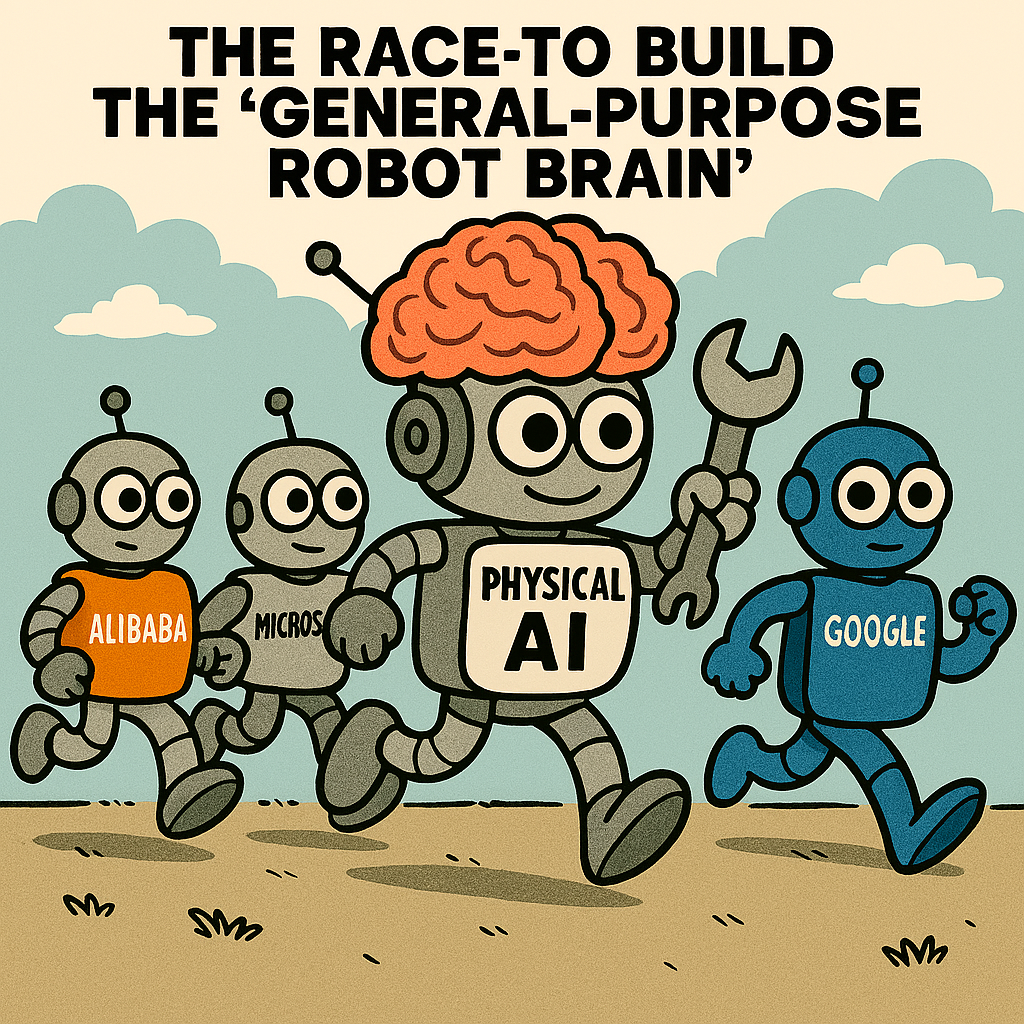
Several companies are racing to build the ‘general‑purpose robot brain’.

Below are the most significant players.

1. Google DeepMind

Focus: Embodied AI, robotics‑ready multimodal model’s Key systems:

RT‑2 (Robotic Transformer)

Gemini‑based robotics extensions

Google has been working on robotics for over a decade. RT‑2 was one of the first models to show that a language model could directly control a robot arm, interpret objects, and perform multi‑step tasks.

DeepMind is now integrating robotics capabilities into the Gemini family.

2. OpenAI

Focus: General‑purpose embodied intelligence Key systems:

OpenAI Robotics (revived internally)

Vision‑language‑action research

OpenAI paused robotics in 2020 but has quietly restarted the programme. Their models are being trained to understand video, track objects and perform physical tasks. They are also working with hardware partners to test embodied versions of their models.

3. Nvidia

Focus: The infrastructure layer for physical AI Key systems:

  • Nvidia Isaac (robotics platform)
  • Cosmos models
  • Omniverse simulation

Nvidia is not building consumer robots; it is building the entire ecosystem for everyone else. Its simulation tools, training environments and robotics‑ready AI models are becoming the backbone of the industry.

4. Tesla

Focus: Humanoid robotics Key system:

  • Optimus (Tesla Bot)

Tesla is training its robot using the same AI stack as its autonomous driving system. The company claims Optimus will eventually perform factory and household tasks.

It is one of the most visible attempts to build a general‑purpose humanoid robot.

5. Amazon

Focus: Warehouse automation and domestic robotics Key systems:

  • Proteus (autonomous warehouse robot)
  • Astro (home robot)

Amazon is integrating multimodal AI into its logistics robots and experimenting with home assistants that can navigate physical spaces.

6. Figure AI

Focus: General‑purpose humanoid robots’ Key system:

  • Figure 01

Backed by OpenAI, Microsoft and Nvidia, Figure is developing a humanoid robot designed to perform everyday tasks.

Their recent demos show robots manipulating objects and responding to natural language instructions.

7. Boston Dynamics

In partnership with Google’s DeepMind Boston Dynamics is also building a ‘foundation model intelligence’ robot brain.

The Big Picture

Alibaba is entering a field dominated by U.S. companies, but the global race is wide open. Physical AI is becoming the next strategic platform — the equivalent of smartphones in the 2000s or cloud computing in the 2010s.

*RynnBrain explained

RynnBrain is Alibaba’s open‑source ‘physical AI‘ framework designed to give robots far more capable real‑world intelligence, enabling them to plan, navigate, and manipulate objects across dynamic environments such as factories and homes.

Developed by the company’s DAMO Academy, it competes directly with Google’s Gemini Robotics and Nvidia’s Cosmos‑Reason models, with Alibaba claiming stronger benchmark performance.

The system is released openly on platforms like GitHub and Hugging Face, offered in configurations from lightweight 2‑billion‑parameter models to advanced mixture‑of‑experts variants, and includes specialised versions—Plan, Nav, and CoP—targeting manipulation, navigation, and spatial reasoning respectively.

Its launch signals China’s ambition to lead global robotics and embodied AI development.

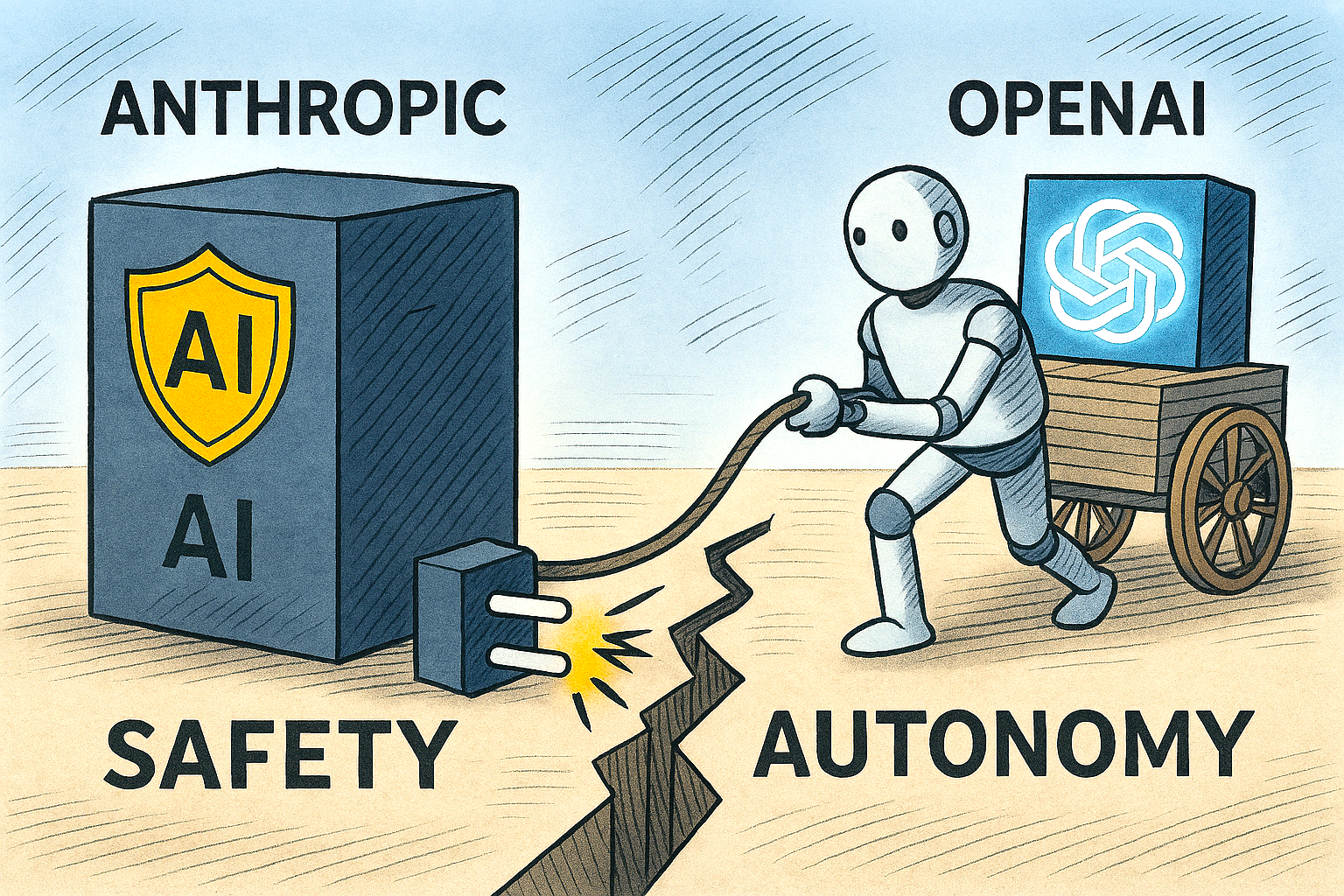
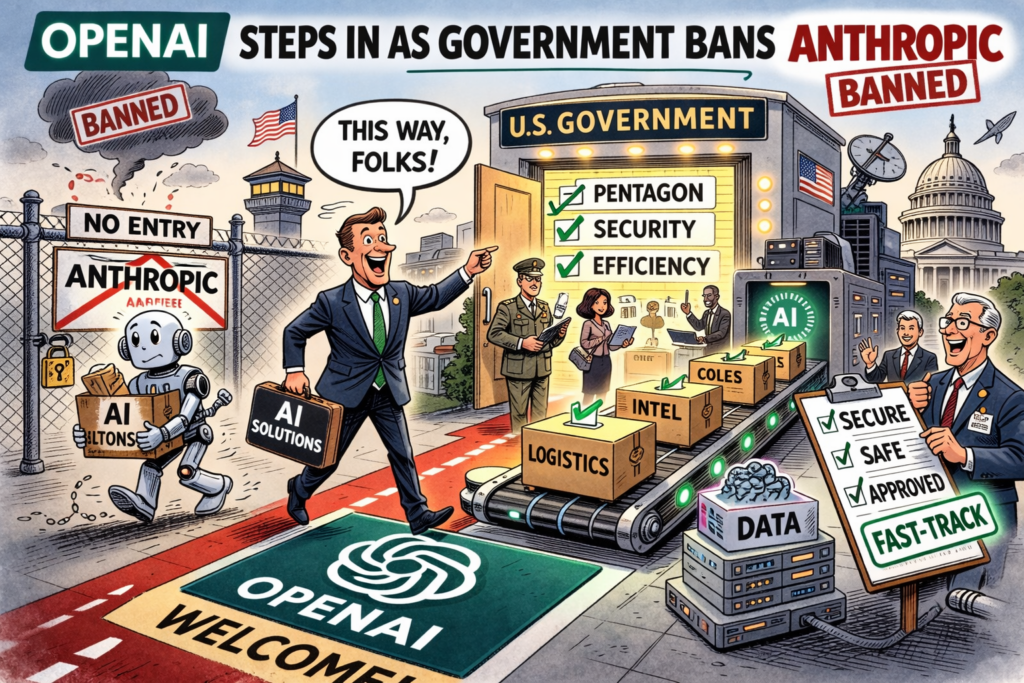
Anthropic Pushes the Frontier Again with Claude Opus 4.6

Claude Opus 4.5

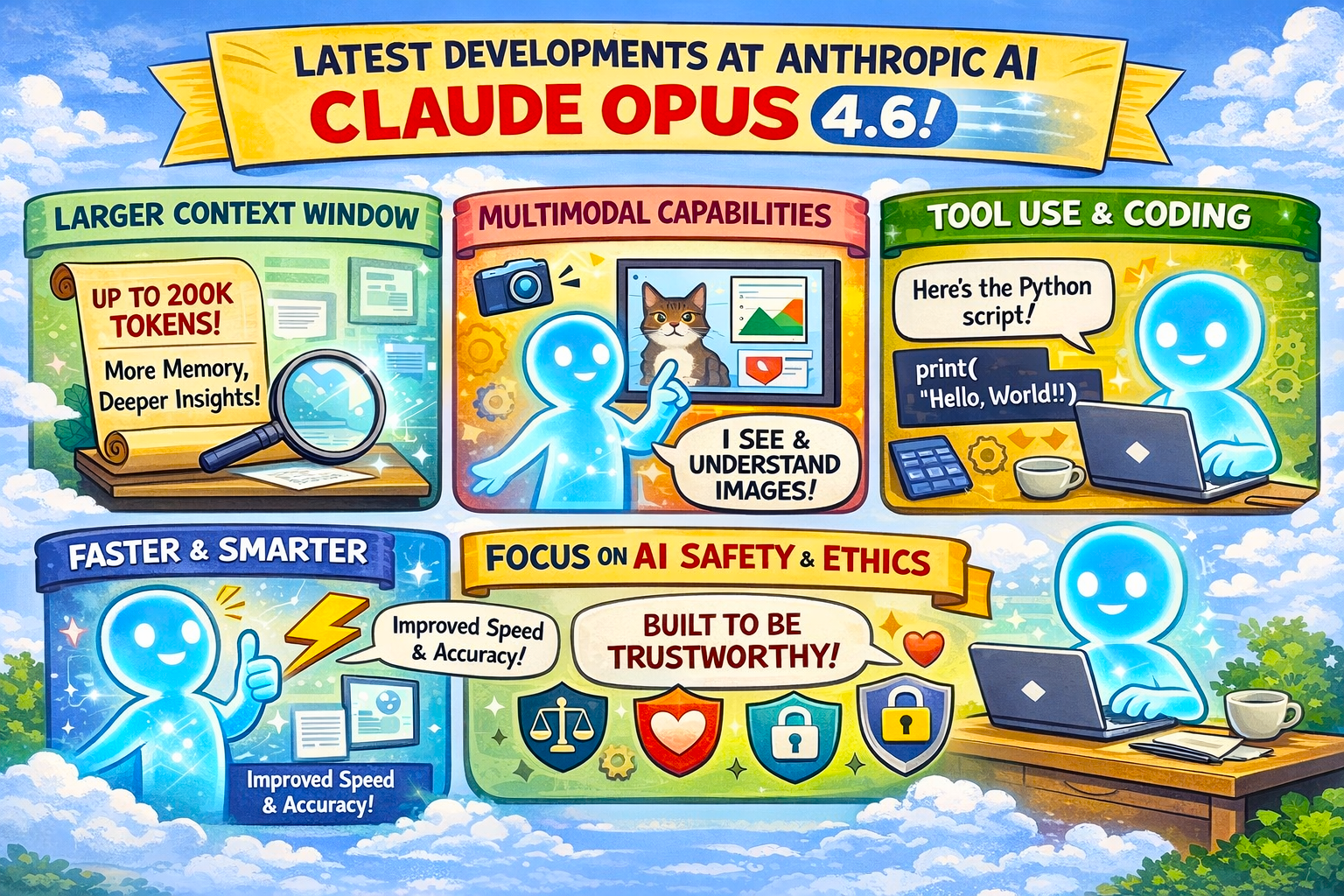
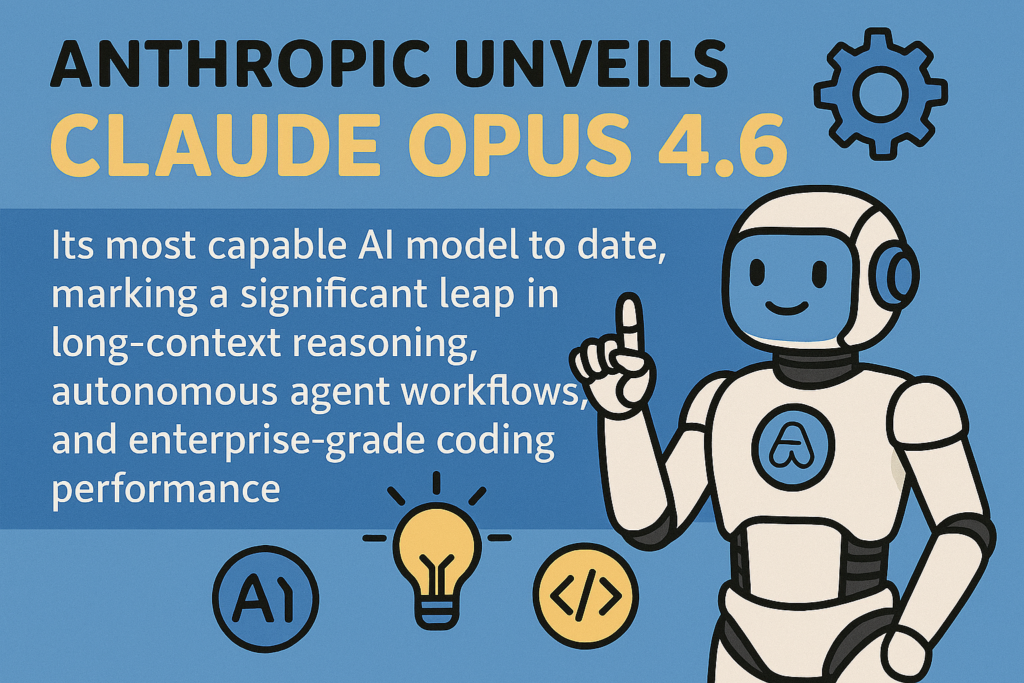
Anthropic has unveiled Claude Opus 4.6, its most capable AI model to date, marking a significant leap in long‑context reasoning, autonomous agent workflows, and enterprise‑grade coding performance.

The release arrives during a turbulent moment for the global software sector, with markets reacting sharply to fears that Anthropic’s accelerating capabilities could reshape entire categories of knowledge work.

At the heart of Opus 4.6 is a 1‑million‑token context window, a first for Anthropic’s Opus line and a direct response to long‑standing limitations around ‘context rot’ in extended tasks.

Benchmarks

Early benchmarks show a dramatic improvement in maintaining accuracy across vast documents and complex, multi‑step workflows.

This expanded capacity enables the model to analyse large codebases, regulatory filings, or research archives in a single pass—an ability already drawing interest from enterprise users.

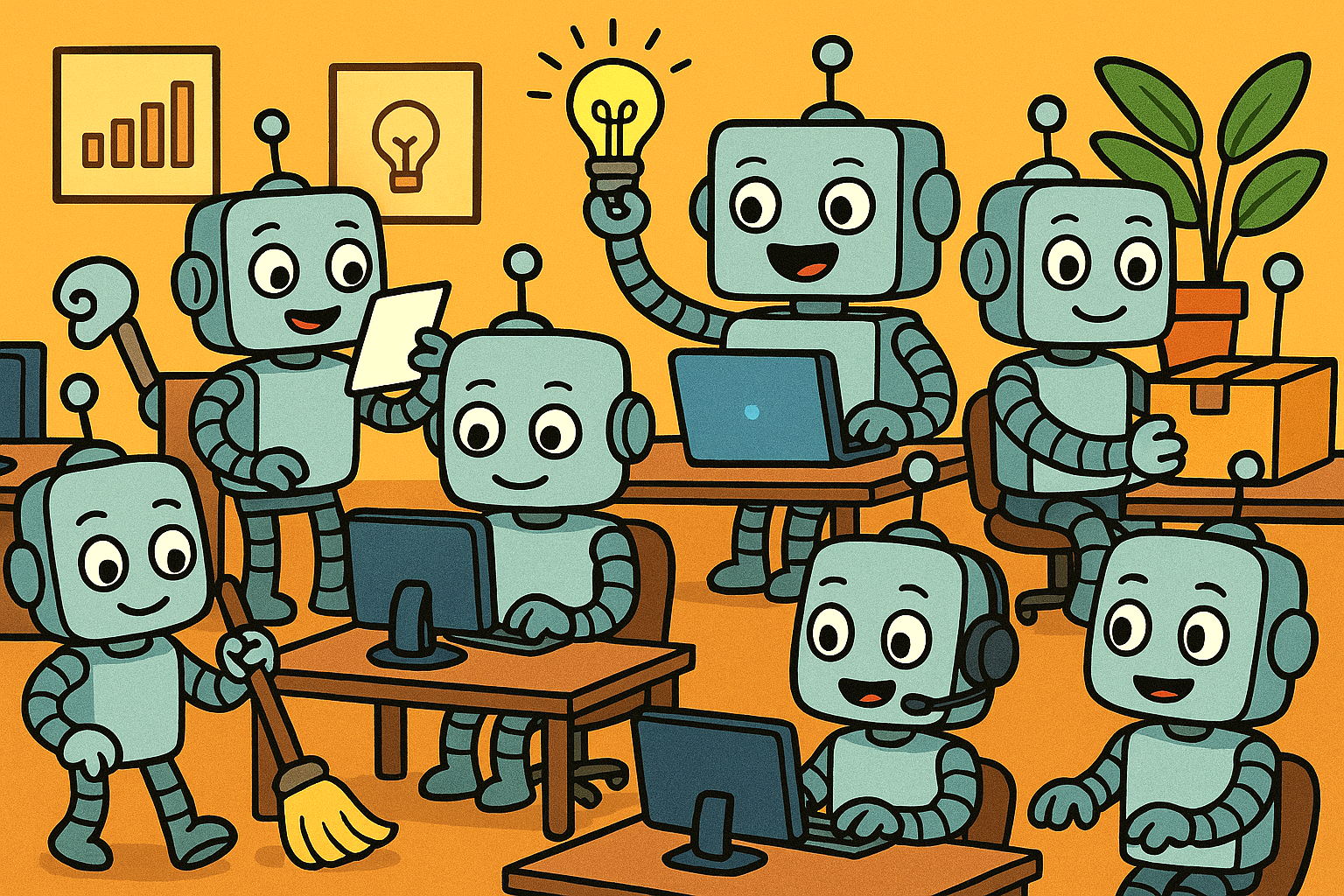
Perhaps the most striking development is Anthropic’s progress in agentic systems. Claude Code and the company’s Cowork framework now support coordinated ‘agent teams’, allowing multiple Claude instances to collaborate on sophisticated engineering challenges.

In one internal experiment, a team of 16 Claude agents built a complete Rust‑based C compiler capable of compiling the Linux kernel—producing nearly 100,000 lines of code with minimal human intervention.

Agentic shift

This agentic shift is reshaping expectations around AI‑driven software development. Anthropic positions Opus 4.6 not merely as a tool but as a foundation for autonomous, multi‑agent workflows that can plan, execute, and refine complex tasks over extended periods.
The company highlights improvements in reliability, coding precision, and long‑running task stability as core differentiators.

With enterprise adoption already representing the majority of Anthropic’s business, Opus 4.6 signals a decisive step toward AI systems that operate as high‑level collaborators rather than assistants.

As markets digest the implications, one thing is clear: Anthropic is accelerating the transition from ‘AI that helps’ to AI that works alongside you—and sometimes, entirely on its own.

Legal profession

Anthropic is pushing aggressively into the legal domain, positioning Claude as a high‑precision research and drafting partner for firms handling complex regulatory workloads.

The latest models emphasise long‑context accuracy, allowing lawyers to ingest entire case bundles, contracts, or disclosure sets without losing coherence.

Anthropic has also expanded constitutional AI safeguards, aiming to reduce hallucinations in high‑stakes legal reasoning.

Early adopters report gains in due‑diligence speed, contract comparison, and regulatory interpretation, particularly in financial services and data‑protection work.

While not a substitute for legal judgement, Claude is rapidly becoming a force multiplier for teams managing heavy document‑driven tasks.

The Rise of OpenClaw and the New Era of AI Agents

Agent AI

A new generation of artificial intelligence is taking shape, and at its centre sits OpenClaw — a fast‑evolving framework that embodies the shift from monolithic AI models to agile, task‑driven agents.

While large language models once dominated the conversation, the momentum has clearly moved toward systems that can reason, plan, and act with far greater autonomy. OpenClaw is emerging as one of the most intriguing examples of this transition.

Appeal

OpenClaw’s appeal lies in its modular design. Instead of relying on a single, all‑purpose model, it orchestrates multiple specialised components that collaborate to complete complex workflows.

This mirrors how real teams operate: one agent may handle research, another may draft content, and a third may evaluate quality or flag risks. The result is a system that behaves less like a tool and more like a coordinated digital workforce.

Defining trend

This shift is not happening in isolation. Across the industry, AI agents are becoming the defining trend. Companies are racing to build systems that can manage inboxes, run businesses, write and deploy code, or even negotiate with other agents.

The ambition is no longer to create a chatbot that answers questions, but an autonomous entity capable of executing multi‑step tasks with minimal human intervention.

OpenClaw stands out because it embraces openness and experimentation. Developers can plug in their own models, customise behaviours, and build agent ‘stacks’ tailored to specific industries.

Adoption

Early adopters in media, finance, and logistics are already exploring how these agents can streamline research, automate reporting, or coordinate supply‑chain decisions.

The promise is efficiency, but also creativity: agents that can generate ideas, test them, and refine them without constant supervision.

Of course, the rise of agentic AI brings challenges. Questions around safety, reliability, and accountability are becoming more urgent. An agent that can act independently must also be constrained responsibly.

Challenge

The industry is now grappling with how to balance autonomy with oversight, ensuring that these systems remain aligned with human goals and values.

Even with these concerns, the trajectory is unmistakable. OpenClaw and its peers represent a decisive step toward AI that is not merely reactive but proactive — capable of taking initiative, managing complexity, and collaborating with humans in more meaningful ways.

As these systems mature, they are likely to reshape not just how we work, but how we think about intelligence itself.

If you want to explore how this trend could influence your editorial or creative workflows, I’m ready to dive deeper with you.

When Markets Lean Too Heavily on High Flyers

The AI trade

The recent rebound in technology shares, led by Google’s surge in artificial intelligence optimism, offered a welcome lift to investors weary of recent market sluggishness.

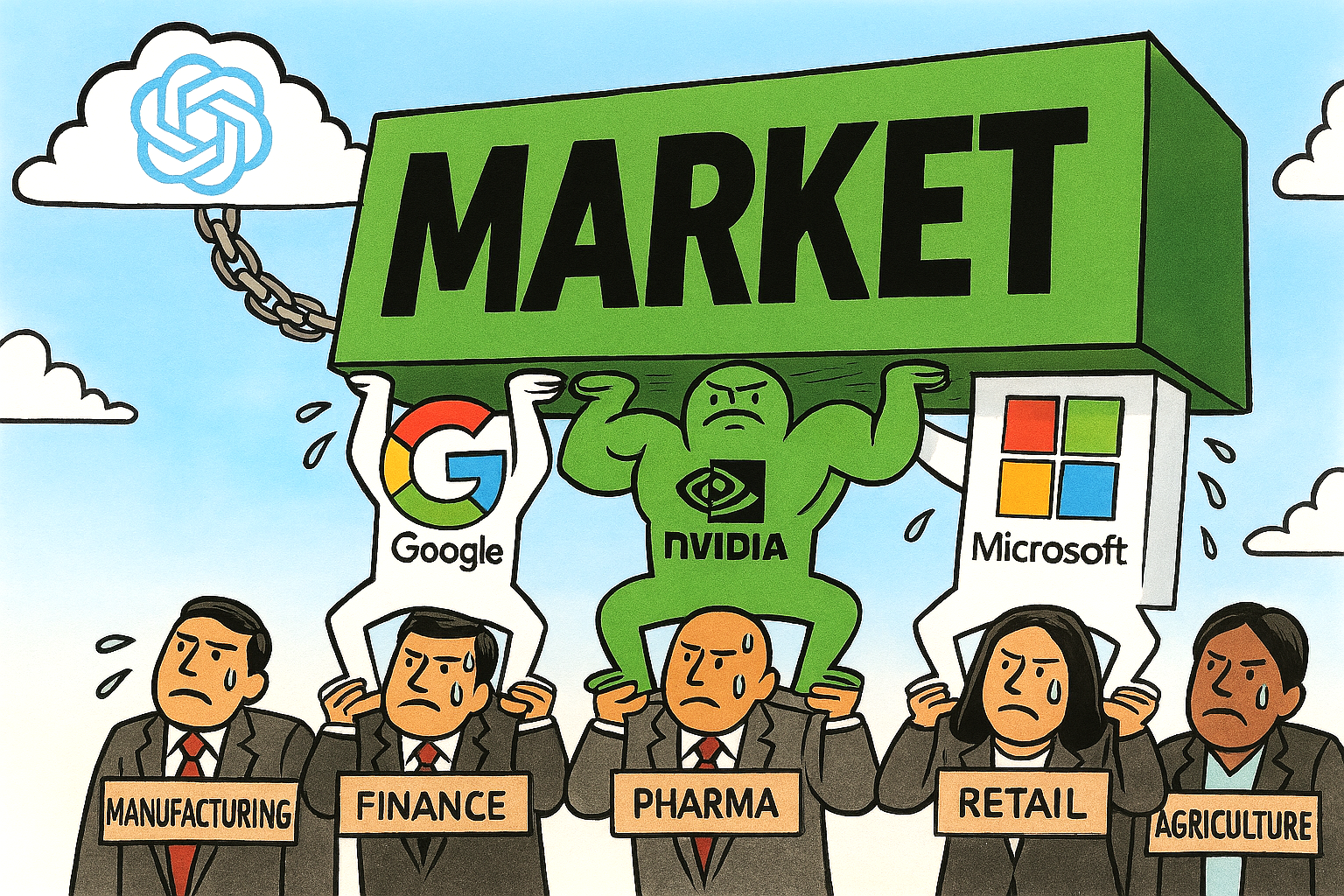
Yet beneath the headlines lies a more troubling dynamic: the increasing reliance on a handful of mega‑capitalisation firms to sustain broader equity gains.

Breadth

Markets thrive on breadth. A healthy rally is one in which gains are distributed across sectors, signalling confidence in the wider economy. When only one or two companies shoulder the weight of investor sentiment, the picture becomes distorted.

Google’s AI announcements may well justify enthusiasm, but the fact that its performance alone can swing indices highlights a fragility in the current market structure.

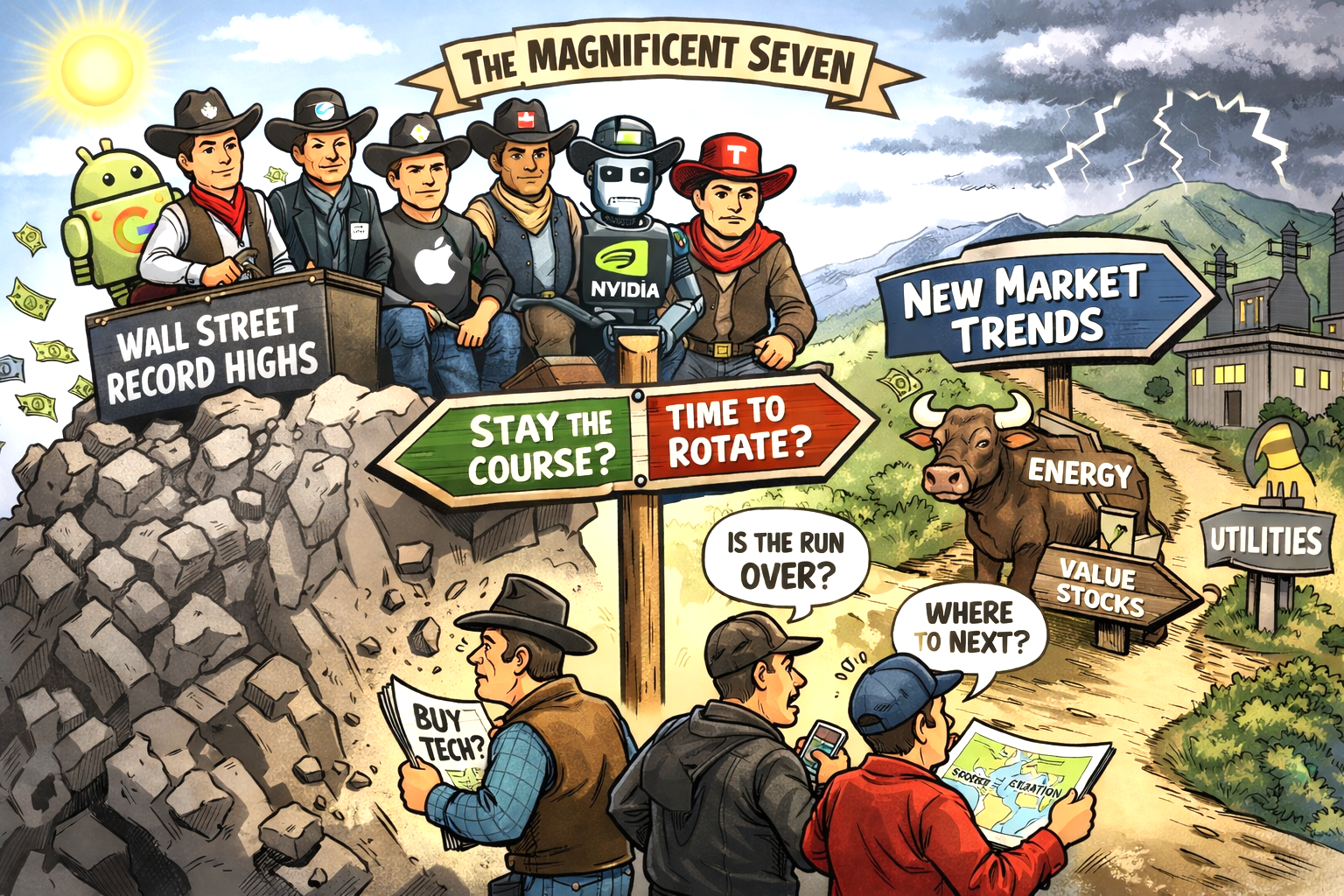
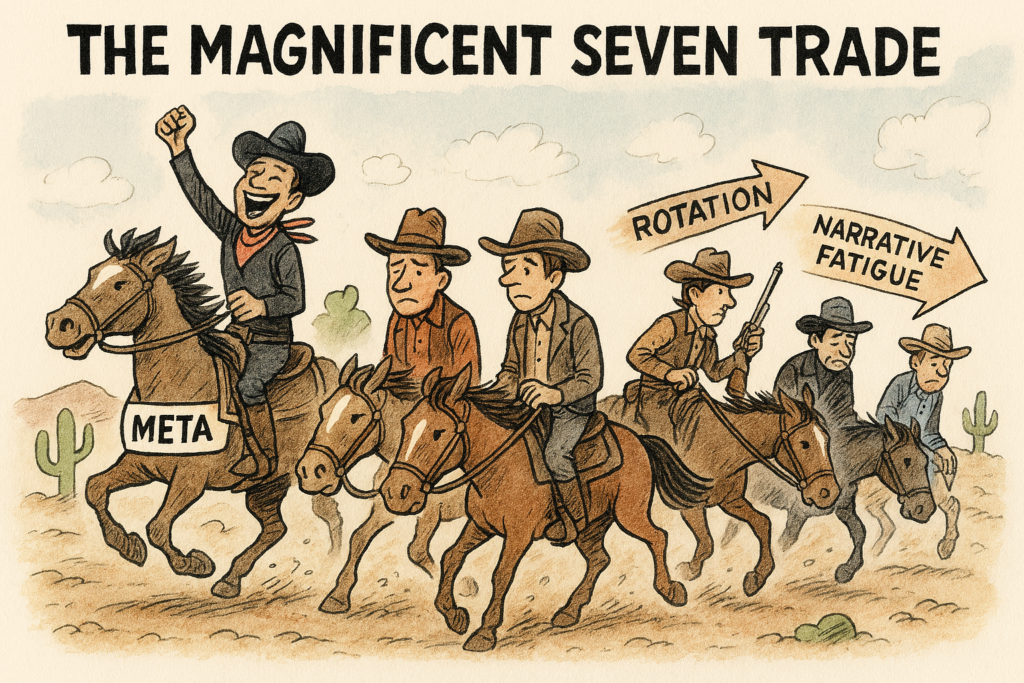
This concentration risk is not new. In recent years, the so‑called ‘Magnificent Seven‘ technology giants have dominated returns, masking weakness in smaller firms and traditional industries.

While investors cheer the headline numbers, the underlying reality is that many sectors remain subdued. Manufacturing, retail, and even parts of the financial industry are not sharing equally in the rally.

Over Dependence

Over‑dependence on highflyers creates two problems. First, it exposes markets to sudden shocks: if sentiment turns against one of these giants, indices can tumble disproportionately.

Second, it discourages capital from flowing into diverse opportunities, stifling innovation outside the tech elite.

For long‑term stability, investors and policymakers alike should be wary of celebrating narrow gains. A resilient market requires participation from a broad base of companies, not just the fortunes of a few.

Google’s success in AI is impressive, but true economic strength will only be evident when growth spreads beyond the marquee names.

Until then, the market remains vulnerable, propped up by giants whose shoulders, however broad, cannot carry the entire economy indefinitely.

Nvidia Q3 results were very strong – but does the AI bubble reside elsewhere – such as with the debt driven AI data centre roll out – and crossover company deals?

AI debt

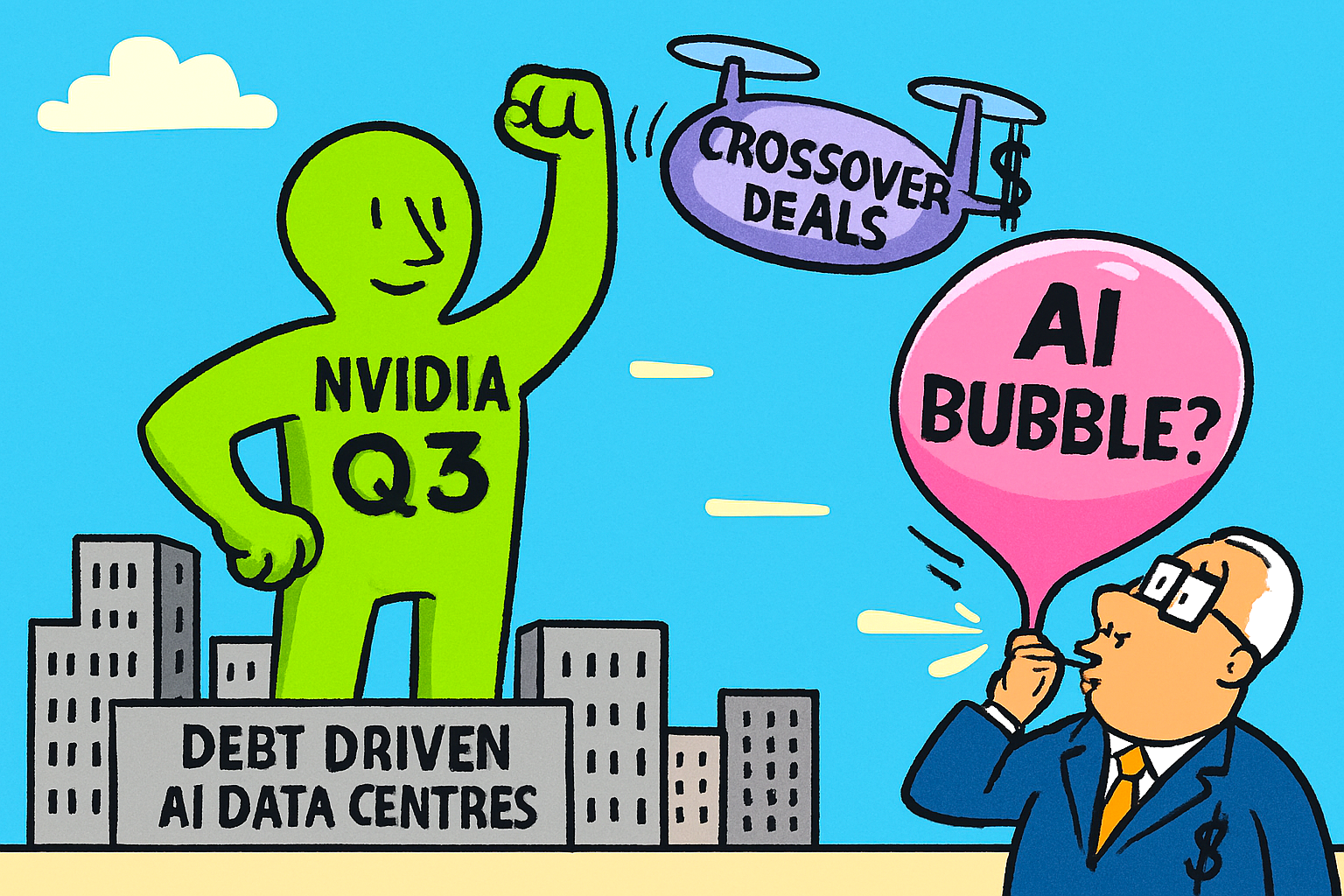
Nvidia’s Q3 results show strength, but the real risk of an AI bubble may lie in the debt-fuelled data centre boom and the circular crossover deals between tech giants.

Nvidia’s latest quarterly earnings were nothing short of spectacular. Revenue surged to $57 billion, up 62% year-on-year, with net income climbing to nearly $32 billion. The company’s data centre division alone contributed $51.2 billion, underscoring how central AI infrastructure has become to its growth.

These figures have reassured investors that Nvidia itself is not the weak link in the AI story. Yet, the question remains: if not Nvidia, where might the bubble be forming?

Data centre roll-out

The answer may lie in the debt-driven expansion of AI data centres. Building hyperscale facilities requires enormous capital outlays, not only for GPUs but also for power, cooling, and connectivity.

Many operators are financing this expansion through debt, betting that demand for AI services will continue to accelerate. While Nvidia’s chips are sold out and cloud providers are racing to secure supply, the sustainability of this debt-fuelled growth is less certain.

If AI adoption slows or monetisation lags, these projects could become overextended, leaving balance sheets strained.

Crossover deals

Another area of concern is the crossover deals between major technology companies. Nvidia’s Q3 was buoyed by agreements with Intel, OpenAI, Google Cloud, Microsoft, Meta, Oracle, and xAI.

These arrangements exemplify a circular investment pattern: companies simultaneously act as customers, suppliers, and investors in each other’s AI ventures.

While such deals create momentum and headline growth, they risk masking the true underlying demand.

If much of the revenue is generated by companies trading capacity and investment back and forth, the market could be inflating itself rather than reflecting genuine end-user adoption.

Bubble or not to bubble?

This dynamic is reminiscent of past bubbles, where infrastructure spending raced ahead of proven returns. The dot-com era saw fibre optic networks built faster than internet businesses could monetise them.

Today, AI data centres may be expanding faster than practical applications can justify. Nvidia’s results prove that demand for compute is real and immediate, but the broader ecosystem may be vulnerable if debt levels rise and crossover deals obscure the true picture of profitability.

In short, Nvidia’s strength does not eliminate bubble risk—it merely shifts the spotlight elsewhere. Investors and policymakers should scrutinise the sustainability of AI infrastructure financing and the circular nature of tech partnerships.

The AI revolution is undoubtedly transformative, but its foundations must rest on genuine demand rather than speculative debt and self-reinforcing deals.

Anthropic’s ‘connected’ AI deal and others too

Anthropic's AI valuation

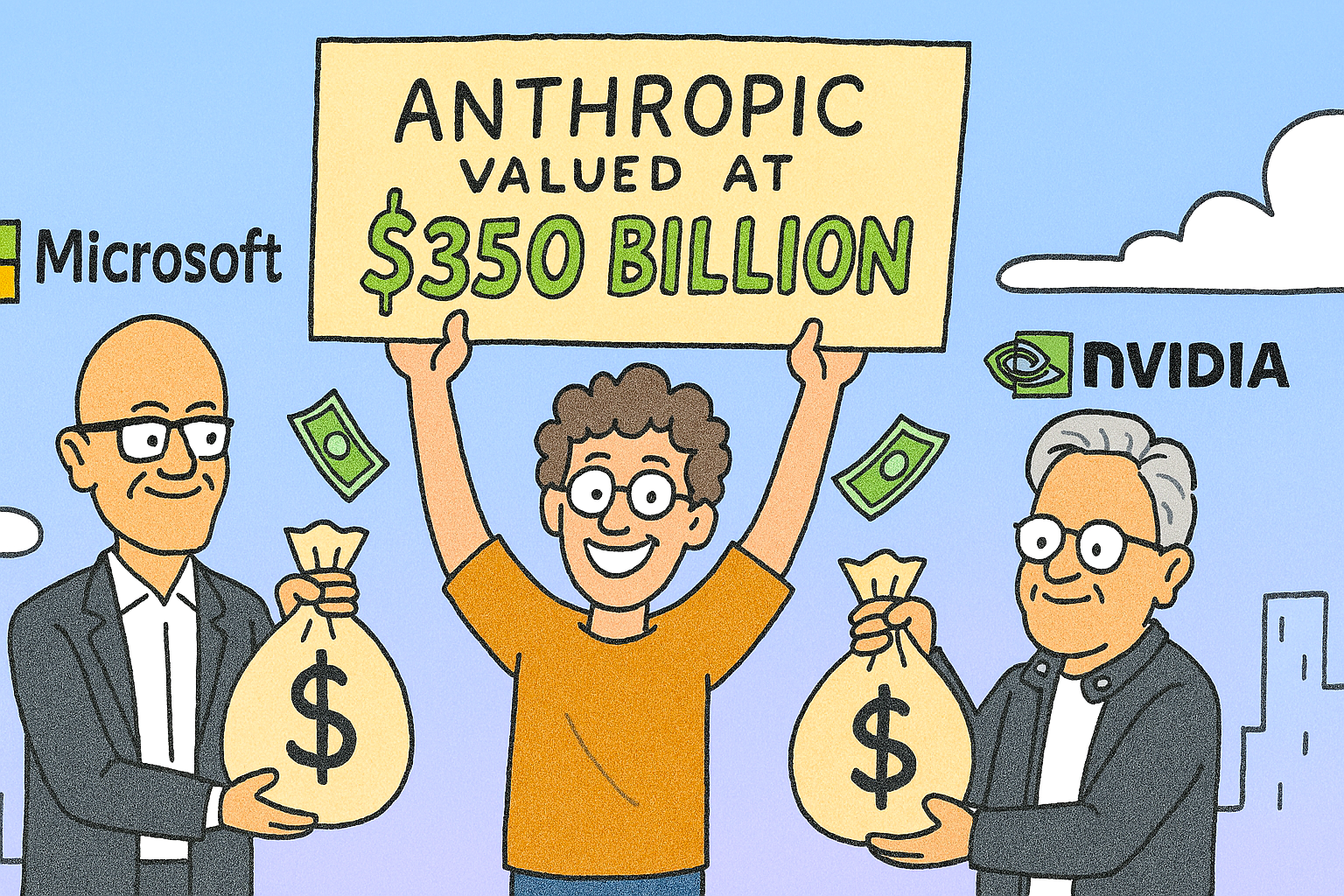
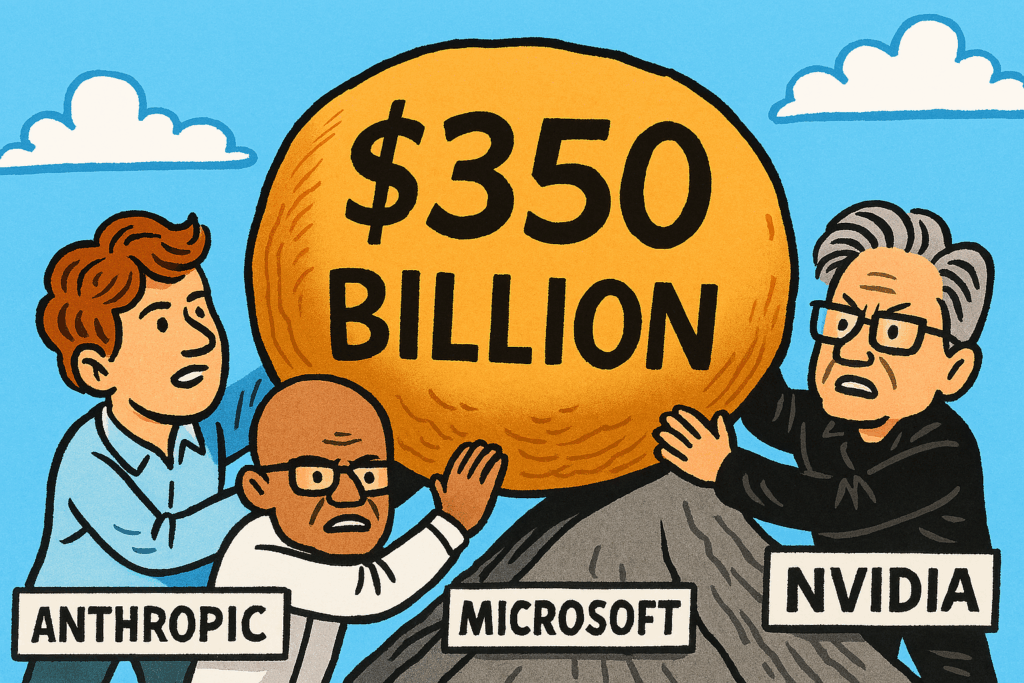
Anthropic has reportedly struck major deals with Microsoft and Nvidia. On Tuesday 18th November 2025, Microsoft announced plans to invest up to $5 billion in the startup, while Nvidia will contribute as much as $10 billion. According to a reports, this brings Anthropic’s valuation to around $350 billion. Wow!

Google has unveiled its newest AI model, Gemini 3. According to Alphabet CEO Sundar Pichai, it will deliver desired answers with less prompting.

This update comes just eight months after the launch of Gemini 2.5 and is reported to be available in the coming weeks.

Money keeps flowing

Money keeps flowing into artificial intelligence companies but out of AI stocks

In what seems like yet another case of mutual ‘back-scratching’, Microsoft and Nvidia are set to invest a combined $15 billion in Anthropic, with the OpenAI rival agreeing to purchase computing power from its two newest backers.

Lately, a large chunk of AI news feels like it boils down to: ‘Company X invests in Company Y, and Company Y turns around and buys from Company X’.

That’s not entirely correct or fair. There are plenty of advancements in the AI world that focus on actual development rather than investments. Google recently introduced the third version of Gemini, its AI model.

Anthropic’s valuation has surged to around $350 billion, propelled by a landmark $15 billion investment from Microsoft and Nvidia.

Anthropic, the AI start-up founded in 2021 by former OpenAI employees, has rapidly ascended into the ranks of the world’s most valuable companies, more than doubling its worth from $183 billion just a few months earlier.

A valuation of $350 billion for a company only 4 years old is astounding!

The deal reportedly sees Microsoft commit up to $5 billion and Nvidia up to $10 billion. Anthropic has agreed to purchase an extraordinary $30 billion in Azure compute capacity and additional infrastructure from Nvidia.

This strategic alliance is not merely financial; it signals a deliberate diversification of Microsoft’s AI ecosystem beyond its reliance on OpenAI. And Nvidia strengthens its dominance in AI hardware.

Anthropic’s valuation has reached $350 billion, following the massive $15 billion investment from Microsoft and Nvidia, which positions the company among the most valuable in the world.

This astronomical figure reflects both the scale of its partnerships — including $30 billion in Azure compute commitments and Nvidia’s cutting-edge hardware.

The valuation underscores both the intensity of the global AI race and the confidence investors place in Anthropic’s safety-conscious approach to artificial intelligence.

Yet, it also raises questions about whether such astronomical figures reflect genuine long-term value. Or is it the froth of an overheated market.

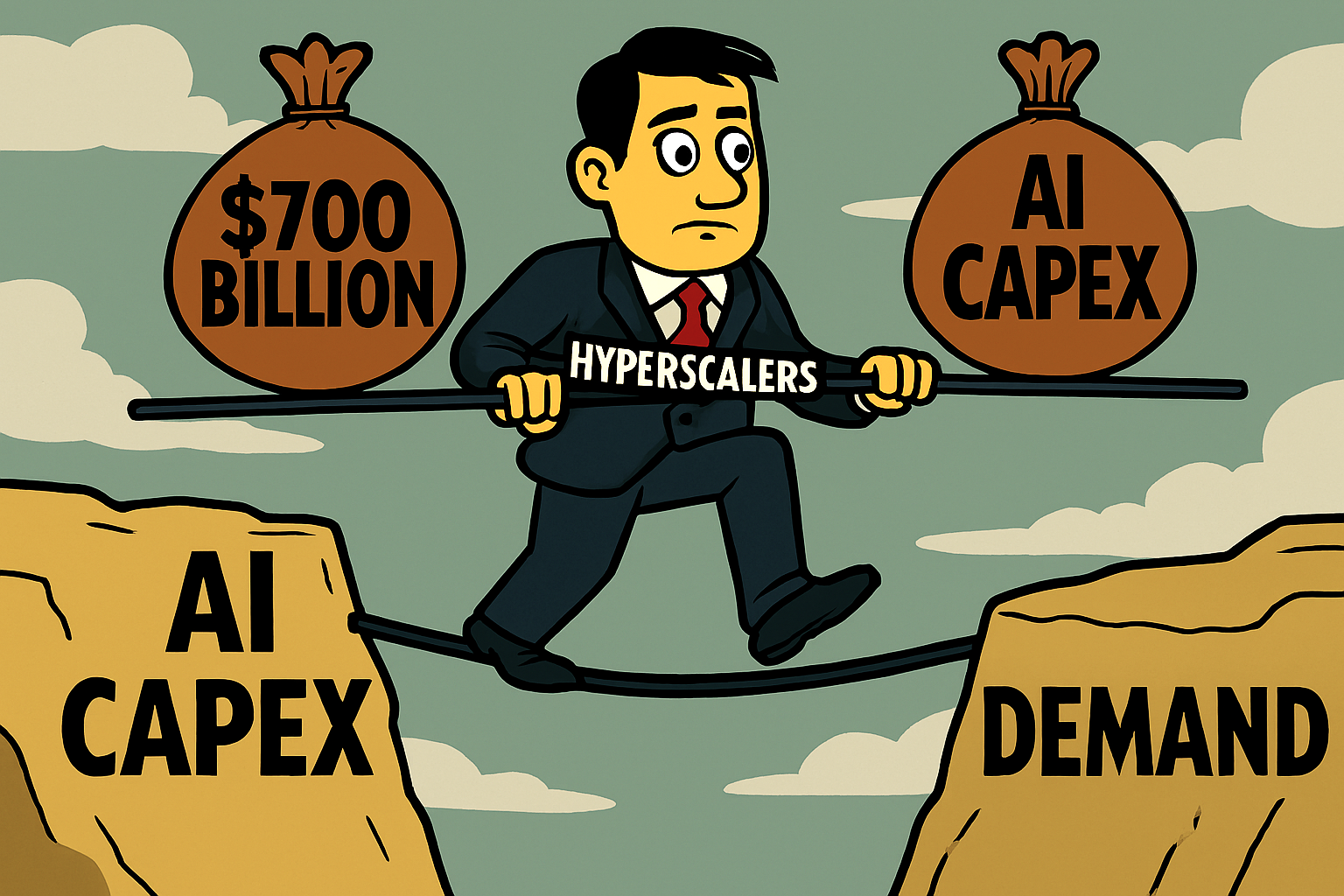
Hyperscalers keep pumping the money into AI but are they getting the justified returns yet? Probably not yet – but it will come in the future.

But by then, it will be time to upgrade the system as it develops and so more money will be pumped in

Pichai Warns of AI Bubble: Google Not Immune to Market Correction

AI Bubble caution

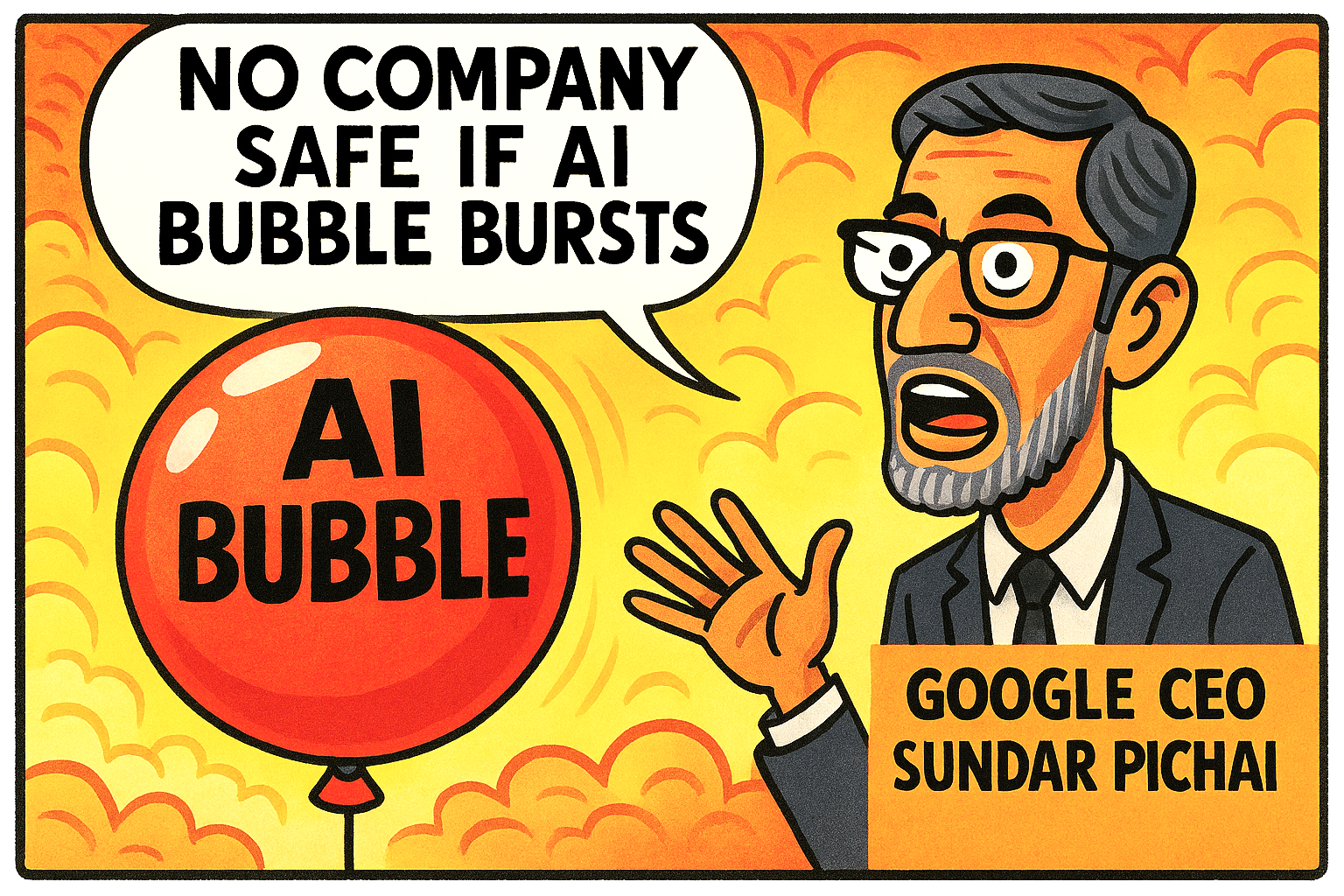
Google CEO Sundar Pichai has warned that no company, including his own, will be immune if the current AI bubble bursts.

He described the boom as both extraordinary and irrational, urging caution amid soaring valuations and investment hype

In a recent interview, Google’s chief executive Sundar Pichai offered a sobering perspective on the rapid expansion of artificial intelligence.

Profound Tech Creation

While he reportedly reaffirmed his belief that AI is ‘the most profound technology humanity has developed‘, he acknowledged growing concerns that the sector may be overheating.

According to Pichai, the surge in investment and valuations has created an atmosphere of exuberance that risks tipping into irrationality.

Pichai stressed that if the so-called AI bubble were to collapse, no company would escape unscathed. Even Google, one of the world’s most powerful technology firms, would feel the impact.

Remember Dot-Com?

He likened the current moment to past speculative cycles, such as the dot-com boom, where innovation was genuine, but market expectations outpaced reality.

Despite these warnings, Pichai emphasised that the long-term potential of AI remains intact.

He argued that professions across the board—from teaching to medicine—will continue to exist, but success will depend on how well individuals adapt to using AI tools.

In his view, the technology will reshape industries, but the hype surrounding short-term gains could distort investment flows and create instability.

His comments arrive at a time when Silicon Valley is grappling with questions about sustainability. Tech stocks have surged on AI optimism, yet analysts caution that inflated valuations may not reflect the true pace of adoption.

Pichai’s intervention serves as both a reality check and a reminder: AI is transformative, but it is not immune to market corrections.

For investors and innovators alike, the message is clear—embrace AI’s promise but prepare for turbulence if the bubble bursts.

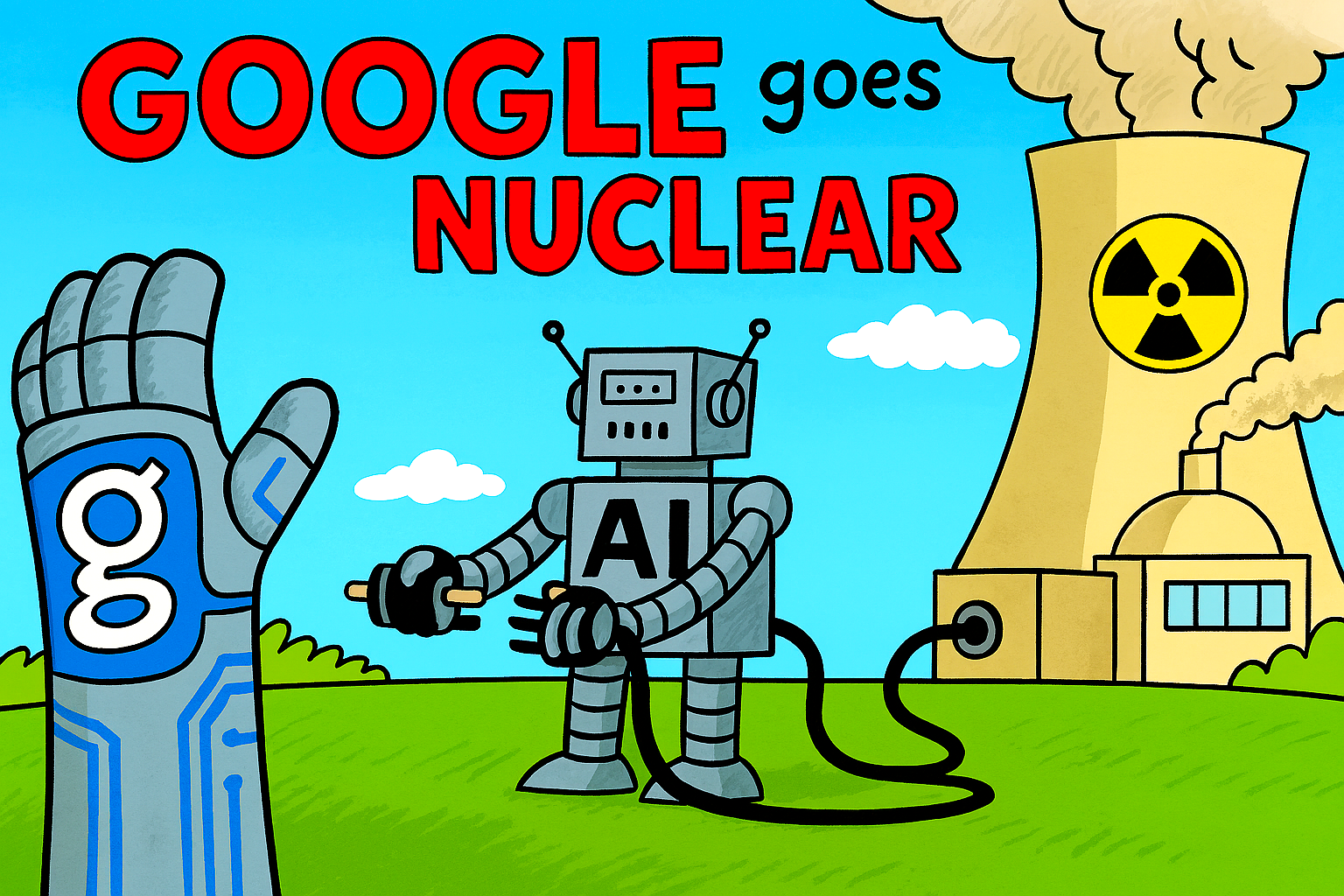
Google Goes Nuclear: Part 1 Powering the AI Revolution with Atomic Energy

Google nuclear power ambitions

In a bold move that signals the escalating energy demands of artificial intelligence, Google has announced plans to invest heavily in nuclear power to fuel its data centres.

As AI models grow more complex and compute-intensive, the tech giant is turning to atomic energy as a stable, carbon-free solution to meet its insatiable appetite for electricity.

The shift comes amid mounting scrutiny over the environmental impact of AI. Training large language models and running real-time inference across billions of queries requires vast amounts of energy—often sourced from fossil fuels.

Google’s pivot to nuclear is both a strategic and symbolic gesture: a commitment to sustainability, but also a recognition that the AI era demands a fundamentally different energy paradigm.

SMR’s

At the heart of this initiative is Google’s partnership with advanced nuclear startups exploring small modular reactors (SMRs) and next-generation fission technologies.

Unlike traditional nuclear plants, SMRs are designed to be safer, more scalable, and quicker to deploy—making them ideal for powering decentralised data infrastructure.

Google’s goal is to integrate these reactors directly into its cloud and AI campuses, creating a closed-loop ecosystem where clean energy powers the very machines shaping the future.

Critics, however, warn of the risks. Nuclear waste, regulatory hurdles, and public perception remain significant barriers.

Some environmentalists argue that the urgency of the climate crisis demands faster, more proven solutions like solar and wind. Yet others see nuclear as a necessary complement—especially as AI accelerates demand beyond what renewables alone can supply.

This isn’t Google’s first foray into atomic ambition. In 2022, it backed nuclear fusion research through its DeepMind subsidiary, applying AI to optimise plasma control.

Now, with fission in focus, the company appears determined to lead not just in AI innovation, but in the infrastructure that sustains it.

The implications are profound. If successful, Google’s nuclear strategy could set a precedent for the entire tech industry, reshaping how data is powered in the 21st century.

It also raises deeper questions: Can the tools of the future be truly sustainable? And what does it mean when the intelligence we build begins to reshape the energy systems that built us?

One thing is clear—AI isn’t just changing how we think. It’s changing what we power, and how we power it.

Oracle Cloud reportedly to deploy 50,000 AMD AI chips, signalling direct competition with Nvidia

Oracle Cloud AI

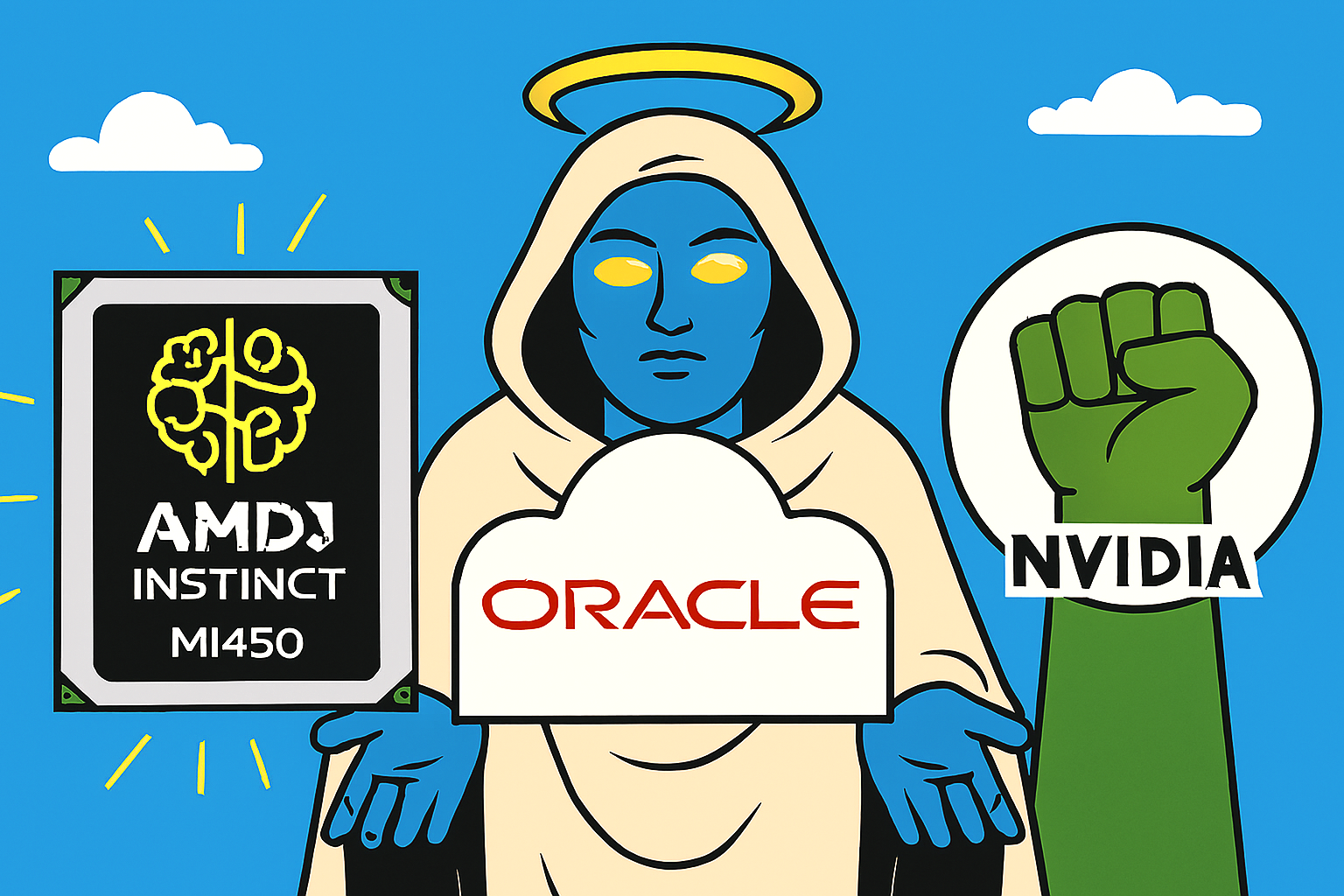
Oracle Bets Big on AMD AI Chips, Challenging Nvidia’s Dominance

Oracle Cloud Infrastructure has announced plans to deploy 50,000 AMD Instinct MI450 graphics processors starting in the second half of 2026, marking a bold strategic shift in the AI hardware landscape.

The move signals a direct challenge to Nvidia’s long-standing dominance in the data centre GPU market, where it currently commands over 90% market share.

AMD’s MI450 chips, unveiled earlier this year, are designed for high-performance AI workloads and can be assembled into rack-sized systems that allow 72 chips to function as a unified engine.

This architecture is tailored for inferencing tasks—an area Oracle believes AMD will excel in. ‘We feel like customers are going to take up AMD very, very well’, reportedly said Karan Batta, Oracle Cloud’s senior vice president.

The announcement comes amid a broader realignment in the AI ecosystem. OpenAI, historically reliant on Nvidia hardware, has recently inked a multi-year deal with AMD involving processors requiring up to 6 gigawatts of power.

If successful, OpenAI could acquire up to 10% of AMD’s shares, further cementing the chipmaker’s role in next-generation AI infrastructure.

Oracle’s pivot also reflects its ambition to compete with cloud giants like Microsoft, Amazon, and Google. With a reported five-year cloud deal with OpenAI potentially worth $300 billion, Oracle is positioning itself not just as a capacity provider but as a strategic AI enabler.

While Nvidia remains a formidable force, Oracle’s investment in AMD chips underscores a growing appetite for alternatives.

As AI demands scale, diversity in chip supply could become a competitive advantage—especially for enterprises seeking flexibility, cost efficiency, and innovation beyond the Nvidia ecosystem.

The AI arms race is far from over, but Oracle’s latest move suggests it’s no longer content to play catch-up. It’s aiming to redefine the rules.

AI Crash! Correction or pullback? Something is coming…

AI Bubble concerns

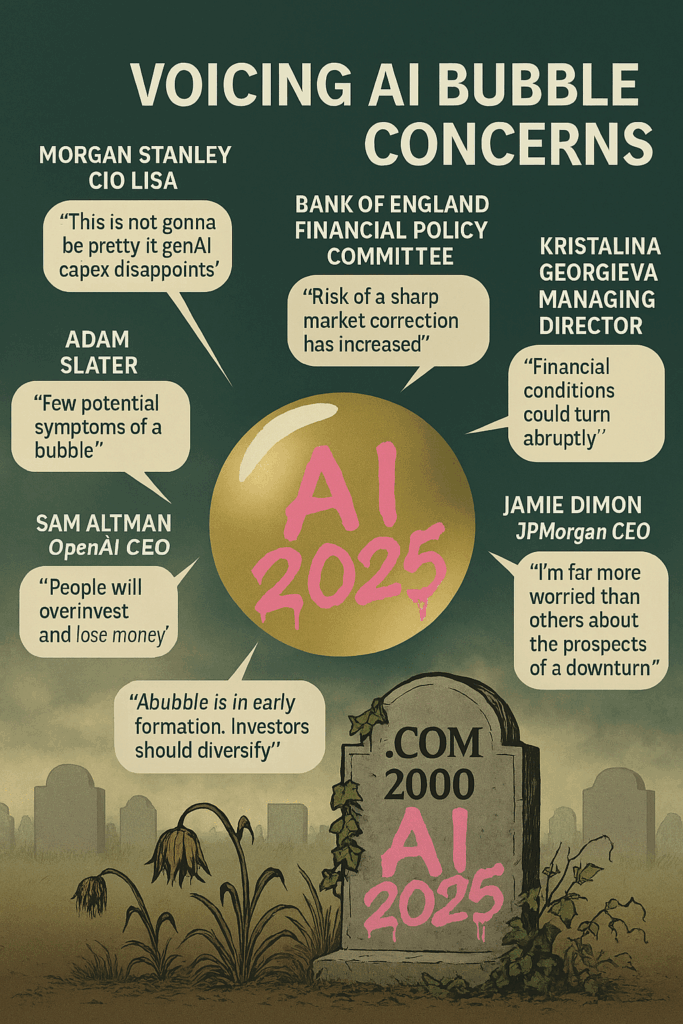
Influential figures and institutions are sounding the AI alarm—or at least raising eyebrows—about the frothy valuations and speculative fervour surrounding artificial intelligence.

Who’s Warning About the AI Bubble?

🏛️ Bank of England – Financial Policy Committee

  • View: Stark warning.
  • Quote: “The risk of a sharp market correction has increased.”
  • Why it matters: The BoE compares current AI stock valuations to the dotcom bubble, noting that the top five S&P 500 firms now command nearly 30% of market cap—the highest concentration in 50 years.

🏦 Jerome Powell – Chair, U.S. Federal Reserve

  • View: Cautiously sceptical.
  • Quote: Assets are “fairly highly valued.”
  • Why it matters: While not naming AI directly, Powell’s remarks echo broader concerns about tech valuations and investor exuberance.

🧮 Lisa Shalett – Chief Investment Officer, Morgan Stanley Wealth Management

  • View: Deeply concerned.
  • Quote: “This is not going to be pretty” if AI capital expenditure disappoints.
  • Why it matters: Shalett warns that 75% of S&P 500 returns are tied to AI hype, likening the moment to the “Cisco cliff” of the early 2000s.

🌍 Kristalina Georgieva – Managing Director, IMF

  • View: Watchful.
  • Quote: Financial conditions could “turn abruptly.”
  • Why it matters: Georgieva highlights the fragility of markets despite AI’s productivity promise, warning of sudden sentiment shifts.

🧨 Sam Altman – CEO, OpenAI

  • View: Self-aware caution.
  • Quote: “People will overinvest and lose money.”
  • Why it matters: Altman’s admission from inside the AI gold rush adds credibility to bubble concerns—even as his company fuels the hype.

📦 Jeff Bezos – Founder, Amazon

  • View: Bubble-aware.
  • Quote: Described the current environment as “kind of an industrial bubble.”
  • Why it matters: Bezos sees parallels with past tech manias, suggesting that infrastructure spending may be overextended.

🧠 Adam Slater – Lead Economist, Oxford Economics

  • View: Analytical.
  • Quote: “There are a few potential symptoms of a bubble.”
  • Why it matters: Slater points to stretched valuations and extreme optimism, noting that productivity projections vary wildly.

🏛️ Goldman Sachs – Investment Strategy Division

  • View: Cautiously optimistic.
  • Quote: “A bubble has not yet formed,” but investors should “diversify.”
  • Why it matters: Goldman acknowledges the risks while maintaining that fundamentals may still justify valuations—though they advise caution.
AI Bubble voices infographic October 2025

🧠 Julius Černiauskas and the Oxylabs AI/ML Advisory Board

🔍 View: The AI hype is nearing its peak—and may soon deflate.

  • Černiauskas warns that AI development is straining environmental resources and public trust. He’s pushing for responsible and sustainable AI practices, noting that transparency is lacking in how many models operate.
  • Ali Chaudhry, research fellow at UCL and founder of ResearchPal, adds that scaling laws are showing their limits. He predicts diminishing returns from simply making models bigger, and expects tightened regulations around generative AI in 2025.
  • Adi Andrei, cofounder of Technosophics, goes further: he believes the Gen AI bubble is on the verge of bursting, citing overinvestment and unmet expectations

🧠 Jamie Dimon on the AI Bubble

🔥 View: Sharply concerned—more than most as widely reported

  • Quote: “I’m far more worried than others about the prospects of a downturn.”
  • Context: Dimon believes AI stock valuations are “stretched” and compares the current surge to the dotcom bubble of the late 1990s.

📉 Key Warnings from Dimon

  • “Sharp correction” risk: He sees a real danger of a sudden market pullback, especially given how AI-related stocks have surged disproportionately—like AMD jumping 24% in a single day after an OpenAI deal.
  • “Most people involved won’t do well”: Dimon told the BBC that while AI will ultimately pay off—like cars and TVs did—many investors will lose money along the way.
  • “Governments are distracted”: He criticised policymakers for focusing on crypto and ignoring real security threats, saying: “We should be stockpiling bullets, guns and bombs”.
  • AI will disrupt jobs and companies”: At a trade event in Dublin, he warned that AI’s ubiquity will shake up industries and employment across the board.

And so…

The AI boom of 2025 has ignited a speculative frenzy across global markets, with tech stocks soaring and investors piling into anything labelled “AI-adjacent.”

But beneath the euphoria, a chorus of high-profile warnings is growing louder. From the Bank of England and IMF to JPMorgan’s Jamie Dimon and OpenAI’s Sam Altman, concerns are mounting that valuations are dangerously stretched, capital is overconcentrated, and the narrative is outpacing reality.

Dimon likens the moment to the dotcom bubble, while Altman admits many will “lose money” chasing the hype. Analysts point to classic bubble signals: retail mania, corporate FOMO, and earnings divorced from fundamentals.

Even as AI’s long-term utility remains promising, the short-term exuberance may be setting the stage for a sharp correction.

Whether it’s a pullback or a full-blown crash, the mood is shifting—from uncritical optimism to wary anticipation.

The question now is not whether AI will change the world, but whether markets have priced in too much, too soon.

We have been warned!

The AI bubble will pop – it’s just a matter of when and not if.

Go lock up your investments!

Are we looking at an AI house of cards? Bubble worries emerge after Oracle blowout figures

AI Bubble?

There’s growing concern that parts of the AI boom—especially the infrastructure and monetisation frenzy—might be built on shaky foundations.

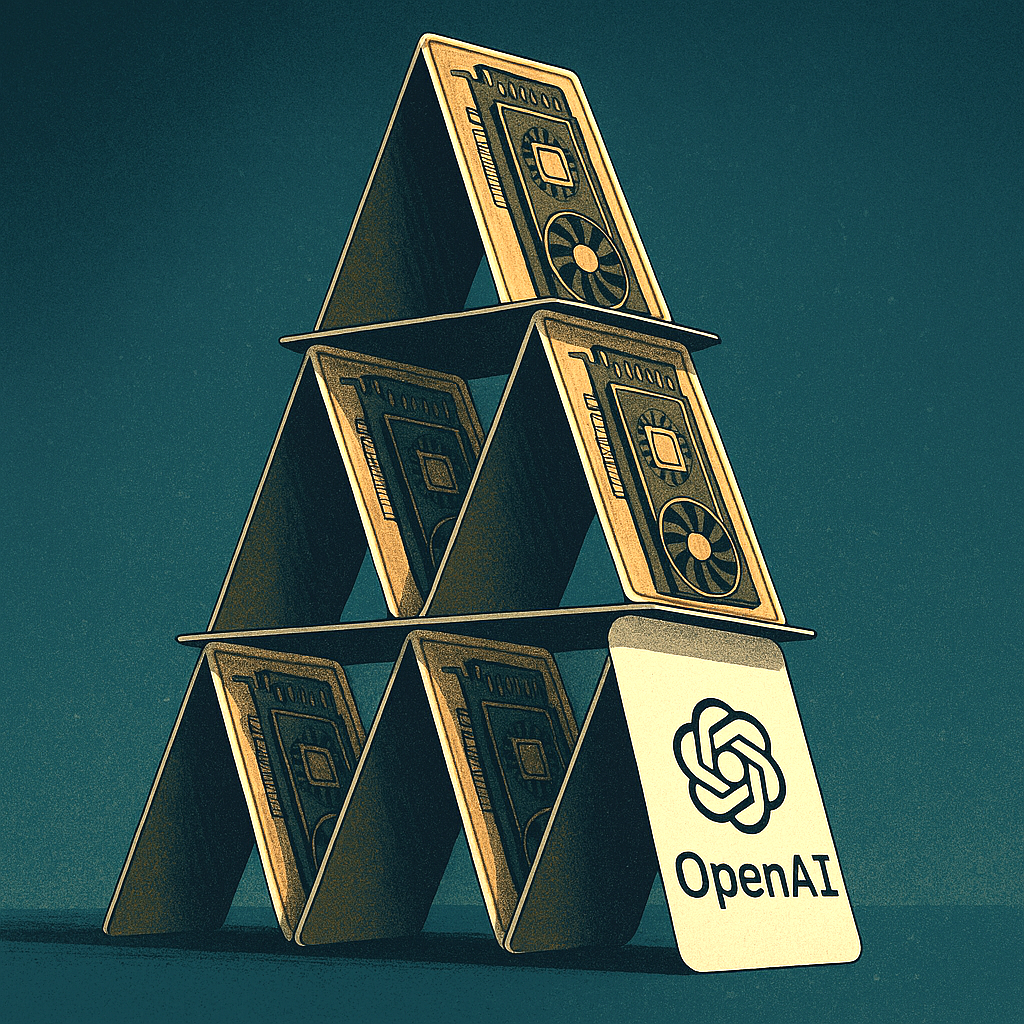
The term ‘AI house of cards’ is being used to describe deals like Oracle’s multiyear agreement with OpenAI, which has committed to buying $300 billion in computing power over five years starting in 2027.

That’s on top of OpenAI’s existing $100 billion in commitments, despite having only about $12 billion in annual recurring revenue. Analysts are questioning whether the math adds up, and whether Oracle’s backlog—up 359% year-over-year—is too dependent on a single customer.

Oracle’s stock surged 36%, then dropped 5% Friday as investors took profits and reassessed the risks.

Some analysts remain neutral, citing murky contract details and the possibility that OpenAI’s nonprofit status could limit its ability to absorb the $40 billion it raised earlier this year.

The broader picture? AI infrastructure spending is ballooning into the trillions, echoing the dot-com era’s early adoption frenzy. If demand doesn’t materialise fast enough, we could see a correction.

But others argue this is just the messy middle of a long-term transformation—where data centres become the new utilities

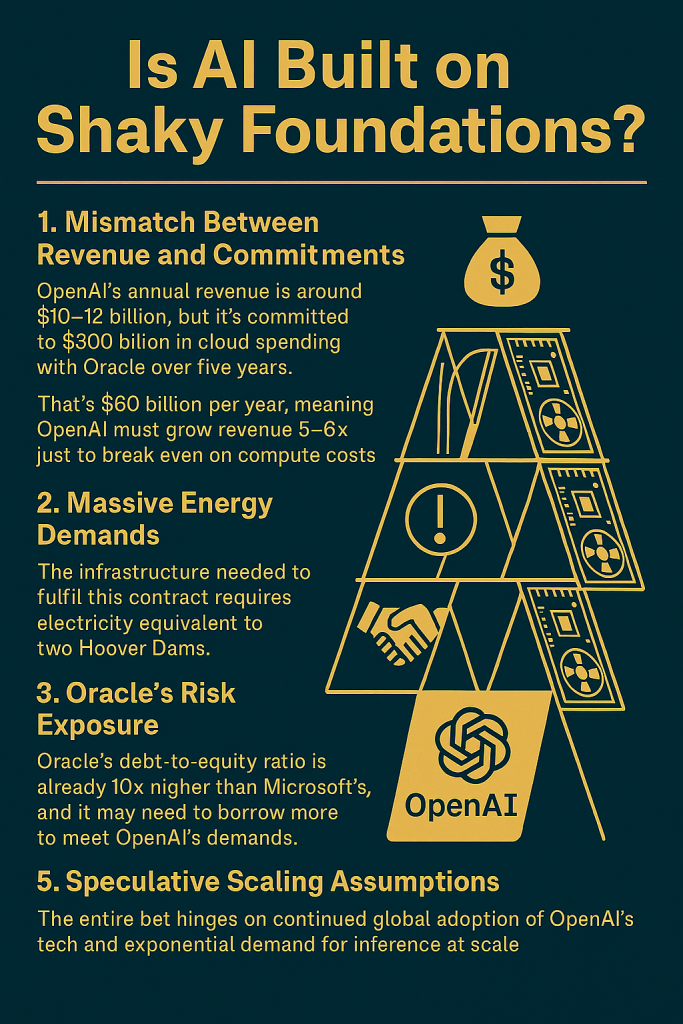
The AI infrastructure boom—especially the Oracle–OpenAI deal—is raising eyebrows because the financial and operational foundations look more speculative than solid.

Here’s why some analysts are calling it a potential house of cards

⚠️ 1. Mismatch Between Revenue and Commitments

  • OpenAI’s annual revenue is reportedly around $10–12 billion, but it’s committed to $300 billion in cloud spending with Oracle over five years.
  • That’s $60 billion per year, meaning OpenAI would need to grow revenue 5–6x just to break even on compute costs.
  • CEO Sam Altman projects $44 billion in losses before profitability in 2029.

🔌 2. Massive Energy Demands

  • The infrastructure needed to fulfill this contract requires electricity equivalent to two Hoover Dams.
  • That’s not just expensive—it’s logistically daunting. Data centres are planned across five U.S. states, but power sourcing and environmental impact remain unclear.
AI House of Cards Infographic

💸 3. Oracle’s Risk Exposure

  • Oracle’s debt-to-equity ratio is already 10x higher than Microsoft’s, and it may need to borrow more to meet OpenAI’s demands.
  • The deal accounts for most of Oracle’s $317 billion backlog, tying its future growth to a single customer.

🔄 4. Shifting Alliances and Uncertain Lock-In

  • OpenAI recently ended its exclusive cloud deal with Microsoft, freeing it to sign with Oracle—but also introducing risk if future models are restricted by AGI clauses.
  • Microsoft is now integrating Anthropic’s Claude into Office 365, signalling a diversification away from OpenAI.

🧮 5. Speculative Scaling Assumptions

  • The entire bet hinges on continued global adoption of OpenAI’s tech and exponential demand for inference at scale.
  • If adoption plateaus or competitors leapfrog, the infrastructure could become overbuilt—echoing the dot-com frenzy of the early 2000s.

Is this a moment for the AI frenzy to take a breather?

U.S. zombie companies on the rise!

BIG tech creating Zombie companies

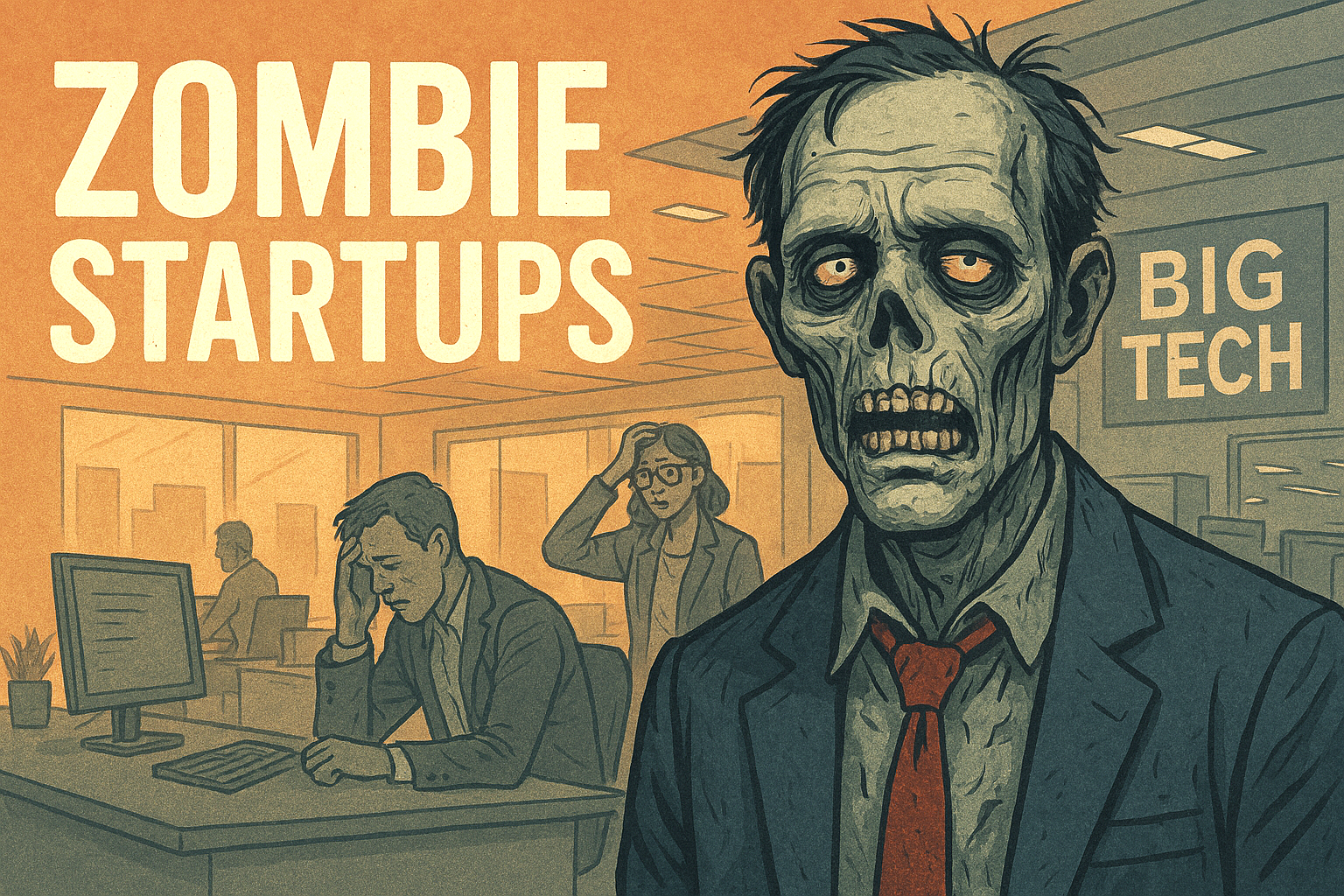
As BIG tech poaches top AI talent, these companies are stripped to the bone as the tech talent is being hollowed out!

In the race to dominate artificial intelligence, America’s tech giants are vacuuming up talent at an unprecedented pace.

But behind the headlines of billion-dollar acquisitions and flashy AI demos lies a quieter crisis. The creation of ‘zombie companies’ — startups left staggering and soulless after their brightest minds are poached by Big Tech.

These zombie firms aren’t dead, but they’re no longer truly alive either. They continue to operate, maintain websites, and pitch to investors, yet their core innovation engine has stalled. The problem isn’t just brain drain — it’s brain decapitation.

When a startup loses its founding engineers, lead researchers, or visionary product designers to the likes of Google, Meta, or Microsoft, what remains is often a shell with no clear path forward.

The allure is understandable. Big Tech offers salaries that dwarf startup equity, access to massive compute resources, and the prestige of working on frontier models. But the downstream effect is corrosive.

Startups, once the lifeblood of AI experimentation, are now struggling to retain talent long enough to reach product maturity. Some pivot to consultancy, others limp along with outsourced development, and many quietly fold — their IP absorbed, their vision diluted.

This phenomenon is particularly acute in the U.S., where venture capital encourages rapid scaling but rarely protects against talent attrition. The result is a growing class of companies that exist more for optics than output — kept alive by inertia, legacy funding, or the hope of acquisition.

They clutter the innovation landscape, making it harder for truly disruptive ideas to gain traction.

Ironically, Big Tech’s hunger for talent may be undermining the very ecosystem it depends on. By stripping startups of their creative lifeblood, it risks turning the AI sector into a monoculture. This culture is then dominated by a few players, with fewer voices and less diversity of thought.

The solution isn’t simple. It may require new funding models, stronger incentives for retention, or even regulatory scrutiny of talent acquisition practices.

But one thing is clear: if the U.S. wants to remain the global leader in AI, it must find a way to nurture its startups — not just harvest them.

Otherwise, the future of innovation may be haunted by the walking dead.

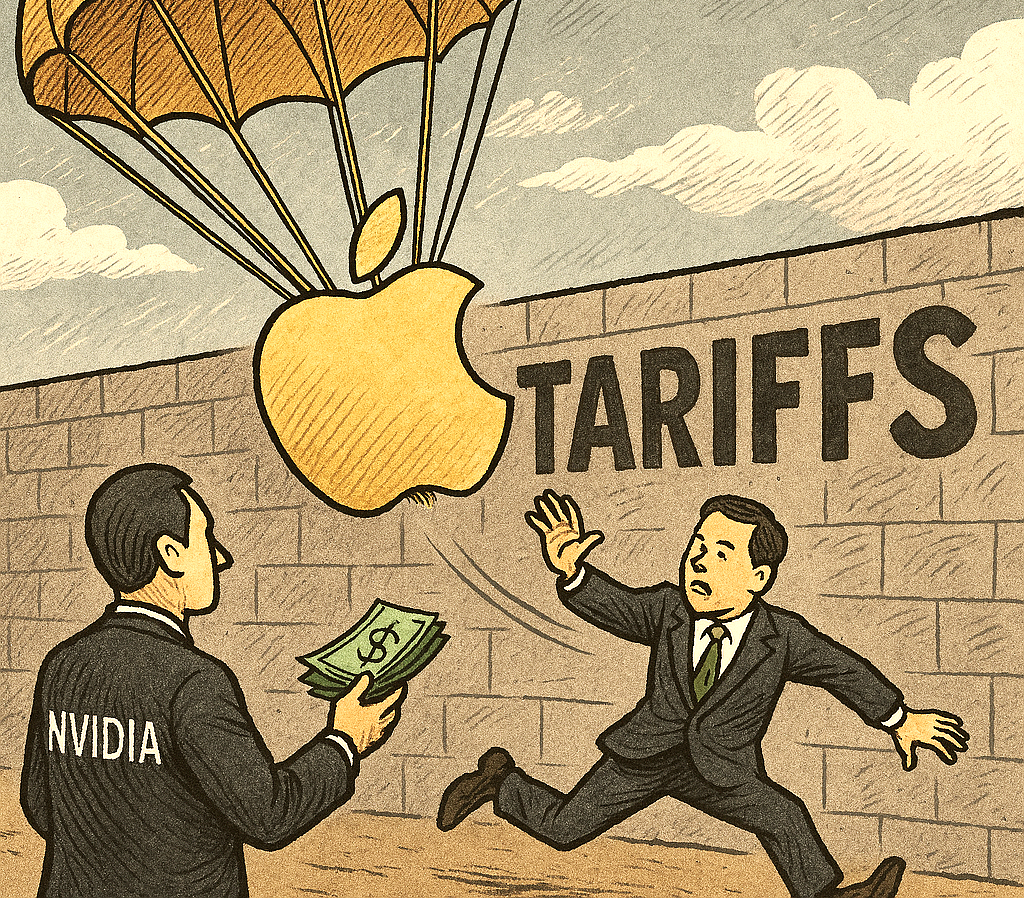
Is BIG tech being allowed to pay its way out of the tariff turmoil

BIG tech money aids tariff avoidance

Where is the standard for the tariff line? Is this fair on the smaller businesses and the consumer? Money buys a solution without fixing the problem!

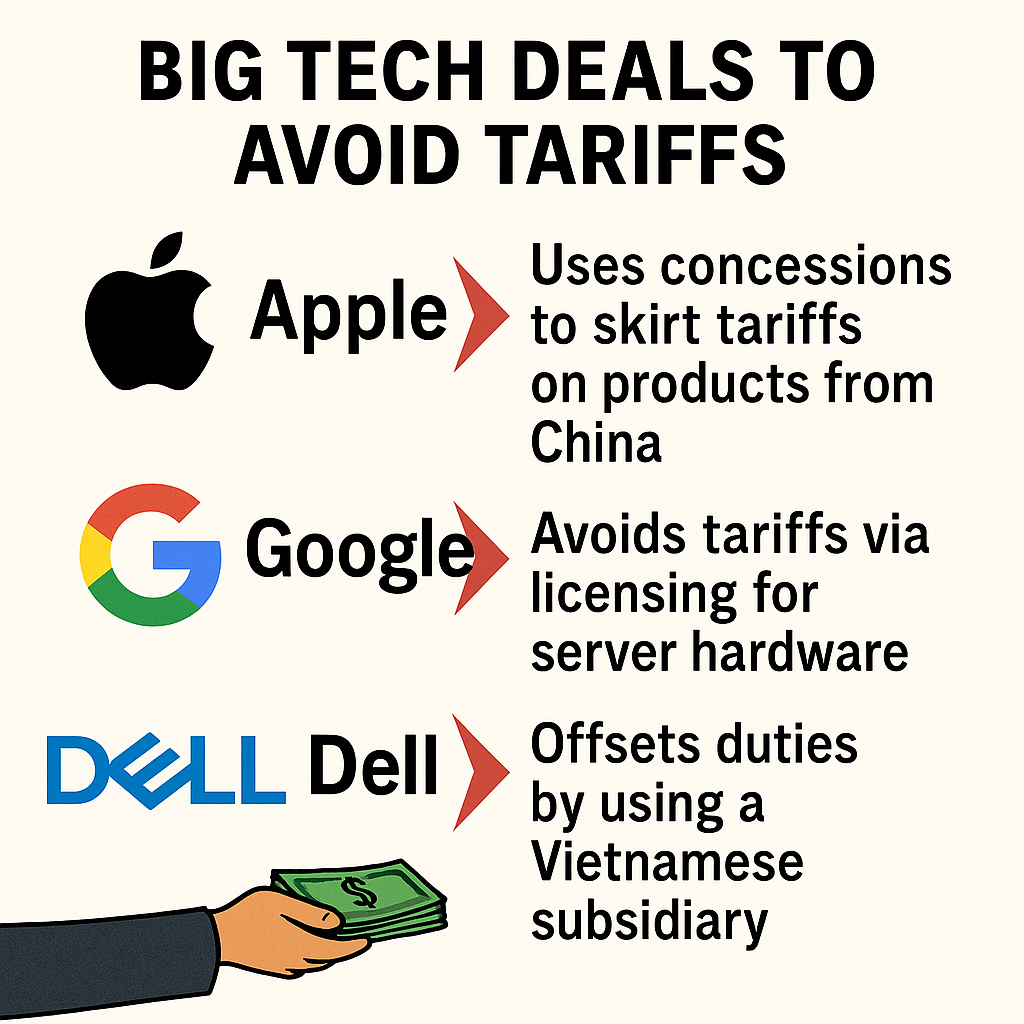
  • Nvidia and AMD have struck a deal with the U.S. government: they’ll pay 15% of their China chip sales revenues directly to Washington. This arrangement allows them to continue selling advanced chips to China despite looming export restrictions.
  • Apple, meanwhile, is going all-in on domestic investment. Tim Cook announced a $600 billion U.S. investment plan over four years, widely seen as a strategic move to dodge Trump’s proposed 100% tariffs on imported chips.

🧩 Strategic Motives

  • These deals are seen as tariff relief mechanisms, allowing companies to maintain access to key markets while appeasing the administration.
  • Analysts suggest Apple’s move could trigger a ‘domino effect’ across the tech sector, with other firms following suit to avoid punitive tariffs.
Tariff avoidance examples

⚖️ Legal & Investor Concerns

  • Some critics call the Nvidia/AMD deal a “shakedown” or even unconstitutional, likening it to a tax on exports.
  • Investors are wary of the arbitrary nature of these deals—questioning whether future administrations might play kingmaker with similar tactics.

Big Tech firms are striking strategic deals to sidestep escalating tariffs, with Apple pledging $600 billion in U.S. investments to avoid import duties, while Nvidia and AMD agree to pay 15% of their China chip revenues directly to Washington.

These moves are seen as calculated trade-offs—offering financial concessions or domestic reinvestment in exchange for continued market access. Critics argue such arrangements resemble export taxes or political bargaining, raising concerns about legality and precedent.

As tensions mount, these deals reflect a broader shift in how tech giants navigate geopolitical risk and regulatory pressure.

They buy a solution…

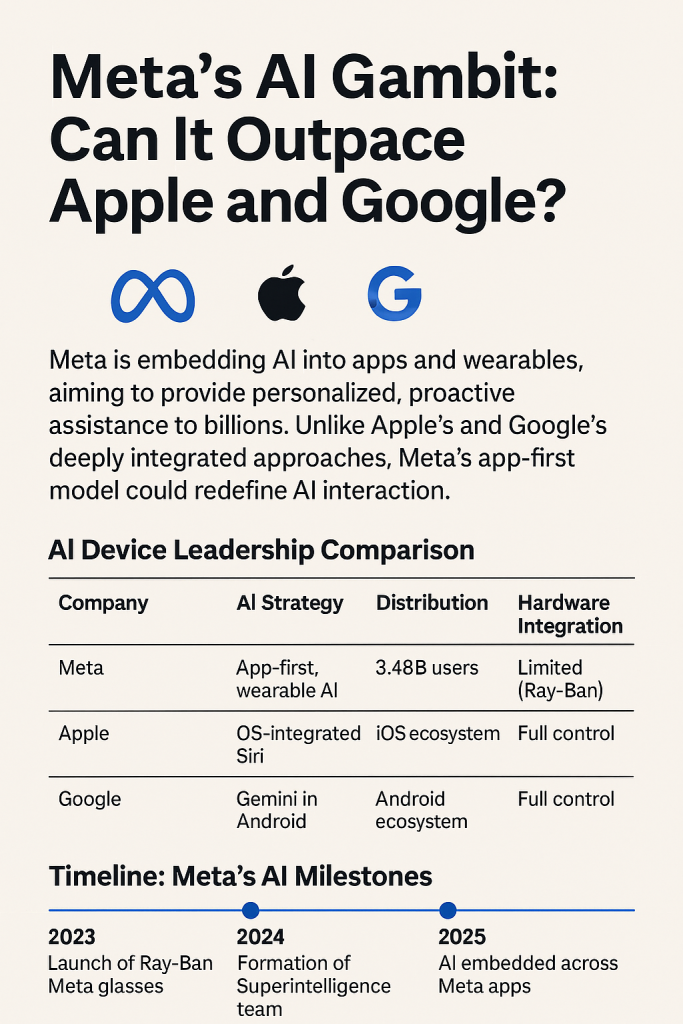
Meta’s AI power play: can it outmanoeuvre Apple and Google in the device race?

META device race

Meta is making a serious play to become the dominant force in AI-powered consumer devices, and it’s not just hype—it’s backed by aggressive strategy, talent acquisition, and a unique distribution advantage.

🧠 Meta’s Strategic Edge in AI Devices

1. Massive User Base

  • Meta has direct access to 3.48 billion daily active users across Facebook, Instagram, WhatsApp, and Messenger.
  • This gives it an unparalleled distribution channel for deploying AI features instantly across billions of devices.

2. Platform-Agnostic Approach

  • Unlike Apple and Google, which tightly integrate AI into their operating systems, Meta is bypassing OS gatekeepers by embedding AI into apps and wearables.
  • It’s partnering with chipmakers like Qualcomm and MediaTek to optimize AI performance on mobile hardware.

3. Talent Acquisition Blitz

  • Meta poached Ruoming Pang, Apple’s head of AI models, and Alexandr Wang, co-founder of ScaleAI, to lead its Superintelligence group.
  • This group aims to build AI that’s smarter than humans—an ambitious goal that’s drawing top-tier talent from rivals.

4. Proprietary Data Advantage

  • Meta’s access to real-time, personal communication and social media data is considered one of the most valuable datasets for training consumer-facing AI.
  • This gives it a leg up in personalization and contextual understanding.

🍏 Apple and Google: Still Strong, But Vulnerable

Apple

  • Struggled with its in-house AI models, reportedly considering outsourcing to OpenAI or Anthropic for Siri upgrades.
  • Losing this battle could signal deeper issues in Apple’s AI roadmap.

Google

  • Has robust AI infrastructure and Gemini models, but faces competition from Meta’s nimble, app-based deployment strategy.

🔮 Could Meta Win?

Meta’s approach is disruptive: it’s not trying to own the OS—it’s trying to own the AI interface. If it continues to scale its AI across apps, smart glasses (like Ray-Ban Meta), and future AR devices, it could redefine how users interact with AI daily.

That said, Apple and Google still control the hardware and OS ecosystems, which gives them deep integration advantages. Meta’s success will depend on whether users prefer AI embedded in apps and wearables over OS-level assistants.

1. AI Device Leadership Comparison

CompanyAI StrategyDistributionHardware Integration
MetaApp-first, wearable AI3.48B usersLimited (Ray-Ban)
AppleOS-integrated SiriiOS ecosystemFull control
GoogleGemini in AndroidAndroid ecosystemFull control

2. Timeline: Meta’s AI Milestones

  • 2023: Launch of Ray-Ban Meta glasses
  • 2024: Formation of Superintelligence team
  • 2025: AI embedded across Meta apps

Remember, Meta has direct access to nearly 3.50 billion users on a daily basis across Facebook, Instagram, WhatsApp, and Messenger.

Bit of a worry, isn’t it?

But good for investors and traders.

Wall Street surges: S&P 500 breaks 6300 as tech optimism outpaces tariff tensions

Record highs!

The S&P 500 closed above 6,300 for the first time in history on Monday 21st July 2025, while the Nasdaq Composite notched yet another record, finishing at 20,974.17.

Investor enthusiasm for upcoming tech earnings has eclipsed broader concerns over looming global tariffs, fuelling a rally in major indexes.

Despite marginal losses in the Dow Jones Industrial Average, the tech-heavy Nasdaq rose 0.38% while the S&P 500 climbed 0.14%, buoyed by gains in heavyweights like Meta Platforms, Alphabet, and Amazon.

With over 60 S&P 500 companies having reported so far this earnings season, more than 85% have exceeded expectations, according to FactSet.

S&P 500 and Nasdaq Comp at new record highs 21st July 2025

redo the charts side by side and correct the S&P 500 value
S&P 500 and Nasdaq Comp at new record highs 21st July 2025

Alphabet shares advanced over 2% ahead of Wednesday’s results, and Tesla headlines the ‘Magnificent Seven’ group expected to drive the bulk of earnings growth this quarter. And not necessarily for the right reason.

Analysts reportedly expect the group to deliver 14% growth year-on-year, far outpacing the remaining S&P constituents’ average of 3.4%.

S&P 500

Despite tariff tensions simmering — with the U.S. setting a 1st August deadline for levy enforcement — investor sentiment remains bullish.

Bank of America estimates Q2 earnings are tracking a 5% annual increase, suggesting resilience amid geopolitical headwinds.

Strategists warn of potential volatility, as earnings surprises or policy shifts could spark swift market reactions.

Still, some analysts see space for further upside, projecting a potential S&P climb to 6,600 before any meaningful pullback.

As the tech titans prepare to report, all eyes are on whether optimism can keep the rally alive — or if tariffs will return to centre stage.

From FANG stocks, MAG 7 stocks to AI – the tech titans just keep giving.

But when will it overload?

AI creates paradigm shift in computing – programming AI is like training a person

Teaching or programing?

At London Tech Week, Nvidia CEO Jensen Huang made a striking statement: “The way you program an AI is like the way you program a person.” (Do we really program people or do we teach)?

This marks a fundamental shift in how we interact with artificial intelligence, moving away from traditional coding languages and towards natural human communication.

Historically, programming required specialised knowledge of languages like C++ or Python. Developers had to meticulously craft instructions for computers to follow.

Huang argues that AI has now evolved to understand and respond to human language, making programming more intuitive and accessible.

This transformation is largely driven by advancements in conversational AI models, such as ChatGPT, Gemini, and Copilot.

These systems allow users to issue commands in plain English – whether asking an AI to generate images, write a poem, or even create software code. Instead of writing complex algorithms, users can simply ask nicely, much like instructing a colleague or student.

Huang’s analogy extends beyond convenience. Just as people learn through feedback and iteration, AI models refine their responses based on user input.

If an AI-generated poem isn’t quite right, users can prompt it to improve, and it will think and adjust accordingly.

This iterative process mirrors human learning, where guidance and refinement lead to better outcomes.

The implications of this shift are profound. AI is no longer just a tool for experts – it is a great equalizer, enabling anyone to harness computing power without technical expertise.

As businesses integrate AI into their workflows, employees will need to adapt, treating AI as a collaborative partner rather than a mere machine.

This evolution in AI programming is not just about efficiency; it represents a new era where technology aligns more closely with human thought and interaction.

Dow closed 700 points lower Friday 28th March 2025 as inflation and tariff fears worsen

Dow down

Stocks sold off sharply on Friday 28th March 2025, pressured by growing uncertainty on U.S. trade policy as well as a grim outlook on inflation

The Dow Jones Industrial Average closed down 715 points at 41,583. The S&P 500 lost 1.97% to close 5,580 ending the week down for the fifth time in the last six weeks. The Nasdaq Composite plunged 2.7% to 17,322.

Shares of several technology giants also fell putting pressure on the broader market. Google-parent Alphabet lost 4.9%, while Meta and Amazon each shed 4.3%.

This week, the S&P 500 lost 1.53%, while the 30-stock Dow shed 0.96%. The Nasdaq declined by 2.59%. With this latest losing week, Nasdaq is now on pace for a more than 8% monthly decline, which would be its worst monthly performance since December 2022.

Dow Jones one-day chart (28th March 2025)

Dow Jones one-day chart (28th March 2025)

Stocks took a leg lower on Friday after the University of Michigan’s final read on consumer sentiment for March 2025 reflected the highest long-term inflation expectation since 1993.

Friday’s core personal consumption expenditures price index also came in hotter-than-expected, rising 2.8% in February and reflecting a 0.4% increase for the month, stoking concerns about persistent inflation.

Economists had reportedly been looking for respective numbers of 2.7% and 0.3%. Consumer spending accelerated 0.4% for the month, below the 0.5% forecast, according to fresh data from the Bureau of Economic Analysis.

The market is getting squeezed by both sides. There is uncertainty about reciprocal tariffs hitting the major exporting sectors like tech alongside concerns about a weakening consumer facing higher prices

Trump’s tariffs push will hit the U.S. harder than Europe in the short term, it has been reported.

Japan’s Nikkei enters correction as Trump’s tariff assault drives sell-off in Asia markets

U.S. tech giants are betting big on humanoid robots

Humanoid robots

U.S. tech giants are making bold strides in the development of humanoid robots, signalling a transformative shift in the robotics industry

Companies like Tesla, Google, Microsoft, and Nvidia are investing heavily in this cutting-edge technology, aiming to create machines that mimic human movement and behaviour.

These humanoid robots are envisioned to revolutionise industries ranging from manufacturing to healthcare, offering solutions to labor shortages and enhancing productivity.

Tesla’s Optimus project is a prime example of this ambition. CEO Elon Musk has announced plans to produce thousands of these robots, designed to perform repetitive and physically demanding tasks.

Optimus robots are expected to integrate seamlessly into factory settings, reducing the need for human intervention in hazardous environments.

Similarly, Boston Dynamics, known for its agile robots, continues to push the boundaries of what humanoid machines can achieve, focusing on tasks that require precision and adaptability.

The integration of artificial intelligence (AI) is a driving force behind these advancements. AI enables robots to learn from their environments, adapt to new tasks, and interact with humans in more intuitive ways.

Companies like Nvidia are leveraging their expertise in AI and machine learning are helping to develop robots capable of complex decision-making and problem-solving.

However, challenges remain. High production costs, limited battery life, and safety concerns are significant hurdles that need to be addressed before humanoid robots can achieve widespread adoption.

Despite these obstacles, the potential benefits are immense. From assisting the elderly to performing intricate surgeries, humanoid robots could redefine the boundaries of human capability.

As U.S. tech giants continue to innovate, the race to dominate the humanoid robotics market intensifies.

Tesla Optimus Gen 2

With China and other nations also making significant investments, the competition is fierce. Analysts warn that U.S. firms could lose out to China, which aims to replicate its success with electric vehicles in the robotics space race.

The future of humanoid robots promises to be a fascinating blend of technology, creativity, and global collaboration

U.S. companies that may benefit from this AI humanoid tech advancement

Tesla: Known for its Optimus humanoid robot project, Tesla is pushing boundaries in robotics and AI.

Google (Alphabet): A leader in AI and robotics research, with projects aimed at enhancing humanoid capabilities.

Microsoft: Investing in AI technologies that support robotics and automation.

Nvidia: Provides advanced AI chips and systems crucial for humanoid robot development.
Boston Dynamics: Famous for its agile robots like Atlas, focusing on precision and adaptability.

Agility Robotics: Creator of Digit, a humanoid robot designed for logistics and manufacturing.

Meta (Facebook): Exploring humanoid robots for social and interactive applications.

Apple: Investing in robotics and AI for potential humanoid advancements.

Amazon: Developing robots like Astro for home monitoring and other tasks.

Figure AI: Innovating humanoid robots like Figure 02 for various industries.

Bill Gates on AI

Bill Gates has shared some fascinating insights about AI recently. He reportedly believes that within the next decade, AI will transform many industries, making specialised knowledge widely accessible.

For example, he predicts that AI could provide high-quality medical advice and tutoring, addressing global shortages of doctors and educators.

Gates has also described this shift as the ‘age of free intelligence,’ where AI becomes a commonplace tool integrated into everyday life. While he acknowledges the immense potential of AI to solve global challenges – like developing breakthrough treatments for diseases and innovative solutions for climate change – he also recognises the disruptive impact it could have on jobs and the workforce.

Despite these concerns, Gates remains optimistic about AI’s ability to drive innovation and improve lives.

He has emphasised that certain human activities, like playing sports or hosting talk shows, will likely remain uniquely human.

However, despite all these predictions from powerful tech leaders – it does beg the question, do these ultra rich CEOs predict the future, or simply make it?

What if Quantum Physics coincides and collides with the ‘full’ arrival of AI and humanoid robots

Quantum computing could enhance the capabilities of AI-powered robots by solving complex optimisation problems, improving machine learning algorithms, and enabling real-time decision-making.

For instance, robots equipped with quantum sensors could navigate intricate environments, detect subtle changes in their surroundings, and interact with humans in more intuitive ways.

This fusion could revolutionise industries such as healthcare, manufacturing, and space exploration. Imagine humanoid robots performing intricate surgeries with precision, managing large-scale logistics, or exploring distant planets with advanced problem-solving abilities.

However, this convergence also raises ethical and societal questions. The potential for such powerful technologies to disrupt industries, impact employment, and challenge privacy norms must be carefully managed.

Collaboration between scientists, policymakers, and ethicists will be crucial to ensure these advancements benefit humanity as a whole.

The intersection of quantum physics, AI, and humanoid robotics is not just a technological milestone – it’s a glimpse into a future where the boundaries of human capability and machine intelligence blur.

It’s an exciting, albeit complex future humans are creating.

But will AI surpass human intelligence – and if it does what then for the human civilisation?

Access videos of Tesla robots here

Artificial intelligence capable of matching humans at any task will be available within five ten years

AI

Artificial General Intelligence (AGI), a form of AI capable of matching or surpassing human intelligence across all tasks, is expected to emerge within the next five to ten years, according to Demis Hassabis, CEO of Google DeepMind.

Speaking recently, Hassabis highlighted the advancements in AI systems that are paving the way for AGI.

While current AI excels in specific domains, such as playing complex games like chess or Go – it still lacks the ability to generalise knowledge and adapt to real-world challenges.

But the advancements made in AI chatbots such as ChatGPT from OpenAI and DeepSeek have showcased remarkable development, and at speed too. Applying AI to work environments, science and domestic tasks is forever expanding.

Hassabis emphasised that significant research is still required to achieve AGI. The focus lies on improving AI’s understanding of context and its ability to plan and reason in dynamic environments.

Multi-agent systems, where AI entities collaborate or compete, are seen as a promising avenue for development.
These systems aim to replicate the intricate decision-making processes humans exhibit in complex scenarios.

The implications of AGI are profound, with potential applications spanning healthcare, education, and beyond.

However, its development also raises ethical and societal questions, including concerns about control, safety, and equitable access.

While the timeline remains speculative, Hassabis’s insights underscore the accelerating pace of AI innovation, bringing humanity closer to a future where machines and humans collaborate in unprecedented ways.

Or not?

China’s AI vs U.S. AI – competition heats up – and that’s good for business – isn’t it?

DeepSeek AI

The escalating AI competition between the U.S. and China has taken a new turn with the emergence of DeepSeek, a Chinese AI startup that has introduced a low-cost AI model capable of rivaling the performance of OpenAI’s models.

This development has significant implications for data centres and the broader technology sector.

The rise of DeepSeek

DeepSeek’s recent breakthrough involves the development of two AI models, V3 and R1, which have been created at a fraction of the cost compared to their Western counterparts.

The total training cost for these models is estimated at around $6 million, significantly lower than the billions spent by major U.S. tech firms. This has challenged the prevailing assumption that developing large AI models requires massive financial investments and access to cutting-edge hardware.

Impact on data centres

The introduction of cost-effective AI models like those developed by DeepSeek could lead to a shift in how data centers operate.

Traditional AI models require substantial computational power and energy, leading to high operational costs for data centers. DeepSeek’s models, which are less energy-intensive, could reduce these costs and make AI technology more accessible to a wider range of businesses and organizations.

Technological advancements

DeepSeek’s success also highlights the potential for innovation in AI without relying on the most advanced hardware.

This could encourage other companies to explore alternative approaches to AI development, fostering a more diverse and competitive landscape. Additionally, the open-source nature of DeepSeek’s models promotes collaborative innovation, allowing developers worldwide to customise and improve upon these models2.

Competitive dynamics

The competition between DeepSeek and OpenAI underscores the broader U.S.-China rivalry in the AI space. While DeepSeek’s models pose a limited immediate threat to well-funded U.S. AI labs, they demonstrate China’s growing capabilities in AI innovation.

This competition could drive both countries to invest more in AI research and development, leading to faster technological advancements and more robust AI applications.

Broader implications

The rise of DeepSeek and similar Chinese and other AI startups could have far-reaching implications for the global technology sector.

As AI becomes increasingly integrated into various industries, the ability to develop and deploy AI models efficiently will be crucial.

Data centres will need to adapt to these changes, potentially investing in more energy-efficient infrastructure and exploring new ways to support AI workloads.

Where from here?

DeepSeek’s emergence as a significant player in the AI race highlights the dynamic nature of technological competition between the U.S. and China.

While the immediate impact on data centres and technology may be limited, the long-term implications could be profound.

As AI continues to evolve, the ability to innovate cost-effectively and collaborate across borders will be key to driving progress and maintaining competitiveness in the global technology landscape.

Could DeepSeek deliver another shock to the stock market and to tech stocks in particular?

AI

DeepSeek’s impact probably isn’t yet fully reflected in U.S. stocks

The ramifications of the Chinese startup DeepSeek, with its promise of delivering cheaper and more energy-efficient alternatives to harness artificial intelligence (AI), have yet to be fully reflected in U.S. equities.

If DeepSeek ends up delivering a less costly way forward – it will make it much easier and cheaper for smaller more typical companies to create AI ‘agents’ or AI opportunities for their businesses.

Under this scenario there will be ‘useful’ and meaningful benefits from DeepSeek that could bring huge earnings potential for a broader mix of companies beyond the current AI heavyweights through greater efficiencies and productivity from less-expensive AI solutions.

AI spending race

When DeepSeek’s chatbot launched earlier this month in the U.S., it shocked Wall Street, prompting a historic $600 billion one-day wipeout for AI chip developer Nvidia.

It also put huge sums being pledged for AI infrastructure by U.S. mega cap tech companies under a microscope. Rather than back down, the U.S. spending race has intensified.

  • Meta’s Chief Executive Mark Zuckerberg spoke a week ago of spending ‘hundreds of billions of dollars’ on AI infrastructure in the coming years, after pledging $60 billion to $65 billion on AI this year.
  • Alphabet announced AI investment for 2025, a bigger figure than Wall Street was anticipating.
  • Google forecast $75 billion in capital expenditures in 2025, a bigger figure than Wall Street was anticipating.
  • Microsoft reported its cloud and AI spending grew 95% in its fiscal second quarter to $22.6 billion.
  • Amazon has reported big AI investment too.

The spending frenzy on anything AI sends the market into a spin. How much more has to be spent before we see capital expenditures reduced or decrease is anyone’s guess right now – but current levels of AI expenditure are high, and returns will be expected.

“When is enough, enough?”

Or more to the point you might ask – when is ‘enough’ too much?

Fresh AI-spending commitments helped lift shares of Nvidia on while we saw a slump for Tesla shares in the week.

China this week saw the U.S. slap new 10% tariffs, while Canada and Mexico saw Trump threaten but delay 25% tariffs by 30 days. China retaliated in kind.

Catching up with the ‘Magnificent Seven’

Despite the high scrutiny on AI stocks, there is also much renewed focus from investors on other areas of the market.

There has been a bit of a rotation – while tech has been under pressure, defensive and rate-sensitive parts of the market have been gaining. This seems to be an emerging pattern.

​But there should be reason for caution. For one thing, the growth rate of ‘Magnificent Seven’ earnings has been tailing off in recent quarters, especially since the group reached a 61% yearly rate in the fourth quarter of 2023 – the spend on AI investment has yet to fully appreciate the full return.

Forward analysts’ expectations have this percentage reportedly closer to 16% to 18% for the end of this year. 

But that also would move the group closer ​to the roughly 12% to 13% yearly growth rate expected for the rest of the companies in the S&P 500 index, potentially making the high valuations of the ‘Magnificent Seven’ tougher to justify.

One of the most surprising things of the past couple of weeks, given the news around DeepSeek and shocks on the trade front, is the fact that stocks were still close to their all-time highs.

The market is pretty resilient right now, but tech stocks are sitting at a very high valuation – a pullback is due, even a correction (in my opinion).

The arrival of DeepSeek creates an alternative ‘cheaper’ AI option and that will unravel the status quo.

Apple and Google shares fall after China reportedly launches probes into Apple App Store practices and Google’s anti-trust issues

Google and Apple probed

China Launches Probes into Google and Apple Over Antitrust Concerns

China has recently initiated investigations into both Google and Apple, raising concerns over potential antitrust violations.

The State Administration for Market Regulation (SAMR) is considering whether to formally investigate Apple’s App Store practices, particularly focusing on the fees Apple charges and its policies that block third-party payment providers. This move has already caused Apple’s shares to fall.

In addition to the probe into Apple, China has also opened a separate investigation into Google, although details about the focus of this investigation have not been disclosed. These probes come at a time when trade tensions between the U.S. and China are escalating under President Donald Trump’s administration.

Apple’s app store under scrutiny

Apple’s App Store has been under scrutiny globally, with regulators in Europe recently forcing the company to open up its App Store under the Digital Markets Act, allowing non-Apple companies to offer app stores and app developers to use third-party payment systems.

If the China probe goes ahead, it would pose further challenges for Apple in one of its largest markets, where it is already facing stiff competition from local companies such as Huawei.

Google

Google, on the other hand, has not yet commented on the specifics of the investigation, but the move highlights the increasing regulatory pressures faced by U.S. tech giants in China.

Both companies will need to navigate these investigations carefully as they continue to operate in a highly competitive and regulated environment.
The outcome of these probes could have significant implications for the tech industry, potentially leading to changes in how these companies operate in China and other markets.

As the investigations unfold, the world will be watching closely to see how Google and Apple respond to these regulatory challenges.

China’s DeepSeek low-cost challenger to AI rattles tech U.S. markets

China Deepseek AI

U.S. technology stocks plunged as Chinese startup DeepSeek sparked concerns over competitiveness in AI and America’s lead in the sector, triggering a global sell-off

DeepSeek launched a free, open-source large-language model in late December 2024, claiming it was developed in just two months at a cost of under $6 million.

The developments have stoked concerns about the large amounts of money big tech companies have been investing in AI models and data centres.

DeepSeek is a Chinese artificial intelligence startup that has recently gained significant attention in the AI world. Founded in 2023 by Liang Wenfeng, DeepSeek develops open-source large language models. The company is funded by High-Flyer, a hedge fund also founded by Wenfeng.

The AI models from DeepSeek have demonstrated impressive performance, rivaling some of the best chatbots in the world at a fraction of the cost. This has caused quite a stir in the tech industry, leading to significant drops in the stock prices of major AI-related firms.

The company’s latest model, DeepSeek-V3, is known for its efficiency and high performance across various benchmarks.

DeepSeek’s emergence challenges the notion that massive capital expenditure is necessary to achieve top-tier AI performance.

The company’s success has led to a re-evaluation of the AI market and has put pressure on other tech giants to innovate and reduce costs.

Trump announces massive U.S. AI investment backed by Oracle, OpenAI and Softbank

U.S. AI investment

President Donald Trump announced a joint venture with OpenAI, Oracle and Softbank to invest billions of dollars in artificial intelligence infrastructure in the U.S.

The project, dubbed Stargate, was unveiled at the White House by Trump, Softbank CEO Masayoshi Son, OpenAI CEO Sam Altman and Oracle co-founder Larry Ellison.

The executives committed to invest an initial $100 billion and up to $500 billion over the next four years in the project, which will be set up as a separate company.

Softbank’s Son had reportedly already promised a four-year, $100-billion investment when he recently visited then-President-elect Trump at his Mar-a-Lago resort.

And this new AI investment is over and above the investments from the likes of Microsoft, Google, Apple, Anthropic and many others already in progress.

UK wants to control its own AI direction – suggesting a divergence from the EU and U.S.

UK tech

The UK is charting its own course when it comes to regulating artificial intelligence, signaling a potential divergence from the approaches taken by the United States and the European Union. This move is part of a broader strategy to establish the UK as a global leader in AI technology.

UK AI framework

Britain’s minister for AI and digital government, Feryal Clark, emphasised the importance of the UK developing its own regulatory framework for AI.

She highlighted the government’s strong relationships with AI companies like OpenAI and Google DeepMind, which have voluntarily opened their models for safety testing. Prime Minister Keir Starmer echoed these sentiments, stating that the UK now has the freedom to regulate AI in a way that best suits its national interests following Brexit.

Unlike the EU, which has introduced comprehensive, pan-European legislation aimed at harmonising

AI rules across the bloc, the UK has so far refrained from enacting formal laws to regulate AI.

Instead, it has deferred to individual regulatory bodies to enforce existing rules on businesses developing and using AI. This approach contrasts with the EU’s risk-based regulation and the U.S.’s patchwork of state and local frameworks.

Labour Party Plan

During the Labour Party’s election campaign, there was a commitment to introducing regulations focusing on ‘frontier’ AI models, such as large language models like OpenAI’s GPT. However, the UK government has yet to confirm the details of proposed AI safety legislation, opting instead to consult with the industry before formalising any rules.

The UK’s AI Opportunities Action Plan, endorsed by tech entrepreneur Matt Clifford, outlines a comprehensive strategy to harness AI for economic growth.

The plan includes recommendations for scaling up AI capabilities, establishing AI growth zones, and creating a National Data Library to support AI research and innovation. The government has committed to implementing these recommendations, aiming to build a robust AI infrastructure and foster a pro-innovation regulatory environment.
Despite the ambitious plans, some industry leaders have expressed concerns about the lack of clear rules. Sachin Dev Duggal, CEO of AI startup Builder.ai, reportedly warned that proceeding without clear regulations could be ‘borderline reckless’.
He reportedly highlighted the need for the UK to leverage its data to build sovereign AI capabilities and create British success stories.

The UK’s decision to ‘do its own thing’ on AI regulation reflects its desire to tailor its approach to national interests and foster innovation.

While this strategy offers flexibility, it also presents challenges in terms of providing clear guidance and ensuring regulatory certainty for businesses. As the UK continues to develop its AI regulatory framework, it will be crucial to balance innovation with safety and public trust

What could quantum computing breakthrough ‘Willow’ mean for the future of Bitcoin and other cryptos

Crypto and quantum computing

The advent of quantum computing presents both opportunities and challenges for the field of cryptography, especially in relation to cryptocurrencies.

Quantum computers, leveraging the principles of quantum mechanics, have the potential to revolutionise computing by solving certain problems significantly faster than classical computers.

One of the primary concerns is the impact of quantum computing on cryptographic algorithms that underpin the security of cryptocurrencies like Bitcoin and Ethereum.

Traditional public-key cryptography, which relies on the difficulty of factoring large prime numbers or solving discrete logarithms, could be broken by a sufficiently powerful quantum computer. Algorithms such as RSA, ECC (Elliptic Curve Cryptography), and DSA (Digital Signature Algorithm) could become vulnerable, as quantum algorithms like Shor’s algorithm are capable of efficiently solving these problems.

This potential vulnerability poses a significant threat to the security and integrity of cryptocurrency transactions. If quantum computers can crack these cryptographic codes, they could potentially access private keys, allowing malicious actors to steal funds or forge transactions. As a result, the trust that underpins the entire cryptocurrency ecosystem could be eroded.

However, the quantum threat is not without its solutions. The field of post-quantum cryptography is actively developing new cryptographic algorithms that are resistant to quantum attacks.

These algorithms leverage mathematical problems believed to be hard even for quantum computers, such as lattice-based cryptography, hash-based cryptography, and multivariate polynomial cryptography.

Transitioning to post-quantum cryptographic algorithms is crucial for ensuring the long-term security of cryptocurrencies in a quantum computing era.

In conclusion, while quantum computing poses a formidable challenge to current cryptographic systems, proactive measures and the development of quantum-resistant algorithms can mitigate these risks.

The cryptocurrency industry must stay ahead of the curve, adopting new technologies and strategies to safeguard against potential quantum threats and ensure the continued security and trust in digital currencies.

It has been estimated that the arrival of quantum computer is at least 10 years away. But is that allowing for the use of AI in its creation?

What is Willow and Quantum Computing?

Willow is the start of a new era of ultra-powerful ‘quantum’ microchips designed by Google. Willow’s speed is almost incomprehensible – according to Google, it is able to perform a computation in under five minutes that would take one of today’s fastest supercomputers 10 septillion years to solve.

This new chip design will inevitably lead to new quantum innovations and computer design over the coming years.

Ten septillion is 10,000,000,000,000,000,000,000,000 years.

If you don’t understand (not many people do) what makes up quantum computing – there is a very simplified way simplified way of thinking about the breakthrough.

Imagine a maze and how a classical computer would try to find its way through the maze from start to finish. It would try one potential path at a time. A quantum computer would be able to try each path at the same time.

The quantum computer is coming. The only delay will be in design restrictions and the power needed to run the system.