Nvidia stock closes at all-time high, a day before earnings
Shares of Nvidia closed up 2.3% at an all-time high of $504 on Monday 20th November 2023. The record comes ahead of the company’s Q3 results due Tuesday 21st November 2023, when analysts are expecting to see revenue growth of over 170%.
And, if that’s not enough, the forecast for Q4, according to some analysts, is likely to show a number close to 200% growth.
Nvidia is still by far the market leader in GPUs for AI, but high prices and competition are fast becoming an issue.
Can Nvidia continue the AI ride and hold this remarkable market share position?
Sam Altman, the former CEO of OpenAI, who was fired last week in a controversial board decision.
According to the latest reports, Altman is joining Microsoft to lead a new AI research team that will focus on advanced and ethical AI development.
Altman is a well-known entrepreneur and investor who has been involved in several AI-related projects.
He was one of the co-founders of OpenAI, a research organization that aims to create artificial general intelligence (AGI) that can ‘benefit humanity without causing harm’ or being controlled by a few elite players.
Leadership and ideology clash
However, Altman’s vision and style clashed with some of the board members and researchers at OpenAI, who reportedly accused him of being too ambitious, secretive, and authoritarian. They also reportedly claimed that he was pursuing a dangerous goal of creating artificial superintelligence (ASI).
The disagreements escalated when Altman announced a partnership with Microsoft in 2023, which gave Microsoft exclusive access to OpenAI’s GPT-4 Turbo model, a powerful natural language processing system that can generate realistic text on any given topic.
Some of the OpenAI staff and community members reportedly felt let-down by this deal, which they saw as a violation of OpenAI’s original mission of creating and sharing ‘AI for the common good’.
On Friday 17th November 2023, the board of OpenAI voted to remove Altman as CEO, citing irreconcilable differences and lack of trust. He was replaced by Emmett Shear, the former CEO of Twitch, who promised to restore transparency and collaboration at OpenAI.
Altman to join Microsoft
Altman did not comment on his dismissal. However, on Monday 20th November 2023, he rocked the AI world by announcing he was joining Microsoft as the head of a new AI research team.
He reportedly said that he was excited to work with Microsoft’s talented people and that he would continue to pursue his vision of creating beneficial and ethical AI for humanity.
Altman’s move to Microsoft has sparked mixed opinions from the AI community. Some have praised him for his innovation and courage, others have criticized him for his arrogance and recklessness.
There were reports over weekend suggesting employees and investors including Microsoft were pushing for Mr Altman to be reinstated. Some employees resigned in support of Altman.
Some have expressed concern about the potential impact of his new role on the future of AI development and regulation.
Where do OpenAI, Microsoft and the AI go from here?
Nvidia has recently announced its latest high-end chip, the GH200 Grace Hopper Superchip, which is designed for training AI models at giant scale.
The GH200 is a breakthrough accelerated CPU that combines the NVIDIA Grace™ and Hopper™ architectures using NVIDIA® NVLink®-C2C to deliver a CPU+GPU coherent memory model for AI and HPC applications. The superchip delivers up to 10X higher performance for applications running terabytes of data, enabling scientists and researchers to reach unprecedented solutions for the world’s most complex problems.
The technical bit
The GH200 features 72 cores of Grace CPU outfitted with 480 GB of ECC LPDDR5X memory, as well as the GH100 compute GPU that is paired with 141 GB of HBM3E memory that comes in six 24 GB stacks and uses a 6,144-bit memory interface.
The GH200 also has a new 900 gigabytes per second (GB/s) coherent interface, which is 7X faster than PCIe Gen5, and supercharges accelerated computing and generative AI with HBM3 and HBM3e GPU memory. The GH200 can run all NVIDIA software stacks and platforms, including NVIDIA AI Enterprise, HPC SDK, and Omniverse™.
Nvidia unveils its newest GH200 high-end AI Superchip.
The GH200 is available as part of the NVIDIA DGX GH200, a massive memory supercomputer that fully connects 256 GH200 Superchips into a singular GPU. The DGX GH200 offers 144 terabytes (TB) of shared memory with linear scalability for giant AI models.
The DGX GH200 is a turnkey data centre-class solution that includes integrated software and white-glove services from NVIDIA, from design to deployment, to speed the ROI of AI.
The DGX GH200 is the only AI supercomputer that offers a massive, shared memory space of 144TB across 256 NVIDIA Grace Hopper Superchips, providing developers with nearly 500X more memory to build giant models.
ChatGPT, OpenAI’s chatbot is back online after experiencing a brief but major outage Wednesday am, 8th November 2023.
The chatbot began returning errors before 9 a.m. ET, affecting OpenAI’s API users, which are used by more than two million developers. ChatGPT users were also told that ‘ChatGPT is at capacity right now’ and a status page referred to the issue as a ‘major outage’.
‘We’ve identified an issue resulting in high error rates across the API and ChatGPT, and we are working on remediation’, OpenAI shared in a status report at 9:50 a.m. ET.
Full services were restored by about 10:50 a.m. ET.
Microsoft ended Tuesday’s trading session at a record high of $360.53, following fresh optimism about growth from a key partner in artificial intelligence (AI). The increase gives the company a market value of about $2.68 trillion.
At a tech event on Monday 6th November 2023, Microsoft’s AI partner, OpenAI, announced a batch of updates, including price cuts and plans to allow people to make custom versions of the ChatGPT chatbot.
Microsoft CEO Satya Nadella attended and emphasized that developers building applications with OpenAI’s tools could get to market quickly by deploying their software on Microsoft’s Azure cloud infrastructure.
Microsoft has invested a reported $13 billion in OpenAI, which has granted Microsoft an exclusive licence on OpenAI’s GPT-4 large language model that can generate human-like prose in response to a few words of text.
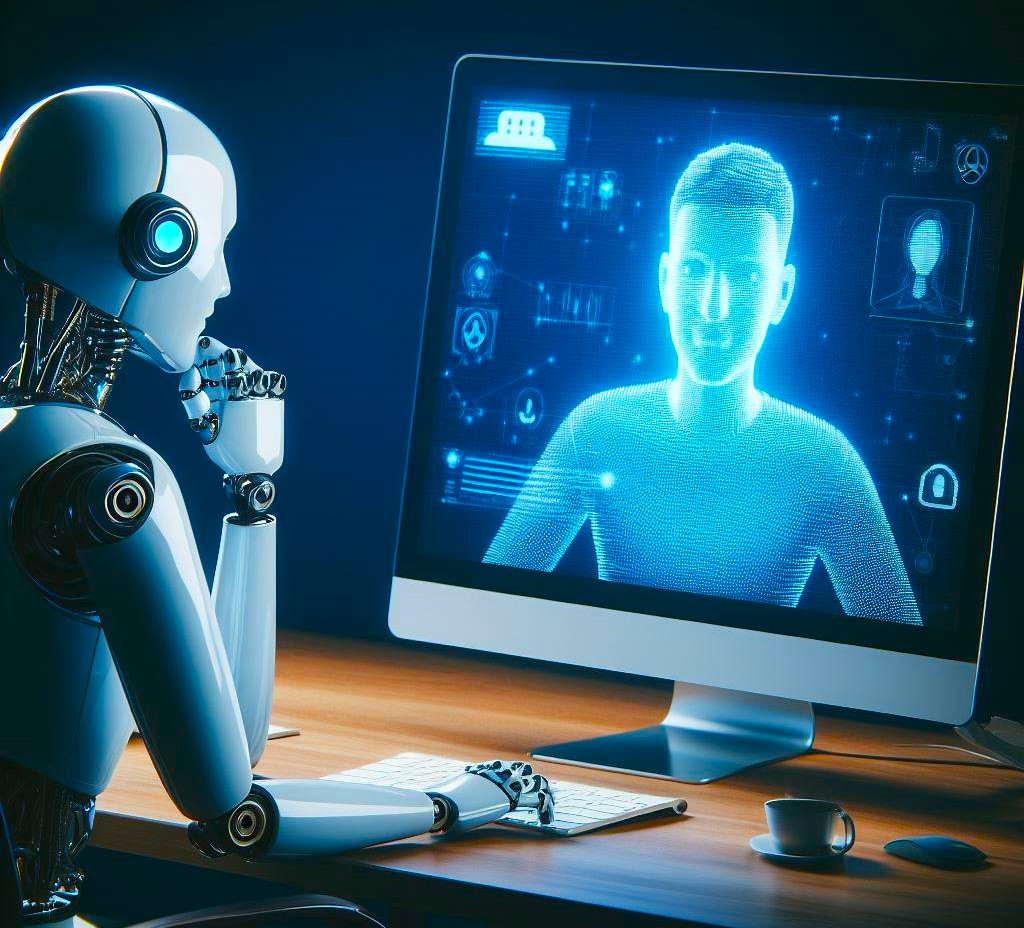
Fictitious AI robot learning from a digital human online
Last week, Microsoft announced the release of an AI add-on for its Office productivity app subscriptions and an assistant in Windows 11, both of which rely on OpenAI models.
The future is looking bright for Microsoft right now.
An old well established and trusted tech brand pivoting to AI that has a high dividend yield is IBM, which has been around for more than a century and is known for both its hardware and software products.
IBM is investing heavily in AI, cloud computing, and quantum computing, and has recently acquired several AI start-ups, such as Instana, Turbonomic, and Waeg.
IBM also has a partnership with OpenAI, one of the leading AI research organizations, to provide cloud infrastructure for its AI models.
Investors who love IBM expect the company to grow its earnings by around 10% annually over the next five years. Investors were also impressed with IBM’s dividend yield, which is currently around 4.5%. Dividends are a great way to generate passive income.
IBM is not the only tech company that is pivoting to AI. Google, Microsoft, and Anthropic are competing in the field of generative AI, which can create text, images, music, and more from natural language prompts.
Integrate generative AI
These companies are attempting to integrate generative AI into their products and services, such as search engines, maps, word processors, office applications, chatbots, and more. Generative AI is seen as a game-changer for many industries and applications, and could potentially disrupt the dominance of Big Tech.
Legacy companies can pivot to a platform model, which is a business strategy that connects producers and consumers of value through a digital interface. Platform companies like Facebook, Amazon, Google, and Tencent have created value at stunning rates, and have grown rapidly and own large market shares.
IBM mainframe from the 1970’s
Legacy companies can leverage their existing systems, such as customer relationships, data, and brand recognition, to create platforms that offer impressive and immersive products and services.
Other successful platform pivots are Disney+, which transformed Disney from a media producer to a media platform; Nike+, which connected Nike’s physical products with digital services; and John Deere, which created a platform for precision agriculture.
Grok is a neologism (a newly coined word or expression), referenced by Robert A. Heinlein for his 1961 science fiction novel Stranger in a Strange Land. It means to understand something so deeply that you become one with it.
Grok is a term used in computer programming to mean to ‘profoundly understand something‘, such as a system, a language, or an algorithm.
Elon Musk’s Grok
Elon Musk debuts ‘Grok’ AI bot to rival ChatGPT and others. But, ‘Grok’ isn’t quite ready yet for the general public – it still has some learning to do. xAI, Elon Musk’s new AI venture, launched its first AI chatbot technology named ‘Grok’.
The prototype is in its infancy and early stages of training and is only available to a select group of users before a wider release.
Elon Musk debuts ‘Grok’ AI bot to rival ChatGPT and others. But, ‘Grok’ isn’t quite ready yet for the general public – it still has some learning to do…
Musk is positioning xAI to compete with OpenAI, Inflection, Anthropic and others.
Less woke
Grok, the company said, is modelled on‘The Hitchhiker’s Guide to the Galaxy’. It is supposed to have ‘a bit of wit, a rebellious streak’ and it should answer the ‘spicy questions’ that other AI might dodge, according to a statement from xAI.
Grok, the company said, is modelled on ‘The Hitchhiker’s Guide to the Galaxy’.
The company’s published mandate is to build artificial intelligence ‘to advance our collective understanding of the universe’. Musk has previously said that he believes today’s AI makers are bending too far toward ‘politically correct’ systems.
xAI’s mission, it reportedly said, ‘is to create AI for people of all backgrounds and political views’.
Future AI
Self-driving car technology, an AI Chatbot built around humour with access to current public data through X, a robot called Optimus and Musk’s drive for the ‘different’. If you add all this together, X.ai, through Musk, is likely positioning itself for the next big push in AI…
There is some evidence that AI could create the next financial crisis, according to some experts and regulators.
AI scenarios
AI could increase the complexity and opacity of financial markets, making it harder to monitor and prevent systemic risks. For example, AI could enable new forms of market manipulation, fraud, or cyberattacks that could destabilize the financial system.
AI could create feedback loops or cascading effects that could amplify shocks and cause contagion across different sectors and regions. For example, AI could trigger flash crashes or sudden liquidity shortages that could spread rapidly and disrupt market functioning.
AI could create new sources of concentration and interdependence that could increase the vulnerability of the financial system. For example, AI could create a reliance on a few dominant data providers, platforms, or models that could fail or malfunction.
AI bots could take control of a stock trading platform or worse a stock exchange.
These are some of the possible scenarios that AI could create the next financial crisis. However, there are many potential benefits and opportunities that AI could bring to the financial sector, such as enhancing efficiency and innovation and even enhancing easier access and personal financial control for millions of investors and savers.
AI could lead to the next financial crash! It could also enhance personal financial control.
The White House has announced what it is calling ‘the most significant actions ever taken by any government to advance the field of AI safety’.
Oh really! Coincidence or deliberate attempt to undermine the UK AI safety drive?
This news comes as the UK draws attention hosting a UK led AI summit. The U.S. wants to police and control the AI arena too as it does most other aspects of our life.
Biden order
An executive order from President Biden requires Artificial Intelligence AI developers to share safety results with the U.S. government. It is an attempt to place the U.S, at the centre of the global debate on AI governance.
However, this is a position the UK government has already engineered as the UK AI safety summit gets underway this week. The UK desires to place itself at the centre of AI governance.
U.S. executive order
The U.S. executive order from Biden suggests the U.S. fancies itself as the leader of global AI governance in terms of how to address such threats or does it simply want to stamp its authority in the AI world. It tried to do the same with cryptocurrencies but fundamentally failed.
U.S. measures include
Creating new safety and security standards for AI, including measures that require AI companies to share safety test results with the federal government.
Protecting consumer privacy, by creating guidelines that agencies can use to evaluate privacy techniques used in AI.
Helping to stop AI algorithms discriminate and creating best practices on the appropriate role of AI in the justice system.
Creating a program to evaluate potentially harmful AI related healthcare practices and creating resources on how educators can responsibly use AI tools
Working with international partners to implement AI standards around the world.
UK AI summit
The UK summit is referenced in the executive order. But it’s mentioned under the heading of ‘advancing American leadership abroad’ – indicating that the U.S. very clearly knows that it is the big player here alongside China.
The UK is determined to position itself as a global leader in the space of trying to minimise the risks posed by this powerful technology.
However, U.S. Vice President Kamala Harris and top executives from the U.S. tech giants are arriving in the UK this week to discuss AI safety at the UK government’s AI Summit, which it has billed as a ‘world first’.
The summit, hosted by UK Prime Minister Rishi Sunak, will focus on the growing fears about the implications of so-called frontier AI. President of the EU Commission Ursula von der Leyen and UN Secretary-General Antonio Guterres will also be in attendance.
The UK is determined to position itself as a global leader in the space of trying to minimise the risks posed by this powerful technology.
But the U.S. as usual, will want to be in control…
Apple and generative AI technology is a topic that has been generating a lot of interest and speculation lately.
According to various reports, Apple is working on developing its own large language model and chatbot, which could potentially enhance its products and services with new features and capabilities. However, some analysts and experts have also raised questions about whether Apple has missed an opportunity to be a leader in the generative AI field, as it seems to be lagging behind its competitors such as Google, Microsoft, and OpenAI.
Apple uses AI in its products but hasn’t launched a generative AI product along the lines of OpenAI’s ChatGPT or Google Bard. Instead, Apple’s AI is used for improving photos and autocorrecting text.
$1 billion per year plan
Apple is on track to spend $1 billion per year on developing its generative artificial intelligence products, Bloomberg reported.
Apple is looking to use AI to improve Siri, Messages and Apple Music.
The spending comes as the company plays catch-up to some competitors who have already debuted new AI products and features, such as Google, Microsoft and Amazon.
Apple was caught flat-footed when ChatGPT and other AI tools took the technology industry by storm.
Generative AI
Generative AI is a subfield of artificial intelligence that focuses on creating content such as text, images, videos, music, and more, based on data and algorithms. One of the most popular examples of generative AI is ChatGPT, a chatbot that can respond to questions and other prompts in a natural and human-like way.
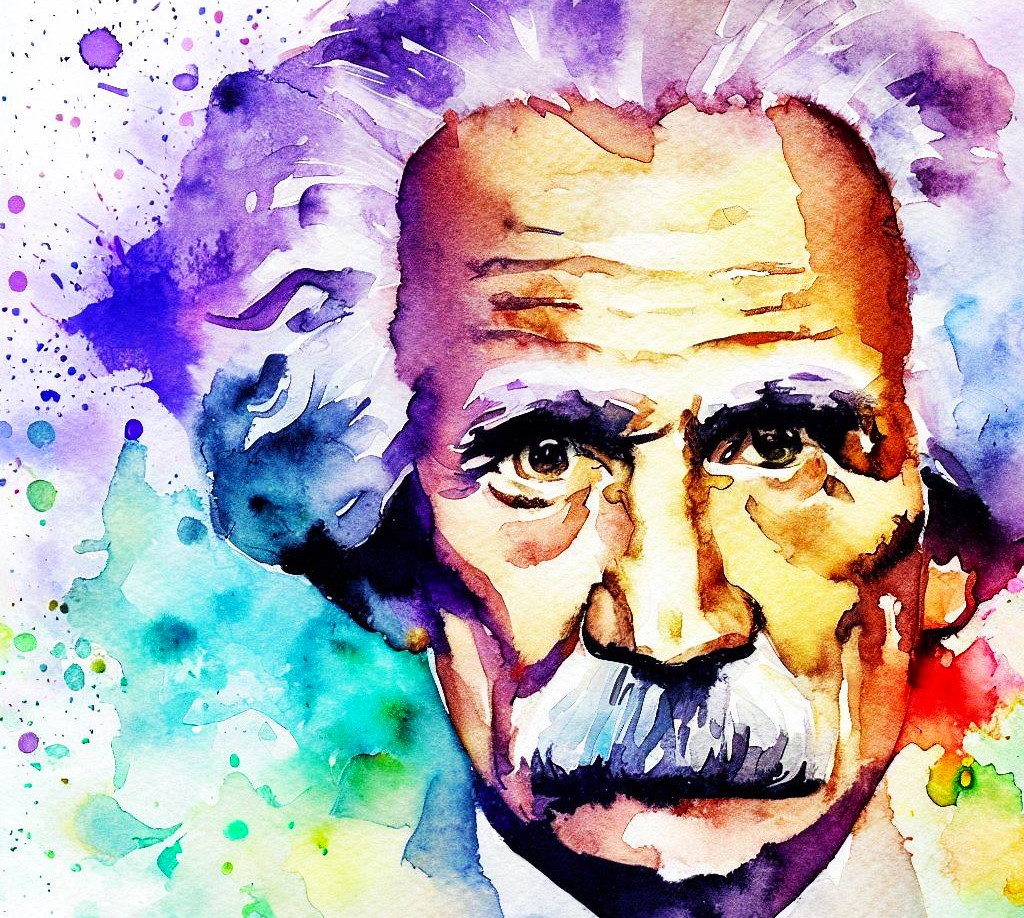
Watercolour artwork impression – ChatGPT was released by OpenAI in 2022, and since then, it has been widely used and improved by various companies and researchers.
ChatGPT was released by OpenAI in 2022, and since then, it has been widely used and improved by various companies and researchers.
Apple slow response
Apple, on the other hand, has been relatively quiet about its generative AI efforts, until recently. In October 2023, Bloomberg reported that Apple was internally testing a ‘ChatGPT-like’ chatbot nicknamed ‘Apple GPT’, but it had not devised a clear strategy for releasing generative AI tools to the public. Apple’s CEO Tim Cook also confirmed that the company was working on generative AI for years, but it was approaching it ‘really thoughtfully and think about it deeply’ because of the potential risks and challenges.
Potential challenges Apple faces in developing and deploying generative AI
Privacy
Apple has always been more cautious than its competitors in handling user data, and it has built its reputation on being a privacy-focused company. However, generative AI requires a lot of data to train and improve its models, which could pose a dilemma for Apple. How can it balance the need for data with the respect for user privacy? How can it ensure that its generative AI does not leak or misuse personal information?
Design
Apple is known for its elegant and intuitive design philosophy, which applies to both its hardware and software products. However, generative AI is a complex and unpredictable technology, which could challenge Apple’s design principles. How can it make its generative AI features easy to use and understand for its customers? How can it avoid confusing or misleading users with its generative AI outputs?
Ethics
Apple has always been mindful of the social and ethical implications of its products, and it has often taken a stance on issues such as human rights, environmental sustainability, and diversity. However, generative AI could raise new ethical concerns, such as bias, misinformation and manipulation. But then that is a common problem for all generative AI systems.
Generative AI could raise new ethical concerns, such as bias, misinformation and manipulation.
These are some of the questions that Apple needs to answer before it can launch its generative AI products to the public. It is possible that Apple is taking its time to address these issues carefully and thoroughly, as it has done in the past with other technologies such as Face ID or Apple Pay. However, it is also possible that Apple has missed an opportunity to be a pioneer in the generative AI field, as it has done in the past with other technologies such as smart speakers or cloud computing.
While Apple is working on its generative AI projects internally, its competitors are already offering generative AI.
Google
Google has integrated its large language model LaMDA into various products and services, such as Google Assistant, Google Photos, Google Docs, Google Translate etc. LaMDA can generate natural and conversational responses to any query or prompt, as well as create images and videos based on text descriptions.
Microsoft
Microsoft has acquired OpenAI’s ChatGPT technology and made it available through its Azure cloud platform. ChatGPT can be used by developers and businesses to create chatbots, voice assistants, content generators, and more. Microsoft has also integrated ChatGPT into some of its products such as Outlook, Teams, PowerPoint, and more.
Amazon
Amazon has launched Alexa Conversations, a feature that allows Alexa users to have more natural and engaging conversations with the voice assistant. Alexa Conversations can also leverage Amazon’s vast e-commerce data to provide personalized recommendations and suggestions to users.
These are just some examples of how generative AI is being used by Apple’s competitors.
Robot chatting to human chatbot online
Apple has missed an opportunity to be a leader in the generative AI field by being too slow or too cautious in developing and deploying its own generative AI products.
However, it is highly likely that Apple is waiting for the right moment to surprise everyone with its innovative and unique generative AI features that will set it apart from its competitors.
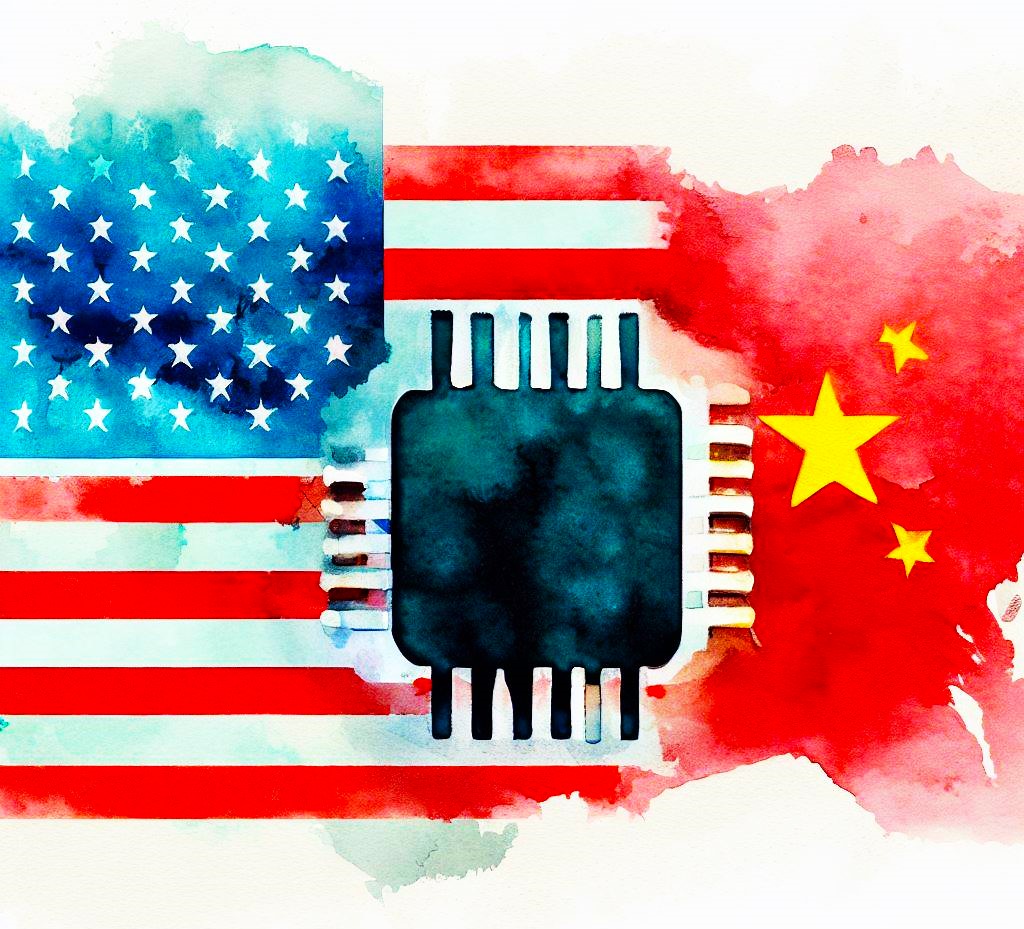
The curbs are aimed at closing loopholes that became apparent after the U.S. announced export curbs on microchips in October 2022. The restrictions are designed to prevent China’s military from importing advanced semiconductors or equipment.
Nvidia has said in a filing that the new export restrictions will block sales of two high-end artificial intelligence chips it created for the Chinese market – A800 and H800. It said that one of its gaming chips will also be blocked.
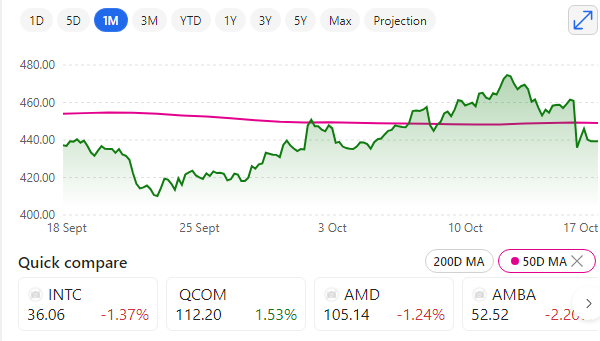
Nvidia Corp one month chart – closed at 439.38 17th October 2023
Although the curbs also affect other chip makers, analysts believe Nvidia will be hit the hardest because China accounts for up to 25% of its revenues from data centre chip sales. Nvidia’s shares, which are considered a star stock, fell by as much as 4.7% in the wake of the announcement.
Semiconductor Industry Association
The Semiconductor Industry Association, which represents 99% of the U.S. semiconductor industry by revenue, said in a statement that the new measures are ‘overly broad‘ and ‘risk harmingthe U.S. semiconductor structure without advancing national security as they encourage overseas customers to source elsewhere’.
China reacts
A spokesperson for the Chinese embassy also said that it ‘firmly opposes‘ the new restrictions, which also target Iran and Russia and go into effect in 30 days.
Nvidia stock falls after restrictions on AI chip exports from U.S. to China
Two months ago, China retaliated by restricting exports of two materials, gallium and germanium, which are key to the semiconductor industry.
The materials are ‘minor metals‘, meaning that they are not usually found on their own in nature, and are often the by-product of other processes. It’s not only the U.S., Japan and the Netherlands – which is home to key chip equipment maker ASML – have also imposed chip technology export restrictions on China.
Fallout
The constant ‘fall-out’ between the world’s two biggest economies has raised concerns over the rise of so-called ‘resource nationalism‘ – a practice where governments hoard critical materials to exert influence over other countries.
These are the seven largest U.S. listed companies in the technology sector.
Apple, Microsoft, Amazon, Alphabet, Nvidia, Tesla and Meta Platforms.
According to a report released Monday 2nd October 2023, these tech’ stocks have seen their valuation drop relative to the median stock in the S&P 500, making them more attractive for investors. The report says that the Magnificent 7 trade at 1.3 times their PEG ratio (price-to-earnings-to-long-term growth), versus 1.9 for the median S&P 500 stock.
This is the cheapest valuation in over six years – time to buy yet?
The report also highlights some positive drivers for these stocks, such as their strong sales growth, their ability to beat expectations, and their resilience to rising interest rates.
However, some analysts also warn that the dominance of these stocks could pose a risk for the broader market if something bad happens to tech’.
Meta has announced a series of new chatbots to be used in its Messenger service.
Charming
The chatbots will have ‘personality’ and specialise in certain subjects, like holidays, and cooking. Let’s hope they haven’t been modelled on the company boss then.
It is the latest attempt in a chatbot ‘chat’ race between tech’ companies desperate to produce more accurate and personalised artificial intelligence. The chatbots are still a work in progress with ‘limitations’, said boss Mark Zuckerberg.
During Meta’s first in-person event since before the pandemic, Mr Zuckerberg said that it had been an ‘amazing year for AI’. The company is calling its main chatbot ‘Meta AI’ and can be used in messaging. For example, users can ask Meta AI questions in chat ‘to settle arguments’ or ask other questions.
It’s been touted as fun entertainment and not just question answering.
I wonder if these AI chatbots will be as good as the Metaverse rollout has been so far?
Zuckerberg’s ‘personality’ chatbots
Zuckerberg’s ‘personality’ chatbots are a new feature of Meta, the company formerly known as Facebook. They are artificial intelligence agents that can chat with users on Messenger, using the faces and voices of celebrities like Snoop Dogg, Kendall Jenner, and Tom Brady.
Chatbots with personality. God help us!
They are supposed to have different personalities and interests, such as sports, cooking, or music. Meta claims that they are for entertainment purposes only, and that they have limitations on what they can answer.
Critical
However, some critics have raised ethical and social concerns about these chatbots. They argue that they are creating “counterfeit people” that could deceive or manipulate users, especially young ones. They also question the consent and privacy of the celebrities whose identities are used by the chatbots. They warn that these chatbots could pose dangers to the authenticity and trustworthiness of online communication.
If you are curious about these chatbots, you can try them out on Messenger by searching for their names. But be aware that they are not real people, and that they may not give you accurate or reliable information. They are just products of Meta’s artificial intelligence technology, which is still a work in progress – a bit like the Metaverse.
Chatbot with creepy personality
All this wonderful AI tech and what do we do? Play games with it!
Luddites were a group of workers who protested against the use of machinery that threatened their livelihoods in the early 19th century in Britain. They were not opposed to technology in general, but to the specific machines that were ‘taking away their livelihoods’.
They attacked factories and smashed machines that were replacing their jobs with cheaper and less skilled labour.
BIG tech Luddite comparison – is AI the latest threat?
Some people have compared the Luddites to the modern movements that resist the effects of Big Tech and artificial intelligence (AI) on workers’ lives. They argue that these technologies are creating a new wave of automation that is displacing workers, eroding their rights, and increasing inequality.
They also point out that the Luddites had the support of a majority of English people and eventually led to changes in the law that improved workers’ conditions.
Progress?
However, others have criticized this comparison as inaccurate or misleading. They claim that the Luddites were not successful in stopping technological progress, and that their actions were violent and destructive.
Technology will create new jobs
They also suggest that the Luddite fallacy, which refers to the belief that technological progress causes mass unemployment, has been proven wrong by history. They contend that technology can create new opportunities and benefits for workers, as long as society adapts and regulates it properly.
The question of whether a new modern Luddite rebellion can rise against Big Tech is not a simple one. It depends on how we define Luddites, how we evaluate the impacts of technology, and how we respond to the challenges and opportunities it presents.
OpenAI’s ChatGPT can now ‘see, hear and speak,’ or, at least, understand spoken words, respond with a synthetic voice and process images, the company announced Monday 25th September 2023.
The update to the chatbot OpenAI’s biggest since the introduction of GPT-4, allows users to opt into voice conversations on ChatGPT’s mobile app and choose from five different synthetic voices for the bot to respond with. Users will also be able to share images with ChatGPT and highlight areas of focus or analysis.
Roll out
The changes will be rolling out to paying users in the next two weeks, OpenAI said. ‘While voice functionality will be limited to the iOS and Android apps, the image processing capabilities will be available on all platforms’.
The big feature push comes alongside ever-rising stakes of the artificial intelligence (AI) race among chatbot leaders such as OpenAI, Microsoft, Google and Anthropic. In an effort to encourage consumers to adopt generative AI into their daily lives, tech giants are racing to launch not only new chatbot apps, but also new features. Google has announced updates to its Bard chatbot, and Microsoft added visual search to Bing.
Investment expansion
Earlier this year, Microsoft’s expanded its investment in OpenAI, an additional $10 billion, it made it the biggest AI investment of the year. In April 2023, the startup reportedly structured a $300 million share sale at a valuation of between $27 billion and $29 billion, with investments from firms such as Sequoia Capital and Andreessen Horowitz.
Concerns
Experts have raised concerns about AI-generated synthetic voices, which in this case could allow users a more natural experience but also enable more convincing deepfakes. Cyber threat investigators and researchers have already begun to explore how deepfakes can be used to penetrate cybersecurity systems.
OpenAI says ChatGPT can now ‘speak,’ listen and process images
OpenAI acknowledged those concerns in its announcement, saying that synthetic voices were ‘created with voice actors we have directly worked with,’ rather than collected from strangers.
The release also provided little information about how OpenAI would use consumer voice inputs, or how the company would secure that data if it were used. OpenAI did not immediately respond to CNBC’s request for comment, and the company’s terms of service say that consumers own their inputs ‘to the extent permitted by applicable law.’
What does ‘ChatGPT’ actually mean?
ChatGPT is an acronym for Chat Generative Pre-trained Transformer. It is a name of an artificial intelligence model that can generate natural language text based on user input.
It was developed by OpenAI, a research organization dedicated to creating and ensuring the safe and beneficial use of artificial intelligence (AI). ChatGPT can be used for various purposes, such as answering questions, having conversations, and producing creative writing.
E-commerce conglomerate Amazon announced on Monday 25th September 2023 that it will invest up to $4 billion in artificial intelligence (AI) firm Anthropic, a rival to ChatGPT developer OpenAI, and take a minority ownership position in the company.
The move further enforces Amazon’s aggressive AI push as it aims to keep pace with rivals such as Microsoft and Alphabet’s Google.
The two firms reportedly said that they are forming a strategic collaboration to advance generative AI, with the startup selecting Amazon Web Services as its primary cloud provider.
Reports suggest as much as $3 trillion is waiting on the sidelines to be invested in tech’.
AI FOMO
The reasoning is that AI is driving a fear of missing out (FOMO). We could very well be experiencing the fourth industrial revolution right now, and it is AI-driven. Strategically, companies can’t just sit around and wait. There’s a window where if they don’t join in or realise the potential and grab the opportunity, they’ll miss out.
IPO’s
Three of the biggest initial public offerings (IPO) in the tech’ sector in nearly two years raised some $6 billion collectively in less than a week. Nvidia has attracted much attention with the AI driven interest it has created recently.
While a handful of tech IPOs and one big acquisition wouldn’t have been much cause for celebration in previous years, they are a welcome return after the drought of pandemic-era hit investment.
The IPO market for tech was effectively shut down until Arm Holdings, Instacart and Klaviyo opened the investors door again. Merger activity such as that driven by Microsoft Corp., OpenAI ChatGPT and Activision Blizzard Inc. is helping to lift up the appetitie for investment again. And it’s pretty much AI induced.
Money ready to go
Some analysts suggest there is $3 trillion sitting on the sidelines ready to invest, mostly held by Big Tech and private equity companies. The fascination with artificial intelligence (AI) and fear of missing out (FOMO) will create massive AI led tech investing opportunities. Everyone will want a slice of this cake.
This could very well be the biggest transformational spending wave that we’ve seen in years and certainly since the internet arrived in 1995.
Just look out for that ‘bubble’ again – it will pop! But much money will be made before that happens and then again after.
Masayoshi Son says AI to surpass human intelligence and that SoftBank will ‘rule the world’. Oh dear…!
Main points in brief
Masayoshi Son reportedly said AI is capable of helping solve the world’s biggest problems and could potentially surpass the intelligence of humans.
He said he was a ‘big believer’ in AI and that Arm, a chip design company owned by Softbank, was a ‘core’ beneficiary of the AI revolution.
He said AI would supercharge human ability and that Softbank would ‘rule the world’ and win the latest generative-AI race thanks to its heavy investment in startups and its majority stake in Arm.
He also acknowledged that AI posed some threats to humanity if mishandled and that society should regulate it to protect humankind.
Masayoshi Son and SoftBank
The 66-year-old founded SoftBank, which still controls about 90% of Arm Holdings after the IPO, back in 1981 after graduating from the University of California, Berkeley. Forbes estimates his net worth at more than $24 billion, making him the world’s 69th richest person.
Son made his early reputation as an investor in Japan’s mobile phone industry, and went on to become one of the first backers of Yahoo as well as Alibaba. Son continues to serve as the chairman of Arm’s board of directors.
AI does pose some threats to humanity if mishandled, Son said, likening its potential misuse to the dangers of speeding, or drinking alcohol while driving a car. But, more positively, AI can also help solve key world problems like diseases or help mitigate or recover from natural disasters, he reportedly said.
‘AI, society should regulate to protect humankind’, Son said. ‘However, it has more merit than the demerits. So, I think I’m a believer. I’m optimistic that AI is going to solve the issues that mankind couldn’t solve in the past‘.
The Magnificent Seven is a term to describe seven tech’ stocks that have been surging in 2023.
Meta Platforms (formerly Facebook), the social media giant that also owns Instagram, WhatsApp, and Oculus.
Apple, the maker of the iPhone, iPad, Mac, Apple Watch, AirPods, and other popular devices and services including cloud and Apple TV streaming service.
Amazon, the e-commerce leader that also operates AWS, Prime Video, Alexa, and Whole Foods.
Alphabet, the parent company of Google, YouTube, Gmail, Google Cloud, and Waymo.
Microsoft, the software company that owns Windows, Office, Azure, LinkedIn, Xbox, and Teams.
Nvidia, the semiconductor company that produces graphics cards, gaming devices, data center solutions, and AI platforms.
Tesla, the electric vehicle maker that also develops solar panels, batteries, and autonomous driving technology.
Dominant
These seven stocks are considered to be dominant in their respective fields and have strong growth prospects driven by innovation and artificial intelligence (AI).
They have outperformed the broader market and attracted many investors who are looking for exposure to the tech’ sector. Some analysts believe that these stocks will continue to lead the market in the future, while others caution that they may face regulatory challenges, competition, or valuation issues.
Approximate combined market cap of the Magnificent Seven tech stocks
The approximate combined market cap value of the Magnificent Seven as of September 2023 is approximately $11.8 trillion.
Apple: $2.5 trillion
Microsoft: $2.3 trillion
Alphabet: $1.9 trillion
Amazon: $1.7 trillion
Nvidia: $0.8 trillion
Meta Platforms: $0.9 trillion
Tesla: $0.7 trillion
Note that these values will change over time as the stock prices fluctuate.
A way to trade the tech sector is through funds
There are many funds that can trade tech stocks, depending on your investment objectives, risk tolerance, and preferences.
Technology mutual funds: These are funds that invest in a diversified portfolio of technology companies across different industries, such as software, hardware, internet, cloud, biotech, and more. Technology mutual funds can offer exposure to the growth potential of the tech sector, as well as reduce the volatility and risk of investing in individual stocks.
Some examples of technology mutual funds are Fidelity Select Technology Portfolio (FSELX), Columbia Global Technology Growth Fund (CGTYX), and Schwab U.S. Large-Cap Growth Index Fund (SCHG).
Which tech fund to invest in?
Technology exchange-traded funds (ETFs): These are funds that track an index of technology stocks and trade on an exchange like a stock. Technology ETFs can offer low-cost and convenient access to the tech sector, as well as allow investors to choose from different themes, such as cybersecurity, artificial intelligence (AI), cloud computing and more.
Some examples of technology ETFs are Invesco QQQ Trust (QQQ), Technology Select Sector SPDR Fund (XLK), and VanEck Vectors Semiconductor ETF (SMH).
Technology index funds: These are funds that replicate the performance of a specific technology index, such as the Nasdaq 100, the S&P 500 Information Technology Index, or the Morningstar U.S. Technology Index. Technology index funds can offer broad and passive exposure to the tech sector, as well as low fees and high tax efficiency.
Some examples of technology index funds are Fidelity NASDAQ Composite Index Fund (FNCMX), Vanguard Information Technology Index Fund Admiral Shares (VITAX), and iShares Morningstar U.S. Technology ETF (IYW).
NOTE: These are not recommendations. Investments may go up or down. Your money is at risk!
Baidu also announced that more than 6 million users have used an AI powered tool that sits inside its Google drive-like cloud product.
At the 4th September event, Baidu also demonstrated ‘displayed generative’ AI-based products that could assist with traffic management, financial research and coal mine logistics.
ChatGPT, from Microsoft-backed OpenAI, is not officially available in China, where Google and Facebook are blocked.
10 new AI products announced by Baidu
Chinese tech giant Baidu announced more than 10 new AI-based applications on 4th September 2023, just days after its ChatGPT-like Ernie bot was released for public use.
Among the products revealed was a generative AI-integrated word processing app called WPS AI, created by Shanghai-listed Kingsoft Office. It was reported the company built the tool using the AI model on which Baidu’s Ernie bot is based, as well as Baidu’s ‘Qianfan’ cloud platform for AI models.
‘This AI malarchy is progressing at quite a rate’.
Nearly 10,000 businesses are actively using Baidu’s Qianfan cloud platform each month, the company claimed.
AI assistant
Baidu also announced that more than 6 million users have used an AI-powered tool that sits inside its Google drive-like cloud product. The AI assistant can search documents, summarize and translate text and create content, the company claimed.
It wasn’t immediately clear to what extent those products were available for public use.
On 31st August 2023, Baidu released its Ernie bot to the public, signaling government approval of the AI-powered chatbot. Other Chinese companies also released similar AI products around the same time.
Chip design firm Arm on 5th September 2023 submitted an updated filing for its upcoming initial public offering on the New York Stock Exchange, setting a price range between $47 and $51. Only 9.4% of Arm’s shares will be freely traded on the NYSE.
Arm was previously listed in London and New York, before SoftBank acquired it for $32 billion in 2016.
Chip design firm Arm on Tuesday is looking to acquire as much as $4.87 billion in its upcoming initial public offering on the New York Stock Exchange, according to the new filing.
The deal could value the company at as much as $52 billion
As a British company, Arm qualifies as a foreign private issuer in the U.S. and its shares will count as American depositary shares, or ADS’s. It is reported that the company will list some 95.5 million ADS’s at a price range of between $47 and $51. At the upper end of that range it is estimated that Arm will likely raise up to $4.87 billion. At the lower end, the IPO would fetch $4.49 billion of fresh capital for Arm. It could do even better.
Institutional funds
When the company floats in New York, it will look to enjoy a very deep pool of professional institutional funds. Arm seeks to ramp up its investments in research and development, particularly as it pursues growth in the artificial intelligence (AI) space with some of its newer chips. The company recently released new chips specifically targeted at AI and machine learning use cases.
Arm seeks up to $52 billion valuation in U.S. IPO
Upper end
At the upper end of the pricing range, Arm would also touch a total valuation of $52 billion or more. Only 9.4% of Arm’s shares will be freely traded on the New York Stock Exchange, with SoftBank expected to own roughly 90.6% of the company’s outstanding shares after the completion of the IPO.
Arm’s listing is set to be the biggest technology IPO of the year. Investors are hoping that the listing could breathe new life into an IPO market that has been ‘slack’ since 2022.
250 billion chips globally
Arm says its energy-efficient processor designs and software platforms are integrated into more than 250 billion chips globally, into products ranging from sensors and smartphones to supercomputers.
The company estimates it enjoys approximately 48.9% share of the market for semiconductor design. Other players, such as Intel and AMD, have raced to catch up on designing their own chip architectures, but have struggled so far.
U.K. misses out… again
The U.K. government had originally hoped Arm would list on the London Stock Exchange, but the company instead dealt a major blow to Britain’s ambitions to become the leading global tech hub by opting for New York. The U.S. financial center has a deep institutional investor base and analysts who have a close understanding of the technology sector.
BIG interest
Chip design firm Arm said in a Tuesday filing that Apple, Google parent Alphabet, Nvidia and other technology companies are interested in buying up to $735 million in its shares as it seeks to go public on Nasdaq.
The investments might not happen, but the fact that these companies are considering them underlines the importance of Arm, whose designs are used for processors in data center servers, consumer devices and industrial products.
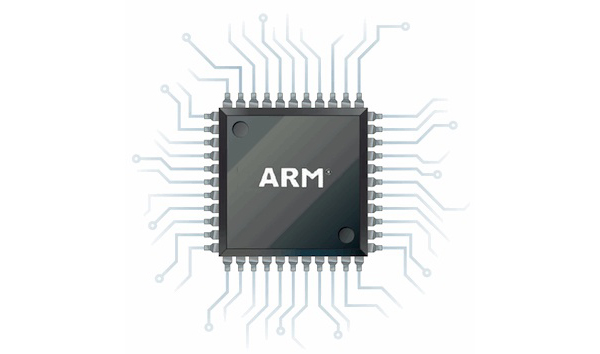
Arm chip – some 250 billion chips globally
Chip makers Intel, Samsung and TSMC are interested in investing alongside the three trillion-dollar technology companies, along with AMD and MediaTek, which make chip designs based on Arm architectures. Cadence Design Systems and Synopsys, which make electronic design automation software for processor development, have also expressed interest, according to a revised prospectus for Arm’s shares sale. This IPO could easily be the biggest of the 2023!
As part of the deal, Arm could wind up with a $52 billion market capitalization and almost $5 billion in new cash.
This is likely to be the biggest IPO of 2023
It is estimated that there will be about 19 billion devices using the Arm processor in the world by the end of 2023.
Arm target
The market share of Arm across different technology markets worldwide, which was 90% for mobile application processors, 34% for embedded computing, and 5% for data center and cloud in 2019.
Arm has a target of increasing its market share to more than 90%, 50%, and 25% respectively by 2028.
The creator of Photoshop and InDesign launched a generative AI tool called ‘firefly’, which has recently gained traction. It is quite possible that Adobe has one of the best AI generative tools available and it’s worth checking it out as a stock to *invest in.
Firefly enables users to edit through simple typed commands
Adobe Firefly is a generative AI-powered content creation tool from Adobe that allows you to experiment, imagine, and create an infinite range of images with simple ‘text’ prompts.
You can use Firefly to generate images from a detailed text description, apply styles or textures to words and phrases, use a brush to remove objects or paint in new ones, generate color variations of your vector artwork, and more.
Adobe Share Chart as at 5th september 2023
Morgan Stanley thinks Adobe can benefit from artificial intelligence-powered products even more.The bank upgraded Adobe to overweight from equal weight.
Bank of America has also upgraded Adobe to buy with a revised target price of $63000 per share.
Definitely one to watch!
*Please do your own careful research – this is not a recommendation but simply an observation. Remember RESEARCH! RESEARCH! RESEARCH!
David Ferrucci, a prominent artificial intelligence researcher who led the team that created IBM Watson, has reportedly raised nearly $60 million for his AI company called Elemental Cognition.
Headquartered in New York, Elemental says on its website that the company seeks to develop AI that ‘thinks before it talks‘. It offers two enterprise products, Cogent and Cora, which are essentially chatbots designed for different scenarios. They can be used in financial services, interactive travel planning and for automating research discovery in life sciences.
Elemental Cognition
The new startup company is called Elemental Cognition, and it was founded in 2015 by David Ferrucci, who led the team that created IBM Watson.
Elemental Cognition aims to develop AI that ‘thinks before it talks‘ and can understand the meaning and context of human language. It offers two enterprise products, Cogent and Cora, which are chatbots for different scenarios.
Elemental Cognition has raised $60 million in funding from 17 investors, including Jim Breyer, former IBM CEO Sam Palmisano, and Geoff Yang of Redpoint Ventures.
What is IBM Watson?
IBM Watson is used in various areas of AI, such as natural language processing, machine learning, computer vision, speech recognition, and knowledge representation. IBM Watson is a cognitive computing system that can process natural language, analyze large amounts of data, and learn from its interactions with humans and machines.
IBM Watson is a question-answering computer system capable of answering questions posed in natural language, developed in IBM’s DeepQA project by a research team led by principal David Ferrucci. Watson was named after IBM’s founder and first CEO, industrialist Thomas J. Watson.
Watson Assistant: A chatbot platform that allows businesses to create conversational agents that can interact with customers and employees through text or voice. Watson Assistant can understand natural language, provide personalized responses, and integrate with other services and data sources.
A watercolour image of an AI microchip powering a mainframe supercomputer computer
Watson Discovery: A data analysis tool that can extract insights from structured and unstructured data, such as documents, web pages, social media posts, and images. Watson Discovery can perform natural language understanding, sentiment analysis, entity extraction, and document classification.
Watson Studio: A cloud-based platform that enables data scientists and developers to build, train, and deploy AI and machine learning models. Watson Studio supports various frameworks and languages, such as Python, TensorFlow, PyTorch and R. Watson Studio also provides tools for data visualization, collaboration, and automation.
Watson Visual Recognition: A computer vision service that can analyze images and videos for content, objects, faces, scenes, and emotions.
Power
The IBM Watson computer consists of a cluster of ninety IBM Power 750 servers, each of which uses a 3.5 GHz POWER7 eight-core processor, with four threads per core. The system has 2,880 POWER7 processor threads and 16 terabytes of RAM. It can process 500 gigabytes (the equivalent of a million books) per second.
Supercomputer now with AI power
The IBM Watson computer has an avatar that is inspired by the IBM ‘Smarter Planet’ logo. The avatar is a globe with a grid pattern and four glowing stripes that represent the four main aspects of Watson: natural language processing, hypothesis generation and evaluation, dynamic adaptation, and evidence-based learning. The avatar also changes color and brightness depending on Watson’s mood and confidence level.
International Business Machines (IBM)
IBM was founded in 1911 in Endicott, New York, as the Computing-Tabulating-Recording Company (CTR) by Charles Ranlett Flint. The company changed its name to International Business Machines (IBM) in 1924 under the leadership of Thomas J. Watson, Sr. IBM is one of the oldest and most influential technology companies in the world, with a history of innovation and research in various fields of computing.
The International Business Machines Corporation (IBM), nicknamed ‘Big Blue’, is an American multinational technology corporation headquartered in New York and is present in over 175 countries. It specializes in computer hardware, middleware, and software, and provides hosting and consulting services in areas ranging from mainframe computers to nanotechnology. IBM is the largest industrial research organization in the world.
IBM holds the record for most annual U.S. patents generated by a business for 29 consecutive years from 1993 to 2021?