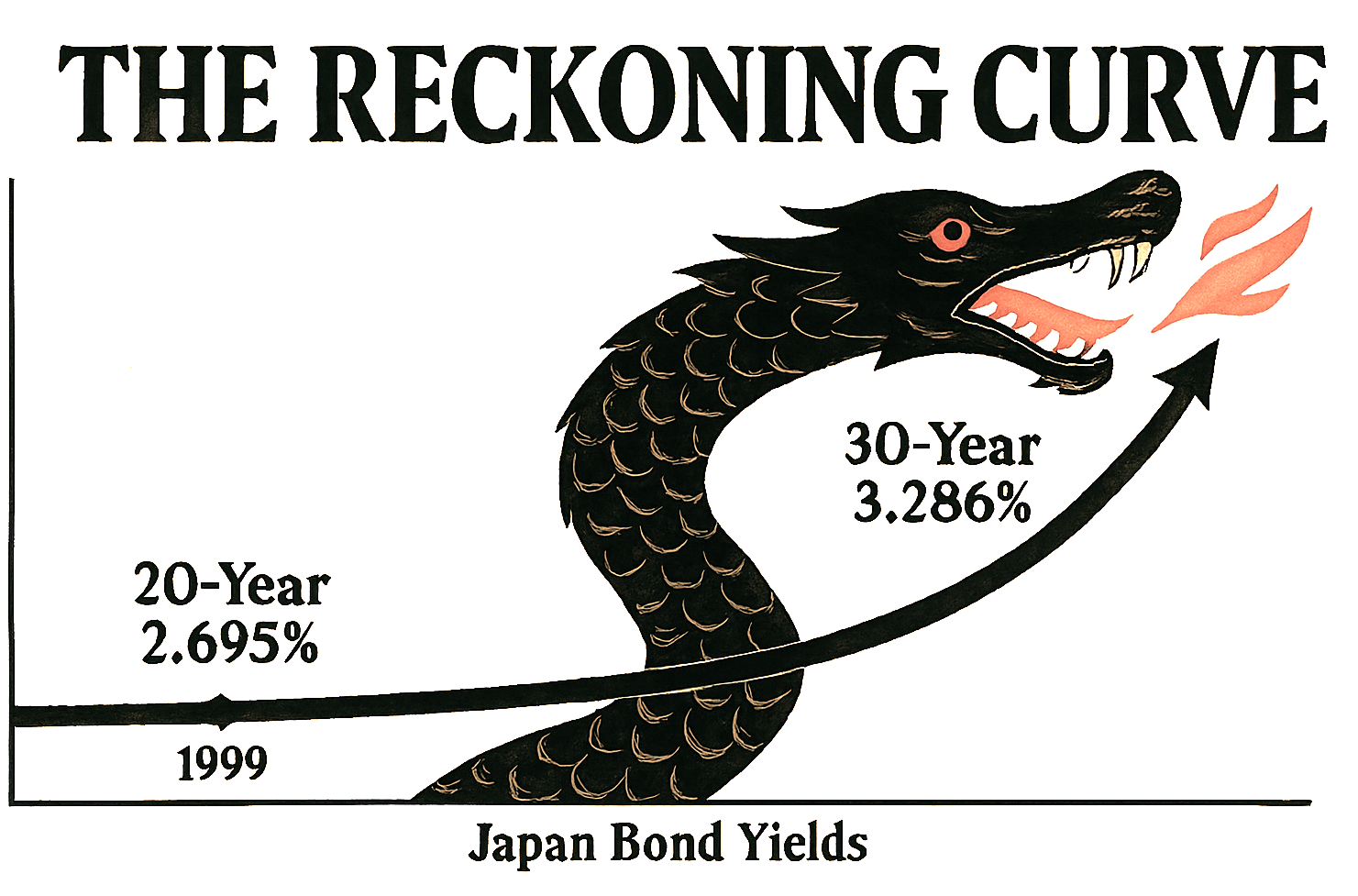
After decades of economic sedation, Japan’s long-term bond yields are rising with a vengeance.
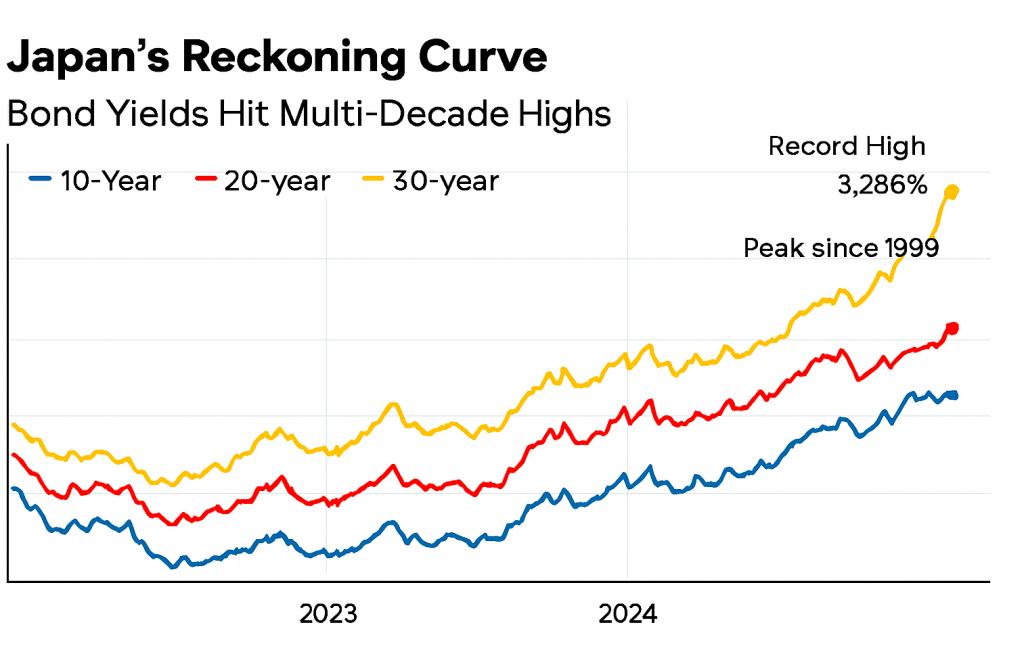
The 30-year government bond has breached 3.286%—its highest level on record—while the 20-year yield has climbed to 2.695%, a peak not seen since 1999.
These aren’t just numbers; they’re seismic signals of a nation confronting its delayed past, now its deferred future.
Indicative Yield Curve for Japan
For years, Japan’s yield curve was a monument to inertia. Negative interest rates, yield curve control, and relentless bond-buying by the Bank of Japan created an artificial calm—a kind of economic Zen garden, raked smooth but eerily still.
That era is ending. Inflation has persisted above target for three years, and the BOJ’s retreat from monetary intervention has unleashed market forces long held at bay.
This steepening curve is more than financial recalibration—it’s a symbolic reckoning. Rising yields demand accountability: from policymakers who masked structural fragility, from investors who chased safety in stagnation, and from a society that postponed hard choices on demographics, debt, and productivity.
The bond market, once a passive witness, now acts as judge. Each basis point is a moral verdict on Japan’s economic past.
The shadows of the Lost Decades—deflation, aging populations, and overspending—are being dispelled not by command, but through the process of price discovery.
In this new era, Japan’s yield curve resembles a serpent uncoiling—no longer dormant but rising with intent.
The question isn’t whether the curve will flatten again, but whether Japan can meet the moment it has long delayed.
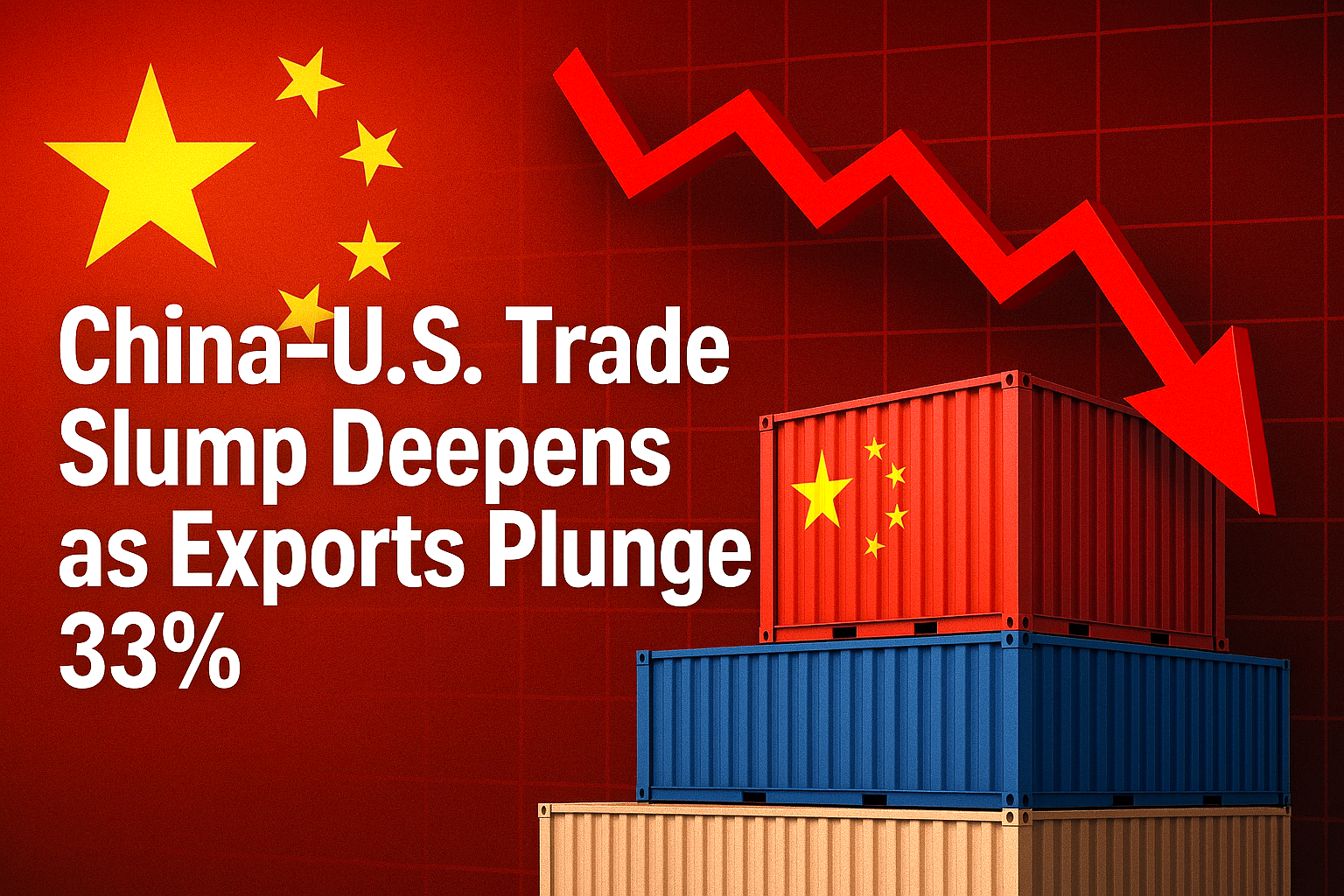
China’s exports to the United States fell sharply in August 2025, marking a six-month low and underscoring the growing strain in global trade dynamics.
According to recent data, shipments from China to the U.S. dropped by 33% year-on-year, reflecting both weakening demand and the ongoing effects of geopolitical tensions.
This decline is part of a broader slowdown in China’s export sector, which saw overall outbound shipments contract for the sixth consecutive month.
Analysts point to several contributing factors: tighter monetary policy in the U.S., shifting supply chains, and a cooling appetite for Chinese goods amid rising tariffs and trade barriers.
Down 33%
The 33% plunge is particularly striking given the scale of bilateral trade. The U.S. remains one of China’s largest export markets, and such a steep drop signals deeper economic recalibrations.
Sectors hit hardest include electronics, machinery, and consumer goods—industries that once formed the backbone of China’s export dominance.
Economists warn that this trend could have ripple effects across global markets. For China, it raises questions about domestic resilience and the need to pivot toward internal consumption.
For the U.S., it may accelerate efforts to diversify supply chains and invest in domestic manufacturing.
The timing is also politically charged. With President Trump’s tariff policies still in effect and China navigating its own economic headwinds, trade relations remain tense.
This downturn may prompt renewed negotiations—or further decoupling.
Despite the ongoing slump in trade, the U.S. continues to be China’s largest export destination among individual countries.
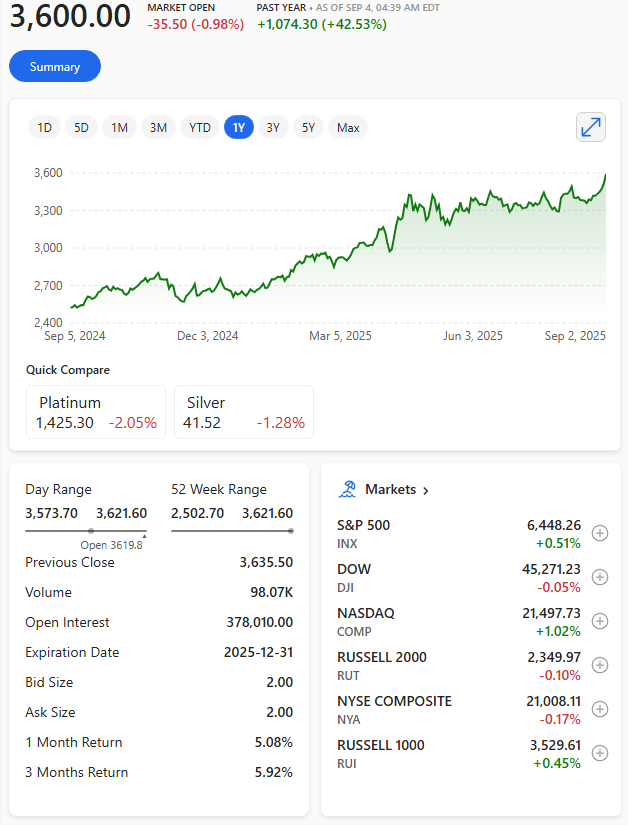
Gold’s recent surge—hitting over $3,550 per ounce (4th September 2025)—isn’t just a speculative blip.
It’s a convergence of deep structural shifts and short-term catalysts that are reshaping how investors, central banks, and governments think about value and stability.
Here’s why
🧭 Strategic Drivers (Long-Term Forces)
Central Bank Buying: Nearly half of surveyed central banks reportedly plan to increase gold reserves through 2025, citing inflation hedging, crisis resilience, and reduced reliance on the U.S. dollar.
Dollar Diversification: After Western sanctions froze Russia’s reserves in 2022, many countries began reassessing their exposure to dollar-denominated assets.
Fiscal Expansion & Debt Concerns: With U.S. debt surpassing $37 trillion and new legislation adding trillions more, gold is seen as a hedge against long-term dollar instability.
⚡ Tactical Catalysts (Short-Term Triggers)
Geopolitical Tensions: Ongoing wars, trade disputes, and questions around Federal Reserve independence have heightened uncertainty, boosting gold’s ‘fear hedge’ appeal.
Interest Rate Expectations: The Fed has held rates steady, but markets anticipate cuts. Lower yields make non-interest-bearing assets like gold more attractive.
Weakening U.S. Dollar: The dollar’s decline against the euro and yen has made gold cheaper for foreign buyers, increasing global demand.
ETF Inflows & Retail Demand: Physically backed gold ETFs saw their largest first-half inflows since 2020, while bar demand rose 10% in 2024.
Gold isn’t just a commodity—it’s a referendum on trust. When institutions wobble and currencies lose their shine, gold becomes the narrative anchor: a timeless, tangible vote of no confidence in the system.
Summary
🛡️ Safe Haven: Retains value during crisis.
📈 Inflation Hedge: Preserves purchasing power.
🧩 Portfolio Diversifier: Low correlation with other assets.
✋ Tangible Asset: Physical, unlike stocks or bonds.
China’s electric vehicle (EV) powerhouse is rewriting the global automotive playbook—but not without homegrown company damage.
BYD, now the world’s largest EV manufacturer by volume, has been caught in the crossfire of a domestic price war.
Damaging price war
The price war is damaging margins. It is unnerving investors and revealing the perils of hyper-competition in the world’s most aggressive car market.
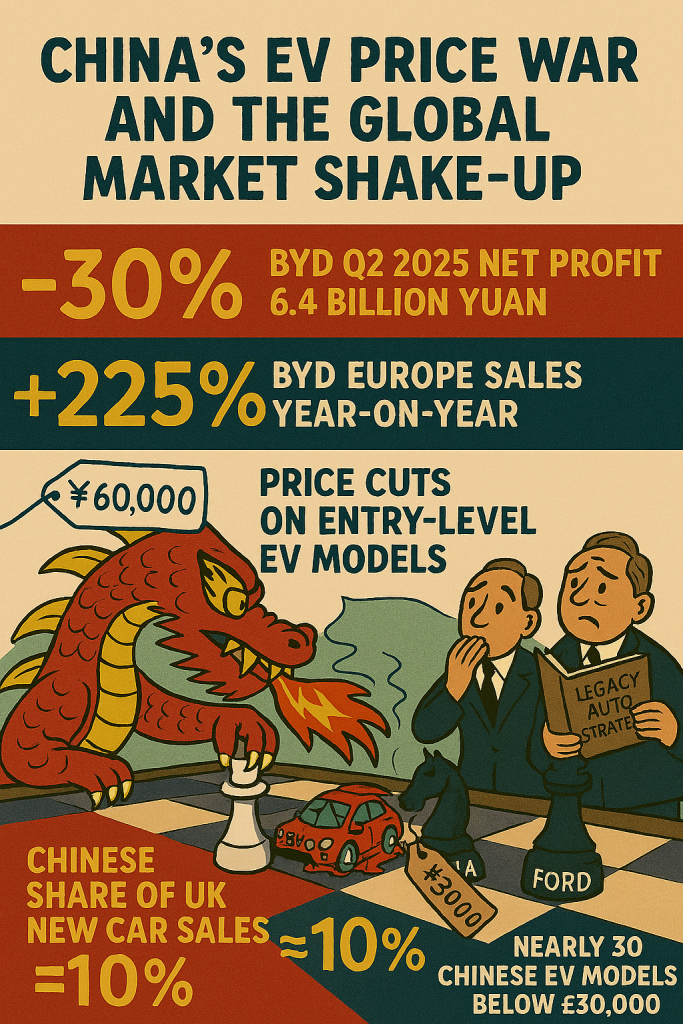
In Q2 2025, BYD posted a 30% drop in net profit to 6.4 billion yuan (£700 million), its first earnings decline in over three years.
Despite a 145% surge in overseas sales, the company’s sweeping discounts across 22 models have eroded profitability at home.
Gross margins slipped to around 16%, and its Hong Kong-listed shares tumbled 8% to a five-month low.
Analysts reportedly now question whether BYD can hit its ambitious 5.5-million-unit sales target, having reached only 45% by July 2025.
The price war, ignited by BYD’s aggressive cuts in May 2025, has forced rivals like Geely, Chery, and SAIC-GM to follow suit. Entry-level EVs now start below (£6,500), with features like driver assistance and smart infotainment once reserved for premium models.
But the race to the bottom has drawn concern from regulators and industry leaders. The China Association of Automobile Manufacturers (CAAM) warned of “disorderly competition”, while executives fear quality compromises and supplier strain.
Yet even as BYD stumbles, the broader Chinese EV machine is gaining global momentum. In Europe, BYD overtook Tesla in July sales, capturing 1.1% market share versus Tesla’s 0.7%.
Chinese EV car brands account for around 10% of new UK car sales
Chinese brands now account for around 10% of new car sales in the UK. There are over 30 affordable EV models priced under £30,000.
Their edge lies in battery supply chains, manufacturing efficiency, and software integration. Transforming cars into ‘smartphones on wheels’ tailored to digitally connected consumers.
China’s EV revolution is no longer just a domestic shake-up—it’s a global reordering. Legacy automakers are retreating from the budget segment. But Chinese firms flooding international markets with sleek, connected, and competitively priced vehicles.
BYD’s profit dip may be a temporary wobble. The long-term trajectory is clear: China isn’t just building cars—it’s building the future of mobility.
For global rivals, the message is unmistakable: adapt, or be outpaced by the dragon’s electric roar.
Infographic: China’s BYD and other EVs
Summary
BYD’s Q2 2025 net profit drop of 30% to 6.4 billion yuan: This figure aligns with recent earnings reports and analyst commentary. The drop is consistent with margin pressure from domestic price cuts.
Gross margin falling to 16.3%: Matches industry estimates for BYD’s automotive segment, which has seen compression due to aggressive discounting.
Overseas sales up 145% YoY: BYD’s international expansion—especially in Europe, Southeast Asia, and Latin America—has been rapid. This growth rate is plausible and supported by export data.
BYD reaching only 45% of its 5.5 million unit sales target by July: This tracks with cumulative delivery figures through mid-year, suggesting a potential shortfall unless H2 volumes accelerate.
Price war triggered by BYD’s cuts across 22 models in May: Confirmed by industry reports and BYD’s own promotional campaigns. Other automakers like Geely and Chery have responded with similar discounts.
CAAM warning of “disorderly competition”: This quote has appeared in official statements and media coverage, reflecting regulatory concern over unsustainable pricing.
Chinese EVs gaining market share in Europe and UK: BYD overtaking Tesla in July 2025 sales in Europe is supported by registration data. Chinese brands now account for ~10% of UK new car sales, with many models priced under £30,000.
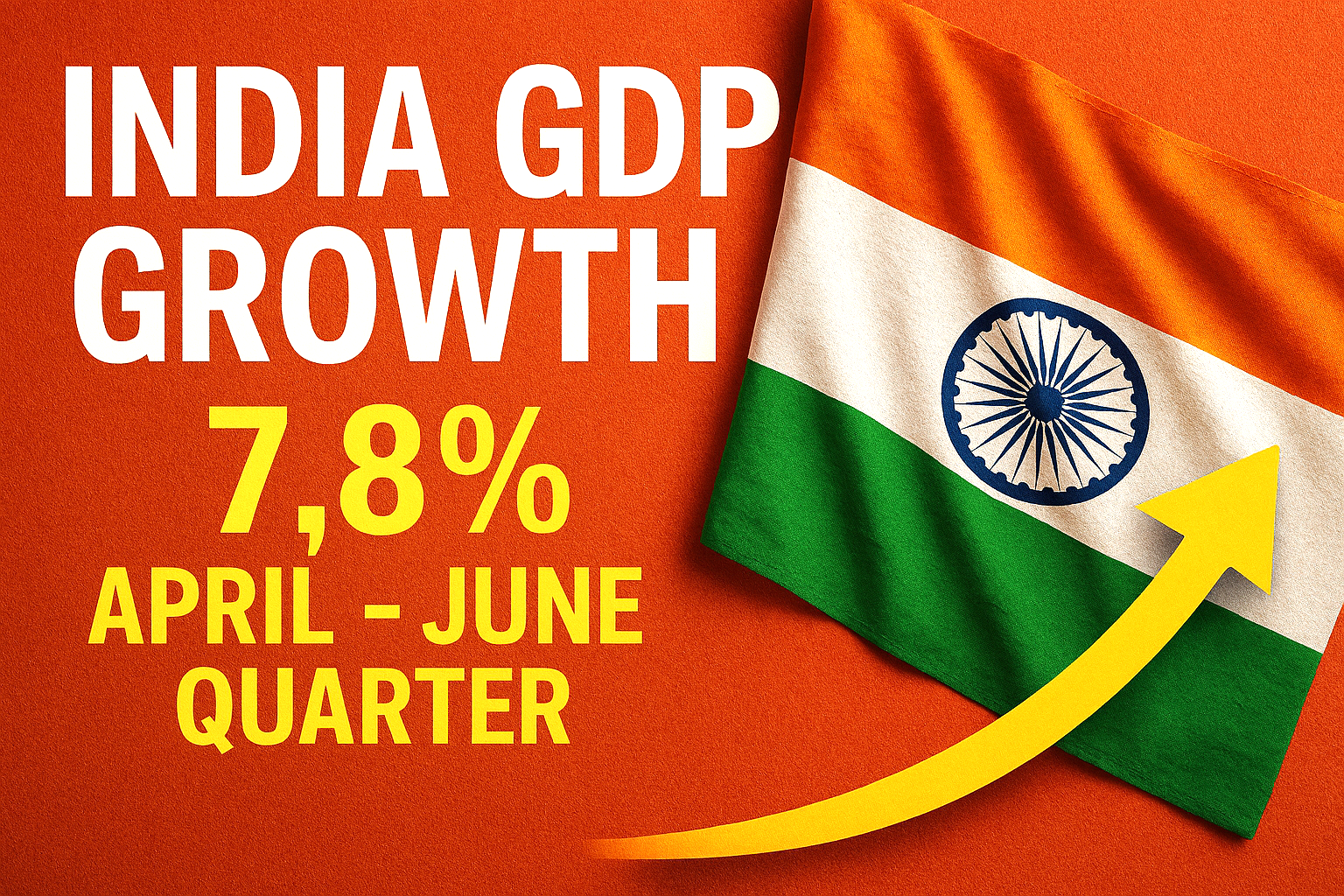
India’s economy continues to defy gravity, posting a robust 7.8% year-on-year GDP growth in the April–June quarter of 2025—the fastest pace in five quarters.
This surge, driven by strong domestic consumption, infrastructure investment, and a booming services sector, beat market expectations and reaffirmed India’s position as the world’s fastest-growing major economy.
Government-led infrastructure spending has catalysed private investment and job creation, while the digital economy—powered by fintech and e-commerce—continues to expand India’s economic footprint.
Manufacturing grew by 7.7%, and services soared by 9.3%, with government services hitting a 12-quarter high.
Yet, external pressures loom. The reintroduction of U.S. tariffs, particularly under a potential Trump administration, could dampen export momentum and strain trade relations.
Rising oil prices and geopolitical tensions in Asia further complicate India’s economic outlook. Despite these risks, the Reserve Bank of India has held steady, managing inflation and currency volatility with precision.
India’s GDP growth isn’t just a number—it’s a narrative of resilience and reinvention. From a service-dominated model to a more balanced mix of manufacturing, tech, and green energy, the country is repositioning itself as a global economic force.
The challenge now lies in sustaining this momentum while navigating fiscal constraints and global uncertainty.
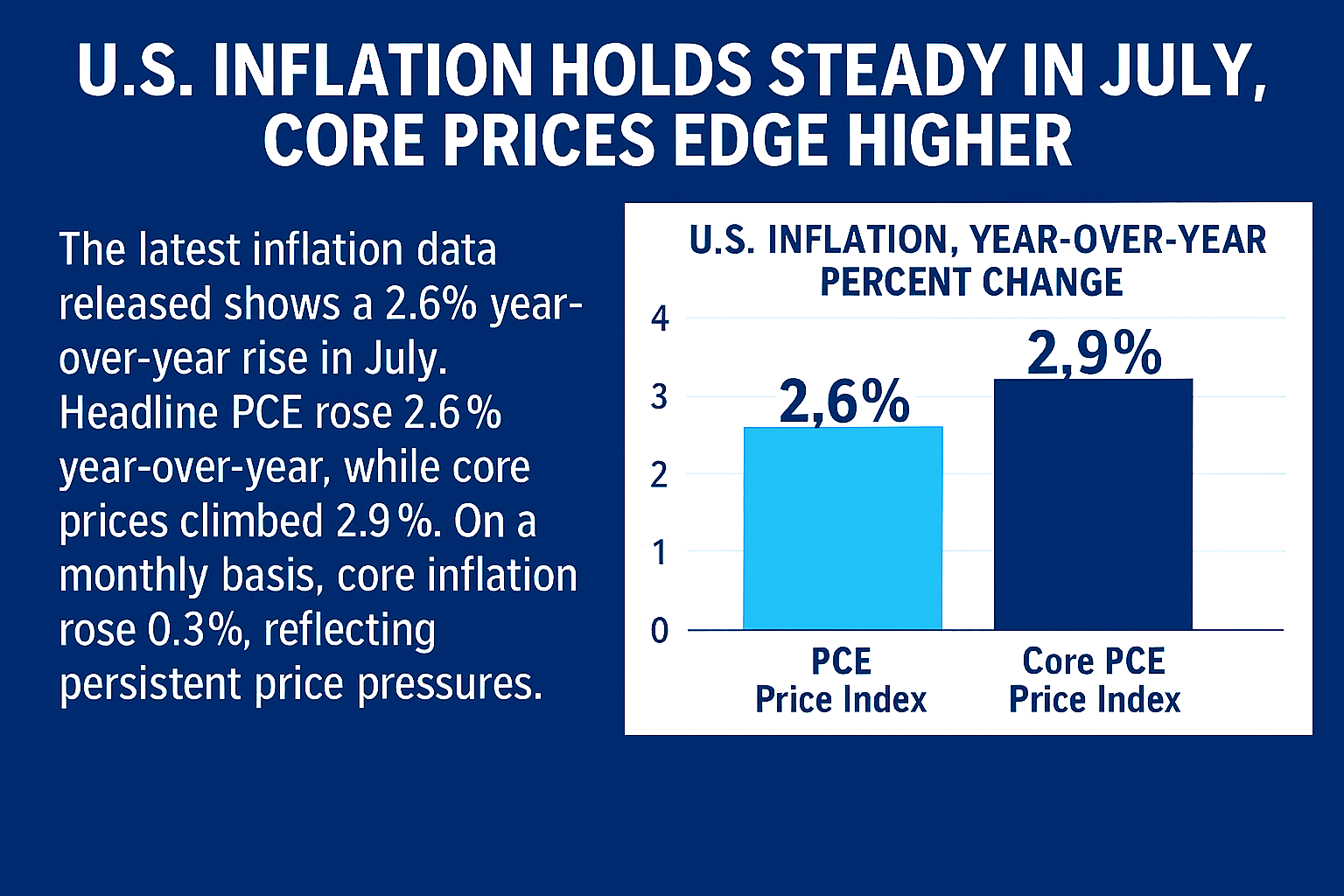
The latest inflation data for the month of July 2025 shows a mixed picture for the U.S. economy, as price pressures remain persistent despite signs of cooling in some sectors.
On a monthly basis, core prices increased 0.3%, in line with expectations, while consumer spending rose 0.5%, suggesting households are still resilient despite elevated costs. Personal income also climbed 0.4%, reinforcing the narrative of steady wage growth.
The Federal Reserve, which uses the PCE index as its preferred inflation gauge, faces a delicate balancing act.
With inflation still above its 2% target and labor market data showing signs of softening, markets are increasingly betting on a rate cut at the Fed’s September meeting.
Fed Chair Jerome Powell, speaking at Jackson Hole, reportedly acknowledged the risks to employment but maintained a cautious tone on policy shifts.
Investors and traders alike now see an 80% chance of a quarter-point cut, keeping all eyes on upcoming jobs data.
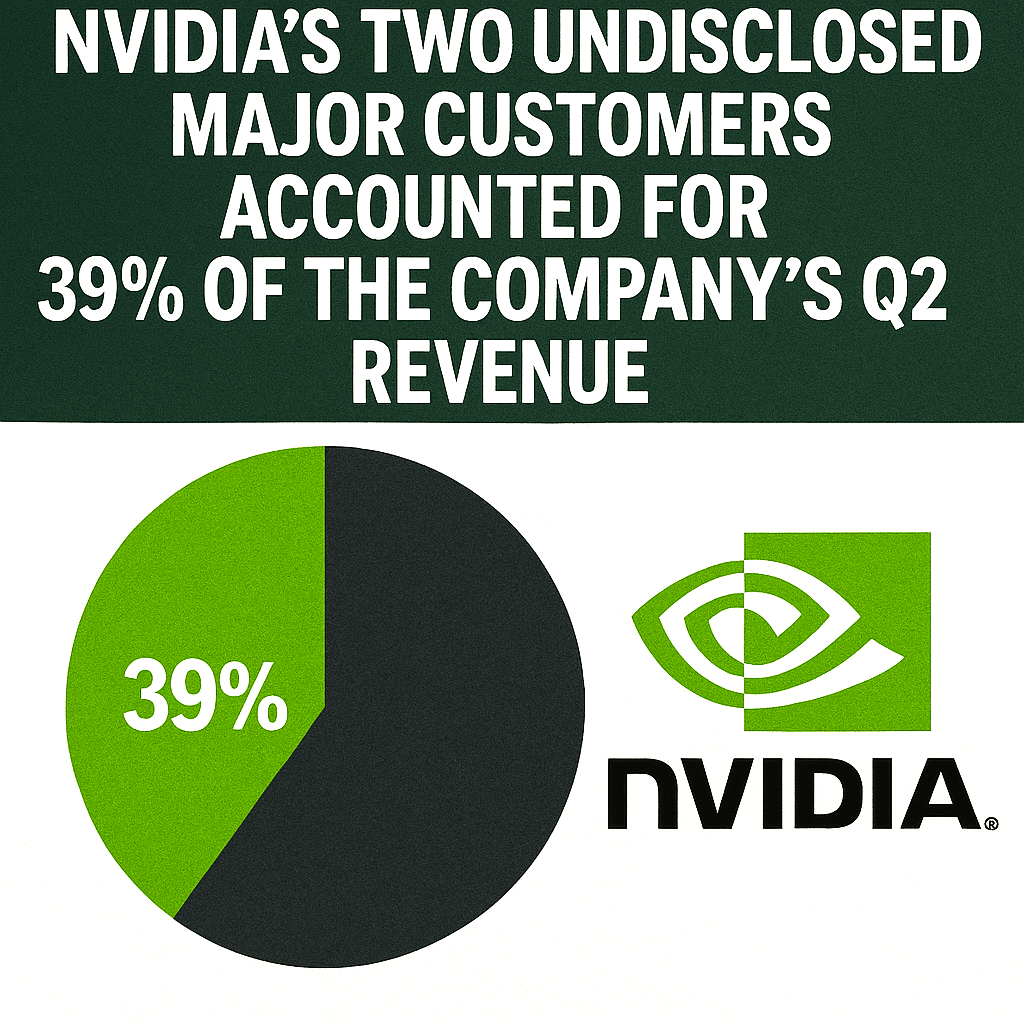
Nvidia revealed in a financial filing (August 2025) that two of its customers accounted for 39% of its revenue in the July 2025 quarter, sparking concerns about the concentration of its client base.
According to the company’s second-quarter filing with the Securities and Exchange Commission, ‘Customer A’ accounted for 23% of total revenue, while ‘Customer B’ made up 16%.
Nvidia announced on Wednesday 27th August 2025 that demand for its AI systems remains strong, not only from cloud providers but also from enterprises investing in AI, neoclouds and foreign governments.
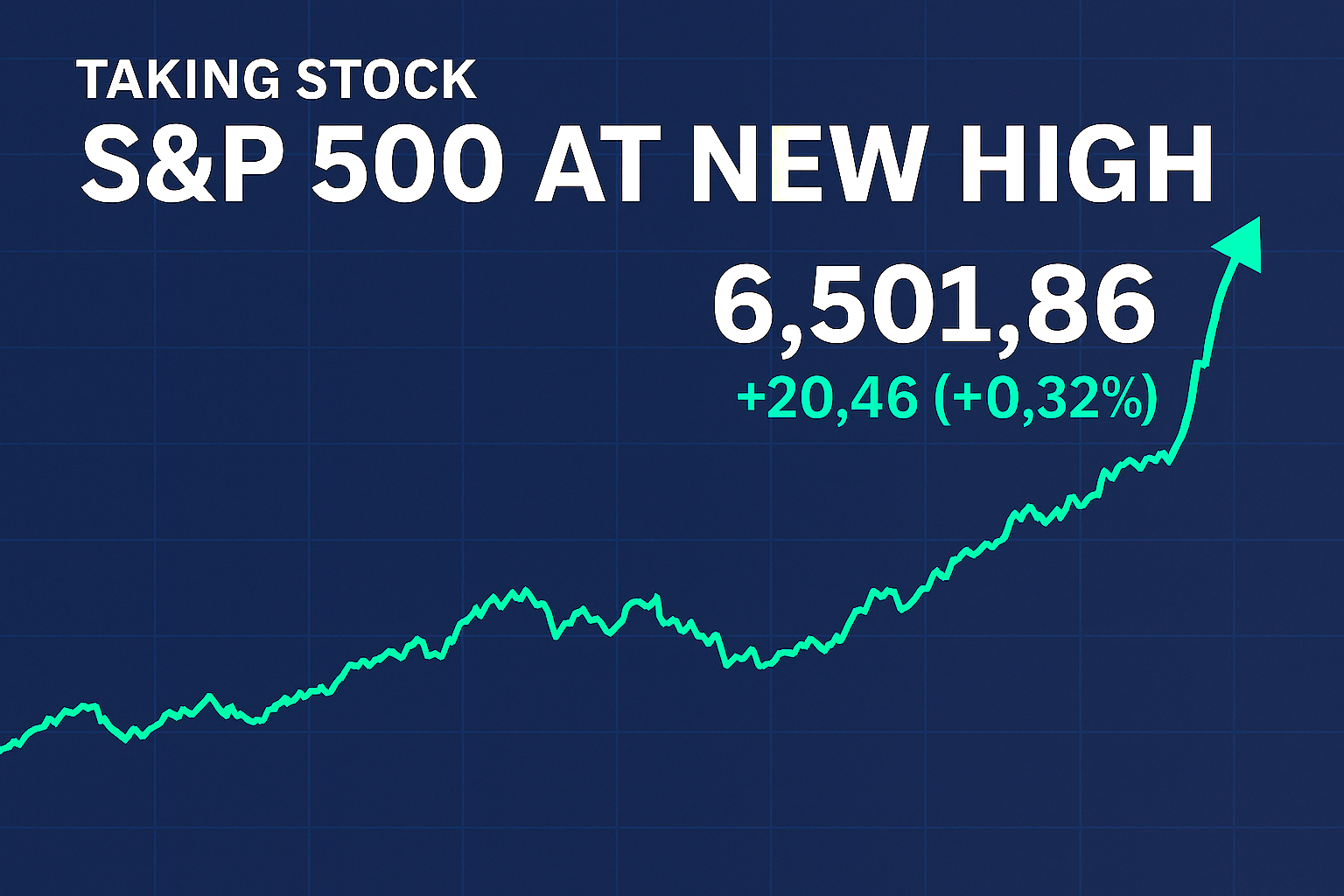
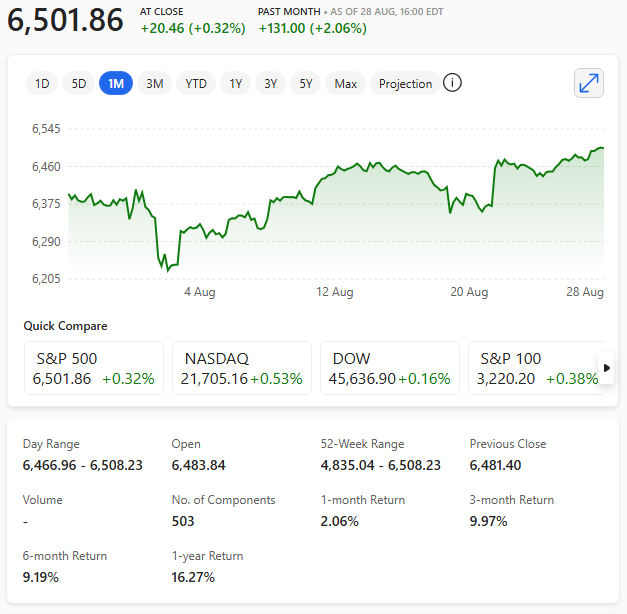
The S&P 500 has notched yet another all-time high, closing at 6501.86 on 28th August 2025
This surge reflects broad investor optimism, driven by strong corporate earnings and expectations of a more accommodative stance from the Federal Reserve.
With tech, healthcare, and financials all contributing to the rally and the indices continued momentum.
Wall Street keeps on giving
Another high for the S&P 500. The index added 0.32% Thursday and closed above the 6,500 level for the first time. Asia-Pacific markets had a mixed performance on Friday 29th August 2025, with Japanese stocks declining as core consumer prices in Tokyo showed slower growth in August.
S&P 500 one-month cart as it hist new all-time high on 28th August 2025
U.S. second-quarter GDP – revised higher than expected. The economy grew at an annualized rate of 3.3%, according to the Commerce Department’s second estimate, surpassing the initial estimate of 3.0% and the Dow Jones consensus forecast of 3.1%.
Two customers made up 39% of Nvidia’s second-quarter revenue. According to Nvidia’s financial filing this week (August 2025), the customers could be either cloud providers or manufacturers, but not much else is known about their identities.
Has BIG tech and AI stopped hiring? Not quite, though the hiring landscape has definitely shifted gears. Here’s the current take…
🧠 AI Hiring: Still Hot, Just More Focused
Private AI firms like OpenAI, Anthropic, and Perplexity are still hiring aggressively, especially for Machine Learning Engineers and Enterprise Sales roles. These two categories alone account for thousands of openings.
Even legacy tech giants like Salesforce are scaling up AI-focused sales teams—Marc Benioff announced 2,000 new hires just to sell AI solutions.
The demand for ML Engineers has splintered into niche specializations like LLM fine-tuning, inference optimisation, and RAG infrastructure, showing how deep the rabbit hole goes.
🖥️ Big Tech: Cooling, Not Collapsing
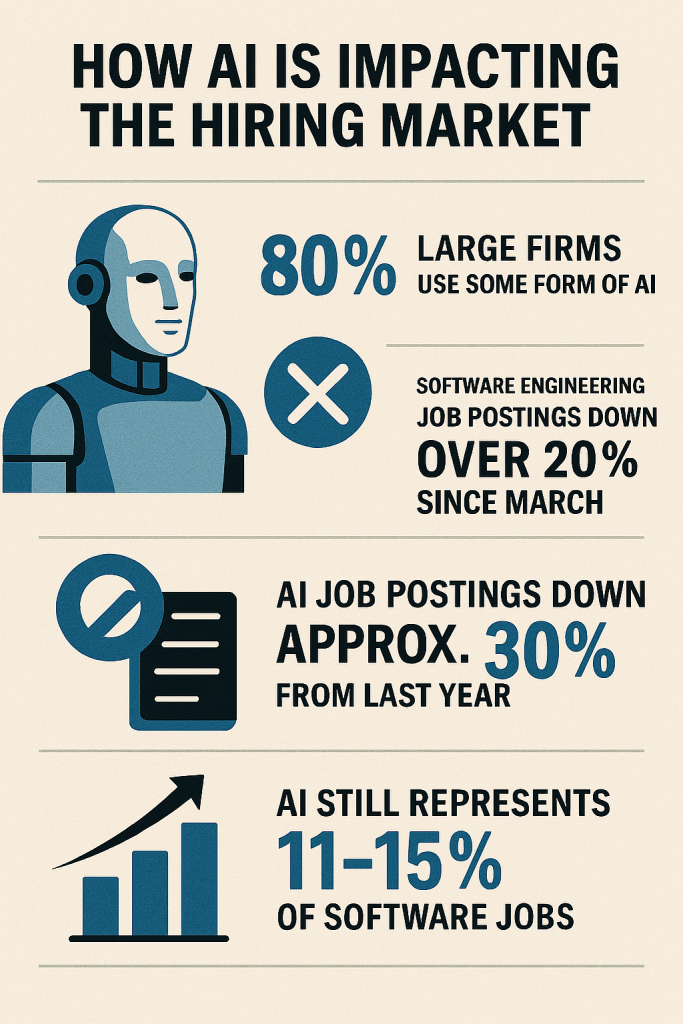
Across the U.S., software engineering roles dropped from 170,000 in March to under 150,000 by July.
AI job postings fell from 80,000 in February to just over 50,000 in June, though July showed a slight rebound.
Despite the slowdown, AI still makes up 11–15% of all software roles, suggesting it’s a strategic priority even as overall hiring cools.
🌍 Beyond Silicon Valley
States like South Dakota and Connecticut are seeing surprising growth in AI job postings—South Dakota reportedly jumped 164% last month.
The hiring boom is expanding into non-traditional industries, not just Big Tech. Think biotech, retail, and even energy sectors integrating AI.
So while the hiring frenzy of 2023 has mellowed, AI talent remains a hot commodity—just more targeted and strategic.
The general reporting across August 2025 paints a clear picture of slower, more cautious hiring, especially in tech and AI-adjacent roles.
🧊 Hiring Has Cooled—Especially for AI-Exposed Roles
In the UK, tech and finance job listings fell 38%, nearly double the broader market decline.
Entry-level roles and those involving repetitive tasks (like document review or meeting summarisation) are increasingly at risk of automation.
Even in sectors with strong business performance, such as IT and professional services, job opportunities have continued to shrink.
🧠 AI’s Paradox: High Usage, Low Maturity
McKinsey reportedly says that while 80% of large firms use AI, only 1% say their efforts are mature, and just 20% report enterprise-level earnings impact.
Most AI deployments are still horizontal (chatbots, copilots), while vertical use cases (full process automation) remain stuck in pilot mode.
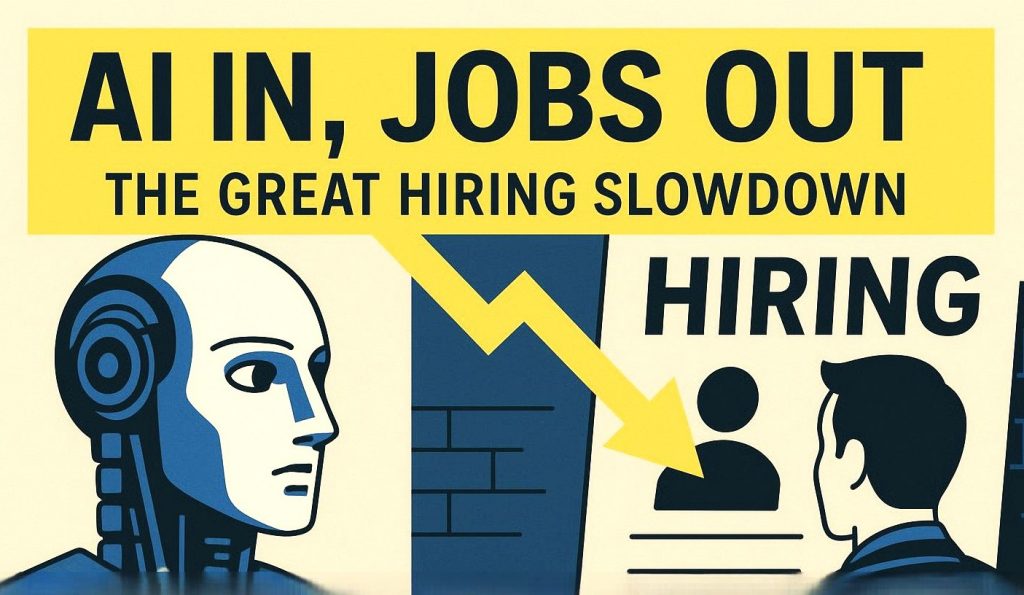
Infographic of AI effect on jobs and hiring
📉 Broader Market Signals
Job adverts have dropped most for occupations most exposed to AI, especially among young graduates.
Despite a slight uptick in hiring intentions in June and July, the overall labour market shows a marked cooling.
So yes, the general tone is one of strategic hesitation—companies are integrating AI but not rushing to hire unless the role is future-proofed.
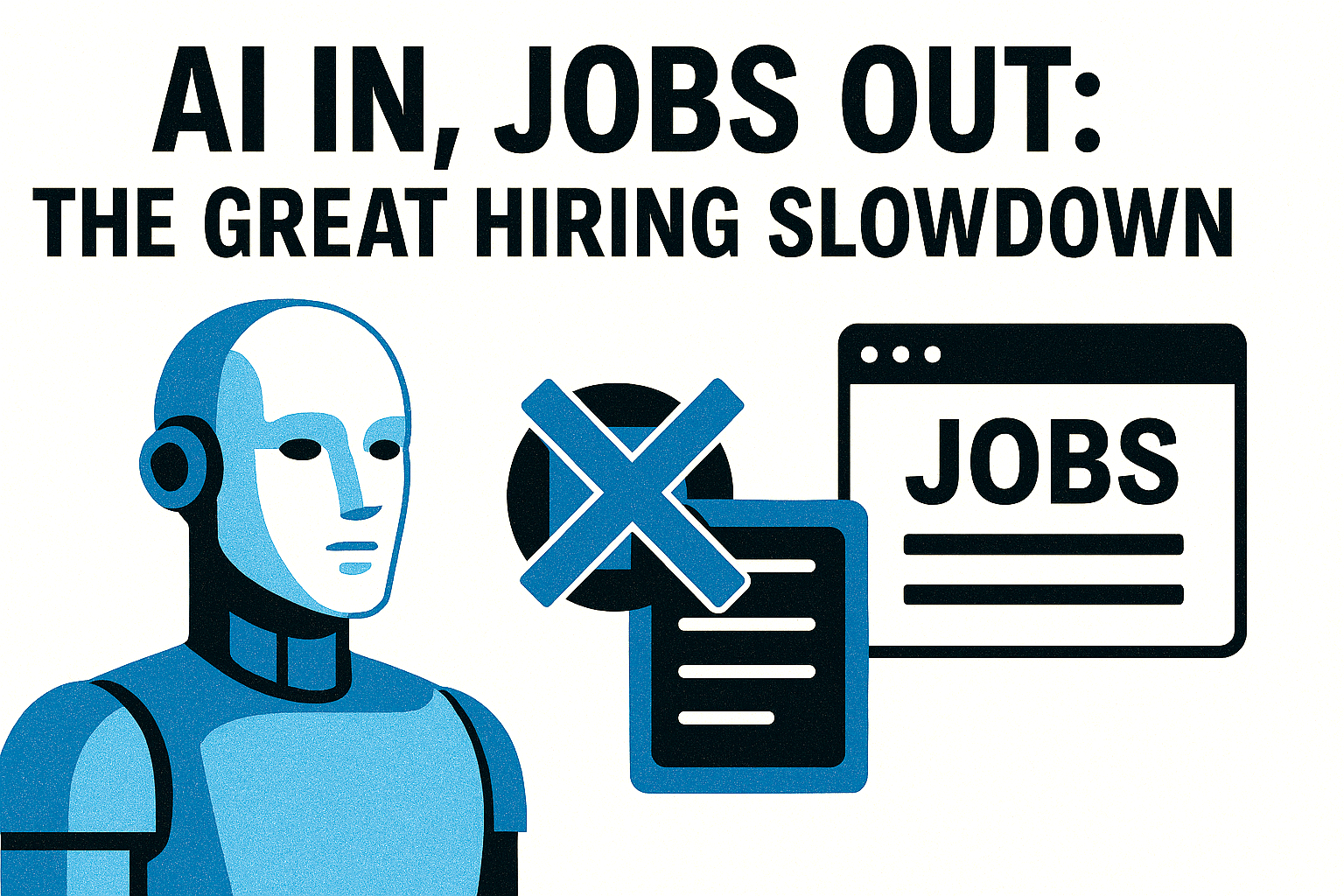
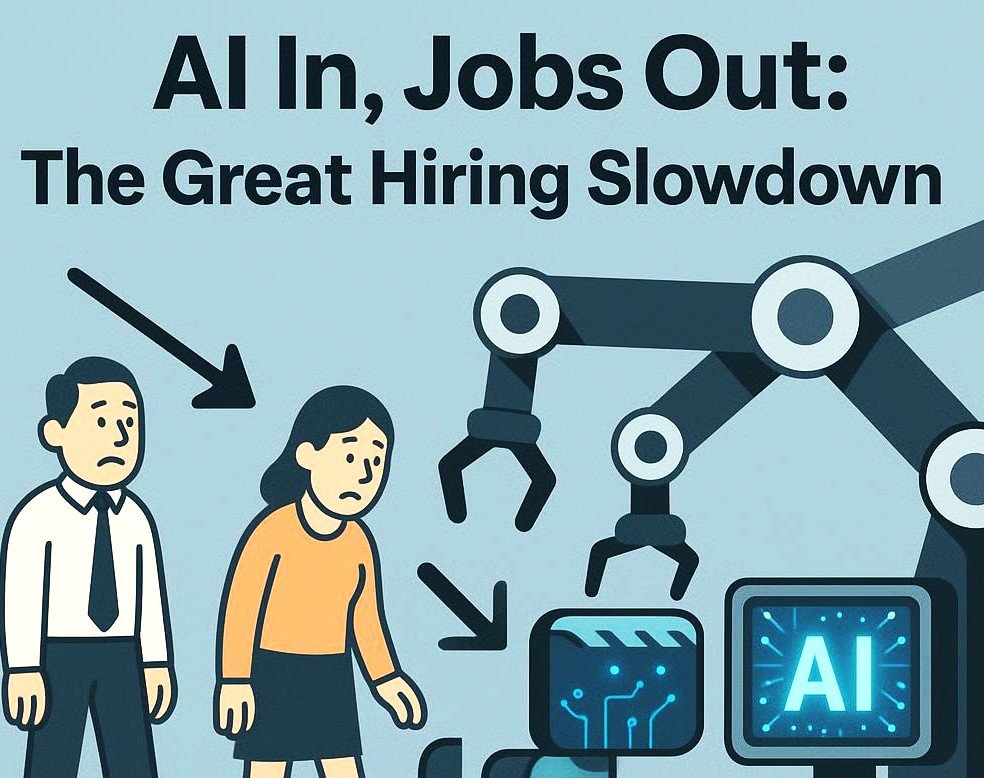
AI In, Jobs Out: The Great Hiring Slowdown
It’s official: the AI revolution has arrived—but the job listings didn’t get the memo.
Across the UK and U.S., tech hiring has slowed to a cautious crawl. Once-bustling boards now resemble digital ghost towns, especially for roles most exposed to automation.
Software engineering vacancies dropped by over 20% in just four months, while AI-related postings—once the darlings of 2023—have cooled from 80,000 to barely 50,000.
The irony? AI adoption is booming. Over 80% of large firms now deploy some form of artificial intelligence, from chatbots to copilots.
Yet only 1% claim their efforts are ‘mature’, and fewer still report meaningful earnings impact. It’s a paradox: widespread usage, minimal payoff, and a hiring freeze to match.
Even in sectors with strong performance—IT, finance, professional services—the job market is shrinking. Graduates face a particularly frosty reception, as entry-level roles vanish into the algorithmic ether.
Meanwhile, AI firms themselves are hiring with surgical precision: machine learning engineers and enterprise sales reps remain in demand, but the days of blanket recruitment are over.
Geographically, the hiring map is shifting too. South Dakota saw a 164% spike in AI job postings last month, while London and San Francisco quietly tightened their belts.
So, AI isn’t killing jobs—it’s reshaping them. The new roles demand fluency in automation, compliance, and creative problem-solving.
The rest? They’re being quietly retired.
For now, the job market belongs to the adaptable, the analytical, and the algorithmically literate.
Everyone else may need to reboot, eventually, but not quite just yet.
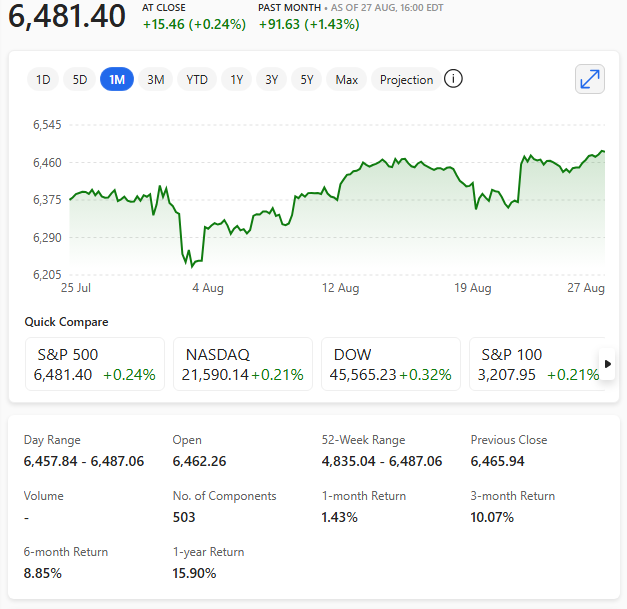
The S&P 500 closed at a fresh all-time high of 6,481.40, on 27th August 2025, marking a milestone driven largely by investor enthusiasm around artificial intelligence and anticipation of Nvidia’s earnings report.
This marks the index’s highest closing level ever, surpassing its previous record from 14th August 2025.
Here’s what powered the rally
🧠 AI Momentum: Nvidia, which now commands over 8% of the S&P 500’s weighting, has become a bellwether for AI-driven growth. Despite closing slightly down ahead of its earnings release, expectations for ‘humongous revenue gains’ kept investor sentiment buoyant.
💻 Tech Surge: Software stocks led the charge, with MongoDB soaring 38% after raising its profit forecast.
🏦 Fed Rate Cut Hopes: Comments from New York Fed President John Williams reportedly hinted at a possible rate cut in September, helping ease bond yields and boost equities.
🔋 Sector Strength: Energy stocks rose 1.15%, leading gains across 8 of the 11 S&P sectors.
S&P 500 at all-time record 27th August 2025
Even with Nvidia’s post-bell dip, the broader market seems to be pricing in sustained AI growth and a more dovish Fed stance.
Nvidia forecasts decelerating growth after a two-year AI Boom. A cautious forecast from the world’s most valuable company raises worries that the current rate of investment in AI systems might not be sustainable.
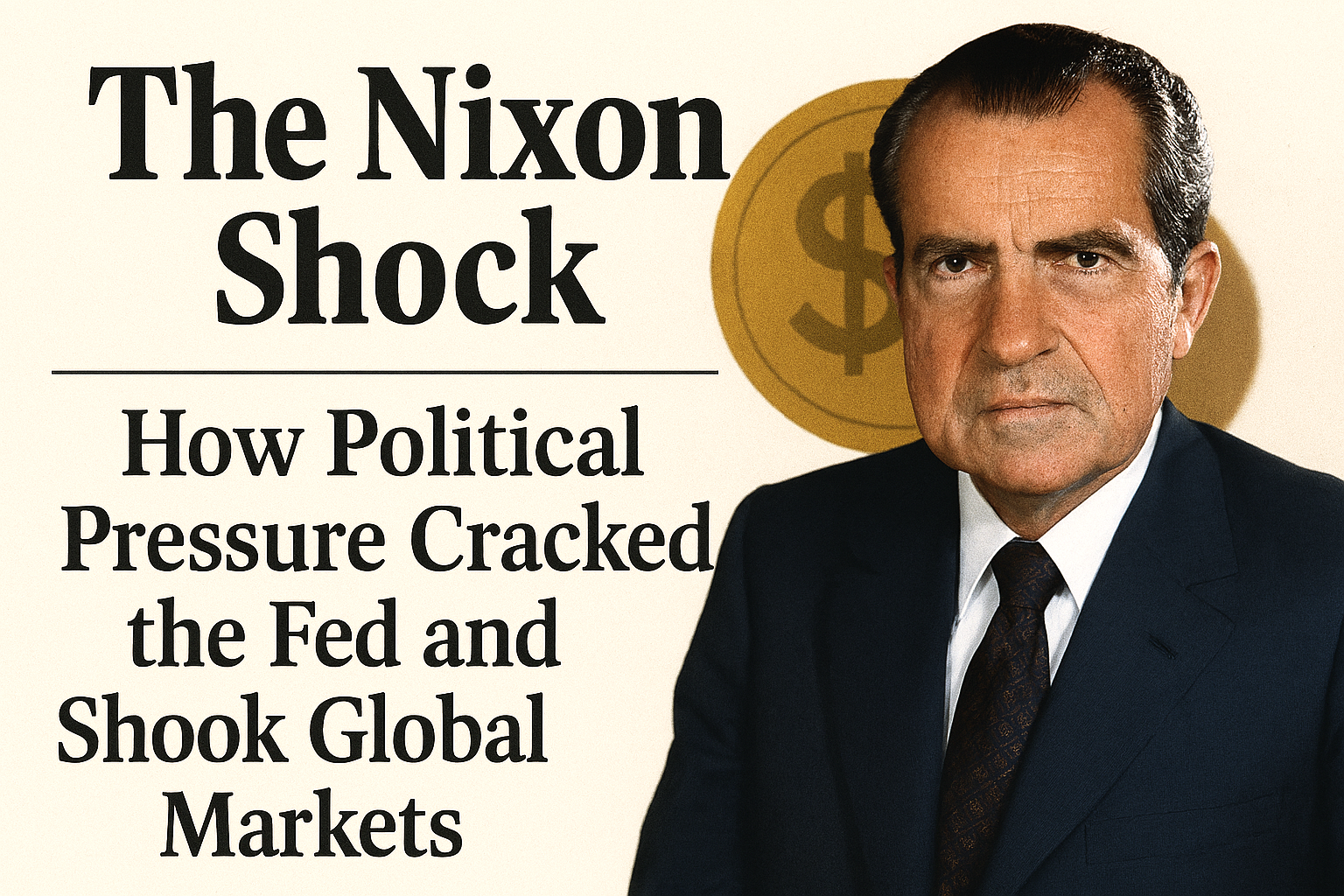
In the early 1970s, President Richard Nixon’s pursuit of re-election collided with the Federal Reserve’s independence, triggering a cascade of economic consequences that reshaped global finance.
The episode remains a cautionary tale about the dangers of politicising monetary policy.
At the heart of the drama was Nixon’s pressure on Fed Chair at the time, Arthur Burns to stimulate the economy ahead of the 1972 election. Oval Office tapes later revealed Nixon’s direct appeals for rate cuts and looser credit conditions—despite rising inflation.
Burns, reluctant but ultimately compliant, oversaw a period of aggressive monetary expansion. Interest rates were held artificially low, and the money supply surged.
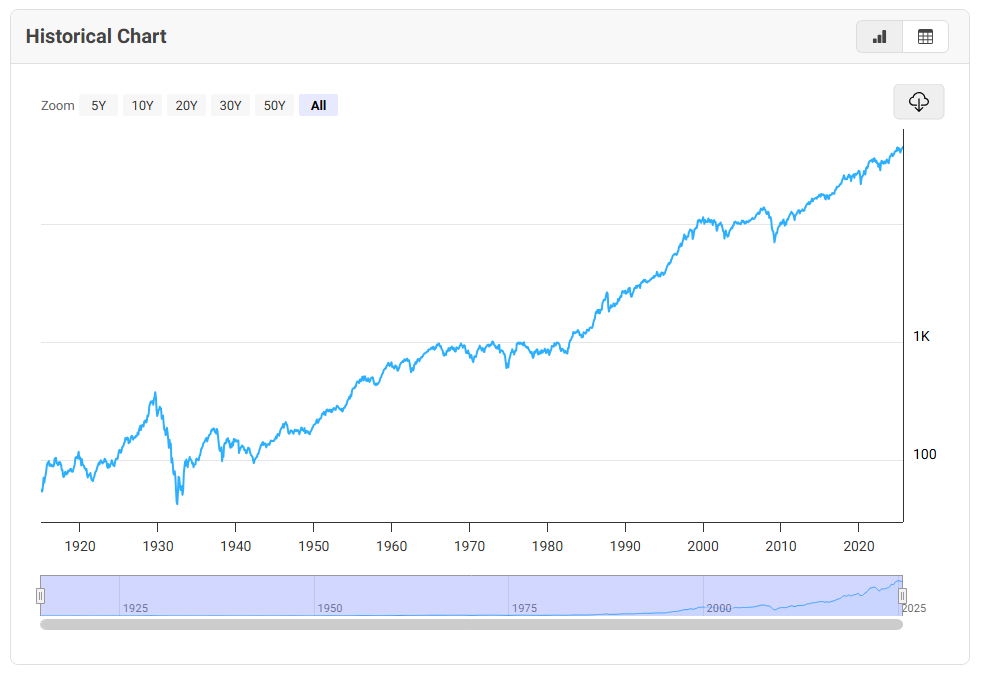
Dow historical chart – lowest 43 points to around 45,400
The short-term result was a booming economy and a landslide victory for Nixon. But the longer-term consequences were severe. Inflation, already simmering, began to boil. By 1973, consumer prices were rising at an annual rate of over 6%, and the dollar was under siege in global markets.
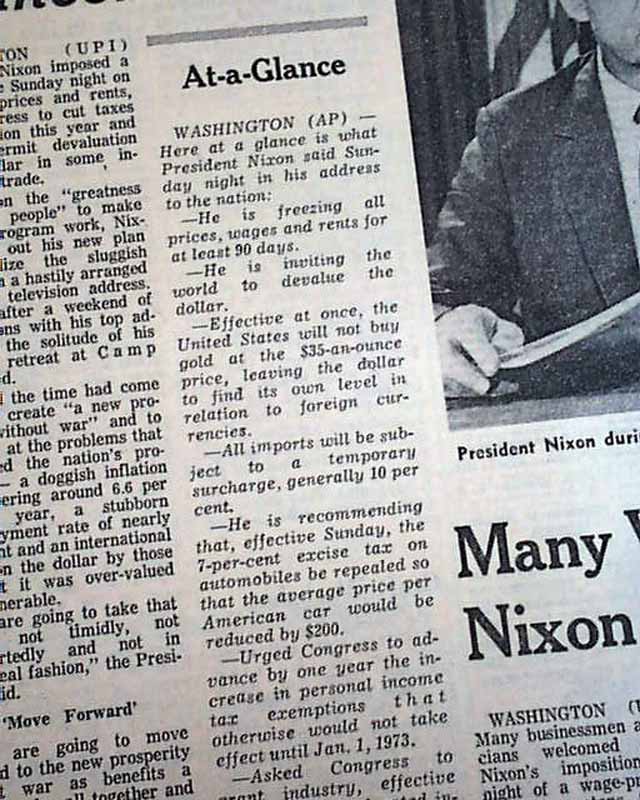
Then came the real shock: in August 1971, Nixon unilaterally suspended the dollar’s convertibility into gold, effectively ending the Bretton Woods system.
This move—intended to halt speculative attacks and preserve U.S. gold reserves—unleashed a new era of floating exchange rates and fiat currency. The dollar depreciated sharply, and global markets entered a period of volatility.
By 1974, the consequences were fully visible. The Dow Jones Industrial Average had fallen nearly 45% from its 1973 peak.
Politics vs the Federal Reserve – lesson learned?
Bond yields soared as investors demanded compensation for inflation risk. The U.S. economy entered a deep recession, compounded by the oil embargo and geopolitical tensions.
The Nixon-Burns episode is now widely viewed as a breach of central bank independence. It demonstrated how short-term political gains can lead to long-term economic instability.
The Fed’s credibility was damaged, and it took nearly a decade—culminating in Paul Volcker’s brutal rate hikes of the early 1980s—to restore price stability.
Today, as debates over Fed autonomy resurface, the lessons of the 1970s remain urgent. Markets thrive on trust, transparency, and institutional integrity. When those are compromised, even the most powerful economies can falter.
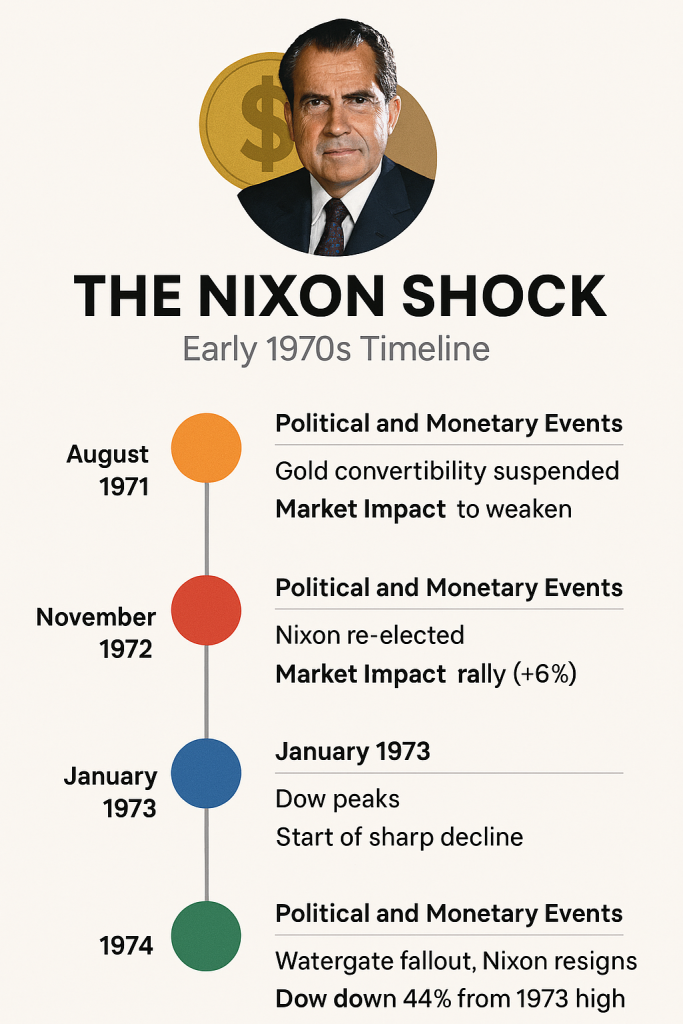
THE NIXON SHOCK — Early 1970’s Timeline
🔶 August 1971Event: Gold convertibility suspended Market Impact: Dollar begins to weaken Context: Nixon ends Bretton Woods, launching the fiat currency era
🔴 November 1972Event: Nixon re-elected Market Impact: Stocks rally briefly (+6%) Context: Fed policy remains loose under political pressure
🔵 January 1973Event: Dow peaks Market Impact: Start of sharp decline Context: Inflation accelerates, investor confidence erodes
🟢 1974Event: Watergate fallout, Nixon resigns Market Impact: Dow down 44% from 1973 high Context: Recession deepens, Fed credibility damaged.
Current dollar dive, stocks boom and bust (the Dow fell 19% in a year and then by 44% in 1975 from its January 1973 peak). U.S. 10-year Treasury yields surged (peaking at nearly 7.60% -close to twice today’s yield).
In hindsight, Nixon won the election—but lost the economy. And the Fed, caught in the crossfire, paid the price in credibility. It’s a reminder that monetary policy is no place for political theatre.
Is history repeating itself? Is Trump’s involvement different, or another catastrophe waiting to happen?
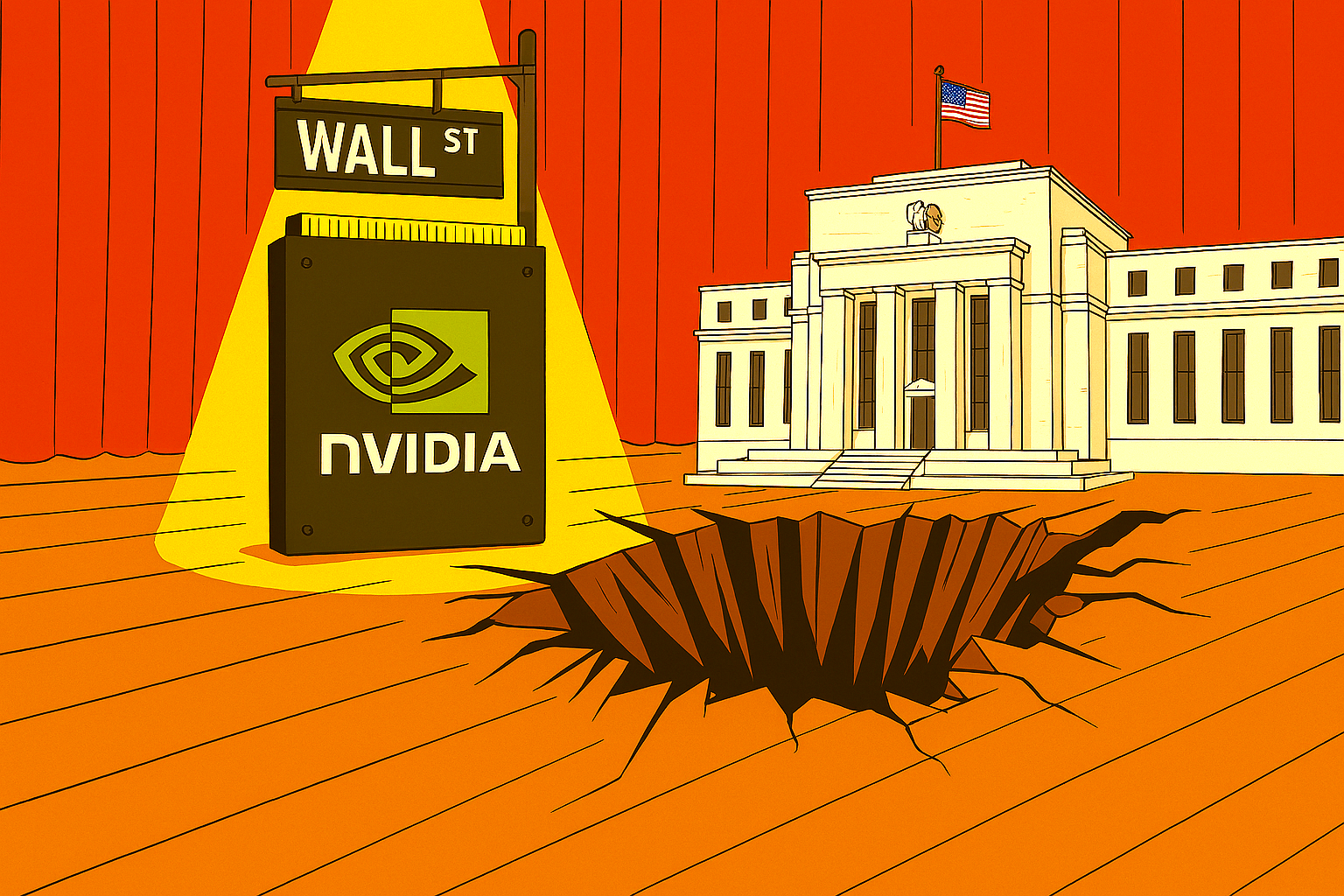
As Nvidia prepares to unveil another round of blockbuster earnings, Wall Street’s gaze remains firmly fixed on the AI darling’s ascent.
The company has become a proxy for the entire tech sector’s hopes, its valuation ballooning on the back of generative AI hype and data centre demand. Traders, analysts, and even pension funds are treating Nvidia’s quarterly results as a bellwether for market sentiment.
But while the Street pops champagne over GPU margins, a quieter and arguably more consequential drama is unfolding in Washington: The Federal Reserve’s independence is under threat.
Recent political manoeuvres—including calls to fire Fed Governor Lisa Cook and reshape the Board’s composition—have raised alarm bells among economists and institutional investors.
The Fed’s ability to set interest rates free from partisan pressure is a cornerstone of global financial stability. Undermining that autonomy could rattle bond markets, distort inflation expectations, and erode trust in the dollar itself.
Yet, the disparity in attention is striking. Nvidia’s earnings dominate headlines, while the Fed’s institutional integrity is relegated to op-eds and academic panels.
Why? In part, it’s the immediacy of Nvidia’s impact—its share price moves billions in minutes.
The Fed’s erosion, by contrast, is a slow burn, harder to quantify and easier to ignore until it’s too late.
Wall Street may be betting that the Fed will weather the political storm. But if central bank independence falters, even Nvidia’s stellar performance won’t shield markets from the fallout.
The real risk isn’t missing an earnings beat—it’s losing the referee in the game of monetary policy.
In the end, Nvidia may be the star of the show, but the Fed is the stage. And if the stage collapses, the spotlight won’t save anyone.
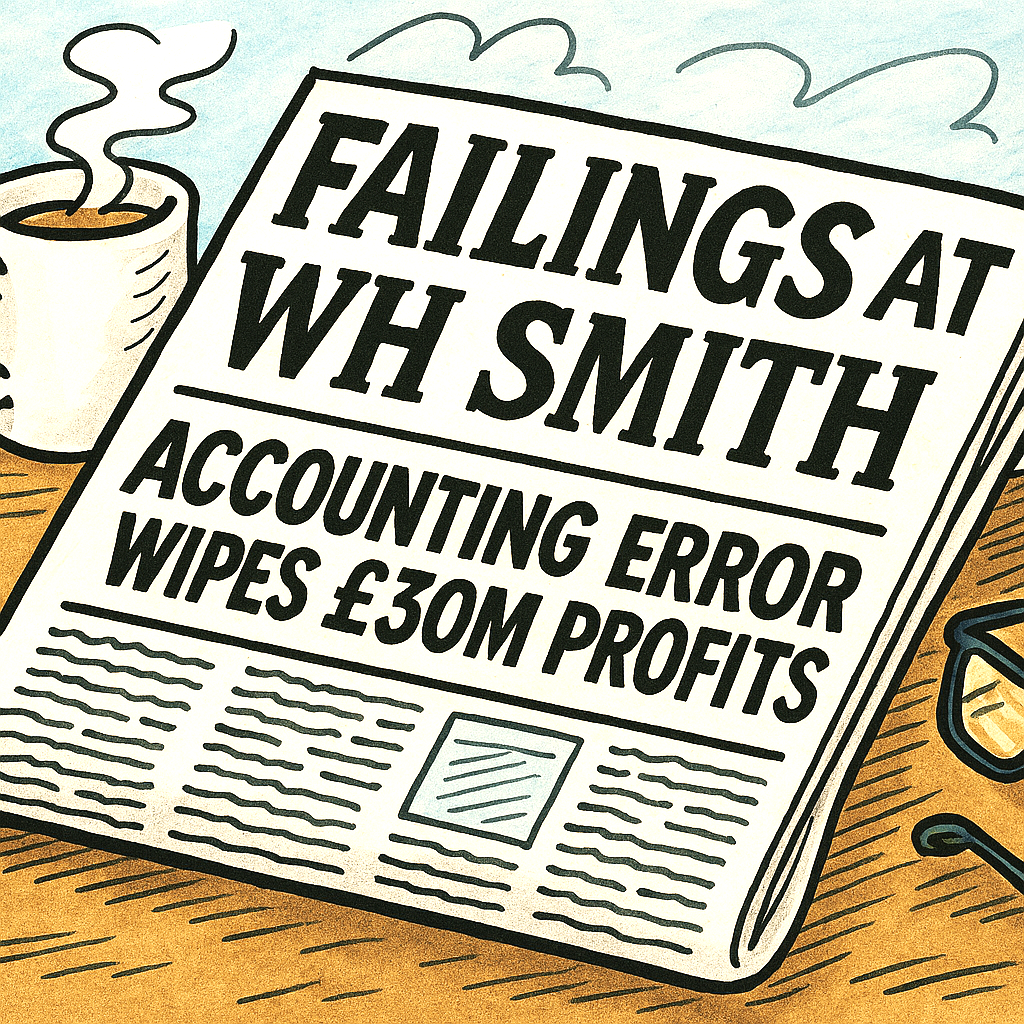
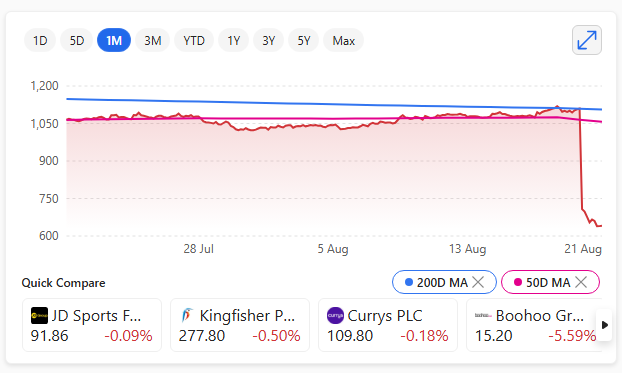
WH Smith’s attempt to reinvent itself as a sleek, travel-focused retailer has hit turbulence, with a £30 million profit overstatement in its North American division sending shares into a 42% nosedive.
The error, stemming from premature recognition of supplier income, has triggered a full audit review and left investors ‘sobbing into their cornflakes’, as one analyst reportedly put it. Not nice!
The timing couldn’t be worse. Having sold off its UK High Street arm earlier this year, WH Smith was banking on its overseas operations to deliver growth.
Instead, the company now expects just £25 million in North American trading profit—less than half its original forecast.
The reputational damage is compounded by the fact that supplier income, often tied to promotional deals, is notoriously tricky to account for.
WH Smith’s misstep suggests not just a lapse in judgement, but a systemic failure in financial controls.
Table of events
Metric
Details
📊 Profit Overstatement
£30 million
🧾 Cause of Error
Premature recognition of supplier income
🇺🇸 Affected Division
North America
📉 Share Price Impact
42% drop
📉 Revised Profit Forecast
£25 million (down from £54 million)
🕵️♂️ Audit Response
Full review initiated by Deloitte
🏪 Strategic Context
WH Smith sold UK High Street arm earlier in 2025
📦 Supplier Income Risk
Often tied to promotional deals; hard to track
This isn’t merely a spreadsheet error—it’s a strategic setback. The retailer’s pivot to travel hubs was meant to offer high-margin stability, buoyed by a captive audience.
But the accounting blunder casts doubt on the robustness of its operational oversight, especially in a market as competitive as the U.S.
With Deloitte now combing through the books, W H Smith faces a long road to restore investor confidence.
For a brand that once prided itself on reliability, this episode is a reminder that even legacy names can falter when ambition outpaces accountability.
W H Smith share price (one-month chart) 21st August 2025
Let’s hope the next chapter isn’t written in red ink.
As BIG tech poaches top AI talent, these companies are stripped to the bone as the tech talent is being hollowed out!
In the race to dominate artificial intelligence, America’s tech giants are vacuuming up talent at an unprecedented pace.
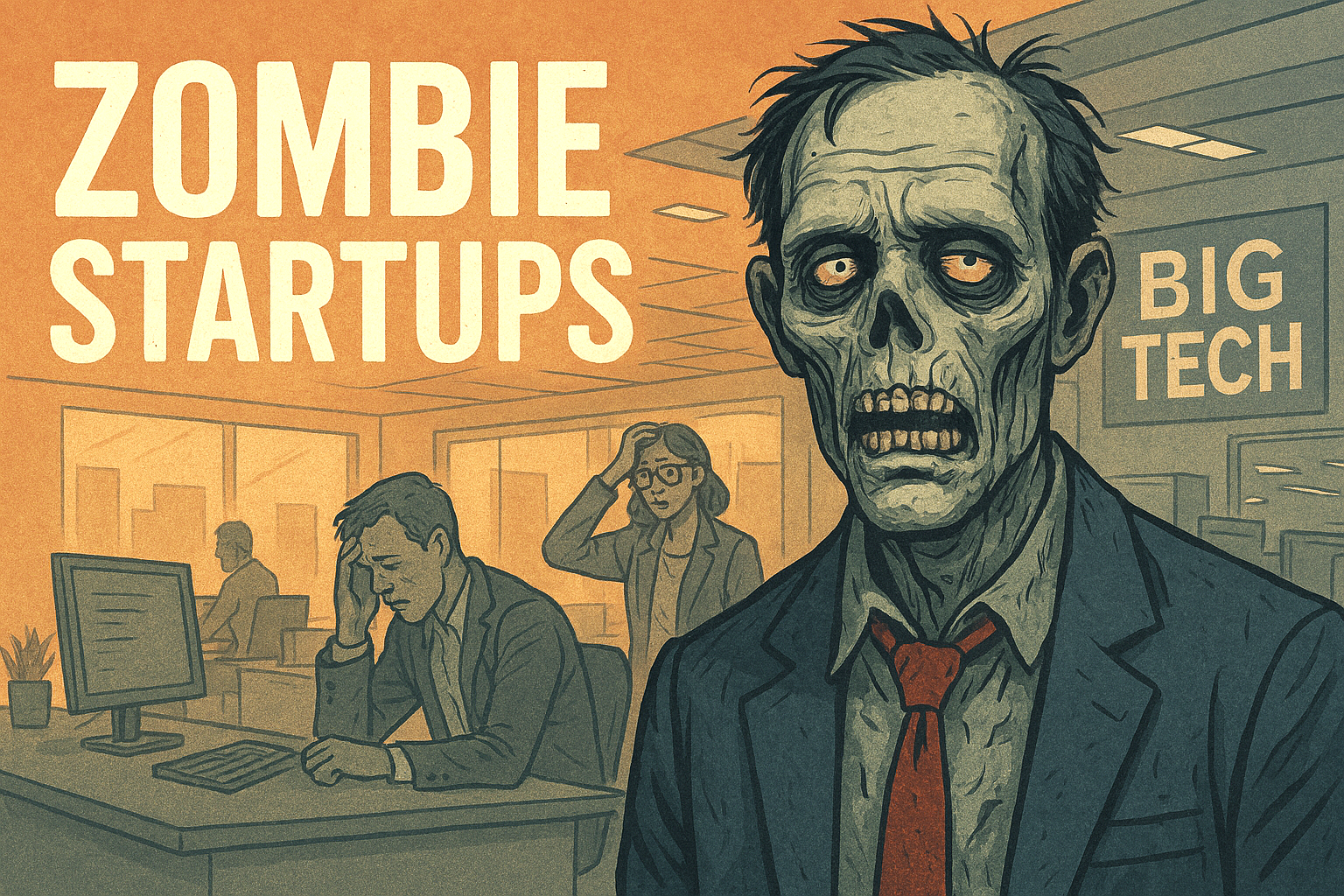
But behind the headlines of billion-dollar acquisitions and flashy AI demos lies a quieter crisis. The creation of ‘zombie companies’ — startups left staggering and soulless after their brightest minds are poached by Big Tech.
These zombie firms aren’t dead, but they’re no longer truly alive either. They continue to operate, maintain websites, and pitch to investors, yet their core innovation engine has stalled. The problem isn’t just brain drain — it’s brain decapitation.
When a startup loses its founding engineers, lead researchers, or visionary product designers to the likes of Google, Meta, or Microsoft, what remains is often a shell with no clear path forward.
The allure is understandable. Big Tech offers salaries that dwarf startup equity, access to massive compute resources, and the prestige of working on frontier models. But the downstream effect is corrosive.
Startups, once the lifeblood of AI experimentation, are now struggling to retain talent long enough to reach product maturity. Some pivot to consultancy, others limp along with outsourced development, and many quietly fold — their IP absorbed, their vision diluted.
This phenomenon is particularly acute in the U.S., where venture capital encourages rapid scaling but rarely protects against talent attrition. The result is a growing class of companies that exist more for optics than output — kept alive by inertia, legacy funding, or the hope of acquisition.
They clutter the innovation landscape, making it harder for truly disruptive ideas to gain traction.
Ironically, Big Tech’s hunger for talent may be undermining the very ecosystem it depends on. By stripping startups of their creative lifeblood, it risks turning the AI sector into a monoculture. This culture is then dominated by a few players, with fewer voices and less diversity of thought.
The solution isn’t simple. It may require new funding models, stronger incentives for retention, or even regulatory scrutiny of talent acquisition practices.
But one thing is clear: if the U.S. wants to remain the global leader in AI, it must find a way to nurture its startups — not just harvest them.
Otherwise, the future of innovation may be haunted by the walking dead.
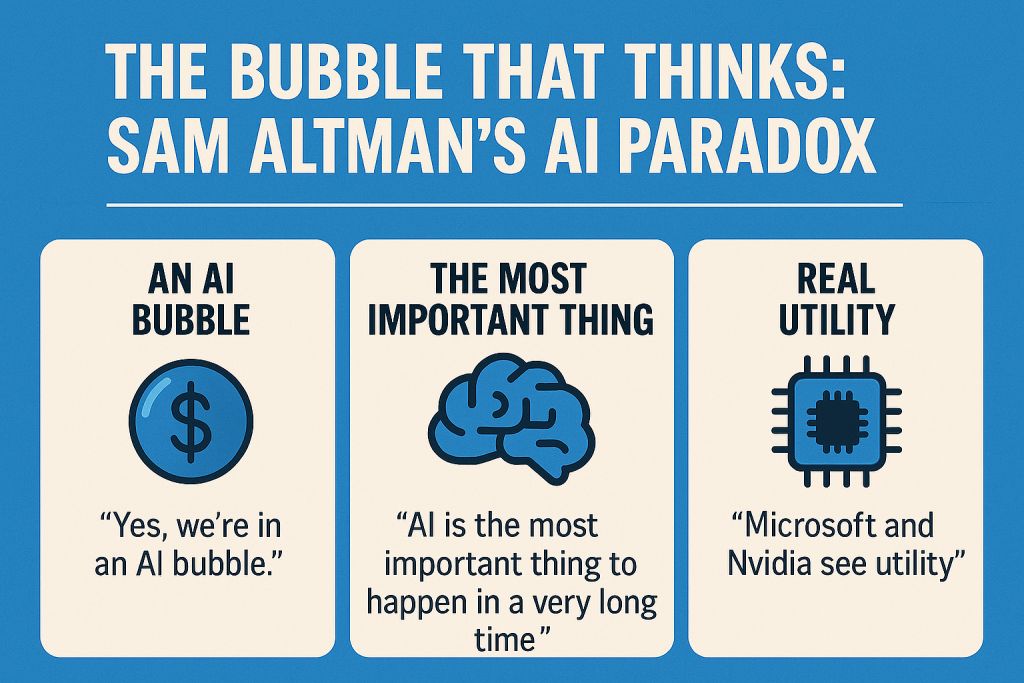
Sam Altman, CEO of OpenAI, has never been shy about bold predictions. But his latest remarks strike a curious chord reportedly saying: ‘Yes, we’re in an AI bubble’.
‘And yes, AI is the most important thing to happen in a very long time’. It’s a paradox that feels almost ‘Altmanesque’—equal parts caution and conviction, like a person warning of a storm while building a lighthouse.
Altman’s reported bubble talk isn’t just market-speak. It’s a philosophical hedge against the frothy exuberance that’s gripped Silicon Valley and Wall Street alike.
With AI valuations soaring past dot-com levels, and retail investors piling into AI-branded crypto tokens and meme stocks, the signs of speculative mania are hard to ignore.
Even ChatGPT, OpenAI’s flagship product, boasts 1.5 billion monthly users—but fewer than 1% pay for it. That’s not a business model—it’s a popularity contest.
Yet Altman isn’t calling for a crash. He’s calling for clarity. His point is that bubbles form around kernels of truth—and AI’s kernel is enormous.
From autonomous agents to enterprise integration in law, medicine, and finance, the technology is reshaping workflows faster than regulators can blink.
Microsoft and Nvidia are pouring billions into infrastructure, not because they’re chasing hype, but because they see utility. Real utility.
Still, Altman’s warning is timely. The AI gold rush has spawned a legion of startups with dazzling demos and dismal revenue. This is likely the Dotcom ‘Esque’ reality – many will fail.
Many are burning cash at unsustainable rates, betting on future breakthroughs that may never materialise. Investors, Altman suggests, need to recalibrate—not abandon ship, but stop treating every chatbot as the next Google.
What makes Altman’s stance compelling is its duality. He’s not a doomsayer, nor a blind optimist. He’s a realist who understands that transformative tech often arrives wrapped in irrational exuberance. The internet had its crash before it changed the world. AI may follow suit.
So, is this a bubble? Yes. But it’s a bubble with brains. And if Altman’s lighthouse holds, it might just guide us through the fog—not to safety, but to something truly revolutionary.
In the meantime, investors would do well to remember hype inflates, but only utility sustains.
And Altman, ever the ‘paradoxical prophet’, seems to be betting on both.
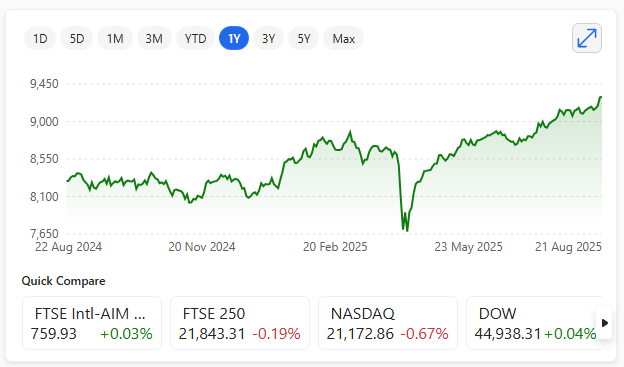
On 20 August 2025, the FTSE 100 hit a new all-time intraday high of 9,301.19, surpassing its previous records.
It closed the day at 9,288.14, up 1.1%—a strong finish despite hotter-than-expected UK inflation and a tech sell-off dragging down Wall Street.
The rally was driven by gains in heavyweight stocks like AstraZeneca, HSBC, Unilever, BAT, RELX, and Lloyds, plus a standout 5.6% surge from ConvaTec Group following its $300 million buyback announcement
FTSE 100 hits new all-time record on 20th August 2025
FTSE 100 hits new all-time record on 20th August 2025
A string of recent failings has exposed deep-rooted issues in the agency’s data collection, processing, and publication methods—raising alarm among economists, policymakers, and watchdogs alike.
The most visible setback came in August 2025, when the ONS abruptly delayed its monthly retail sales figures, citing the need for ‘further quality assurance’. This two-week postponement, while seemingly minor, is symptomatic of broader dysfunction.
Retail data is a key indicator of consumer confidence and spending, and its delay undermines timely decision-making across government and financial sectors.
But the problems run deeper. Labour market statistics—once a gold standard—have been plagued by collapsing response rates. The Labour Force Survey, a cornerstone of employment analysis, now garners responses from fewer than 20% of participants, down from 50% a decade ago.
This erosion has left institutions like the Bank of England flying blind on crucial metrics such as wage growth and economic inactivity.
Trade data and producer price indices have also suffered from delays and revisions, prompting the Office for Statistics Regulation (OSR) to demand a full overhaul.
In June, a review led by Sir Robert Devereux identified “deep-seated” structural issues within the ONS, calling for urgent modernisation.
The resignation of ONS chief Ian Diamond in May, citing health reasons, added further instability to an already beleaguered institution.
Critics argue that the failings are not merely technical but systemic. Funding constraints, outdated methodologies, and a culture resistant to reform have all contributed to the malaise.
As Dame Meg Hillier, chair of the Treasury Select Committee, reportedly warned: ‘Wrong decisions made by these institutions can mean constituents defaulting on mortgages or losing their livelihoods’.
Efforts are underway to replace the flawed Labour Force Survey with a new ‘Transformed Labour Market Survey’, but its rollout may not be completed until 2027.
Meanwhile, the ONS is attempting to integrate alternative data sources—such as VAT records and rental prices—to bolster its national accounts. Yet progress remains slow.
In an era where data drives policy, the failings of the ONS are more than bureaucratic hiccups—they are a threat to informed governance.
Without swift and transparent reform, Britain risks making economic decisions based on statistical guesswork.
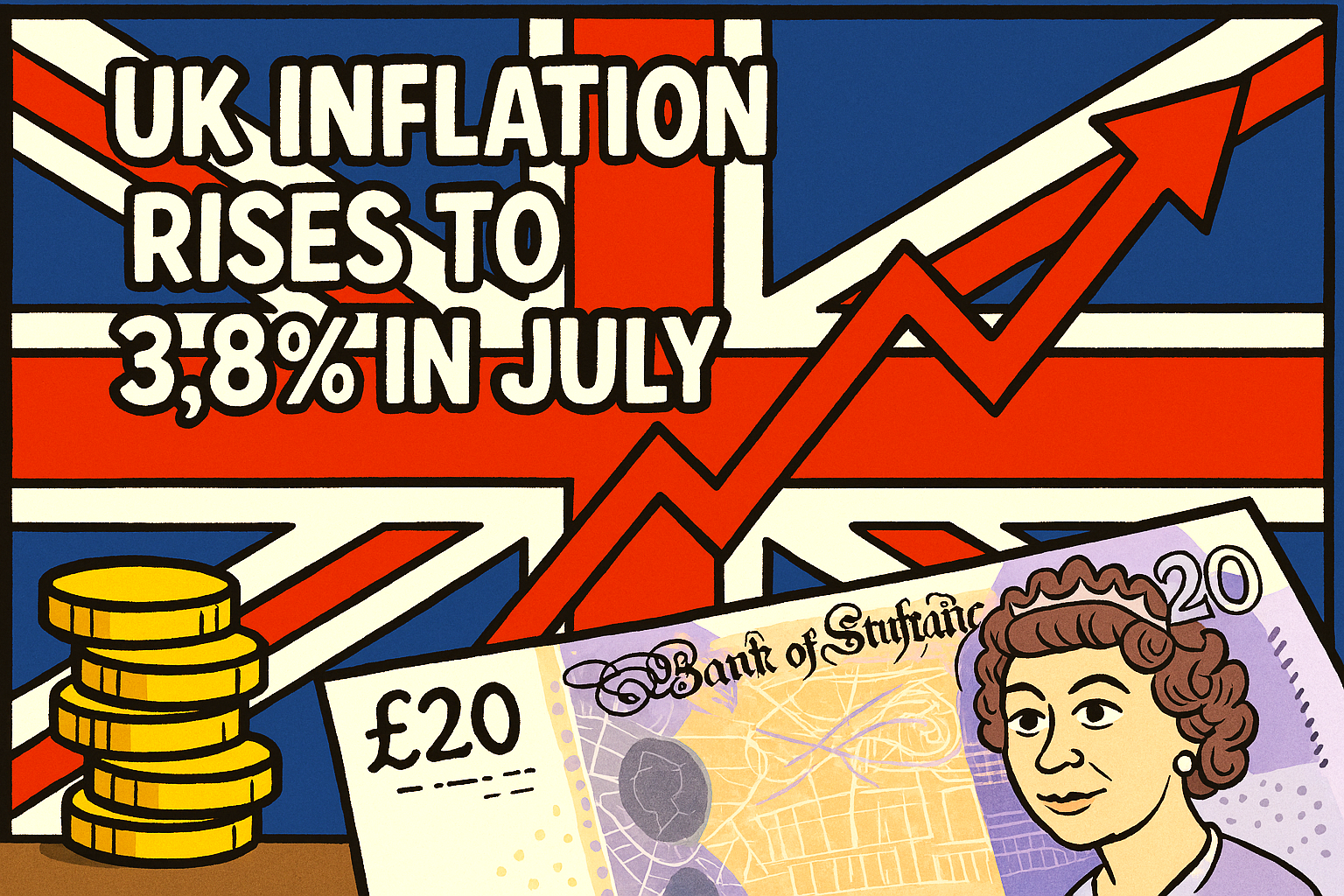
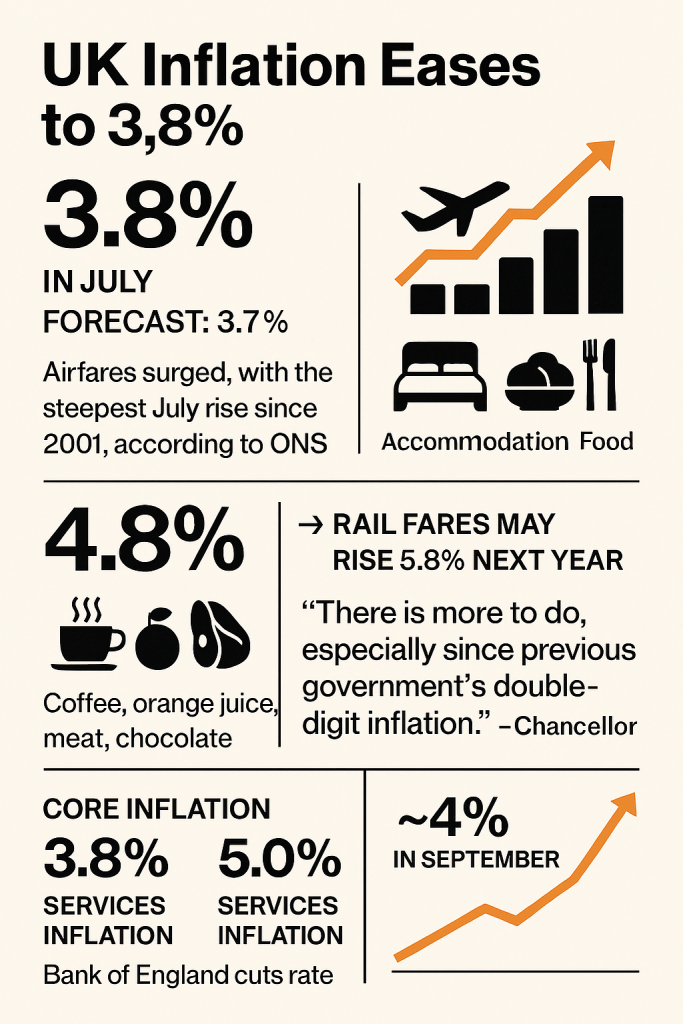
The UK’s annual inflation rate climbed to 3.8% in July, marking its highest level since January 2024 and outpacing economists’ forecasts of 3.7%.
The Office for National Statistics (ONS) attributed the unexpected rise to soaring airfares, elevated accommodation costs, and persistent food price pressures.
Transport costs were the primary driver, with airfares experiencing their steepest July increase since monthly tracking began in 2001.
Analysts suggest the timing of school holidays and a spike in demand—possibly amplified by high-profile events like the Oasis reunion tour—contributed to the surge.
Food inflation also continued its upward trend, with notable increases in coffee, fresh orange juice, meat, and chocolate.
The Retail Prices Index (RPI), which influences rail fare caps, rose to 4.8%, potentially signalling a 5.8% hike in regulated train fares next year.
Core inflation, which excludes volatile items such as energy and food, matched the headline rate at 3.8%, suggesting underlying price pressures remain stubborn.
Services inflation rose to 5%, reinforcing concerns that inflation may be embedding itself more deeply in the economy.
Despite the Bank of England’s recent rate cut to 4%, policymakers face a delicate balancing act. With inflation still nearly double the Bank’s 2% target, further monetary easing may be limited.
UK inflation July 2025 infographic
Chancellor Rachel Reeves acknowledged the challenge, stating that while progress has been made since the previous government’s double-digit inflation, ‘there’s more to do to ease the cost of living’.
Measures such as raising the minimum wage and expanding free school meals aim to cushion households from rising prices.
As inflation edges closer to a projected 4% peak in September 2025, the coming months will test both fiscal and monetary resilience.
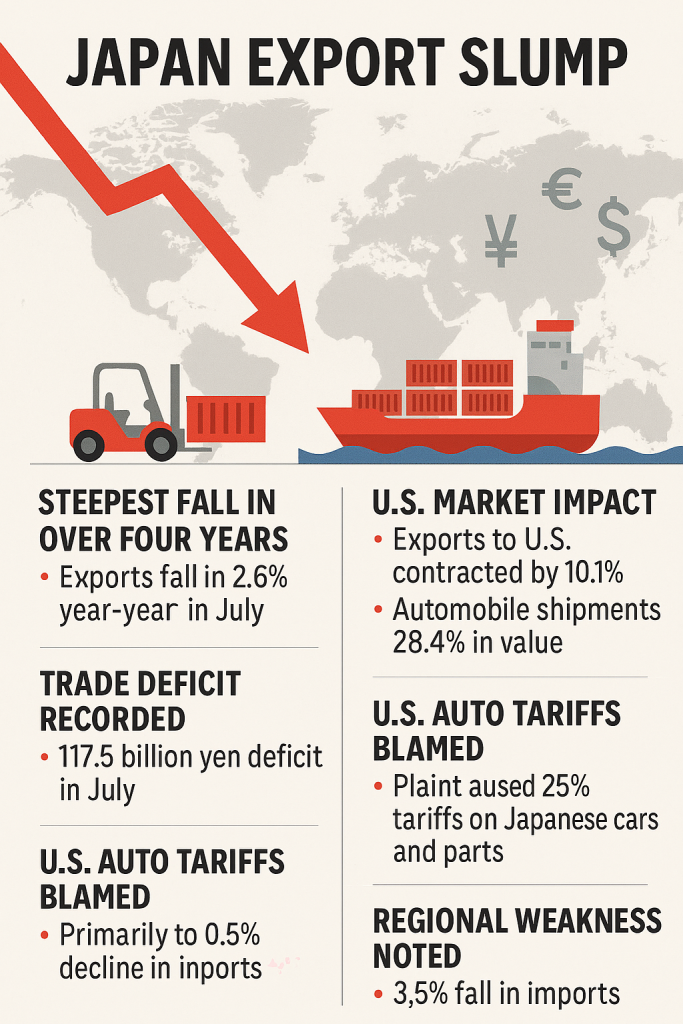
Japan’s economy has hit a troubling patch, with July 2025 marking its sharpest export contraction in over four years.
The Ministry of Finance reported a 2.6% year-on-year drop, driven largely by tariff led trade tensions and weakening global demand.
The most dramatic impact came from the United States, where exports fell 10.1%, led by a 28.4% plunge in automobile shipments.
This follows the U.S. administration’s decision to impose 25% tariffs on Japanese vehicles and auto parts in April—a move that has rattled Japan’s automotive sector, long a pillar of its export economy.
Despite a partial tariff rollback to 15% in July, the damage was already done. Japanese carmakers absorbed much of the cost to maintain shipment volumes, which only fell 3.2%, but the value loss was substantial.
Japan – July export data infographic
Exports to China also declined by 3.5%, underscoring broader regional weakness. Meanwhile, imports dropped 7.5%, signalling sluggish domestic consumption and further strain on Japan’s trade balance, which recorded a 117.5 billion yen deficit.
Economists warn that if the export downturn continues, Japan could face a recession. Although Q2 GDP showed modest growth of 0.3%, the July figures suggest that momentum may be fading.
The Bank of Japan is now expected to hold off on interest rate hikes, with its next policy meeting scheduled for 19th September 2025.
As global markets digest the implications, Japan’s export slump serves as a stark reminder of how vulnerable even advanced economies can be to shifting trade policies and geopolitical headwinds.
The short answer is no! AI hasn’t peaked in terms of potential—but the market frenzy around it may well be in bubble territory.
🚀 Signs of a Bubble?
Valuations vs. Earnings: The top 10 companies in the S&P 500—heavily weighted toward AI giants like Nvidia, Microsoft, and Apple—are more overvalued today than during the dot-com boom.
Retail Frenzy: Retail investors are piling into AI stocks, often driven by hype rather than fundamentals. Meme stocks and AI-branded crypto tokens are surging again.
Low Conversion Rates: Despite massive user numbers, paid adoption is weak. OpenAI’s ChatGPT has 1.5 billion monthly users, but only 0.96% pay for it. That’s a poor monetisation ratio compared to services like Gmail. However, commercial uptake is far higher.
Unsustainable Business Models: Many AI startups operate at huge losses, relying on speculative funding rather than sustainable revenue.
🧠 But Has AI Peaked Technologically?
No-way – not even close.
Agentic AI: Models like GLM-4.5 from China and Anthropic’s Claude are pushing toward autonomous task decomposition—meaning smarter, more efficient systems.
Enterprise Integration: AI is transforming workflows in law, medicine, and finance. Companies like RELX are embedding AI into decision-making tools with real-world impact.
Hardware & Infrastructure: Microsoft and Nvidia are investing billions in AI infrastructure, suggesting long-term belief in its utility—not just hype.
What Comes Next?
Rebalancing: Like the dot-com crash, we may see a correction. Overhyped firms could fall, while those with real utility and revenue survive and thrive.
Regulatory Pressure: Governments are starting to scrutinise AI’s economic and ethical impact. That could reshape the landscape.
Investor Reality Check: As soon as investors stop chasing hype and start demanding profitability, the bubble may deflate.
Less than 1% of users currently pay for ChatGPT (is this a failure to monetise or massive future potential to unfold)?
Remember how long it took Google to monetise its search engine in the beginning? Think – MySpace, Yahoo, AOL and others?
As of mid-2025, OpenAI ChatGPT has around 1.5 billion monthly users, but only a tiny fraction pay for premium plans like ChatGPT Plus ($20/month) or Pro ($200/month).
While OpenAI hasn’t published exact conversion rates, multiple industry analysts estimate that fewer than 1% of users are paying subscribers, based on app store revenue data and internal usage leaks.
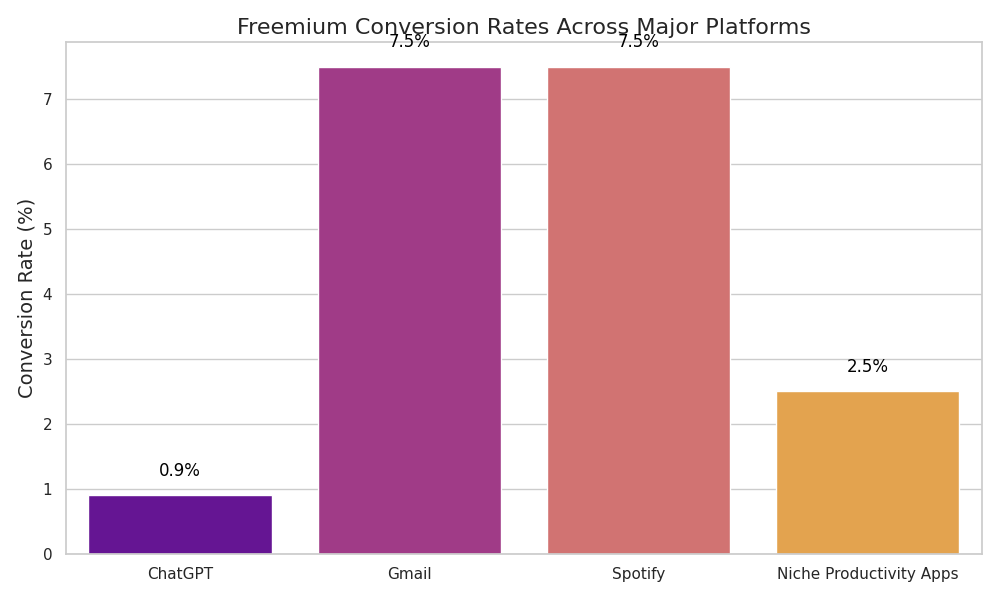
This low monetisation rate is striking when compared to other freemium models:
Gmail and Spotify convert ~5–10% of users to paid tiers
Even niche productivity apps often hit 2–3%
Indication of pay per use and free conversion rates
Platform
Conversion Rate
ChatGPT
0.9%
Gmail
7.5%
Spotify
7.5%
Niche Productivity Apps
2.5%
Platform
Conversion Rate
Spotify
7.5%
YouTube Music
4.2%
Apple Music
6.8%
Deezer
3.9%
Amazon Music
5.1%
So, despite massive reach, ChatGPT’s revenue per user is still very low. That’s one reason why some analysts argue the AI market is in a bubble: huge valuations, but weak direct monetisation.
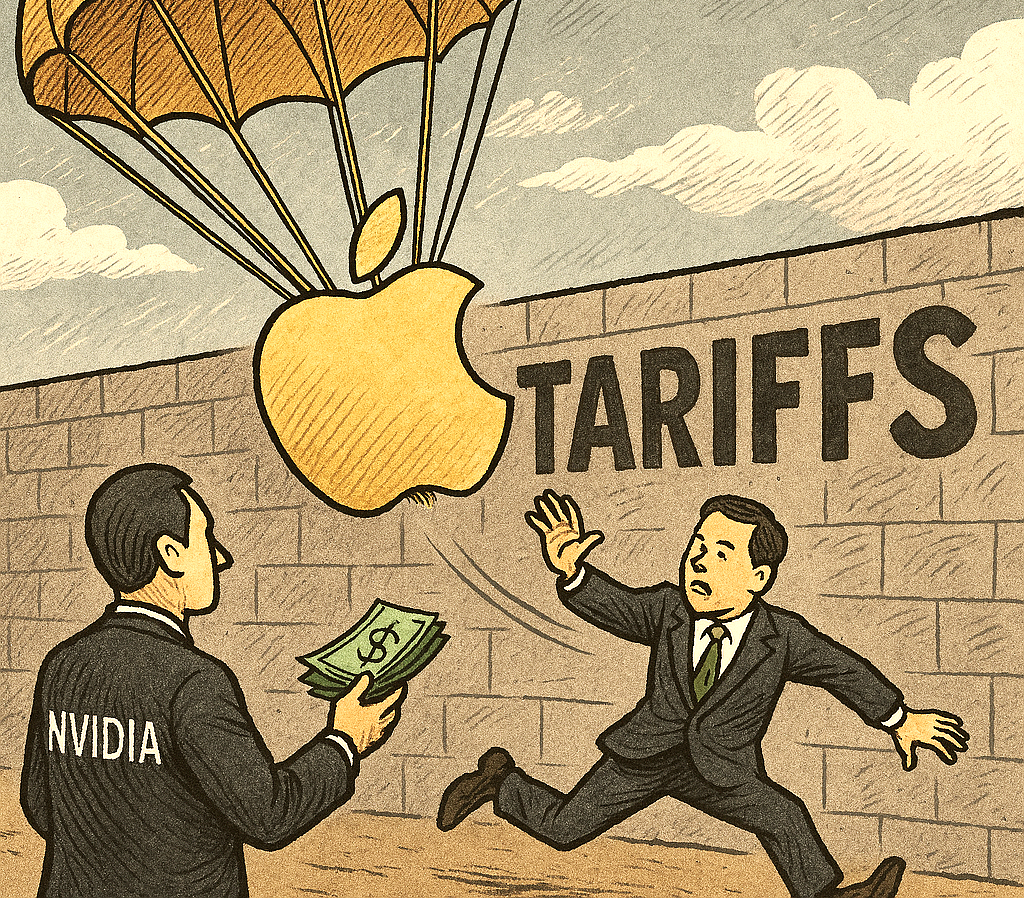
Where is the standard for the tariff line? Is this fair on the smaller businesses and the consumer? Money buys a solution without fixing the problem!
Nvidia and AMD have struck a deal with the U.S. government: they’ll pay 15% of their China chip sales revenues directly to Washington. This arrangement allows them to continue selling advanced chips to China despite looming export restrictions.
Apple, meanwhile, is going all-in on domestic investment. Tim Cook announced a $600 billion U.S. investment plan over four years, widely seen as a strategic move to dodge Trump’s proposed 100% tariffs on imported chips.
🧩 Strategic Motives
These deals are seen as tariff relief mechanisms, allowing companies to maintain access to key markets while appeasing the administration.
Analysts suggest Apple’s move could trigger a ‘domino effect’ across the tech sector, with other firms following suit to avoid punitive tariffs.
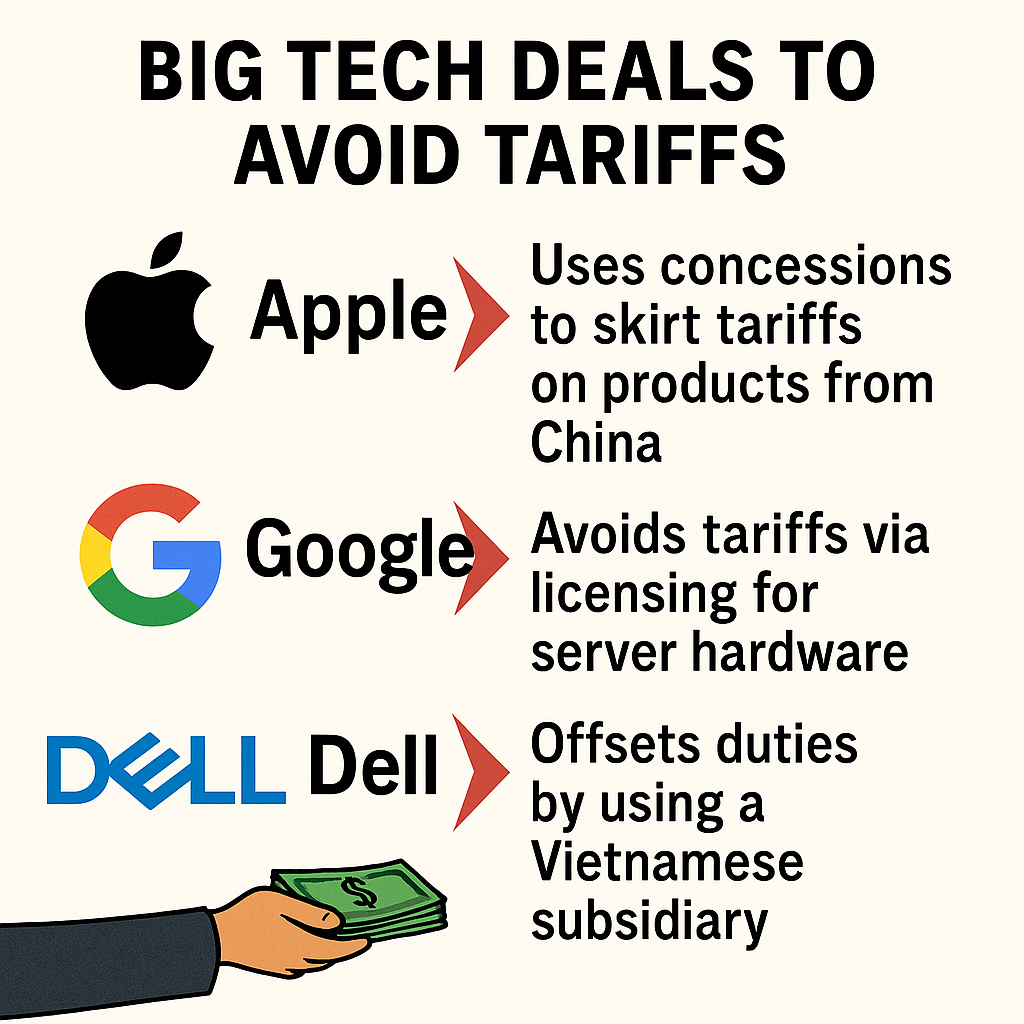
Tariff avoidance examples
⚖️ Legal & Investor Concerns
Some critics call the Nvidia/AMD deal a “shakedown” or even unconstitutional, likening it to a tax on exports.
Investors are wary of the arbitrary nature of these deals—questioning whether future administrations might play kingmaker with similar tactics.
Big Tech firms are striking strategic deals to sidestep escalating tariffs, with Apple pledging $600 billion in U.S. investments to avoid import duties, while Nvidia and AMD agree to pay 15% of their China chip revenues directly to Washington.
These moves are seen as calculated trade-offs—offering financial concessions or domestic reinvestment in exchange for continued market access. Critics argue such arrangements resemble export taxes or political bargaining, raising concerns about legality and precedent.
As tensions mount, these deals reflect a broader shift in how tech giants navigate geopolitical risk and regulatory pressure.
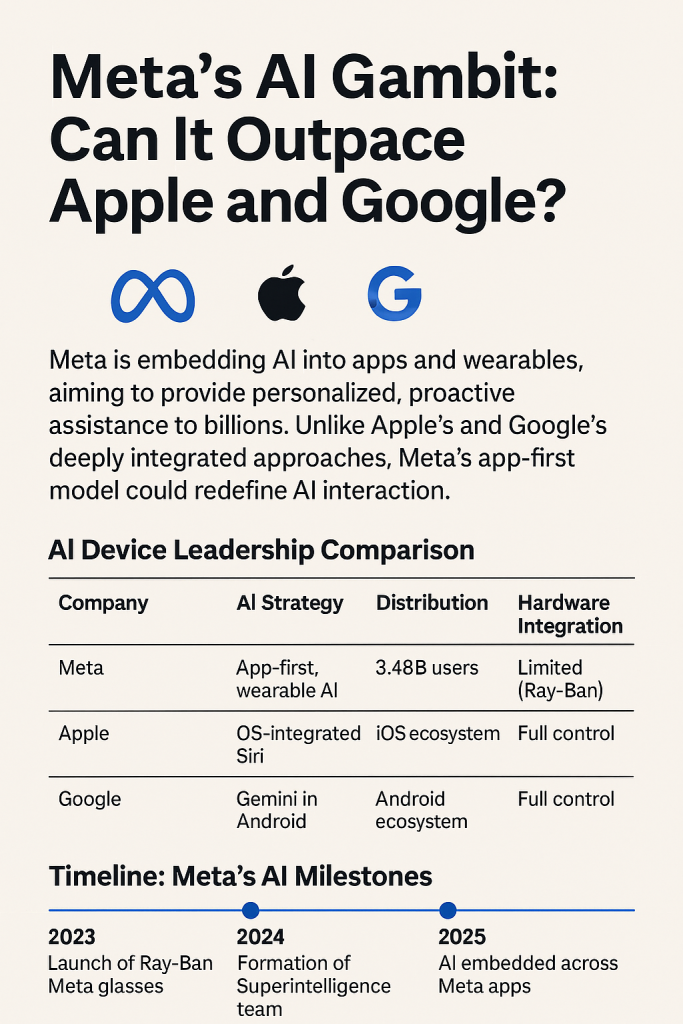
Meta is making a serious play to become the dominant force in AI-powered consumer devices, and it’s not just hype—it’s backed by aggressive strategy, talent acquisition, and a unique distribution advantage.
🧠 Meta’s Strategic Edge in AI Devices
1. Massive User Base
Meta has direct access to 3.48 billion daily active users across Facebook, Instagram, WhatsApp, and Messenger.
This gives it an unparalleled distribution channel for deploying AI features instantly across billions of devices.
2. Platform-Agnostic Approach
Unlike Apple and Google, which tightly integrate AI into their operating systems, Meta is bypassing OS gatekeepers by embedding AI into apps and wearables.
It’s partnering with chipmakers like Qualcomm and MediaTek to optimize AI performance on mobile hardware.
3. Talent Acquisition Blitz
Meta poached Ruoming Pang, Apple’s head of AI models, and Alexandr Wang, co-founder of ScaleAI, to lead its Superintelligence group.
This group aims to build AI that’s smarter than humans—an ambitious goal that’s drawing top-tier talent from rivals.
4. Proprietary Data Advantage
Meta’s access to real-time, personal communication and social media data is considered one of the most valuable datasets for training consumer-facing AI.
This gives it a leg up in personalization and contextual understanding.
🍏 Apple and Google: Still Strong, But Vulnerable
Apple
Struggled with its in-house AI models, reportedly considering outsourcing to OpenAI or Anthropic for Siri upgrades.
Losing this battle could signal deeper issues in Apple’s AI roadmap.
Google
Has robust AI infrastructure and Gemini models, but faces competition from Meta’s nimble, app-based deployment strategy.
🔮 Could Meta Win?
Meta’s approach is disruptive: it’s not trying to own the OS—it’s trying to own the AI interface. If it continues to scale its AI across apps, smart glasses (like Ray-Ban Meta), and future AR devices, it could redefine how users interact with AI daily.
That said, Apple and Google still control the hardware and OS ecosystems, which gives them deep integration advantages. Meta’s success will depend on whether users prefer AI embedded in apps and wearables over OS-level assistants.
The UK economy (GDP) grew by 0.3% in the second quarter of 2025, outperforming forecasts of just 0.1% growth (not difficult).
This marks a slowdown from the robust 0.7% expansion seen in Q1, but June’s rebound helped offset weaker activity in April and May 2025.
📊 Key Highlights:
Monthly growth: +0.4% in June, following a slight dip in May.
Sector drivers: Services led the charge, with gains in computer programming, health, vehicle leasing, and scientific R&D. Construction also rose, while production dipped slightly.
Updated data: April’s contraction was revised to show a milder decline than previously estimated.
💬 Expert commentary:
Economists caution that the momentum may not last, citing a softening labour market and inflationary pressures.
The Bank of England recently cut interest rates to 4%, aiming to balance inflation control with economic support.
Chancellor Rachel Reeves welcomed the figures but stressed the need for deeper reform to unlock long-term growth.
Despite the sunny headline, analysts remain wary of headwinds from global weakness, tax changes, and cautious consumer sentiment.
The outlook for Q3 is more muted, with hopes of a sharp rebound likely to be tempered.
In a sweeping rally that spanned continents and sectors, major global indices surged to fresh record highs yesterday, buoyed by cooling inflation data,renewed hopes of U.S. central bank rate cuts, and easing trade tensions.
U.S. inflation figures released 12th August 2025 for July came in at: 2.7% – helping to lift markets to new record highs!
U.S. Consumer Price Index — July 2025
Metric
Value
Monthly CPI (seasonally adjusted)
+0.2%
Annual CPI (headline)
+2.7%
Core CPI (excl. food & energy)
+0.3% monthly, +3.1% annual
Despite concerns over Trump’s sweeping tariffs, the U.S. July 2025 CPI came in slightly below expectations (forecast was 2.8% annual).
Economists noted that while tariffs are beginning to show up in certain categories, their broader inflationary impact remains modest — for now.
Global Indices Surged to Record Highs Amid Rate Cut Optimism and Tariff Relief
Tuesday, 12 August 2025 — Taking Stock
📈 S&P 500: Breaks Above 6,400 for First Time
Closing Level: 6,427.02
Gain: +1.1%
Catalyst: Softer-than-expected U.S. CPI data (+2.7% YoY) boosted bets on a September rate cut, with 94% of traders now expecting easing.
Sector Drivers: Large-cap tech stocks led the charge, with Microsoft, Meta, and Nvidia all contributing to the rally.
💻 Nasdaq Composite & Nasdaq 100: Tech Titans Lead the Way
Nasdaq Composite: Closed at a record 21,457.48 (+1.55%)
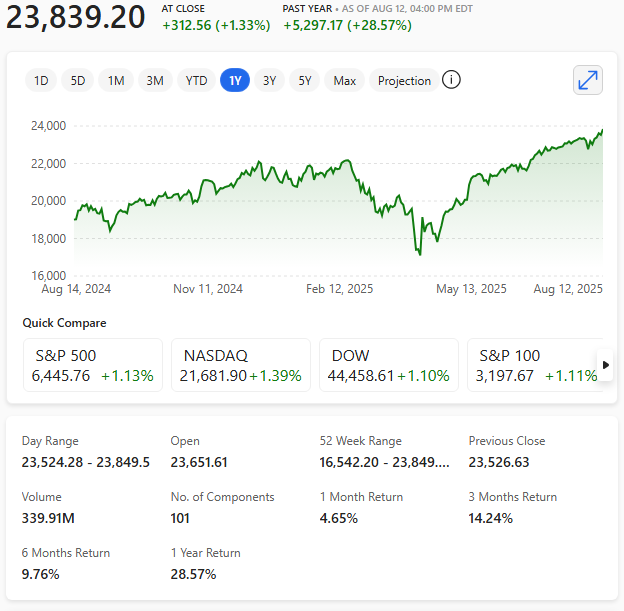
Nasdaq 100: Hit a new intraday high of 23,849.50, closing at 23,839.20 (+1.33%)
Highlights:
Apple surged 4.2% after announcing a $600 billion U.S. investment plan.
AI optimism continues to fuel gains across the Magnificent Seven stocks.
Nasdaq 100 chart 12th August 2025
Nasdaq 100 chart 12th August 2025
🧠 Tech 100 (US Tech Index): Momentum Builds
Latest High: 23,849.50
Weekly Gain: Nearly +3.7%
Outlook: Traders eye a breakout above 24,000, with institutional buying accelerating. Analysts note a 112% surge in net long positions since late June.
🇯🇵 Nikkei 225: Japan Joins the Record Club
Closing Level: 42,718.17 (+2.2%)
Intraday High: 43,309.62
Drivers:
Relief over U.S. tariff revisions and a 90-day pause on Chinese levies.
Strong earnings from chipmakers like Kioxia and Micron.
Speculation of expanded fiscal stimulus following Japan’s recent election results.
🧮 Market Sentiment Snapshot
Index
Record Level Reached
% Gain Yesterday
Key Driver
S&P 500
6,427.02
+1.1%
CPI data, rate cut bets
Nasdaq Comp.
21,457.48
+1.55%
AI optimism, Apple surge
Nasdaq 100
23,849.50
+1.33%
Tech earnings, institutional buying
Tech 100
23,849.50
+1.06%
Momentum, bullish sentiment
Nikkei 225
43,309.62
+2.2%
Tariff relief, chip rally
📊 Editorial Note: While the rally reflects strong investor confidence, analysts caution that several indices are approaching technical overbought levels.
The Nikkei’s RSI, for instance, has breached 75, often a precursor to short-term pullbacks.
Trump’s latest flurry of tariff U-turns has left global markets whiplashed but oddly resilient.
From threatening Swiss gold bars with a 39% levy to abruptly tweeting ‘Gold will not be Tariffed!’ The former president’s reversals have become a hallmark of his political tactic.
Investors now brace for volatility not from policy itself, but from its rapid retraction. With China tariffs delayed, praise for previously criticised CEOs, and shifting stances on Ukraine and Russia, Trump’s tactics seem less about strategy and more about spectacle.
Yet despite the chaos, markets appear unfazed—suggesting that unpredictability may now be priced in
🧠 Why So Many U-Turns?
Market Sensitivity: Many reversals follow stock market dips or investor backlash.
Diplomatic Pressure: Allies like Switzerland, India, Ukraine, Canada and Australia have pushed back hard.
Narrative Control: Trump often uses Truth Social to pivot public messaging rapidly.
Strategic Ambiguity: Some analysts argue it’s part of a negotiation tactic—others call it chaos.
🔁 Latest Trump U-Turns
Topic
Initial Position
Reversal
Date
Gold Tariffs
Swiss gold bars to face 39% tariff
Trump tweets “Gold will not be Tariffed!”
7 Aug 2025
China Tariffs
145% reciprocal tariffs to begin
Delayed for 90 days
12 Aug 2025
Intel CEO Lip-Bu Tan
“Must resign, immediately”
“His success and rise is an amazing story”
11 Aug 2025
Russia-Ukraine Arms
Paused military aid to Ukraine
Resumed shipments after backlash
8 Jul 2025
India’s Role in Peace Talks
Criticised India’s neutrality
Praised India’s diplomatic efforts
9 Aug 2025
Global Tariffs
Imposed sweeping import taxes
Suspended most tariffs within 13 hours
9 Apr 2025
Epstein Files
Promised full declassification
Now downplaying and deflecting
Ongoing
TACO – Trump Always Chickens Out! Tactics or turmoil?
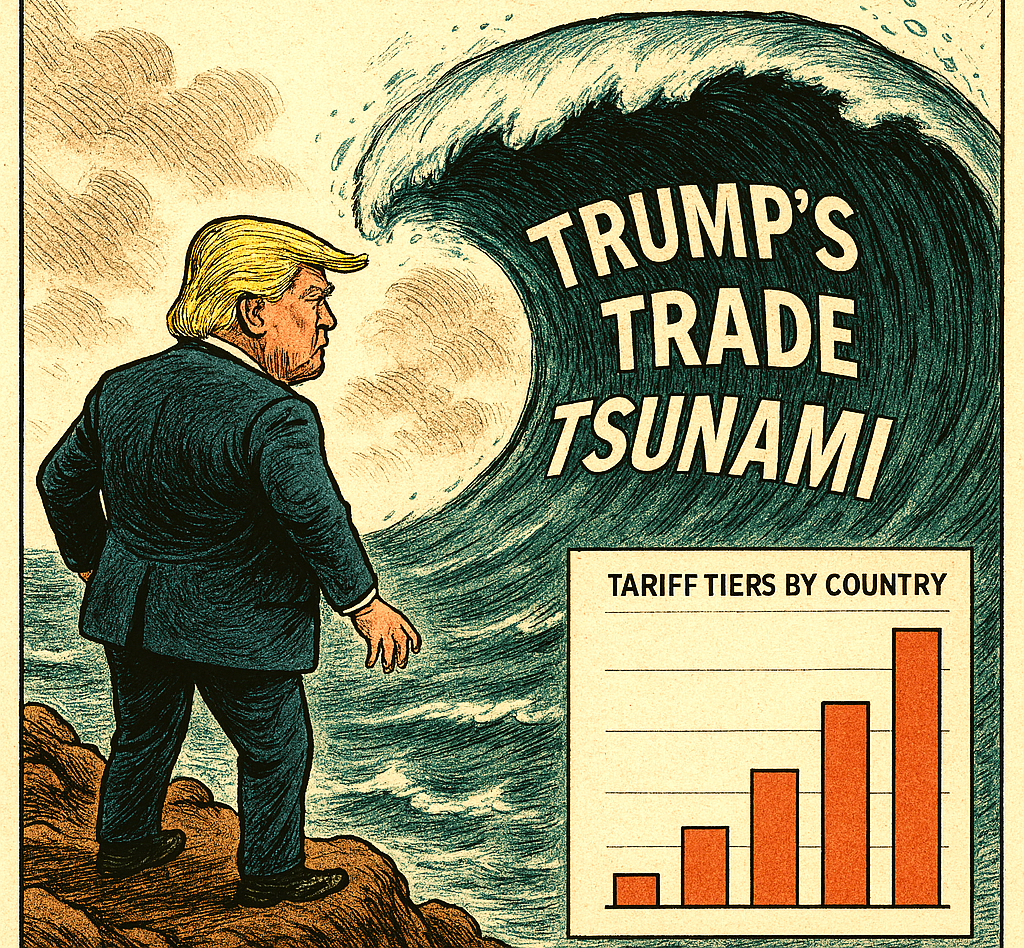
Despite the scale and aggression of Donald Trump’s 2025 tariff attack—averaging approximately 27% and targeting nearly 100 countries—financial markets have shown a surprisingly muted response.
Here’s a breakdown of why that might be
🧠 1. Markets Have Priced in the Chaos
Trump’s protectionist rhetoric and erratic trade moves have been a fixture since his first term. Investors have grown desensitized to tariff threats and now treat them as part of the geopolitical noise.
The April ‘Liberation Day’ announcement triggered initial volatility, but subsequent delays, exemptions, and partial deals (e.g. with the UK, EU, Japan) softened the blow.
🧮 2. Selective Impact and Exemptions
Tariffs are not blanket: electronics, smartphones, and some pharmaceuticals are exempt.
Countries like the UK and Australia face relatively low rates (10%), while others like Brazil and Switzerland are hit harder (50% and 39%).
For India, even the steep 50% tariff affects only 4.8% of its global exports.
🔄 3. Supply Chain Adaptation
Companies are already pivoting manufacturers are reshoring or shifting production to tariff-friendly countries like Vietnam and Bangladesh.
Agri-tech and automation investments are helping offset cost pressures in affected sectors.
💰 4. Short-Term Pain, Long-Term Strategy
The US expects $2.4 trillion in tariff revenue by 2035, despite $587 billion in dynamic losses.
Investors are recalibrating portfolios toward resilient sectors (semiconductors, automation) and geographic diversification.
🧊 5. Political Fatigue and Uncertainty Premium
Trump’s tariff moves are seen as political theatre, especially with his threats often followed by renegotiations or delays.
Markets may be holding back deeper reactions until retaliatory measures (especially from China) fully materialise.
Where now?
These tariffs spanned sectors from automotive and pharmaceuticals to semiconductors—where a 100% duty was imposed unless firms manufactured in the U.S.
While Trump framed the measures as a push to revive domestic industry and reduce trade deficits, critics argued they were legally dubious and economically disruptive, with a federal court later ruling them unconstitutional.
Despite the aggressive scope, global markets showed surprising resilience, suggesting investors had grown desensitised to Trump’s brinkmanship and were instead focusing on broader economic signals.