Japan’s Nikkei 225 hit a record high of: 39098 on Thursday 22nd February 2024.
The rally was propelled by electronics, banking and consumer stocks as robust earnings and investor-friendly measures fuel a blistering rally in Japanese equities.
The Nikkei 225 jumped 2%, surpassing the previous record high of 38,915.87 reached in 1989.
Standout performance
Both the Nikkei and the broader Topix have been standout performers in Asia up more than 10% so far in 2024 after surging more than 25% in 2023. Their best annual gains in at least a decade.
Japan Inc’s solid third-quarter corporate earnings have prompted Bank of America analysts to upgrade their 2024 year-end forecasts for the Nikkei 225 to 41000 from 38500. They raised their forecasts for the Topix to 2,850 from 2,715.
The rally has also been supported by a weaker yen.
MOD missile test flops as £17 million weapon plops into sea
The Trident missile test is a routine exercise of the UK’s nuclear deterrent, which involves firing an unarmed missile from a submarine into the Atlantic Ocean
However, the latest test failed when the missile’s booster rockets didn’t function correctly and plopped into the sea near the launch site.
This is the second time in a row that a Trident missile test has failed, raising concerns over the reliability and safety of the UK’s nuclear weapons system. The defence secretary and the head of the navy were on board the submarine HMS Vanguard when the test went wrong.
Deterrent remains a safe option…?
The Ministry of Defence said the nuclear deterrent remains ‘safe, secure and effective’ and that the issue was specific to the test and would not affect a real launch. So that’s reassuring to hear then.
However, some critics have called for an inquiry into the incident and questioned the need for spending billions of pounds on renewing the Trident programme.
This is highly embarrassing for both the UK and the U.S. and for the manufacturer of the Trident missile.
British telecoms group BT said Wednesday 21st February 2024 that it had agreed to sell London’s iconic BT Tower – once an important piece of network infrastructure
It has been sold to developer MCR Hotels for £275 million ($346.6 million).
The 189-meter structure has loomed over the capital city’s central Fitzrovia since 1965, when it opened as the Post Office tower.
It carried telecommunications signals from London to the rest of the country, but its microwave aerials were made redundant more than a decade ago.
It was also known for a revolving restaurant on its 34th floor, which took 22 minutes to complete a rotation.
MCR Hotels owns 150 properties, including the TWA Hotel located in the former TWA Flight Centre at JFK International Airport in New York, USA.
The U.K. logged a record £16.7 billion net budget surplus in January 2024, according to official figures released on Wednesday 21st February 2024
The Office for National Statistics noted that the country’s public finances usually run a surplus in January, unlike during other months, as receipts from annual self-assessment tax returns come in.
Combined self-assessment income and capital gains tax receipts totaled £33 billion in January, the ONS noted, down £1.8 billion from the same period of last year.
Total government tax receipts came in at a record £90.8 billion, up £2.9 billion compared to January 2023.
Government borrowing during the financial year spanning to the end of January 2024 was £96.6 billion, £3.1 billion lower than over the same 10-month period a year ago and £9.2 billion lower than the £105.8 billion previously forecast by the independent Office for Budget Responsibility.
Albert Einstein 1879 – 1955 was a German-born theoretical physicist who is widely held to be one of the greatest and most influential scientists of all time.
‘You have to learn the rules of the game. Then you have to play better than anyone else’.
That’s the fear spreading through Wall Street as another inflation reading on Friday 16th February 2024 came in hotter-than-expected.
The producer price index rose 0.3% in January 2024. The largest increase since August 2024 and higher than the 0.1% forecast. Excluding food and energy, core PPI jumped 0.5%, again well above consensus.
Stubborn
It is yet another sign of stubborn price pressures across the broader U.S. economy. And it came just days after an unexpectedly hot CPI reading, which gave markets a nasty jolt.
Both data have stoked investor worries on whether inflation is firmly under control. The latest developments also reinforce the Fed’s caution that it will need to see more evidence of disinflation before committing to lower rates.
Mohamed El-Erian, Allianz chief economic advisor, posted on X that like the CPI data, the PPI report was a further indication that the last mile of the inflation battle is more complex than many had assumed (and still assume).
Some economists even argue the jump in Friday’s data will likely push January’s personal consumption expenditures price index, the Fed’s preferred inflation gauge.
The PPI data means we can finalise our core PCE forecast for January, at 0.32%. That would be the biggest increase since September. But the three months since then all saw much smaller gains.
But investors will have to wait until later this month for PCE data when it’s released on 29th February 2024.
The Magnificent Seven, or MAMA ANT, is a term coined by Bank of America to describe the seven most dominant tech companies in the world
The Seven are: Microsoft, Amazon, Meta Platforms, Apple, Nvidia, Tesla, and Alphabet. These companies have not only led the tech sector in terms of innovation, growth, and profitability, but have also become some of the most valuable entities in the world by market capitalization.
Valuation at $15 trillion
Market capitalization, or market cap, is the total value of all the shares of a company that are traded on the stock market. It reflects the market’s perception of the company’s future prospects and earnings potential.
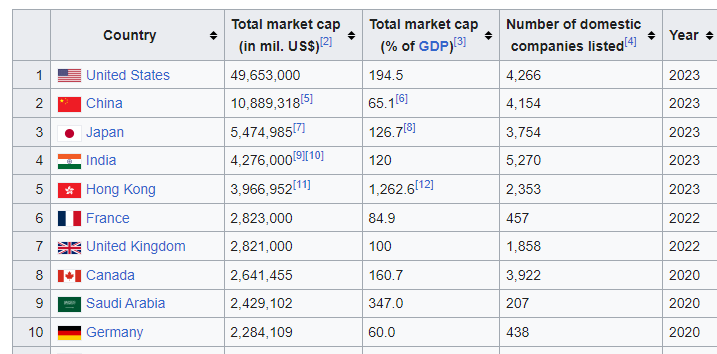
As of January 2023, the Magnificent Seven had a combined market cap of about $15 trillion, which was more than the gross domestic product (GDP) of almost every country in the world, except for the United States, China and Japan (just).
Magnificent Seven
The Magnificent Seven have achieved such a remarkable feat by leveraging their core competencies in various fields of technology, such as artificial intelligence (AI), cloud computing, social media, e-commerce, gaming, electric vehicles, and online advertising. They have also diversified their revenue streams by acquiring or developing new products and services, such as Activision Blizzard, AWS, Oculus, iPhone, GeForce, SpaceX, and YouTube. They have also benefited from the increased demand for digital solutions amid the Covid-19 pandemic, which accelerated the adoption of online platforms, remote work, and entertainment.
Challenges
However, the Magnificent Seven also face some challenges and risks that could threaten their dominance and valuation. These include increasing competition from other tech companies, especially from China, such as Alibaba, Tencent, Baidu, and Huawei.
They also face regulatory scrutiny and pressure from governments and consumers over issues such as antitrust, privacy, taxation, content moderation, and environmental impact. Furthermore, they may encounter technical difficulties, security breaches, or ethical dilemmas that could damage their reputation and customer trust.
Conclusion
In conclusion, the Magnificent Seven are the most powerful and influential tech companies in the world, and their market cap surpasses that of almost every country in the world.
List of 10 countries by stock market capitalization
List of 10 countries by stock market capitalisation
The meteoric rise in the profits and market capitalisations of the Magnificent 7 U.S. tech giants: Apple, Amazon, Alphabet, Meta, Microsoft, Nvidia and Tesla – outstrip those of all listed companies in almost every G20 country. Of the non-U.S. G20 countries, only China and Japan (and the latter, only just) have greater profits when their listed companies are combined.
They have achieved this by exploiting their competitive advantages in various domains of technology and expanding their offerings and markets. However, they also need to overcome some challenges and risks that could hamper their growth and value in the future.
A forced size reduction to stop the monopolising of market share could help tame these beasts too and open up fairer competition.
Should we worry?
Basically, yes, we should be concerned about the size and dominance of these companies.
This level of wealth and power concentrated in just a handful of companies has led some analysts to voice concerns over related risks in the U.S. and global stock markets.
Economists and stock market analysts have cautioned that the U.S. stock market is rivalling 2000 and 1929 in terms of being at its most concentrated in history.
Most of the world’s largest tech companies, including Microsoft, Amazon and Google have agreed to tackle what they are calling deceptive artificial intelligence (AI) in elections
The tech accord
The twenty companies have signed an accord committing them to fighting voter-deceiving content. They say they will deploy technology to detect and counter the material.
The Tech Accord to Combat Deceptive Use of AI in 2024 Elections was announced at the Munich Security Conference on Friday 16th February 2024.
The issue has come into sharp focus because it is estimated up to four billion people will be voting this year in countries such as the U.S., UK and India.
Technology to mitigate risk
Among the accord’s pledges are commitments to develop technology to mitigate risks related to deceptive election content generated by AI, and to provide transparency to the public about the action firms have taken.
Other steps include sharing best practice with one another and educating the public about how to spot when they might be seeing manipulated content.
Signatories include social media platforms X, Snap, Adobe and Meta, the owner of Facebook, Instagram and WhatsApp.
Proactive
However, the accord has some shortcomings, according to computer scientist Dr Deepak Padmanabhan, from Queen’s University Belfast, who has co-authored a report on elections and AI.
But he reportedly said they needed to take more proactive action instead of waiting for content to be posted before then seeking to take it down.
That could mean that realistic AI content, that may be more harmful, may stay on a platform for longer compared to obvious fakes which are easier to detect and remove, he suggested.
Target
The accord’s signatories say they will target content which deceptively fakes or alters the appearance, voice, or actions of key figures in elections.
It will also seek to deal with audio, images or videos which provide false information to voters about when, where, and how they can vote.
We have a responsibility to help ensure these tools don’t become weaponised in elections, Brad Smith, the president of Microsoft is reported to have said.
These measures, in my opinion, are a sticking plaster and will not stop the spread of dishonest and fake news!
The use of nuclear reactors for data centres is a controversial and complex topic that has both advantages and disadvantages
Nuclear reactors can provide a reliable, stable, and carbon-free source of electricity for power-hungry data centres, which are essential for the operation of various applications, such as artificial intelligence (AI).
Grid overload
Nuclear reactors can also reduce the dependence on the existing grid, which may be vulnerable to blackouts, fluctuations, or cyberattacks. On the other hand, nuclear reactors require a high initial investment, as well as strict safety and regulatory standards. Nuclear reactors also pose potential risks of radiation, waste disposal, and proliferation. Moreover, nuclear reactors may not be suitable for all locations, as they may face public opposition, environmental concerns, or geopolitical issues.
Small Modular Reactor (SMR)
One of the possible solutions to these challenges is to use small modular reactors (SMRs), which are advanced reactors with about a third of the power generation of a traditional, large nuclear plant. SMRs are designed to be more flexible, scalable, and cost-effective than conventional reactors, as they can be built off-site and transported to the desired location. SMRs can also be integrated with renewable energy sources, such as solar or wind, to create a hybrid system that can balance the power demand and supply.
However, the technology of SMRs is still in its early stages of development and deployment, and there are currently no data centres in the world that use built-in nuclear reactors. Therefore, it remains to be seen whether nuclear reactors will become a common or viable option for future data centres. The decision to use nuclear reactors for data centres should be based on a careful evaluation of the benefits and risks, as well as the alternatives and trade-offs, of each specific case.
It has been calculated that a ‘norma’ data centre (whatever that is), needs 32 megawatts of power flowing into the building. For an AI data centre, it’s closer to 80 megawatts.
AI systems are using all this extra electricity simply because they are doing so much more processing than standard computing. They are chewing through far more data.
As AI continues to develop, so too will the power requirement needed to run these monsters.
Retail sales rebounded in January as shoppers went on a determined spending spree, latest figures show.
ONS figures revealed a 3.4% jump in sales following a drop in December 2023.
Food sales at supermarkets rose strongly while department stores reported a good impact from January sales.
The Office for National Statistics (ONS) said that the value of goods people bought in January went up 3.9%, compared to the 3.4% increase in the volume of products purchased.
Inflation, which measures the pace of price rises, has slowed significantly but at 4% it remains higher than the Bank of England’s (BoE) 2% target.
Sales increased across nearly all retail sectors, and it was a particularly strong month for supermarkets according to the ONS.
Shares of cryptocurrency exchange Coinbase soared 12% Friday 16th February 2024 after the company reported its first profit in two years.
Coinbase, the largest U.S. venue for buying and selling cryptocurrencies, said that net income totalled $273 million in Q4.
This is the first time that the company has reported positive net income since the fourth quarter of 2021.
Net revenue
Coinbase reported its net revenue was $905 million in the Q4 of 2023, up almost 50% from $605 million in the same period of the previous year.
Bitcoin ETFs
Cryptocurrencies saw a huge amount of interest from investors in the fourth quarter of 2023, following news of the U.S. Securities and Exchange Commission approving the first Bitcoin exchange-traded funds (ETFs).
Bitcoin ETFs enable retail investors to access the cryptocurrency as a share that’s traded on a regulated exchange without directly exposing them to the underlying asset.
The news has driven demand for cryptocurrencies due to anticipation that it could drive interest from retail investors.
It’s true. 2012 statistics show that citizens of Japan registered 21 million or so pets against 16.5 million children (under 15 years).
This is a problem for Japan as it has a growing elderly population. It means Japan has one older person for every three citizens. 33% of the population is elderly and not part of its workforce.
If this trend continues Japan is on course to lose around 40% of its workforce and that is a massive problem for Japan’s economy.
According to a survey conducted by Rakuten Insight in 2023, dogs were the most popular pets in Japan, followed by cats and fish.
The most popular dog breeds in Japan were toy poodle, chihuahua, and Shiba Inu. Many Japanese people love their pets and treat them as part of their family.
More Japanese people have a pet than they do children?
The UK fell into recession during the final three months of 2023, official figures show, after the economy shrank by more than expected.
The Office for National Statistics said U.K. gross domestic product shrank by 0.3% in the final three months of the year, giving the second consecutive quarterly decline.
That follows a fall between July and September 2023. The UK is considered to be in recession if GDP falls for two successive three-month periods.
All three main sectors of the economy contracted in Q4, with declines of 0.2% in services, 1% in production and 1.3% in construction output, the ONS reported.
Technical recession
A technical recession is a term used to describe two consecutive quarters of decline in output. It is measured by the Gross Domestic Product (GDP), which is the overall output of goods and services in a country.
A ‘technical’ recession is usually caused by slowing growth or an isolated event rather than a major underlying cause.
Japan’s economy slipped into a technical recession, after the economy unexpectedly contracted again in the October-December 2023period, government data showed Thursday 15th February 2024.
High inflation affected domestic demand and private consumption in what’s now the world’s fourth-largest economy.
Provisional gross domestic product contracted 0.4% in the fourth quarter compared with a year ago, after a revised 3.3% slump in the July-September period. This was below the estimate of a 1.4% growth.
The Japanese economy also contracted 0.1% in the fourth quarter from the previous quarter, after shrinking a revised 0.8% in the Q3. This was also weaker than the expected 0.3% expansion.
Nikkei one year chart to 15th February 2024
Nikkei one year chart to 15th February 2024
Japan has lost its spot as the world’s third-largest economy to Germany, as the country unexpectedly slipped into recession.
Technical recession
A technical recession is a term used to describe two consecutive quarters of decline in output. It is measured by the Gross Domestic Product (GDP), which is the overall output of goods and services in a country.
A technical recession is usually caused by slowing growth or an isolated event rather than a major underlying cause.
The value of all the Bitcoin market capitalization, on Wednesday 14th January 2024 climbed above $1 trillion for the first time since late 2021, according to CoinMarketCap data.
Bitcoin also broke through the 51000 level, marking the first time it has hit this value since December 2021.
The price rise continues a rally that began in January 2023. Bitcoin is up more than 21% in 2024 so far.
One year Bitcoin chart
One year Bitcoin chart from March 2023 to February 2024 – CoinMarketCap
The UK’s inflation rate remained at 4% in January 2024, despite the first monthly fall in food prices in two years, ONS figures show.
January U.K. inflation held steady at 4% year-on-year benefitting from easing prices for furniture and household goods, food and non-alcoholic beverages.
According to the latest figures from the Office for National Statistics (ONS), prices for food and non-alcoholic beverages fell on a monthly basis by 0.4%, marking the first decrease since September 2021.
The core CPI figure excluding volatile food, energy, alcohol and tobacco prices annual reading was 5.1%, below the 5.2% estimate – but only a micro 0.1% difference.
The latest inflation data is a reflection of what is happening in the labour market: a tight labour supply is sustaining high wage growth and thus underlying inflationary pressure.
Stocks dropped on Tuesday 13th February 2024 after hotter-than-expected inflation data for January caused Treasury yields to spike
The new inflation figure raised doubts that the Federal Reserve would be able to cut rates several times this year, a key part of the equity market bull run case.
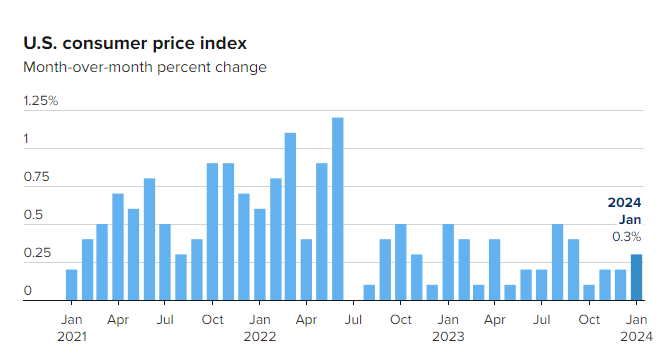
The consumer price index rose 0.3% in January 2024 from December 2023. CPI was up 3.1% year-to-year. Economists expected CPI to have increased by 0.2% month over month in January and 2.9% from a year earlier.
U.S. inflation ticks back up in January 2024 figures
Jeff Bezos filed a statement indicating his sale of nearly 12 million shares of Amazon stock worth more than $2 billion
The Amazon executive chairman notified the U.S. SEC – Securities and Exchange Commission of the sale of 11,997,698 shares of common stock on the 7th and 8th February 2024.
The collective value of the shares of Amazon, which is based in Seattle where he founded the company in a garage around thirty years ago, was about $2.04 billion.
More to come
In a separate SEC filing, Bezos listed the proposed sale of 50 million Amazon shares on or around 7th February 2024 with an estimated market value of $8.4 billion.
Taxing decision?
Jeff Bezos moved from Seattle to Miami in November 2023, shortly before he announced his plan to sell up to 50 million Amazon shares by January 2025.
Florida does not have a capital gains tax, unlike Washington state, which imposes a 7% tax on any gains of more than $250,000 from the sale of stocks and bonds. Therefore, by moving to Florida, Bezos could save up to $600 million in taxes on his stock sale – more than enough for a luxury yacht and 2 or 3 more luxury properties.
But, of course, we do not know if this was the real reason for his move.
Arm’s strong growth forecast has led investors to declare it an AI darling
Arm shares soared 29% on Monday, extending last week’s rally as investors continue to applaud the chipmaker’s better-than-expected third-quarter earnings and its position in the artificial intelligence boom.
Up 93% since 8th February 2024
Arm is now up 93% since it reported quarterly figures on 8th February 2024. There is no obvious reason for the 29% climb on Monday. The fear of missing out (FOMO) could be playing a part in the meteoric share price move.
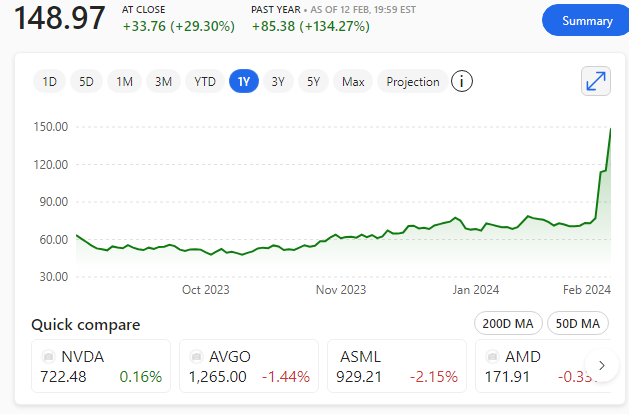
The stock has almost tripled since Arm’s initial public offering in September 2023, closing at $148.97 and is now worth almost $153 billion, that’s a little more than $30 billion below Intel’s market cap.
Arm 1 year chart showing huge gain in February 2024
Arm 1 year chart showing huge gain in February 2024
AI demand fuels Arm’s success
Last week, Arm said it could double the price for its latest instruction set, which accounts for 15% of the company’s royalties, suggesting it can expand its margin and make more money off new chips. It also said it was breaking into new markets, such as cloud servers and automotive, due to AI demand.
Its royalty strength combined with Arm’s optimistic growth forecast has made the company the latest AI darling among investors, despite a higher earnings multiple than Nvidia or AMD.
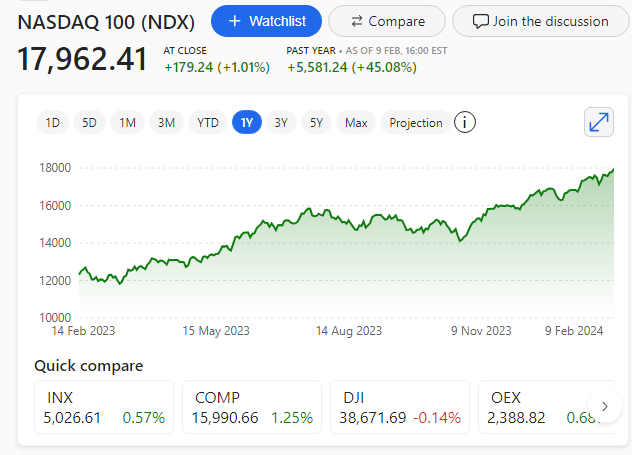
The index continues its march breaking all-time records on its way
The index continues on its march breaking all-time records on its journey
Nasdaq 100 climbs to new record 9th February 2024
A solid earnings season, easing inflation data and a resilient economy have charged 2024′s market rally. It has helped propel the Nasdaq 100 to close at these new highs!
We are enjoying good news at an economic and earnings level, and the market is reacting positively. The longer the good news story plays out, the more likely it will be that the market will hold from here.
FOMO or the fear of missing out is likely playing its part here too.
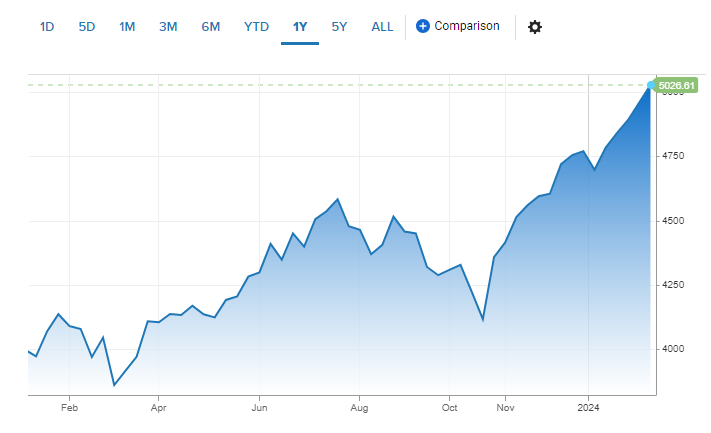
The S&P 500 climbed to a new all-time high of 5026 on 9th February 2024
Stocks rose on Friday 9th February 2024 after December’s revised inflation reading came in lower than first reported, and the S&P 500 closed above the key 5,000 level as strong earnings and economic news came in.
A solid earnings season, easing inflation data and a resilient economy have charged 2024′s market rally. It propelled the S&P 500 to close above the 5,000 level after first touching the milestone during the trading week. The index first crossed 4,000 in April 2021.
We are enjoying good news at an economic and earnings level, and the market is reacting positively. The longer the good news story plays out, the more likely it will be that the market will hold from here.
But it won’t take much to spoil the party, right now I don’t know what that might be…?
S&P 500 1-year chart 9th February 2024 – new all-time high of 5026
S&P 500 1 year chart 9th February 2024 – new all-time high of 5026
FOMO or the fear of missing out is likely playing its part here too.