The stock market has been experiencing some volatility and uncertainty in September and October 2023, as investors fret about inflation, interest rates, and the possibility of a U.S. recession.
Main facts affecting the current stock market
The month of October has produced some severe stock market crashes over the past century, such as the Bank Panic of 1907, the Wall Street Crash of 1929, and Black Monday 1987.
October has also marked the start of several major long-term stock market rallies, such as Black Monday itself and the 2002 nadir of the Nasdaq-100 after the bursting of the dot-com bubble.
The S&P 500 dropped 4.5% in September 2023 and finished the third quarter in the red.
The U.S. Treasury yield curve has been inverted for months – which is a historically strong recession indicator.
The Fed maintained interest rates at the current target range of between 5.25% and 5.5% in September 2023, but signalled that it may need to raise rates again to combat inflation.
The consumer price index gained 3.7% year-over-year in August 2023, down from peak inflation levels of 9.1% in June 2022 but still well above the Fed’s 2% long-term target.
The bond market is currently pricing in an 81.7% chance the Fed will choose not to raise rates again on 1st November 2023.
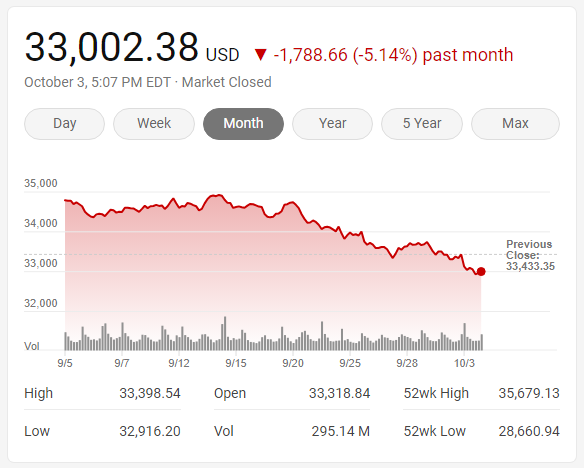
The Dow Jones Industrial Average was down at 33002, Tuesday 3rd October 2023.
Stocks fell as investors pulled money from equities and moved it to the hot bond market.
International markets also faced significant turmoil, sending mini shockwaves through global financial centres, which reverberated in equities.
The dollar rose to the highest since December and is heading towards the twelfth positive week in a row.
Uncertainty
Uncertainty in the U.S. political system is having a major affect too. Especially with the ousting of the speaker and the real fear of a government shutdown looming large.
The U.S. Treasury yields are the interest rates that the U.S. government pays to borrow money. The 10-year and 30-year Treasury yields are the most widely followed indicators of the long-term health of the U.S. economy and the expectations of inflation and growth.
10 year yield at 4.80%
According to the latest data, the 10-year Treasury yield surged to 4.80% on Tuesday, 3rd October 2023, which is the highest level since 12th October 2007.
30 year yield at 4.79
The 30-year Treasury yield rose to 4.79% on Monday, 2nd October 2023, which is the highest since 6th April 2010.
The main reasons for the rise in the Treasury yields
The strong U.S. economic data that showed that the labour market remains hot and the manufacturing sector rebounded in September 2023.
The Federal Reserve’s ‘higher for longer’ mantra signalled that the central bank would keep raising rates until inflation is under control.
The reduced demand for safe-haven assets as the U.S. government averted a shutdown over the weekend by passing a short-term stopgap funding measure.
Uncertainty at the heart of the U.S. political system.
The implications of higher Treasury yields
The higher borrowing costs could weigh on the economic growth and consumer spending in the future.
Higher inflation expectations could erode the purchasing power of the fixed-income investors and increase the risk of a bond market sell-off.
The higher interest rate differential could attract more foreign capital inflows into the U.S. dollar and strengthen its value against other currencies.
Gold value has been slipping in recent months of 2023 – here are some of the reasons gold prices fluctuate.
Dynamic market
Gold is a precious metal that is often seen as a safe haven investment and a store of value, but it is also subject to the forces of supply and demand, as well as many other factors that affect its price.
The gold market is complex and dynamic, and the price of gold can change quickly and unpredictably. Therefore, it is important to do your own research and analysis before investing in gold or any other asset.
Always do your research! Remember, RESEARCH! RESEARCH! RESEARCH!
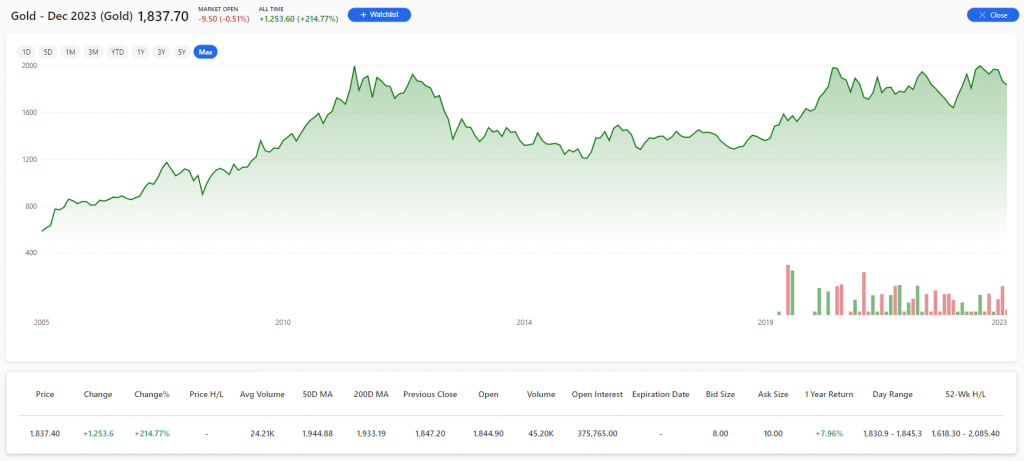
Gold price from 2005 – September 2023
The production costs of gold
The cost of mining, refining, and transporting gold can influence the supply and the price of gold. If the production costs are high, the gold miners may reduce their output or increase their selling price, which can affect the market balance and the gold price.
Money supply
The amount of money in circulation can affect the value of the currency and the inflation rate, which in turn can affect the demand and the price of gold. Generally, when the money supply increases, the currency value decreases and the inflation rate increases, which can boost the demand and the price of gold as a hedge.
Geopolitical stability
The political and economic events around the world can affect the market sentiment and the risk appetite of investors, which can influence the demand and the price of gold. Generally, when there is uncertainty, instability, or conflict, investors tend to seek safe-haven assets such as gold, which can increase the demand and the price of gold.
Jewellery and industrial demand
The demand for gold from the jewellery and industrial sectors can affect the market balance and the price of gold. Jewelry is the largest source of gold demand, especially in countries like India and China, where gold is culturally and traditionally valued. Industrial demand for gold comes from its use in various electronic and medical devices, such as smartphones, computers, and dentistry. The changes in the consumer preferences, the income levels, the technological innovations, and the environmental regulations can affect the demand and the price of gold from these sectors.
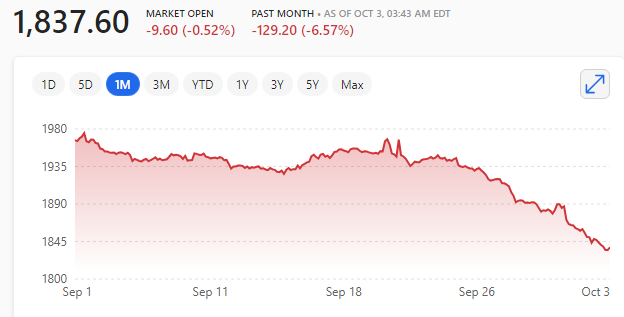
Gold price 3rd October 2023
Central bank actions
The actions of central banks around the world can affect the supply and the demand of gold, as well as the value of the currency and the interest rates, which can influence the price of gold. Central banks hold gold reserves as part of their foreign exchange assets, and they can buy or sell gold to diversify their portfolios, to manage their liquidity, or to intervene in the currency markets. Central banks can also affect the price of gold indirectly through their monetary policies, such as setting the interest rates, printing money, or buying bonds, which can affect the inflation expectations, the currency value, and the opportunity cost of holding gold.
Strength of the U.S. dollar
Gold is priced in U.S. dollars in most of the major trading exchanges around the world, so when the dollar rises against other currencies, gold becomes more expensive for foreign investors, reducing the demand for it. The U.S. dollar has been strengthening since, partly due to the Federal Reserve’s monetary tightening policy that has raised the interest rates and the attractiveness of U.S. Treasury securities.
Rise of global equities
Gold is often considered a hedge against inflation, currency devaluation, and the failure of other financial assets, but when the stock market is performing well, investors tend to shift their money from gold to equities, seeking higher returns and growth potential. The global stock market has been rallying since the bottom of the Covid-19 pandemic in March 2020, boosted by the roll-out of vaccines, the fiscal stimulus, and the economic recovery.
The Krugerrand
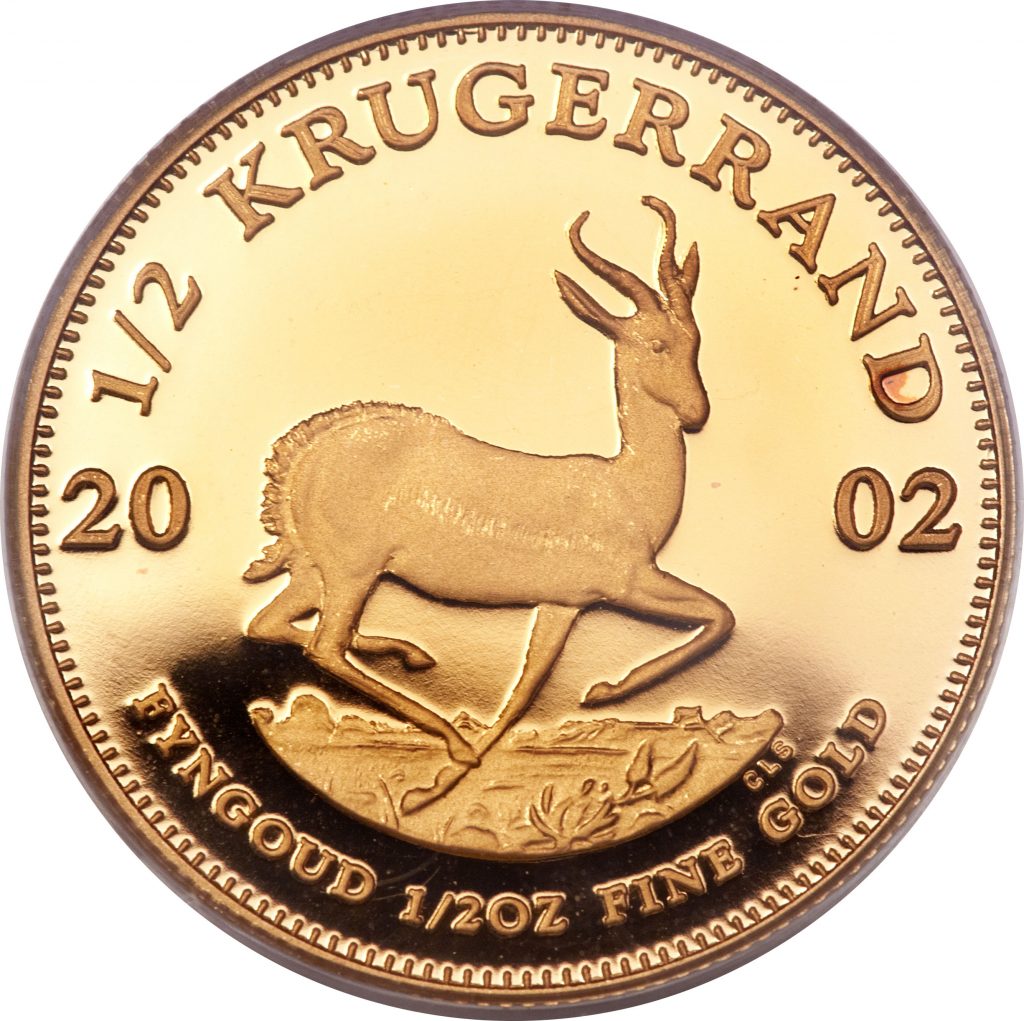
The Krugerrand is a South African coin, first minted on 3rd July 1967
Krugerrand gold coins are a type of bullion coin that were first minted in 1967 by the South African Mint. They are made of 22 karat gold and have a diameter of 32.77 mm and a thickness of 2.84mm. The obverse side features the portrait of Paul Kruger, the former president of the South African Republic, and the reverse side depicts a springbok, the national animal of South Africa. The name ‘krugerrand’ is a combination of ‘Kruger’ and ‘rand’, the currency of South Africa.
Krugerrand gold coins are popular among investors and collectors because they have a high gold content and are easy to trade. They are also legal tender in South Africa, although they do not have a fixed face value.
Decline of inflation expectations
Gold is also seen as a protection against the erosion of purchasing power caused by inflation, but when inflation expectations are low or falling, gold loses some of its appeal as an inflation hedge. The inflation expectations have been declining in recent months, partly due to the easing of supply chain disruptions, the moderation of energy prices, and the fading of the base effects from the previous year.
These are some of the main factors that have been weighing on the gold price lately, but there may be other reasons as well, such as the speculations, the market sentiments, and the geopolitical events that can influence the supply and demand of gold.
These are the seven largest U.S. listed companies in the technology sector.
Apple, Microsoft, Amazon, Alphabet, Nvidia, Tesla and Meta Platforms.
According to a report released Monday 2nd October 2023, these tech’ stocks have seen their valuation drop relative to the median stock in the S&P 500, making them more attractive for investors. The report says that the Magnificent 7 trade at 1.3 times their PEG ratio (price-to-earnings-to-long-term growth), versus 1.9 for the median S&P 500 stock.
This is the cheapest valuation in over six years – time to buy yet?
The report also highlights some positive drivers for these stocks, such as their strong sales growth, their ability to beat expectations, and their resilience to rising interest rates.
However, some analysts also warn that the dominance of these stocks could pose a risk for the broader market if something bad happens to tech’.
October is a special month in the stock market for several reasons. It is the month when some of the most spectacular market crashes have occurred, such as in 1929 and 1987.
However, it is also a month that has historically performed well on average, with a 0.6% price gain for the Dow Jones Industrial Average from 1928 to 2022.
The month of October also marks the beginning of a seasonal pattern that favours stocks, as the fourth quarter and the winter months tend to see strong rallies. The ‘Santa’ rally may also visit.
Swings
However, October can also be a volatile month, with significant swings in both directions. It is the only month where all major indices have recorded losses of at least 17% (in 1987 and 2008), but also the month where the S&P 500 and the Dow Jones Industrial Average have posted their highest percentage gains of any month (in 1974 and 2022).
Therefore, investors should be prepared for potential turbulence and seek professional advice to navigate the market. Do your research!
RESEARCH! RESEARCH! RESEARCH!
Read-all-about-it, 1987 October stock market crash!
Additionally, October may face some special factors that could affect the market performance this year, such as the ongoing strike action, the rising inflation and interest rates, and the political uncertainty in the U.S. over the debt ceiling and government spending. These factors could create headwinds or even opportunities for different sectors and industries, depending on how they are resolved.
Summary
In summary, October is a month that has a mixed reputation in the stock market, with both risks and rewards. Investors should be aware of the historical trends and the current events that could influence the market direction.
‘How bad can October really get?’ ‘Remember the 1987 crash?’
E-commerce conglomerate Amazon announced on Monday 25th September 2023 that it will invest up to $4 billion in artificial intelligence (AI) firm Anthropic, a rival to ChatGPT developer OpenAI, and take a minority ownership position in the company.
The move further enforces Amazon’s aggressive AI push as it aims to keep pace with rivals such as Microsoft and Alphabet’s Google.
The two firms reportedly said that they are forming a strategic collaboration to advance generative AI, with the startup selecting Amazon Web Services as its primary cloud provider.
Cathie Wood is an American investor and the founder, CEO and CIO of ARK Invest, an investment management firm that focuses on disruptive innovation. She is known for her bullish views on Tesla, DeepMind, and many other AI companies.
DeepMind and Tesla
Cathie Wood is a fan of DeepMind, an artificial intelligence research lab acquired by Google in 2014 and founded in 2010. She reportedly says it is ‘one of the best AI companies in the world’ and that the ‘AI revolution’ will ‘change everything’.
She also says that Tesla is the ‘biggest AI opportunity in the world’ today. She believes that Tesla has a huge advantage in data collection and innovation, and that it has just started its growth potential.
Additionally, Cathie Wood has been betting on other AI stocks, such as C3.ai, UiPath, Exact Sciences, and Upstart. She thinks these companies have strong prospects in various fields, such as cloud computing, automation, healthcare, and lending.
British-American AI DeepMind
DeepMind is a British-American artificial intelligence research lab that is a subsidiary of Google. It was founded in 2010 and acquired by Google in 2014. DeepMind is known for creating neural network models that can learn how to play video games, solve complex problems, and mimic human intelligence. Some of its famous products are AlphaGo, AlphaZero, AlphaFold, and Flamingo.
DeepMind
Mission
DeepMind’s mission is to ‘solve intelligence and use it to make the world a better place‘. It has been involved in various fields, such as healthcare, climate change, computer systems, and board games.
DeepMind also collaborates with Google Cloud to enhance its solutions for customers
The maker of weight-loss drug ‘Wegovy’ has become Europe’s most valuable company, dethroning the French luxury conglomerate LVMH.
Is there an irony here…? Exploitation of the obese, or a genuine attempt to help? It is used in the fight against diabetes too.
It’s a business after all
Wegovy is a brand name for ‘Semaglutide‘, a prescription medicine used for weight loss in obese or overweight adults with other weight-related medical issues. It works by regulating appetite and reducing calorie intake, leading to weight loss and helping with weight management.
Wegovy was launched in the UK on 4th September 2023 and is available on the NHS as an ‘option‘ for weight management in line with NICE guidance, alongside a reduced-calorie diet and increased physical activity. However, only people with the highest medical need may qualify for the drug, as it is in short supply and its use will be restricted – but celebrities have direct access – do they have the ‘highest medical needs’? Of course they do.
Clinical trials
Wegovy has been shown to be effective in clinical trials, achieving up to a 15% reduction in body weight after one year. It has also been found to reduce the risk of a heart attack or stroke in obese people with cardiovascular disease by 20%.
To get Wegovy on the NHS, eligible adults would need a referral to an NHS specialist weight management service, which would usually be made by a GP. Alternatively, Wegovy can be obtained privately, but it may be expensive and not covered by insurance.
Watercolour image of a generic medicine bottle. Wegovy is a brand name for ‘Semaglutide‘, a prescription medicine used for weight loss in obese or overweight adults with other weight-related medical issues.
Shares rose after the Danish pharmaceutical giant, Novo Nordisk, launched the popular drug in the UK.
At the close of trading on Monday, 4th September 2023, the company had a stock market valuation of $428bn (£339bn).
The drug is now available on the National Health Service in the UK and also via private outlets.
Obesity treatment
Wegovy is an obesity treatment that is taken once a week which tricks people into thinking that they are already full, so they end up eating less and losing weight.
Famous personalities such as Elon Musk are among the reported users of the drug, which has gained traction in Hollywood and with the public more widely since it was approved by regulators in the US in 2021.
Wegovy and Ozempic – a diabetes treatment with similar effects – have been described as ‘miracle’ drugs. Would that be a ‘miracle for the user or for the pharmaceutical company – or both perhaps?
Experts warn the drug is not a quick fix nor a ‘substitute for a healthy diet and exercise’.
In trials, users often put weight back on after stopping treatment.
‘Supply restriction as production ramps up’
There has been a global shortage of the drug, so only limited is awailable for the NHS in the UK.
The company said it will continue to restrict global supplies as it works to ramp up manufacturing.
While the findings still have to be fully reviewed, experts agreed the results were potentially significant.
Sequoia Capital and Andreessen Horowitz, two of Silicon Valley’s most high-profile venture firms, are poised to take a massive hit on their investments in grocery delivery company Instacart, a deal that closed in 2021 as tech stocks were soaring.
In its latest IPO prospectus update, Instacart said it plans to sell shares at $28 – $30 a share, valuing the company at around $10 billion at the top of the range. That’s more than 75% below where Sequoia and Andreessen invested in early 2021. At that time, Instacart sold shares at $125 a pop valuing Instacart at $39 billion.
Valuation plunge
The reason for the valuation collapse is that the U.S. economy reopened after the pandemic, then inflation spiked and the Federal Reserve started raising interest rates, which were stuck near to zero throughout the Covid pandemic.
Borrowed money suddenly became expensive again, and quickly too. Tech’ companies in early stages of development, need access to research and development finance – interest rate increases restricted investment.
Instacart 75% plunge in valuation from original price of $125 per share
Then consumers started shopping again on foot, and with capital costs increasing, investors began demanding that companies find a strong path to profitability.
IPO
Instacart is trying to crack open an IPO market that’s been closed for venture-backed companies for nearly two years, so it won’t be easy. However, the ARM IPO recently may re-adjust that view.
Masayoshi Son says AI to surpass human intelligence and that SoftBank will ‘rule the world’. Oh dear…!
Main points in brief
Masayoshi Son reportedly said AI is capable of helping solve the world’s biggest problems and could potentially surpass the intelligence of humans.
He said he was a ‘big believer’ in AI and that Arm, a chip design company owned by Softbank, was a ‘core’ beneficiary of the AI revolution.
He said AI would supercharge human ability and that Softbank would ‘rule the world’ and win the latest generative-AI race thanks to its heavy investment in startups and its majority stake in Arm.
He also acknowledged that AI posed some threats to humanity if mishandled and that society should regulate it to protect humankind.
Masayoshi Son and SoftBank
The 66-year-old founded SoftBank, which still controls about 90% of Arm Holdings after the IPO, back in 1981 after graduating from the University of California, Berkeley. Forbes estimates his net worth at more than $24 billion, making him the world’s 69th richest person.
Son made his early reputation as an investor in Japan’s mobile phone industry, and went on to become one of the first backers of Yahoo as well as Alibaba. Son continues to serve as the chairman of Arm’s board of directors.
AI does pose some threats to humanity if mishandled, Son said, likening its potential misuse to the dangers of speeding, or drinking alcohol while driving a car. But, more positively, AI can also help solve key world problems like diseases or help mitigate or recover from natural disasters, he reportedly said.
‘AI, society should regulate to protect humankind’, Son said. ‘However, it has more merit than the demerits. So, I think I’m a believer. I’m optimistic that AI is going to solve the issues that mankind couldn’t solve in the past‘.
Investors gobbled up UK microchip designer Arm Holdings at its U.S. debut on the Nasdaq on 14th September 2023, sending its market value soaring to $60 billion (£48.3 billion).
The shares ended the day worth more than $63 each, after climbing by almost 25% from the high end start of $51 per share set by Arm.
The sale was the biggest initial public offering of the year, raising $4.87 billion for owner Softbank Group.
Despite some concerns surrounding the company’s exposure to risks in China and a potential AI slowdown – the shares soared.
British tech
A star of the British technology industry, Arm designs microchips for devices including smartphones and game consoles. It estimates that some 70% of the world’s population uses products that rely on its chips, including nearly all of the world’s smartphones. And with AI nestling in on the horizon, the future potential for Arm is massive.
Arm stock chart 14th September 2023
Arm said it expects the total market for its chip designs to be worth about $250 billion by 2025, including new growth areas such as data centres and cars.
Legacy
Many of Arm’s royalties come from products released decades ago. About half of the company’s royalty revenue of $1.68 billion in 2022, came from products released between 1990 and 2012.
Bright Future
The future looks bright for Arm but the company is trading at more than 25 times its most recent full year of revenue, and at more than 100 times profit.
And that could be where things get tricky for Arm in the not too distant future. Projections for future profits will be interesting, esecially if it’s to keep up with Nvidia for instance.
The upcoming IPO of Arm Holdings, the British chip designer that is owned by SoftBank Group is already oversubscribed by more than 10 times. Bankers plan to stop taking orders by the afternoon of 12th Deptember 2023.
This means that there is a massive demand for the shares and the company may raise more money than expected. The IPO could end up as much as 15 times oversubscribed by Wednesday 13th September 2023, which would indicate a very high valuation for Arm.
High end valuation $55 billion
Arm filed for its IPO at $47 to $51 a share, which could value the company at $54.5 billion at the high end of the range. However, Arm is still reportedly considering raising the price range of its IPO. This could easily make Arm one of the most valuable tech companies in the world.
ARM IPO over subscribed September 2023
Arm is a key part of the chip supply chain, designing semiconductors found in most of the world’s smartphones, as well as other devices and applications.
Arm is poised to become a bigger and more profitable business, as it shifts to high-margin chips and benefits from the boom in cloud computing and artificial intelligence (AI).
Arm’s CEO Rene Haas has been pitching investors on this pivot and the growth prospects of the company.
The Magnificent Seven is a term to describe seven tech’ stocks that have been surging in 2023.
Meta Platforms (formerly Facebook), the social media giant that also owns Instagram, WhatsApp, and Oculus.
Apple, the maker of the iPhone, iPad, Mac, Apple Watch, AirPods, and other popular devices and services including cloud and Apple TV streaming service.
Amazon, the e-commerce leader that also operates AWS, Prime Video, Alexa, and Whole Foods.
Alphabet, the parent company of Google, YouTube, Gmail, Google Cloud, and Waymo.
Microsoft, the software company that owns Windows, Office, Azure, LinkedIn, Xbox, and Teams.
Nvidia, the semiconductor company that produces graphics cards, gaming devices, data center solutions, and AI platforms.
Tesla, the electric vehicle maker that also develops solar panels, batteries, and autonomous driving technology.
Dominant
These seven stocks are considered to be dominant in their respective fields and have strong growth prospects driven by innovation and artificial intelligence (AI).
They have outperformed the broader market and attracted many investors who are looking for exposure to the tech’ sector. Some analysts believe that these stocks will continue to lead the market in the future, while others caution that they may face regulatory challenges, competition, or valuation issues.
Approximate combined market cap of the Magnificent Seven tech stocks
The approximate combined market cap value of the Magnificent Seven as of September 2023 is approximately $11.8 trillion.
Apple: $2.5 trillion
Microsoft: $2.3 trillion
Alphabet: $1.9 trillion
Amazon: $1.7 trillion
Nvidia: $0.8 trillion
Meta Platforms: $0.9 trillion
Tesla: $0.7 trillion
Note that these values will change over time as the stock prices fluctuate.
A way to trade the tech sector is through funds
There are many funds that can trade tech stocks, depending on your investment objectives, risk tolerance, and preferences.
Technology mutual funds: These are funds that invest in a diversified portfolio of technology companies across different industries, such as software, hardware, internet, cloud, biotech, and more. Technology mutual funds can offer exposure to the growth potential of the tech sector, as well as reduce the volatility and risk of investing in individual stocks.
Some examples of technology mutual funds are Fidelity Select Technology Portfolio (FSELX), Columbia Global Technology Growth Fund (CGTYX), and Schwab U.S. Large-Cap Growth Index Fund (SCHG).
Which tech fund to invest in?
Technology exchange-traded funds (ETFs): These are funds that track an index of technology stocks and trade on an exchange like a stock. Technology ETFs can offer low-cost and convenient access to the tech sector, as well as allow investors to choose from different themes, such as cybersecurity, artificial intelligence (AI), cloud computing and more.
Some examples of technology ETFs are Invesco QQQ Trust (QQQ), Technology Select Sector SPDR Fund (XLK), and VanEck Vectors Semiconductor ETF (SMH).
Technology index funds: These are funds that replicate the performance of a specific technology index, such as the Nasdaq 100, the S&P 500 Information Technology Index, or the Morningstar U.S. Technology Index. Technology index funds can offer broad and passive exposure to the tech sector, as well as low fees and high tax efficiency.
Some examples of technology index funds are Fidelity NASDAQ Composite Index Fund (FNCMX), Vanguard Information Technology Index Fund Admiral Shares (VITAX), and iShares Morningstar U.S. Technology ETF (IYW).
NOTE: These are not recommendations. Investments may go up or down. Your money is at risk!
Apple sells around 50 million iPhones in China annually. A sweeping ban is what investors fear and that spells trouble for Apple.
Apple stock drops after The Wall Street Journal reported a day earlier that Chinese authorities have curbed the use of the iPhone. Apple’s flagship product will no longer be legal to use by some central government officials.
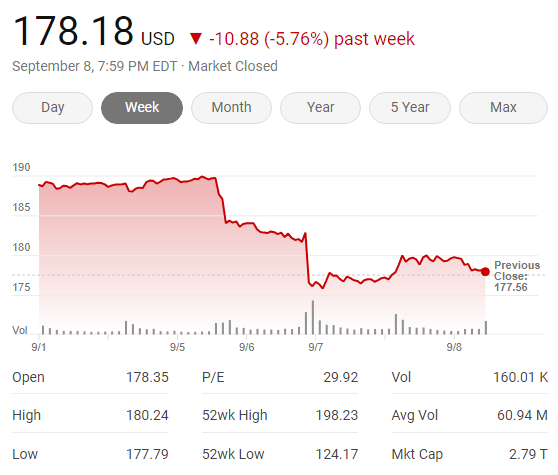
The potential crackdown threatens to dissrupt Apple’s sales as China accounts for about 20% of Apple’s total revenue. Uncertainties about the news prompted investors to retreat from Apple postions, leading to a 6% drop in Apple shares in two days. More than $200bn of market cap was wiped out.
$200 market cap drop
Apple shares fall $200 billion in just days September 2023
The iPhone commeth
Adding to the concern, Apple is just days away from its key event. On the 12th september 2023, the company is expected to officially announce the launch of its newest smartphone – the iPhone 15.
A unit trust is a type of investment fund that allows you to pool your money with other investors and invest in a variety of assets, such as shares, bonds, property, or cash.
A unit trust is managed by a professional fund manager who decides what to buy and sell according to the fund’s objectives and strategy. You can buy or sell units in a unit trust at any time, depending on the market price of the units. The price of each unit is calculated by dividing the total value of the fund’s assets by the number of units issued.
The more units you own, the more you benefit from the fund’s performance. A regular monthly purchase is the best way to buy as you evenly spread the cost and smooth out and the ‘up’s and ‘downs’ over time.
Some of the advantages of investing in a unit trust
You can access a diversified portfolio of assets with a relatively small amount of money.
You can benefit from the expertise and research of the fund manager who makes the investment decisions for you.
You can choose from a wide range of unit trusts that suit your risk appetite, investment goals, and preferences.
Some of the disadvantages of investing in a unit trust
The performance of the unit trust depends on the skill and judgment of the fund manager, who may not always make the best choices.
You have to pay fees and charges to the fund manager and other service providers, which can reduce your returns.
You may face market risks and volatility, which can affect the value of your units.
A unit trust is a good way to invest in the markets but beware, like any investment, markets go up and they go down! Be aware and be careful.
Chip design firm Arm on 5th September 2023 submitted an updated filing for its upcoming initial public offering on the New York Stock Exchange, setting a price range between $47 and $51. Only 9.4% of Arm’s shares will be freely traded on the NYSE.
Arm was previously listed in London and New York, before SoftBank acquired it for $32 billion in 2016.
Chip design firm Arm on Tuesday is looking to acquire as much as $4.87 billion in its upcoming initial public offering on the New York Stock Exchange, according to the new filing.
The deal could value the company at as much as $52 billion
As a British company, Arm qualifies as a foreign private issuer in the U.S. and its shares will count as American depositary shares, or ADS’s. It is reported that the company will list some 95.5 million ADS’s at a price range of between $47 and $51. At the upper end of that range it is estimated that Arm will likely raise up to $4.87 billion. At the lower end, the IPO would fetch $4.49 billion of fresh capital for Arm. It could do even better.
Institutional funds
When the company floats in New York, it will look to enjoy a very deep pool of professional institutional funds. Arm seeks to ramp up its investments in research and development, particularly as it pursues growth in the artificial intelligence (AI) space with some of its newer chips. The company recently released new chips specifically targeted at AI and machine learning use cases.
Arm seeks up to $52 billion valuation in U.S. IPO
Upper end
At the upper end of the pricing range, Arm would also touch a total valuation of $52 billion or more. Only 9.4% of Arm’s shares will be freely traded on the New York Stock Exchange, with SoftBank expected to own roughly 90.6% of the company’s outstanding shares after the completion of the IPO.
Arm’s listing is set to be the biggest technology IPO of the year. Investors are hoping that the listing could breathe new life into an IPO market that has been ‘slack’ since 2022.
250 billion chips globally
Arm says its energy-efficient processor designs and software platforms are integrated into more than 250 billion chips globally, into products ranging from sensors and smartphones to supercomputers.
The company estimates it enjoys approximately 48.9% share of the market for semiconductor design. Other players, such as Intel and AMD, have raced to catch up on designing their own chip architectures, but have struggled so far.
U.K. misses out… again
The U.K. government had originally hoped Arm would list on the London Stock Exchange, but the company instead dealt a major blow to Britain’s ambitions to become the leading global tech hub by opting for New York. The U.S. financial center has a deep institutional investor base and analysts who have a close understanding of the technology sector.
BIG interest
Chip design firm Arm said in a Tuesday filing that Apple, Google parent Alphabet, Nvidia and other technology companies are interested in buying up to $735 million in its shares as it seeks to go public on Nasdaq.
The investments might not happen, but the fact that these companies are considering them underlines the importance of Arm, whose designs are used for processors in data center servers, consumer devices and industrial products.
Arm chip – some 250 billion chips globally
Chip makers Intel, Samsung and TSMC are interested in investing alongside the three trillion-dollar technology companies, along with AMD and MediaTek, which make chip designs based on Arm architectures. Cadence Design Systems and Synopsys, which make electronic design automation software for processor development, have also expressed interest, according to a revised prospectus for Arm’s shares sale. This IPO could easily be the biggest of the 2023!
As part of the deal, Arm could wind up with a $52 billion market capitalization and almost $5 billion in new cash.
This is likely to be the biggest IPO of 2023
It is estimated that there will be about 19 billion devices using the Arm processor in the world by the end of 2023.
Arm target
The market share of Arm across different technology markets worldwide, which was 90% for mobile application processors, 34% for embedded computing, and 5% for data center and cloud in 2019.
Arm has a target of increasing its market share to more than 90%, 50%, and 25% respectively by 2028.
With second-quarter earnings season now largely behind the U.S. market, stock investors have been focusing on the latest economic data and for the most part been reacting positively to bad economic news, or any data that may point to an economic slowdown.
It’s been almost nine months since the trend emerged, as softening economic data and lower inflation may mean the Federal Reserve can stop raising interest rates.
Traders are reportedly pricing in an over 90% chance that the Fed will hold its policy interest rate unchanged at its September 2023 meeting, and a roughly 35% likelihood that the U.S. central bank will raise interest rates by 0.25% in November 2023.
Fed policy weakening?
The Fed’s monetary policy has lost some of its potency and interest rates may need to rise as a result, economists say.
U.S. stocks closed higher ahead of the Labour Day holiday weekend, after data released indicated a cooling labour market, though there was speculation that summertime jobs data may have been a factor. The U.S. created 187,000 new jobs in August, while the unemployment rate jumped to 3.8% from 3.5%.
The data supports the narrative of a gradual slowdown in the U.S. labour market, but there are no dramatic signs that the economy is weakening significantly economists say. The economic data has not been bad. It is just softening.
‘Good news bad news, bad news good news’!
However, if investors see a significant decline in the housing and U.S. labour markets, that could change the narrative and break the cycle in which ‘bad economic news is good news’ for stocks, economic data have to be much worse than now, indicating more damage from high interest rates and higher inflation.
The trend may also reverse if there is a meaningful downgrade of corporate earnings ‘expectations’ and then this translates into weakened profitability.
Inflation just may climb again
Investors should also be alert for the possibility that inflation may accelerate again. Data showed that the personal consumption expenditures price index rose 0.2% in July, but the yearly inflation rate crept up to 3.3% from 3%. Inflation has been trending down but that trend could turn again.
If investors start to treat ‘bad economic news as bad news’ for the stock market, it could put pressure on the 2023 stock-market rally, with the S&P 500 SPX already up 17.6% since the start of the year and the Nasdaq Composite COMP up 34%.
General concensus is that the bull run ain’t over just yet.
The creator of Photoshop and InDesign launched a generative AI tool called ‘firefly’, which has recently gained traction. It is quite possible that Adobe has one of the best AI generative tools available and it’s worth checking it out as a stock to *invest in.
Firefly enables users to edit through simple typed commands
Adobe Firefly is a generative AI-powered content creation tool from Adobe that allows you to experiment, imagine, and create an infinite range of images with simple ‘text’ prompts.
You can use Firefly to generate images from a detailed text description, apply styles or textures to words and phrases, use a brush to remove objects or paint in new ones, generate color variations of your vector artwork, and more.
Adobe Share Chart as at 5th september 2023
Morgan Stanley thinks Adobe can benefit from artificial intelligence-powered products even more.The bank upgraded Adobe to overweight from equal weight.
Bank of America has also upgraded Adobe to buy with a revised target price of $63000 per share.
Definitely one to watch!
*Please do your own careful research – this is not a recommendation but simply an observation. Remember RESEARCH! RESEARCH! RESEARCH!
Think of the biggest market for a physical product you can possibly imagine – are you thinking mobile phones, cars or game devices even? Think again…?
They are all big commercial markets but in the coming decades a new product is coming and it will be so desirable that it will dwarf these giants – it will be… the ‘robot’.
Robots will be able to understand what we want, comprehend the way the world works and looks and have the skills to execute our commands in a safe and controlled manner – at home and in the workplace.
Biggest market
The labour market is the biggest market that has ever existed in the history of business – it’s the market where we want things ‘done’ – where we do things – and it’s forever evolving. It carries massive stock market and investing potential right now and for the future.
Robot AI tech – a market place to explore
Take Nvidia, Microsoft, Google, Meta, Apple and Tesla as prime examples of companies pioneering technological advancements for instance – we can already enjoy and invest in these – and there’s much more to come.
Dozens of firms around the world are working on the technology
One of the highest profile companies in the market is Tesla, Elon Musk’s electric car company. It is working on the Optimus humanoid robot, which Mr Musk intimates could be on sale to the public in a few years’ time.
Massive tecnological advancement in artificial intelligence (AI) and robotics suggest the development of humanoid robots is accelerating… and fast. It’s a race to the become the first to succeed in the biggest practical labour market ever… and it carries huge potential for everyone, including you and me.
20 years from now…? Where were Tesla and Apple 20 years ago?
Twenty years at the pace the technology is developing now is is an eternity – every week, month and year there are new developments in the AI world that have introduced fundamental changes and enhancements to our world.
Mainstream interest in AI exploded late 2022 when a powerful version of ChatGPT was made public. Its ability to generate almost unlimited useful text and images has spawned rivals and a wave of investment in AI technology.
But developing the AI that would allow a robot to complete useful tasks is a different and much more difficult task. Tesla could be the company best placed to be one of the first to achieve this goal – given its advancements in ‘self driving’ technology. But, unlike ChatGPT and its rivals, humanoid robots have to navigate the physical world and need to understand how objects in that world relate to each other.
Tasks that seem easy to humans are major feats for humanoid robots. This is a problem that engages a lot of different complex issues in an AI driven robotics system. Picking up a cup and having a drink is a major undergoing for a robot.
The market place potential is unlimited
The potential market for robots in the future depends on various factors, such as the level of technological innovation, the demand from different industries and sectors, the regulatory and ethical frameworks, and the social and economic impacts of robot adoption. But if recent developments are anything to go by – it promises to be big!
Robot AI – a massive potential future market place
Based on the some indicative web search results, the current market size for robots is estimated to be around $55 billion to $114 billion in 2023, depending on the type and scope of robots included. The projected market size for robots in 2028 or 2029 ranges from $165 billion to $260 billion, with a compound annual growth rate (CAGR) of 11.4% to 17.6%.
The professional services robots, which include medical, agricultural, and personal assistance robots, are expected to dominate the market and account for more than half of the total sales by 2030. The industrial and logistics robots, which include conventional, collaborative, and mobile robots, are also expected to grow steadily and increase their productivity and efficiency in various manufacturing and transportation applications.
However, these projections are based on assumptions – but one thing is for sure the robots are coming and the market will be massive!
I for one will be keeping a watchful eye on where to invest my hard earned cash to take advantage of this potentially high growth market in the coming years (and now).
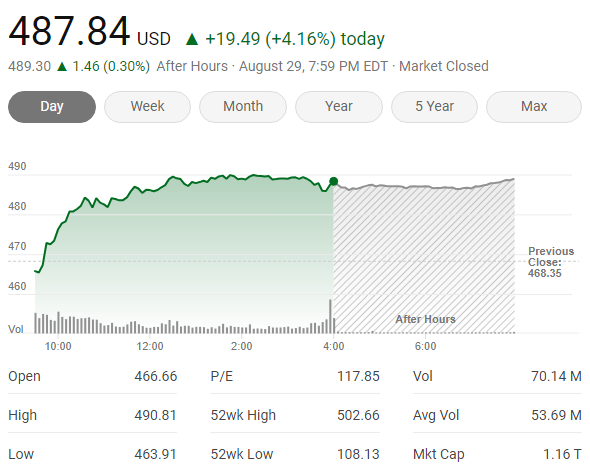
Nvidia shares rose 4.2% Tuesday 29th August 2023 to close at a record high, after the company announced a partnership with Google that could expand distribution of its artificial intelligence technology (AI).
The stock’s bountiful run continued, now up 234% in 2023, making it by far the best performer in the S&P 500. Facebook parent Meta is second in the index, up 148% so far this year.
The record close comes less than a week after the company said quarterly revenue doubled from a year earlier and gave a forecast indicating that sales this period could rise 170% on an annual basis. The day after the better-than-expected earnings report, the stock climbed to a record intraday high of $502.66 before declining later in the afternoon.
Nvidia’s business is booming because its graphics processing (GPU’s) are being gobbled up by cloud companies, government agencies and startups to train and deploy generative AI models like the technology deployed in OpenAI’s ChatGPT as fasta as Nvidia can make them.
NVIDIA stock chart
Nvidia announcment
On Tuesday 29th August 2023, Nvidia CEO Jensen Huang appeared at a Google conference to announce an AI agreement between the two companies.
Through the partnership, Google’s cloud customers will have greater access to technology powered by Nvidia’s powerful H100 GPUs.
‘Our expanded collaboration with Google Cloud will help developers accelerate their work with infrastructure, software and services that supercharge energy efficiency and reduce costs’, the Nvidia CEO reportedly said in a blog post.
Nvidia’s GPUs are also available on competing cloud platforms from Amazon and Microsoft.
At 4.33%, the 10-year Treasury yield in the U.S. is at its highest in 16 years. That represents a risk-free, long-duration asset with relatively high returns and this is challenging the stock market.
Why should traders invest in stocks that may not return as much, or just slightly more and take unecessary risks, when there is an asset class that guarantees around 4% return or slighlty more?
Cash is king?
Cash is now yielding 5% in the U.S., short term bonds are yielding 5% plus, so equities for the first time in a long time, have actually got some competition.
Typically stocks if they do well, are likely to return more than a risk-free asset, precisely because it isn’t certain stocks will rise. That’s called the equity risk premium, a return that’s supposed to compensate stock investors for the chance that they might lose money. But, as the premium is below 1% now. Historically, it’s been between 2% and 4% – meaning stocks are looking much less attractive than Treasuries.
Harder job for the Fed?
Another potential issue that could crop up with high Treasury yields is that it could make the Federal Reserve’s job tougher. During the recent Jackson Hole gathering, the Fed head has indicated that more interest rate hikes are still high possibility.
But don’t panic just yet… this is likely a pullback phase of a bull market analysts suggest. That is, it’s still too early to be bearish on stocks.
Yardeni Research president Ed Yardeni is reported to have said that the market is ‘going to hang in there’ and ‘a year-end rally will bring the S&P 500 back to something like 4,600‘.
That implied an increase of almost 5% in stocks – while not certain – would give Treasuries a run for their money again.
Technology giant Nvidia reports its sales have hit a record after more than doubling as demand for its artificial intelligence (AI) chips take off!
It figures
The company says revenue jumped to above $13.5bn (£10.6bn) for the three months to the end of June. Nvidia also expects sales to perform very well in the current quarter and plans to buy back $25bn of its stock. The firm’s shares rose by more than 6.5% in extended trading in New York, adding to their huge gains this year. Nvidia also said it expects revenue of around $16bn for the three months to the end of September 2023.
That is substantially higher than Wall Street expected and would equate to a rise of around 170%, compared to the same time last year.
Even before 23rd August’s figures, Nvidia’s stock price had more than tripled for the year, making it the top performer in the S&P 500. It’s share price jumped to around $500 after hours, a level that would mark a record if it closes there on 24th August 2023. Its prior closing high was $474.94 on 18th July 2023.
‘A new computing era has begun’, Nvidia’s chief executive, Jensen Huang, said in a statement. ‘Companies worldwide are transitioning from general-purpose to accelerated computing and generative AI’, he reportedly added.
Strong performance
The strong performance was driven by Nvidia’s data centre business, which includes AI chips.
The power of Nvidia’s AI microchips
Revenue for that unit came in at more $10.3bn, a rise of more than 170% from year ago, as cloud computing service providers and large consumer internet companies snapped up its next-generation processors.
This year, Nvidia’s stock market value has jumped to more than $1 trillion as its shares more than tripled in value, mking it the fifth publicly traded U.S. company to join the so-called ‘Trillion dollar club’, along with Apple, Amazon, Alphabet and Microsoft.
AI ‘mania’ helps Nvidia
Nvidia have been making micro chips for a long time and it’s only really been in the last couple of years that the market has caught on.
Nvidia was originally known for making the type of computer chips that process graphics, particularly for computer games. They have been making chips for a long time and have now become the leader in AI chip design and manufacture.
Now Nvidia’s hardware is the foundation for most AI applications, with one report suggesting it had cornered 95% of the market for machine learning.
ChatGPT which generates human-like responses to user queries within seconds was trained using 10,000 of Nvidia’s graphics processing units clustered together in a supercomputer belonging to Microsoft.
AI products are expected to dramatically change how we use computers and the role they play in our lives.
Arm is a British semiconductor and software design company that is known for its Arm processors, which are widely used in smartphones, tablets, laptops, and other devices. Arm was founded in 1990 as a joint venture between Acorn Computers, Apple Computer, and VLSI Technology. The company was originally called Advanced RISC Machines, but later changed its name to Arm Ltd in 1998.
In 1985, the first Arm silicon chip was created by Acorn engineers Sophie Wilson and Steve Furber, who designed a 32-bit processor with a simple and elegant instruction set.
In 1990, Arm was spun off from Acorn as a separate company, with Apple as a major investor. Arm’s first product was the ARM6 processor, which was used in Apple’s Newton personal digital assistant.
Impression of the Apple Newton PDA device
In 1993, Arm introduced the ARM7 processor, which became one of the most successful embedded processors in history. It was used in devices such as the Nokia 6110 mobile phone, the Nintendo Game Boy Advance, and the Lego Mindstorms robotics kit.
In 1994, Arm launched the ARM9 processor family, which offered higher performance and lower power consumption than previous generations. The ARM9 was used in devices such as the Sony PlayStation Portable, the Palm Treo smartphone, and the Amazon Kindle e-reader.
In 1997, Arm introduced the ARM10 processor family, which featured a superscalar architecture and a floating-point unit. The ARM10 was used in devices such as the Apple iPod, the Samsung Galaxy S smartphone, and the Raspberry Pi computer.
In 1998, Arm changed its name from Advanced RISC Machines to Arm Ltd, reflecting its global expansion and recognition.
In 1999, Arm launched the ARM11 processor family, which featured a vector floating-point unit and a TrustZone security extension. The ARM11 was used in devices such as the iPhone 3G, the Nintendo DS, and the Raspberry Pi Zero.
In 2000, Arm became a public company, listing on the London Stock Exchange and the Nasdaq. The company raised £213 million in its initial public offering.
In 2001, Arm introduced the Cortex processor family, which offered a range of performance, power, and cost options for different applications. The Cortex processors are used in devices such as the Samsung Galaxy S10, the Apple Watch, and the Tesla Model 3.
In 2005, Arm acquired Artisan Components, a provider of physical intellectual property (IP) for chip design. This enabled Arm to offer a complete solution for system-on-chip (SoC) development.
In 2006, Arm announced the Mali graphics processing unit (GPU) family, which complemented its CPU offerings with high-performance graphics capabilities. The Mali GPUs are used in devices such as the Huawei Mate 20 Pro, the Oculus Quest, and the Samsung Smart TV.
Artistic image of ARM chip
In 2009, Arm partnered with IBM, Samsung, Texas Instruments, and others to form the Linaro consortium, which aimed to improve the Linux software ecosystem for Arm-based devices.
In 2010, Arm unveiled the Cortex-A15 processor, which was the first Arm processor to support virtualization and big.LITTLE technology. The Cortex-A15 was used in devices such as the Google Nexus 10, the LG G3, and the Nintendo Switch.
In 2011, Arm announced the Cortex-M0+ processor, which was the world’s most energy-efficient microcontroller. The Cortex-M0+ was used in devices such as the Arduino Nano 33 IoT, the Fitbit Flex 2, and the Nest Thermostat.
In 2012, Arm launched the Cortex-A53 and Cortex-A57 processors, which were the first Arm processors to support the 64-bit ARMv8 architecture. The Cortex-A53 and Cortex-A57 were used in devices such as the iPhone 6s, the Samsung Galaxy S6 Edge+, and the Microsoft Surface Pro X.
In 2013, Arm acquired Geomerics, a developer of real-time lighting technology for video games. This enhanced Arm’s graphics portfolio with dynamic illumination and global illumination effects.
In 2014, Arm introduced the Cortex-A72 processor, which delivered a 50% performance improvement over the previous generation. The Cortex-A72 was used in devices such as the Huawei P9, the Xiaomi Mi 5s Plus, and the Amazon Fire HD 10.
In 2015, Arm announced the Cortex-A35 processor, which was the most efficient Arm processor for smartphones and tablets. The Cortex-A35 was used in devices such as the Nokia 2.1, the Samsung Galaxy J2 Core, and the Lenovo Tab M7.
In 2016, Arm was acquired by SoftBank Group for £24.3 billion, becoming a subsidiary of the Japanese conglomerate. The deal was motivated by SoftBank’s vision of investing in technologies that would drive the future of artificial intelligence (AI), internet of things (IoT), and smart cities.
In 2017, Arm launched Project Trillium, a suite of machine learning (ML) solutions that included an ML processor , an object detection processor , and an open-source software framework. The Project Trillium products aimed to enable low-power and high-performance ML applications on edge devices.
In 2018, Arm unveiled the Cortex-A76 processor , which offered a 35% performance boost over its predecessor. The Cortex-A76 was used in devices such as the OnePlus 7T, the Huawei MateBook D14, and the Acer Chromebook Spin 13.
In 2019, Arm announced the Cortex-A77 processor , which improved on its predecessor with a higher clock speed, a larger cache, and better branch prediction . The Cortex-A77 was used in devices such as the Samsung Galaxy S20, the Asus ROG Phone II, and the Lenovo Yoga C940.
In 2020, Arm introduced the Cortex-X1 processor , which was its most powerful CPU design to date. The Cortex-X1 was designed to deliver peak performance for premium device , such as flagship smartphones, laptops and gaming consoles. The Cortex-X1 was used in devices such as the Samsung Galaxy S21 Ultra, the Xiaomi Mi 11, and the Google Pixel 6.
In 2021, Arm launched the Cortex-A78C processor , which was optimized for high-performance computing (HPC) applications. The Cortex-A78C featured up to eight CPU cores , a larger L3 cache, and support for ECC memory. The Cortex-A78C was used in devices such as the Samsung Galaxy Book Pro, the HP Elite Folio , and the Acer Chromebook Spin 513.
Microchip
In 2022, Arm unveiled the Cortex-A710 processor, which was its first big core to support the Armv9 architecture. The Cortex-A710 offered a 30% energy efficiency improvement over its predecessor, as well as enhanced security and ML features. The Cortex-A710 was used in devices such as the OnePlus 10 Pro, the Huawei MatePad Pro 2, and the Microsoft Surface Laptop Studio.
In 2023, Arm announced the Immortalis GPU family , which was its next-generation graphics solution that included hardware-based ray-tracing and variable rate shading capabilities . The Immortalis GPUs aimed to deliver realistic and immersive graphics for gaming, VR and AR applications on mobile devices . The Immortalis GPUs were used in devices such as the Samsung Galaxy S22 Ultra , the Sony Xperia 1 IV, and the Oculus Quest 3.
Powerful world presence
Arm is a leading semiconductor and software design company that has revolutionized the computing industry with its innovative and efficient processor architectures. Arm’s processors power billions of devices across various domains, such as mobile, IoT, AI, HPC, and gaming. Arm has been at the forefront of technological advancements for over three decades, delivering performance, energy efficiency, and security to its customers and partners.
Arm is a subsidiary of SoftBank Group and has a massive global presence.
British microchip designing giant Arm has announced that it has filed paperwork to sell its shares in the U.S.
The Cambridge-based company, which designs chips for devices from smartphones to game consoles, plans to list on New York’s Nasdaq in September. The highly anticipated IPO in the U.S. comes after UK Prime Minister, failed to convince Arm to float in London or pursue a dual UK-U.S. listing.
Arm’s decision to list in New York rather than London has fuelled fears that the City is losing its competitiveness to Wall Street, where valuations are typically higher. SoftBank-owned chip designer Arm on 21st August 2023 disclosed a modest 1% fall in annual revenue as it made public the paperwork for a U.S. listing that is expected to be the year’s biggest initial public offering. The company is reportedly looking for a valuation of between $60bn (£47bn) to $70bn.
Arm was bought in 2016 by Japanese conglomerate Softbank in a deal worth £23.4bn. Prior to the takeover, it was listed in both London and New York for 18 years.
Companies that use ARM processors in their products
Some of the companies that use ARM processors include Apple, Qualcomm, Samsung, Broadcom, and Fujitsu. ARM technology is used in a wide range of devices, from smartphones to game consoles to supercomputers.
ARM
Arm is a British semiconductor and software design company that is known for its Arm processors, which are widely used in smartphones, tablets, laptops, and other devices. Arm was founded in 1990 as a joint venture between Acorn Computers, Apple Computer, and VLSI Technology. The company was originally called Advanced RISC Machines, but later changed its name to Arm Ltd in 1998.
The U.S. stock market has experienced a 5.6% slide for the S&P 500 index over 15 trading sessions through 17th August 2023 and levelling off in the last trading day of that week.
This is about as bad as August typically gets, as August is a rocky month with low volume and high volatility. Some of the reasons for the pullback include the rise in the 10-year Treasury yield, the strengthening of the U.S. dollar, and the signs of a slowing Chinese economy.
Pullback temporary for August?
However, some analysts argue that the pullback will likely prove to be temporary and not turn into a serious market rout. It has been suggested that the bull run isn’t quite over just yet, and that a 10% ‘pullback’ was on the cards.
Analysts also suggest that the rise in yields would need to threaten a serious shift or there would need to be an additional shock to cause a larger selloff.
NASDAQ
NASDAQ drops some 7% in one month from 19th July – 18th August 2023
However, some suggest that the market is showing signs of stability, as the speed of the surge in the 10-year yield often occurs near the end of a selling cycle for equities. Investors should watch for indicators such as oil prices, wage pressures, and inflation expectations to gauge the market sentiment.
The S&P 500 and the Dow levelled off the week at the close of trading Friday 18th August 2023.
The NASDAQ did score its best first half of the trading year since 1983 January to June 2023 so a pullback was likely to happen.
The Buffet Indicator is a valuation multiple used to assess how expensive or cheap the aggregate stock market is at a given point in time. It was proposed by investor Warren Buffett in 2001, who called it ‘probably the best single measure of where valuations stand at any given moment‘ . It compares the total value of all publicly traded securities in the U.S. to the U.S. GDP .
The current value of the Buffet Indicator is 181%, (July 2023) – which suggests that the U.S. stock market is reportedly worth $48.37 trillion, while the U.S. GDP is $26.74 trillion.
This ratio is 50.50% above the historical trend line, suggesting that the stock market is overvalued relative to GDP. Buffett warned that if the ratio approaches 200%, ‘you are playing with fire‘.
Buffett Indicator: $48.85T ÷ $26.91T = 182%
Does it Matter?
The Buffett Indicator expresses the value of the U.S. stock market in terms of the size of the U.S. economy. If the stock market value is growing much faster than the actual economy, then it may be in a bubble.
Buffet Indicator Movement Above and Below Trend Line