
“All the batteries currently on Earth store just 10 minutes of the world’s electricity needs.”


Observe. Think. Chat. Do. Trade. Repeat…

AI data centres require cooling, and substantial amounts of fresh water are utilized for this purpose. Additionally, water is consumed in the mining and production of AI-related hardware.
The production of AI hardware utilizes and contaminates water due to the mining of rare materials like silicon, germanium, gallium, boron, lithium, gold, copper and phosphorus. The extraction of these minerals is resource-intensive and significantly affects the environment, leading to water pollution. AI is hungry for power too – the amount of additional energy required to run an AI data centre is far greater.
The water consumption associated with AI is not limited to its operational phase. AI hardware production requires intensive mining for rare materials such as silicon, germanium, gallium, boron, and phosphorus. The extraction of these minerals has a substantial environmental impact and contributes to water pollution.
Additionally, AI systems’ water use extends to the production of related hardware. The extensive deployment of AI compounds this problem, putting pressure on the drinking water supplies of local communities. With the increasing adoption of AI, there is additional strain on municipalities, agriculture, and various industries that are already facing challenges due to drought and scarce water resources.
Researchers have explored AI’s potential to address water challenges.
AI can optimise water usage in agriculture by automating irrigation systems. Smart machines, robots, and sensors analyse data to enhance efficiency and detect leaks, as demonstrated in smart irrigation systems for crops.
AI-powered biosensors can accurately detect toxic chemicals in drinking water, surpassing current quality monitoring practices.
AI can aid in managing water security and wastewater treatment, contributing to sustainable water use. However, on the practical side, it is the willingness to implement these grand ideas and systems that is quite often the problem.
While there is peer-reviewed analysis on the role of AI in managing water and achieving Sustainable Development Goals (SDGs), the direct and indirect effects of AI on water usage are largely uncharted.
Recent reports indicate that AI systems, such as ChatGPT, may use approximately 500 millilitres of water for every 5 to 50 prompts or questions posed by a user. Given the rapid increase in chatbot usage globally, this could lead to a considerable water footprint, raising concerns among experts and environmentalists.
As technological advancement continues, it is imperative to move forward with caution. Achieving a balance between innovation and the responsible use of resources is essential for a sustainable future where AI contributes positively without jeopardizing our essential water resources.

Unveiled at Google I/O 2024, this latest model enhances sophisticated features with rapid performance and efficiency. The new AI Chatbot was unveiled on 15th May 2024.
The unveiling comes a day after OpenAI announced its newest artificial intelligence (AI) model, GPT-4o.
The Gemini 1.5 Flash is engineered for exceptional speed, processing queries with reduced latency, which makes it perfectly suited for real-time applications.
Similar to its forerunner, Gemini 1.5 Pro, Flash is adept at contextual understanding. It is capable of interpreting user prompts through multiple modalities such as text, images, video, and speech.
Google also introduced a scaled-down version called Gemini 1.5 Nano, which runs locally on devices.
A prominent feature of Gemini 1.5 Flash is the AI Overviews integration. These ‘precis’ summaries deliver rapid responses to intricate inquiries. Users are presented with a topical overview and pertinent links for additional research. The AI Overviews feature is currently being introduced to U.S. users, with worldwide availability anticipated by the end of the year.
Gemini 1.5 Flash is Google’s latest endeavour to improve search experiences. Whether it’s for research, planning, or brainstorming, this AI model simplifies the process. With the advent of generative AI, Google Search is becoming increasingly potent, enabling users to effortlessly access reliable information.

GPT-4o accepts any combination of text, audio, and image as input and generates corresponding outputs in any of these modalities. It’s a step toward more natural human-computer interaction.
GPT-4o can respond to audio inputs in as little as 232 milliseconds, with an average of 320 milliseconds – similar to human conversation speed.
It matches GPT-4 Turbo performance on English text and code, with significant improvements in non-English languages. Plus, it’s 50% cheaper in the API.
GPT-4o excels in understanding images and audio compared to existing models.
Unlike previous Voice Mode (which used separate models), GPT-4o is trained end-to-end across text, vision, and audio. This means it processes all inputs and outputs using the same neural network.
OpenAI is still exploring what GPT-4o can do and its limitations. It’s a promising step toward more versatile AI interactions.

Claude.ai will be accessible to both individuals and businesses via the web and an iPhone app. While it is already free on both platforms in the U.K., Anthropic states that this marks the product’s inaugural launch for users in the EU and non-EU nations such as, Switzerland, Norway and Iceland.
Anthropic is introducing a paid subscription-based version of its Claude assistant, named Claude Pro, which will provide users with access to all its models, including the highly advanced Claude 3 Opus.
In its announcement about launching Claude in European countries, Anthropic emphasized security and privacy as central aspects.
Earlier this year, the EU enacted the first significant global regulatory framework to govern AI.


NVIDIA’s stock reached an all-time high of $950.02 on 25th March 2024. The 52-week high stands at $974.00, which is 9.7% higher than the current share price. Conversely, the 52-week low was $280.46, which is considerably below the current price.
Annual percentage changes
In 2024, the average stock price reached $763.29, marking a year-to-date rise of 79.30%.
In 2023, NVIDIA’s stock price experienced a remarkable surge of 239.02%.
Conversely, in 2022, the stock price witnessed a decline of 50.27%.
Throughout the past decade, the stock has undergone considerable volatility, exhibiting both notable gains and significant losses.
Focus
NVIDIA began as a pioneer in PC graphics and has since expanded its focus to artificial intelligence (AI) solutions. Its GPUs (graphics processing units) are pivotal in AI, high-performance computing (HPC), gaming, and virtual reality (VR) platforms.
The company’s parallel processing capabilities, powered by thousands of computing cores, are vital for executing deep learning algorithms. Additionally, NVIDIA is active in emerging markets such as robotics and autonomous vehicles.
Market position
NVIDIA holds a dominant position in the Data Centre, professional visualization, and gaming markets. Its success is bolstered by strategic partnerships with leading cloud service providers and server vendors.
Financial performance
NVIDIA’s revenue and profit have seen substantial growth over time. Its emphasis on AI and new technologies suggests a strong potential for further expansion. In summary, despite NVIDIA’s stock achieving impressive gains, it is still influenced by market trends and technological changes.
Its peak status hinges on multiple elements such as industry movements, competitive landscape, and upcoming innovations. Investors are advised to meticulously assess these factors when determining the stock’s future prospects.
Considering a long-term investment yet expecting a downturn, it might be prudent to realise some profits now, given the enormous 20,000% surge in stock value.
Take some profit and buy again after a pull-back.

This initiative is aimed at catching up with the booming AI market, currently dominated by Nvidia.
Arm, alongside competitors such as AMD, Intel, and Qualcomm, is accelerating efforts to gain position in the AI sector.
SoftBank is negotiating with contract manufacturers, including Taiwan’s TSMC, to produce the AI chips. Mass production is expected to commence in autumn 2025.
Arm’s shares have surged by nearly 45% this year, bringing its market capitalization to over $113 billion.
The chip designer based in the U.K., plans to create an AI chip unit to develop a prototype by spring 2025.
Discussions are reportedly ongoing with contract manufacturers like Taiwan’s TSMC for the production of the AI chips. It was reported that production is anticipated to start in fall 2025.
Arm is responsible for designing the core architecture for these chips. The company licences its designs to companies including Qualcomm and Nvidia and earning royalty fees from each sale. The company asserts that 99% of high-end smartphones utilize Arm technology.
Established by Japanese billionaire Masayoshi Son, SoftBank is heavily investing in AI. The company has new plans to allocate $960 million by the following year to enhance its generative AI computing capabilities. In June 2023, Son expressed SoftBank’s ambition to occupy a leading role in the AI revolution.
Reportedly, SoftBank aims to establish AI data centres equipped with proprietary chips throughout the U.S., Europe, Asia, and the Middle East by 2026.
For the fiscal year concluding in March 2024, SoftBank recorded a 7.24 billion Japanese Yen ($4.6 billion) profit in its Vision Fund.
This was the first profitable year for the principal tech investment division since 2021.

Researchers have developed an ultra-pure form of silicon, known as silicon-28 (Si-28), which is fundamental for ‘silicon-spin qubits’ in quantum computers. This advancement addresses a major challenge in quantum computing: the ‘fragile quantum coherence.’
Quantum computers tend to accumulate errors quickly due to slight environmental changes, affecting their dependability.
Quantum bits, or qubits, are analogous to classical computer bits but are extremely sensitive to environmental interference.
Current quantum computers, even when cooled to near absolute zero, can only maintain error-free operation for a very short time.
This new technique generates qubits by embedding phosphorus atoms into crystals of pure, stable silicon. A concentrated silicon beam then directs onto a silicon chip, replacing impurities with pure silicon.
As a result, the impurity levels in silicon have been significantly reduced, from 4.5% to a mere 0.0002%.
David Jamieson, a project co-supervisor from the University of Melbourne, mentioned that the team achieved this level of purity using a standard piece of equipment – an ion implanter – that’s typically found in semiconductor fabrication laboratories.
Richard Curry, a professor at The University of Manchester where extensive research took place, believes that this advancement could accelerate the development of operational quantum computers. Processes that might have taken a decade to complete could now be accomplished in potentially half that time or less.

Practical quantum computers have the potential to revolutionize numerous fields
The creation of the world’s purest silicon represents a significant step forward in the development of large-scale quantum computers.

Arm announced a 47% increase in fiscal Q4 revenue to $928 million on Wednesday.
This surge was propelled by its licensing business, which saw a 60% increase to $414 million for the quarter, attributed to several high-value licencing deals for AI chips.
Additionally, Arm’s royalty revenues rose 37% to $514 million year-over-year, thanks to the growing adoption of its new Armv9-based chips, which offer higher margins.
However, Arm’s revenue projection for 2025, estimated between $3.8 billion and $4.1 billion, did not meet investor expectations, with analysts anticipating $3.99 billion for the year.
Contrary to chipmakers like Nvidia, which manufacture and market their own products, Arm creates the ‘architectures’ that form the foundation of chips.
These designs are then licenced to various chip manufacturers, including Qualcomm and Nvidia, with Arm earning royalties on each unit sold.
Originally founded in Cambridge, England, in 1990, Arm was an independent company listed in London until 2016, when it was acquired by Japanese tech investor SoftBank for $32 billion.
In September 2023, SoftBank listed Arm on the Nasdaq. Since its initial public offering, Arm’s share value has more than doubled, driven by the explosive demand for chips that power advanced generative AI applications, such as ChatGPT.
But this recent revenue forecast had a negative effect on its share price


South Korean convenience stores are now the latest attraction for gold enthusiasts. Instead of the typical snacks and beverages, customers can now buy gold bars.
GS Retail, one of South Korea’s largest convenience store chains, introduced gold bars in vending machines at select locations in September 2023. These machines offer five different sizes, ranging from a tiny 0.13-ounce bar to a bigger 1.3-ounce bar.
The most sought-after option is the diminutive 0.13-ounce gold bar, with a price tag of approximately $225. It’s the younger demographic – individuals in their twenty’s and thirty’s – who are eagerly acquiring these lustrous assets. They possibly view gold as a secure refuge in the face of worldwide inflationary pressures and heightened global geopolitical tensions.
GS Retail has reported total sales of gold bars amounting to $19 million in the past nine months, concluding in May. The rising popularity of these bars has led the company to increase the number of stores offering them, aiming to reach 50 locations by the end of the year.
In a competitive move, CU, the nation’s premier convenience store chain, has partnered with the Korea Minting and Security Printing Corporation (KOMSCO) to sell mini gold bars ranging from 0.1 to 1.87 grams. These diminutive bars have been on sale at CU stores since April.
The pricing of these mini gold bars is tied to fluctuating international gold prices, updated daily. Evidently, even these small quantities of gold are attracting keen interest from young consumers.
The soaring popularity of gold bars in South Korea can be attributed to their accessibility. With convenience stores at every corner, purchasing gold has become as simple as walking in and making a selection.
A representative from Inha University reportedly noted that while some may purchase gold bars as a serious investment, others might buy them for the novelty and ease of access. Imagine the allure of picking up a gold bar along with your daily groceries.
To sum up, convenience stores in South Korea have become modern-day treasure chests, where gold bars are sold next to daily necessities. Whether for investment purposes or for a bit of indulgence, these shiny objects are creating a buzz in the country known for K-pop and kimchi.
So, next time you visit a Korean convenience store, don’t miss the chance to check out the shiny vending machine – it could present a golden opportunity.

Recent reports suggest the company is developing a project dubbed ‘Project ACDC,’ (Apple Chips in Data Centre) with the goal of creating specialized AI chips for data centres.
AI applications are becoming ever more essential in our daily routines, prompting tech giants to vie for dominance in this arena. Apple, previously trailing behind its rivals in AI, is now channelling substantial investments to bridge the gap. Project ACDC marks Apple’s strategic endeavour to position itself as a key contender in AI processing.
Traditionally, data centres have depended on general-purpose processors, like Intel Xeon or AMD EPYC, to manage diverse workloads. AI workloads, however, demand unique features such as extensive parallelism and high computational throughput. Specialized AI chips are crucial to meet these demands.
Apple’s AI chips, designed specifically for data centre servers, aim to efficiently expedite AI tasks. These chips will facilitate capabilities such as natural language processing, image recognition, and recommendation systems. With the development of its own AI chips, Apple seeks to secure a competitive edge in the AI technology race.
Apple is said to be partnering with Taiwan Semiconductor Manufacturing Co. (TSMC) to design and produce AI chips. TSMC, a top semiconductor manufacturer, is recognized for its cutting-edge process technology. Although the release timeline for these chips is not specified, their development underscores Apple’s dedication to AI.
Rumors indicate that Apple may reveal AI-based features enabled by its new chips at the Worldwide Developers Conference (WWDC) in June 2024. Should this be accurate, it could mark a significant milestone for Apple’s AI initiatives.
In conclusion, Apple’s Project ACDC signifies an aggressive move towards AI supremacy. With ongoing investments in generative AI, we can anticipate significant advancements in the near future.

The compromised system contained names and bank details of both current and past members of the UK armed forces.
While the full extent and consequences of the breach are still under investigation, preliminary results reportedly indicate that no data was extracted during the incident.
It appears that a minimal number of addresses might have been compromised.
The Ministry of Defence (MoD) responded quickly by disconnecting the external network, which is managed by a contractor.
Affected service members will be informed as a precautionary measure and will be provided with expert advice.
The hacker’s identity has not been revealed, but it is significant that in March, the UK and the U.S. charged China with conducting a worldwide campaign of “malicious” cyber-attacks.
These assaults targeted the Electoral Commission watchdog in 2021 and involved online “reconnaissance” of MPs’ and peers’ email accounts. The limited response to these events highlights the persistent cybersecurity challenges and the importance of constant alertness.
As the inquiry progresses, the MoD is expected to implement additional security measures to safeguard sensitive data, measures that ideally should have already been established.

Apple shares rose by 7% in after-hours trading on Thursday 2nd May 2024, following the company’s announcement of fiscal second-quarter earnings that exceeded expectations, coupled with the unveiling of an expanded stock repurchase program.
The tech giant disclosed that its board has approved a new $110 billion share buyback plan, marking a 22% increase from the previous year’s $90 billion authorization and setting a record as the largest buyback in history, significantly surpassing Apple’s prior repurchase initiatives.

Revenue: $90.75 billion vs. $90.01 billion estimated
iPhone revenue: $45.96 billion vs. $46.00 billion estimated
iPad revenue: $5.6 billion vs. $5.91billion estimated
Mac revenue: $7.5 billion vs. $6.86 billion estimated
Other Products revenue: $7.9 billion vs. $8.08 billion estimated
Services revenue: $23.9 billion vs. $23.27 billion estimated
EPS: $1.53 vs. $1.50 estimated
Gross margin: 46.6% vs. 46.6% estimated
According to Apple’s latest results, iPhone sales have declined in nearly every global market. The tech giant reported that the overall demand for its smartphones decreased by over 10% in the first quarter of the year, with sales diminishing in all geographic regions except Europe.

U.S. prosecutors had suggested a sentence of 36 months for Zhao. As part of his deal with the Justice Department, the cryptocurrency billionaire resigned from his position as CEO of Binance.
The billionaire is reportedly expected to see his massive crypto fortune remain intact. His wealth is likely to continue to climb even as he serves time in prison.

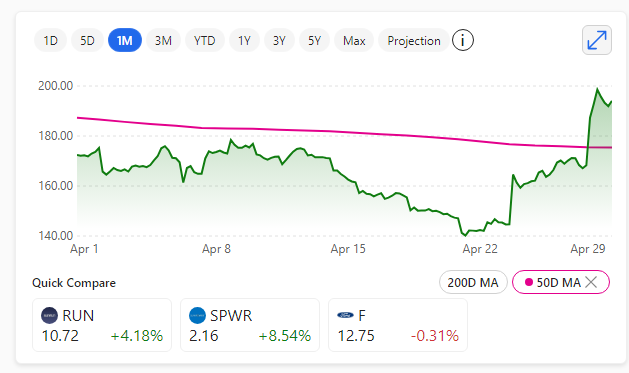
The stock closed 15% higher, buoyed by investor enthusiasm over Tesla CEO Elon Musk’s visit to China.
On Sunday 28th April 2024, Tesla announced that Chinese authorities had lifted restrictions on its vehicles after they met the nation’s data security standards.
This development has heightened anticipation for the imminent availability of Tesla’s Full Self-Driving (FSD) software in China, the world’s biggest market for electric vehicles.

The company reported earnings of $630 million (£502 million) for the first quarter, a drop of over 47% from the previous quarter.
Competing with Elon Musk’s Tesla for the title of the world’s top EV seller, BYD recently fell behind as Tesla regained the lead earlier this month.
In the first quarter, BYD’s sales of battery-only vehicles fell to just over 300,000, a decrease from the last quarter of 2023’s record high of 526,000 units.

Intel shares fall after company provides weak forecast for earnings, but disappoints with sales.
The stock fell 8% in extended trading.

Earnings per share: 18 cents vs. 14 cents expected
Revenue: $12.72 billion vs. $12.78 billion expected
For the second quarter, Intel anticipates earnings of 10 cents per share with a projected revenue of $13 billion. This projection is in contrast to analysts’ expectations, which predict earnings of 25 cents per share on sales amounting to $13.57 billion.
In the first quarter, Intel disclosed a net loss of $400 million, equivalent to 9 cents per share, as opposed to the previous year’s net loss of $2.8 billion, 66 cents per share.
Revenue was $12.7 billion versus $11.7 billion a year ago, a 9% year-over-year increase.

This translates to roughly $7.75 (£6.20) per share, which is a 44% premium over the company’s average share price as calculated over the last three months.
Darktrace, headquartered in Cambridge, focuses on cybersecurity, employing self-learning AI to counteract and automate reactions to cyber threats via its Darktrace ActiveAI Security Platform. The company caters to approximately 9,400 clients globally.
Thoma Bravo’s acquisition of Darktrace adds to its cybersecurity portfolio, which is currently estimated at around $45 billion in value.
The loss of Darktrace from the London Stock Exchange (LSE) was described as ‘disappointing news.’ There have been calls for greater pro-business reforms to help maintain London’s attractiveness for technology companies.
Darktrace was established in 2013 by Invoke Capital, an investment firm led by Autonomy’s founder Mike Lynch. He now holds a 3.9% stake in Darktrace, positioning him to gain just over $200 million from its sale. His wife holds an additional 2.9%.
Concurrently, Lynch is entangled in a fraud trial in San Francisco. He is reportedly facing accusations of being the ‘driving force’ behind significant fraud at Autonomy.
Autonomy was the software company he co-founded and eventually sold to Hewlett-Packard for $11 billion (£8.6bn) in 2011.
The acquisition represents a significant development in the cybersecurity industry.

But the revenue forecast for Q4 was less than anticipated, with the company reportedly projecting $64 billion, which is below the consensus of $64.5 billion – (only just).
Revenue: $61.86 vs. $60.80 billion expected
Earnings per share: $2.94 vs. $2.82 expected
Additionally, Microsoft is reportedly boosting its capital expenditures to acquire Nvidia graphics processing units, which are essential for training and operating artificial intelligence (AI) models.


AI startup Synthesia on Thursday 25th April 2024 announced its ‘Expressive Avatars’. These are AI-generated digital avatars that can express human emotions including happiness, sadness, and frustration.
Synthesia, supported by the tech giant Nvidia, reportedly secured an investment of $90 million in 2023, reaching a valuation close to $1 billion.
This video was created using the Synthesia platform, it took just two minutes to create.

Delving deeper into AI, it becomes crucial to comprehend the environmental impact of this technological revolution.
A new peer-reviewed study featured in ‘Joule‘ highlights the significant energy requirements of AI. The research, carried out by Alex de Vries, a data scientist at the Dutch central bank, provides a quantification of the energy usage linked to the trends in AI capacity and adoption.
The AI industry is experiencing rapid growth as major technology companies incorporate AI-driven services into their platforms. These applications require significantly more power than traditional ones, resulting in online interactions that are more energy-intensive.
Continuing on the present course, NVIDIA could be dispatching 1.5 million AI server units each year by 2027. If these servers were to run at maximum capacity, they would consume a minimum of 85.4 terawatt-hours of electricity annually. For comparison, this amount of energy surpasses the yearly consumption of numerous small nations.
By 2027, it is projected that global AI-related electricity consumption may rise by 85 to 134 terawatt-hours (TWh) annually. This estimate is on par with the yearly electricity requirements of nations such as the Netherlands, Argentina, and Sweden.
While AI heralds significant breakthroughs, its sustainability is a crucial risk factor to consider. Picture Google’s search engine evolving into a ChatGPT-style chatbot, managing nine billion interactions daily. This would cause energy demands to soar, matching the consumption of a nation like Ireland. Although this scenario isn’t immediately likely due to logistical limitations, it highlights the resource-intensive nature of generative AI applications.
As we explore the AI domain, sustainability should not be neglected. Discussing AI’s risks, such as errors and biases, should also include its environmental impact. Innovation must be balanced with responsible energy use for a sustainable future.
In essence, AI’s demand for power is substantial, and the challenge is to leverage its capabilities while reducing its environmental impact. We must proceed with caution to ensure our technological advances do not compromise the health of our planet.

It embarked on an incredible journey, venturing beyond the boundaries of our solar system and into interstellar space.
On 14th November 2023, Voyager 1 experienced an unexpected glitch, rendering its binary communication code with NASA’s flight team incomprehensible.
However, after several months of indecipherable signals, Voyager 1 has resumed clear communication with Earth. On 20th April2024, the spacecraft reported back to its NASA team, detailing its health status for the first time in five months.
Although it is not yet transmitting scientific data, Voyager 1 is providing valuable information regarding the health and functionality of its onboard engineering systems.
Thirty-five years post-launch, Voyager 1 marked a milestone as the first human-made object to exit the solar system and enter interstellar space.

Six years thereafter, in 2018, Voyager 2 emulated its predecessor, venturing beyond the sun’s dominion. Together, these spacecraft stand as humanity’s lone envoys in the cosmic expanse, bearing our scientific endeavours and inquisitive spirit.
In March, the team operating NASA’s Voyager 1 sent a command to the spacecraft, which triggered its flight data subsystem (FDS) to transmit a complete memory readout to Earth.
The analysis of the memory dump reportedly indicated that the malfunction was due to a piece of corrupted code on a single chip, accounting for approximately 3% of the FDS’s memory.
While it’s not possible to physically repair or replace the chip, the team is adeptly shifting the problematic code within the FDS’s memory. This process apparently involves dividing the code into segments and reallocating them to different storage areas, with the goal of maintaining the smooth operation of Voyager 1’s systems.
Ultimately, Voyager 1’s recent successful communication serves as a remarkable example of human creativity and determination in space exploration. Even from its extraordinary distance from Earth, the venerable spacecraft continues to provide important updates on its status and insights into the unknowns of interstellar space.
Voyager 1 is approximately 15 billion miles from home. It takes about 1 day for information to travel from Voyager to Earth. Voyager 1 is travelling at an estimated speed of: 38026
Voyage One mission status

Bitcoin halving, which happens roughly every four years, cuts the rate of new Bitcoin creation by half. This event is tied to the method of recording and generating Bitcoins. Transactions are logged on a blockchain, a ledger accessible to all.
Miners compile transactions into blocks and connect them by resolving cryptographic challenges, earning new bitcoins as their reward.
Satoshi Nakamoto, the enigmatic creator of Bitcoin, designed the cryptocurrency to have a maximum circulation of 21 million coins. To ensure this, the Bitcoin protocol halves the reward given to miners every 210,000 blocks, an event that occurs approximately every four years.
The latest Bitcoin halving took place in the early hours of Saturday 20th April 2024, reducing the reward for adding a new block of transactions to the blockchain from 6.25 Bitcoins to 3.125. Bitcoin’s halving will persist until the total supply approaches the 21 million cap, anticipated around the year 2140.
The halving of Bitcoin reduces the number of new coins entering circulation, which, in theory, could drive up the price if demand remains constant.
According to economic principles, a stable demand coupled with a reduced supply should lead to a price increase.
Analysis of the three previous halvings (in 2012, 2016, and 2020) indicates an average price surge of 16% in the 60 days post-halving.
Typically, investors see the highest price increase approximately 500 days following a halving event.
Despite a recent drop from its peak, Bitcoin holds a high-level interest for crypto investors, even with its volatile behaviour. It has posted a 40% increase in 2024 compared to the same period last year.
In summary, the halving of Bitcoin reduces the availability of new coins, which could lead to an increase in value. However, the complete effects may only become apparent gradually over time.

Britain’s Metropolitan Police announced on Thursday 18th April 2024 that the ‘LabHost‘ website had been utilised by 2,000 criminals to pilfer personal details from users.
The police have reportedly identified approximately 70,000 UK individuals whose details were compromised via LabHost’s websites. The websites of LabHost have been disrupted and now displays a notice indicating that the services have been seized by law enforcement.
They have arrested 37 people worldwide and are contacting victims affected by the scam.
Officers say younger people who grew up with the internet were the most likely to fall for the ‘phishing’ scam.
‘Phishing’ is a type of social engineering attack where perpetrators trick individuals into disclosing sensitive information or downloading malware. This often entails the use of deceptive emails or messages that mimic reputable entities, luring users to input their login details on counterfeit websites.
See Wikipedia definition.
The technology enabled scammers without technical expertise to inundate victims with deceptive messages aimed at eliciting online payments.
Authorities focused on the gang’s website, LabHost, which facilitated the despatch of these messages and steered victims towards counterfeit websites. These sites mimicked authentic online payment or shopping platforms.
This operation allowed the perpetrators to pilfer personal identity details, including 480,000 card numbers and 64,000 PIN codes. It was referred to as ‘fullz data‘ in criminal circles, according to the police.
The exact amount of money stolen remains unknown. However, detectives estimate that the LabHost site generated close to £1 million ($1.25 million) in profits.

The assistant is reportedly designed to respond to queries, craft animations, and produce ‘high-quality’ images, according to Meta CEO Mark Zuckerberg in a recent video posting.
Zuckerberg also noted that the company has integrated ‘real-time knowledge’ from Google and Microsoft’s Bing to enhance the assistant’s responses.
The development of Meta AI is based on the company’s most advanced large language model, Meta Llama 3, which was unveiled on the same day – Thursday 18th April 2024.

On a linear scale, the size of a dust speck is nowhere near the midpoint between an atom and Earth. However, if we consider a logarithmic scale, which compares things in terms of orders of magnitude rather than absolute size, the idea becomes more meaningful.

While 30 grams is heavier than what we’d typically consider a speck of dust, it’s not too far off when we’re looking at the vast difference in scale between an atom and the Earth.
So, proportionally speaking, a speck of dust’s mass is closer to the midpoint on a logarithmic scale, even though it’s not exactly halfway.
It’s a way to visualize and understand the immense range of scales in our universe, from the very small to the very large. It’s not meant to be a precise measurement but rather an illustration of the concept of scale.