

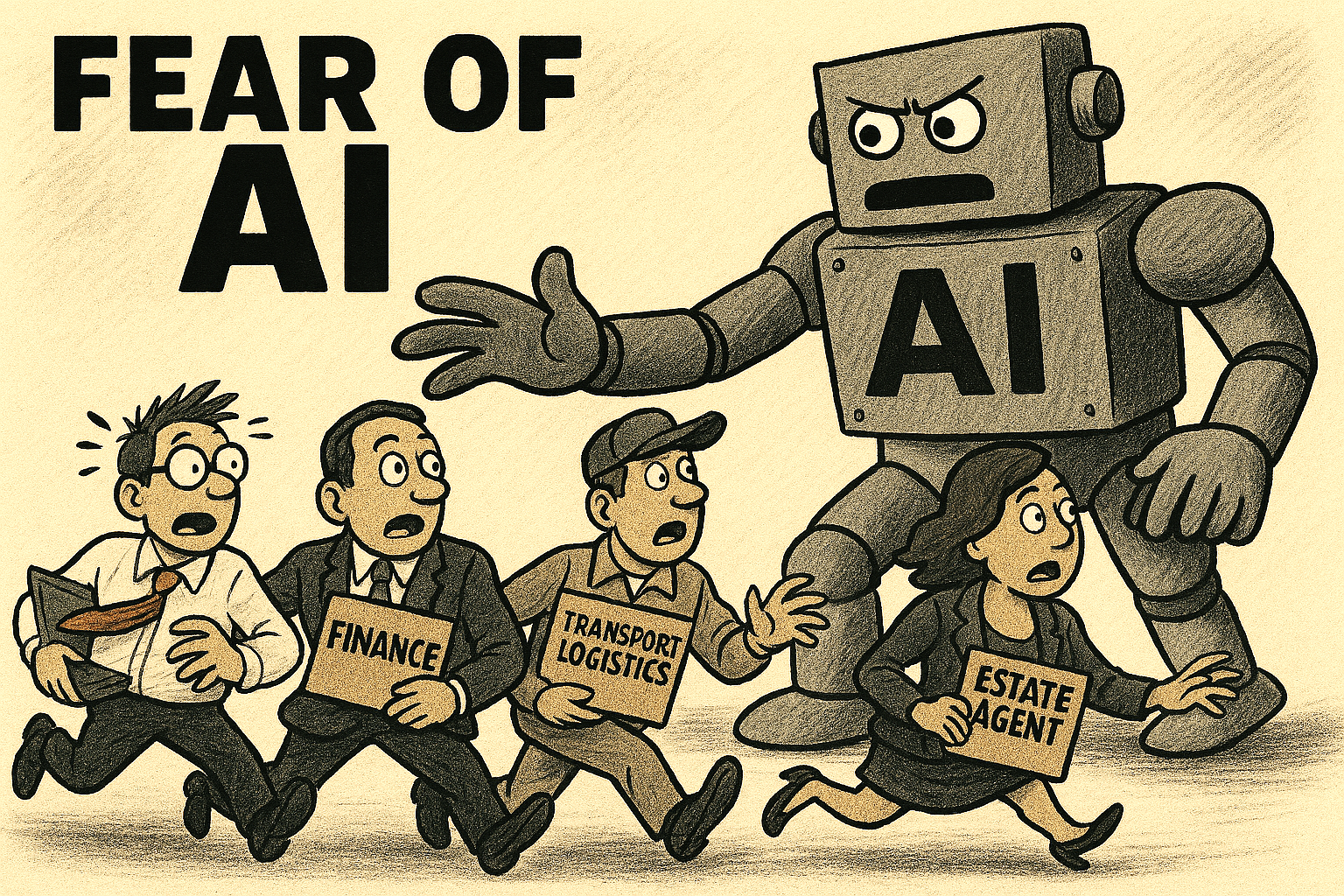
A curious shift has taken place over the past year. The fear of AI ‘taking over’ is no longer confined to software engineers, coders, or the legal and financial professions.
It has spilled into transport logistics, estate agency, recruitment, customer service, and even the once‑untouchable world of creative work.
Anxiety spreads
The anxiety is spreading horizontally across the economy rather than vertically within a single industry — and that tells us something important about where we are in the technological cycle.
At the heart of this unease is a simple realisation: AI is no longer a specialised tool. It is becoming a general‑purpose capability, much like electricity or the internet.
When a technology can be applied to almost any workflow, the boundaries between ‘safe’ and ‘at risk’ jobs dissolve.
Estate agents see AI systems that can generate listings, negotiate pricing models, and automate client follow‑ups. Logistics managers watch algorithms optimise routes, staffing, and inventory with a precision no human team can match.
Even white‑collar professionals, once insulated by complexity and regulation, now face AI systems capable of drafting contracts, analysing case law, or producing financial models in seconds.
This broadening of impact is what’s fuelling the current wave of concern. It’s not that AI is replacing everyone — it’s that it could plausibly reshape the value chain in every sector.
Axis shift
For the stock market, this shift has created a two‑speed economy. Companies building AI infrastructure — chips, cloud platforms, foundation models — are being rewarded with valuations that assume long‑term dominance.
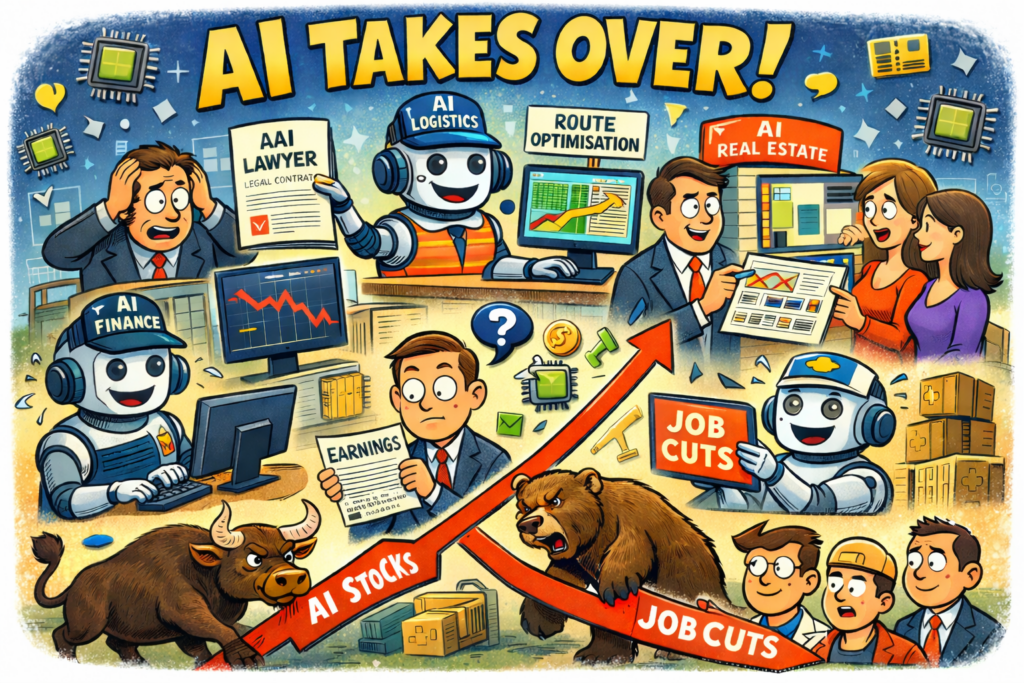
Meanwhile, firms whose business models rely on labour‑intensive processes are being quietly repriced. Investors are asking a new question: Which companies can integrate AI fast enough to defend their margins? Those that can’t risk being treated like legacy utilities.
But the story isn’t simply about winners and losers. The diffusion of AI across industries also creates a multiplier effect.
Productivity gains in logistics lower costs for retailers; smarter estate agency tools accelerate housing transactions; automated legal drafting reduces friction for start‑ups. Each improvement compounds the next.
AI taking over?
The fear, then, is partly a misunderstanding. AI isn’t ‘taking over’ — it’s infiltrating. It is dissolving inefficiencies, redrawing job descriptions, and forcing companies to rethink what they actually do.
The stock market has already priced in the first wave of this transformation. The second wave — where every sector becomes an AI‑enabled sector — is only just beginning.