

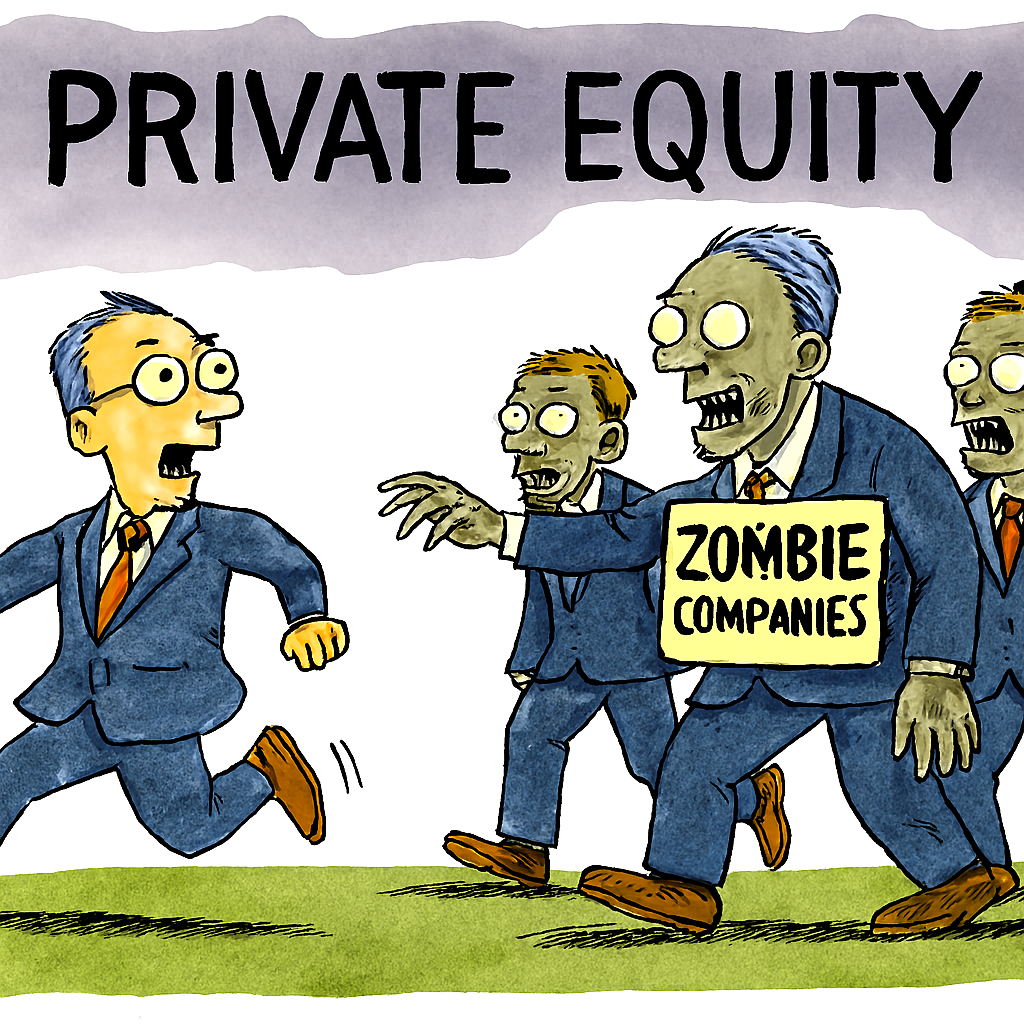
Private equity is increasingly burdened by ‘zombie companies‘ – firms that neither grow nor collapse, but linger in portfolios, draining resources and blocking exits.
In recent years, private equity has faced a troubling phenomenon: the rise of the zombie company.
These are businesses that generate just enough cash to service their debt but fail to deliver meaningful growth or attract buyers, even at discounted valuations.
They remain trapped on balance sheets long after the intended investment horizon, creating a drag on both investors and the wider economy.
The roots of this problem lie in shifting market conditions. Rising interest rates have made debt-heavy buyouts harder to sustain, while a slowdown in dealmaking has reduced opportunities for profitable exits.
Offloading?
In the past, firms could rely on buoyant markets to offload underperforming assets, but today’s cautious buyers are unwilling to take on companies with weak fundamentals.
As noted by a financial educationalist, Oliver GOTTSCHALG – ‘the machine is stuck’ – private equity firms cannot recycle capital efficiently.
For investors, the implications are stark. Capital is locked in funds that cannot distribute returns, potentially undermining confidence in the asset class.
Some firms have resorted to continuation vehicles or fee-generating strategies to keep operations afloat, but these are stopgaps rather than solutions.
The longer companies remain in this half-alive state, the more they consume scarce managerial attention and financial resources.
The persistence of zombie companies also raises broader concerns. They tie up capital that could otherwise support innovation and growth, while their stagnation risks eroding trust in private equity’s promise of dynamic value creation.
Unless market conditions improve or restructuring strategies succeed, the industry may face a decade defined not by bold exits, but by portfolios haunted by the undead.
In short, zombie companies symbolise private equity’s struggle to adapt, neither thriving nor dying but stubbornly refusing to leave
Zombie companies in private equity trap capital, reducing liquidity and investor confidence, which indirectly pressures public markets—especially high‑valuation sectors like AI.
When private equity funds are clogged with underperforming assets, institutional investors face tighter cash flows and may rebalance away from riskier equities.
This creates capital shortages and amplifies volatility in growth stocks. AI firms, already under scrutiny for sky‑high valuations, are particularly vulnerable: investors pull back when liquidity is constrained, leading to sharper corrections.
Recent sell‑offs saw AI stocks lose over $820 billion in value as confidence faltered, reflecting how private equity stagnation can ripple into tech markets.
Beware the Zombie!