

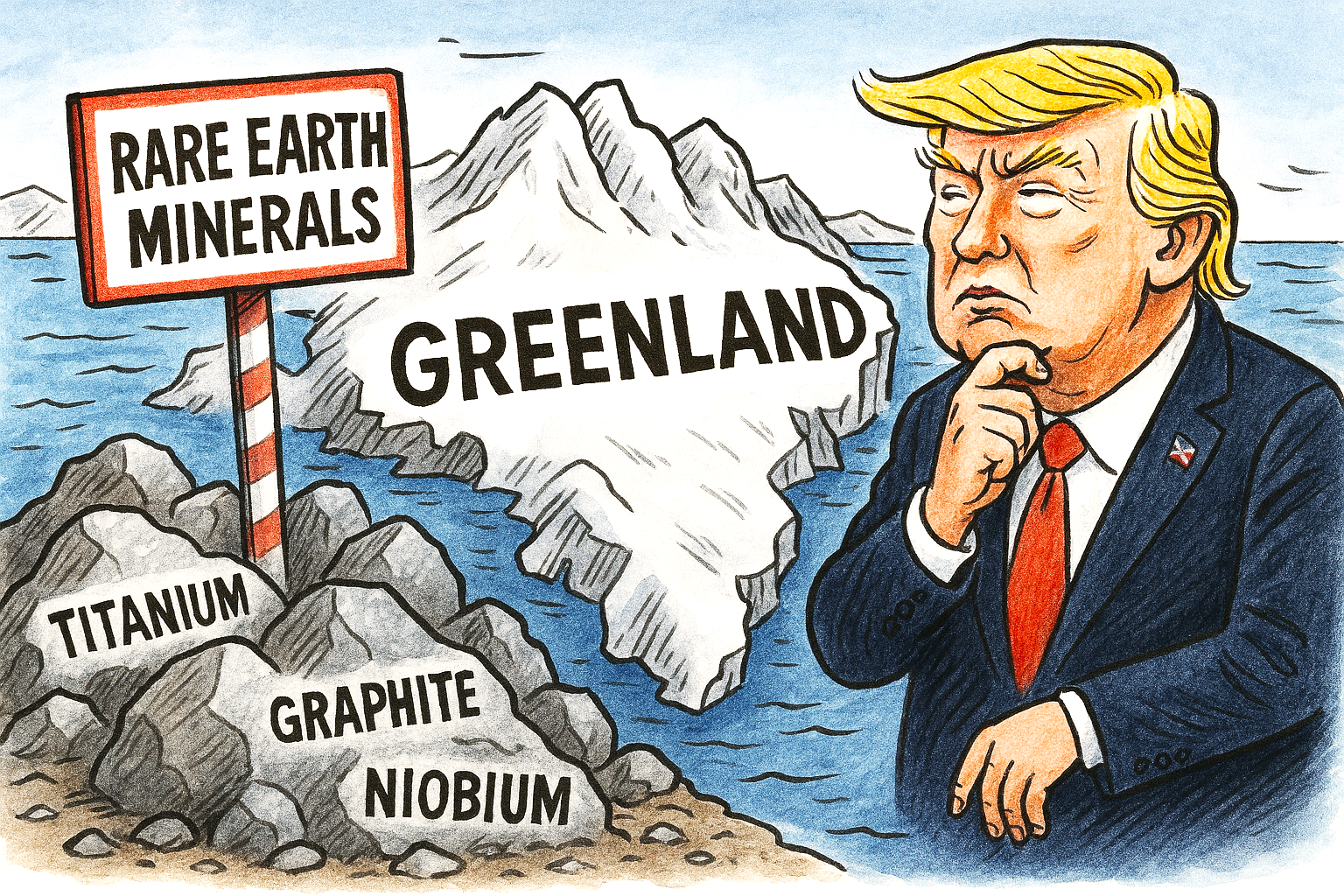
Greenland’s Subsurface Power – Why Its Minerals Matter

Rare earths in Greenland

Greenland has long been portrayed as a remote Arctic frontier, but its bedrock tells a very different story.

Beneath the ice lies a concentration of critical minerals that has drawn global attention, not least from President Trump, whose administration has repeatedly emphasised the island’s strategic and economic value.

Much of that interest stems from the sheer breadth of materials Greenland contains, according to the Geological Survey of Denmark and Greenland, 25 of the 34 minerals classified as ‘critical raw materials’ by the European Commission can be found there, including graphite, niobium and titanium.

Rare Earth Elements

The most geopolitically charged of these are rare earth elements — a group of 17 metals essential for electronics, renewable energy technologies, advanced weaponry and satellite systems.

These minerals are currently dominated by Chinese production and processing, a reality that has shaped US strategic thinking for more than a decade. Analysts note that Trump’s interest is ‘primarily about access to those resources and blocking China’s access’.
Greenland also holds significant deposits of uranium, zinc, copper and potentially vast reserves of oil and natural gas. As Arctic ice retreats, previously inaccessible rock formations are becoming easier to survey and, in some cases, to mine.

Ice melt?

Melting ice is even creating new opportunities for hydropower in exposed regions, potentially lowering the energy costs of extraction in the future.

Yet the island’s mineral wealth remains largely untapped. Reportedly, only two mines are currently operational, with harsh weather, limited infrastructure and high extraction costs slowing development.

Despite these challenges, the strategic calculus is clear: in a world increasingly defined by competition over supply chains for green technologies and defence systems, Greenland represents a rare opportunity to diversify away from existing global chokepoints.

For the Trump administration, the island’s mineral potential, combined with its location along emerging Arctic shipping routes, elevates Greenland from a frozen outpost to a cornerstone of long‑term geopolitical strategy.

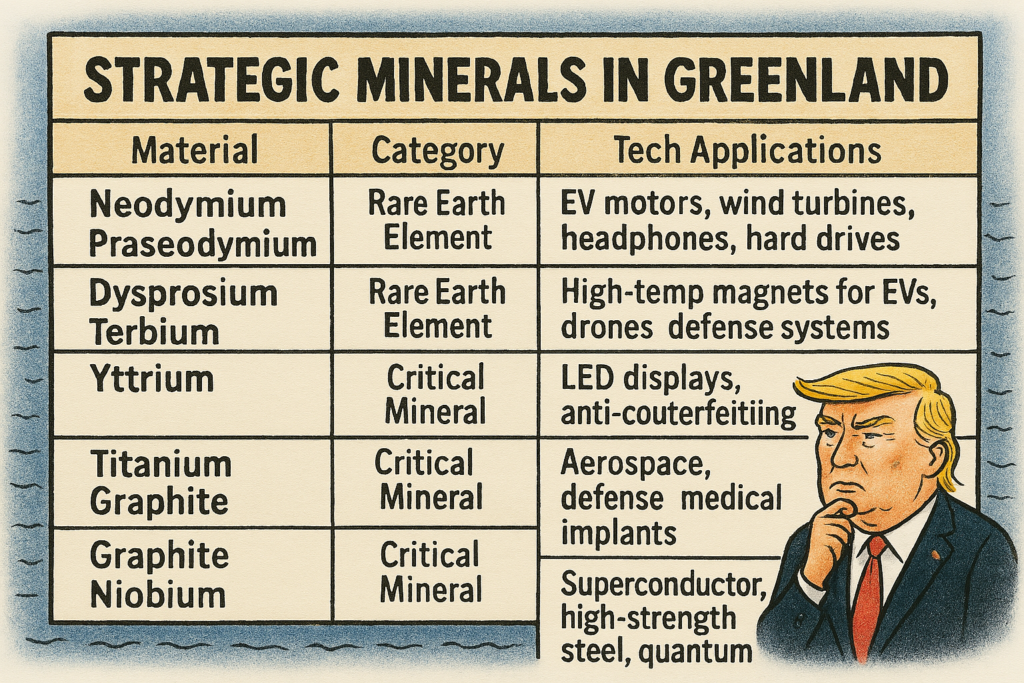
 Strategic Minerals in Greenland

MaterialCategoryTech Applications
NeodymiumRare Earth ElementEV motors, wind turbines, headphones, hard drives
PraseodymiumRare Earth ElementMagnet alloys, aircraft 
engines
DysprosiumRare Earth ElementHigh-temp magnets for EVs, 
drones, defence systems
TerbiumRare Earth ElementLED phosphors, magnet 
alloys
EuropiumRare Earth ElementLED displays, anti-counterfeiting inks
YttriumRare Earth ElementLasers, superconductors, 
ceramics
LanthanumRare Earth ElementCamera lenses, batteries
CeriumRare Earth ElementCatalytic converters, glass 
polishing
SamariumRare Earth ElementHeat-resistant magnets, missiles, precision motors
GadoliniumRare Earth ElementMRI contrast agents, 
neutron shielding
TitaniumCritical MineralAerospace, defence, medical implants
GraphiteCritical MineralBattery anodes, lubricants, 
nuclear reactors
NiobiumCritical MineralSuperconductors, high-strength steel, quantum 
technologies

These materials are not only present in Greenland’s geology but also feature prominently in strategic supply chains— especially as the West seeks to reduce reliance on Chinese and Russian sources.
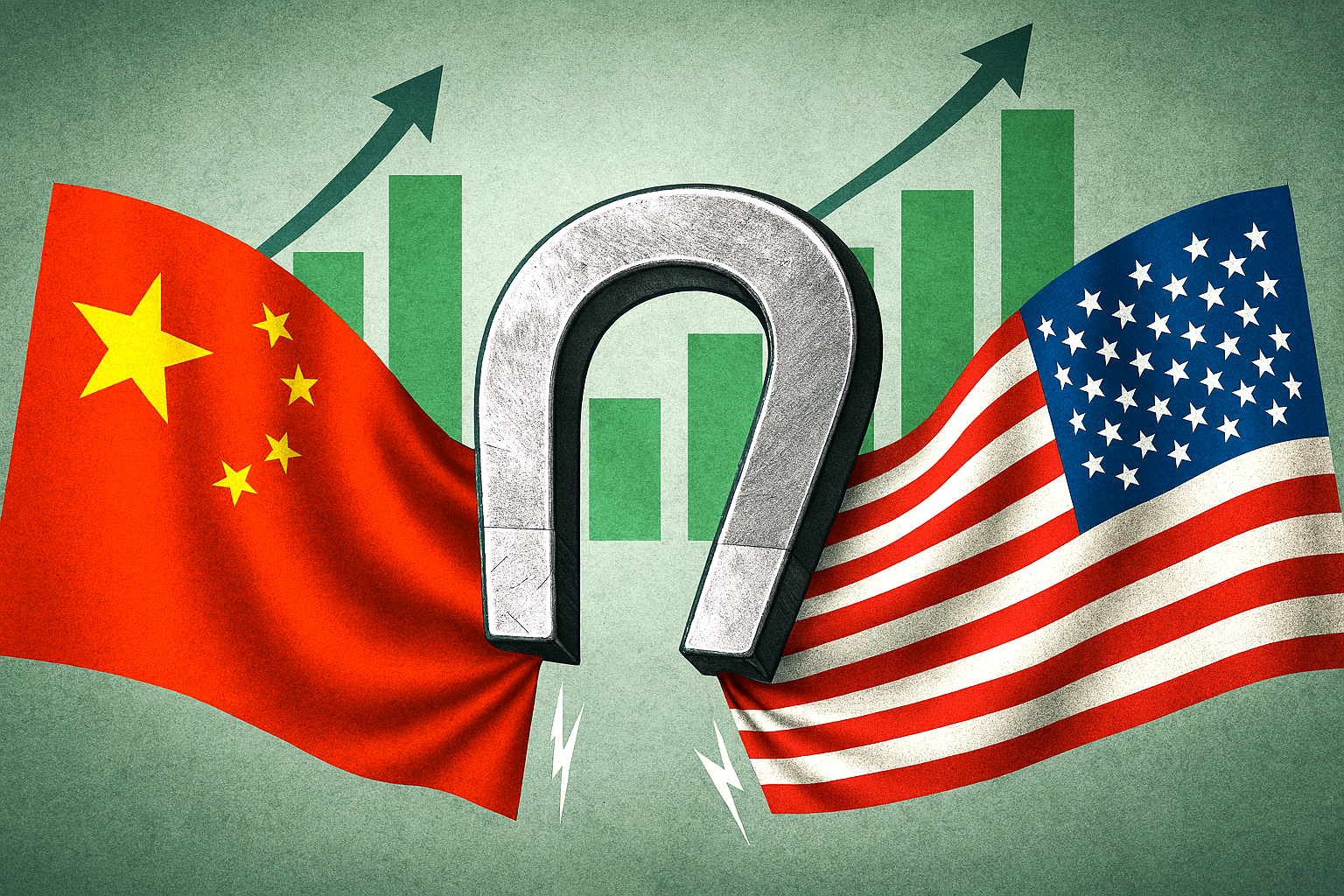
China’s rare Earth clampdown continues to send shockwaves through global markets

Rare Earth Materials

China’s latest tightening of rare earth exports has reignited global concerns over supply chain fragility and strategic resource dependence.

With Beijing now requiring special permits for the export of key rare earth elements—used in everything from electric vehicles to missile guidance systems—the move is widely seen as a geopolitical lever in an increasingly fractured global trade landscape.

Rare earths, despite their name, are not scarce—but China controls over 60% of global production and an even larger share of refining capacity. The new restrictions, framed as national security measures, have already begun to ripple through equity markets.

Shares of Western mining firms such as Albemarle and MP Materials surged on the news, as investors bet on alternative sources gaining traction. Meanwhile, defence and tech stocks in Europe dipped, reflecting fears of supply bottlenecks and rising input costs1.

This isn’t China’s first foray into rare earth brinkmanship. Similar curbs in 2010 triggered a scramble for diversification, but progress has been slow.

The current squeeze coincides with rising tensions over semiconductor access and military technology, suggesting a broader strategy of resource weaponisation.

For investors, the message is clear: rare earths are no longer just a niche commodity—they’re a geopolitical flashpoint. Expect increased volatility in sectors reliant on high-performance magnets, batteries, and advanced optics.

Countries like the US, Australia, and Canada are accelerating domestic mining initiatives, but scaling up remains a long-term play.

In the short term, China’s grip on rare earths is tightening—and markets are reacting accordingly.

As the global economy pivots toward electrification and AI-driven infrastructure, the battle over these elemental building blocks is only just beginning. The stocks may rise and fall, but the strategic stakes are climbing ever higher.

China’s sweeping export restrictions on rare earths have triggered a sharp rally in related stocks, especially among U.S.-based producers and processors.

The market is interpreting Beijing’s move as both a supply threat and a strategic opportunity for non-Chinese firms to gain ground.

📈 Some companies in the spotlight

  • USA Rare Earth surged nearly 15% in a single day and is up 94% over the past five weeks, buoyed by speculation of a potential U.S. government investment and its vertically integrated magnet production pipeline.
  • NioCorp Developments, Ramaco Resources, and Energy Fuels all posted gains of approximately between 9–12%.
  • MP Materials, the largest U.S. rare earth miner, rose over 6% following news of tighter Chinese controls. The company recently secured a strategic equity deal with the U.S. Department of Defence.
  • Albemarle, Lithium Americas, and Trilogy Metals also saw modest gains, reflecting broader investor interest in critical mineral plays.
Company / SectorStock MovementStrategic Note
MP Materials (US)↑ +6%DoD-backed, key US supplier
USA Rare Earth↑ +15%Magnet pipeline, gov’t investment buzz
NioCorp / Ramaco / Energy Fuels↑ +9–12%Domestic mining surge
European Defence Stocks↓ 2–4%Supply chain fears
Chinese Magnet Producers↔ / ↓Export permit uncertainty

China’s new rules, effective December 1st, require export licences for any product containing more than 0.1% rare earths or using Chinese refining or magnet recycling tech. This has intensified scrutiny on global supply chains and elevated the strategic value of domestic alternatives.

🧭 Investor sentiment is shifting toward companies that can offer secure, non-Chinese sources of rare earths—especially those with downstream capabilities like magnet manufacturing. The rally suggests markets are pricing in long-term geopolitical risk and potential government backing.

Weekend update

Is President Trump in control of the stock market? A comment on TruthSocial suggesting that more China tariffs might be introduced in response to China’s restrictions on rare earth materials reportedly wipes out around $2 trillion from U.S. stocks.

Then it reverses as Trump says, ‘All will be fine’. Stocks climb back up. What’s going on?

It’s just a game.

But who is the game master?