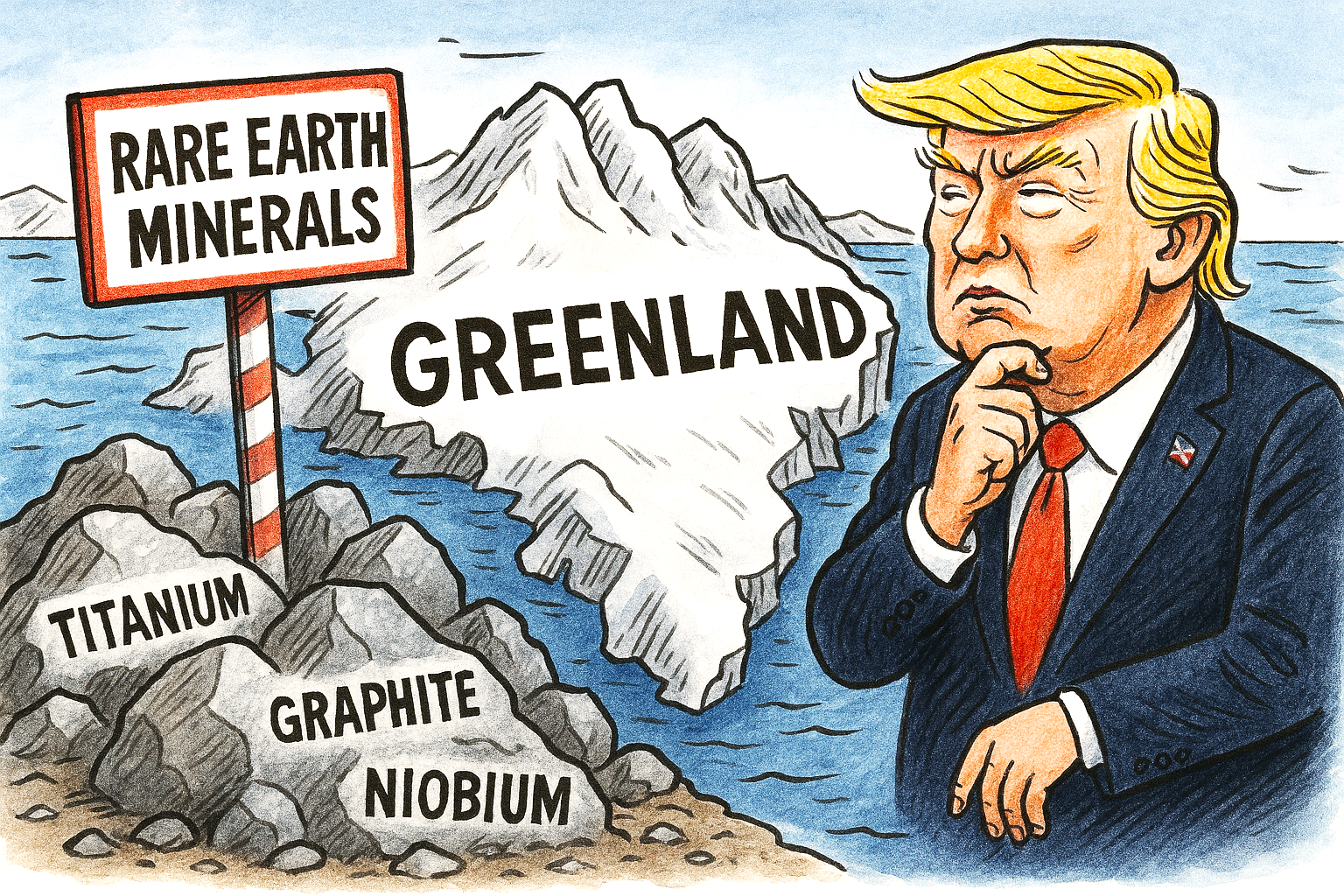
Donald Trump’s fascination with Greenland has been a topic of intrigue and speculation since his first term in office.
His renewed interest in acquiring the world’s largest island has raised eyebrows and sparked debates about the underlying motivations and implications of such a move.
Greenland, a semi-autonomous territory of Denmark, holds significant strategic and economic value. Its location in the Arctic makes it a key player in global geopolitics, especially as ‘climate change’ could potentially open up new shipping routes and access to untapped natural resources.
The island is rich in rare earth minerals, oil, and natural gas, which are becoming increasingly accessible due to the melting ice caps. These resources are crucial for advanced technologies and the clean energy economy, making Greenland a highly coveted asset.
Critical minerals
Critical minerals refer to a subset of materials considered essential to the energy transition. These minerals, which tend to have a high risk of supply chain disruption, include metals such as copper, lithium, nickel, cobalt and rare earth elements.
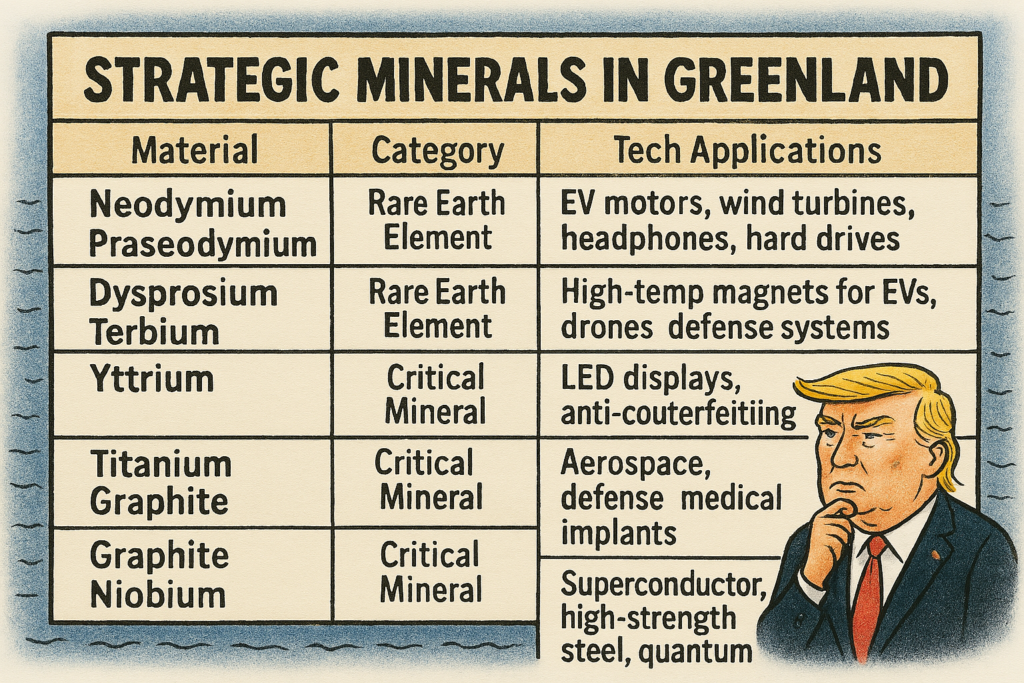
Critical minerals and rare earth elements are vital components in emerging green technologies, such as wind turbines and electric vehicles, energy storage technologies and national security applications.
China is the undisputed leader of the critical minerals supply chain, accounting for roughly 60% of the world’s production of rare earth minerals and materials. U.S. officials have previously warned that this poses a strategic challenge amid the pivot to low-carbon energy sources
Jakob Kløve Keiding, senior consultant at the Geological Survey of Denmark and Greenland (GEUS), reportedly said a 2023 survey of Greenland’s resource potential evaluated a total of some 38 raw materials on the island, the vast majority of which have a relatively high or moderate potential.
These materials include the rare earth metals graphite, niobium, platinum group metals, molybdenum, tantalum and titanium.
A lot of independent state surveys are pointing to Greenland and its natural shelf boundaries as potentially hosting 20% to 25% of the last remaining extractable resources on the planet. Now, if that’s right, that’s an enormous opportunity for Greenland.”
Not just about money, it’s also about strategic benefits and ‘national’ security
Trump’s interest in Greenland is not solely driven by its natural resources. The island’s strategic military importance cannot be overlooked. Greenland hosts the U.S.’ northernmost military base, the Pituffik Space Base, which plays a critical role in ballistic missile early warning systems and space operations.
Control over Greenland would enhance the U.S.’ ability to monitor and respond to potential threats from adversaries, solidifying its position in the Arctic region.
And… it’s personal too
Beyond the strategic and economic factors, there are also personal and political motivations behind Trump’s fixation with Greenland.
Some experts suggest that Trump’s desire to acquire Greenland is fueled by his ambition to leave a lasting legacy and be remembered as a transformative leader. The idea of adding a vast, resource-rich territory to the United States’ portfolio aligns with his ‘America First’ agenda and his penchant for grandiose projects.
However, Trump’s pursuit of Greenland has not been without controversy. The Danish government and Greenland’s leadership have firmly rejected the idea of selling the island.
Greenland’s Prime Minister Múte Egede has emphasised the island’s desire for independence and self-determination, stating that Greenland is not for sale and that its future should be decided by its people. This stance reflects the broader sentiment among Greenlanders, who are wary of foreign exploitation and committed to preserving their unique cultural and environmental heritage.
Donald Trump’s fixation with Greenland is a complex interplay of strategic, economic, and personal factors.
While the island’s vast natural resources and strategic military importance make it an attractive target, the political and ethical implications of such a move cannot be ignored. As the debate continues, it remains to be seen whether Trump’s ambitions will materialize or if Greenland will maintain its autonomy and chart its own path in the Arctic region.
Rare earth minerals
Greenland is home to a variety of rare earth minerals, which are crucial for many modern technologies. Some of the key rare earth minerals found in Greenland include:
- Yttrium
- Scandium
- Neodymium
- Dysprosium
- Terbium
- Europium
- Gadolinium
- Holmium
- Erbium
- Thulium
- Ytterbium
- Lutetium
- Copper
- Gold
- Zinc
- Titanium
- Lead
- Silver
- Platinum
- Palladium
- Rhodium
- Nickel
- Cobalt
- Lithium
Some of these minerals are essential for the production of permanent magnets used in electric vehicles (EVs) and wind turbines. Others are more obvious.
Greenland’s rich mineral resources make it a significant player in the global supply of rare earth elements.
Greenland ‘mini’ history lesson
Greenland history of ownership is a captivating narrative of exploration colonization, and strategic significance. The island, the largest has been inhabited for millennia, with the known settlers arriving around 2500 BC. These early inhabitants were succeeded by several other groups migrating from continental North America.
The first formal claim Greenland can be traced to the late10th century when Erik the Red, a Norse, settled on the island after being banished from Iceland. He named it ‘Greenland’ to attract settlers, and small Norse communities established themselves along the coast. These settlements endured for centuries, despite the Arctic conditions and the encroaching cold of the Little Ice Age.
In the 18th century, Denmark-Norway began to reassert its influence over. In 1721, a missionary expedition led by Hans Egede marked the beginning of Denmark colonisation efforts. Greenland was formally incorporated into the Danish Kingdom in 1953, transitioning a colony to overseas county.
During World, Greenland became more closely connected to the U.S. due to Denmark’s occupation by Nazi Germany. After the war, Denmark reasserted its control, and in 1979 Greenland was granted home rule, allowing it to govern its affairs. Denmark retained control over defence and foreign policy.
Today, an autonomous territory within the Kingdom of Denmark, with increasing self-governance. It manages its domestic matters, including education health, natural resources, while Denmark oversees defense and foreign affairs.
Greenland’s strategic importance has it as a subject of interest for various global powers throughout history, and its unique position continues to shape its political and economic landscape.
Though a part of the continent of North America, Greenland has been politically and culturally associated with Europe (specifically Denmark and Norway)
See Wikipedia for more information.