

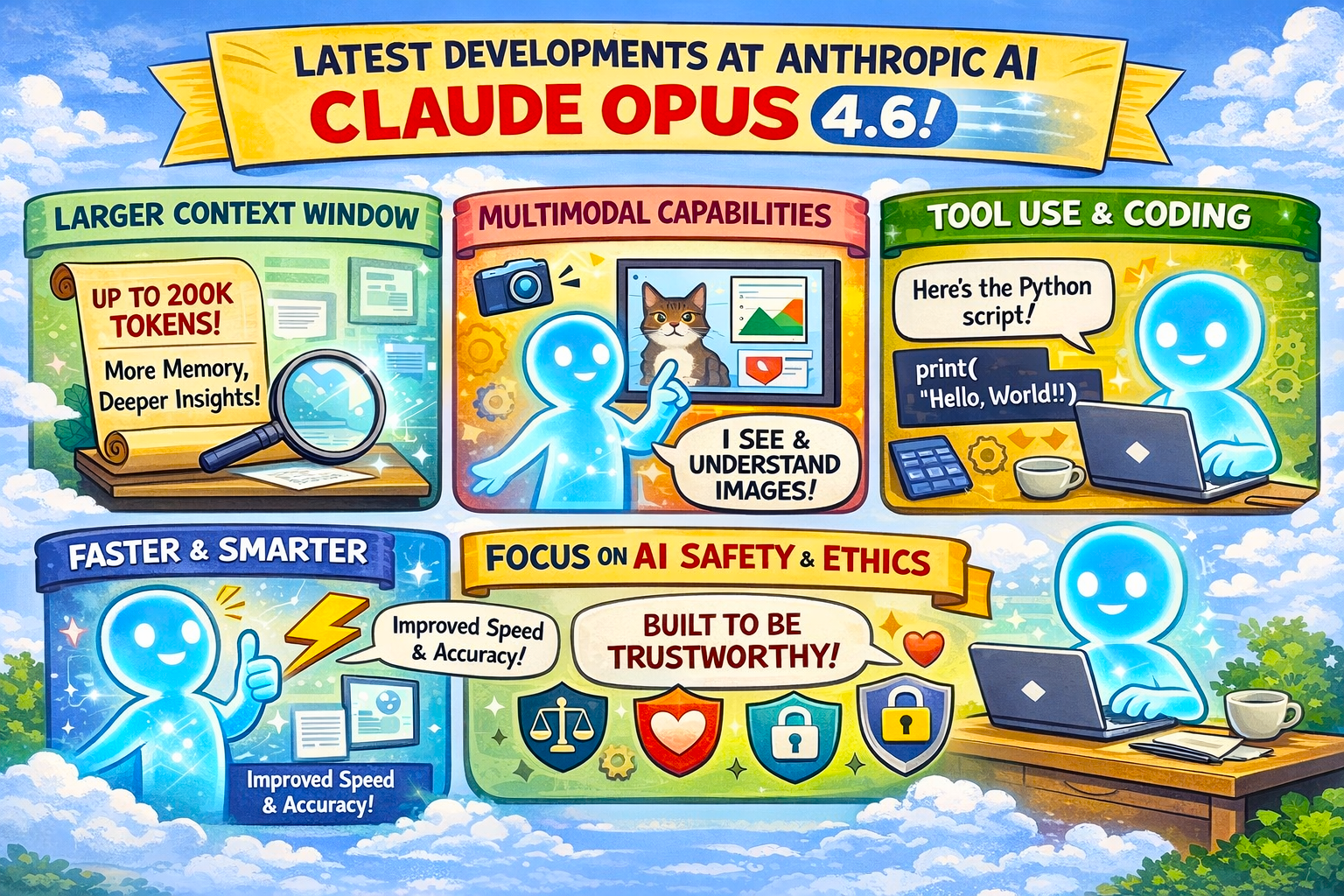
Anthropic Pushes the Frontier Again with Claude Opus 4.6

Claude Opus 4.5

Anthropic has unveiled Claude Opus 4.6, its most capable AI model to date, marking a significant leap in long‑context reasoning, autonomous agent workflows, and enterprise‑grade coding performance.

The release arrives during a turbulent moment for the global software sector, with markets reacting sharply to fears that Anthropic’s accelerating capabilities could reshape entire categories of knowledge work.

At the heart of Opus 4.6 is a 1‑million‑token context window, a first for Anthropic’s Opus line and a direct response to long‑standing limitations around ‘context rot’ in extended tasks.

Benchmarks

Early benchmarks show a dramatic improvement in maintaining accuracy across vast documents and complex, multi‑step workflows.

This expanded capacity enables the model to analyse large codebases, regulatory filings, or research archives in a single pass—an ability already drawing interest from enterprise users.

Perhaps the most striking development is Anthropic’s progress in agentic systems. Claude Code and the company’s Cowork framework now support coordinated ‘agent teams’, allowing multiple Claude instances to collaborate on sophisticated engineering challenges.

In one internal experiment, a team of 16 Claude agents built a complete Rust‑based C compiler capable of compiling the Linux kernel—producing nearly 100,000 lines of code with minimal human intervention.

Agentic shift

This agentic shift is reshaping expectations around AI‑driven software development. Anthropic positions Opus 4.6 not merely as a tool but as a foundation for autonomous, multi‑agent workflows that can plan, execute, and refine complex tasks over extended periods.

The company highlights improvements in reliability, coding precision, and long‑running task stability as core differentiators.
With enterprise adoption already representing the majority of Anthropic’s business, Opus 4.6 signals a decisive step toward AI systems that operate as high‑level collaborators rather than assistants.

As markets digest the implications, one thing is clear: Anthropic is accelerating the transition from ‘AI that helps’ to AI that works alongside you—and sometimes, entirely on its own.

Legal profession

Anthropic is pushing aggressively into the legal domain, positioning Claude as a high‑precision research and drafting partner for firms handling complex regulatory workloads.

The latest models emphasise long‑context accuracy, allowing lawyers to ingest entire case bundles, contracts, or disclosure sets without losing coherence.

Anthropic has also expanded constitutional AI safeguards, aiming to reduce hallucinations in high‑stakes legal reasoning.

Early adopters report gains in due‑diligence speed, contract comparison, and regulatory interpretation, particularly in financial services and data‑protection work.

While not a substitute for legal judgement, Claude is rapidly becoming a force multiplier for teams managing heavy document‑driven tasks.

A hidden UK GEM?

A UK GEM

RELX plc stands today as one of the UK’s most quietly formidable global enterprises, a testament to strategic reinvention and technological foresight.

Originally formed in 1993 from the merger of Reed International and Dutch giant Elsevier NV, RELX evolved from a conventional publishing conglomerate into a data-driven, analytics-centric powerhouse.

Reed owned IPC Magazines and published UK comics from 1950’s through to the 1980’s.

The company’s history lies in print—academic journals, legal texts, and trade publications—but its future is unequivocally digital.

Today, RELX operates across four primary segments: Risk, Legal, Scientific & Medical, and Exhibitions. Through subsidiaries such as LexisNexis and Elsevier, it delivers critical decision-support tools to professionals in law, healthcare, insurance, and research.

Notably, more than 80% of its revenue is now derived from digital and data-based services, reflecting both market demand and RELX’s methodical transition away from legacy publishing models.

Its financials underscore this shift. In 2024, RELX reported revenues of *£9.43 billion and net income of *£1.93 billion, with strong margins driven by scalable analytics platforms.

The company currently ranks as the seventh-largest member of the FTSE 100 and reportedly boasts operations in over *180 countries.

RELX YTD chart (GBP)

RELX YTD chart (GBP)

AI impact

The incorporation of artificial intelligence (AI) has been pivotal. From intelligent legal drafting in Lexis+ AI to conversational medical search via Elsevier’s ClinicalKey AI, RELX deploys AI not just as a productivity tool but as a cornerstone of value creation.

Its proprietary data reserves — legal databases, scientific journals, and risk profiles — offer an unmatched training ground for high-integrity, professional-grade AI models.

However, success in AI comes with responsibility. RELX maintains rigorous governance frameworks to ensure responsible usage, mitigate bias, and comply with evolving privacy laws.

The company faces ongoing scrutiny in high-stakes domains like law and healthcare, but its approach to retrieval-augmented generation and citation-based validation reflects a commitment to safety and transparency.

Looking ahead, RELX is well-positioned to lead the next wave of enterprise AI adoption. As regulatory frameworks tighten and clients demand greater interpretability, RELX’s blend of curated data, ethical oversight, and domain-specific AI could prove a defining advantage.

With planned buybacks of *£1.5 billion and continuing acquisitions in analytics, the company appears both financially robust and strategically attuned to future demands.

SegmentAI ImpactNotes
Legal (LexisNexis)✅ TransformativeLexis+ AI enables intelligent drafting, summarisation, and conversational legal search—boosting lawyer productivity and accuracy.
Risk & Analytics✅ Enhanced PrecisionAI tools help insurers and banks detect fraud, assess risk, and comply with regulations more efficiently.
Scientific & Medical (Elsevier)✅ Smarter ResearchScopus AI and ClinicalKey AI offer summarised insights and conversational search for researchers and clinicians.
Exhibitions (RX)⚖️ Mixed but improvingAI helps with attendee targeting and logistics, but this segment is less data-driven and more event-dependent. Still, it’s recovering post-pandemic.

Summary

🧠 What RELX Does

RELX provides information-based analytics and decision tools across four major segments:

  • Risk: LexisNexis Risk Solutions helps insurers, banks, and governments assess fraud, identity, and compliance risks.
  • Scientific, Technical & Medical (STM): Elsevier delivers research platforms like ScienceDirect and Scopus, serving academics and healthcare professionals.
  • Legal: LexisNexis Legal & Professional offers legal research, analytics, and workflow tools.
  • Exhibitions: RX Global runs major trade shows like New York Comic Con and the London Book Fair.

📈 Financial Highlights

  • 2024 Revenue: £9.43 billion, up 3% year-on-year*
  • Net Income: £1.93 billion*
  • EBITDA Margin: ~39.5%—a sign of strong operational efficiency*
  • Digital Dominance: Over 80% of revenue now comes from electronic and data-driven product*

🧬 AI & Innovation

RELX has leaned heavily into AI-powered analytics, especially in legal and risk segments. JPMorgan recently upgraded its legal growth forecast to 10% annually, citing the transformative potential of Agentic AI and tools like Protégé.

🏛️ Market Position

  • FTSE 100 Rank: 7th largest company by market cap
  • Global Reach: Serves clients in 180+ countries*
  • Stock Performance: Up ~120% over five years*

🧩 Strategic Moves

  • Buybacks: £1.5 billion planned for 2025, with £150 million already completed*
  • Recent Acquisitions: Two in H1 2025 totaling £61 million, focused on expanding analytics capabilities*.

In summary, RELX exemplifies the art of reinvention—rooted in publishing heritage, powered by digital innovation, and poised to shape the ethical evolution of AI across critical professional fields.

*Unverified