Tesla’s $1 Trillion Bet on Elon Musk

$1 trillion Elon pay deal

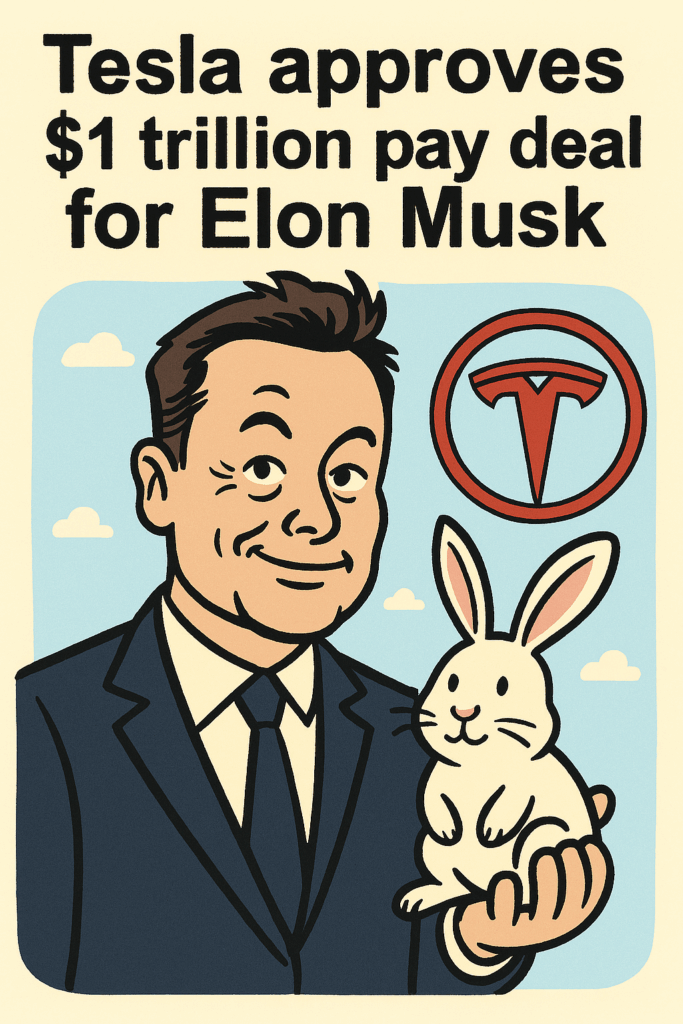
In a move that has stunned financial analysts, corporate governance experts, and the broader public alike, Tesla Inc. has approved a record-breaking $1 trillion (£761 billion) compensation package for its CEO, Elon Musk.

In a landmark decision, Tesla shareholders have approved a staggering $1 trillion (£761 billion) compensation package for CEO Elon Musk, marking the largest executive pay deal in corporate history.

The vote, held at Tesla’s annual meeting in Austin, Texas, reportedly saw over 75% of investors back the plan, reaffirming their confidence in Musk’s leadership and long-term vision.

Share deal

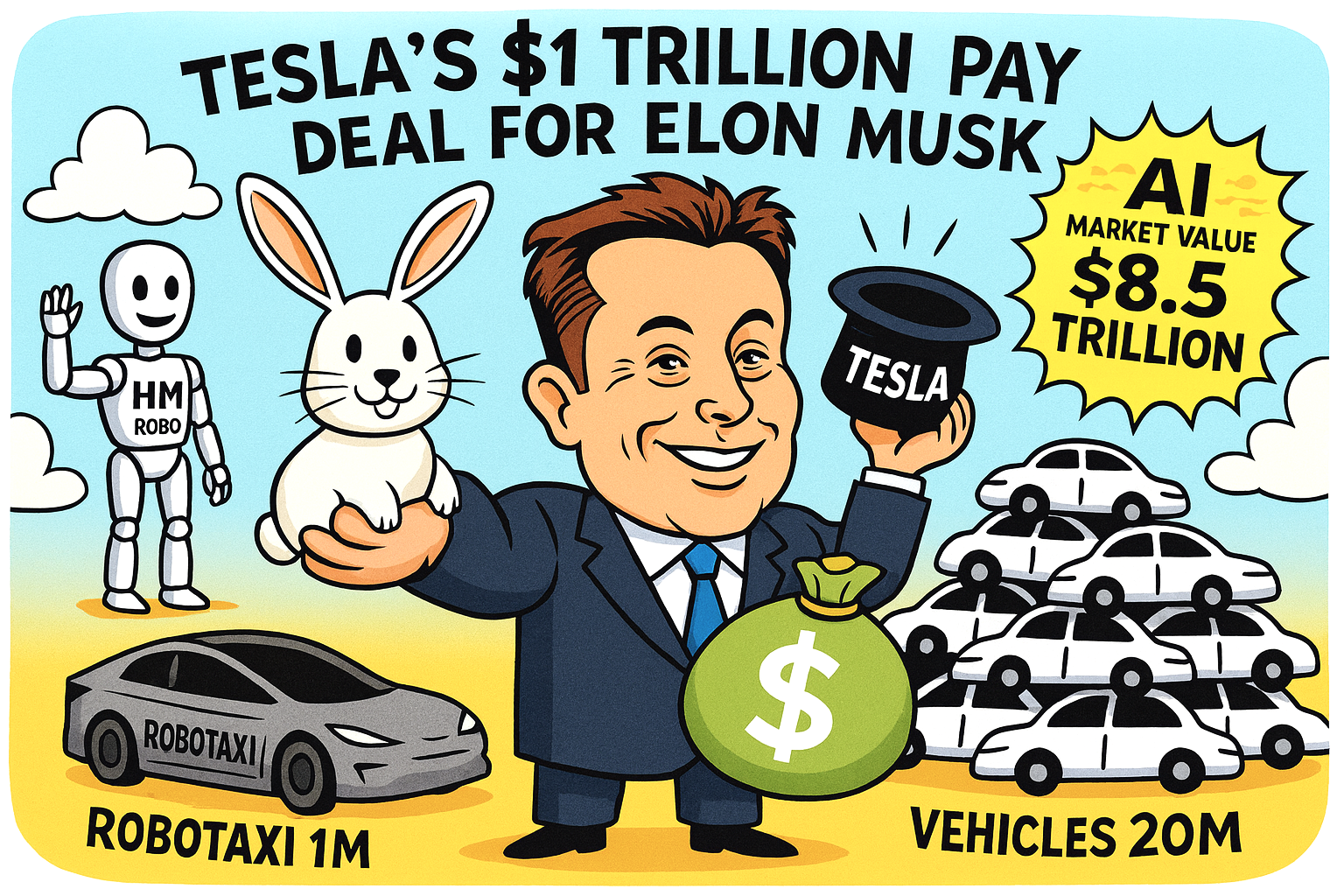
The deal is entirely performance-based, with Musk eligible to receive up to 423 million Tesla shares if the company meets a series of ambitious milestones.

These include producing 20 million vehicles annually, deploying one million robotaxis and humanoid robots, and reaching a market valuation of $8.5 trillion.

Reportedly there is no salary or cash bonus—Musk’s payout depends solely on Tesla’s success.

Supporters argue the package aligns Musk’s incentives with shareholder interests, encouraging innovation and growth.

Critics, however, warn of governance risks and the unprecedented concentration of wealth and power.

Musk, already the world’s richest person, could become the first trillionaire if Tesla achieves its targets.

The vote signals Tesla’s intent to evolve beyond electric vehicles into a broader tech powerhouse, betting on AI, robotics, and autonomy—with Musk at the helm.

AI creates paradigm shift in computing – programming AI is like training a person

Teaching or programing?

At London Tech Week, Nvidia CEO Jensen Huang made a striking statement: “The way you program an AI is like the way you program a person.” (Do we really program people or do we teach)?

This marks a fundamental shift in how we interact with artificial intelligence, moving away from traditional coding languages and towards natural human communication.

Historically, programming required specialised knowledge of languages like C++ or Python. Developers had to meticulously craft instructions for computers to follow.

Huang argues that AI has now evolved to understand and respond to human language, making programming more intuitive and accessible.

This transformation is largely driven by advancements in conversational AI models, such as ChatGPT, Gemini, and Copilot.

These systems allow users to issue commands in plain English – whether asking an AI to generate images, write a poem, or even create software code. Instead of writing complex algorithms, users can simply ask nicely, much like instructing a colleague or student.

Huang’s analogy extends beyond convenience. Just as people learn through feedback and iteration, AI models refine their responses based on user input.

If an AI-generated poem isn’t quite right, users can prompt it to improve, and it will think and adjust accordingly.

This iterative process mirrors human learning, where guidance and refinement lead to better outcomes.

The implications of this shift are profound. AI is no longer just a tool for experts – it is a great equalizer, enabling anyone to harness computing power without technical expertise.

As businesses integrate AI into their workflows, employees will need to adapt, treating AI as a collaborative partner rather than a mere machine.

This evolution in AI programming is not just about efficiency; it represents a new era where technology aligns more closely with human thought and interaction.

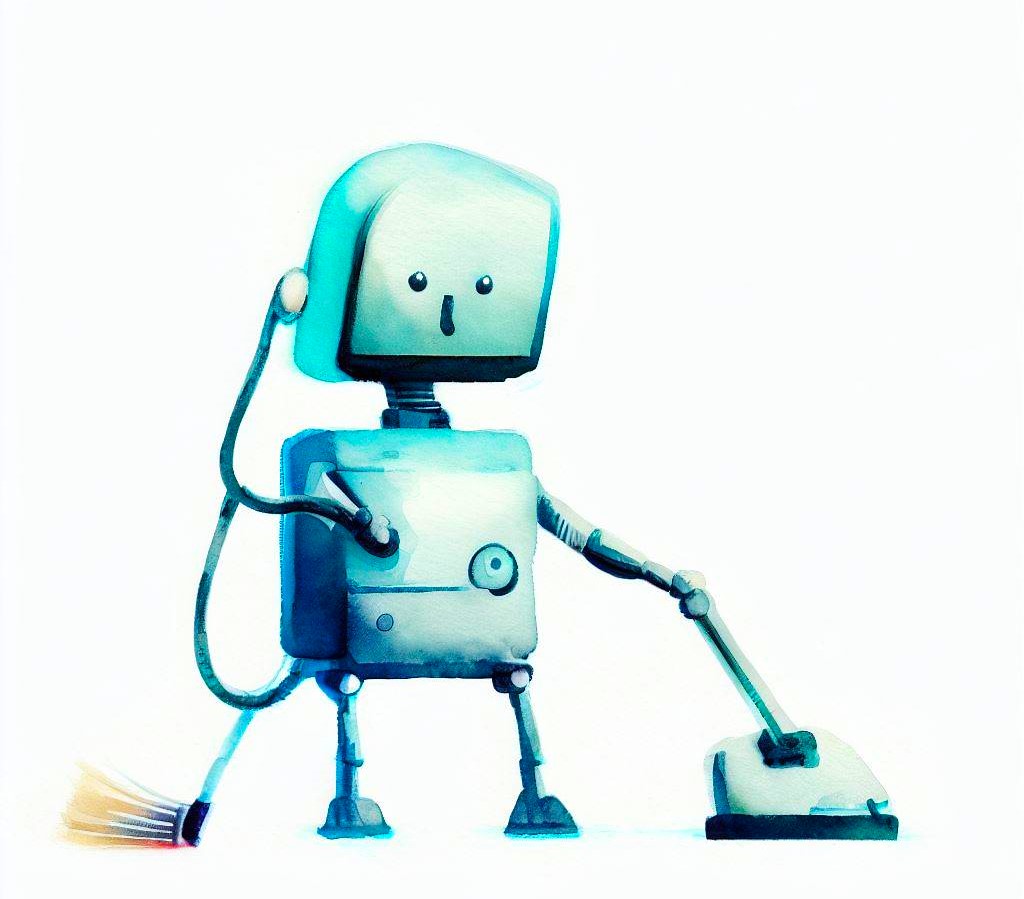
Robots are coming to a home near you..?

Robot AI

Think of the biggest market for a physical product you can possibly imagine – are you thinking mobile phones, cars or game devices even? Think again…?

They are all big commercial markets but in the coming decades a new product is coming and it will be so desirable that it will dwarf these giants – it will be… the ‘robot’.

Robots will be able to understand what we want, comprehend the way the world works and looks and have the skills to execute our commands in a safe and controlled manner – at home and in the workplace.

Biggest market

The labour market is the biggest market that has ever existed in the history of business – it’s the market where we want things ‘done’ – where we do things – and it’s forever evolving. It carries massive stock market and investing potential right now and for the future.

Robot AI tech
Robot AI tech – a market place to explore

Take Nvidia, Microsoft, Google, Meta, Apple and Tesla as prime examples of companies pioneering technological advancements for instance – we can already enjoy and invest in these – and there’s much more to come.

Dozens of firms around the world are working on the technology

In the UK, Dyson is investing in AI and robotics aimed at household chores.

One of the highest profile companies in the market is Tesla, Elon Musk’s electric car company. It is working on the Optimus humanoid robot, which Mr Musk intimates could be on sale to the public in a few years’ time.

Massive tecnological advancement in artificial intelligence (AI) and robotics suggest the development of humanoid robots is accelerating… and fast. It’s a race to the become the first to succeed in the biggest practical labour market ever… and it carries huge potential for everyone, including you and me.

20 years from now…? Where were Tesla and Apple 20 years ago?

Twenty years at the pace the technology is developing now is is an eternity – every week, month and year there are new developments in the AI world that have introduced fundamental changes and enhancements to our world.

Mainstream interest in AI exploded late 2022 when a powerful version of ChatGPT was made public. Its ability to generate almost unlimited useful text and images has spawned rivals and a wave of investment in AI technology.

But developing the AI that would allow a robot to complete useful tasks is a different and much more difficult task. Tesla could be the company best placed to be one of the first to achieve this goal – given its advancements in ‘self driving’ technology. But, unlike ChatGPT and its rivals, humanoid robots have to navigate the physical world and need to understand how objects in that world relate to each other.

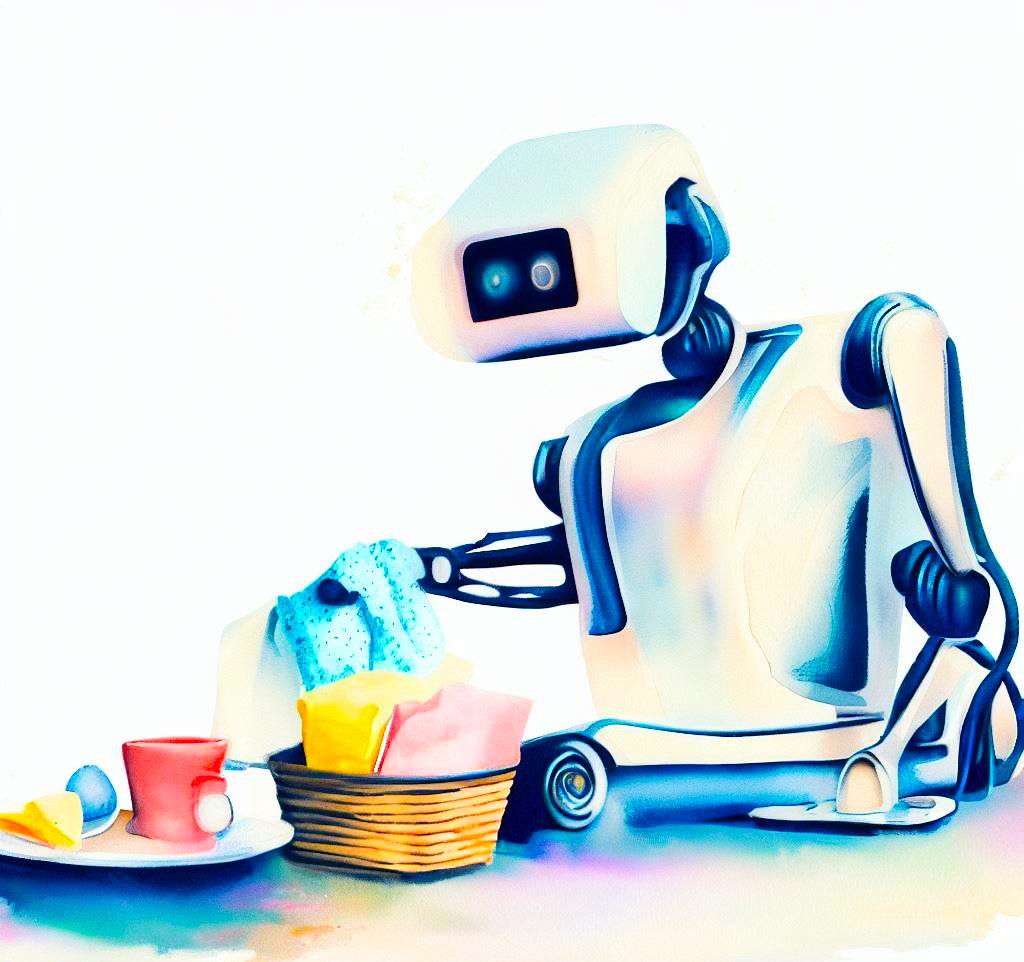
Tasks that seem easy to humans are major feats for humanoid robots. This is a problem that engages a lot of different complex issues in an AI driven robotics system. Picking up a cup and having a drink is a major undergoing for a robot.

The market place potential is unlimited

The potential market for robots in the future depends on various factors, such as the level of technological innovation, the demand from different industries and sectors, the regulatory and ethical frameworks, and the social and economic impacts of robot adoption. But if recent developments are anything to go by – it promises to be big!

Robot
Robot AI – a massive potential future market place

Based on the some indicative web search results, the current market size for robots is estimated to be around $55 billion to $114 billion in 2023, depending on the type and scope of robots included. The projected market size for robots in 2028 or 2029 ranges from $165 billion to $260 billion, with a compound annual growth rate (CAGR) of 11.4% to 17.6%.

The professional services robots, which include medical, agricultural, and personal assistance robots, are expected to dominate the market and account for more than half of the total sales by 2030. The industrial and logistics robots, which include conventional, collaborative, and mobile robots, are also expected to grow steadily and increase their productivity and efficiency in various manufacturing and transportation applications.

However, these projections are based on assumptions – but one thing is for sure the robots are coming and the market will be massive!

I for one will be keeping a watchful eye on where to invest my hard earned cash to take advantage of this potentially high growth market in the coming years (and now).

Nvidia stock anyone?