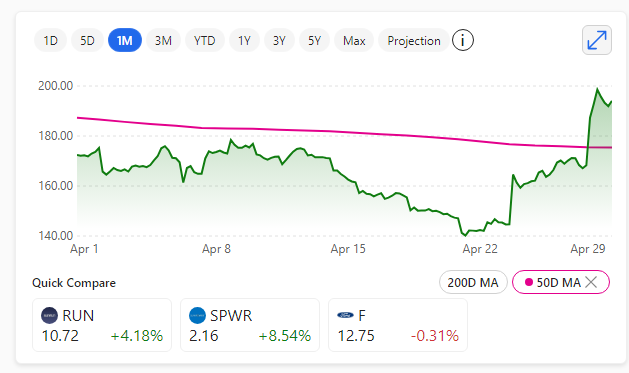
Tesla’s shares surged on Monday 29th April 2024, marking their best performance since March 2021, following the company’s achievement in advancing its driver-assistance technology in China.
The stock closed 15% higher, buoyed by investor enthusiasm over Tesla CEO Elon Musk’s visit to China.
On Sunday 28th April 2024, Tesla announced that Chinese authorities had lifted restrictions on its vehicles after they met the nation’s data security standards.
This development has heightened anticipation for the imminent availability of Tesla’s Full Self-Driving (FSD) software in China, the world’s biggest market for electric vehicles.
Tesla share price closed at 194.05 after enjoying a 15% climb
Tesla share price closed at 194.05 after enjoying a 15% climb
Chinese automotive giant BYD has experienced a decline in profits amid a slowdown in electric vehicle (EV) demand and a price war in the largest car market globally.
The company reported earnings of $630 million (£502 million) for the first quarter, a drop of over 47% from the previous quarter.
Competing with Elon Musk’sTesla for the title of the world’s top EV seller, BYD recently fell behind as Tesla regained the lead earlier this month.
In the first quarter, BYD’s sales of battery-only vehicles fell to just over 300,000, a decrease from the last quarter of 2023’s record high of 526,000 units.
The CEO of Tesla, Elon Musk recently made an announcement regarding the company’s robotaxi.
According to his social media post on X, Tesla will unveil its robotaxi product on 8th August 2024. This project has been a topic of discussion for several years and could potentially represent a significant new business venture for Tesla.
The robotaxi initiative aims to allow Tesla vehicles to use self-driving technology for autonomous ride-hailing services, picking up passengers without human intervention.
Previous predictions
Elon Musk has made bold predictions regarding the timeline for robotaxis. In 2019, he anticipated having over a million robotaxis in operation by 2020. Currently, Tesla’s advanced driver-assistance systems, such as Autopilot and the premium Full Self-Driving option, still necessitate human oversight.
Nonetheless, amidst the competitive landscape of autonomous vehicles, Tesla remains steadfast in its pursuit of a fully autonomous future.
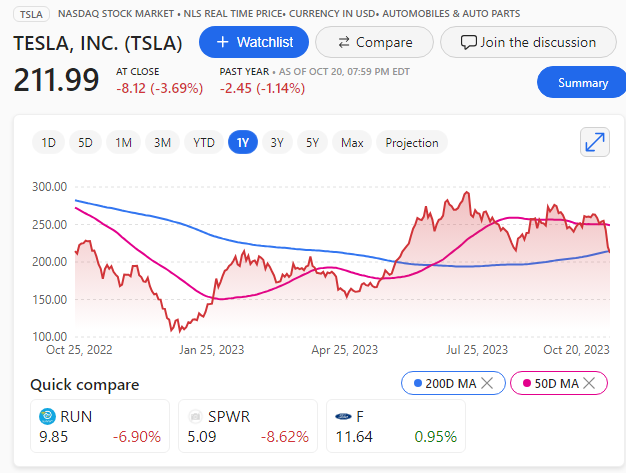
Tesla One year Chart
Tesla one year chart
Mass production?
Musk stated that a robotaxi model lacking a steering wheel or pedals is expected to enter mass production by 2024. The aim is to make the cost of a journey in the Tesla robotaxi lower than that of a public bus or underground train ticket.
Elon Musk’s neurotech startup Neuralink implanted its device in a human for the first time on Sunday 28th January 2024, and the patient is ‘recovering well,‘ the entrepreneur said in a post on X, on Monday 29th January 2024.
The company is developing a brain implant that aims to help patients with severe paralysis control external technologies using only neural signals.
Neuralink began recruiting patients for its first in-human clinical trial in the autumn after it received approval from the U.S. Food and Drug Administration to conduct the study back in May 2023, according to a blog post.
Musk, in an X post on Monday 29th January 2024 said that Neuralink’s first product is called Telepathy.
If the technology functions well, patients with severe degenerative diseases such as motor neurone disease could someday use the implant to communicate or access social media by moving cursors and typing with their minds.
Leaders at some of the world’s leading artificial intelligence (AI) companies are expecting a form of AI on a par with, or even exceeding human intelligence to arrive sometime in the near future. But what it will eventually look like and how it will be applied are unknown.
Artificial General Intelligence or AGI is coming soon
Leaders from OpenAI, Microsoft and Google’s DeepMind, and many other major tech companies debated the risks and opportunities presented by AI at the World Economic Forum in Davos, Switzerland in January 2024.
AI has become the talk of ‘town’ around the world through 2023, mainly due to the success of ChatGPT, OpenAI’s popular generative AI chatbot, brought to us by Microsoft. Generative AI tools, like ChatGPT, are powered large language models, algorithms trained on vast quantities of data, but are not AGI.
Executives at some of the world’s leading artificial intelligence companies see ‘artificial general intelligence,’ or AGI, a hypothesized form of AI with intelligence on a par or better than humans. This prospect is both exciting and worrying.
Concern
AI and AGI have created concern among governments, corporations and public consultation groups worldwide, owing to the risks around the lack of transparency of AI systems; social manipulation through computer algorithms; job losses due to increased automation; surveillance; and data privacy and worse… the lack of human control!
Extinction event possible
Many industry leaders in technology have warned that AI could lead to an ‘extinction-level’ event where machines become so powerful they get out of control and wipe out humanity.
A new powerful AI is coming but the techies have no clue as to what it will look like
Several prominent technology leaders, including Elon Musk and Steve Wozniak for example, have called for a pause in AI development, stating that a moratorium would be beneficial in allowing society to catch up.
Turing test
AI chatbots like ChatGPT have passed the Turing test, a test called the ‘imitation game,’ which was developed by British computer scientist Alan Turing to determine whether someone is communicating with a machine and a human. The one big area where AI is lacking is common sense.
It has been reported on many occasions, that the tech world is taking steps to ensure that the AI race doesn’t lead to a ‘Hiroshima moment.‘
According to the Bloomberg Billionaires Index, Elon Musk is the wealthiest person in the world, with an estimated net worth of $243.46 billion USD as of 8th Jan 2024.
Musk is the founder and CEO of Tesla and SpaceX, X and X.ai as well as the co-founder of PayPal and Neuralink. He made his fortune from various business ventures, starting from a web software company called Zip 2 that he sold in 1999 for around $307 million. He also inherited some wealth from his father, who owned an emerald mine in South Africa.
Think about this for a moment
It’s a little difficult to imagine such wealth so, maybe think of it like this… If you had been given $10,000 every day since the birth of Jesus Christ, 2024 years ago – you would have accumulated some $7.4 billion (without interest and leap years etc).
So, Mr Elon Musk has a net worth of around $243 billion and you would have $7.4 billion and that equates to only 3% of his current wealth.
Or, if you had been given $10,000 every day since the pyramids were built in Egypt around 4500 years ago – you would have accumulated $16.4 billion. That’s still only 6.75% of Elon Musk’s current wealth.
One last thought
A recent report conducted by Oxfam calculated that just 5 of the world’s richest men (including Musk) are worth $869 billion between them.
Your $16.4 billion accumulated over 4500 years would equate to less than 2% of that combined wealth.
Now that’s crazy!
Final thought
8 of the top 10 current billionaires made their money in…technology.
Please note:figures are estimated, but it perfectly demonstrates my point.
The world’s five richest men have increased their combined fortune from $405 billion in March 2020 to $869 billion in November 2023, according to a report from Oxfam.
Wealth increased at a rate of $14 million per hour for 5 people
A report by the charity highlighted the wealth of Tesla CEO Elon Musk, LVMH boss Bernard Arnault and family, Amazon founder Jeff Bezos, Oracle founder Larry Ellison, and investor Warren Buffett.
Oxfam is calling for restrictions on ‘corporate power’ to reduce the massive inequality between the super-rich and the rest of society. Two of the suggestions to correct the inequality is through capping CEO pay and introducing taxes on permanent wealth and excess profits.
This report was released to coincide with the Davos meeting as the rich and wealthy business leaders and bankers gather.
Oxfam says
Fortunes of five richest men have shot up by 114% since 2020.
Oxfam predicts the world could have its first-ever trillionaire in just a decade while it would take more than two centuries to end poverty.
A billionaire is running or the principal shareholder of 7 out of 10 of the world’s biggest corporations.
148 top corporations made $1.8 trillion in profits, 52% up on 3-year average, and dished out huge payouts to rich shareholders while hundreds of millions faced cuts in real-term pay.
Oxfam urges a new era of public action, including public services, corporate regulation, breaking up monopolies and enacting permanent wealth and excess profit taxes.
Social media platform X suffered global outages for just over an hour on Thursday 21st December 2023.
According to Downdetector, which tracks outages by collating status reports, more than 47,000 U.S. users encountered issues with X and X Pro.
Some users in the UK were also unable to view posts on the site with the message ‘Welcome to X!’ X, (formerly Twitter), is owned by Elon Musk which he bought for $44 billion (£35 billion) in 2022.
The hashtag #TwitterDown started trending within minutes of reports of the outages emerging. But the outage was short-lived, with users able to access the platform again after just over an hour. Since Mr Musk bought the platform, it has been experiencing a loss of advertising revenue.
He has also been accused of allowing antisemitic posts next to advertising. X sued a left-leaning pressure group, Media Matters for America, which made the accusation.
Last month, Elon Musk slammed advertisers that left X, saying they would kill the social media platform.
Unfortunately, X has been attracting the wrong kind of attention in recent months – the question is, can it weather the storm?
It has been a turbulent time at Twitter since Musk’s acquisition and the subsequent renaming of the company to X.
X is a subsidiary of X Holdings Corp., which is owned by Elon Musk. X has faced several issues and controversies since its inception, such as advertiser boycott, declining user base, staff layoffs, and more recently accusations of antisemitism and even more recently of a profane outburst levelled against X advertisers.
What a mess
Elon Musk launches attack on X advertisers in a profanity-laced outburst.
Musk has slammed advertisers that have left X, warning they will kill the social media platform. At an event in New York, he accused companies that have joined an advertising boycott of the site formerly known as Twitter of trying to blackmail him.
Musk tells X (Twitter) advertisers to go ‘f**k yourselves,’ but admits it will die without them: Despite this, Musk refused to accept responsibility for the impact of his statements on X’s ability to do business.
Instead, the billionaire insisted that if X (Twitter) went under, the blame would be entirely on the advertisers who fled as opposed to his decisions as its owner which more likely pushed them away.
His message to advertisers leaving X of: ‘Go f**k yourself’ – didn’t help matters as he admits responding to anti-Semitic post on X was one of the most foolish things he’s done on the platform.
Elon Musk is reported to have said on Wednesday 29th November 2023 that he regretted his November 15th tweet allegedly endorsing an anti-Semitic conspiracy theory.
Is the death knell of X and of a $44 billion investment?
Musk should be a force for good in the world – could that still happen?
Grok is a neologism (a newly coined word or expression), referenced by Robert A. Heinlein for his 1961 science fiction novel Stranger in a Strange Land. It means to understand something so deeply that you become one with it.
Grok is a term used in computer programming to mean to ‘profoundly understand something‘, such as a system, a language, or an algorithm.
Elon Musk’s Grok
Elon Musk debuts ‘Grok’ AI bot to rival ChatGPT and others. But, ‘Grok’ isn’t quite ready yet for the general public – it still has some learning to do. xAI, Elon Musk’s new AI venture, launched its first AI chatbot technology named ‘Grok’.
The prototype is in its infancy and early stages of training and is only available to a select group of users before a wider release.
Elon Musk debuts ‘Grok’ AI bot to rival ChatGPT and others. But, ‘Grok’ isn’t quite ready yet for the general public – it still has some learning to do…
Musk is positioning xAI to compete with OpenAI, Inflection, Anthropic and others.
Less woke
Grok, the company said, is modelled on‘The Hitchhiker’s Guide to the Galaxy’. It is supposed to have ‘a bit of wit, a rebellious streak’ and it should answer the ‘spicy questions’ that other AI might dodge, according to a statement from xAI.
Grok, the company said, is modelled on ‘The Hitchhiker’s Guide to the Galaxy’.
The company’s published mandate is to build artificial intelligence ‘to advance our collective understanding of the universe’. Musk has previously said that he believes today’s AI makers are bending too far toward ‘politically correct’ systems.
xAI’s mission, it reportedly said, ‘is to create AI for people of all backgrounds and political views’.
Future AI
Self-driving car technology, an AI Chatbot built around humour with access to current public data through X, a robot called Optimus and Musk’s drive for the ‘different’. If you add all this together, X.ai, through Musk, is likely positioning itself for the next big push in AI…
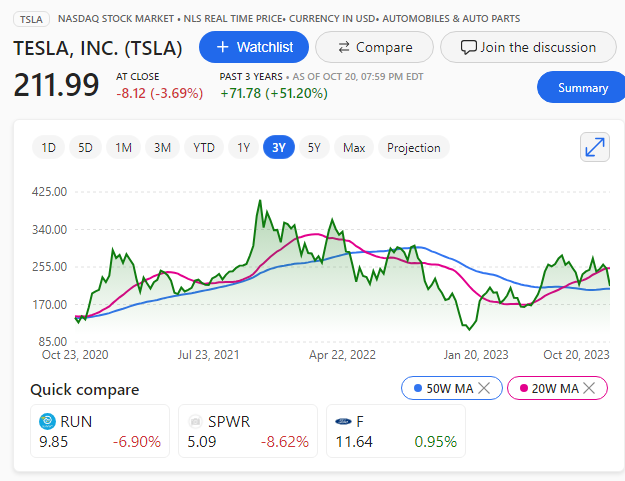
The stock dropped more than 15% over the last few days after the company posted third-quarter earnings on Wednesday 20th October 2023.
The earnings report showed that Tesla missed analysts’ expectations on revenue and earnings per share. Tesla also announced a recall of 475,000 vehicles in the US due to a potential battery fire risk.
Additionally, Tesla faced regulatory challenges in China, where it was banned from selling its AI chips due to national security concerns. These factors contributed to the negative sentiment around Tesla stock and increased its volatility.
Tesla stock has fallen 73% from its record high in November 2021. The stock is down 69% in 2022, more than double the decline in the Nasdaq.
Tesla price crossed below 200 day moving average this is a bearish indicator.
Tesla price crossed below 200 day moving average this is a bearish indicator.
Among major carmakers, Ford is down 46% and General Motors has fallen 43%. Since its IPO in 2010, Tesla has only fallen in one other year, an 11% drop in 2016. Some analysts and investors are still optimistic about Tesla’s long-term prospects, citing its innovation, leadership, and loyal customer base.
However, others are sceptical about Tesla’s valuation, profitability, and competition. Tesla’s stock performance in the coming months will depend on how it can overcome its current challenges and deliver on growth.
Don’t underestimate Elon Musk, but bear in mind other big car manufacturers are now catching and moving ahead of Tesla in the EV race.
Think of the biggest market for a physical product you can possibly imagine – are you thinking mobile phones, cars or game devices even? Think again…?
They are all big commercial markets but in the coming decades a new product is coming and it will be so desirable that it will dwarf these giants – it will be… the ‘robot’.
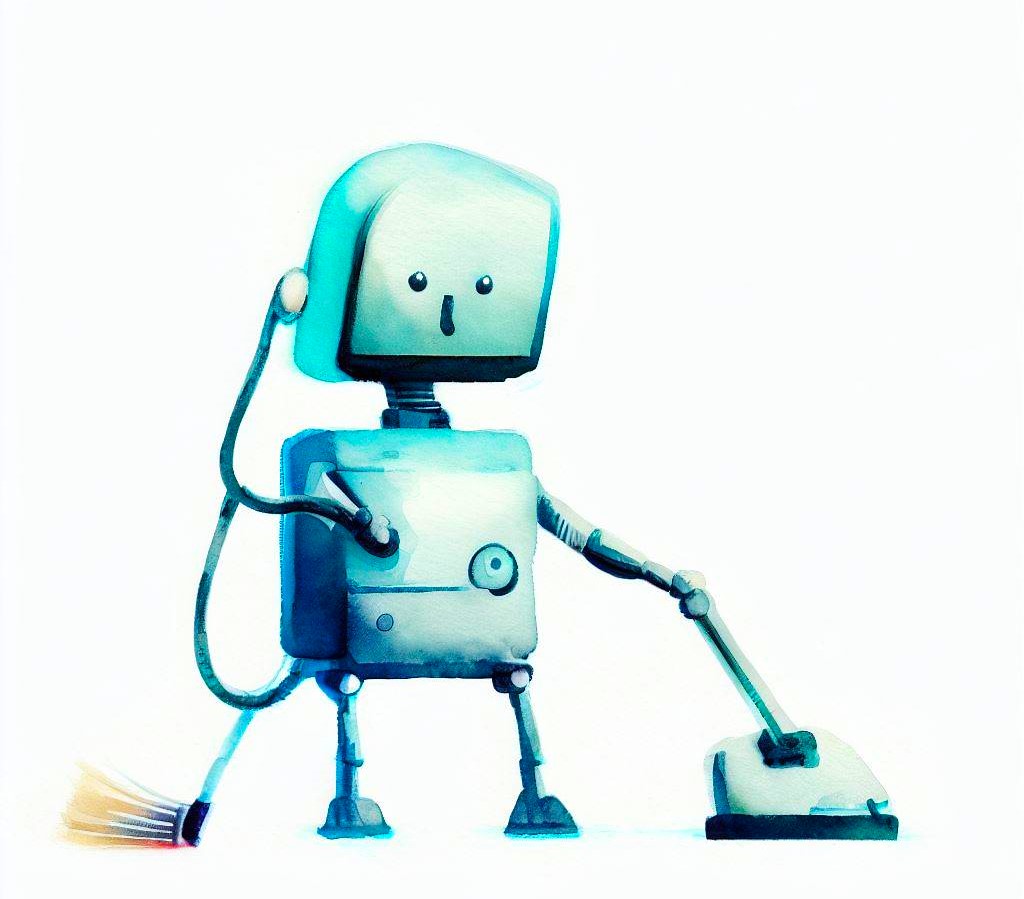
Robots will be able to understand what we want, comprehend the way the world works and looks and have the skills to execute our commands in a safe and controlled manner – at home and in the workplace.
Biggest market
The labour market is the biggest market that has ever existed in the history of business – it’s the market where we want things ‘done’ – where we do things – and it’s forever evolving. It carries massive stock market and investing potential right now and for the future.
Robot AI tech – a market place to explore
Take Nvidia, Microsoft, Google, Meta, Apple and Tesla as prime examples of companies pioneering technological advancements for instance – we can already enjoy and invest in these – and there’s much more to come.
Dozens of firms around the world are working on the technology
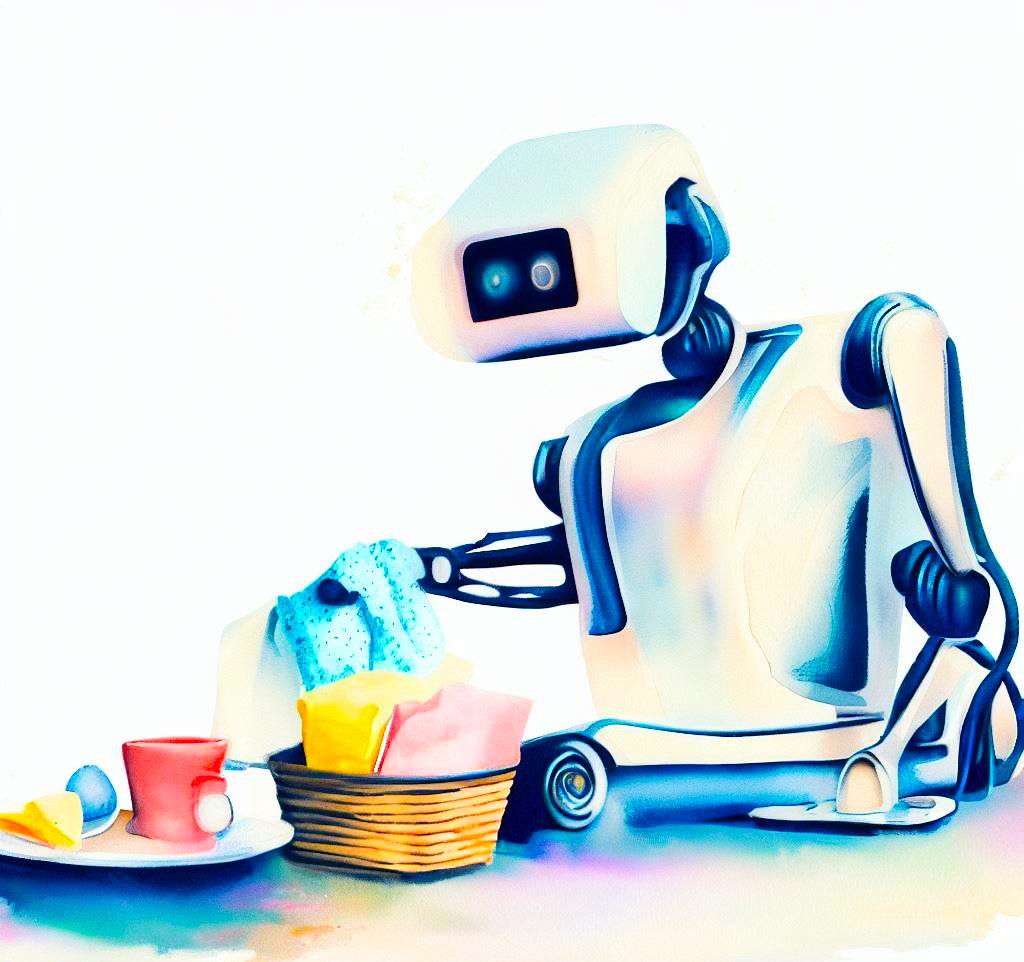
One of the highest profile companies in the market is Tesla, Elon Musk’s electric car company. It is working on the Optimus humanoid robot, which Mr Musk intimates could be on sale to the public in a few years’ time.
Massive tecnological advancement in artificial intelligence (AI) and robotics suggest the development of humanoid robots is accelerating… and fast. It’s a race to the become the first to succeed in the biggest practical labour market ever… and it carries huge potential for everyone, including you and me.
20 years from now…? Where were Tesla and Apple 20 years ago?
Twenty years at the pace the technology is developing now is is an eternity – every week, month and year there are new developments in the AI world that have introduced fundamental changes and enhancements to our world.
Mainstream interest in AI exploded late 2022 when a powerful version of ChatGPT was made public. Its ability to generate almost unlimited useful text and images has spawned rivals and a wave of investment in AI technology.
But developing the AI that would allow a robot to complete useful tasks is a different and much more difficult task. Tesla could be the company best placed to be one of the first to achieve this goal – given its advancements in ‘self driving’ technology. But, unlike ChatGPT and its rivals, humanoid robots have to navigate the physical world and need to understand how objects in that world relate to each other.
Tasks that seem easy to humans are major feats for humanoid robots. This is a problem that engages a lot of different complex issues in an AI driven robotics system. Picking up a cup and having a drink is a major undergoing for a robot.
The market place potential is unlimited
The potential market for robots in the future depends on various factors, such as the level of technological innovation, the demand from different industries and sectors, the regulatory and ethical frameworks, and the social and economic impacts of robot adoption. But if recent developments are anything to go by – it promises to be big!
Robot AI – a massive potential future market place
Based on the some indicative web search results, the current market size for robots is estimated to be around $55 billion to $114 billion in 2023, depending on the type and scope of robots included. The projected market size for robots in 2028 or 2029 ranges from $165 billion to $260 billion, with a compound annual growth rate (CAGR) of 11.4% to 17.6%.
The professional services robots, which include medical, agricultural, and personal assistance robots, are expected to dominate the market and account for more than half of the total sales by 2030. The industrial and logistics robots, which include conventional, collaborative, and mobile robots, are also expected to grow steadily and increase their productivity and efficiency in various manufacturing and transportation applications.
However, these projections are based on assumptions – but one thing is for sure the robots are coming and the market will be massive!
I for one will be keeping a watchful eye on where to invest my hard earned cash to take advantage of this potentially high growth market in the coming years (and now).
In July 2023, Elon Musk rebranded Twitter to X – another step in his master plan to emulate Chinese super app WeChat.
Mr Musk has long said that he wants to transform his social media firm, which he bought last year for $44 billion, into a much larger platform.
He has previously praised WeChat – a so-called ‘everything app‘ that combines chat, dating, payments and social media – and has said creating something “even close to that with Twitter… would be an immense success”.
In a post on X this week, Mr Musk said that over the coming months, ‘we will add comprehensive communications and the ability to conduct your entire financial world’.
He will hope that growing X will lead to a revenue recovery – the company has lost almost half its advertising revenue since Mr Musk bought it, and it is struggling under a heavy debt load.
Established businesses
He has successfully disrupted several industries with his ventures such as Tesla, SpaceX, Neuralink, and The Boring Company. He may be able to bring some fresh ideas and solutions to the social media space with X. It will be interesting to see if he adopts an existing digital payment system or develops his own. XRP, for instance – could be a good fit.
What is WeChat?
WeChat is a ‘super-app’ that combines messaging, social media, payments, e-commerce, entertainment, news, and more. It is owned by Tencent, one of China’s largest tech companies, and has over 1.2 billion monthly active users, mostly in mainland China.
Everything App
WeChat users can do almost anything within the app, from ordering food to booking tickets to paying bills, without leaving the app. WeChat also hosts millions of mini-apps that are created by third-party developers and businesses to offer various services and functions to users. It is like WhatsApp, Facebook, Apple Pay, Uber, Amazon, Tinder and a whole lot more rolled into one. Launched by technology giant Tencent in 2011. WeChat is now used by almost all of China’s 1.4 billion pupulation (1.2 billion users seems to be the latest concensus).
Will it work in the West?
WeChat’s huge success in China is arguably down to two major factors. For one, most people in China access WeChat on smartphones, rather than desktop computers, due to the relatively late development of the internet in the country. And two, China’s lack of competition regulation – which contrasts with most Western countries – allows an app like WeChat to potentially effectively block rival platforms.
Could Mr Musk make a similar app work outside China? We may be finding out soon – and experts believe it may all depend on digital payments and his ‘system’ to implement this everyday task.
A major difference between China and the West is the widespread adoption of digital payment technology.
While shops in China are legally obliged to accept cash, in practice, digital payments are far more common.
This difference, may be an obstacle to Mr Musk’s ambitions. It will take the Western world longer to implement a truly cashless or credit card free society.
Why does Musk want to emulate WeChat?
Elon Musk has been an admirer of WeChat for a long time. He once said that WeChat is ‘so usable and helpful to daily life‘ in China, and that he wanted to achieve something similar with Twitter, no X. He also said that buying Twitter was an ‘accelerant’ to creating X, the everything app.
X The company likely to bring you the ‘Super’ App or the ‘Everything’ App
Mr Musk has hinted that he plans to add more features and functionalities to Twitter, such as video, communications, and financial services. He also said that the Twitter name did not make sense in the new context, so he decided to rename it as X, a brand that he has used before for his online banking business that later became PayPal.
Dystopia or Utopia – A dark sideor a force for good?
Is the Super App a natural progression and development for good or yet another infringement on our freedom, liberty and privacy. Is it even necessary?
In China, we have witnessed a level of state control interference over the internet that has reportedly made it extremely dangerous for people to speak out against the government on WeChat.
It is not unusual for dissenting voices to have their accounts suspended for days or weeks for something they have said in Chats or on Moments.
Even people sharing seemingly uncontroversial information have found themselves on the wrong side of government censors and had their accounts and chat groups shut down.
Digital life footprint
Everything Everywhere – a super ‘system’ monitoring what you do, what you buy, where you go, when, how, who you talk to, what you say – all your movements, comments, discussions and activity will be known by someone else, somewhere, even your private discussions, holiday activity and medical details will be visible in the ‘system’.
Some may say this has happened already, but this ‘super-app’ will be a massive step closer to ‘life without privacy’.
Threads is a new app, owned by Meta (Facebook), and built by theInstagram team, for sharing public conversations akin to Twitter. You log in using your Instagram account and posts can be up to 500 characters long and include links, photos, and videos with a 5 minute limit. Threads is Meta’s first app envisioned to be compatible with an open social networking protocol
Threads is seen by many as a direct competitor toTwitter, the social media platform owned by billionaire Elon Musk. Threads has been setting records for user growth since its launch on July 5, 2023, with politicians, celebrities, news creators and users joining the platform. Threads surpassed 100 million user ‘sign-ups’ within five days of launch according to information from Meta.
Projected to create revenue of $8 billion by 2025
Threads is projected to contribute a staggering$8 billion to Meta’s annual revenue by 2025. The report further highlights that Threads has already garnered 1 million sign-ups and is on track to reach an impressive milestone of 1 billion users in the near future.
User drop-off to be expected?
However, some recent news reports suggest that Threads has encountered challenges in retaining its users and competing with Twitter. Threads ‘daily active users’ is reporteded to have fallen from 49 million two days after its launch, to 23.6 million users about three weeks later in July 2023, according to reports. The app’s average usage time also fell from 21 minutes to 6 minutes over the same timeframe.
Twitter rebrands as X and kills off blue bird logo
Twitter, the social media platform, has undergone a major rebranding, changing its name to X and replacing its iconic blue bird logo with a simple black-and-white X. The move was announced by the company’s owner, Elon Musk, who reportedly said he wanted to create a “super app” that would transform the global ‘town square’.
New Logo
Musk and Twitter’s chief executive, Linda Yaccarino, posted pictures of the new logo projected on the side of Twitter’s headquarters in San Francisco, California. They also changed profile pictures and bios to reflect the new brand identity. The desktop version of the app has already switched to the new logo, while the mobile version is expected to follow soon.
My last tweet – says the BLUE bird
Musk is reported to have said he was looking to change Twitter’s logo because he wanted to “embody the imperfections in us all that make us unique”. He also said he had a personal affinity for the letter X, which he also used for his other ventures, such as SpaceX and X.com. Yaccarino said the rebrand was an exciting new opportunity to make a fresh “big impression” and go further than Twitter.
Rebranding
The rebranding of Twitter marks the biggest change to the platform since Musk began his tumultuous tenure. Among the changes have been sacking thousands of staff, locking verification checkmarks behind a paywall, reinstating banned accounts like those of Andrew Tate and Donald Trump, and applying reading limits.
The reaction from users and marketers has been mixed, with some praising the bold move and others criticising it as unnecessary and confusing. Some have also questioned whether the new logo infringes on the trademarks of other companies that use similar designs, such as Tesla and Xbox.
The company has not yet revealed whether other aspects of the platform, such as tweets, hashtags, and handles, will also be changed to match the new brand name.
Elon Musk, the billionaire entrepreneur behind Tesla, SpaceX and Neuralink, has revealed his latest venture: xAI, a new artificial intelligence company that aims to “understand the true nature of the universe”.
Musk announced the formation of xAI on Wednesday on Twitter and on the company’s official website, which features a minimalist design and a brief introduction.
“Today we announce the formation of xAI,” the website states. “The goal of xAI is to understand the true nature of the universe.”
AI
The website also lists 12 members of the xAI team, including Musk himself as the director. The team consists of researchers and engineers who have worked at leading AI firms such as Google’s DeepMind, OpenAI, Microsoft Research and Tesla.
Power
It was reported that xAI was incorporated in Nevada in June 2023 and Musk has purchased thousands of graphic processing units (GPUs) to power his AI vision. The company also has a Twitter account, @xAI, which has gained over 300,000 followers in less than a day.
Musk invited the public to ask questions about xAI on a Twitter Space – this was scheduled for 1h. July 2023. He has not provided any further details about the company’s mission, vision or products.
However, based on Musk’s previous comments and involvement in AI, it is likely that xAI will focus on developing artificial general intelligence (AGI), or human-level intelligence that can perform any task across any domain.
AI Critic
Musk has been a vocal critic of OpenAI, the AI research organization that he co-founded in 2015 but left in 2018. He has accused OpenAI of becoming too secretive, too commercial and too “woke”, especially after the launch of its popular chatbot ChatGPT.
Musk has also expressed his concerns about the potential dangers of AI, warning that it could pose an existential threat to humanity if not aligned with human values and goals. He has advocated for ethical and responsible development of AI, as well as global cooperation and regulation.
With xAI, Musk may be trying to create an alternative to OpenAI that is more aligned with his vision and values. He may also be aiming to achieve breakthroughs in AI that could benefit his other ventures, such as Tesla’s self-driving cars, SpaceX’s reusable rockets and Neuralink’s brain-computer interfaces.
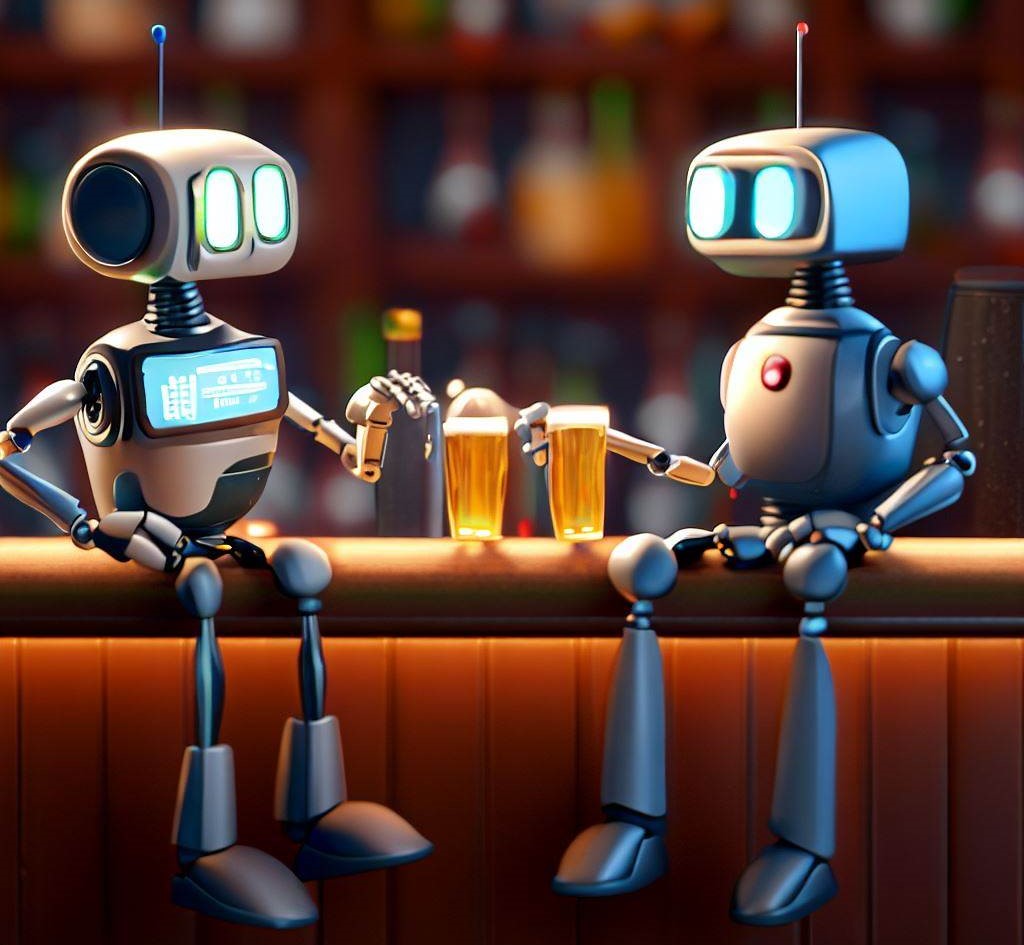
AI Robots at a bar
However, xAI will also face many challenges and uncertainties in its quest to understand reality. AI is a complex and rapidly evolving field that requires massive amounts of data, computing power and talent. It also raises many ethical, social and philosophical questions that are not easy to answer.
Moreover, xAI will have to compete with other established and emerging players in the AI space, such as Google, Facebook, Amazon, IBM, Microsoft and Meta. These companies have invested billions of dollars in AI research and development and have access to vast amounts of data and resources.
It remains to be seen whether xAI will be able to achieve its ambitious goal and how it will impact the AI industry and society at large.