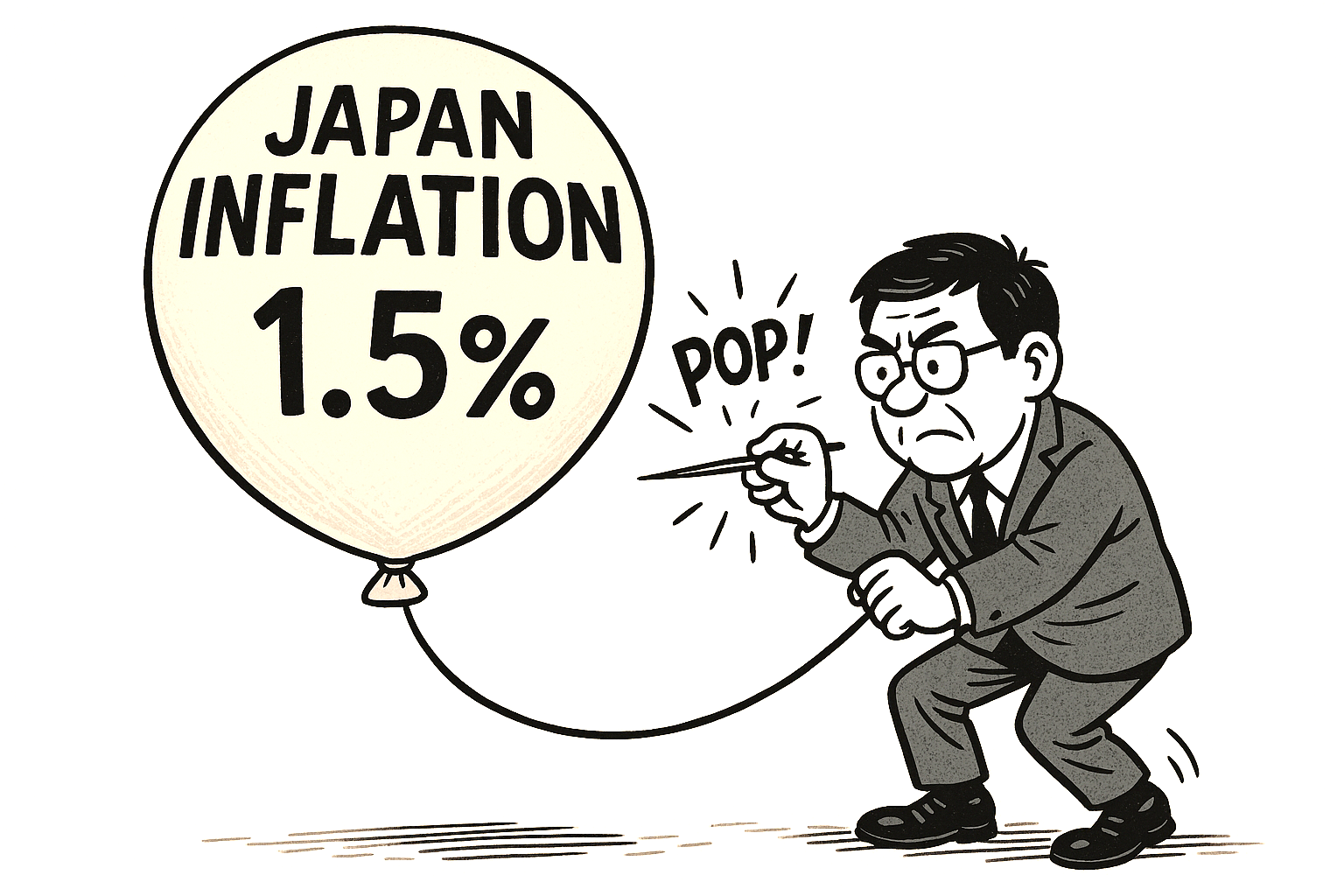
Japan’s inflation rate has dipped below the Bank of Japan’s long‑standing 2% target for the first time in almost four years, marking a notable turning point in the country’s post‑pandemic price cycle.
Official figures show headline inflation easing to 1.5% in January, ending a 45‑month stretch above the central bank’s benchmark.
Slowdown
The slowdown reflects a broad cooling in cost pressures that had dominated the Japanese economy since 2022. Food inflation has eased to a 15‑month low, while transport, healthcare, and household goods have all seen slower price growth.
Energy costs remain negative, helped by government subsidies that continue to cushion households from global fuel volatility.
Core inflation — which strips out volatile fresh food prices — has also softened, slipping to 2.0%, its weakest pace in two years.
Analysts attribute much of the deceleration to base effects following last year’s sharp price increases, suggesting that underlying demand‑driven inflation remains relatively stable.
For the Bank of Japan, the latest figures present a delicate policy challenge. While inflation is finally within the target range, underlying price pressures have not disappeared entirely.
Rate increases?
Some economists argue the BOJ may still lean toward gradual rate increases, particularly as wage negotiations progress and the government pushes for sustained real income growth.
Others caution that tightening too soon could risk undermining Japan’s still‑fragile consumption recovery.
What is clear is that Japan has entered a new phase of its inflation story — one defined less by imported cost shocks and more by the question of whether domestic demand can carry the momentum forward.
In a move that reverberated across global financial markets, the Bank of Japan (BOJ) recently bid farewell to its negative interest rate policy – the last of its kind in the world. This decision marks a pivotal moment in the realm of central banking and has far-reaching implications for economies and investors worldwide.
The Negative Interest Rate Saga
To understand the significance of this shift, let’s rewind the clock. Japan, grappling with deflation for years, embarked on an ambitious economic experiment known as ‘Abenomics’ in 2013. The strategy combined massive government spending with unconventional monetary measures. The BOJ, under the leadership of then-Prime Minister Shinzo Abe, injected liquidity into the system by purchasing bonds and other assets. The goal? Achieve a 2% inflation target and kickstart growth.
Among these measures was the adoption of negative interest rates. The idea was simple: discourage banks from hoarding excess reserves and encourage lending. However, the path to higher inflation proved elusive, and the BOJ found itself navigating uncharted waters.
The Change
Fast forward to 2024. Japan’s economy has experienced a moderate recovery, prompting policymakers to reassess their strategic options. The Bank of Japan (BOJ) has elevated its short-term interest rate from minus 0.1% to a range between zero and 0.1%. This adjustment marks the first increase in rates since 2007, representing a significant, even a ‘seismic’ policy shift.
The Effect
Policy Pivot: The BOJ acknowledges that negative rates have played their part. With improving wages and corporate profits, the time is ripe for a change. The new rate range signals a departure from the era of ultra-accommodative policies.
Global Implications: Japan now stands as the last central bank to exit negative rates. For years, central bankers worldwide wielded cheap money and unconventional tools. Now, the tide turns. The era of negative rates draws to a close, and other central banks take note.
Market Response: Tokyo’s Nikkei 225 index responded positively, gaining 0.7%. The Japanese yen weakened against the dollar. Investors recalibrate their strategies, adjusting to a world where negative rates are no longer the norm. The Nikkei is sitting close to or at its all-time high!
Nikkei 225 3 month chart at: 40003 – close to its recent new all-time high of 40109
Nikkei 225 3 month chart at: 40003 – close to its recent new all-time high of 40109
The future?
As the BOJ takes its first step toward policy normalization, questions abound. Will further rate adjustments follow? How will markets adapt? And what does this mean for global liquidity?
One thing is certain: The decision of the Bank of Japan resonates beyond the confines of the nation. It heralds the beginning of a new era in which central banks adjust their strategies, economies establish stability, and investors once more chart a course through unfamiliar territory.
Within the chronicles of monetary history, the cessation of negative rates at the Bank of Japan will be marked as a pivotal moment. As the final details of this policy transition are solidified, the global community observes, prepared for the forthcoming developments.
Disclaimer: The views expressed in this article do not constitute financial advice. Readers are encouraged to consult professional advisors before making any investment decisions.