

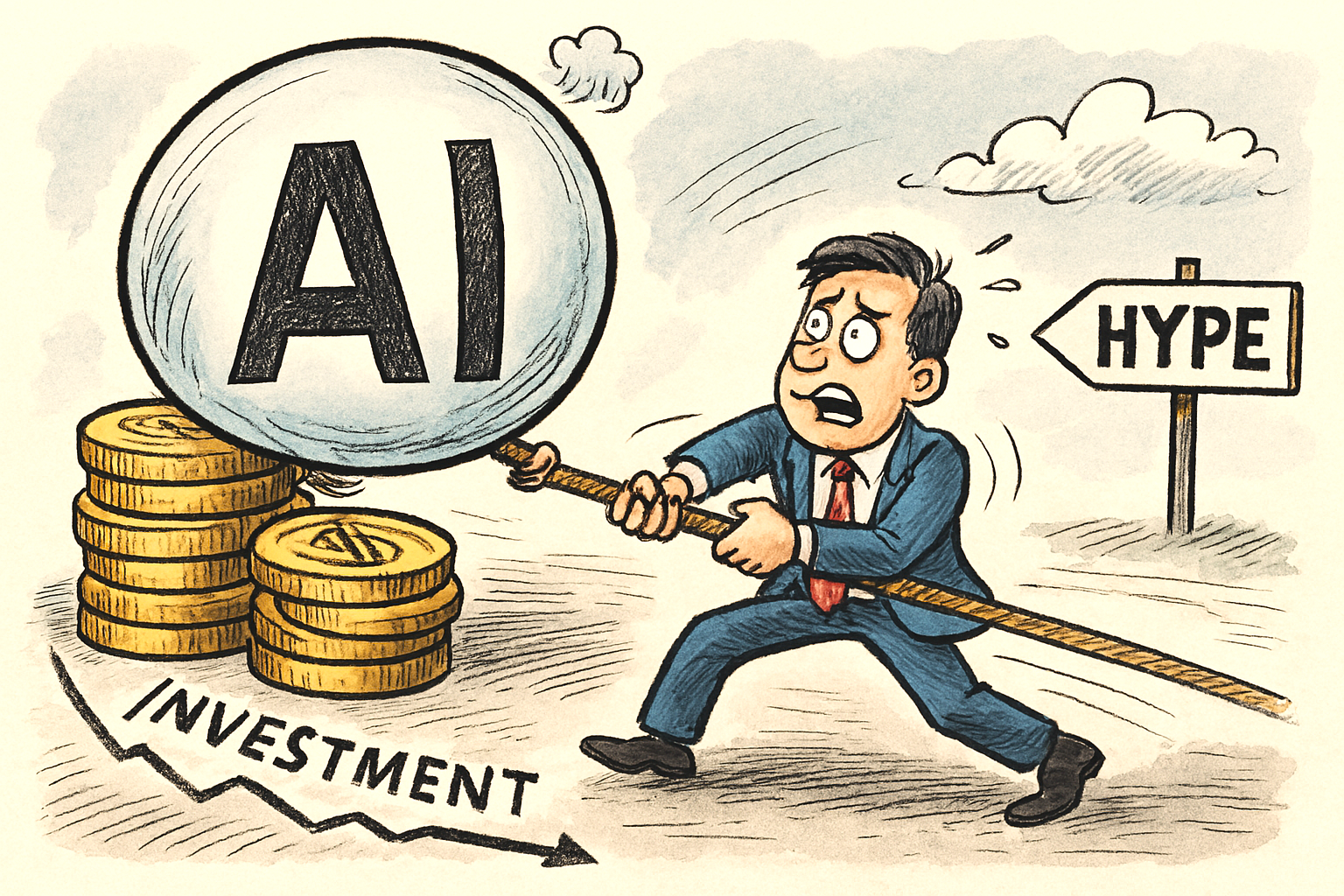
Has AI Investment Gone Too Far Too Fast? A Quick Look at Hype Reality and Returns

Bubble and turmoil

Few technologies have attracted capital as aggressively as artificial intelligence. In just a few years, AI has shifted from a promising research frontier to the centrepiece of global corporate strategy.

Yet as investment has surged, so too has scepticism. Many analysts now argue that the pace of spending has outstripped both practical readiness and measurable returns.

Recent research suggests that the era of uncritical AI enthusiasm is giving way to a more sober assessment.

Implementation

Capgemini’s findings indicate that businesses are moving from experimentation to implementation, but they also reveal that firms are increasingly focused on proving real value rather than chasing novelty.

This shift reflects a broader concern: despite tens of billions poured into generative AI, a striking proportion of organisations report no financial return at all.

Some studies suggest that as many as 95% of generative AI investments have yet to produce measurable gains.

This disconnect between investment and outcome has fuelled claims that AI has been over‑hyped. The comparison to the telecom‑fibre boom of the early 2000s is becoming more common, particularly as much of the AI infrastructure build‑out is debt‑funded.

Transformative

The risk is not that AI lacks long‑term utility—few doubt its transformative potential—but that the current wave of spending is misaligned with operational readiness, data quality, and realistic deployment timelines.

At the same time, it would be simplistic to declare the AI boom a bubble destined to burst. Many leaders argue that the scale of investment is necessary to meet future demand for data centres, chips, and agentic AI systems.
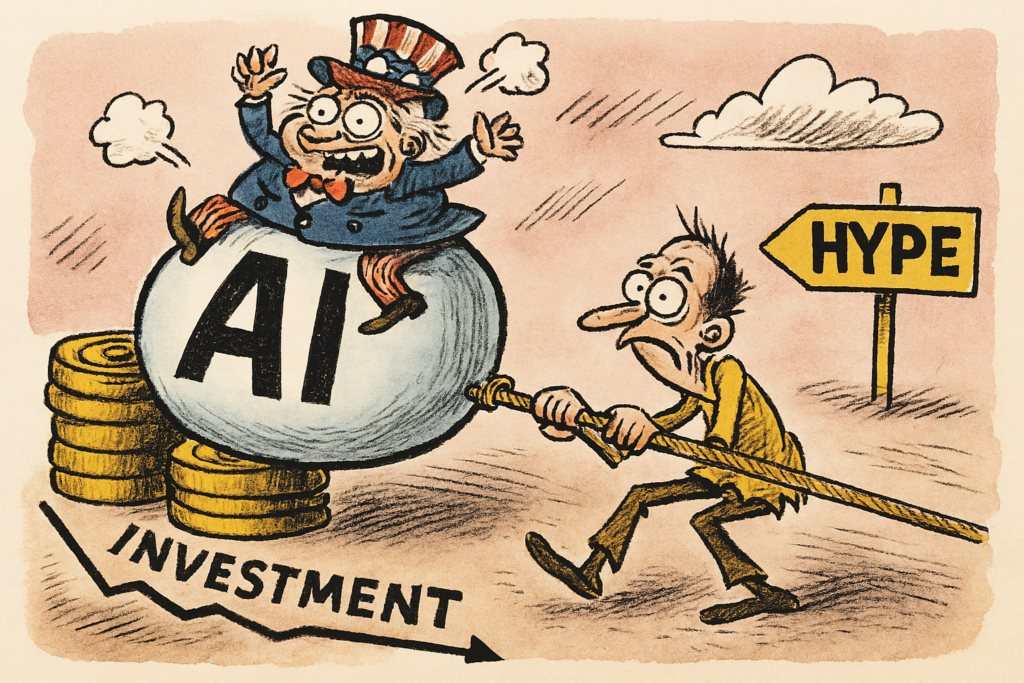
Indeed, some firms are already shifting focus from generative AI to more autonomous, productivity‑driven agentic models, which may offer clearer paths to return on investment.

Long-term potential vs short term hype

The truth likely lies between the extremes. AI has undoubtedly been over‑sold in the short term, with inflated expectations and rushed adoption leading to disappointing early results.

But the long‑term case remains strong. As tools mature, integration improves, and organisations learn to measure value beyond simple cost savings, returns may begin to justify the extraordinary capital outlay.

For now, the market is entering a more pragmatic phase—one where hype gives way to accountability, and where the winners will be those who invest not just heavily, but wisely.

Less expensive and simpler AI systems may arrive before these huge investments materialise a decent return.
U.S. AI vs China AI – the difference

China and U.S. AI

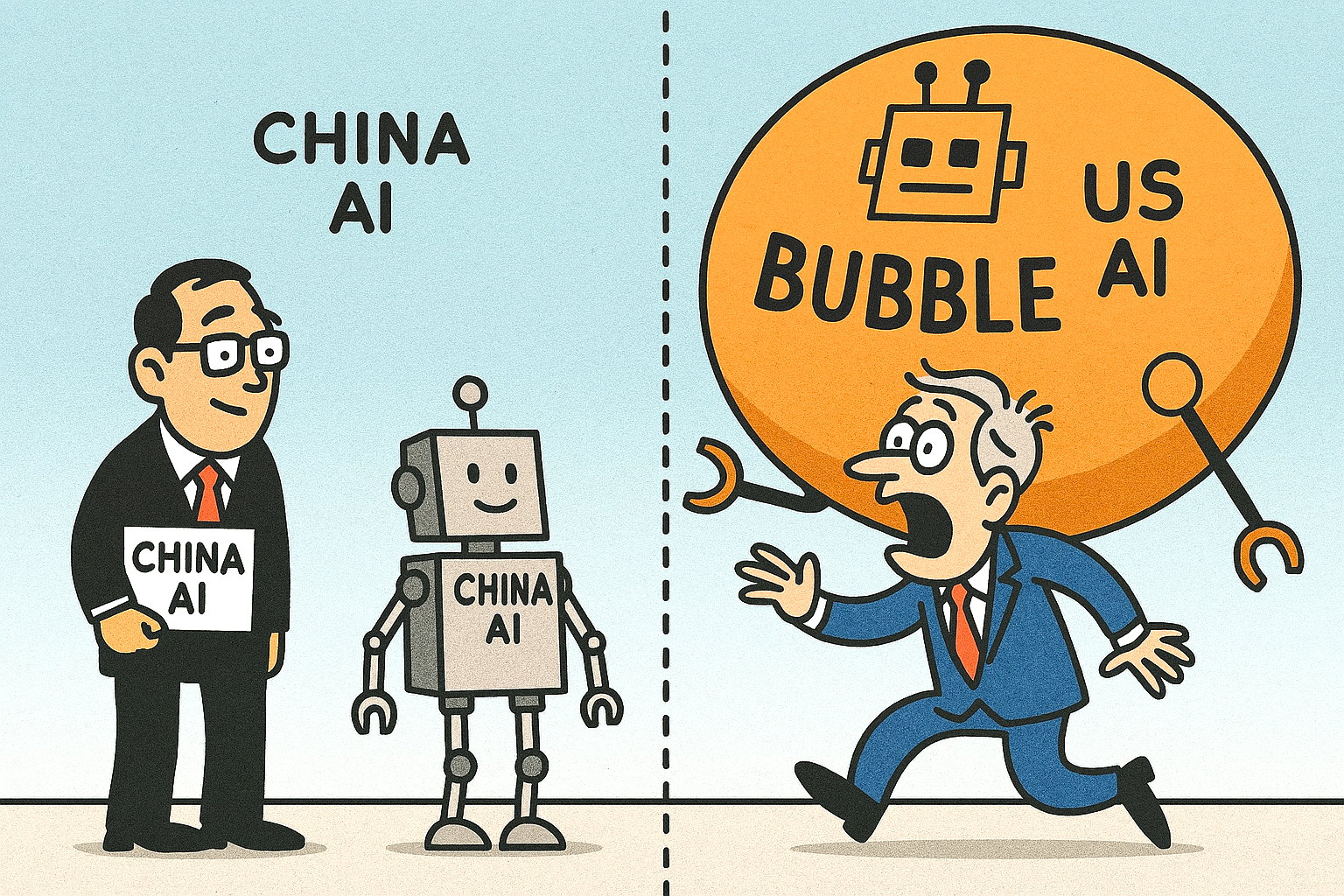
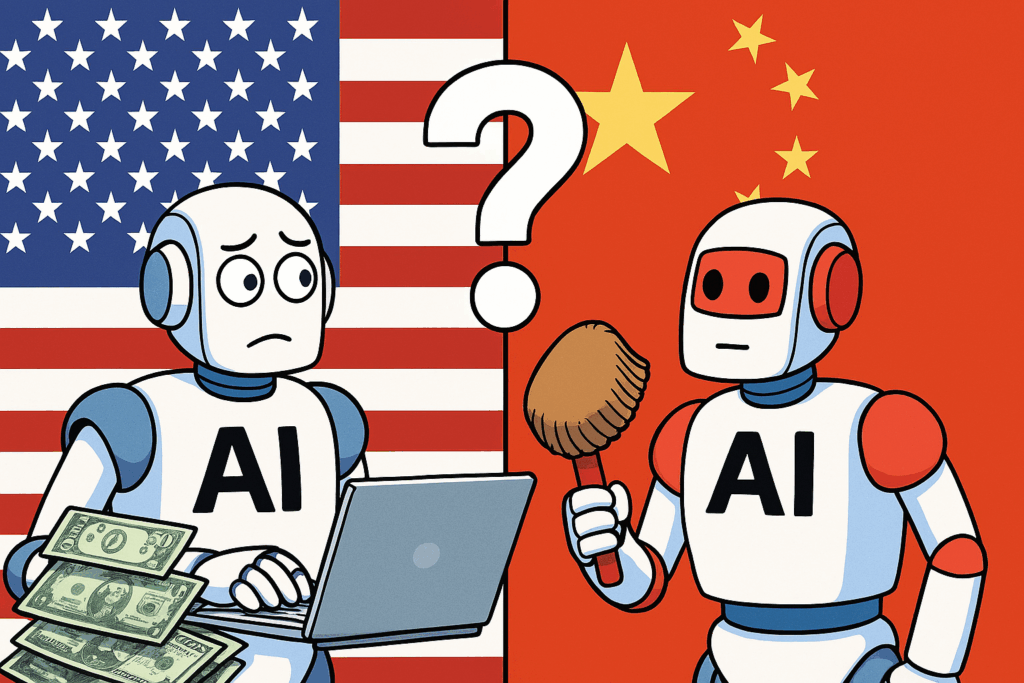
China’s AI industry has indeed cultivated a reputation for ‘doing more with less’, while the U.S. has poured vast sums into AI development, raising concerns about overinvestment and inflated valuations.

The contrast lies not only in the scale of funding but also in the efficiency and strategic focus of each country’s approach.

The U.S. Approach: Scale and Spending

The United States remains the global leader in AI infrastructure, driven by massive private investment and access to advanced computing resources.

Venture capital deals in U.S. AI and robotics startups have more than quadrupled since 2023, surpassing $160 billion in 2025.

This surge has produced headline-grabbing valuations, such as humanoid robotics firms raising billions in single rounds. Yet analysts warn of bubble risks, with valuations often detached from sustainable revenue models.

The U.S. strategy prioritises scale: building the largest models, securing the most powerful GPUs, and attracting top-tier talent.

This has led to breakthroughs in generative AI and large language models, but at extraordinary cost.

Estimates suggest that OpenAI alone has spent over $100 billion on development. Critics argue this reflects a ‘more is better’ philosophy, where innovation is equated with sheer financial muscle.

China’s Approach: Efficiency and Restraint

China, by contrast, has invested heavily but with a different emphasis. In 2025, Chinese AI investment is reportedly projected at $98 billion, far below U.S. levels.

Yet Chinese firms have achieved notable progress by focusing on cost-efficient innovation. For example, AI2 Robotics developed a model requiring less than 10% of the parameters used by Alphabet’s RT-2, demonstrating a commitment to leaner, more resource-conscious design.

Foreign investors are increasingly drawn to China’s cheaper valuations, which are roughly one-quarter of U.S. equivalents.

This efficiency stems from lower research costs, government-led initiatives, and a culture of frugality shaped by regulatory pressures and limited access to advanced hardware.

Rather than chasing scale, Chinese firms often prioritise practical applications and affordability, enabling broader adoption across industries.

Doing More with Less?

The evidence suggests that China has achieved competitive outcomes with far fewer resources, while the U.S. has arguably overpaid in pursuit of dominance.

However, the U.S. still leads in infrastructure, talent, and global influence. China’s strength lies in its ability to innovate under constraints, turning scarcity into efficiency.

Ultimately, the question is not whether one side has ‘overinvested’ or ‘underinvested’, but whether their strategies align with long-term sustainability.

The U.S. risks a bubble fuelled by excess capital, while China’s leaner approach may prove more resilient. In this sense, China is indeed ‘doing more with less’—but whether that will be enough to surpass U.S. dominance remains uncertain.

Bubble vulnerability

The sheer scale of U.S. AI investment has left the industry vulnerable to bubble shock, as valuations and spending appear increasingly detached from sustainable returns.

Analysts warn that the U.S. equity market is showing signs of an AI-driven bubble, with trillions poured into data centres, chips, and generative models at unprecedented speed.

While this has fuelled rapid innovation, it has also created irrational exuberance reminiscent of the dot-com era, where hype outpaces monetisation.

If growth expectations falter or capital tightens, the U.S. could face sharp corrections across tech stocks, credit markets, and employment, exposing the fragility of an industry built on extraordinary but potentially unsustainable levels of investment.