Russell 2000 goes into bear territory as Dow Jones – S&P 500 and Nasdaq hit correction!

Stocks fall

The Russell 2000, a key benchmark for small-cap U.S. stocks, has officially entered bear market territory.

This means the index has fallen more than 20% from its all-time high in late November 2024. The decline was accelerated by the recent rollout of President Donald Trump’s sweeping tariffs, which have raised concerns about rising costs, economic softening, and global supply chain disruptions3.

Small-cap stocks, which were initially seen as beneficiaries of Trump’s policies due to their domestic focus, are now facing significant challenges. Many of these companies are particularly vulnerable to input cost shocks and lack the financial flexibility of larger firms.

Analysts warn that the combination of higher costs and a slowing economy is squeezing profits, leaving small caps in a precarious position.

The Russell 2000’s downturn highlights the broader market volatility triggered by the tariff measures. While other major indices like the S&P 500 and Nasdaq are in correction territory, the Russell 2000 was the first to enter a bear market.

Russell 2000 index

Russell 2000 index

This development underscores the heightened risks for small-cap stocks in the current economic climate.

Despite the challenges, some strategists believe there could be opportunities for recovery, particularly if the Federal Reserve takes steps to cut interest rates.

However, Trump’s tariffs have introduced uncertainty into this policy, as inflation is likely to increase, casting doubt on the possibility of further interest rate cuts.

For now, the Russell 2000’s performance serves as a stark reminder of the delicate balance between protectionist policies and market stability.

The Russell 2000, a key benchmark for small-cap U.S. stocks, has officially entered bear market territory.

Dow Jones decline – the ripple effects of tariff policies

The Dow Jones Industrial Average has seen a sharp decline, falling from its all-time high of 45,073.63 points in December 2024 to its current level of 38,314.86 points—a drop of approximately 15%.

Dow Jones one-year chart

Dow Jones one-year chart

This downturn reflects a mix of economic challenges, including the impact of President Donald Trump’s tariff policies.

Trump’s sweeping tariffs, introduced as part of his ‘Liberation Day‘ initiative, aimed to bolster American manufacturing by imposing taxes on imported goods. While the policy sought to ‘level the playing field’, it triggered significant disruptions in global trade.

Retaliatory tariffs from key trading partners, including China and the European Union, compounded the issue, ultimately leading to higher costs for U.S. businesses and consumers.

The tariffs have also strained supply chains, particularly in industries reliant on international components. This has contributed to inflationary pressures, further dampening investor sentiment.

The tech sector, already grappling with regulatory scrutiny, has been hit hard, with companies facing increased production costs.

Nasdaq tech 100 one-year chart

Nasdaq tech 100 one-year chart

While some view the market’s decline as a natural correction, others warn of prolonged economic challenges, especially with the uncertainty surround Trump’s tariff agenda.

For investors, the key lies in navigating these turbulent times with caution and a focus on long-term fundamentals.

As the Dow adjusts to these pressures, its performance underscores the far-reaching consequences of trade policies on global markets.

S&P 500 one-year chart

S&P 500 one-year chart

Dow drops 2200 points Friday 4th April 2025 – S&P 500 loses 10% in 2 days as Trump’s tariff rout deepens – just two days after ‘Liberation Day!’

Stocks down

The stock market was smashed for a second day Friday 4th April 2025 after China retaliated with new tariffs on U.S. goods, sparking fears President Donald Trump has ignited a global trade war that will lead to a global recession.

Stock market damage

The Dow Jones Industrial Average dropped 2,231.07 points, or 5.5%, to 38,314.86 on Friday 4th April 2025, the biggest decline since June 2020 during the Covid-19 pandemic.

This follows a 1,679-point decline on Thursday 3rd April 2025 and marks the first time ever that it has shed more than 1,500 points on consecutive days.

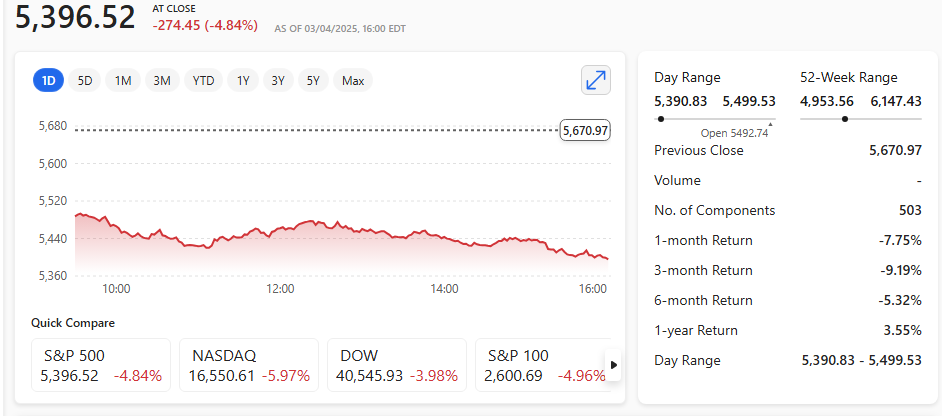
The S&P 500 collapsed 5.97% to 5,074.08, the biggest decline since March 2020. The benchmark shed 4.84% on Thursday 3rd April 2025 and is now down more than 17% off its recent high.

The Nasdaq Composite, home to many well-known tech companies that sell to China and manufacture there as well, dropped 5.8%, to 15,587.79.

This follows a nearly 6% drop on Thursday 3rd April 2025 and takes the index down by 22% from its December 2024 record – pushing it into a bear market.

The selling was wide ranging with only 14 members of the S&P 500 higher on the day. Major market indexes closed at their lows of the session.

China’s commerce ministry said the country will impose a 34% levy on all U.S. products, disappointing investors who had hoped countries would negotiate with Trump before retaliating.

Technology stocks led the massive rout Friday

Apple shares slumped 7%, bringing its loss for the week to 13%.

Nvidia dropped 7% during the session.

Tesla fell 10%.

All three companies have large exposure to China and are among the hardest hit from Beijing’s retaliatory tariffs.

The bull market is dead, and it was destroyed by self-inflicted wounds!

Dow dives 1600 points after Trump’s tariff attack – S&P 500 and Nasdaq drop the most since 2020

Stocks markets fall

The U.S. stock market experienced a dramatic plunge following President Donald Trump’s announcement of sweeping tariffs, marking one of the most significant market downturns since 2020.

On 3rd April 2025, the Dow Jones Industrial Average plummeted by 1,600 points, a staggering 4% drop, closing at 40,546.

Dow Jones one day chart

The S&P 500 fell by 4.8%, while the tech-heavy Nasdaq Composite suffered a 6% decline, reflecting widespread investor anxiety.

S&P 500 one day chart

Trump’s tariffs, which include a baseline 10% levy on imports from all trading partners and higher rates for specific countries, have sparked fears of a global trade war.

The effective tariff rate for China, for instance, has risen to 54%, raising concerns about supply chain disruptions and inflation. Major industries, including technology, retail, and manufacturing, were hit hard.

Apple shares dropped nearly 10%, while companies like Nike and Nvidia saw significant losses.

Apple one day chart

The market reaction underscores the uncertainty surrounding the economic impact of these tariffs. Analysts warn that the measures could dampen consumer spending, increase inflation, and slow economic growth.

The ripple effects were felt globally, with European and Asian markets also experiencing declines. The Nikkei index declined a further 3%.

Nikkei Index five-day chart

Despite the turmoil, Trump defended the tariffs, likening them to a necessary ‘operation’ for the economy. He expressed confidence that the markets would eventually rebound, emphasising the long-term benefits of reshoring manufacturing and generating federal revenue.

As investors grapple with the implications of these policies, the focus remains on potential retaliatory measures from affected countries and the broader impact on global trade dynamics.

The sharp market sell-off serves as a stark reminder of the delicate balance between protectionist policies and economic stability in an interconnected world.

The coming weeks will be crucial in determining whether these tariffs lead to lasting economic shifts or temporary market volatility.

U.S. companies are experiencing more harm from Trump’s tariffs. He wants manufacturing to come back to America – but after decades of globalization fine tuning – that is no easy task.

Are markets underestimating the impact of the tariffs on inflation?

Are markets pricing in the fact that Trump’s tariff policy will not be fully followed through?

The U.S. would be lucky to see a single rate cut from the Federal Reserve this year – and that will unsettle investors.

The U.S. economy could now only expand by between 1% and 1.5% this year – this would be a significant change in the growth outlook when compared with the International Monetary Fund’s (IMF) projection of 2.7% U.S. growth made earlier this year.

If we get close to 1%, we get close to ‘stall’ speed and then it could just stop – and that will mean recession or worse for the U.S.

Dow closed 700 points lower Friday 28th March 2025 as inflation and tariff fears worsen

Dow down

Stocks sold off sharply on Friday 28th March 2025, pressured by growing uncertainty on U.S. trade policy as well as a grim outlook on inflation

The Dow Jones Industrial Average closed down 715 points at 41,583. The S&P 500 lost 1.97% to close 5,580 ending the week down for the fifth time in the last six weeks. The Nasdaq Composite plunged 2.7% to 17,322.

Shares of several technology giants also fell putting pressure on the broader market. Google-parent Alphabet lost 4.9%, while Meta and Amazon each shed 4.3%.

This week, the S&P 500 lost 1.53%, while the 30-stock Dow shed 0.96%. The Nasdaq declined by 2.59%. With this latest losing week, Nasdaq is now on pace for a more than 8% monthly decline, which would be its worst monthly performance since December 2022.

Dow Jones one-day chart (28th March 2025)

Dow Jones one-day chart (28th March 2025)

Stocks took a leg lower on Friday after the University of Michigan’s final read on consumer sentiment for March 2025 reflected the highest long-term inflation expectation since 1993.

Friday’s core personal consumption expenditures price index also came in hotter-than-expected, rising 2.8% in February and reflecting a 0.4% increase for the month, stoking concerns about persistent inflation.

Economists had reportedly been looking for respective numbers of 2.7% and 0.3%. Consumer spending accelerated 0.4% for the month, below the 0.5% forecast, according to fresh data from the Bureau of Economic Analysis.

The market is getting squeezed by both sides. There is uncertainty about reciprocal tariffs hitting the major exporting sectors like tech alongside concerns about a weakening consumer facing higher prices

Trump’s tariffs push will hit the U.S. harder than Europe in the short term, it has been reported.

Japan’s Nikkei enters correction as Trump’s tariff assault drives sell-off in Asia markets

S&P 500 slides into correction territory

S&P 500 enters correction

The S&P 500 has officially entered correction territory, marking a significant shift in market sentiment

The index, widely regarded as a benchmark for the health of large U.S. companies, has fallen over 10% from its February 2025 peak.

This downturn follows a series of escalating trade tensions, with President Donald Trump announcing a 200% tariff on European alcoholic products in response to the European Union’s levies on American whiskey.

The correction reflects growing investor concerns over the potential economic fallout of these trade disputes. The Nasdaq Composite, another major index, had already entered correction territory earlier, signaling broader market unease. The Dow Jones Industrial Average also experienced a decline, marking its fourth consecutive day of losses.

Economists warn that the ongoing trade war could exacerbate fears of a recession, as businesses face rising costs and uncertainty. The Federal Reserve’s recent inflation reports suggest price growth remains elevated, adding to the challenges.

While corrections are not uncommon, they often serve as a wake-up call for investors. Historically, only a fraction of corrections evolve into bear markets, but the current environment of trade tensions and inflationary pressures has heightened concerns.

As markets navigate these turbulent waters, all eyes remain on policymakers and their next moves to stabilise the economy.

Trump and his tariff agenda

Trade tariffs

The United States has intensified its tariff policies, marking a significant shift in global trade dynamics

On 4th March 2025, President Donald Trump announced a sweeping increase in tariffs on steel and aluminum imports, raising them to 25% across the board. This move, aimed at bolstering domestic industries, has sparked widespread reactions both domestically and internationally.

The tariffs, which now include a broader range of products such as nuts, bolts, and soda cans, have drawn sharp criticism from key U.S. allies, including Canada, the United Kingdom, and Australia.

U.S and the EU

The European Union has responded with countermeasures, imposing tariffs on $28 billion worth of American goods, set to take effect on 1st April 2025. European Commission President Ursula von der Leyen expressed regret over the U.S. decision but emphasised the need to protect European consumers and businesses.

Domestically, the tariffs have been met with mixed reactions. While U.S. steel and aluminum producers have welcomed the measures, citing potential job creation and increased investment, downstream manufacturers that rely on these metals are bracing for higher costs.

Economists warn that the tariffs could lead to increased prices for consumers and potential disruptions in supply chains. Trump has indicated many times that the tariffs levelled at the U.S. are unfair and unequal.

The Trump administration has justified the tariffs as a means to encourage foreign companies to establish manufacturing facilities in the United States. However, critics argue that the policy could backfire, leading to retaliatory measures from trading partners and a potential slowdown in global economic growth.

As the global trade landscape continues to evolve, the long-term impact of these tariffs remains uncertain. Businesses and policymakers alike are closely monitoring the situation, weighing the potential benefits of protecting domestic industries against the risks of escalating trade tensions.

The coming weeks and months will be crucial in determining the effectiveness of this bold and possibly misguided economic strategy.

U.S. and Canada

The trade relationship between the U.S. and Canada has recently faced significant strain due to escalating tariff policies.

President Donald Trump announced a sharp increase in tariffs on Canadian steel and aluminum, raising them from 25% to 50%. This decision was reportedly in response to Ontario’s provincial government imposing higher electricity prices on U.S. customers.

However, after discussions between Ontario Premier Doug Ford and U.S. Commerce Secretary Howard Lutnick, Ontario agreed to pause the electricity surcharge.

As a result, the U.S. decided to maintain the original 25% tariff rate instead of doubling it. Despite this temporary resolution, tensions remain high, with Canada preparing to implement retaliatory tariffs on $30 billion worth of American goods.

These developments highlight the ongoing challenges in U.S. – Canada trade relations, with both nations navigating the complexities of economic and political interests.

U.S. and China

The U.S. – China trade tensions have escalated significantly in recent months. President Donald Trump recently imposed a 20% tariff on all imports from China, reportedly citing concerns over China’s role in the flow of fentanyl into the U.S.

This move has reignited the trade war that began during Trump’s first term.

In response, China has implemented retaliatory measures, including a 15% tariff on U.S. liquefied natural gas (LNG) and coal, as well as a 10% tariff on crude oil, agricultural machinery, and large-engine cars.

Additionally, China has restricted the export of rare earth minerals and metals, which are critical for U.S. tech and green energy industries.

Both nations have expressed a willingness to engage in dialogue, but the situation remains tense. The economic impact of these tariffs is being closely monitored, as they have the potential to disrupt global supply chains and affect industries worldwide.

U.S. and Mexico

The U.S. – Mexico trade conflict has intensified with the U.S. imposing a 25% tariff on Mexican imports, excluding oil and energy products, which face a 10% tariff.

This decision, aimed at addressing trade deficits and border concerns, prompted Mexico to announce retaliatory tariffs targeting $20 billion worth of U.S. goods. Critics argue these measures undermine the United States-Mexico-Canada Agreement (USMCA) and could disrupt supply chains.

Both nations are bracing for the economic impact, with businesses and consumers facing potential cost increases. This trade dispute highlights the challenges of balancing domestic priorities while maintaining strong international partnerships in a connected global economy.

And there’s more…

Russia and Ukraine peace deal according to Trump. Taking rare earth and other minerals from Ukraine in a ‘deal’. The potential reshaping of Gaza to become the riviera of the middle east. Talk of taking over Greenland. Making Canada the 51st state. etc. etc.

And this is just what we already know after 8 weeks of Trump in power!

U.S. markets tumble as Trump and his administration dismiss stock slump and economic concern

U.S. stocks fall

The Elon Musk-led Department of Government Efficiency claims to be streamlining the federal government’s spending

But it has so far sown confusion, with the Trump administration attempting to rehire employees it had previously fired.

DOGE presents a distorted reflection of the current state of the U.S. economy. U.S. President Trump has implemented a series of policies to try to stimulate effect, frequently modifying them mid-course, resulting in collateral damage within the country’s own borders.

U.S. markets have been on a downward trend and were significantly impacted on. Tesla shares have lost some 50% since Trump’s election. Consumers are also boycotting Tesla vehicles.

Tariffs, according to Trump, are meant to protect U.S. businesses and punish trade partners. But so far, it seems that the world’s biggest economy is the one suffering.

Dismal day in the markets

U.S. stocks experienced a rout Monday 10th March 2025 as fears of a recession gripped investors. The S&P 500 dropped 2.7%, the Dow Jones Industrial Average lost 2.08% and the Nasdaq Composite sank 4% in its worst session since September 2022.

The White House downplayed the market slump, saying it’s not as ‘meaningful’ as business activity (what does that mean exactly)? 

Asia markets also retreated Tuesday 11th March 2025. Japan’s Nikkei 225 fell around 1% amid a weaker-than-expected showing for its fourth-quarter gross domestic product (GDP).

Tesla shares plunge 15% in one day – X goes off -line and Space X test flight explodes

Tesla shares down 50%

Tesla’s sell-off on Wall Street intensified on Monday, with shares of the electric vehicle maker plunging a whopping 15%, marking their worst trading day on the market since September 2020

On Friday, Tesla wrapped up a seventh straight week of losses, its longest losing streak since debuting on the Nasdaq in 2010. The stock has fallen every week since CEO Elon Musk went to Washington, D.C., to take on a major role in the Trump ‘2’ White House.

Since peaking at $479.86 on 17th December 2024 Tesla shares have lost more than 50% of their value, wiping out upward of $800 billion in market cap. Monday 10th March 2025 marked the stock’s seventh worst day on record.

Tesla 3 month share chart as of close 10th March 2025 – down a total of 50% and 15% in one day

Tesla 3 month share chart as of close 10th March 2025 – down a total of 50% and 15% in one day

Tesla led a broader slump in U.S. equities, with the Nasdaq tumbling almost 4%, its steepest decline since 2022.

During an interview on Monday 10th March 2025, Musk was reportedly asked how he manages to run his businesses while fulfilling his role in the Trump White House. He reportedly said he’s doing so – ‘with great difficulty’.

In addition to Tesla’s troubles, Musk’s social network X experienced several outages throughout the day on Monday 10th March 2025, and his company SpaceX is investigating two explosions in a row that occurred during test flights of its massive Starship rocket.

Elon Musk is also reported as saying that he expects to remain in the Trump administration for another year. He posted on X that ‘It will be fine long-term’, referencing Tesla’s steep stock price decline.

Tesla shares have declined every week since Elon Musk joined team Trump

Tesla in the red

For seven consecutive weeks since Elon Musk travelled to Washington to join the Trump administration, shares in his automaker have declined, closing on Friday at $270.48.

This marks the longest losing streak for Tesla in its 15 years as a public company.

Tesla shares concluded the week a decline of over 10%, reaching their lowest level since 5th November 2024, U.S. Election Day, when they closed at $251.44.

Since their peak at $480 on 17th December 2024, Tesla has lost over $800 billion in market capitalisation.

Global markets slide into chaos as Trump pushes his ‘America First Agenda’

U.S. tariffs

Global markets have been thrown into turmoil following the announcement of sweeping tariffs by U.S. President Donald Trump

U.S. tariffs, which include a 25% levy on imports from Canada and Mexico and a 10% increase on Chinese goods, have sparked fears of a global trade war. Retaliatory measures from Canada and China have only added to the uncertainty, sending shockwaves through financial markets worldwide.

The FTSE 100, London’s blue-chip index, fell by 1.3%, marking its steepest decline since October last year. Across the Atlantic, Wall Street saw significant losses, with the S&P 500 dropping 1.6% and the Dow Jones Industrial Average falling 1.7%. European markets were not spared, as Germany’s DAX and France’s CAC 40 plunged by 3.5% and 2.1%.

Investors are increasingly concerned about the long-term implications of these tariffs. The measures threaten to disrupt global supply chains, inflate costs, and dampen economic growth. Analysts warn that prolonged trade tensions could push the global economy closer to a recession.

The tariffs have also had a notable impact on currency markets. The U.S. dollar weakened against major currencies, with the pound rising to a six-week high of $1.27. Meanwhile, safe-haven assets like gold saw a surge in demand, with prices climbing above $2,900 per ounce.

Oil markets were not immune to the fallout, as Brent crude futures dropped to a three-month low of $70.65 per barrel. The decline reflects growing concerns over reduced demand amid escalating trade tensions.

As the world braces for further economic uncertainty, the focus now shifts to how global leaders will navigate these turbulent waters.

The stakes are high, and the path forward remains uncertain.

Trump’s tariffs tumble markets!

Stocks go red!

Trump’s tariffs have created fresh concern and new volatility in the markets forcing a stock market reversal.

The tariffs, which include a 25% duty on imports from Mexico and Canada, as well as a 10% levy on Chinese goods, have led to significant market volatility.

Investors remain cautious as they assess the long-term implications of these trade restrictions. The tariffs are expected to raise inflation in the U.S. and could potentially lead to a severe market correction.

It’s a complex situation with far-reaching consequences for global trade and the economy.

The S&P 500 retreated on Monday, extending February’s rout and turning red for the year after President Donald Trump’s confirmation of forthcoming tariffs.

The S&P 500 index fell to end at 5849, marking its worst day since December 2024 and bringing its year-to-date performance to a loss of about 0.5%.

The Dow Jones Industrial Average dropped 649 points to finish at 43191. The Nasdaq Composite slid to close at 18350, weighed down by Nvidia’s decline of more than 8%.

Stocks took a notable leg down in the afternoon following President Trump’s reiteration that 25% levies on imports from Mexico and Canada would go into effect on Tuesday 5th March 2025, dashing investors’ hopes of a last-minute deal to avert the full tariffs on the two U.S. allies.

All three indexes traded in positive territory earlier in the day, with the Dow rising nearly 200 points at session highs.

China retaliated with reciprocal tariffs of 15% on some U.S. goods due to take effect 10th. March 2025.

Is the world order being dramatically upended?

Rolls-Royce shares jump 15% on impressive earnings report

Rolls-Royce accouts

Rolls-Royce’s share price surged by 15% following the announcement of its impressive full-year earnings and positive outlook.

The British aerospace giant reported a 57% increase in operating profit, reaching £2.46 billion for 2024. This exceeded analyst expectations and was driven by strong performance in its jet engine and power systems divisions.

In addition to the robust earnings, Rolls-Royce reinstated its dividend, proposing a 6 pence per share payout, and launched a £1 billion share buyback program.

The company also upgraded its mid-term guidance, projecting operating profit to rise to between £3.6 billion and £3.9 billion.

The market reacted positively to these developments, with Rolls-Royce’s stock hitting a new 52-week high.

Rolls-Royce one-year chart (as of 28th February 2025 09:50 GMT)

Rolls-Royce one-year chart (as of 28th February 2025 09:50 GMT)

The company’s CFO, Helen McCabe, highlighted the significant progress made in their multi-year transformation journey, emphasising the expanding earnings potential and improving balance sheet.

Nvidia sales grow 78% on AI demand – gives strong guidance

AI

Nvidia recently reported its Q4 results, showcasing impressive growth driven by strong demand for AI technology.

The company achieved a record quarterly revenue of $39.3 billion, marking a 78% increase from the previous year.

This growth was primarily fuelled by the success of Nvidia’s Blackwell AI supercomputers, which saw billions of dollars in sales in their first quarter.

The data centre segment, which constitutes the bulk of Nvidia’s revenue, also performed exceptionally well, generating $35.60 billion, up 16% from the previous quarter. Nvidia’s adjusted earnings per share for Q4 were $0.89, surpassing analysts’ expectations of $0.84.

Looking ahead, Nvidia provided strong guidance for Q1, forecasting revenue of $43 billion, which exceeds market expectations of $42.05 billion. The company also projected a gross margin of 70.60% for the upcoming quarter.

The first-quarter forecast indicates a year-over-year growth of approximately 65%, a deceleration from the 262% annual growth recorded in the same period the previous year.

Nvidia’s CEO, Jensen Huang reportedly highlighted the rapid advancements in AI technology and the company’s successful ramp-up of Blackwell AI supercomputers as key drivers of this growth.

Despite facing competition from Chinese AI firms like DeepSeek, Nvidia remains optimistic about the demand for its AI chips.

The company’s robust performance and positive outlook signal continued growth and innovation in the AI sector.

Tesla’s market cap falls below $1 trillion

Tesla

Tesla shares sank 8% on Tuesday 25th February 2025 and have now lost most of their gains that followed President Donald Trump’s election victory in November 2024.

The stock has plunged 25% this year, while the Nasdaq is down 1.5%.

It was also reported on that the company’s long-awaited upgrade of its partially automated driving system in China left owners unimpressed.

Tesla 3-month chart as of 25th February 2025

Tesla 3-month chart as of 25th February 2025

Bump to slump?

The ‘Trump Bump’ – a term referring to the surge in stocks and other assets, such as cryptocurrency, following Donald Trump’s election and inauguration seems to have plateaued.

This is most evident in Tesla shares, which plummeted Tuesday 25th February 2025, wiping out most of the post-election gains linked to CEO Elon Musk’s association with Trump.

Concerns about Tesla pertain to the company’s and Musk’s significant amount of time spent in Washington, D.C.

Investors are increasingly worried about impact of Trump’s tariffs on the economy. A U.S. Conference Board survey indicated pessimism regarding job availability, business conditions, and future income, along with heightened expectations for inflation in 2025.

The 10-year Treasury yield, considered an indicator of growth expectations, declined on this news. Stocks continued to fall. If this trend does not reverse soon, we could be facing a ‘Trump Slump.’

China’s AI vs U.S. AI – competition heats up – and that’s good for business – isn’t it?

DeepSeek AI

The escalating AI competition between the U.S. and China has taken a new turn with the emergence of DeepSeek, a Chinese AI startup that has introduced a low-cost AI model capable of rivaling the performance of OpenAI’s models.

This development has significant implications for data centres and the broader technology sector.

The rise of DeepSeek

DeepSeek’s recent breakthrough involves the development of two AI models, V3 and R1, which have been created at a fraction of the cost compared to their Western counterparts.

The total training cost for these models is estimated at around $6 million, significantly lower than the billions spent by major U.S. tech firms. This has challenged the prevailing assumption that developing large AI models requires massive financial investments and access to cutting-edge hardware.

Impact on data centres

The introduction of cost-effective AI models like those developed by DeepSeek could lead to a shift in how data centers operate.

Traditional AI models require substantial computational power and energy, leading to high operational costs for data centers. DeepSeek’s models, which are less energy-intensive, could reduce these costs and make AI technology more accessible to a wider range of businesses and organizations.

Technological advancements

DeepSeek’s success also highlights the potential for innovation in AI without relying on the most advanced hardware.

This could encourage other companies to explore alternative approaches to AI development, fostering a more diverse and competitive landscape. Additionally, the open-source nature of DeepSeek’s models promotes collaborative innovation, allowing developers worldwide to customise and improve upon these models2.

Competitive dynamics

The competition between DeepSeek and OpenAI underscores the broader U.S.-China rivalry in the AI space. While DeepSeek’s models pose a limited immediate threat to well-funded U.S. AI labs, they demonstrate China’s growing capabilities in AI innovation.

This competition could drive both countries to invest more in AI research and development, leading to faster technological advancements and more robust AI applications.

Broader implications

The rise of DeepSeek and similar Chinese and other AI startups could have far-reaching implications for the global technology sector.

As AI becomes increasingly integrated into various industries, the ability to develop and deploy AI models efficiently will be crucial.

Data centres will need to adapt to these changes, potentially investing in more energy-efficient infrastructure and exploring new ways to support AI workloads.

Where from here?

DeepSeek’s emergence as a significant player in the AI race highlights the dynamic nature of technological competition between the U.S. and China.

While the immediate impact on data centres and technology may be limited, the long-term implications could be profound.

As AI continues to evolve, the ability to innovate cost-effectively and collaborate across borders will be key to driving progress and maintaining competitiveness in the global technology landscape.

Amazon passes Walmart in revenue for the first time

Walmart vs Amazon

For the first time, Amazon surpassed Walmart in quarterly sales.

Walmart reported sales of $180.5 billion during most recent quarter while Amazon achieved $187.8 billion in sales.

Walmart still leads the way in annual sales, though Amazon is gaining ground.

Amazon one-year chart as of 20th February 2025

Amazon one-year chart as of 20th February 2025

Walmart one-year chart as of 20th February 2025

Walmart one-year chart as of 20th February 2025

Musk’s xAI releases new Grok 3 AI

xAI Grok AI

Elon Musk’s AI company, xAI, has recently released its latest AI model, Grok 3.

This new AI model is designed to be significantly more powerful and capable than its predecessor, Grok 2.
  • Enhanced Capabilities: Grok 3 boasts 10 times more computing power than Grok 2 and has been trained on an expanded dataset, including court case filings.
  • Reasoning Models: Grok 3 includes reasoning models that can carefully analyze and fact-check information before providing responses. This helps in avoiding common pitfalls of AI models.
  • Benchmark Performance: Grok 3 has outperformed other leading AI models, including OpenAI’s GPT-4o and DeepSeek’s R1, on various benchmarks such as AIME (math questions) and GPQA (physics, biology, chemistry problems).
  • New Features: The Grok app now includes a ‘DeepSearch’ feature that scans the internet and xAI’s social network, X, to provide summarised responses to user queries.
  • Subscription Plans: xAI has introduced a new subscription plan called SuperGrok, which offers additional reasoning capabilities and unlimited image generation.

Grok 3 is being hailed as the ‘smartest AI on Earth’ by Musk, and it’s expected to have a significant impact on various industries.

Definition

Grok is a neologism (a newly coined word or expression), referenced by Robert A. Heinlein for his 1961 science fiction novel Stranger in a Strange Land. It means to understand something so deeply that you become one with it.

Grok is a term used in computer programming to mean to ‘profoundly understand something‘, such as a system, a language, or an algorithm.

Less woke

Grok, the company previously reportedly said, is modelled on ‘The Hitchhiker’s Guide to the Galaxy’. 

It is supposed to have ‘a bit of wit, a rebellious streak’ and it should answer the ‘spicy questions’ that other AI might dodge, according to a statement from xAI.

I wonder if it has been modelled on Elon Musk?

S&P 500 hits new record high

S&P 500 record

The S&P 500 closed at a record high Tuesday 18th February 2025 after investors shook off headwinds on the global trade and inflation

The S&P 500 index gained 0.24% to close at a record of 6129 on 18th February 2025. The Nasdaq Composite closed up at 20041 while the Dow Jones Industrial Average added finished the day at 44556.

S&P 500 hits new record high to close at 6129 as of 18th February 2025

The energy sector was the top performer in the S&P 500, increasing by 1.9%. Halliburton and Valero Energy spearheaded the gains. Technology stocks also gained.

The general consensus is that the market is still trying to break out of the consolidation it’s been in since early December. This week we see retail earnings, but news on Trumps tariffs could continue to be a wild card for the markets.

Wall Street is coming off a winning week. The Dow Jones gained around 0.6% last week, while the S&P 500 advanced 1.5%. The Nasdaq rose 2.6%.

Much of last week’s gains occurred later in the week after President Donald Trump’s proposal for reciprocal tariffs on countries that impose levies on U.S. goods reassured investors who were concerned that the tariffs would be more severe.

Musk is everywhere!

Elon Musk

Elon Musk is the world’s richest person and the leader of Tesla, SpaceX, X, The Boring Company, x.AI, and Neuralink.

He is also the co-founder of PayPal and Zip2 and now the co-leader of DOGE – of U.S. Department of Government Efficiency and also recently led a group of investors in a bid to acquire OpenAI.

From a business perspective, Musk’s achievements are undeniable and even astonishing. The companies he leads are not only market leaders but also pioneers in their respective fields – consider how Tesla initiated the electric vehicle industry or how SpaceX successfully commercialised spaceflight.

Paradoxically, achieving success on a broad scale can have adverse effects. Investors appear to be increasingly concerned that Musk, despite his business acumen, is becoming distracted.

Tesla shares have declined over the past five trading days, dropping more than 6% on Tuesday 11th February 2025 as Chinese competitor BYD seems to be surpassing the company in AI-enabled autonomous driving.

If hands-free driving becomes a reality at Tesla, it could allow Musk to engage in other ventures without negatively impacting the company’s shares.

What you need to know today

BYD is a Tesla threat – but this is Elon Musk we’re talking about

Tesla shares fell 6.3% Tuesday 11th February 2025 after Chinese EV maker BYD said it will integrate DeepSeek into its autonomous driving technology and offer it in nearly all its vehicles.

There are also concerns over Musk’s distractions, such as his bid for OpenAI and his role at the ‘DOGE’ – Department of Government Efficiency in the White House.

Tesla’s stock price has fallen over 16% in the past five trading days

Tesla’s stock price has fallen over 16% in the past five trading days (5-day chart as of 11th February 2025)

BYD shares hit record as the EV maker rolls out advanced driver tech with DeepSeek’s AI assistance

BYD with DeepSeek AI (fictitious image)

Shares of BYD, the Chinese electric vehicle (EV) giant, surged to a record high on Tuesday 11th February 2025, following the announcement of its new driver assistance technology.

The company revealed its latest ‘DiPilot’ assisted driving system, which integrates artificial intelligence (AI) from Chinese startup DeepSeek.

This move is expected to significantly enhance the driving experience and safety features of BYD’s vehicles.

BYD’s founder and chairman, Wang Chuanfu, announced the launch of the DiPilot system at a livestreamed event, emphasizing that advanced smart driving will become a standard safety feature, akin to seatbelts and airbags (time will tell on that statement).

The system includes features such as remote parking and autonomous highway navigation. These features reportedly are being integrated into over 20 models. Budget-friendly options priced below 70,000 yuan ($9,555) will also have the system.

DeepSeek AI integration

The integration of DeepSeek’s AI technology is a game-changer for BYD. DeepSeek, known for its innovative chatbot that rivals U.S. competitors such as OpenAI and others brings high-quality AI capabilities to BYD’s autonomous driving systems.

This partnership allows BYD to offer advanced intelligent features at a competitive price, putting it ahead of its rivals in the fiercely competitive Chinese EV market.

Analysts have praised BYD’s strategic shift from price-cutting to upgrading vehicle functions and have noted that BYD is now dictating the pace of technological features in the market.

The company’s stock rose by 4.5% to a record high in Hong Kong, reflecting investor optimism about the new technology.

BYD’s move to integrate advanced driver assistance systems into budget models is expected to intensify the EV price war. The company’s aggressive pricing strategy, combined with cutting-edge technology, positions it well to capture a larger market share.

With more than 20 models featuring the new driver assistance tech, BYD is set to lead the way in smart vehicle innovation.

As BYD continues to expand its presence globally, the integration of DeepSeek’s AI technology marks a significant milestone in the company’s journey towards becoming a leader in the EV industry.

The future looks promising for BYD as it continues to innovate and push the boundaries of automotive technology.

One Year BYD charts as of 11th February 2025

One Year BYD charts as of 11th February 2025

Waning enthusiasm around Trump – AI and crypto

Lack of enthusiasm

As we progress through 2025, it’s evident that the initial excitement surrounding Donald Trump’s election win, artificial intelligence (AI), and cryptocurrency has begun to wane – but for how long?

Investors and the general public seem to be growing more cautious, reflecting a shift in sentiment towards these once highly anticipated topics.

Trump’s tariffs

In the realm of politics, Trump’s influence on the stock market has been notably erratic. His tariff threats and new policies have created uncertainty and volatility, leading investors to react negatively. Trump’s riviera suggestion for the Gaza strip, his interest in Canada and fixation for Greenland ownership have all tilted ‘standard’ political logic.

Recent announcements of additional tariffs on steel and aluminum imports have only heightened concerns, causing stock market fluctuations and dampening investor enthusiasm. The initial optimism that Trump’s policies would bolster the economy has been replaced by a more cautious outlook.

AI

Artificial intelligence, once hailed as the technological revolution of the century, is also experiencing a cooling of enthusiasm. While AI continues to make strides in various industries, the initial hype has given way to a more measured perspective.

Investors are now more wary of the long-term potential and the substantial investments required to develop AI technologies. Companies like DeepSeek, which have claimed cost efficiencies, are causing big tech firms to reevaluate their spending on AI projects, leading to a more tempered approach.

Crypto

Cryptocurrency, too, has seen mixed sentiments. Despite ongoing enthusiasm from dedicated supporters, the market’s volatility and regulatory challenges have tempered the initial excitement.

The dramatic price swings and uncertain regulatory landscape have made investors more cautious. While there are still significant investments and innovations in the crypto space, the euphoria that once surrounded it has subdued.

The excitement around Trump, AI, and cryptocurrency is not as fervent as it once was. The reality of market volatility, regulatory challenges, and the substantial investments required has led to a more cautious and measured approach.

As we move forward, it will be interesting to see how these areas evolve and whether they regain the heightened enthusiasm they once enjoyed.

Could DeepSeek deliver another shock to the stock market and to tech stocks in particular?

AI

DeepSeek’s impact probably isn’t yet fully reflected in U.S. stocks

The ramifications of the Chinese startup DeepSeek, with its promise of delivering cheaper and more energy-efficient alternatives to harness artificial intelligence (AI), have yet to be fully reflected in U.S. equities.

If DeepSeek ends up delivering a less costly way forward – it will make it much easier and cheaper for smaller more typical companies to create AI ‘agents’ or AI opportunities for their businesses.

Under this scenario there will be ‘useful’ and meaningful benefits from DeepSeek that could bring huge earnings potential for a broader mix of companies beyond the current AI heavyweights through greater efficiencies and productivity from less-expensive AI solutions.

AI spending race

When DeepSeek’s chatbot launched earlier this month in the U.S., it shocked Wall Street, prompting a historic $600 billion one-day wipeout for AI chip developer Nvidia.

It also put huge sums being pledged for AI infrastructure by U.S. mega cap tech companies under a microscope. Rather than back down, the U.S. spending race has intensified.

  • Meta’s Chief Executive Mark Zuckerberg spoke a week ago of spending ‘hundreds of billions of dollars’ on AI infrastructure in the coming years, after pledging $60 billion to $65 billion on AI this year.
  • Alphabet announced AI investment for 2025, a bigger figure than Wall Street was anticipating.
  • Google forecast $75 billion in capital expenditures in 2025, a bigger figure than Wall Street was anticipating.
  • Microsoft reported its cloud and AI spending grew 95% in its fiscal second quarter to $22.6 billion.
  • Amazon has reported big AI investment too.

The spending frenzy on anything AI sends the market into a spin. How much more has to be spent before we see capital expenditures reduced or decrease is anyone’s guess right now – but current levels of AI expenditure are high, and returns will be expected.

“When is enough, enough?”

Or more to the point you might ask – when is ‘enough’ too much?

Fresh AI-spending commitments helped lift shares of Nvidia on while we saw a slump for Tesla shares in the week.

China this week saw the U.S. slap new 10% tariffs, while Canada and Mexico saw Trump threaten but delay 25% tariffs by 30 days. China retaliated in kind.

Catching up with the ‘Magnificent Seven’

Despite the high scrutiny on AI stocks, there is also much renewed focus from investors on other areas of the market.

There has been a bit of a rotation – while tech has been under pressure, defensive and rate-sensitive parts of the market have been gaining. This seems to be an emerging pattern.

​But there should be reason for caution. For one thing, the growth rate of ‘Magnificent Seven’ earnings has been tailing off in recent quarters, especially since the group reached a 61% yearly rate in the fourth quarter of 2023 – the spend on AI investment has yet to fully appreciate the full return.

Forward analysts’ expectations have this percentage reportedly closer to 16% to 18% for the end of this year. 

But that also would move the group closer ​to the roughly 12% to 13% yearly growth rate expected for the rest of the companies in the S&P 500 index, potentially making the high valuations of the ‘Magnificent Seven’ tougher to justify.

One of the most surprising things of the past couple of weeks, given the news around DeepSeek and shocks on the trade front, is the fact that stocks were still close to their all-time highs.

The market is pretty resilient right now, but tech stocks are sitting at a very high valuation – a pullback is due, even a correction (in my opinion).

The arrival of DeepSeek creates an alternative ‘cheaper’ AI option and that will unravel the status quo.

AMD misses on data centre revenue – but profit and revenue are up

AMD

AMD shows mixed results in Q4 2024 earnings report

Advanced Micro Devices (AMD) has released its Q4 2024 earnings report, revealing a mixed bag of results that have sparked interest and discussions among investors and analysts.

While the company managed to surpass expectations in certain areas, it fell short in others, notably in data centre revenue.

Key highlights

  • Earnings per share (EPS): AMD reported an adjusted EPS of $1.09, slightly above the expected $1.08. This indicates a stable performance in terms of profitability, showcasing the company’s ability to manage costs effectively.
  • Revenue: The company posted a revenue of $7.66 billion, surpassing analysts’ estimates of $7.53 billion. This positive result highlights AMD’s continued growth and market presence, particularly in its core segments.
  • Data centre sales: Despite the overall positive revenue, AMD’s data centre sales fell short of expectations. Sales in this segment nearly doubled to $3.86 billion, reflecting a 69% increase year-over-year. However, this figure was below the anticipated $4.14 billion, signaling challenges in meeting the high demand and competition in the data center market.
  • Income: AMD reported a net income of $482 million, or 29 cents per share, down from $667 million, or 41 cents per share, in the year-ago period. This decline in net income suggests that the company faced increased expenses or other financial challenges during the quarter.

First quarter guidance

Looking ahead, AMD has provided guidance for the first quarter of 2025. The company expects Q1 sales to be around $7.1 billion, with a gross margin of approximately 54%. This forecast indicates cautious optimism, with AMD aiming to navigate the complexities of the semiconductor industry and maintain steady growth.

CEO’s statement

AMD’s CEO, Lisa Su, reportedly expressed confidence in the company’s future, particularly in the data centre AI market.

She highlighted the significant opportunities and potential for growth in this area, predicting strong double-digit revenue and EPS growth for 2025.

Her statement underscores AMD’s strategic focus on innovation and expanding its market share in high-growth segments.

Future

AMD’s Q4 2024 earnings report presents a nuanced picture of the company’s performance. While it has achieved notable successes in certain areas, challenges remain, particularly in meeting data centre revenue expectations.

As AMD continues to navigate the competitive landscape of the semiconductor industry, its future strategies and market positioning will be closely watched by investors and analysts alike.

Apple and Google shares fall after China reportedly launches probes into Apple App Store practices and Google’s anti-trust issues

Google and Apple probed

China Launches Probes into Google and Apple Over Antitrust Concerns

China has recently initiated investigations into both Google and Apple, raising concerns over potential antitrust violations.

The State Administration for Market Regulation (SAMR) is considering whether to formally investigate Apple’s App Store practices, particularly focusing on the fees Apple charges and its policies that block third-party payment providers. This move has already caused Apple’s shares to fall.

In addition to the probe into Apple, China has also opened a separate investigation into Google, although details about the focus of this investigation have not been disclosed. These probes come at a time when trade tensions between the U.S. and China are escalating under President Donald Trump’s administration.

Apple’s app store under scrutiny

Apple’s App Store has been under scrutiny globally, with regulators in Europe recently forcing the company to open up its App Store under the Digital Markets Act, allowing non-Apple companies to offer app stores and app developers to use third-party payment systems.

If the China probe goes ahead, it would pose further challenges for Apple in one of its largest markets, where it is already facing stiff competition from local companies such as Huawei.

Google

Google, on the other hand, has not yet commented on the specifics of the investigation, but the move highlights the increasing regulatory pressures faced by U.S. tech giants in China.

Both companies will need to navigate these investigations carefully as they continue to operate in a highly competitive and regulated environment.

The outcome of these probes could have significant implications for the tech industry, potentially leading to changes in how these companies operate in China and other markets.

As the investigations unfold, the world will be watching closely to see how Google and Apple respond to these regulatory challenges.

Apple shares rise as services revenue compensates for iPhone miss

Artificial Intelligence

Apple’s shares recently rose by 3% despite a decline in iPhone sales, thanks to a significant boost in services revenue.

The company’s overall revenue for the first fiscal quarter of 2025 reported an increase of 4% to $124.3 billion, surpassing Wall Street’s expectations.

However, iPhone sales fell short of estimates, totalling $69.14 billion compared to the expected $71.03 billion.

The services division, which includes subscriptions, warranties, and licencing deals, reported a revenue of $26.34 billion, a 14% increase from the same period last year. This growth in services revenue helped offset the decline in iPhone sales and contributed to the positive market response.

Apple CEO Tim Cook reportedly highlighted that iPhone sales were stronger in countries where Apple Intelligence is available.

The company reportedly plans to release additional languages for Apple Intelligence in April 2025, including a version in simplified Chinese.

FTSE 100 hits new all-time high in boost for London

FTSE 100

The FTSE 100, London’s premier stock index, has recently achieved a new all-time high, closing at 8,646.88 on 30th January 2025.

This milestone marks a significant boost for the City of London, reflecting strong corporate performance, investor confidence, and favourable economic conditions.

Factors driving the surge

Several key factors have contributed to the FTSE 100’s impressive rise

  1. Strong Corporate Updates – Companies like St James’s Place and Airtel Africa have reported robust financial results, attracting investor interest. St James’s Place, for instance, saw its shares rise by over 10% after announcing it had attracted £4.3 billion in assets last year.
  2. Value Seeking – With extreme valuations of some American companies, international investors are looking for better value in London. The FTSE 100’s relatively lower price-to-earnings (P/E) ratio and high dividend yield make it an attractive option.
  3. Return of ‘Animal Instincts‘ – The market has seen a resurgence of mergers and acquisitions, driven by investor optimism and confidence in the economic outlook.
  4. Interest Rate Expectations: Hopes for further interest rate cuts by the Bank of England have also played a role in lifting the index. The European Central Bank’s recent decision to cut interest rates has further fueled investor optimism.
  5. Weaker Pound – The pound’s weakness against the U.S. dollar has benefited many FTSE 100 companies that earn a significant portion of their revenues overseas. This has boosted the relative value of their foreign earnings when converted back to sterling.

Implications for the City of London

The new high represents a significant boost for the City of London, especially amid concerns that the market was losing ground to American exchanges.

The FTSE 100’s performance highlights the resilience and attractiveness of London’s financial markets, even in the face of global economic uncertainties.

FTSE 100 new high reached 30th January 2025

FTSE 100 new high reached 30th January 2025

The return of ‘animal instincts’ had prompted more mergers and acquisitions in London, while the extreme valuations of some American companies had sent investors looking for better value elsewhere. This shift in investor sentiment underscores the importance of London’s financial markets in the global economy.

Looking Ahead

While the FTSE 100’s recent performance is encouraging, it is essential to remain cautious. Market volatility and global economic uncertainties, such as the outlook for artificial intelligence-related growth stocks and the potential impact of a Trump presidency, could influence future market movements.

Nevertheless, the FTSE 100’s new all-time high is a testament to the strength and resilience of London’s financial markets. As investors continue to seek value and stability, the FTSE 100 is well-positioned to remain a key player in the global financial landscape.

A list of the companies in the FTSE 100 as of January 2025

No.Company NameNo.Company Name
13i Group PLC51Intertek Group PLC
2Admiral Group PLC52International Consolidated Airlines Group SA
3Airtel Africa PLC53JD Sports Fashion PLC
4Alliance Witan PLC54Kingfisher PLC
5Anglo American PLC55Land Securities Group PLC
6Antofagasta PLC56Legal & General Group PLC
7Ashtead Group PLC57Lloyds Banking Group PLC
8Associated British Foods PLC58London Stock Exchange Group PLC
9AstraZeneca PLC59LondonMetric Property PLC
10Auto Trader Group PLC60M&G PLC
11Aviva PLC61Marks & Spencer Group PLC
12BAE Systems PLC62Melrose Industries PLC
13Barclays PLC63Mondi PLC
14Barratt Redrow PLC64National Grid PLC
15Beazley PLC65NatWest Group PLC
16Berkeley Group Holdings PLC66Next PLC
17BP PLC67Pearson PLC
18British American Tobacco PLC68Pershing Square Holdings Ltd
19British Land Co PLC69Persimmon PLC
20BT Group PLC70Phoenix Group Holdings PLC
21Bunzl PLC71Prudential PLC
22Centrica PLC72Reckitt Benckiser Group PLC
23Coca-Cola HBC AG73RELX PLC
24Compass Group PLC74Rentokil Initial PLC
25Convatec Group PLC75Rightmove PLC
26Croda International PLC76Rio Tinto PLC
27DCC PLC77Rolls-Royce Holdings PLC
28Diageo PLC78Sage Group PLC
29Diploma PLC79Sainsbury (J) PLC
30Easyjet PLC80Schroders PLC
31Endeavour Mining PLC81Scottish Mortgage Investment Trust PLC
32Entain PLC82Segro PLC
33Experian PLC83Severn Trent PLC
34F&C Investment Trust PLC84Shell PLC
35Fresnillo PLC85Smith & Nephew PLC
36Games Workshop Group PLC86Smith (DS) PLC
37Glencore PLC87Smiths Group PLC
38GSK PLC88Spirax-Sarco Engineering PLC
39Haleon PLC89SSE PLC
40Halma PLC90St. James’s Place PLC
41Hargreaves Lansdown PLC91Standard Chartered PLC
42Hikma Pharmaceuticals PLC92Taylor Wimpey PLC
43Hiscox Ltd93Tesco PLC
44Howden Joinery Group PLC94Unilever PLC
45HSBC Holdings PLC95Unite Group PLC
46IMI PLC96United Utilities Group PLC
47Imperial Brands PLC97Vodafone Group PLC
48Informa PLC98Weir Group PLC
49Intercontinental Hotels Group PLC99Whitbread PLC
50Intermediate Capital Group PLC100WPP PLC