It was a good day of earnings for Big Tech companies.
Three of the Magnificent 7 results dominated the headlines: Meta, Amazon and Apple. Nasdaq and S&P 500 gained in ‘after the bell’ trading. This after a punishing day for Alphabet and Microsoft, despite good results.
Nasdaq 100 closed at: 17344 but climbed above 17500 in after-hours trading.
Wall Street seemed impressed with Meta’s results.
Meta
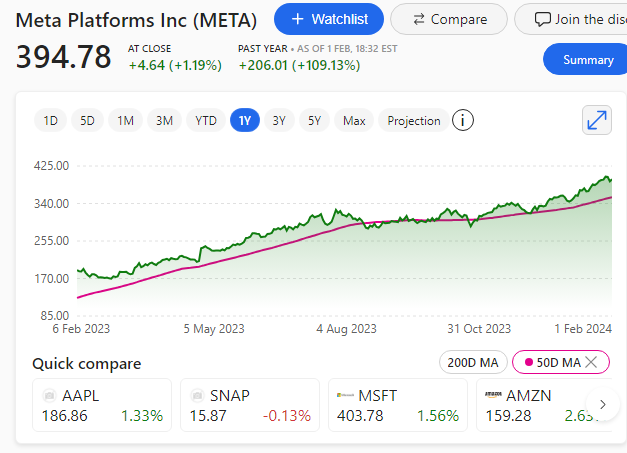
Shares of Meta surged 15% after the social-media giant defied analysts’ estimates. It posted earnings of $5.33 per share on revenue of $40.11 billion. The company also declared its first-ever dividend payment. Share buy-back was also announced.
Meta platforms Inc. One year chart
Meta platforms Inc. One year chart
The results show Meta’s online ad business continues to recover well from a terrible 2022.
Sales in the Q4 jumped 25% year on year.
Expenses decreased 8% year over year to $23.73 billion.
Amazon
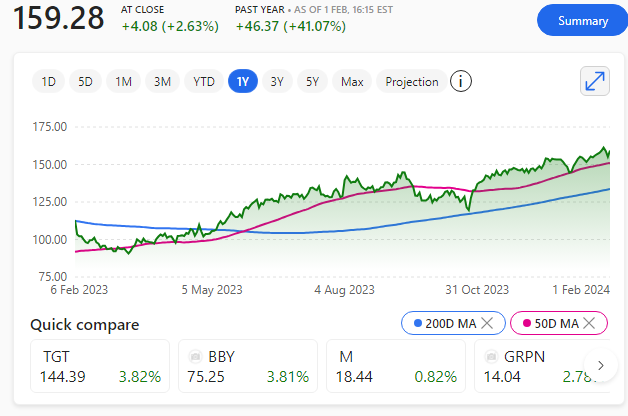
Investors also enjoyed Amazon’s earnings, which easily topped Wall Street’s predictions. The ecommerce giant also provided a strong positive outlook. The stock jumped 7% in extended trading.
Amazon.com Inc. One year chart
Amazon.com Inc. One year chart
Q4 was a record-breaking Holiday shopping season in the U.S. and closed out a robust 2023 for Amazon. Amazon has much planned for 2024.
Apple
But Apple didn’t benefit from the same treatment despite posting strong results.
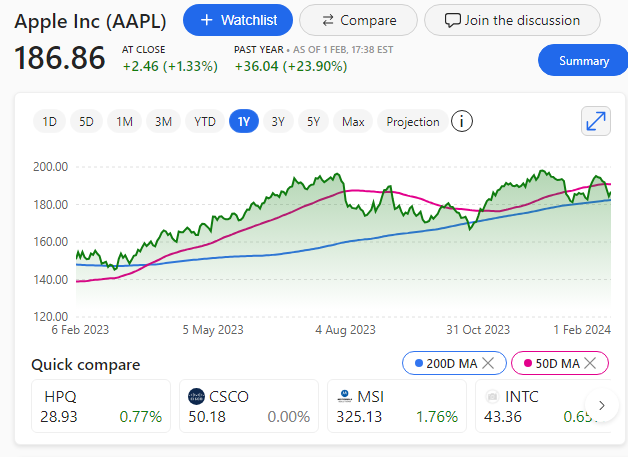
Apple Inc. One year chart
Apple Inc. One year chart
Apple also exceeded estimates, reporting revenue growth for the first time in a year. But shares slid more than 2% in extending trading after it posted a 13% decline in sales in China.
Apple’s outlook suggesting weak iPhones sales may have also disappointed investors.
Nasdaq 100 futures declined around 0.75%. S&P 500 futures were also down around 0.4%
In after-hours trading, shares of Alphabet dropped more than 5%, while Microsoft slipped 2% after the tech giants, part of the Magnificent Seven posted quarterly earnings. However, both companies achieved on both top and bottom lines. However, advertising revenue for Alphabet came short of analysts’ expectations.
Tech powerhouse
The tech sector powered the market rally from 2023 into 2024 and is now trading at a relatively high valuation of nearly 29 times its 2024 earnings, according to recent figures. Investors will need to see earnings expansion in order for the tech companies to be able to maintain their elevated levels.
Results were good but not good enough according to Wall Street as stocks were priced for perfection and that wasn’t delivered.
Even though the results were better-than-expected, investors are likely selling because they just want to take some money off the table.
Absolute perfection comes at a price on Wall Street.
Microsoft’s market cap surpassed $3 trillion in intraday trading Wednesday after the stock climbed more than 1% and hit around $404 per share. The stock lost some ground throughout the day to close at: $402 per share.
The achievement comes nearly two weeks after Microsoft eclipsed Apple as the world’s most valuable public company on 12th January 2024. However, Apple has reclaimed top spot – its market cap closed at around $3.01 trillion on Wednesday 24th January 2024.
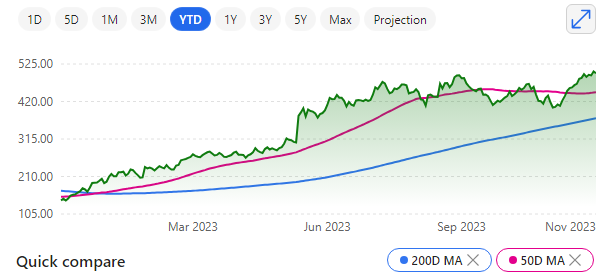
Microsoft share price 24th January 2024 – $402.00, 1year chart
Microsoft share price 24th January 2024 – $402.00, 1 year chart
Microsoft shares are up more than 7% year to date as investors remain bullish about the company’s investments in artificial intelligence.
It is strongly expected that Microsoft will deliver good results in the Q2 earnings report, because of its leadership position gained in generative AI.
Microsoft due to announce Q2 figures on 30th January 2024
Microsoft due to announce Q2 figures on 30th January 2024
Meta, OpenAI, and Microsoft said they will use AMD’s newest AI chip, the Instinct MI300X.
An indication that tech companies want alternatives to the expensive Nvidia graphics processors that have been essential for artificial intelligence (AI).
If the MI300X is good enough and inexpensive enough when it starts shipping early next year, it will likely lower costs for developing AI models.
AMD CEO Lisa Su projected the market for AI chips will amount to $400 billion or more in 2027, and she said she hopes AMD has a sizable part of that market.
Wall Street rallies on AMD and Google AI news
Wall Street resumed its rally after a short break as technology giants intensified their AI race, pushing up tech stocks.
When you witness Google launching a new AI model (Gemini) and AMD chasing a slice of the hot AI chip market, you know a pre-Christmas cheer will wash over investors.
To think, just a handful of years ago, other than in Science Fiction novels, the term ‘artificial intelligence’ didn’t exist in our vocabulary and now it is becoming more and more integrated with our day-to-day lives.
Stockmarkets love it. AI is fast becoming a business necessity and not just an option.
Wall Streets love affair with AI – how long will it last?
Music streaming service Spotify is laying off some 17% of its workforce, in a dramatic move aimed at reducing its costs and adjusting for a slowdown in growth, CEO Daniel Ek said Monday 4th December 2023.
It is reported Ek said Spotify invested too much in 2020 and 2021 and had to ‘rightsize’ its costs for a new economic reality.
Spotify reported a 65 million euros ($70.7 million) profit in the third quarter, citing lower spend on marketing and personnel.
The latest round of cuts is reported to equate to roughly 1,500 jobs – but this has not been confirmed by Spotify.
Nvidia’s revenue grew 206% from year 2022 during the quarter ending 29th October 2023, according to data from Nvidia.
Net income, at $9.24 billion, or $3.71 per share, was up from $680 million, in the same quarter of 2022.
The company’s data centre revenue came in at: $14.51 billion, up a massive 279% and above consensus of $12.97 billion. Half of the data centre revenue came from cloud infrastructure providers such as Amazon, and the other from consumer internet and large companies, Nvidia said. Healthy uptake also came from clouds that specialized in renting out GPUs to clients.
Earnings: $4.02 per share, adjusted, vs. $3.37 per share expected
Revenue: $18.12 billion, vs. $16.18 billion expected
The gaming segment contributed $2.86 billion, up 81% and higher than the $2.68 billion general consensus. Nvidia’s future guidance suggested $20 billion in revenue for Q4, implying a nearly 231% revenue growth.
Year on year Nvidia share price movement.
Year on year Nvidia share price movement – Nov 2022 – Nov 2023
During the quarter, Nvidia announced the GH200 GPU, which has more memory than the current H100 and an additional Arm processor onboard. The H100 is expensive and in demand. Nvidia said Australia-based Iris Energy, an owner of bitcoin mining data centers, was buying 248 H100s for $10 million, which works out around $40,000 each.
Nvidia share price moved down 1% in after-hours trading on Tuesday 21st November 2023 after the reporting fiscal Q3 results that surpassed predictions. But the company called for a negative impact in the next quarter because of export restrictions affecting sales to organizations in China and other countries.
‘We expect that our sales to these destinations decline significantly in the Q4 2024, though we believe the decline will be more than offset by strong growth in other regions’, Nvidia reported.
At the speed of AI, the story at OpenAI moves at lightning speed.
Hundreds of OpenAI employees signed a letter demanding the OpenAI board resign or face an employee exodus to Sam Altman’s new venture at Microsoft ‘imminently‘.
The board then attempted to negotiate Altman’s return, but those talks were unsuccessful.
At the touch of a button – resignation letter sent to the OpenAI board of directors
To the Board of Directors at OpenAI
OpenAI is the world’s leading AI company. We, the employees of OpenAI, have developed the best models and pushed the field to new frontiers. Our work on AI safety and governance shapes global norms. The products we built are used by millions of people around the world. Until now, the company we work for and cherish has never been in a stronger position.
The process through which you terminated Sam Altman and removed Greg Brockman from the board has jeopardized all of this work and undermined our mission and company. Your conduct has made it clear you did not have the competence to oversee OpenAI.
When we all unexpectedly learned of your decision, the leadership team of OpenAI acted swiftly to stabilize the company. They carefully listened to your concerns and tried to cooperate with you on all grounds. Despite many requests for specific facts for your allegations, you have never provided any written evidence. They also increasingly realized you were not capable of carrying out your duties, and were negotiating in bad faith.
The leadership team suggested that the most stabilizing path forward – the one that would best serve our mission, company, stakeholders, employees and the public – would be for you to resign and put in place a qualified board that could lead the company forward in stability. Leadership worked with you around the clock to find a mutually agreeable outcome. Yet within two days of your initial decision, you again replaced interim CEO Mira Murati against the best interests of the company. You also informed the leadership team that allowing the company to be destroyed “would be consistent with the mission.”
Your actions have made it obvious that you are incapable of overseeing OpenAI. We are unable to work for or with people that lack competence, judgement and care for our mission and employees. We, the undersigned, may choose to resign from OpenAI and join the newly announced Microsoft subsidiary run by Sam Altman and Greg Brockman. Microsoft has assured us that there are positions for all OpenAI employees at this new subsidiary should we choose to join. We will take this step imminently, unless all current board members resign, and the board appoints two new lead independent directors, such as Bret Taylor and Will Hurd, and reinstates Sam Altman and Greg Brockman.”
In just 5 days
Sam Altman sacked from OpenAI.
Altman appears to move to Microsoft.
OpenAI staff revolt.
No confidence in OpenAI board.
Space for staff to move to Microsoft and create new AI company under Altman’s leadership.
OpenAI mass employee resignation letter emerges.
Microsoft CEO Nadella says OpenAI governance needs to change no matter where Altman ends up.
Altman back at OpenAI after board changes.
Now, Altman is back after getting the sack.
So, is all OK at OpenAI? I asked CHATGPT the question, here is the answer…
Nvidia stock closes at all-time high, a day before earnings
Shares of Nvidia closed up 2.3% at an all-time high of $504 on Monday 20th November 2023. The record comes ahead of the company’s Q3 results due Tuesday 21st November 2023, when analysts are expecting to see revenue growth of over 170%.
And, if that’s not enough, the forecast for Q4, according to some analysts, is likely to show a number close to 200% growth.
Nvidia is still by far the market leader in GPUs for AI, but high prices and competition are fast becoming an issue.
Can Nvidia continue the AI ride and hold this remarkable market share position?
Microsoft is working on its own artificial intelligence chip, code-named Athena, that could compete with Nvidia’s products.
The company introduced two new microchips.
The first, its Maia 100 artificial intelligence chip, could compete with Nvidia’s highly sought-after AI graphics processing units.
The second, a Cobalt 100 Arm chip, is aimed at general computing tasks and could compete with Intel processors.
The chip is designed for training large language models (LLM’s) like ChatGPT and powering AI applications. Microsoft has been developing the chip since 2019 using Taiwan Semiconductor’s 5-nanometer process. The chip is currently being tested by a small select group of Microsoft and OpenAI employees.
Long-term objective
Microsoft’s objective is to reduce its dependency on third-party hardware providers and to customize its AI infrastructure for its own projects.
Microsoft has invested billions in OpenAI, which makes ChatGPT, to enhance its position in the AI field. The Athena chip could also enable Microsoft to add AI capabilities to its Office products and GitHub, but it has already achieved this using the OpenAI system.
Microsoft has not announced when the chip will be available to the public or to its Azure cloud customers.
U.S. Inflation was flat in October from the previous month, providing a positive sign that high prices are finally easing their tight grip on the U.S. economy. Is this also a green light for the Federal Reserve to stop raising interest rates.
The consumer price index (CPI) was flat in October 2023 from the previous month but up 3.2% from a year ago. Both were below analysts’ estimates, sparking a major stock market rally.
Excluding volatile food and energy prices, the core CPI rose 0.2% and 4%, against the forecast of 0.3% and 4.1%. The annual rate was the smallest increase since September 2021.
The flat reading on the headline CPI came as energy prices declined 2.5% for the month, offsetting a 0.3% increase in the food index.
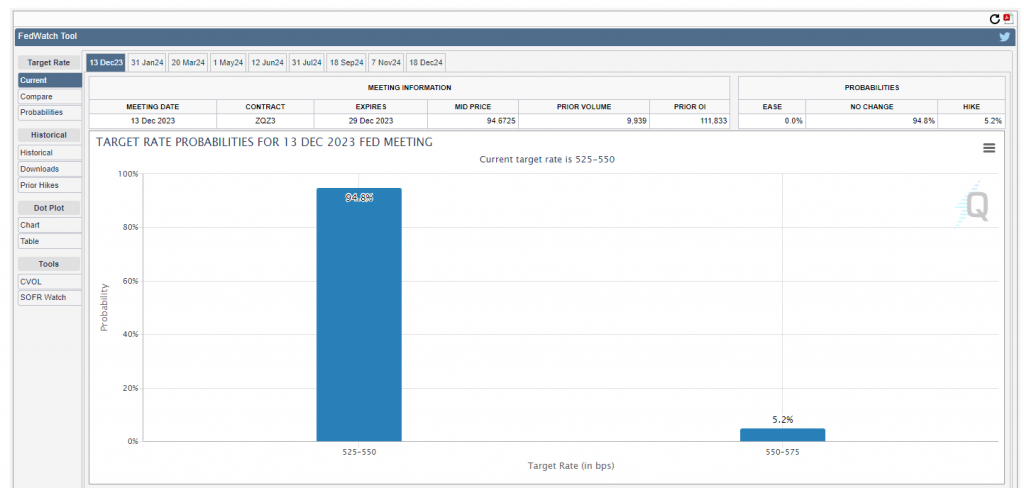
Traders do not anticipate that the Fed will raise interest rates in December 2023, according to data from the CME Group.
Traders do not anticipate that the Fed will raise interest rates in December 2023, according to data from the CME Group.
U.S. Treasury yields fall
U.S. Treasury yields fell on Tuesday 14th November 2023 as key inflation data showed a surprisingly ‘soft’ change in prices last month.
The 10-year Treasury yield fell to about 4.45%. The 2-year Treasury yield fell more to under 4.9%.
Good data
Inflation stabilising, yields falling and equities up – are the stars aligning for a stock market rally leading into Christmas 2023?
Microsoft ended Tuesday’s trading session at a record high of $360.53, following fresh optimism about growth from a key partner in artificial intelligence (AI). The increase gives the company a market value of about $2.68 trillion.
At a tech event on Monday 6th November 2023, Microsoft’s AI partner, OpenAI, announced a batch of updates, including price cuts and plans to allow people to make custom versions of the ChatGPT chatbot.
Microsoft CEO Satya Nadella attended and emphasized that developers building applications with OpenAI’s tools could get to market quickly by deploying their software on Microsoft’s Azure cloud infrastructure.
Microsoft has invested a reported $13 billion in OpenAI, which has granted Microsoft an exclusive licence on OpenAI’s GPT-4 large language model that can generate human-like prose in response to a few words of text.
Fictitious AI robot learning from a digital human online
Last week, Microsoft announced the release of an AI add-on for its Office productivity app subscriptions and an assistant in Windows 11, both of which rely on OpenAI models.
The future is looking bright for Microsoft right now.
An old well established and trusted tech brand pivoting to AI that has a high dividend yield is IBM, which has been around for more than a century and is known for both its hardware and software products.
IBM is investing heavily in AI, cloud computing, and quantum computing, and has recently acquired several AI start-ups, such as Instana, Turbonomic, and Waeg.
IBM also has a partnership with OpenAI, one of the leading AI research organizations, to provide cloud infrastructure for its AI models.
Investors who love IBM expect the company to grow its earnings by around 10% annually over the next five years. Investors were also impressed with IBM’s dividend yield, which is currently around 4.5%. Dividends are a great way to generate passive income.
IBM is not the only tech company that is pivoting to AI. Google, Microsoft, and Anthropic are competing in the field of generative AI, which can create text, images, music, and more from natural language prompts.
Integrate generative AI
These companies are attempting to integrate generative AI into their products and services, such as search engines, maps, word processors, office applications, chatbots, and more. Generative AI is seen as a game-changer for many industries and applications, and could potentially disrupt the dominance of Big Tech.
Legacy companies can pivot to a platform model, which is a business strategy that connects producers and consumers of value through a digital interface. Platform companies like Facebook, Amazon, Google, and Tencent have created value at stunning rates, and have grown rapidly and own large market shares.
IBM mainframe from the 1970’s
Legacy companies can leverage their existing systems, such as customer relationships, data, and brand recognition, to create platforms that offer impressive and immersive products and services.
Other successful platform pivots are Disney+, which transformed Disney from a media producer to a media platform; Nike+, which connected Nike’s physical products with digital services; and John Deere, which created a platform for precision agriculture.
If the Israel-Hamas conflict further intensifies, the risks to the global economy are growing, economist Mohamed el-Erian reportedly said Monday 30th October 2023.
The impact on global markets was initially limited, as investors viewed the conflict as contained. However, the prospect of a regional spillover has added to a sense of unease.
‘The longer this conflict goes on, the more likely it will escalate. The higher the risk of escalation, the higher the risk of contagion to the rest of the world in terms of economics and finance’, el-Erian said.
The idea is simple – pick good companies and hold them for the long-term.
Every time you buy shares in a company, you have purchased a piece of that company. And as a share owner, you are entitled to a ‘share’ of the profits.
When it comes to investing, the goal is to find great companies, super companies. Buy shares in these companies at good prices. And then behave like owners of these companies and enjoy all of the successes.
Then… HOLD those shares for as long as possible – as if you own the company.
Ask yourself this question: ‘Would you buy the company?’
If the answer is yes – then go buy the shares.
Holding on as long as possible means that as long as you believe a company is still a great, you are more likely to keep the shares. But if something changes and it’s no longer a good choice, then it may be time to sell up.
The message here is to believe in a long-term investing strategy – because it works!
Short-Term versus Long-Term Investing
What you must not do is gamble on shares or any other high-risk activity or product. Share prices go up and they go down all the time. And in some cases, prices continue to move even after the stock market has closed!
Long term investing is a long-term winner!
Most people aren’t successful trying to ‘bet’ on when a share is going to go up or down especially short-term bets laced over minutes, hours, days or weeks. You can’t build wealth this way. In fact, there are plenty of traders out there with tragic stories to tell of failed ‘dumb money bets’. This is one of the fastest ways to lose your hard-earned cash; just don’t do it!
Platforms
There are many investing platforms available today that offer all sorts of trading solutions, from day trading, CFDs (contract for differences), spread betting, and more recently, cryptocurrencies. These instruments aren’t really designed to assist a long-term strategy but rather a short-term punt or bet. It’s an endless game where someone, somewhere is always left with nothing. These systems will happily take your money.
Please read the small print for these services. Do not be surprised to see disclosures that read something like, ‘75%+ of retail traders lose money’. It’s true, they do, and it could be you! Its far far easier to learn to become financially successful over the long term.
Long-Term Investing
Diversify
A hard truth about investing is that sometimes you’ll get it wrong, we all do.
The term for this is firm-specific risk (sometimes referred to as unsystematic risk). And every company in the world, even industry behemoths like Amazon, Apple or Microsoft get it wrong sometimes too. It’s unavoidable.
Fortunately, such risk can be mitigated through diversification. By owning a number of companies, the returns of one successful investment can easily offset the losses of several losers.
It is wise to aim to build a portfolio over time of around say 10 – 20 quality businesses that you believe in. If you would be prepared to ‘buy’ the company; buying shares in it is the next best option.
Have Patience
In the short term, the movements of the stock market are chaotic, unpredictable or volatile even. But over a longer period of time, a recurring pattern starts to emerge among quality businesses.
Select quality companies and hold them!
Companies can’t magically double their profits overnight. Building a massive multi-billion or even trillion-pound enterprise takes time. But the investors who have the patience and financial prudence to invest in quality businesses with such long-term potential can unlock enormous wealth.
Invest consistently
Getting started with investing is the first major step. The second is to keep investing over time. Little and often. It’s not easy to ‘free up’ cash but the more money you put to work by investing in stocks, the better your portfolio will do overall.
It is easy for me to suggest for you to go invest and spend your money, you most likely need the money spare to be able to go do this in the first place. So, a little invested spread over time will help open that ‘wealth’ door as time trickles by.
However, there is a caveat to this rule. You should only invest money you don’t need to live. Invest only what you have spare or can ‘free up’.
This is the way!
Long-term investing requires holding investments for years or even decades. This strategy works – this is the way! It’s easier said than done, but a little invested now will go a long way later. It’s also a matter of priorities and sacrifice to ‘free up’ some spare cash to invest instead of buying that new must have gadget (that you don’t really need).
Also, the last place you want to find yourself in is where you are forced to sell your investment before it’s had time to ‘climb’ because you’re short on cash. Or even worse, forced to sell your holding during a stock market crash when prices are extremely low. That’s an awful place to be – don’t go there if you can avoid it. However, buying after a crash is a different matter – but again, buy only good quality companies.
Select super good companies and hold them.
In short, invest consistently. But only the money you can afford. Don’t borrow, don’t use credit. Only invest what you can afford. It will work for you over time. But invest wisely in good high quality comapnies,
Don’t panic – volatility happens!
The stock market will crash; this is an inevitable fact of investing. Naive investors, who panic during these volatile times, often end up selling their shares that are either completely unaffected by the catalysts of the crash or perfectly capable of weathering the storm.
Just take a look at what happened with Applein 2008. The tech giant fell by over 50% in the space of 12 months despite having no exposure to the U.S. housing market – even Apple got caught up in the sub-prime lending fiasco. And while the subsequent recession did impact sales, recessions, just like stock market crashes, are temporary. Apple share price recovered, as did many other top-notch companies too.
As horrible a stock market crash is, this is actually one of the best times to buy shares, especially when investing for the long-term. And these opportunities only come around once a decade or so. So, don’t miss out on these incredible opportunities to buy fantastic businesses at major discounts if you have the cash spare.
Let your winners run
Portfolio management is something every investor has to do. Yet a common mistake, is to sell shares in thriving companies too soon. This is usually an error – bear in mind that winners have a tendency to keep winning! But I get that – I understand you may want to sell as you need the money or want some of your investment back. Try and hold if you can – but not at any odds. Keep a close eye on the market – sentiment will change and that will alter the markets direction.
Let the winners run!
Having said that, there is an exception. It’s perfectly possible for a company that was just 2% of your portfolio to grow to 20% or even higher. In these scenarios, it can be wise to sell a few shares to reduce the risk of being over-exposed to a single investment.
But otherwise, let your winners win. LET THE WINNERS RUN!
You can do it!
There is no such thing as risk-free investing, even with a long-term approach. But many of these risk factors can be mitigated through strategies like diversification. Try and manage your portfolio, add stop losses and follow your investments through the newswires.
Remember to always do your research! No short cuts!
Apple and generative AI technology is a topic that has been generating a lot of interest and speculation lately.
According to various reports, Apple is working on developing its own large language model and chatbot, which could potentially enhance its products and services with new features and capabilities. However, some analysts and experts have also raised questions about whether Apple has missed an opportunity to be a leader in the generative AI field, as it seems to be lagging behind its competitors such as Google, Microsoft, and OpenAI.
Apple uses AI in its products but hasn’t launched a generative AI product along the lines of OpenAI’s ChatGPT or Google Bard. Instead, Apple’s AI is used for improving photos and autocorrecting text.
$1 billion per year plan
Apple is on track to spend $1 billion per year on developing its generative artificial intelligence products, Bloomberg reported.
Apple is looking to use AI to improve Siri, Messages and Apple Music.
The spending comes as the company plays catch-up to some competitors who have already debuted new AI products and features, such as Google, Microsoft and Amazon.
Apple was caught flat-footed when ChatGPT and other AI tools took the technology industry by storm.
Generative AI
Generative AI is a subfield of artificial intelligence that focuses on creating content such as text, images, videos, music, and more, based on data and algorithms. One of the most popular examples of generative AI is ChatGPT, a chatbot that can respond to questions and other prompts in a natural and human-like way.
Watercolour artwork impression – ChatGPT was released by OpenAI in 2022, and since then, it has been widely used and improved by various companies and researchers.
ChatGPT was released by OpenAI in 2022, and since then, it has been widely used and improved by various companies and researchers.
Apple slow response
Apple, on the other hand, has been relatively quiet about its generative AI efforts, until recently. In October 2023, Bloomberg reported that Apple was internally testing a ‘ChatGPT-like’ chatbot nicknamed ‘Apple GPT’, but it had not devised a clear strategy for releasing generative AI tools to the public. Apple’s CEO Tim Cook also confirmed that the company was working on generative AI for years, but it was approaching it ‘really thoughtfully and think about it deeply’ because of the potential risks and challenges.
Potential challenges Apple faces in developing and deploying generative AI
Privacy
Apple has always been more cautious than its competitors in handling user data, and it has built its reputation on being a privacy-focused company. However, generative AI requires a lot of data to train and improve its models, which could pose a dilemma for Apple. How can it balance the need for data with the respect for user privacy? How can it ensure that its generative AI does not leak or misuse personal information?
Design
Apple is known for its elegant and intuitive design philosophy, which applies to both its hardware and software products. However, generative AI is a complex and unpredictable technology, which could challenge Apple’s design principles. How can it make its generative AI features easy to use and understand for its customers? How can it avoid confusing or misleading users with its generative AI outputs?
Ethics
Apple has always been mindful of the social and ethical implications of its products, and it has often taken a stance on issues such as human rights, environmental sustainability, and diversity. However, generative AI could raise new ethical concerns, such as bias, misinformation and manipulation. But then that is a common problem for all generative AI systems.
Generative AI could raise new ethical concerns, such as bias, misinformation and manipulation.
These are some of the questions that Apple needs to answer before it can launch its generative AI products to the public. It is possible that Apple is taking its time to address these issues carefully and thoroughly, as it has done in the past with other technologies such as Face ID or Apple Pay. However, it is also possible that Apple has missed an opportunity to be a pioneer in the generative AI field, as it has done in the past with other technologies such as smart speakers or cloud computing.
While Apple is working on its generative AI projects internally, its competitors are already offering generative AI.
Google
Google has integrated its large language model LaMDA into various products and services, such as Google Assistant, Google Photos, Google Docs, Google Translate etc. LaMDA can generate natural and conversational responses to any query or prompt, as well as create images and videos based on text descriptions.
Microsoft
Microsoft has acquired OpenAI’s ChatGPT technology and made it available through its Azure cloud platform. ChatGPT can be used by developers and businesses to create chatbots, voice assistants, content generators, and more. Microsoft has also integrated ChatGPT into some of its products such as Outlook, Teams, PowerPoint, and more.
Amazon
Amazon has launched Alexa Conversations, a feature that allows Alexa users to have more natural and engaging conversations with the voice assistant. Alexa Conversations can also leverage Amazon’s vast e-commerce data to provide personalized recommendations and suggestions to users.
These are just some examples of how generative AI is being used by Apple’s competitors.
Robot chatting to human chatbot online
Apple has missed an opportunity to be a leader in the generative AI field by being too slow or too cautious in developing and deploying its own generative AI products.
However, it is highly likely that Apple is waiting for the right moment to surprise everyone with its innovative and unique generative AI features that will set it apart from its competitors.
The stock dropped more than 15% over the last few days after the company posted third-quarter earnings on Wednesday 20th October 2023.
The earnings report showed that Tesla missed analysts’ expectations on revenue and earnings per share. Tesla also announced a recall of 475,000 vehicles in the US due to a potential battery fire risk.
Additionally, Tesla faced regulatory challenges in China, where it was banned from selling its AI chips due to national security concerns. These factors contributed to the negative sentiment around Tesla stock and increased its volatility.
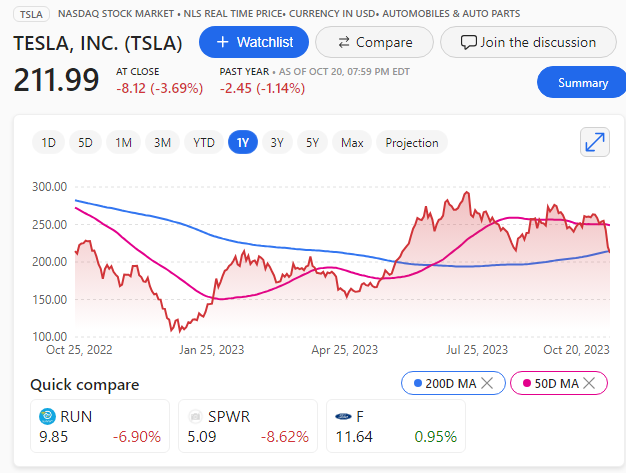
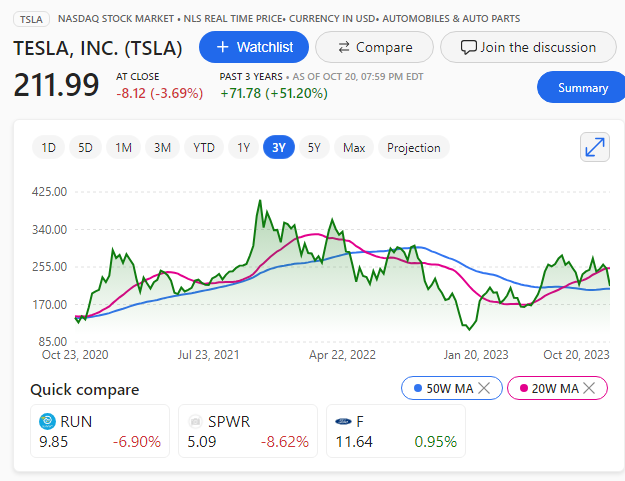
Tesla stock has fallen 73% from its record high in November 2021. The stock is down 69% in 2022, more than double the decline in the Nasdaq.
Tesla price crossed below 200 day moving average this is a bearish indicator.
Tesla price crossed below 200 day moving average this is a bearish indicator.
Among major carmakers, Ford is down 46% and General Motors has fallen 43%. Since its IPO in 2010, Tesla has only fallen in one other year, an 11% drop in 2016. Some analysts and investors are still optimistic about Tesla’s long-term prospects, citing its innovation, leadership, and loyal customer base.
However, others are sceptical about Tesla’s valuation, profitability, and competition. Tesla’s stock performance in the coming months will depend on how it can overcome its current challenges and deliver on growth.
Don’t underestimate Elon Musk, but bear in mind other big car manufacturers are now catching and moving ahead of Tesla in the EV race.
Shares of Chinese electric vehicle manufacturers took a hit on Thursday 18th October 2023 after Tesla reported disappointing 3Q results on Wednesday 17th October 2023.
It was the first time Tesla, co-founded by Elon Musk, missed on both earnings and revenue since Q2 2019.
On Thursday morning, Hong Kong-listed shares of Chinese EV makers BYD and Xpeng fell approximately 2.18% and 8.76%. Li Auto slid 3.14%, while Nio and Geely dropped 8.36% and 3.97%.
Elon Musk reportedly cautioned that the Tesla Cybertruck, the electric full-size pickup truck model; would not deliver substantial positive cashflow for 12-18 months after production begins.
Musk reportedly said the company is working to bring down the prices of its cars amid high interest rates. ‘I’m worried about the high interest rate environment we’re in,’ he said, adding that it will be much harder for consumers to purchase cars if interest rates were to increase further.
Tesla shares down
Tesla shares closed 4.78% lower on Wednesday 17th October 2023. Other U.S. EV rivals Lucid and Rivian fell more than 9% on the same day. Lucid’s stock dropped a day earlier after it reported disappointing Q3 EV deliveries.
Tesla shares closed 4.78% lower on Wednesday 17th October 2023.
In the first six months of the year, BYD was the world’s top EV manufacturer, contributing 21% of global sales of EVs, according to research firm Canalys. Tesla trailed behind at second place with 15% market share while German carmaker Volkswagen held 7% market share in third place.
Price pressure
EV players are under pressure from a price war to gain market share amid intense competition.
Tesla introduced a number of price cuts over the last few months, especially in China – the world’s biggest EV market.
Rivals BYD, Nio, Li Auto and Xpeng have also joined Tesla in lowering the prices for some of their EV models.
Shares in BYD, (Build Your Dreams), jumped this week after it said it expected third-quarter profits to more than double compared with last year.
BYD is now ahead of Tesla in quarterly production – and second to the U.S. car maker in global sales.
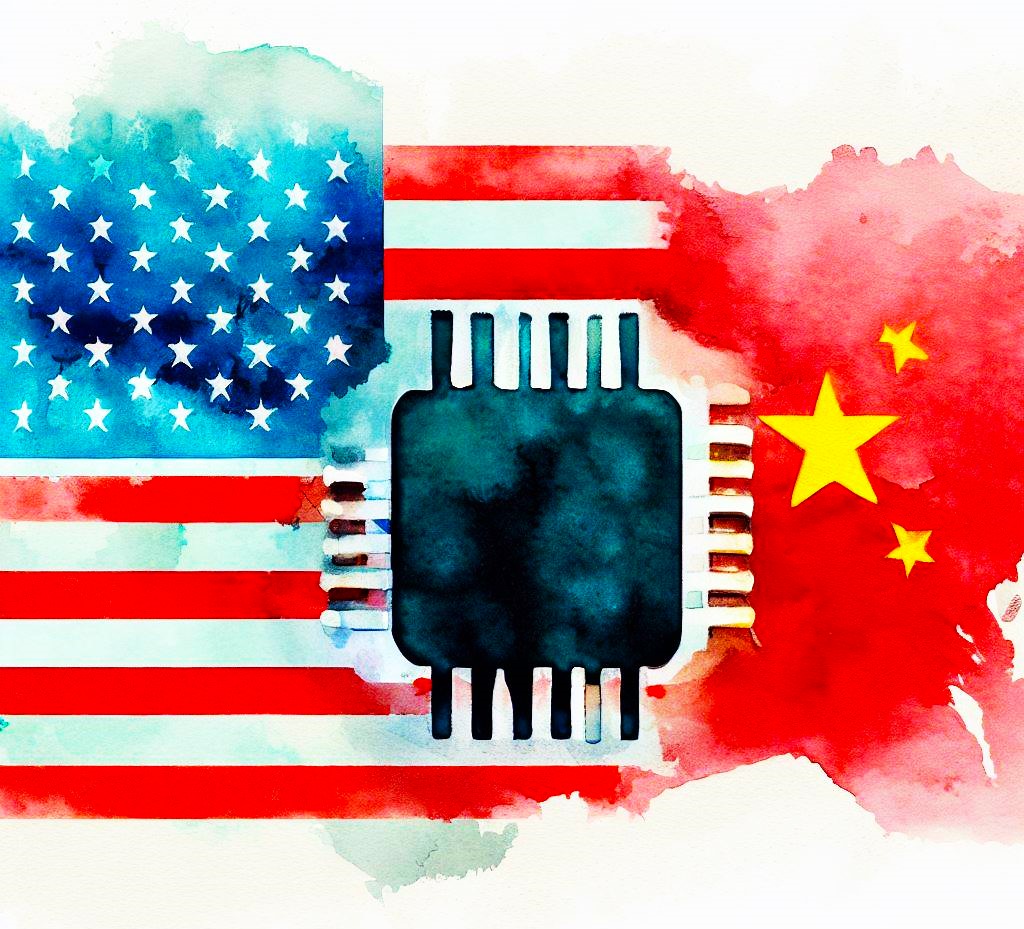
The curbs are aimed at closing loopholes that became apparent after the U.S. announced export curbs on microchips in October 2022. The restrictions are designed to prevent China’s military from importing advanced semiconductors or equipment.
Nvidia has said in a filing that the new export restrictions will block sales of two high-end artificial intelligence chips it created for the Chinese market – A800 and H800. It said that one of its gaming chips will also be blocked.
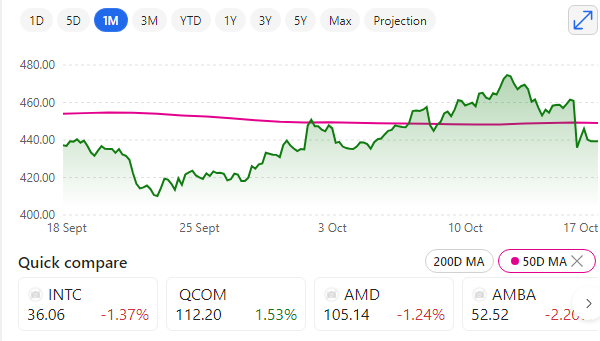
Nvidia Corp one month chart – closed at 439.38 17th October 2023
Although the curbs also affect other chip makers, analysts believe Nvidia will be hit the hardest because China accounts for up to 25% of its revenues from data centre chip sales. Nvidia’s shares, which are considered a star stock, fell by as much as 4.7% in the wake of the announcement.
Semiconductor Industry Association
The Semiconductor Industry Association, which represents 99% of the U.S. semiconductor industry by revenue, said in a statement that the new measures are ‘overly broad‘ and ‘risk harmingthe U.S. semiconductor structure without advancing national security as they encourage overseas customers to source elsewhere’.
China reacts
A spokesperson for the Chinese embassy also said that it ‘firmly opposes‘ the new restrictions, which also target Iran and Russia and go into effect in 30 days.
Nvidia stock falls after restrictions on AI chip exports from U.S. to China
Two months ago, China retaliated by restricting exports of two materials, gallium and germanium, which are key to the semiconductor industry.
The materials are ‘minor metals‘, meaning that they are not usually found on their own in nature, and are often the by-product of other processes. It’s not only the U.S., Japan and the Netherlands – which is home to key chip equipment maker ASML – have also imposed chip technology export restrictions on China.
Fallout
The constant ‘fall-out’ between the world’s two biggest economies has raised concerns over the rise of so-called ‘resource nationalism‘ – a practice where governments hoard critical materials to exert influence over other countries.
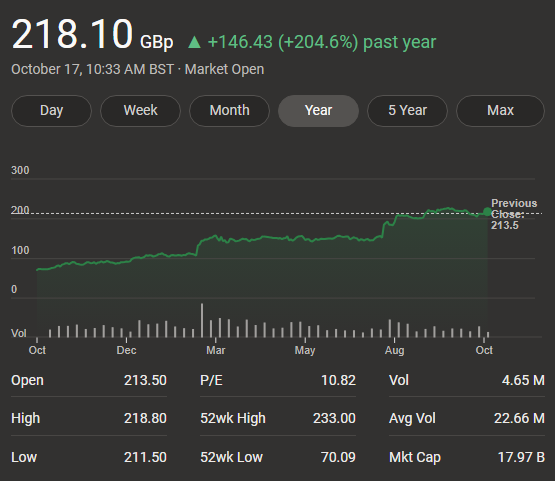
Rolls-Royce, the British manufacturer of aircraft engines, amongst many other products announced on Tuesday 16th October 2023, that it plans to axe up to 2,500 jobs worldwide. The company said that the decision is part of its plans for a simpler, more streamlined, and more efficient organisation.
The job cuts are expected to affect mostly non-engineering roles across its global operations, and are likely to impact UK staff.
The restructuring is one of the most significant steps taken by the new chief executive, who took over at the start of the year.
He has described the company as ‘a burning platform‘ and said one of its main subsidiaries had been ‘grossly mismanaged‘.
Challenge
The news comes as Rolls-Royce faces a challenging business environment due to the COVID-19 pandemic, which severely affected the aviation industry.
The company has already cut 9,000 jobs and raised capital from shareholders during the crisis. However, its share price has recovered in the last year, thanks to a resurgence in aviation demand and the early results of its transformation plan.
Rolls-Royce share price has enjoyed a healthy recovery in 2023
The company, which makes engines for aircraft, is based in Derby. It employs 42,000 people around the world with about half based in the UK.
It employs 13,700 people in Derby, and a further 3,400 people in Bristol.
Microsoft’s $69 billion revised offer to buy Call of Duty-maker Activision Blizzard has been approved by UK regulators.
The Competition and Markets Authority (CMA) said the deal addressed its concerns, after the watchdog blocked the original $69bn (£59bn) bid in April 2023. The green light marks the culmination of a near two-year fight to secure the gaming industry’s biggest-ever takeover.
CMA criticised Microsoft’s conduct.
After the competition watchdog blocked the takeover earlier this year, Microsoft’s president hit out at the CMA’s decision which it said was ‘bad for Britain’.
The CMA chief executive reportedly said: ‘Businesses and their advisors should be in no doubt that the tactics employed by Microsoft are no way to engage with the CMA. Microsoft had the chance to restructure during our initial investigation but instead continued to insist on a package of measures that we told them simply wouldn’t work. Dragging out proceedings in this way only wastes time and money’.
The CMA also said the revised deal would ‘preserve competitive prices’ in the gaming industry and provide more choice and better services.
Prior to the approval, the deal, which makes Microsoft the owner of Call of Duty, World of Warcraft, Overwatch and Candy Crush, could not be finalised globally.
Under the restructured transaction, Microsoft will not acquire cloud rights for existing Activision PC and console games, or for new games released by Activision during the next 15 years. Instead, these rights will be divested to Ubisoft Entertainment before Microsoft’s acquisition of Activision, according to the CMA.
Vice Chair and President, Brad Smith seem happy after saying it would be ‘bad for Britain.
‘We’re grateful for the CMA’s thorough review and decision today. We have now crossed the final regulatory hurdle to close this acquisition, which we believe will benefit players and the gaming industry worldwide’.
Buying the dip means purchasing an asset, usually a stock, when its price has dropped. The expectation is that the drop is a short-term anomaly, and the asset’s price will soon go back up. It is a strategy that some traders and investors use to take advantage of price fluctuations and profit from market rebounds.
However, buying the dip can also be risky, as there is no guarantee that the price will recover or that the asset is not in a long-term downtrend. Therefore, it is important to do your research, use indicators, and have a risk management plan before buying the dip.
Current market situation and general ‘readout’
The S&P 500 is still ‘buy the dip’ for the next six months,’ some analysts suggest.
In some reports, it is expected that the profit cycle will be positive over the next six months and for data to improve before a consumer-spending led downturn leads to a selloff in U.S. stocks! That’s the ‘general’ readout.
Corporate profit expectations are behind much of that forecast for stocks. Analysts expect profit growth to accelerate over the next two quarters and see the S&P 500 in a range of 4,050 to 4,750. A mild recession in early or middle 2024 should lead to a higher risk premium, pushing the S&P 500 back close to 3,800. This is all conjecture.
Other analysts doubt the earnings uplift potential and anticipate stocks to fall back sooner as PE ratios sit at an already high level.
Take your pick
My view, for what it’s worth, is for stocks to climb for the time being through into the New Year and then to face pullback.
Truth is, no one knows. We can all make educated guesses.
Just watch the markets and be ready for the fall – that is coming for sure!
Cybersecurity is a very important and relevant topic in today’s world. It refers to the practice of protecting systems, networks, and programs from digital attacks that can harm individuals and organizations.
Cyberattacks will all have malicious intent, such as accessing, changing, or destroying sensitive information; extorting money from users via ransomware; or interrupting normal business processes.
Cybersecurity aims to prevent or mitigate these attacks by using various technologies, measures, and practices.
There are many types of cybersecurity, depending on the domain or layer of IT infrastructure that needs to be protected.
Critical infrastructure security
This protects the computer systems, applications, networks, data and digital assets that a society depends on for national security, economic health and public safety. For example, the power grid, the water supply, the transportation system, the health care system, etc.
In the United States, there are some guidelines and frameworks for IT providers in this area, such as the NIST cybersecurity framework and the CISA guidance.
Network security
This prevents unauthorized access to network resources and detects and stops cyberattacks and network security breaches in progress. For example, firewalls, antivirus software, encryption, VPNs, etc. Network security also ensures that authorized users have secure access to the network resources they need, when they need them.
Application security
This protects applications from cyberattacks by ensuring that they are designed, developed, tested, and maintained with security in mind. For example, code reviews, vulnerability scanning, penetration testing, secure coding practices, etc. Application security also involves educating users about safe and responsible use of applications.
Cyberattacks will all have malicious intent, such as accessing, changing, or destroying sensitive information; extorting money from users via ransomware; or interrupting normal business processes.
There are many more types of cybersecurity, such as cloud security, endpoint security, data security, identity and access management (IAM), etc. Each type of cybersecurity has its own challenges and solutions.
Companies to watch
Cybersecurity companies such as CrowdStrike, Okta, Zscaler and Palo Alto Networks are valuable assets with businesses willing to pay good money to protect against hackers.
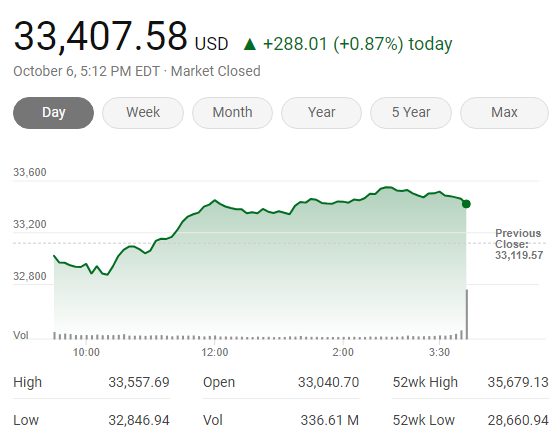
Stocks rallied Friday 6th October 2023 even after the release of stronger-than-expected U.S. jobs data and an increase in Treasury yields.
The U.S. economy added 336,000 jobs in September 2023, the Labour Department said. Economists expected 170,000 jobs.
Confused?
Stocks posted a surprise turnaround on Friday, 6th October 2023 after initially falling on a hotter-than-expected jobs report. At its session low, the Dow had fallen some 270 points, then surged by more than 400 points at in intraday trading. The Nasdaq and the S&P 500 also lost ground too only but then quickly recovered the losses.
Unclear
Traders were unclear as to the reason for the intraday reversal. Some noted it could be the softer wage number in the jobs report that made investors rethink their earlier bearish stance. Others noted the pullback in yields from the day’s highs.
Rally
The rally may just be because the market had been extremely oversold with the S&P 500 at one point in the week down more than 8% from its high earlier this year.
Yields initially surged after the report, with the 10-year Treasury rate trading near its highest level in 16 years. The benchmark rate later eased from those levels, but was still up around 6 basis points at 4.78%.
Extreme market movements maybe here for a while yet.
The stock market is influenced by many factors, such as economic data, earnings reports, geopolitical events, investor sentiment, and technical indicators.
Some analysts have suggested that the recent sell-off in the market may have created some oversold conditions that could lead to a relief rally or a bounce back in the near future.
Stochastics oscillation
One of the technical indicators that some traders use to identify buy and sell signals is the stochastics oscillator, which measures the momentum of price movements. The stochastics oscillator consists of two lines: the %K line and the %D line.
The %K line shows the current position of the price relative to its high and low range over a certain period of time, usually 14 days. The %D line is a moving average of the %K line, usually a three-day average. When the %K line crosses above the %D line, it is considered a bullish signal, indicating that the price may be reversing from a downtrend to an uptrend.
When the %K line crosses below the %D line, it is considered a bearish signal, indicating that the price may be reversing from an uptrend to a downtrend.
80/20 analysis
The stochastics oscillator also has two levels: 20 and 80. When the %K line falls below 20, it means that the price is oversold, meaning that it has fallen too much and may be due for a rebound. When the %K line rises above 80, it means that the price is overbought, meaning that it has risen too much and may be due for a pullback.
Careful research before buying is paramount to successful trade
The FTSE 100 index, which tracks the performance of 100 large companies listed on the London Stock Exchange, has recently fallen below 20 on the stochastics oscillator, indicating that it may be oversold and ready for a bounce back.
No guarantee
However, this is not a guarantee, as other factors may also affect the market direction. Therefore, it is advisable to use stochastics in conjunction with other tools, such as trend lines, support and resistance levels, moving averages, and other technical indicators.
Additionally, some traders use different settings for the stochastics oscillator, such as changing the time period or the smoothing factor, to suit their own trading style and preferences. Always though, long term investing produces far better results over time as it smooths out the ‘ups and downs’.
In summary, there is no definitive answer to whether the stock market is building up to a major buy signal again right now, as different traders will have different opinions and strategies and views. But one possible way to gauge the market sentiment and momentum is to use the stochastics oscillator, which can provide some clues about potential reversals and opportunities in the market.
Note
This indicator should not be used in isolation, but rather in combination with other tools and analysis – it is just that, a tool. Good well-established companies that have good track records over many many years are a good place to look for long term returns. But even then, do your thorough research first.
So, what next?
The interest-rate/inflation correlation is crucial, because nominal company earnings grow faster when inflation is higher. That does not mean investors should welcome inflation, since higher inflation also means that future years’ earnings must be discounted at a higher rate.
But for many behavioural reasons, investors place greater weight on the negative impact of the greater discount rate than on the higher nominal earnings-growth rate that typically accompanies higher inflation.
Inflation illusion
Economists refer to this investor error as ‘inflation illusion’. Perhaps the seminal study documenting how this error impacts the stock market was conducted by Jay Ritter of the University of Florida and Richard Warr of North Carolina State University. They found that investors systematically undervalue stocks in the presence of high inflation.
Investors will make the same error, in reverse, when inflation and interest rates start to come down. That’s why the foundation of a likely big buy signal is currently being built.
Maybe the buy signal is about to go green for a quick buying opportunity. But be careful, in this environment it can switch again very quickly.
Remember, always do your own research carefully before buying.
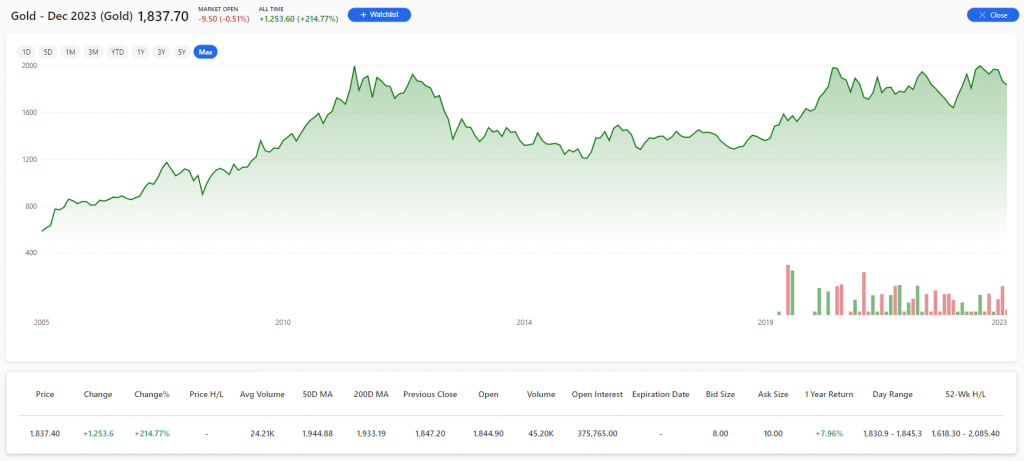
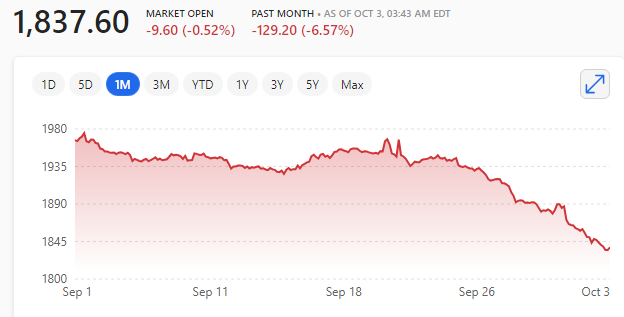
Gold value has been slipping in recent months of 2023 – here are some of the reasons gold prices fluctuate.
Dynamic market
Gold is a precious metal that is often seen as a safe haven investment and a store of value, but it is also subject to the forces of supply and demand, as well as many other factors that affect its price.
The gold market is complex and dynamic, and the price of gold can change quickly and unpredictably. Therefore, it is important to do your own research and analysis before investing in gold or any other asset.
Always do your research! Remember, RESEARCH! RESEARCH! RESEARCH!
Gold price from 2005 – September 2023
The production costs of gold
The cost of mining, refining, and transporting gold can influence the supply and the price of gold. If the production costs are high, the gold miners may reduce their output or increase their selling price, which can affect the market balance and the gold price.
Money supply
The amount of money in circulation can affect the value of the currency and the inflation rate, which in turn can affect the demand and the price of gold. Generally, when the money supply increases, the currency value decreases and the inflation rate increases, which can boost the demand and the price of gold as a hedge.
Geopolitical stability
The political and economic events around the world can affect the market sentiment and the risk appetite of investors, which can influence the demand and the price of gold. Generally, when there is uncertainty, instability, or conflict, investors tend to seek safe-haven assets such as gold, which can increase the demand and the price of gold.
Jewellery and industrial demand
The demand for gold from the jewellery and industrial sectors can affect the market balance and the price of gold. Jewelry is the largest source of gold demand, especially in countries like India and China, where gold is culturally and traditionally valued. Industrial demand for gold comes from its use in various electronic and medical devices, such as smartphones, computers, and dentistry. The changes in the consumer preferences, the income levels, the technological innovations, and the environmental regulations can affect the demand and the price of gold from these sectors.
Gold price 3rd October 2023
Central bank actions
The actions of central banks around the world can affect the supply and the demand of gold, as well as the value of the currency and the interest rates, which can influence the price of gold. Central banks hold gold reserves as part of their foreign exchange assets, and they can buy or sell gold to diversify their portfolios, to manage their liquidity, or to intervene in the currency markets. Central banks can also affect the price of gold indirectly through their monetary policies, such as setting the interest rates, printing money, or buying bonds, which can affect the inflation expectations, the currency value, and the opportunity cost of holding gold.
Strength of the U.S. dollar
Gold is priced in U.S. dollars in most of the major trading exchanges around the world, so when the dollar rises against other currencies, gold becomes more expensive for foreign investors, reducing the demand for it. The U.S. dollar has been strengthening since, partly due to the Federal Reserve’s monetary tightening policy that has raised the interest rates and the attractiveness of U.S. Treasury securities.
Rise of global equities
Gold is often considered a hedge against inflation, currency devaluation, and the failure of other financial assets, but when the stock market is performing well, investors tend to shift their money from gold to equities, seeking higher returns and growth potential. The global stock market has been rallying since the bottom of the Covid-19 pandemic in March 2020, boosted by the roll-out of vaccines, the fiscal stimulus, and the economic recovery.
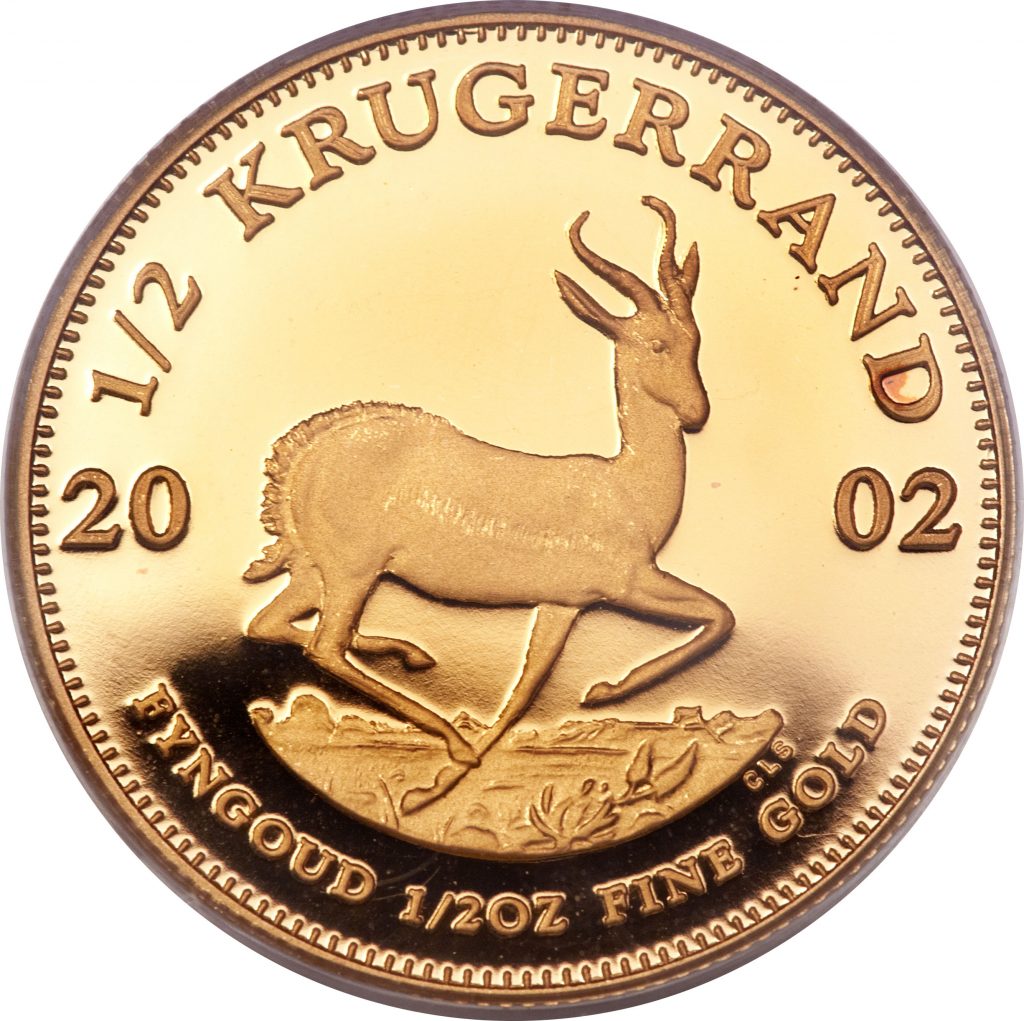
The Krugerrand
The Krugerrand is a South African coin, first minted on 3rd July 1967
Krugerrand gold coins are a type of bullion coin that were first minted in 1967 by the South African Mint. They are made of 22 karat gold and have a diameter of 32.77 mm and a thickness of 2.84mm. The obverse side features the portrait of Paul Kruger, the former president of the South African Republic, and the reverse side depicts a springbok, the national animal of South Africa. The name ‘krugerrand’ is a combination of ‘Kruger’ and ‘rand’, the currency of South Africa.
Krugerrand gold coins are popular among investors and collectors because they have a high gold content and are easy to trade. They are also legal tender in South Africa, although they do not have a fixed face value.
Decline of inflation expectations
Gold is also seen as a protection against the erosion of purchasing power caused by inflation, but when inflation expectations are low or falling, gold loses some of its appeal as an inflation hedge. The inflation expectations have been declining in recent months, partly due to the easing of supply chain disruptions, the moderation of energy prices, and the fading of the base effects from the previous year.
These are some of the main factors that have been weighing on the gold price lately, but there may be other reasons as well, such as the speculations, the market sentiments, and the geopolitical events that can influence the supply and demand of gold.